Ceftazidime and avibactam (Zhou 2016)
Source:vignettes/articles/Zhou_2016_ceftazidime_avibactam.Rmd
Zhou_2016_ceftazidime_avibactam.RmdModel and source
Zhou W, Johnson TN, Xu H, Cheung SYA, Bui KH, Li J, Al-Huniti N, Zhou D. “Predictive Performance of Physiologically Based Pharmacokinetic and Population Pharmacokinetic Modeling of Renally Cleared Drugs in Children.” CPT Pharmacometrics Syst Pharmacol 2016;5(9):475-483. doi:10.1002/psp4.12101.
Zhou 2016 asks how well adult models predict the clearance of renally eliminated drugs in children. It takes two routes:
- PBPK in Simcyp 14.1 for nine drugs. These are platform models whose physiology lives in the Simcyp pediatric database; the paper prints only drug-specific inputs (Supplementary Table S2), so they are not reproducible outside that platform and are not part of the library.
- Population PK: adult models taken from the literature for five drugs, stripped of covariates that do not carry over to children, and simulated in pediatric virtual cohorts. Supplementary Table S4 tabulates all five.
Two of the five are in the library under Zhou 2016’s name, both from the same original analysis (Li J, Knebel W, Riggs M, Zhou D, Nichols WW, Das S; ICAAC 2012, Zhou 2016 reference 31):
Zhou_2016_avibactamZhou_2016_ceftazidime
That original analysis exists only as a conference abstract, so Zhou 2016 Table S4 is the only available full parameter set for it. The other three rows of Table S4 are left to their primary publications:
- Meropenem (Li 2006) is already in the library as
Li_2006_meropenem. - The pregabalin (Bockbrader 2011) and vancomycin (Dolton 2010) rows cannot be read as printed. Pregabalin repeats the meropenem residual error character for character, and both rows have lost the exponent formatting of their covariate terms.
Both models are linear two-compartment models with zero-order IV infusion into the central compartment. Creatinine clearance (CRCL) on clearance is the only covariate. Zhou 2016 removed the age and disease effects of the original model before simulating (“Age and disease effects removed for simulations”, Table S4).
modAvi <- readModelDb("Zhou_2016_avibactam")
modCaz <- readModelDb("Zhou_2016_ceftazidime")
uiAvi <- rxode2::rxode(modAvi)
#> ℹ parameter labels from comments will be replaced by 'label()'
uiCaz <- rxode2::rxode(modCaz)
#> ℹ parameter labels from comments will be replaced by 'label()'
Population
Zhou 2016 does not report the size or demographics of the original adult analysis. Its title places the cohort as healthy subjects plus adults with complicated intra-abdominal infection (cIAI). With the disease effect removed, the models describe the reference group of that fit. The adult study that Zhou 2016 simulated to check the models (Supplementary Table S1) was 16 healthy males aged 22-46 years. They received avibactam 500 mg and ceftazidime 2000 mg as 2-hour IV infusions. The pediatric evaluation (Supplementary Table S1) covered 32 hospitalized children aged 3 months to 18 years, dosed at 12.5 mg/kg avibactam (maximum 500 mg) and 50 mg/kg ceftazidime (maximum 2000 mg) by 2-hour infusion.
Source trace
All values are from Zhou 2016 Supplementary Table S4 (“Summary of POPPK models”).
tribble(
  ~Quantity, ~Avibactam, ~Ceftazidime, ~`Model element`,
  "CL at CRCL = 100 mL/min (L/h)", "11.1", "7.4", "lcl",
  "V1 (L)", "12.9", "13.3", "lvc",
  "Q (L/h)", "6.1", "20.5", "lq",
  "V2 (L)", "7.1", "9.0", "lvp",
  "CRCL exponent on (CRCL/100)", "1.1 (CRCL < 50); 0.5 (CRCL > 50)", "0.4", "e_crcl_cl*",
  "IIV CL (% CV)", "36.7", "35.8", "etalcl",
  "IIV V1 (% CV)", "52.4", "70.2", "etalvc",
  "CL-V1 omega block", "36.7%", "47.5%", "etalcl + etalvc",
  "Proportional error", "26.5%", "41.3%", "propSd",
  "Additive error", "14.5 ng/mL", "79.2 ng/mL", "addSd (mg/L)",
  "Structure", "2 CMT, IV", "2 CMT, IV", "model()"
) |>
knitr::kable(caption = "Source trace: every ini() value against Zhou 2016 Supplementary Table S4.")| Quantity | Avibactam | Ceftazidime | Model element |
|---|---|---|---|
| CL at CRCL = 100 mL/min (L/h) | 11.1 | 7.4 | lcl |
| V1 (L) | 12.9 | 13.3 | lvc |
| Q (L/h) | 6.1 | 20.5 | lq |
| V2 (L) | 7.1 | 9.0 | lvp |
| CRCL exponent on (CRCL/100) | 1.1 (CRCL < 50); 0.5 (CRCL > 50) | 0.4 | e_crcl_cl* |
| IIV CL (% CV) | 36.7 | 35.8 | etalcl |
| IIV V1 (% CV) | 52.4 | 70.2 | etalvc |
| CL-V1 omega block | 36.7% | 47.5% | etalcl + etalvc |
| Proportional error | 26.5% | 41.3% | propSd |
| Additive error | 14.5 ng/mL | 79.2 ng/mL | addSd (mg/L) |
| Structure | 2 CMT, IV | 2 CMT, IV | model() |
The IIV column is the log-scale omega standard deviation times 100.
The meropenem row of the same table settles this. Its IIV entries (34.3,
37.8, 53.9 and 31.9) are exactly the square roots of the omega variances
of the independently transcribed Li_2006_meropenem model,
and its structural values and residual error match that model too.
ref <- data.frame(
  zhou_cv = c(34.3, 37.8, 53.9, 31.9),
  li2006_variance = c(0.118, 0.143, 0.290, 0.102)
)
# Both sides are rounded (variances to 3 decimals, CVs to 1), so require the
# CV rounding interval to overlap the interval implied by the variance.
stopifnot(all(
  100 * sqrt(ref$li2006_variance - 0.0005) <= ref$zhou_cv + 0.05 &
    100 * sqrt(ref$li2006_variance + 0.0005) >= ref$zhou_cv - 0.05
))
Clearance as a function of renal function
crclGrid <- c(seq(5, 49.9, by = 0.1), seq(50, 200, by = 0.1))
clCurve <- bind_rows(
  data.frame(
    drug = "Avibactam", CRCL = crclGrid,
    CL = 11.1 * (crclGrid / 100)^ifelse(crclGrid < 50, 1.1, 0.5)
  ),
  data.frame(drug = "Ceftazidime", CRCL = crclGrid, CL = 7.4 * (crclGrid / 100)^0.4)
)

ggplot(clCurve, aes(CRCL, CL, group = interaction(drug, CRCL < 50))) +
  geom_line() +
  facet_wrap(~drug, scales = "free_y") +
  geom_vline(xintercept = c(50, 100), linetype = "dashed", colour = "grey50") +
  labs(x = "Creatinine clearance (mL/min)", y = "Typical clearance (L/h)") +
  theme_bw()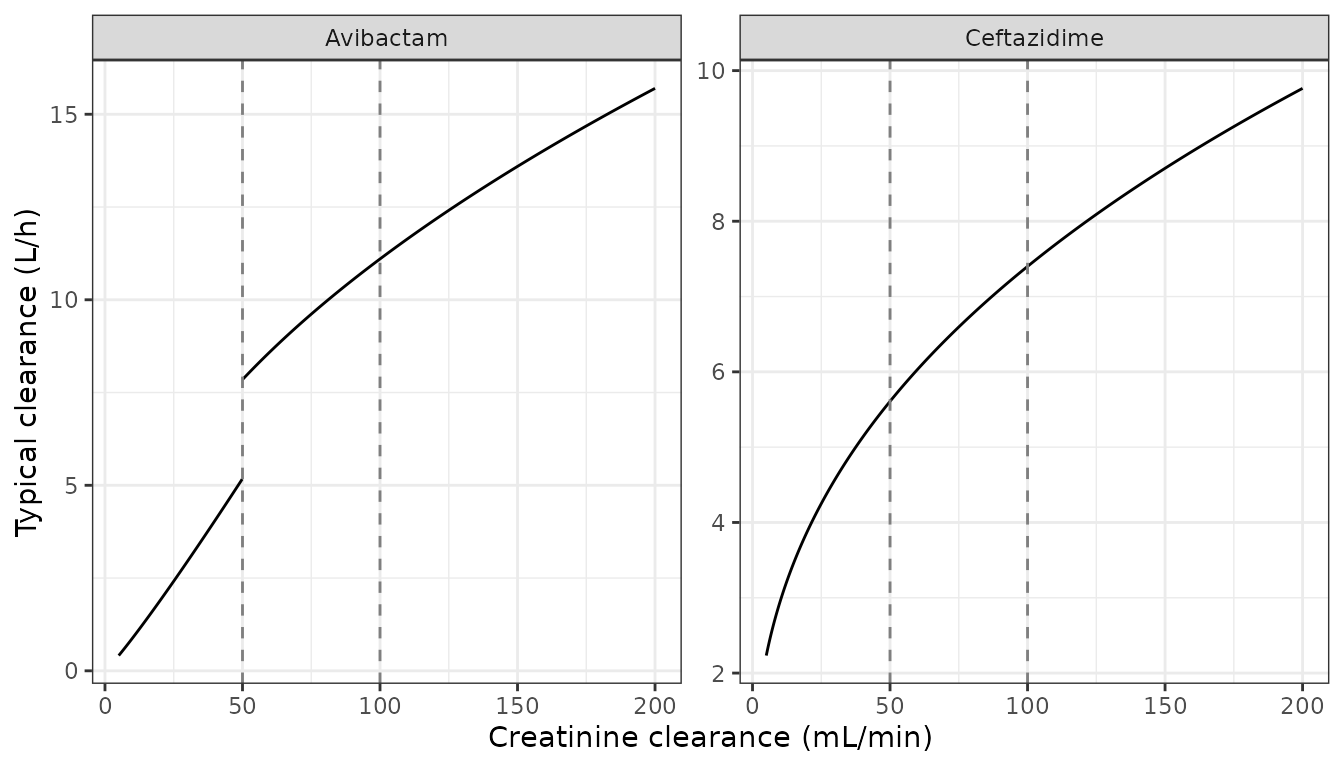
As printed, the avibactam exponent switches at 50 mL/min while both arms keep the same reference of 100 mL/min, so typical clearance jumps at the switch. The deterministic typical-value solve below confirms that the model file produces this curve, and that the solved clearance equals Dose / AUC.
crclProbe <- c(30, 49.9, 50, 100, 150)
probeEvents <- function(dose) {
  rxode2::et(amt = dose, rate = dose / 2, cmt = "central") |>
    rxode2::et(seq(0, 72, by = 0.25)) |>
    as.data.frame() |>
    select(-any_of("id")) |>
    tidyr::crossing(CRCL = crclProbe) |>
    mutate(id = match(CRCL, crclProbe)) |>
    arrange(id, time, desc(evid))
}
typAvi <- rxode2::rxSolve(rxode2::zeroRe(modAvi), probeEvents(500), returnType = "data.frame")
#> ℹ parameter labels from comments will be replaced by 'label()'
#> ℹ omega/sigma items treated as zero: 'etalcl', 'etalvc'
#> Warning: multi-subject simulation without without 'omega'
typCaz <- rxode2::rxSolve(rxode2::zeroRe(modCaz), probeEvents(2000), returnType = "data.frame")
#> ℹ parameter labels from comments will be replaced by 'label()'
#> ℹ omega/sigma items treated as zero: 'etalcl', 'etalvc'
#> Warning: multi-subject simulation without without 'omega'

typCl <- bind_rows(
  typAvi |> group_by(id) |> slice(1) |> ungroup() |>
    transmute(drug = "Avibactam", CRCL = crclProbe[id], cl),
  typCaz |> group_by(id) |> slice(1) |> ungroup() |>
    transmute(drug = "Ceftazidime", CRCL = crclProbe[id], cl)
) |>
  mutate(expected = ifelse(
    drug == "Avibactam",
    11.1 * (CRCL / 100)^ifelse(CRCL < 50, 1.1, 0.5),
    7.4 * (CRCL / 100)^0.4
  ))

typCl |>
  mutate(across(c(cl, expected), \(x) signif(x, 4))) |>
  rename(`CRCL (mL/min)` = CRCL, `Model CL (L/h)` = cl, `Table S4 CL (L/h)` = expected) |>
knitr::kable(caption = "Typical clearance from the model file against the Table S4 equation.")| drug | CRCL (mL/min) | Model CL (L/h) | Table S4 CL (L/h) |
|---|---|---|---|
| Avibactam | 30.0 | 2.952 | 2.952 |
| Avibactam | 49.9 | 5.167 | 5.167 |
| Avibactam | 50.0 | 7.849 | 7.849 |
| Avibactam | 100.0 | 11.100 | 11.100 |
| Avibactam | 150.0 | 13.590 | 13.590 |
| Ceftazidime | 30.0 | 4.572 | 4.572 |
| Ceftazidime | 49.9 | 5.604 | 5.604 |
| Ceftazidime | 50.0 | 5.608 | 5.608 |
| Ceftazidime | 100.0 | 7.400 | 7.400 |
| Ceftazidime | 150.0 | 8.703 | 8.703 |
Adult validation cohort
The cohort mirrors the adult study Zhou 2016 simulated (Supplementary Table S1): healthy adults aged 22-46 years given one 2-hour infusion of avibactam 500 mg or ceftazidime 2000 mg. Zhou 2016 does not print the adult CRCL distribution it used, so CRCL is drawn log-normally around a median of 110 mL/min with a 20% CV. That is a typical healthy young-adult value; see Assumptions and deviations. Each drug gets 200 virtual subjects.
# rxSetSeed() fixes rxode2's draws (the etas); set.seed() fixes the cohort.
set.seed(20160827)
rxode2::rxSetSeed(20160827)
nSub <- 200
cohort <- data.frame(
  id = seq_len(nSub),
  CRCL = 110 * exp(rnorm(nSub, 0, sqrt(log(1 + 0.2^2))))
)

obsTimes <- sort(unique(c(seq(0, 4, by = 0.25), seq(4.5, 12, by = 0.5), seq(13, 24, by = 1))))

makeEvents <- function(dose, drug) {
  rxode2::et(amt = dose, rate = dose / 2, cmt = "central") |>
    rxode2::et(obsTimes) |>
    as.data.frame() |>
    select(-any_of("id")) |>
    tidyr::crossing(id = cohort$id) |>
    left_join(cohort, by = "id") |>
    mutate(drug = drug) |>
    arrange(id, time, desc(evid))
}
evAvi <- makeEvents(500, "Avibactam")
evCaz <- makeEvents(2000, "Ceftazidime")

simAvi <- rxode2::rxSolve(modAvi, evAvi, returnType = "data.frame", keep = "drug")
#> ℹ parameter labels from comments will be replaced by 'label()'
simCaz <- rxode2::rxSolve(modCaz, evCaz, returnType = "data.frame", keep = "drug")
#> ℹ parameter labels from comments will be replaced by 'label()'

sim <- bind_rows(simAvi, simCaz) |>
  mutate(id = as.integer(as.character(id)))
stopifnot(nrow(sim) > 0, all(is.finite(sim$Cc)), all(is.finite(sim$sim)))
sim |>
  group_by(drug, time) |>
  summarise(
    med = median(Cc), lo = quantile(Cc, 0.05), hi = quantile(Cc, 0.95),
    .groups = "drop"
  ) |>
  ggplot(aes(time, med)) +
  geom_ribbon(aes(ymin = lo, ymax = hi), alpha = 0.2, fill = "steelblue") +
  geom_line(colour = "steelblue") +
  facet_wrap(~drug, scales = "free_y") +
  scale_y_log10() +
  labs(
    x = "Time after start of infusion (h)",
    y = "Total plasma concentration (mg/L)",
    caption = "Median and 5th-95th percentiles of individual predictions (between-subject variability only)."
  ) +
  theme_bw()
#> Warning in scale_y_log10(): log-10 transformation introduced infinite values.
#> log-10 transformation introduced infinite values.
#> log-10 transformation introduced infinite values.
#> log-10 transformation introduced infinite values.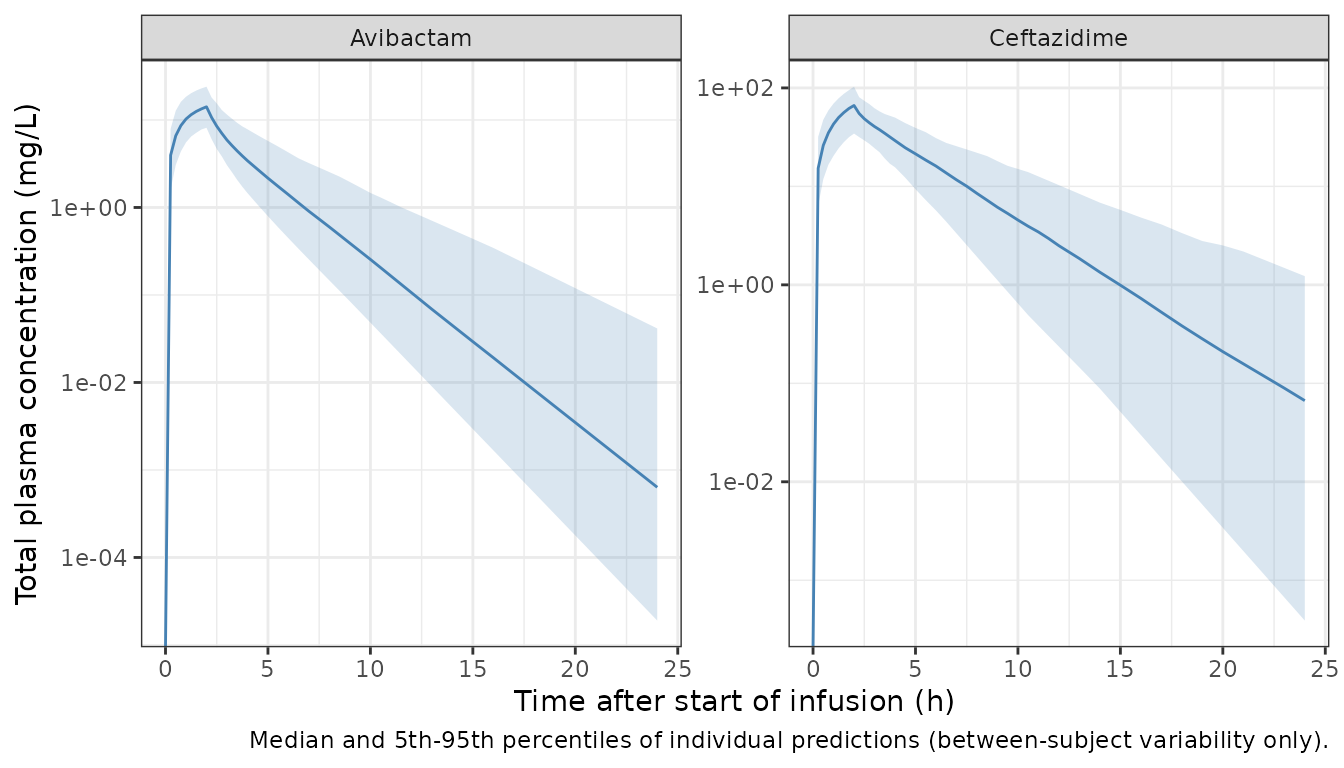
Zhou 2016 shows concentration-time profiles only for pregabalin (Figure 4), so these profiles have no published counterpart. Figure 2 of the paper reports the avibactam and ceftazidime results only as predicted/observed clearance ratios.
PKNCA validation
The NCA uses the individual predictions (Cc), so
residual error does not enter the clearance estimate.
concNca <- sim |>
  filter(!is.na(Cc)) |>
  transmute(id, time, Cc, drug)
doseNca <- bind_rows(evAvi, evCaz) |>
  filter(evid == 1) |>
  transmute(id, time, amt, dur = 2, drug)

concObj <- PKNCA::PKNCAconc(concNca, Cc ~ time | drug + id, concu = "mg/L", timeu = "h")
doseObj <- PKNCA::PKNCAdose(doseNca, amt ~ time | drug + id, doseu = "mg", route = "intravascular", duration = "dur")
intervals <- data.frame(
  start = 0, end = Inf,
  cmax = TRUE, tmax = TRUE, aucinf.obs = TRUE, cl.obs = TRUE, half.life = TRUE
)
ncaRes <- PKNCA::pk.nca(PKNCA::PKNCAdata(concObj, doseObj, intervals = intervals))
ncaLong <- as.data.frame(ncaRes$result) |>
  filter(PPTESTCD %in% c("cmax", "tmax", "aucinf.obs", "cl.obs", "half.life"))

ncaLong |>
  group_by(drug, PPTESTCD) |>
  summarise(
    Median = median(PPORRES, na.rm = TRUE),
    P05 = quantile(PPORRES, 0.05, na.rm = TRUE),
    P95 = quantile(PPORRES, 0.95, na.rm = TRUE),
    .groups = "drop"
  ) |>
  mutate(
    # IV dosing: PKNCA's cl.obs is systemic clearance, not CL/F
    Parameter = sub("CL/F", "CL", nlmixr2lib::ncaParamLabel(PPTESTCD), fixed = TRUE),
    across(c(Median, P05, P95), \(x) signif(x, 3))
  ) |>
  select(Drug = drug, Parameter, Median, P05, P95) |>
knitr::kable(caption = "Simulated single-dose NCA by drug (adult validation cohort).")| Drug | Parameter | Median | P05 | P95 |
|---|---|---|---|---|
| Avibactam | AUC0-∞ (obs) | 40.00 | 21.40 | 81.30 |
| Avibactam | CL | 12.50 | 6.15 | 23.40 |
| Avibactam | Cmax | 14.10 | 8.15 | 24.00 |
| Avibactam | t½ | 1.62 | 1.23 | 2.73 |
| Avibactam | Tmax | 2.00 | 2.00 | 2.00 |
| Ceftazidime | AUC0-∞ (obs) | 263.00 | 152.00 | 471.00 |
| Ceftazidime | CL | 7.60 | 4.25 | 13.20 |
| Ceftazidime | Cmax | 66.30 | 34.40 | 103.00 |
| Ceftazidime | t½ | 2.20 | 1.28 | 3.99 |
| Ceftazidime | Tmax | 2.00 | 2.00 | 2.00 |
Each subject’s NCA clearance must equal that subject’s own model clearance. Both sides use the same drawn parameters, so any difference is numerical error and the bound is tight.
Comparison against the published adult values
Zhou 2016 Table 1 pools published adult studies into a median clearance: avibactam 12.5 L/h (range 9.4-13.9) and ceftazidime 6.9 L/h (range 6.6-6.9). It also gives a volume of distribution at steady state of 0.22-0.35 L/kg (avibactam) and 0.24-0.26 L/kg (ceftazidime). The simulated median clearance is compared with the pooled median below.
refTable1 <- data.frame(drug = c("Avibactam", "Ceftazidime"), cl.obs = c(12.5, 6.9))
cmp <- nlmixr2lib::ncaComparisonTable(
  ncaLong |> select(drug, PPTESTCD, PPORRES),
  refTable1,
  by = "drug",
  params = "cl.obs",
  units = c(cl.obs = "L/h")
)
cmp |>
  mutate(`NCA parameter` = sub("CL/F", "CL", `NCA parameter`, fixed = TRUE)) |>
  rename(Drug = drug) |>
knitr::kable(caption = "Simulated median clearance against the pooled adult median of Zhou 2016 Table 1.")| NCA parameter | Drug | Reference | Simulated | % diff |
|---|---|---|---|---|
| CL (L/h) | Avibactam | 12.5 | 12.5 | -0.1% |
| CL (L/h) | Ceftazidime | 6.9 | 7.6 | +10.2% |
pctDiff <- ncaLong |>
  filter(PPTESTCD == "cl.obs") |>
  group_by(drug) |>
  summarise(sim = median(PPORRES), .groups = "drop") |>
  left_join(refTable1, by = "drug") |>
  mutate(pct = 100 * (sim - cl.obs) / cl.obs)
# The reference is a literature median and the simulated CRCL distribution is
# assumed, so assert on the centre with room for that assumption: a
# mis-transcribed clearance or exponent would move it far more than this.
stopifnot(all(abs(pctDiff$pct) < 20))
The simulated median clearance matches the pooled adult median for avibactam and is about 10% higher for ceftazidime. Zhou 2016 Table S5 reports PopPK predicted/observed adult clearance ratios of 1.05 (avibactam) and 0.81 (ceftazidime). Those ratios are against the single adult study of Supplementary Table S1, not the Table 1 pooled median, so they are not comparable number for number.
The model volume at steady state is V1 + V2 = 20.0 L (avibactam) and 22.3 L (ceftazidime), taken from the parameters. The NCA table leaves out Vss because the infusion-duration correction to the mean residence time matters here: a 2-hour infusion adds about CL x 1 h to an uncorrected estimate. That is 0.29 and 0.32 L/kg at 70 kg. The avibactam value lies inside the Table 1 range, and the ceftazidime value lies above the 0.24-0.26 L/kg pooled range.
Pediatric predictions in the paper
Zhou 2016 used these models to predict clearance in children. Because neither model carries body weight, the predictions are driven only by CRCL. CRCL was estimated with the Schwartz equation for infants and the Rhodin equation from 2 years of age, in 1,000 virtual children per age group built from CDC growth charts. The paper prints neither the estimating-equation inputs (serum creatinine, height) nor the observed pediatric clearances, which appear only as ratios. The pediatric step is therefore summarized here, not re-simulated.
tribble(
  ~`Age group`, ~`Avibactam PopPK`, ~`Avibactam PBPK`, ~`Ceftazidime PopPK`, ~`Ceftazidime PBPK`,
  "Adults", "1.05 (0.45)", "1.11 (0.33)", "0.81 (0.34)", "0.97 (0.30)",
  "Infants", "0.90 (0.52)", "0.98 (0.54)", "1.06 (0.55)", "1.17 (0.58)",
  "Young children", "0.64 (0.36)", "0.77 (0.41)", "1.50 (0.73)", "1.48 (0.67)",
  "School aged", "0.68 (0.38)", "0.86 (0.41)", "1.33 (0.64)", "1.29 (0.52)",
  "Adolescents", "0.66 (0.45)", "0.83 (0.50)", "1.41 (0.87)", "1.33 (0.70)"
) |>
knitr::kable(caption = "Predicted/observed mean clearance ratio (Ratio SD) by age group, Zhou 2016 Supplementary Table S5.")| Age group | Avibactam PopPK | Avibactam PBPK | Ceftazidime PopPK | Ceftazidime PBPK |
|---|---|---|---|---|
| Adults | 1.05 (0.45) | 1.11 (0.33) | 0.81 (0.34) | 0.97 (0.30) |
| Infants | 0.90 (0.52) | 0.98 (0.54) | 1.06 (0.55) | 1.17 (0.58) |
| Young children | 0.64 (0.36) | 0.77 (0.41) | 1.50 (0.73) | 1.48 (0.67) |
| School aged | 0.68 (0.38) | 0.86 (0.41) | 1.33 (0.64) | 1.29 (0.52) |
| Adolescents | 0.66 (0.45) | 0.83 (0.50) | 1.41 (0.87) | 1.33 (0.70) |
All PopPK ratios fall inside the twofold window that Zhou 2016 uses as its success criterion.
Assumptions and deviations
-
Secondary source. Every value is Zhou 2016’s
transcription of the Li 2012 ICAAC model, not the original authors’
table. The original analysis was never published in full. If it is, it
should be extracted under its own author name. The later
ceftazidime-avibactam models in the library
(
Li_2019_ceftazidime,Li_2019_avibactam,Franzese_2022_*) are separate, larger analyses, not the same model. -
Covariates removed by Zhou 2016. The original
model’s age and disease (cIAI) effects were removed before Zhou 2016
simulated. Their forms and estimates are not printed and are recorded
only in
covariatesDataExcluded. -
CL-V1 omega block. Table S4 gives the CL-V1 block
as a percentage (“Omega block between CL-V1 36.7%” for avibactam, 47.5%
for ceftazidime). The models read it as a correlation coefficient, which
is how PsN-style summary tables usually print off-diagonal OMEGA
elements. The alternative reading treats the percentage as the square
root of the covariance times
- That gives correlations of 0.70 (avibactam) and 0.90 (ceftazidime), where these models use 0.367 and 0.475. Neither reading changes typical values or the distribution of CL alone. For avibactam the printed 36.7% equals the CL IIV, which may be a coincidence or a transcription slip.
- Avibactam CRCL switch. The exponent of (CRCL/100) is 1.1 below 50 mL/min and 0.5 above, encoded literally. With a shared reference of 100 mL/min the typical clearance jumps by about 52% at 50 mL/min. The table does not say whether the original model also had this jump, or a re-centred and continuous hinge.
- Residual error units. Table S4 gives the additive errors in ng/mL. They are converted to mg/L (0.0145 and 0.0792) to match the dosing and concentration units.
- CRCL definition. The CRCL is raw mL/min, as implied by the 100 mL/min reference with no BSA term. The adult estimating equation is not stated.
- Validation cohort. Zhou 2016 does not print the adult CRCL distribution it simulated. The log-normal median of 110 mL/min and 20% CV used here is an assumption. Sex and body weight do not enter either model, so they are not simulated.