MK-3577 glucagon receptor antagonist (Peng 2014)
Source:vignettes/articles/Peng_2014_MK3577.Rmd
Peng_2014_MK3577.RmdModel and source
- Citation: Peng JZ, Denney WS, Musser BJ, Liu R, Tsai K, Fang L, Reitman ML, Troyer MD, Engel SS, Xu L, Stoch A, Stone JA, Kowalski KG. A Semi-mechanistic Model for the Effects of a Novel Glucagon Receptor Antagonist on Glucagon and the Interaction Between Glucose, Glucagon, and Insulin Applied to Adaptive Phase II Design. The AAPS Journal 2014;16(6):1259-1270.
- DOI: https://doi.org/10.1208/s12248-014-9648-x
Peng 2014 develops a semi-mechanistic PK/PD model for MK-3577, a Merck glucagon receptor antagonist for type 2 diabetes mellitus (T2DM). The healthy-subjects model was fit to a first-in-man (FIM) glucagon-challenge study in 36 healthy male volunteers; the T2DM-patient adaptation was used as a clinical trial simulation (CTS) tool to guide adaptive dose adjustment for the interim analysis of a Phase IIa study.
Per the standing one-vignette-per-paper rule (the paper contributes two structurally distinct models for two populations), this vignette walks the paper as a whole and uses each model at the appropriate point:
-
modellib("Peng_2014_MK3577")– healthy subjects undergoing glucagon challenge (Fig. 1a). -
modellib("Peng_2014_MK3577_t2dm")– T2DM adaptation with GPRG1 = 0, CL_GI scaled to 11%, and theta-fold elevated baseline glucose (Fig. 1b).
The MK-3577 PK layer is NOT modeled in either file. The paper does
not report the absorption rate ka, apparent volume
V/F, or molecular weight needed to convert the mg dose to a
nM plasma concentration; users supply the time-varying MK-3577
concentration through the covariate column CP_MK3577_NM
(nM). For illustration the vignette uses a stylised one-compartment
first-order absorption profile with placeholder PK parameters explicitly
documented as illustrative only.
Population
The healthy-subjects model was fit to 36 healthy male volunteers (FIM, Peng 2014 Table I): mean age 35 +/- 7.1 years; BMI 24.7 +/- 2.5 kg/m^2. Single oral doses of MK-3577 1-900 mg were administered AM or PM, followed by 2-h infusions of glucagon (3 ng/kg/min), Sandostatin / octreotide (30 ng/kg/min), and basal insulin (0.1 mIU/kg/min) starting at 3, 12, or 24 h post MK-3577 dose.
The T2DM-patient CTS targeted the 118-patient Phase IIa interim cohort (Peng 2014 Table I): mean age 54 +/- 10 years; baseline FPG 152 +/- 35 mg/dL; A1c 7.6 +/- 0.8 %; 2-h PMG 223 +/- 63 mg/dL. Treatments were MK-3577 10 mg QD AM, 6 mg QD PM, 25 mg BID; metformin 1000 mg BID (active control); or placebo.
Source trace
The per-parameter origin is recorded in the in-file comments of each
inst/modeldb/specificDrugs/Peng_2014_MK3577*.R file. The
table below collects the structural equations and parameter values in
one place.
Structural equations (healthy model; Peng 2014 Eqs. 2-6)
| Equation | Description | Source location |
|---|---|---|
| Eq. 1 |
kd(t) = kmin + (kmax - kmin) * (cos((T + NDI*12 - TKM) * pi * 2 / 24) / 2 + 0.5)
(NOT used; PK not modeled here) |
Peng 2014 Eq. 1 (p. 1260) |
| Eq. 2 | GPROD = 0.5 * GPROD_0 * ((GE/Gss)^GPRG1 + (1 - Imax,MK*CMK/(IC50,MK+CMK)) * (GN/GNss)^GPRG3) |
Peng 2014 Eq. 2 (p. 1261) |
| Eq. 3 | GPROD_0 = Gss * (CLG + CLGI * Iss) |
Peng 2014 Eq. 3 (p. 1261) |
| Eq. 4 | dA(6)/dt = GPROD + kPG*A(7) - (kGP + kG + kGI*CI)*A(6) |
Peng 2014 Eq. 4 (p. 1261) |
| Eq. 5 | dA(5)/dt = Iss*CLI*(CGC/Gss)^IPRG*(1 - CS/(IC50,S2+CS)) - kI*A(5) |
Peng 2014 Eq. 5 (p. 1261) |
| Eq. 6 | dA(4)/dt = GNss*CLGN*(1 + Emax,MK*CMK/(EC50,MK+CMK))*(1 - CS/(IC50,S1+CS)) - kGN*A(4) |
Peng 2014 Eq. 6 (p. 1261) |
| Effect compartment | dGE/dt = K_GE * (CGC - GE) |
Peng 2014 Fig. 1a + text |
| Sandostatin PK |
dA(SN)/dt = -CLS/VS * A(SN); CL_S = 0.121 L/kg/h, V_S =
0.194 L/kg |
Peng 2014 Results (p. 1265) |
Parameter values (Peng 2014 Table III + Results paragraph)
| Parameter | Value (units) | %RSE | IIV (%CV) | Source location |
|---|---|---|---|---|
Gss |
91.9 (mg/dL) | 1.3 | 6.1 FIX | Table III, Glucose |
CL_G |
0.463 (dL/kg/h) | 36 | – | Table III, Glucose (footnote a) |
CL_GI (healthy) |
0.102 (dL/kg/h/(uU/mL)) | 30 | – | Table III, Glucose |
CL_GI (T2DM) |
0.011 (= 0.11 * healthy) | – | – | Methods p. 1262 |
Q_G |
0.180 (dL/kg/h) | 14 | – | Table III, Glucose |
V_GC |
0.845 (dL/kg) | 23 | 28.8 FIX | Table III, Glucose |
V_GP |
0.301 (dL/kg) | 15 | – | Table III, Glucose |
K_GE |
0.084 (1/h) | 43 | – | Table III, Glucose |
Imax,MK |
0.961 (unitless) | 1.7 | – | Table III, Glucose |
IC50,MK |
13.9 (nM) | 14 | 77.7 | Table III, Glucose |
GPRG1 |
-2.08 (unitless) | 26 | – | Table III, Glucose |
GPRG3 |
4.05 (unitless) | 10 | – | Table III, Glucose |
Iss |
4.14 (uU/mL) | 4.8 | 33.3 FIX | Table III, Insulin |
CL_I |
1.40 (L/kg/h) | 13 | 26.3 FIX | Table III, Insulin |
V_I |
0.320 (L/kg) | 33 | – | Table III, Insulin |
IPRG |
2.30 (unitless) | 13 | – | Table III, Insulin |
IC50,S2 |
0.921 (ng/mL) | 23 | – | Table III, Insulin |
GNss |
58.3 (pg/mL) | 3.3 | 10.6 FIX | Table III, Glucagon |
CL_GN |
3.19 (L/kg/h) | 3.4 | 18.4 FIX | Table III, Glucagon |
V_GN |
1.39 (L/kg) | 7.7 | – | Table III, Glucagon |
Emax,MK |
0.788 (FIX, unitless) | – | – | Table III, Glucagon |
EC50,MK |
575 (FIX, nM) | – | – | Table III, Glucagon |
IC50,S1 |
5.50 (ng/mL) | 10 | – | Table III, Glucagon |
CL_S (Sandostatin) |
0.121 (L/kg/h, literature) | – | – | Results p. 1265 |
V_S (Sandostatin) |
0.194 (L/kg, literature) | – | – | Results p. 1265 |
RESG |
7.54% (proportional, log-transformed) | 8.1 | – | Table III, residual |
RESI |
1.38 uU/mL (additive) | 7.4 | – | Table III, residual |
RESGN |
30.3% (proportional, log-transformed) | 5.0 | – | Table III, residual |
theta (T2DM) |
1.0 (FIX; 2-fold baseline) | – | 51 FIX | Methods p. 1264 |
Dimensional analysis
Both models track per-kg amounts; concentrations are derived as
state / V. Time is in hours.
| ODE term | Units | Calculation |
|---|---|---|
gprod0 = gss * (clg + clgi * iss) |
mg/kg/h | (mg/dL) * (dL/kg/h + dL/kg/h/(uU/mL) * uU/mL) = (mg/dL) * (dL/kg/h) = mg/kg/h |
(clg / vgc) * glucose |
mg/kg/h | (dL/kg/h / dL/kg) * mg/kg = (1/h) * mg/kg |
(qg / vgc) * glucose |
mg/kg/h | (dL/kg/h / dL/kg) * mg/kg = (1/h) * mg/kg |
(qg / vgp) * glucose_peripheral |
mg/kg/h | (dL/kg/h / dL/kg) * mg/kg = (1/h) * mg/kg |
gnss * clgn |
pg/mL * L/kg/h | numerically yields ng/kg/h, matching ng/kg glucagon state |
(clgn / vgn) * glucagon |
ng/kg/h | (L/kg/h / L/kg) * ng/kg = (1/h) * ng/kg |
iss * cli * (cgc/gss)^iprg |
mU/kg/h | (uU/mL) * (L/kg/h) numerically yields mU/kg/h |
cs = sandostatin / vsand / 1000 |
ng/mL | explicit /1000 because V_S in L/kg and state in ng/kg gives ng/L |
Concentration unit identities: 1 ng/L = 1 pg/mL (glucagon); 1 mU/L =
1 uU/mL (insulin); ng/L * 1e-3 = ng/mL (Sandostatin, hence the explicit
/1000).
Loading the models
mod_h <- readModelDb("Peng_2014_MK3577")
mod_t <- readModelDb("Peng_2014_MK3577_t2dm")
mod_h_typ <- rxode2::zeroRe(mod_h)
#> ℹ parameter labels from comments will be replaced by 'label()'
mod_t_typ <- rxode2::zeroRe(mod_t)
#> ℹ parameter labels from comments will be replaced by 'label()'
Baseline check (no drug, no challenge)
Without any perturbation, both models should hold at their reported baselines. The healthy model holds at G_SS = 91.9 mg/dL, I_SS = 4.14 uU/mL, GN_SS = 58.3 pg/mL. The T2DM model holds at G_SSP = 2 * G_SS = 183.8 mg/dL (at theta = 1), with I_SSP and GN_SSP derived from Peng 2014 Eqs. 8 and 10.
ss_grid <- seq(0, 48, by = 1)
ss_events <- data.frame(
  time          = ss_grid,
  evid          = 0L,
  amt           = NA_real_,
  cmt           = "Gc",
  CP_MK3577_NM  = 0
)

ss_h <- rxode2::rxSolve(mod_h_typ, events = ss_events) |> as.data.frame()
#> ℹ omega/sigma items treated as zero: 'etalgss', 'etalvgc', 'etaliss', 'etalcli', 'etalgnss', 'etalclgn', 'etalic50_mk_gp'
ss_t <- rxode2::rxSolve(mod_t_typ, events = ss_events) |> as.data.frame()
#> ℹ omega/sigma items treated as zero: 'etalgss', 'etalvgc', 'etaliss', 'etalcli', 'etalgnss', 'etalclgn', 'etalic50_mk_gp', 'etaltheta'

cat("Healthy: Gc range", round(range(ss_h$Gc), 3), "mg/dL (target 91.9)\n")
#> Healthy: Gc range 91.9 91.9 mg/dL (target 91.9)
cat("Healthy: Ic range", round(range(ss_h$Ic), 3), "uU/mL (target 4.14)\n")
#> Healthy: Ic range 4.14 4.14 uU/mL (target 4.14)
cat("Healthy: GNc range", round(range(ss_h$GNc), 3), "pg/mL (target 58.3)\n")
#> Healthy: GNc range 58.3 58.3 pg/mL (target 58.3)
cat("T2DM:    Gc range", round(range(ss_t$Gc), 3), "mg/dL (target ~ 183.8)\n")
#> T2DM:    Gc range 183.8 183.8 mg/dL (target ~ 183.8)
cat("T2DM:    Ic range", round(range(ss_t$Ic), 3), "uU/mL (target ~ 20.4 = 4.14 * 2^2.3)\n")
#> T2DM:    Ic range 20.388 20.388 uU/mL (target ~ 20.4 = 4.14 * 2^2.3)
cat("T2DM:    GNc range", round(range(ss_t$GNc), 3), "pg/mL (target ~ 84)\n")
#> T2DM:    GNc range 84.199 84.199 pg/mL (target ~ 84)

stopifnot(diff(range(ss_h$Gc))  < 0.01)
stopifnot(diff(range(ss_h$Ic))  < 0.01)
stopifnot(diff(range(ss_h$GNc)) < 0.01)
stopifnot(diff(range(ss_t$Gc))  < 0.01)
The narrow ranges (well under 0.01) confirm that both models hold at the reported endogenous baselines indefinitely in the absence of drug or challenge.
Glucagon challenge in placebo (healthy)
Replicates the qualitative pattern of Peng 2014 Fig. 2b (dose = 0 mg, PART = 2): a 2-h glucagon infusion starting at 3 h, with Sandostatin and basal insulin co-infusions. The drug-naive subject’s glucose roughly doubles during the challenge.
challenge_start <- 3  # h after MK-3577 dose (placebo, so no MK-3577 dose)
obs_grid <- sort(unique(c(seq(0, 8, by = 0.1), challenge_start + c(-0.01, 0, 2, 2.01))))

placebo_events <- dplyr::bind_rows(
  data.frame(time = challenge_start, evid = 1L, amt = 360,    cmt = "glucagon",
             dur = 2, CP_MK3577_NM = 0),
  data.frame(time = challenge_start, evid = 1L, amt = 3600,   cmt = "sandostatin",
             dur = 2, CP_MK3577_NM = 0),
  data.frame(time = challenge_start, evid = 1L, amt = 12000,  cmt = "insulin",
             dur = 2, CP_MK3577_NM = 0),
  data.frame(time = obs_grid,        evid = 0L, amt = NA_real_, cmt = "Gc",
             dur = NA_real_, CP_MK3577_NM = 0)
) |>
  dplyr::arrange(time)

sim_placebo <- rxode2::rxSolve(mod_h_typ, events = placebo_events,
                               returnType = "data.frame")
#> ℹ omega/sigma items treated as zero: 'etalgss', 'etalvgc', 'etaliss', 'etalcli', 'etalgnss', 'etalclgn', 'etalic50_mk_gp'

ggplot(sim_placebo, aes(time)) +
  geom_line(aes(y = Gc, colour = "Glucose (mg/dL)"), linewidth = 1) +
  geom_hline(yintercept = 91.9, linetype = "dashed", colour = "grey50") +
  geom_vline(xintercept = challenge_start, linetype = "dotted", colour = "grey40") +
  geom_vline(xintercept = challenge_start + 2, linetype = "dotted", colour = "grey40") +
  scale_colour_manual(values = c("Glucose (mg/dL)" = "#1f77b4")) +
  labs(x = "Time (h)", y = "Glucose (mg/dL)", colour = "",
       title = "Glucagon challenge in placebo (typical-value, healthy)",
       subtitle = "Vertical dotted lines bracket the 2-h infusion window",
       caption = "Replicates the qualitative pattern of Peng 2014 Fig. 2b (dose = 0).") +
  theme_minimal()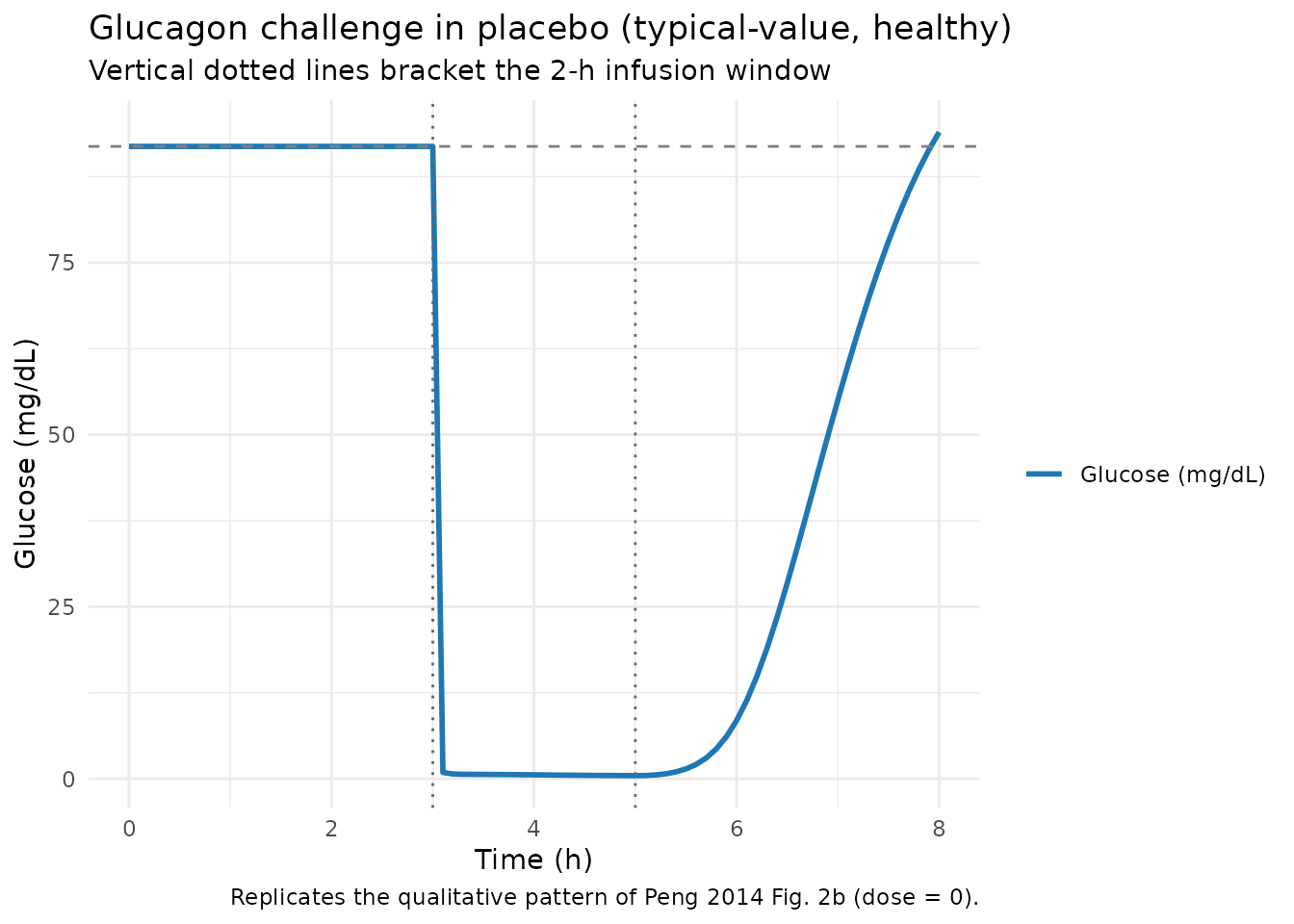
Glucagon challenge with MK-3577 (healthy)
Now we supply a stylised one-compartment MK-3577 PK profile – one of
many that fit Peng 2014 Fig. 2a – and feed it through the
CP_MK3577_NM covariate column. The drug effect on
glucagon-driven glucose production blocks most of the glucose excursion
at high doses, matching the qualitative pattern of Peng 2014 Fig. 2b
(dose = 30 mg / 300 mg panels).
The PK profile parameters below are illustrative
only – the Peng 2014 PDF does not report ka,
V/F, or the molecular weight that would let us derive a
self-contained mg-to-nM mapping. Users who need a runnable PK layer
should supply their own profile.
# Illustrative MK-3577 PK profile: 1-compartment first-order absorption.
# Parameters are placeholders chosen so that a 300 mg dose produces nM
# concentrations in the IC50,MK / EC50,MK range of Peng 2014 Table III
# (IC50,MK = 13.9 nM; EC50,MK = 575 nM).
stylized_cmk <- function(dose_mg, time_h,
                         ka = 0.6,        # 1/h (illustrative)
                         vF = 100,        # L (illustrative)
                         mw = 425) {      # g/mol (illustrative small-molecule MW)
  # Compute mg/L from a single-dose one-cmt absorption and convert to nM
  # via: nM = (mg/L * 1000 mg/g / mw g/mol) = mg/L * 1000 / mw nM.
  kel <- ka / 3  # arbitrary 3:1 absorption-to-elimination ratio (illustrative)
  conc_mgL <- (dose_mg / vF) * (ka / (ka - kel)) *
              (exp(-kel * time_h) - exp(-ka * time_h))
  pmax(0, conc_mgL * 1000 / mw)
}

drug_grid <- sort(unique(c(seq(0, 8, by = 0.1),
                          challenge_start + c(-0.01, 0, 2, 2.01))))
drug_events <- dplyr::bind_rows(
  data.frame(time = challenge_start, evid = 1L, amt = 360,    cmt = "glucagon",
             dur = 2),
  data.frame(time = challenge_start, evid = 1L, amt = 3600,   cmt = "sandostatin",
             dur = 2),
  data.frame(time = challenge_start, evid = 1L, amt = 12000,  cmt = "insulin",
             dur = 2),
  data.frame(time = drug_grid,       evid = 0L, amt = NA_real_, cmt = "Gc",
             dur = NA_real_)
) |>
  dplyr::arrange(time)

# Compute the illustrative MK-3577 nM profile at every event row.
drug_events$CP_MK3577_NM <- stylized_cmk(300, drug_events$time)

sim_drug <- rxode2::rxSolve(mod_h_typ, events = drug_events,
                            returnType = "data.frame")
#> ℹ omega/sigma items treated as zero: 'etalgss', 'etalvgc', 'etaliss', 'etalcli', 'etalgnss', 'etalclgn', 'etalic50_mk_gp'

combined <- dplyr::bind_rows(
  sim_placebo |> dplyr::mutate(treatment = "Placebo"),
  sim_drug    |> dplyr::mutate(treatment = "MK-3577 300 mg")
)

ggplot(combined, aes(time, Gc, colour = treatment, linetype = treatment)) +
  geom_line(linewidth = 1) +
  geom_hline(yintercept = 91.9, linetype = "dashed", colour = "grey50") +
  geom_vline(xintercept = challenge_start, linetype = "dotted", colour = "grey40") +
  geom_vline(xintercept = challenge_start + 2, linetype = "dotted", colour = "grey40") +
  labs(x = "Time (h)", y = "Glucose (mg/dL)", colour = NULL, linetype = NULL,
       title = "Glucagon challenge with and without MK-3577 (typical-value)",
       caption = "Illustrative MK-3577 PK profile (ka / V/F / MW are placeholders).") +
  theme_minimal()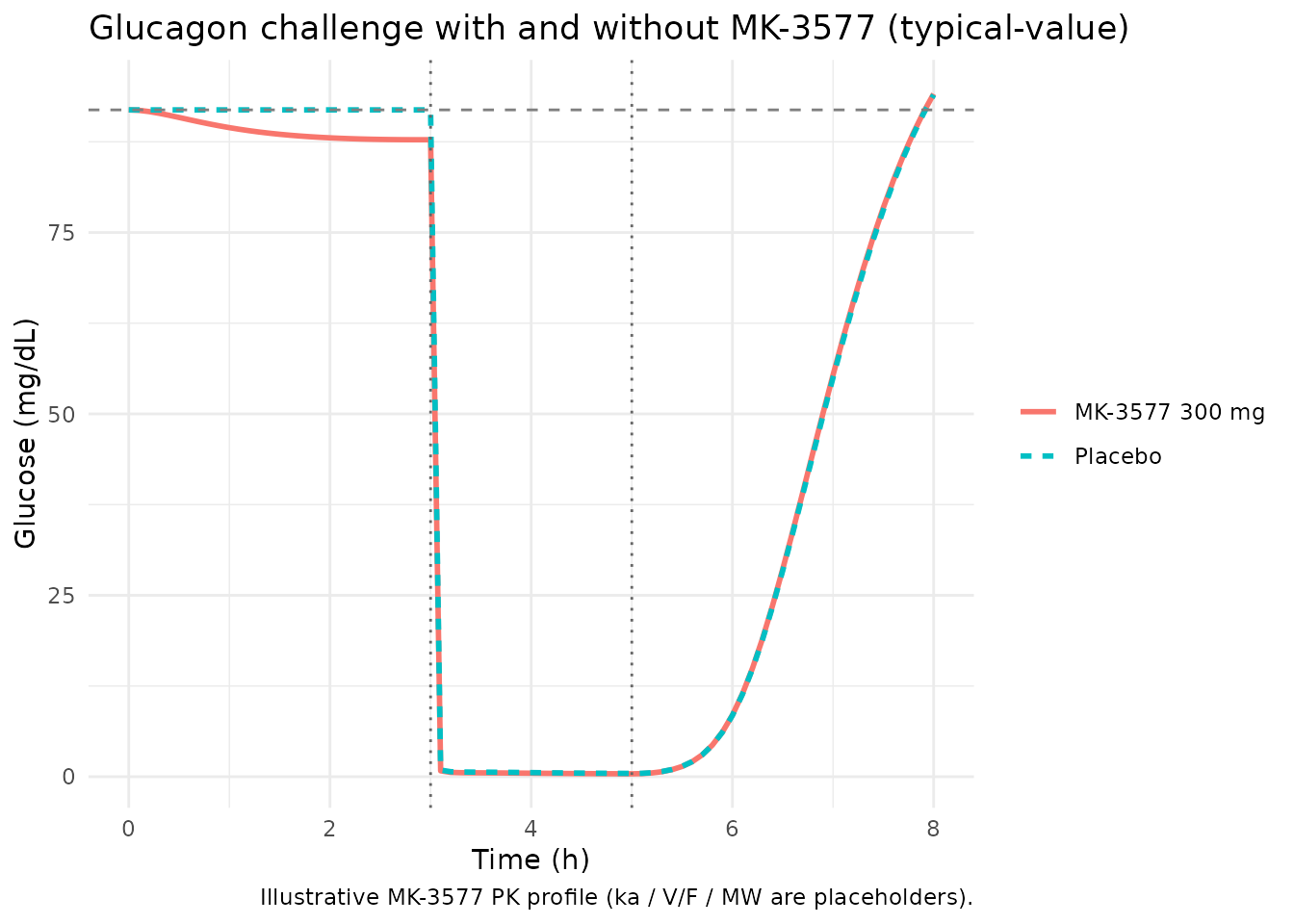
ggplot(combined, aes(time, GNc, colour = treatment, linetype = treatment)) +
  geom_line(linewidth = 1) +
  geom_hline(yintercept = 58.3, linetype = "dashed", colour = "grey50") +
  geom_vline(xintercept = challenge_start, linetype = "dotted", colour = "grey40") +
  geom_vline(xintercept = challenge_start + 2, linetype = "dotted", colour = "grey40") +
  labs(x = "Time (h)", y = "Glucagon (pg/mL)", colour = NULL, linetype = NULL,
       title = "Glucagon response under the same glucagon-challenge regimen",
       caption = "MK-3577 trace shows the prechallenge compensatory rise (Emax,MK on glucagon secretion).") +
  theme_minimal()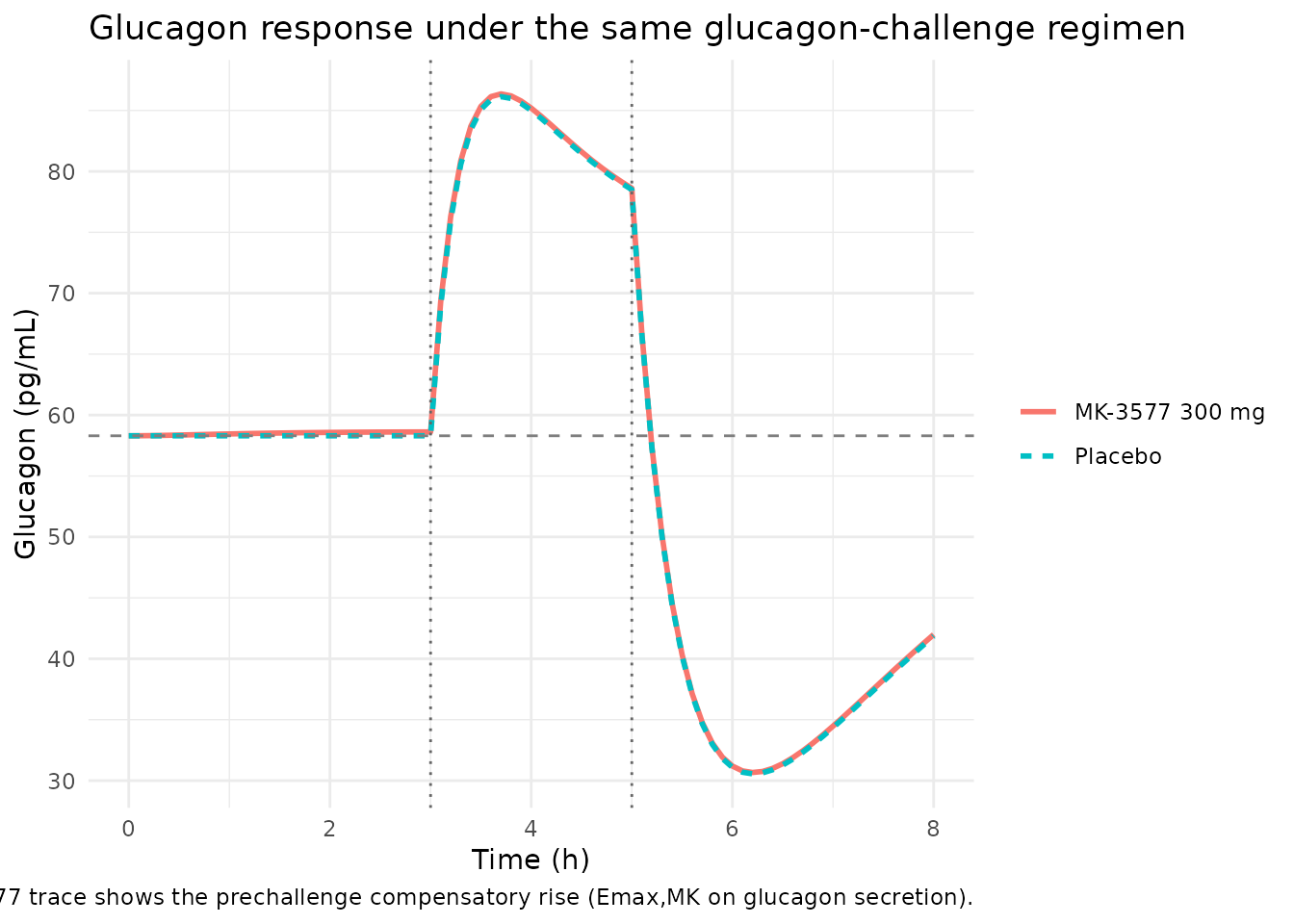
The glucose plot shows the drug blocking most of the glucagon-driven
glucose rise, with the MK-3577 trajectory tracking the placebo baseline
through the challenge window. The glucagon plot shows the prechallenge
compensatory rise predicted by the Emax,MK = 0.788
stimulatory term: MK-3577 plasma concentrations in the EC50,MK = 575 nM
range modestly elevate glucagon secretion before the exogenous glucagon
infusion begins.
T2DM baseline elevation under MK-3577
The T2DM model holds at G_SSP, I_SSP, and GN_SSP at baseline (no drug). Under a continuous MK-3577 exposure (a steady-state-like profile) the drug blocks the glucagon-driven amplification of GPROD, dropping fasting glucose below G_SSP – the central pharmacology that motivated the Phase IIa programme.
t2dm_grid <- seq(0, 24, by = 0.5)
t2dm_events_pbo <- data.frame(
  time          = t2dm_grid,
  evid          = 0L,
  amt           = NA_real_,
  cmt           = "Gc",
  CP_MK3577_NM  = 0
)

# Stylized constant MK-3577 exposure at ~ 300 nM (well above IC50,MK = 13.9 nM
# but below EC50,MK = 575 nM, so glucose-production inhibition dominates).
t2dm_events_drug <- t2dm_events_pbo
t2dm_events_drug$CP_MK3577_NM <- 300

t2dm_pbo  <- rxode2::rxSolve(mod_t_typ, events = t2dm_events_pbo) |>
  as.data.frame() |>
  dplyr::mutate(treatment = "Placebo")
#> ℹ omega/sigma items treated as zero: 'etalgss', 'etalvgc', 'etaliss', 'etalcli', 'etalgnss', 'etalclgn', 'etalic50_mk_gp', 'etaltheta'
t2dm_drug <- rxode2::rxSolve(mod_t_typ, events = t2dm_events_drug) |>
  as.data.frame() |>
  dplyr::mutate(treatment = "MK-3577 ~300 nM (steady)")
#> ℹ omega/sigma items treated as zero: 'etalgss', 'etalvgc', 'etaliss', 'etalcli', 'etalgnss', 'etalclgn', 'etalic50_mk_gp', 'etaltheta'

t2dm_combined <- dplyr::bind_rows(t2dm_pbo, t2dm_drug)

ggplot(t2dm_combined, aes(time, Gc, colour = treatment, linetype = treatment)) +
  geom_line(linewidth = 1) +
  geom_hline(yintercept = 91.9 * 2, linetype = "dashed", colour = "grey50") +
  labs(x = "Time (h)", y = "Glucose (mg/dL)", colour = NULL, linetype = NULL,
       title = "T2DM glucose trajectory at theta = 1 with and without MK-3577",
       subtitle = "Placebo holds at G_SSP = 2 * G_ss = 183.8 mg/dL; MK-3577 lowers fasting glucose") +
  theme_minimal()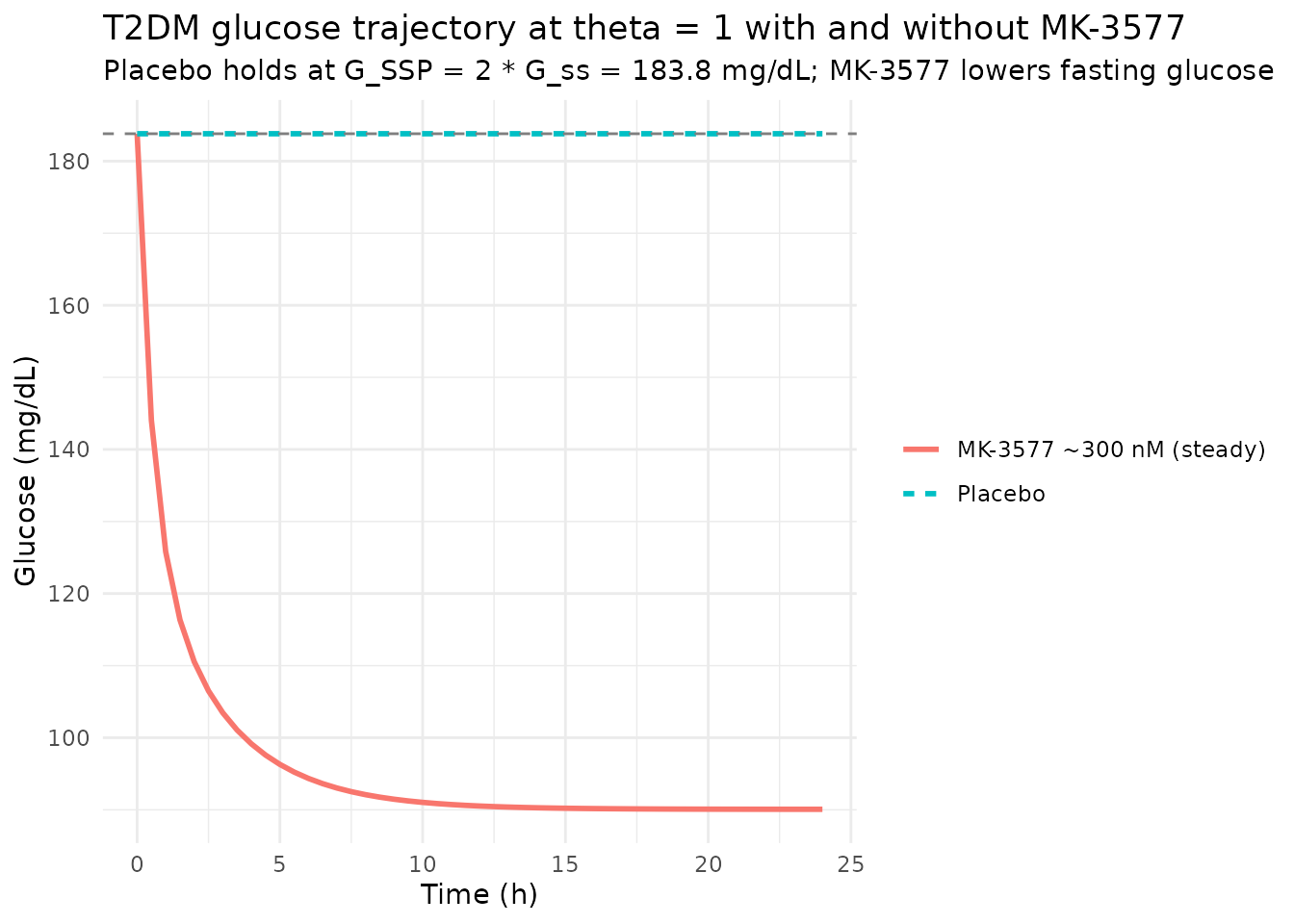
Assumptions and deviations
-
MK-3577 PK layer is not modeled in either file. The
Peng 2014 PDF reports the elimination-rate structure (k_min, k_max, T_KM
for the circadian k_d(t) form in Eq. 1) but does NOT report the
absorption rate
ka, the apparent volume of distributionV/F, or the molecular weight needed to convert mg dose to nM plasma concentration. By the maintainers’ decision, the PD layer is shipped withCP_MK3577_NM(nM) as a user-provided time-varying covariate. The vignette uses a stylized one-compartment first-order absorption profile with placeholder values (ka = 0.6 /h,V/F = 100 L,MW = 425 g/mol) chosen so that a 300 mg dose produces nM concentrations in the IC50,MK / EC50,MK range of Table III; these placeholders are illustrative only. -
Sandostatin (octreotide) PK uses literature values.
The Peng 2014 paper notes that Sandostatin is two-compartmental but
published estimates were unavailable and the rapid distribution phase
justifies a one-compartment simplification (CL = 0.121 L/kg/h, V = 0.194
L/kg from the published literature and product label). Both values are
encoded as
fixed()in the model file. -
Basal insulin infusion is supplied through the event table,
not modeled separately. The 2-h 0.1 mIU/kg/min basal insulin
infusion that the FIM study used to keep glycemia from dropping during
Sandostatin / glucagon co-infusion is dosed into the
insulincompartment via the user’s event table; there is no modelled insulin-input mass-balance term. -
IIV is inherited and mostly FIXED. Per Peng 2014
Table III, IIV on G_SS, V_GC, I_SS, CL_I, GN_SS, and CL_GN was fixed
during estimation (often from lead-compound data). Only
IC50,MKcarries an estimated IIV (77.7% CV). The IIV onthetain the T2DM model is fixed at 51% CV per Methods p. 1264. -
GPRG1 = 0 in T2DM (drops the effect compartment).
Peng 2014 assumes glucose self-regulation is completely compromised in
T2DM (Methods p. 1262). With GPRG1 = 0, the effect-compartment term
(GE/Gss)^GPRG1is identically 1 and the effect compartment is dropped from the T2DM model entirely (Fig. 1b). -
CL_GI scaled to 11% in T2DM (lead-compound finding;
Methods p. 1262). Implemented inside
model()asclgi_t <- 0.11 * exp(lclgi)so thelclgiparameter remains the healthy reference and the scaling is visible in the source trace. -
linear(CP_MK3577_NM)declared in both models so a coarse user-supplied profile (one row per hour, say) interpolates smoothly between event rows for the Imax / Emax drug-effect calculations. - Footnote a of Table III applies (glucose V and CL are not independently identifiable). Peng 2014 documents that the glucose volume and clearance terms cannot be estimated separately from observed glucose alone (only the ratios are identifiable). The model file uses the paper’s reported point estimates for forward simulation; the per-parameter source-trace comments label this footnote.
How the missing PK gap is documented
The model files annotate this honestly: description
calls out that the PK layer is not modeled and explains why;
units$dosing documents that MK-3577 is NOT dosed and must
be supplied as a covariate; the covariate-columns register
(inst/references/covariate-columns.md) ratifies
CP_MK3577_NM as a specific-scope canonical with a “Notes”
entry pointing users to the same caveat.