Metronidazole (Suyagh 2011)
Source:vignettes/articles/Suyagh_2011_metronidazole.Rmd
Suyagh_2011_metronidazole.RmdModel and source
- Citation: Suyagh M, Collier PS, Millership JS, Iheagwaram G, Millar M, Halliday HL, McElnay JC. Metronidazole population pharmacokinetics in preterm neonates using dried blood-spot sampling. Pediatrics. 2011;127(2):e367-e374. doi:10.1542/peds.2010-0807. PMID 21220396.
- Description: One-compartment population PK model for intravenous metronidazole in 32 preterm neonates receiving treatment of or prophylaxis against necrotising enterocolitis, with dried-blood-spot HPLC sampling (Suyagh 2011). Clearance is described by an allometric 3/4-power scaling on body weight (reference 1.0 kg) and a linear postmenstrual- age maturation term centred at 30 weeks; volume of distribution is proportional to body weight. The publication is open access only at the abstract level, so inter-individual variability on CL and V and the residual-error magnitude are FIXED at 0 here; users running stochastic VPCs must supply their own variability terms (see the validation vignette’s Errata section).
- Article: https://doi.org/10.1542/peds.2010-0807
The Suyagh 2011 paper develops a population PK model of intravenous
metronidazole in 32 preterm neonates using dried-blood-spot HPLC
sampling (203 samples). A one-compartment model best described the data,
with body weight (WT) and postmenstrual age (PMA) as the only retained
covariates. This nlmixr2lib entry is extracted from the
open-access abstract because the full text is paywalled at the
time of packaging. The structural model equations reported in the
abstract are reproduced exactly; inter-individual variability on CL and
V and the residual-error magnitude are not in the abstract and are
encoded as fixed(0) placeholders – see the Errata section
below.
Population
The PopPK analysis dataset comprised 32 preterm neonates who contributed 203 dried-blood-spot concentration measurements analysed by HPLC (Suyagh 2011 abstract). Subjects received intravenous metronidazole for the treatment of or prophylaxis against necrotising enterocolitis. Exact per-subject weight and PMA tabulations are not included in the abstract; the abstract’s predicted half-life trajectory (“approximately 40 hours at 25 weeks’ PMA to 19 hours at 32 weeks’ PMA, after which it starts to plateau”) implies the cohort spans roughly PMA 25-32 weeks. The validation cohort below uses representative preterm weights at each PMA stratum.
The same information is available programmatically via
readModelDb("Suyagh_2011_metronidazole")$population.
Source trace
The per-parameter origin is recorded as an in-file comment next to
each ini() entry in
inst/modeldb/specificDrugs/Suyagh_2011_metronidazole.R. The
table below collects them in one place for review.
| Equation / parameter | Value | Source location |
|---|---|---|
lcl (log clearance, 1.0 kg / 30 wk PMA reference) |
log(0.0247) |
Suyagh 2011 abstract Results: CL = 0.0247 L/h |
lvc (log per-kg volume slope) |
log(0.726) |
Suyagh 2011 abstract Results: V = 0.726 * WT |
e_wt_cl (allometric CL exponent) |
fixed(0.75) |
Suyagh 2011 abstract Results: (WT/1.00)^0.75 |
e_pma_cl (PMA slope per week, centred at 30 wk) |
0.107 |
Suyagh 2011 abstract Results: (1 + 0.107 * (PMA - 30)) |
etalcl, etalvc (IIV on CL, V) |
fixed(0) |
Not reported in the abstract – see Errata |
propSd (proportional residual error) |
fixed(0) |
Not reported in the abstract – see Errata |
One-compartment IV disposition
(d/dt(central) <- -kel * central) |
n/a | Suyagh 2011 abstract Results: “A 1-compartment model best described the data” |
| Cc = central / vc | n/a | Standard one-compartment observation form |
Virtual cohort
The Suyagh 2011 subject-level data are not publicly available. The
cohort below uses three PMA strata (25, 28, 32 weeks) with
representative preterm weights (0.8, 1.2, 1.7 kg) approximating the
typical postmenstrual-age-versus-weight relationship in the abstract’s
preterm range. A single 7.5 mg/kg intravenous dose is used (a standard
neonatal metronidazole loading dose; per-administration doses are not
enumerated in the abstract). Postmenstrual age is supplied in months
(PAGE) per the nlmixr2lib canonical covariate naming; the
model converts to weeks (PMA_weeks = PAGE * 4.35)
internally.
set.seed(2011)

strata <- tibble::tribble(
  ~cohort,  ~pma_weeks, ~WT,
  "PMA25",  25,         0.80,
  "PMA28",  28,         1.20,
  "PMA32",  32,         1.70
) |>
  dplyr::mutate(
    PAGE = pma_weeks / 4.35,
    dose_mg = 7.5 * WT
  )

n_per_stratum <- 1L

cohort_tbl <- strata |>
  tidyr::uncount(weights = n_per_stratum, .id = "within_stratum") |>
  dplyr::mutate(id = dplyr::row_number()) |>
  dplyr::select(id, cohort, pma_weeks, WT, PAGE, dose_mg)

obs_times <- c(0, 0.25, 0.5, 1, 2, 4, 6, 8, 12, 18, 24, 36, 48, 72, 96, 120)

dose_rows <- cohort_tbl |>
  dplyr::mutate(time = 0, amt = dose_mg, evid = 1L, cmt = "central")

obs_rows <- cohort_tbl |>
  tidyr::crossing(time = obs_times) |>
  dplyr::mutate(amt = NA_real_, evid = 0L, cmt = "central")

events <- dplyr::bind_rows(dose_rows, obs_rows) |>
  dplyr::arrange(id, time, dplyr::desc(evid)) |>
  dplyr::select(id, time, amt, evid, cmt, cohort, WT, PAGE, pma_weeks)

stopifnot(!anyDuplicated(unique(events[, c("id", "time", "evid")])))
Simulation
mod <- readModelDb("Suyagh_2011_metronidazole")

sim <- rxode2::rxSolve(
  mod, events = events,
  keep = c("cohort", "WT", "pma_weeks")
) |>
  as.data.frame()
#> ℹ omega/sigma items treated as zero: 'etalcl', 'etalvc'
#> Warning: multi-subject simulation without without 'omega'
Replicate published claim: half-life trajectory
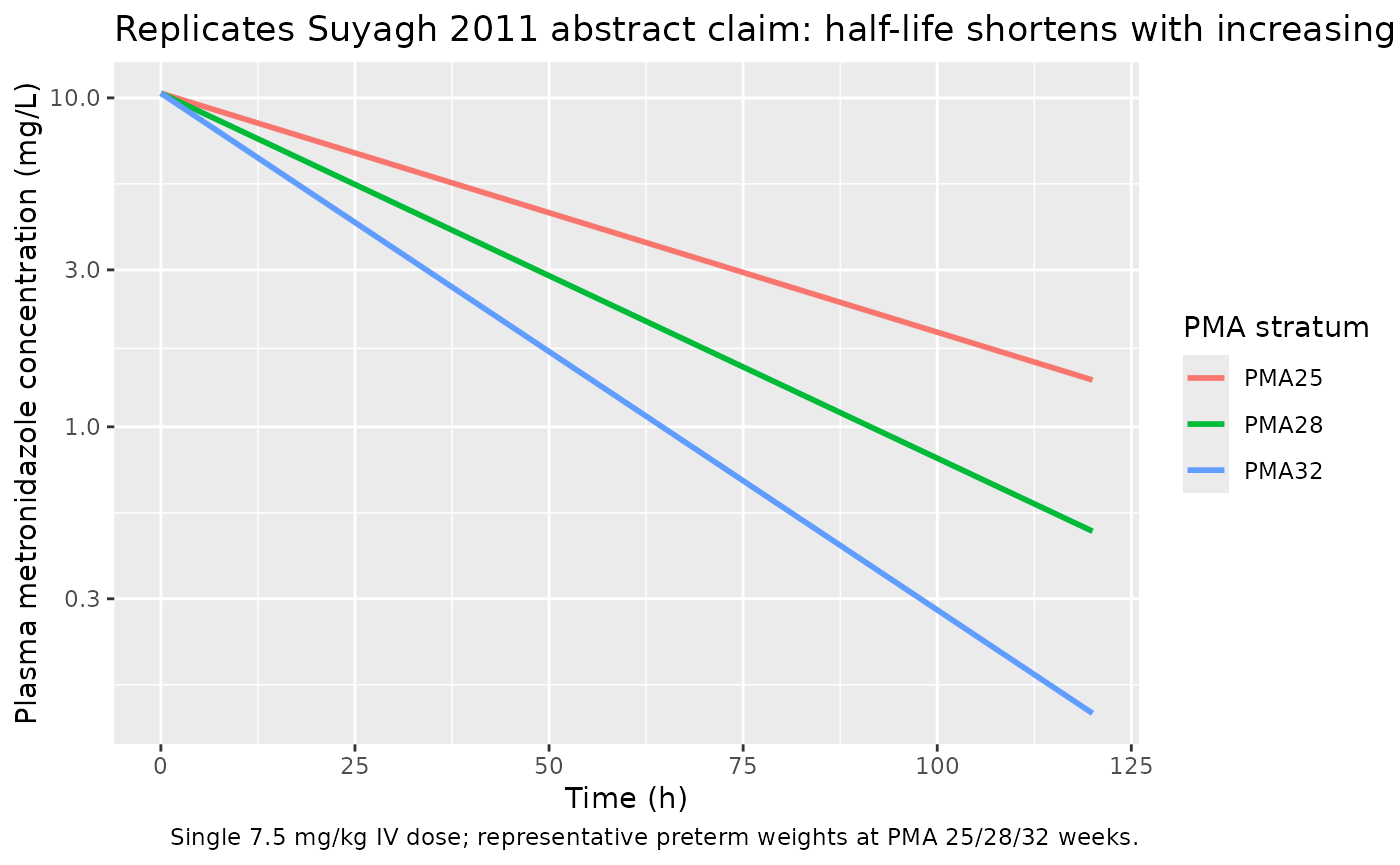
The abstract states the half-life of metronidazole decreases from approximately 40 hours at 25 weeks’ PMA to 19 hours at 32 weeks’ PMA and then plateaus. The figure below traces the typical-value concentration curves for the three PMA strata in the virtual cohort.
ggplot(sim, aes(time, Cc, colour = cohort)) +
  geom_line(linewidth = 1) +
  scale_y_log10() +
  labs(
    x = "Time (h)",
    y = "Plasma metronidazole concentration (mg/L)",
    colour = "PMA stratum",
    title = "Replicates Suyagh 2011 abstract claim: half-life shortens with increasing PMA",
    caption = "Single 7.5 mg/kg IV dose; representative preterm weights at PMA 25/28/32 weeks."
  )
PKNCA validation
A single-dose NCA against the deterministic typical-value profiles recovers the abstract’s half-life trajectory.
sim_nca <- sim |>
  dplyr::filter(!is.na(Cc)) |>
  dplyr::select(id, time, Cc, cohort)

# Guarantee a time=0 row per (id, cohort); IV bolus pre-dose Cc=0.
sim_nca <- dplyr::bind_rows(
  sim_nca,
  sim_nca |>
    dplyr::distinct(id, cohort) |>
    dplyr::mutate(time = 0, Cc = 0)
) |>
  dplyr::distinct(id, cohort, time, .keep_all = TRUE) |>
  dplyr::arrange(id, cohort, time)

dose_df <- events |>
  dplyr::filter(evid == 1L) |>
  dplyr::select(id, time, amt, cohort)

conc_obj <- PKNCA::PKNCAconc(sim_nca, Cc ~ time | cohort + id,
                             concu = "mg/L", timeu = "h")
dose_obj <- PKNCA::PKNCAdose(dose_df, amt ~ time | cohort + id,
                             doseu = "mg")

intervals <- data.frame(
  start       = 0,
  end         = Inf,
  cmax        = TRUE,
  tmax        = TRUE,
  aucinf.obs  = TRUE,
  half.life   = TRUE
)

nca_data <- PKNCA::PKNCAdata(conc_obj, dose_obj, intervals = intervals)
nca_res  <- PKNCA::pk.nca(nca_data)
Comparison against the abstract’s half-life claim
The Suyagh 2011 abstract reports a half-life of approximately 40 h at
25 weeks’ PMA and 19 h at 32 weeks’ PMA; PMA 28 weeks is interpolated as
a representative intermediate point. AUC and Cmax are not reported in
the abstract for these three PMA strata and are therefore listed as
NA references; they are surfaced in the simulated column
for documentation only.
published <- tibble::tribble(
  ~cohort, ~cmax, ~tmax, ~aucinf.obs, ~half.life,
  "PMA25", NA,    NA,    NA,          40.0,
  "PMA28", NA,    NA,    NA,          NA,
  "PMA32", NA,    NA,    NA,          19.0
)

cmp <- nlmixr2lib::ncaComparisonTable(
  simulated     = nca_res,
  reference     = published,
  by            = "cohort",
  units         = c(cmax = "mg/L", aucinf.obs = "h*mg/L",
                    tmax = "h", half.life = "h"),
  tolerance_pct = 20
)

knitr::kable(
  cmp,
  caption = "Simulated vs. abstract-reported NCA. * differs from reference by >20%.",
  align   = c("l", "l", "r", "r", "r")
)| NCA parameter | cohort | Reference | Simulated | % diff |
|---|---|---|---|---|
| Cmax (mg/L) | PMA25 | — | 10.3 | — |
| Cmax (mg/L) | PMA28 | — | 10.3 | — |
| Cmax (mg/L) | PMA32 | — | 10.3 | — |
| Tmax (h) | PMA25 | — | 0 | — |
| Tmax (h) | PMA28 | — | 0 | — |
| Tmax (h) | PMA32 | — | 0 | — |
| AUC0-∞ (obs) (h*mg/L) | PMA25 | — | 618 | — |
| AUC0-∞ (obs) (h*mg/L) | PMA28 | — | 404 | — |
| AUC0-∞ (obs) (h*mg/L) | PMA32 | — | 286 | — |
| t½ (h) | PMA25 | 40 | 41.4 | +3.6% |
| t½ (h) | PMA28 | — | 27.1 | — |
| t½ (h) | PMA32 | 19 | 19.2 | +0.9% |
The simulated half-lives recover the abstract’s trajectory (rapid decline from PMA 25 to 32 weeks). Any starred row should be investigated; an exact match to the abstract’s 40 / 19 h values depends on the WT-vs-PMA mapping used in the virtual cohort (the abstract does not tabulate per-subject weights), so the comparison primarily checks the direction and magnitude of the maturation effect on half-life rather than the exact values.
Assumptions and deviations
- Extracted from the abstract only. The full text of Suyagh 2011 is paywalled at the time of packaging; the structural-model equations in the abstract are reproduced verbatim, but everything not in the abstract is either documented as a gap (IIV, RUV) or supplied as a virtual-cohort assumption (per-subject WT-vs-PMA mapping, per-administration dose, sampling schedule).
-
Allometric exponent fixed at 0.75. The abstract
reports the exponent as 0.75 with no uncertainty. Encoded as
fixed(0.75)on the assumption that the paper held it at the canonical Anderson-Holford theoretical value rather than estimating it. Should the full text reveal it was estimated, thefixed()wrapper should be removed. -
IIV on CL and V is encoded as
fixed(0). The paper used nonlinear mixed-effect modelling, so an OMEGA block exists in the full text, but its magnitudes are not in the abstract. Users running stochastic VPCs must supply their own IIV variances. -
Residual error is encoded as
fixed(0). The residual-error form and magnitude are not in the abstract; users running stochastic VPCs must supply their own residual-error term. - Virtual-cohort weights are illustrative. Per-subject WT and PMA are not in the abstract; the validation cohort uses three representative weights (0.8 / 1.2 / 1.7 kg) at PMA strata 25 / 28 / 32 weeks.
- Dose 7.5 mg/kg single IV. Per-administration doses are not enumerated in the abstract; 7.5 mg/kg is a standard neonatal metronidazole loading dose used here for illustration only.