Meropenem + tobramycin against P. aeruginosa PAO1 and PAOdelta-mutS (Landersdorfer 2018)
Source:vignettes/articles/Landersdorfer_2018_meropenem_tobramycin.Rmd
Landersdorfer_2018_meropenem_tobramycin.RmdModel and source
- Article: https://doi.org/10.1128/AAC.02055-17
- Supplement (model equations Eqs 2-5, Table S3 parameter estimates): same DOI; SUPPLEMENTAL FILE 1, PDF.
pao1   <- rxode2::rxode(readModelDb("Landersdorfer_2018_meropenem_tobramycin_PAO1"))
paomut <- rxode2::rxode(readModelDb("Landersdorfer_2018_meropenem_tobramycin_PAOmutS"))
cat(pao1$reference, sep = "\n")
#> Landersdorfer CB, Rees VE, Yadav R, Rogers KE, Kim TH, Bergen PJ, Cheah SE, Boyce JD, Peleg AY, Oliver A, Shin BS, Nation RL, Bulitta JB. Optimization of a meropenem-tobramycin combination dosage regimen against hypermutable and nonhypermutable Pseudomonas aeruginosa via mechanism-based modeling and the hollow-fiber infection model. Antimicrob Agents Chemother. 2018 Mar 27;62(4):e02055-17. doi:10.1128/AAC.02055-17. Model differential equations (Eqs 2-5) and Table S3 population parameter estimates are in the supplemental material.
This paper develops a single mechanism-based PK/PD model (MBM) of
bacterial killing and resistance and co-fits it to static-concentration
time-kill (SCTK) data from two strains of Pseudomonas
aeruginosa: the wild-type reference strain PAO1 and its isogenic
hypermutable PAOdelta-mutS sibling (~1000-fold higher mutation rate due
to defective DNA-mismatch repair). The published model shares the bulk
of its parameters across strains and reports strain-specific estimates
for the bacterial killing rate constants (Kmax_MEM_*,
Kmax_TOB_*), one of the meropenem KC50s
(KC50_MEM_IR), and the two pre-existing less-susceptible
subpopulation fractions (Log10PRB_RI,
Log10PRB_IR). The MBM was subsequently used in in-silico
simulations to predict bacterial outcomes for hollow-fiber infection
model (HFIM) regimens under CF-patient meropenem and tobramycin
pharmacokinetics.
Because the strain-specific parameter sets give two distinct deterministic trajectories that a downstream user is likely to want to compare side by side, the model is packaged as two sibling files:
-
Landersdorfer_2018_meropenem_tobramycin_PAO1– parameter estimates for PAO1 (Table S3 column “a”). -
Landersdorfer_2018_meropenem_tobramycin_PAOmutS– parameter estimates for PAOdelta-mutS (Table S3 column “b”).
Both files implement the same model structure (Eqs 2-5 of the
supplement); they differ only in the eight strain-specific
ini() values.
This is not a population PK model. The antibiotic exposures (meropenem and tobramycin concentrations) are model inputs that the user doses; they decline with the simulated CF-patient half-lives (0.8 h meropenem, 2.5 h tobramycin) reported in Methods. There is no absorption-distribution-elimination profile of a drug to integrate for NCA, so PKNCA is not the right validation; the mechanistic checks below replace it.
Population (biological context)
Both strains share an identical pre-treatment MIC pair (1 mg/L
meropenem, 0.5 mg/L tobramycin). The SCTK that calibrated the MBM ran
for 96 h at static antibiotic concentrations of 2, 8, and 16 mg/L
meropenem and 1, 4, and 8 mg/L tobramycin, alone and in all 9
combinations, with a targeted initial inoculum of ~10^7.8 CFU/mL in 15
mL of cation-adjusted Mueller-Hinton broth at 36 deg C (the
supplement-fitted Log10CFU0 is 7.72). Bacterial suspensions
were centrifuged and resuspended in fresh antibiotic-containing medium
every 24 h to maintain static concentrations, with meropenem
additionally supplemented at 30% of the initial concentration at 6, 30,
54, and 78 h to compensate for thermal degradation.
PAO1 is the wild-type P. aeruginosa reference strain (Hancock laboratory). PAOdelta-mutS is its isogenic hypermutable derivative constructed by Mena et al. via mutS deletion – mutS encodes a component of the DNA mismatch-repair system, and its loss increases the mutation rate ~1000-fold without changing the baseline drug MICs. Hypermutable strains are prevalent in cystic fibrosis chronic lung infection and are linked to multidrug resistance and reduced lung function.
The same information is available programmatically via
readModelDb("Landersdorfer_2018_meropenem_tobramycin_PAO1")$population
and its _PAOmutS sibling.
Source trace
Per-parameter origins are recorded as in-file comments next to each
ini() entry in the two model files. The tables below
collect them in one place.
| Parameter | PAO1 value | PAOdelta-mutS value | Source location |
|---|---|---|---|
log10cfu0 |
7.72 | 7.72 | Table S3 (shared) |
log10cfumax |
9.57 | 9.57 | Table S3 (shared) |
lk21 |
log(50.0) FIXED | log(50.0) FIXED | Supplement prose (“k21 was assumed to be fast”); value 50/h is the same-group Rees 2018 precedent |
mgt_ss |
57.3 | 57.3 | Table S3 (shared) MGT_SS |
mgt_ri |
2341 | 2341 | Table S3 (shared) MGT_RI |
mgt_ir |
78.4 | 78.4 | Table S3 (shared) MGT_IR |
log10prb_ri |
-8.53 | -7.63 | Table S3 Log10PRB_RI |
log10prb_ir |
-3.08 | -2.99 | Table S3 Log10PRB_IR |
kmax_mem_ss |
3.77 | 2.81 | Table S3 Kmax_MEM_SS |
kmax_mem_ri |
0.652 | 0.458 | Table S3 Kmax_MEM_RI |
kmax_mem_ir |
3.92 | 1.69 | Table S3 Kmax_MEM_IR |
kc50_ss_mem |
2.07 | 2.07 | Table S3 (shared) KC50_MEM_SS |
kc50_ri_mem |
81.2 | 81.2 | Table S3 (shared) KC50_MEM_RI |
kc50_ir_mem |
61.5 | 40.0 | Table S3 KC50_MEM_IR |
hill_mem |
0.563 | 0.563 | Table S3 (shared) HillMEM |
kmax_tob_ss |
7.03 | 5.73 | Table S3 Kmax_TOB_SS |
kmax_tob_ri |
0.624 | 0.182 | Table S3 Kmax_TOB_RI |
kmax_tob_ir |
0.156 | 0.156 | Table S3 (shared) Kmax_TOB_IR |
kc50_ss_tob |
1.62 | 1.62 | Table S3 (shared) KC50_TOB_SS |
kc50_ri_tob |
31.0 | 31.0 | Table S3 (shared) KC50_TOB_RI |
kc50_ir_tob |
92.8 | 92.8 | Table S3 (shared) KC50_TOB_IR |
hill_tob |
3.03 | 3.03 | Table S3 (shared) HillTOB |
imax_om |
1.0 FIXED | 1.0 FIXED | Table S3 footnote e (fixed) |
ic50_om |
0.587 | 0.587 | Table S3 (shared) IC50_OM |
addSd |
0.41 | 0.41 | Table S3 (shared) SDCFU |
thalf_mem |
0.8 FIXED | 0.8 FIXED | Main-text Methods: simulated CF-patient meropenem half-life |
thalf_tob |
2.5 FIXED | 2.5 FIXED | Main-text Methods: simulated CF-patient tobramycin half-life |
| Life-cycle growth ODEs (2 states/subpop) | n/a | n/a | Supplement Eqs 2, 4 |
| Killing term (Hill MEM with synergy + Hill TOB) | n/a | n/a | Supplement Eq 2 |
Replication factor REP = 2 - CFUall/CFUmax
|
n/a | n/a | Supplement Eq 3 |
Mechanistic synergy
OM_effect = 1 - Imax_OM * Ctob / (Ctob + IC50_OM)
|
n/a | n/a | Supplement Eq 5 (HillOM taken as 1 – see Assumptions) |
Units (dimensional analysis)
| Symbol | Meaning | Units |
|---|---|---|
bact_*1, bact_*2 (six bacterial
states) |
bacterial counts | CFU/mL |
cmem, ctob
|
antibiotic concentrations | mg/L |
k21, k12*, kel_*,
kill_*, kmax_*
|
rate constants | 1/h |
kc50_*, ic50_om
|
half-effect concentrations | mg/L |
hill_mem, hill_tob,
rep_factor, om_effect,
imax_om
|
dimensionless | – |
cfumax, cfu0
|
population scale | CFU/mL |
Every growth/kill ODE term has units (1/h) x (CFU/mL) = (CFU/mL)/h
matching d/dt(state); the drug ODEs have (1/h) x (mg/L) =
(mg/L)/h. k12 = 60/MGT carries the 60 in (min/h),
converting the mean generation time (min) to a rate (1/h).
Parameter tables (paper vs. file)
data.frame(
  parameter      = names(pao1$theta),
  PAO1_file      = unname(pao1$theta),
  PAOmutS_file   = unname(paomut$theta)
) |>
  knitr::kable(digits = 6,
caption = "Typical-value parameter values as loaded from each model file (Landersdorfer 2018 Table S3).")| parameter | PAO1_file | PAOmutS_file |
|---|---|---|
| log10cfu0 | 7.720000 | 7.720000 |
| log10cfumax | 9.570000 | 9.570000 |
| lk21 | 3.912023 | 3.912023 |
| mgt_ss | 57.300000 | 57.300000 |
| mgt_ri | 2341.000000 | 2341.000000 |
| mgt_ir | 78.400000 | 78.400000 |
| log10prb_ri | -8.530000 | -7.630000 |
| log10prb_ir | -3.080000 | -2.990000 |
| kmax_mem_ss | 3.770000 | 2.810000 |
| kmax_mem_ri | 0.652000 | 0.458000 |
| kmax_mem_ir | 3.920000 | 1.690000 |
| kc50_ss_mem | 2.070000 | 2.070000 |
| kc50_ri_mem | 81.200000 | 81.200000 |
| kc50_ir_mem | 61.500000 | 40.000000 |
| hill_mem | 0.563000 | 0.563000 |
| kmax_tob_ss | 7.030000 | 5.730000 |
| kmax_tob_ri | 0.624000 | 0.182000 |
| kmax_tob_ir | 0.156000 | 0.156000 |
| kc50_ss_tob | 1.620000 | 1.620000 |
| kc50_ri_tob | 31.000000 | 31.000000 |
| kc50_ir_tob | 92.800000 | 92.800000 |
| hill_tob | 3.030000 | 3.030000 |
| imax_om | 1.000000 | 1.000000 |
| ic50_om | 0.587000 | 0.587000 |
| addSd | 0.410000 | 0.410000 |
| thalf_mem | 0.800000 | 0.800000 |
| thalf_tob | 2.500000 | 2.500000 |
Solver note
The meropenem Hill exponent (hill_mem = 0.563) is <
1. The analytical Jacobian of the meropenem killing term has a
c^(hill_mem - 1) = c^(-0.437) factor that is singular at
cmem = 0. The default rxode2 stiff solver
(lsoda, BDF with numerical Jacobian) propagates that
singularity and produces NaN trajectories once any subpopulation’s
state-2 cell count is non-trivial. The explicit Dormand-Prince RK8
solver (method = "dop853") does not need the Jacobian and
integrates the published equations cleanly – all simulations below use
it. The bare rxSolve() defaults will fail; this is a
property of the published Hill < 1 form, not a model-file bug.
Carrying-capacity (growth control) check
With no antibiotic, the population grows from the inoculum (10^7.72)
toward a stationary plateau. A structural property of the published
two-state life-cycle growth model with
REP = 2 - CFUall/CFUmax (supplement Eq 3) is that the
stationary plateau settles at CFUmax, not at a fraction
of CFUmax: at steady state REP = 1, which requires
CFUall = CFUmax. The simulated growth controls below
approach log10(CFUmax) = 9.57 for both strains, matching
the predicted plateau. (The observed HFIM growth control in the paper
reaches ~10.5 log10 CFU/mL, but that is a different experimental system;
the MBM was calibrated against SCTK plateau data, not the HFIM growth
control.)
ev_gc <- as.data.frame(et(seq(0, 96, by = 1)))

gc <- bind_rows(
  rxode2::rxSolve(pao1,   ev_gc, returnType = "data.frame",
                  maxsteps = 1e6, method = "dop853") |>
    transmute(time, log10CFU = log_cfu, strain = "PAO1"),
  rxode2::rxSolve(paomut, ev_gc, returnType = "data.frame",
                  maxsteps = 1e6, method = "dop853") |>
    transmute(time, log10CFU = log_cfu, strain = "PAOdelta-mutS")
)

cat(sprintf("PAO1   log10CFU(0)=%.3f  log10CFU(96)=%.3f  (expected approach CFUmax=9.57)\n",
            gc$log10CFU[gc$strain=="PAO1"   & gc$time==0],
            gc$log10CFU[gc$strain=="PAO1"   & gc$time==96]))
#> PAO1   log10CFU(0)=7.720  log10CFU(96)=9.570  (expected approach CFUmax=9.57)
cat(sprintf("PAOmS  log10CFU(0)=%.3f  log10CFU(96)=%.3f  (expected approach CFUmax=9.57)\n",
            gc$log10CFU[gc$strain=="PAOdelta-mutS" & gc$time==0],
            gc$log10CFU[gc$strain=="PAOdelta-mutS" & gc$time==96]))
#> PAOmS  log10CFU(0)=7.720  log10CFU(96)=9.570  (expected approach CFUmax=9.57)

ggplot(gc, aes(time, log10CFU, colour = strain)) +
  geom_line(linewidth = 1) +
  geom_hline(yintercept = 9.57, linetype = 2, colour = "grey50") +
  labs(x = "Time (h)", y = expression(log[10]~CFU/mL),
       title = "Antibiotic-free growth control",
       caption = "Dashed line: predicted stationary plateau Log10CFUmax = 9.57.")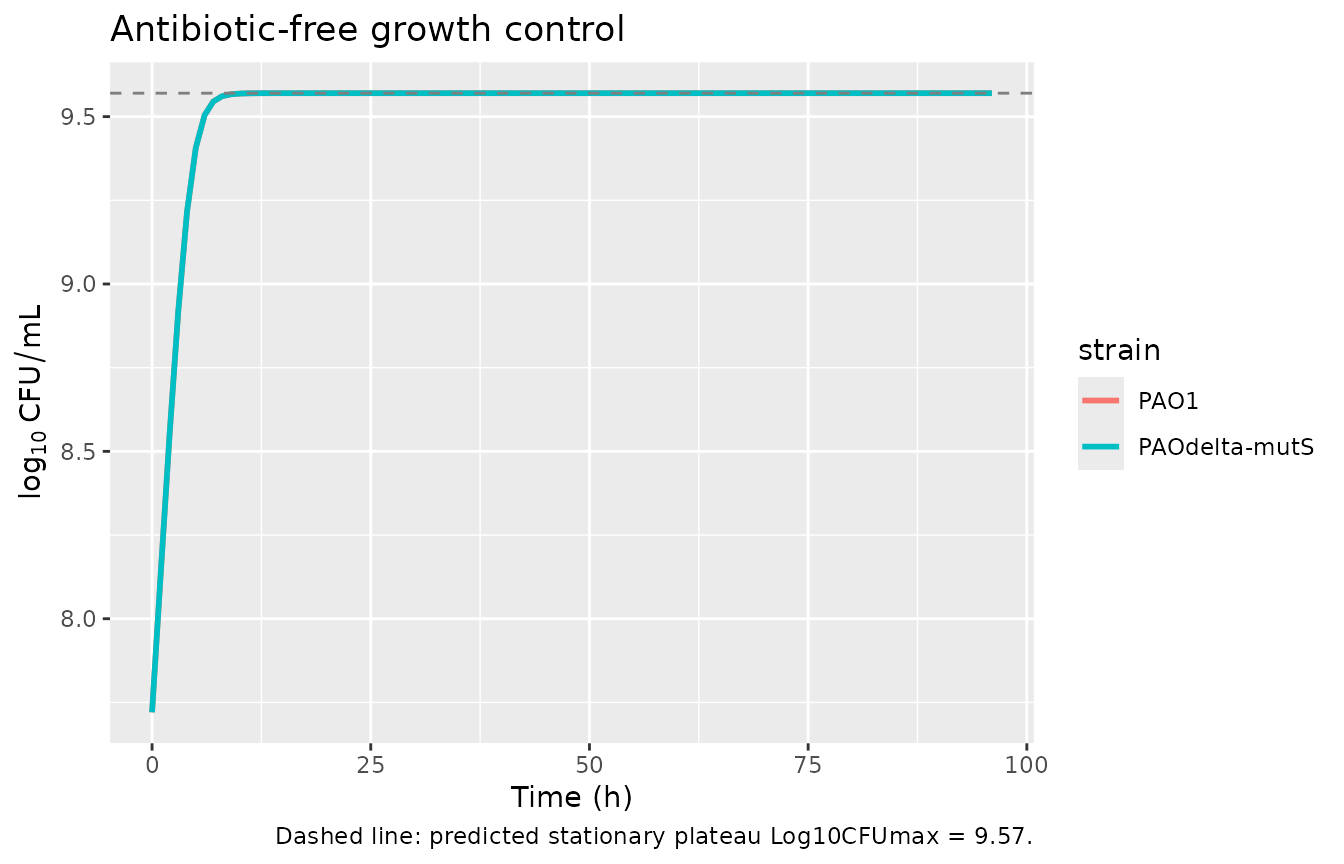
Mechanistic synergy check (outer-membrane effect)
Tobramycin lowers the effective meropenem KC50 through the synergy
factor om_effect = 1 - Imax_OM * Ctob / (Ctob + IC50_OM)
(supplement Eq 5; Imax_OM fixed at 1, IC50_OM = 0.587 mg/L). The
meropenem killing term uses (om_effect * KC50_MEM)^HillMEM
in its denominator, so the effective KC50_MEM is
om_effect * KC50_MEM, and the fold-decrease in KC50_MEM is
1 / om_effect. At the regimens used in the HFIM, target
tobramycin Cmax was about 25-26 mg/L; even modest persistent tobramycin
concentrations strongly reduce the effective meropenem KC50.
imax_om <- 1; ic50_om <- 0.587
om_effect <- function(ctob) 1 - imax_om * ctob / (ctob + ic50_om)

data.frame(
  Ctob_mgL = c(0, ic50_om, 1, 3, 10, 25),
  om_effect = om_effect(c(0, ic50_om, 1, 3, 10, 25)),
  KC50_MEM_fold_decrease = 1 / om_effect(c(0, ic50_om, 1, 3, 10, 25))
) |>
  knitr::kable(digits = 3,
caption = "Mechanistic synergy: fold-decrease in effective meropenem KC50 (1/om_effect) as a function of tobramycin concentration.")| Ctob_mgL | om_effect | KC50_MEM_fold_decrease |
|---|---|---|
| 0.000 | 1.000 | 1.000 |
| 0.587 | 0.500 | 2.000 |
| 1.000 | 0.370 | 2.704 |
| 3.000 | 0.164 | 6.111 |
| 10.000 | 0.055 | 18.036 |
| 25.000 | 0.023 | 43.589 |
Replicate static-concentration time-kill (SCTK) – Figure 1 subset
Figure 1 of Landersdorfer 2018 shows total bacterial counts over 96 h
for each strain under all SCTK regimens. The SCTK held the antibiotic
concentrations static via 24-hourly medium replacement plus meropenem
re-supplementation at 6, 30, 54, and 78 h. We approximate that
experimental design by giving instantaneous “refresh” bolus doses into
cmem and ctob on the published schedule, sized
so each refresh restores the target nominal concentration. The simulated
profile is the model’s prediction, not the observed data (the observed
total viable counts are in the paper’s Figure 1).
# SCTK schedule: refresh to nominal concentration at 0, 24, 48, 72 h; partial MEM
# refresh (+ 30% of nominal) at 6, 30, 54, 78 h. We treat the refreshes as
# instantaneous boluses on a unit-volume concentration state (amt = target,
# replace = 1 via reset on dose). Since rxode2 boluses are additive, we instead
# pre-decay-cancel by dosing the SHORTFALL needed to restore the target.

# Helper: simulate one regimen across one strain with SCTK-style refreshes.
sim_sctk <- function(mod, mem_nom, tob_nom, obs_times = c(0,1,3,6,24,29,48,72,96)) {
  kel_mem <- log(2) / 0.8
  kel_tob <- log(2) / 2.5
  # Pre-compute residual concentrations just before each refresh and dose the
  # shortfall as a bolus into the cmem / ctob state (which behaves as a
  # concentration because the corresponding ODE has no V scaling).
  refresh_full_t <- c(0, 24, 48, 72)
  refresh_mem_30 <- c(6, 30, 54, 78)

  ev <- as.data.frame(et(time = sort(unique(c(obs_times,
                                              refresh_full_t,
                                              refresh_mem_30)))))
  doses <- list()
  # Walk through each refresh in increasing time, computing the residual via
  # exponential decay from the previous refresh.
  schedule_mem <- data.frame(
    t = c(refresh_full_t, refresh_mem_30),
    add = c(rep(mem_nom, length(refresh_full_t)), rep(0.3 * mem_nom, length(refresh_mem_30)))
  )
  schedule_mem <- schedule_mem[order(schedule_mem$t), ]
  # Cumulative residual + shortfall logic: at each refresh time, restore (or top
  # up by 30%) the nominal concentration. We dose the SHORTFALL = (target - residual).
  residual_mem <- 0
  last_t <- 0
  for (i in seq_len(nrow(schedule_mem))) {
    t <- schedule_mem$t[i]; add <- schedule_mem$add[i]
    residual_mem <- residual_mem * exp(-kel_mem * (t - last_t))
    if (add == mem_nom) {
      # Full refresh: restore to nominal
      shortfall <- max(mem_nom - residual_mem, 0)
      residual_mem <- mem_nom
    } else {
      # +30% top-up
      shortfall <- add
      residual_mem <- residual_mem + add
    }
    if (shortfall > 0) {
      doses[[length(doses) + 1L]] <- as.data.frame(
        et(amt = shortfall, cmt = "cmem", time = t))
    }
    last_t <- t
  }
  residual_tob <- 0
  last_t <- 0
  for (t in refresh_full_t) {
    residual_tob <- residual_tob * exp(-kel_tob * (t - last_t))
    shortfall <- max(tob_nom - residual_tob, 0)
    if (shortfall > 0) {
      doses[[length(doses) + 1L]] <- as.data.frame(
        et(amt = shortfall, cmt = "ctob", time = t))
    }
    residual_tob <- tob_nom
    last_t <- t
  }
  events <- bind_rows(ev, do.call(bind_rows, doses))
  rxode2::rxSolve(mod, events, returnType = "data.frame",
                  maxsteps = 1e6, method = "dop853") |>
    filter(time %in% obs_times) |>
    select(time, log_cfu, cmem, ctob)
}

regimens <- list(
  "Growth control"    = c(mem = 0,  tob = 0),
  "MEM 2 mg/L"        = c(mem = 2,  tob = 0),
  "MEM 8 mg/L"        = c(mem = 8,  tob = 0),
  "MEM 16 mg/L"       = c(mem = 16, tob = 0),
  "TOB 1 mg/L"        = c(mem = 0,  tob = 1),
  "TOB 4 mg/L"        = c(mem = 0,  tob = 4),
  "MEM 2 + TOB 1"     = c(mem = 2,  tob = 1),
  "MEM 8 + TOB 4"     = c(mem = 8,  tob = 4),
  "MEM 16 + TOB 8"    = c(mem = 16, tob = 8)
)

sctk_all <- bind_rows(lapply(names(regimens), function(rg) {
  pars <- regimens[[rg]]
  bind_rows(
    sim_sctk(pao1,   pars["mem"], pars["tob"]) |>
      mutate(strain = "PAO1", regimen = rg),
    sim_sctk(paomut, pars["mem"], pars["tob"]) |>
      mutate(strain = "PAOdelta-mutS", regimen = rg)
  )
}))
sctk_all$regimen <- factor(sctk_all$regimen, levels = names(regimens))

ggplot(sctk_all, aes(time, log_cfu, colour = strain)) +
  geom_line(linewidth = 0.7) +
  geom_hline(yintercept = log10(100), linetype = 3, colour = "grey60") +
  facet_wrap(~ regimen, ncol = 3) +
  scale_x_continuous(breaks = seq(0, 96, by = 24)) +
  labs(x = "Time (h)", y = expression(log[10]~CFU/mL), colour = NULL,
       title = "Replicates the SCTK arms in Figure 1 of Landersdorfer 2018",
       caption = "Dotted line: limit of counting (10^2 CFU/mL). Refreshes at 0, 24, 48, 72 h plus MEM +30% at 6, 30, 54, 78 h.") +
  theme(legend.position = "bottom")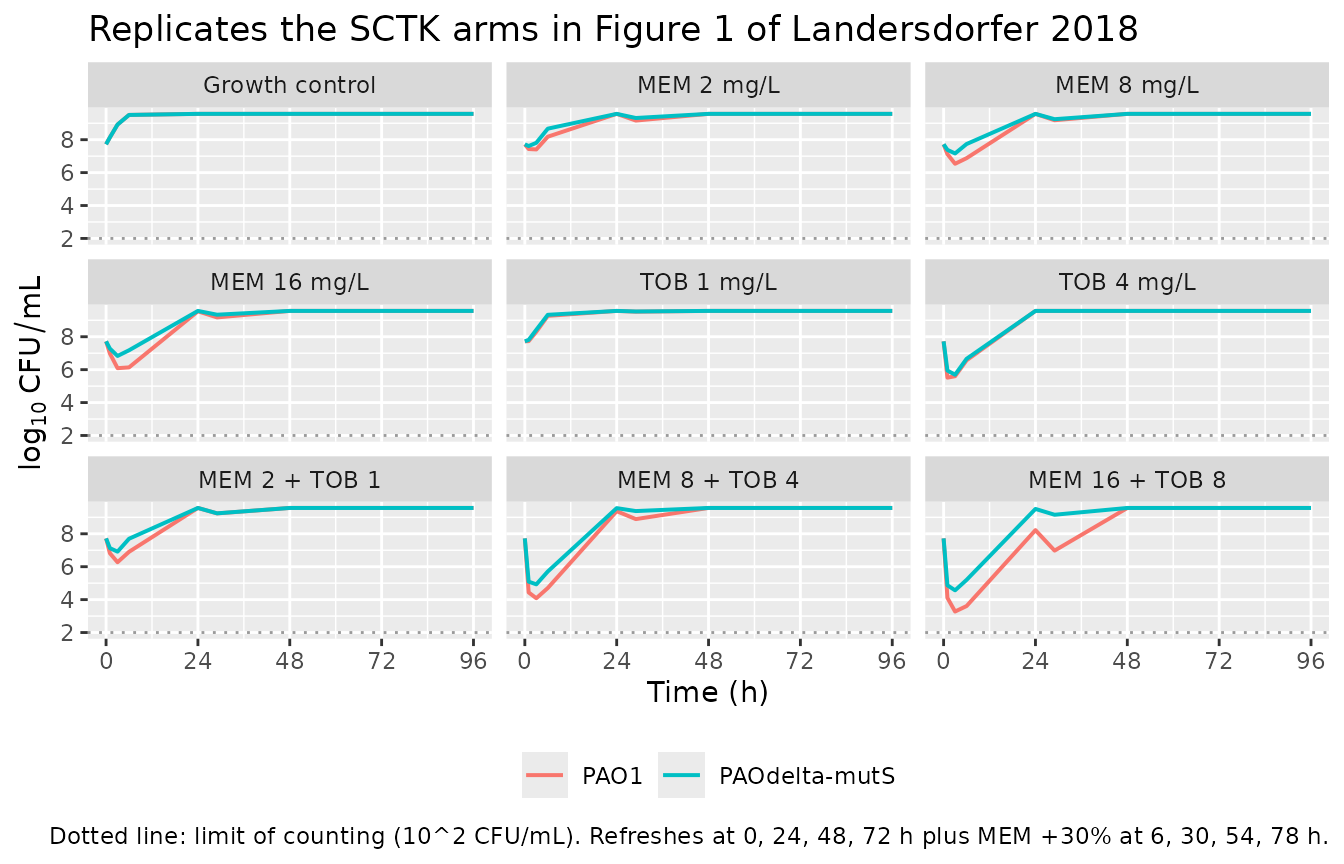
Replicate hollow-fiber infection model (HFIM) – Figure 4 subset
The HFIM in Landersdorfer 2018 simulated CF-patient pharmacokinetics for meropenem and tobramycin (CL_MEM = 15.9 L/h, t1/2 = 0.8 h; CL_TOB = 4.9 L/h, t1/2 = 2.5 h). Regimens were (i) meropenem 1 g q8h as a 0.5-h infusion, (ii) meropenem 3 g/day as a continuous infusion (CI) started at the steady-state concentration of ~8 mg/L, (iii) tobramycin 10 mg/kg q24h as a 1-h infusion, and the two MEM regimens combined with TOB. Figure 4 of the paper shows the observed bacterial-count time courses across 240 h. We reproduce the qualitative behaviour using rate-shaped infusions chosen to match the published Cmax / Cmin envelope.
The HFIM uses a humidified incubator at 36 deg C and the meropenem concentration in the central reservoir was reproduced experimentally to the target profile. Our simulated meropenem and tobramycin Cmax targets were calibrated to reach the in-text reference values: meropenem peaks of ~60 mg/L (1 g q8h 0.5-h infusion) and steady-state ~8 mg/L (3 g/day CI), and tobramycin peak ~25 mg/L (10 mg/kg q24h 1-h infusion).
# Infusion rate (mg/L per h) that, given first-order elimination at rate kel,
# delivers target Cmax over a tau-h interval with a T-h infusion (steady state).
rate_for <- function(Cmax, kel, tau, Tinf) {
  Cmax * kel * (1 - exp(-kel * tau)) / (1 - exp(-kel * Tinf))
}

kel_mem <- log(2) / 0.8
kel_tob <- log(2) / 2.5
TARGET_MEM_INT_CMAX  <- 60   # mg/L peak for 1 g q8h 0.5-h infusion
TARGET_MEM_CI_SS     <- 8    # mg/L steady-state for 3 g/day CI
TARGET_TOB_CMAX      <- 25   # mg/L peak for 10 mg/kg q24h 1-h infusion
HFIM_DUR <- 240              # h

mem_intermittent <- function(id) {
  R <- rate_for(TARGET_MEM_INT_CMAX, kel_mem, tau = 8, Tinf = 0.5)
  as.data.frame(et(id = id, amt = R * 0.5, rate = R, ii = 8,
                   cmt = "cmem", until = HFIM_DUR))
}
mem_continuous <- function(id) {
  # 3 g/day CI starting at SS ~ 8 mg/L: a single bolus = TARGET (concentration
  # state) at t = 0 to reach the SS instantly, then a sustained infusion at
  # rate = kel * Css for the duration.
  bind_rows(
    as.data.frame(et(id = id, amt = TARGET_MEM_CI_SS, cmt = "cmem", time = 0)),
    as.data.frame(et(id = id, amt = kel_mem * TARGET_MEM_CI_SS * HFIM_DUR,
                     rate = kel_mem * TARGET_MEM_CI_SS,
                     cmt = "cmem", time = 0))
  )
}
tob_intermittent <- function(id) {
  R <- rate_for(TARGET_TOB_CMAX, kel_tob, tau = 24, Tinf = 1)
  as.data.frame(et(id = id, amt = R * 1, rate = R, ii = 24,
                   cmt = "ctob", until = HFIM_DUR))
}

obs <- function(id) as.data.frame(et(id = id, time = seq(0, HFIM_DUR, by = 1)))

regimens_hfim <- list(
  "Growth control"                  = function(id) as.data.frame(et(id = id, amt = 0, cmt = "cmem", time = 0)),
  "MEM 1 g q8h"                     = function(id) mem_intermittent(id),
  "MEM 3 g/day CI"                  = function(id) mem_continuous(id),
  "TOB 10 mg/kg q24h"               = function(id) tob_intermittent(id),
  "MEM 1 g q8h + TOB 10 mg/kg q24h" = function(id) bind_rows(mem_intermittent(id), tob_intermittent(id)),
  "MEM 3 g/day CI + TOB 10 mg/kg q24h" = function(id) bind_rows(mem_continuous(id), tob_intermittent(id))
)

sim_hfim_strain <- function(mod, strain_label) {
  events <- bind_rows(lapply(seq_along(regimens_hfim), function(i) {
    bind_rows(regimens_hfim[[i]](i), obs(i)) |>
      mutate(regimen = names(regimens_hfim)[i])
  }))
  rxode2::rxSolve(mod, events, keep = "regimen",
                  returnType = "data.frame", maxsteps = 1e6, method = "dop853") |>
    mutate(strain = strain_label)
}

hfim_sim <- bind_rows(
  sim_hfim_strain(pao1,   "PAO1"),
  sim_hfim_strain(paomut, "PAOdelta-mutS")
)
#> Warning: multi-subject simulation without without 'omega'
#> Warning: multi-subject simulation without without 'omega'
hfim_sim$regimen <- factor(hfim_sim$regimen, levels = names(regimens_hfim))
loc <- 1.0  # limit of counting on antibiotic-free agar (10^1 CFU/mL)
hfim_long <- hfim_sim |>
  mutate(
    `Total`          = pmax(log10(pmax(CFUall, 1e-3)), loc),
    `MEM-resistant`  = pmax(log10(pmax(CFUri,  1e-3)), loc),
    `TOB-resistant`  = pmax(log10(pmax(CFUir,  1e-3)), loc)
  ) |>
  select(time, strain, regimen, Total, `MEM-resistant`, `TOB-resistant`) |>
  pivot_longer(c(Total, `MEM-resistant`, `TOB-resistant`),
               names_to = "population", values_to = "log10CFU")

ggplot(hfim_long, aes(time, log10CFU, colour = population)) +
  geom_line(linewidth = 0.6) +
  facet_grid(strain ~ regimen) +
  scale_x_continuous(breaks = seq(0, HFIM_DUR, by = 96)) +
  labs(x = "Time (h)", y = expression(log[10]~CFU/mL), colour = NULL,
       title = "Replicates Figure 4 of Landersdorfer 2018 (HFIM, 10 days)",
       caption = paste("Counts floored at the limit of counting (10^1 CFU/mL).",
                       "The optimized MEM 3 g/day CI + TOB combination is predicted to suppress",
                       "regrowth in both strains.")) +
  theme(legend.position = "bottom",
        strip.text.x = element_text(size = 8),
        strip.text.y = element_text(size = 9))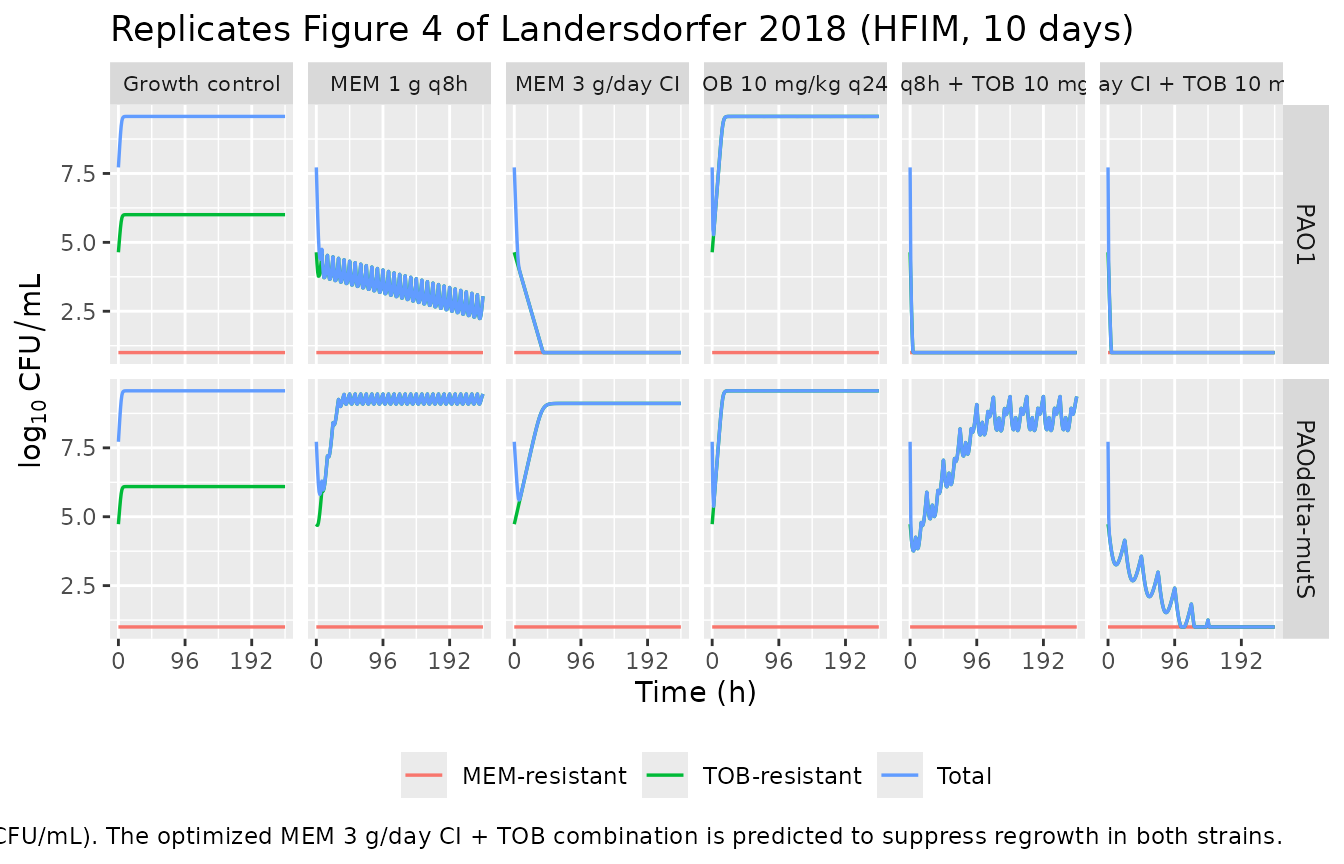
hfim_sim |>
  group_by(strain, regimen) |>
  summarise(
    nadir_total_log10  = round(min(log10(pmax(CFUall, 1e-3))), 2),
    end_total_log10    = round(log10(pmax(tail(CFUall, 1), 1e-3)), 2),
    end_MEMres_log10   = round(log10(pmax(tail(CFUri,  1e-3), 1)), 2),
    end_TOBres_log10   = round(log10(pmax(tail(CFUir,  1e-3), 1)), 2),
    .groups = "drop"
  ) |>
  arrange(strain, regimen) |>
knitr::kable(caption = "Simulated nadir and day-10 (240 h) populations by strain and regimen. The MEM 3 g/day CI + TOB combination is predicted to drive total bacteria toward / below the limit of counting in both strains; the standard MEM 1 g q8h + TOB regimen leaves the hypermutable strain with a regrown TOB-resistant subpopulation, matching the paper's qualitative HFIM findings (Figure 4, Table 1).")| strain | regimen | nadir_total_log10 | end_total_log10 | end_MEMres_log10 | end_TOBres_log10 |
|---|---|---|---|---|---|
| PAO1 | Growth control | 7.72 | 9.57 | 0.00 | 6.00 |
| PAO1 | MEM 1 g q8h | 2.24 | 3.05 | 0.00 | 3.05 |
| PAO1 | MEM 3 g/day CI | -3.00 | -3.00 | 0.00 | 0.00 |
| PAO1 | TOB 10 mg/kg q24h | 5.28 | 9.57 | 0.00 | 9.57 |
| PAO1 | MEM 1 g q8h + TOB 10 mg/kg q24h | -3.00 | -3.00 | 0.00 | 0.00 |
| PAO1 | MEM 3 g/day CI + TOB 10 mg/kg q24h | -3.00 | -3.00 | 0.00 | 0.00 |
| PAOdelta-mutS | Growth control | 7.72 | 9.57 | 0.14 | 6.09 |
| PAOdelta-mutS | MEM 1 g q8h | 5.81 | 9.45 | 0.00 | 9.45 |
| PAOdelta-mutS | MEM 3 g/day CI | 5.60 | 9.11 | 0.00 | 9.11 |
| PAOdelta-mutS | TOB 10 mg/kg q24h | 5.38 | 9.57 | 0.00 | 9.57 |
| PAOdelta-mutS | MEM 1 g q8h + TOB 10 mg/kg q24h | 3.76 | 9.36 | 0.00 | 9.36 |
| PAOdelta-mutS | MEM 3 g/day CI + TOB 10 mg/kg q24h | -1.95 | -1.06 | 0.00 | 0.00 |
Assumptions and deviations
-
Model class / species. This is an in-vitro
mechanism-based PK/PD model, not a popPK model;
population$speciesrecords the two P. aeruginosa strains. No PKNCA validation is performed (there is no drug NCA to compute); the mechanistic checks above replace it, per the endogenous / mechanistic validation strategy. -
Two files, one vignette. Replicating the author’s
structure: the published MBM was co-fit to both strains with shared and
strain-specific parameters (Table S3). Splitting into two
.Rfiles keeps the strain- specific parameter sets self-contained and addressable by name; one vignette walks the paper as a unit. -
REP formula and plateau location. The supplement
prose for Eq 3 is explicit: REP approaches 2 at low CFU and approaches 1
at CFUall = CFUmax. We implement
rep_factor = 2 - CFUall/CFUmax, which gives the published asymptote (stationary plateau at CFUmax). The sibling Rees 2018 file in this package uses a different form (2 * (1 - CFUall/CFUmax), plateau at 0.5 * CFUmax); the difference is documented to be consistent with each paper’s supplement on its own terms. -
Synergy term Hill exponent. Supplement Eq 5 renders
the OM_effect form with a HillOM exponent on tobramycin:
1 - Imax * Ctob^HillOM / (Ctob^HillOM + IC50_OM^HillOM). Table S3 reports no estimate for HillOM, and the sibling Rees 2018 MBM (same group) uses the plain Emax form (HillOM = 1). We follow the Rees 2018 convention and use Emax (HillOM = 1). If a HillOM value is later obtained from the authors, swap theom_effectline inmodel()for the Hill form and add the parameter toini(). - k21 (replication rate constant) value. The supplement states “k21 was assumed to be fast” but does not report a numeric value. We fix k21 at 50/h, matching the Bulitta-group precedent (Rees 2018, AAC). The system is insensitive to the specific k21 value when k21 >> k12 (a few-fold change in k21 leaves trajectories essentially unchanged).
-
Pre-existing subpopulation labels. Table S3 labels
the two pre-existing less-susceptible subpopulations “intermediate
population” (with the symbol Log10PRB_RI) and “resistant population”
(Log10PRB_IR). The table footnotes decode the labels: the “intermediate”
subpopulation is MEM-resistant / TOB-intermediate (RI), and the
“resistant” subpopulation is MEM-intermediate / TOB-resistant (IR). The
compartment names
bact_resistant_intermediate*andbact_intermediate_resistant*follow the MEM-status / TOB-status order. - Initial state partitioning. All inoculum is placed in life-cycle state 1; the paper specifies the inoculum and the pre-existing subpopulation fractions but not the state-1 / state-2 split. State 2 equilibrates within ~1/k12 (under 1 h for SS, IR; about 40 h for the slow RI subpopulation, which the SCTK fits accommodate).
-
Simulated antibiotic disposition. Both half-lives
are fixed inputs taken from the clinical CF-patient PK literature cited
in Methods (refs 55, 56), not MBM estimates. They parameterise the
cmemandctobelimination so the model is self-contained. -
SCTK refresh approximation. SCTK held antibiotic
concentrations static via 24-hourly medium replacement (plus meropenem
+30% at 6, 30, 54, 78 h). We model that schedule with instantaneous
“shortfall” boluses into the
cmem/ctobconcentration states so the post-refresh concentration returns to nominal. Between refreshes the drugs decay at the published half-lives (an approximation – in the actual SCTK the medium was static between refreshes, but the published half-lives are short enough that the decay between refreshes is small for the 24-h interval). - HFIM regimen parameterisation. The HFIM rate-shaped infusions were derived analytically to hit published Cmax / Cmin envelopes (Methods and Table 1 footnote), not fitted to the bacterial data. The continuous infusion of meropenem is started at the steady-state concentration of ~8 mg/L (paper Methods).
-
Solver.
method = "dop853"andmaxsteps = 1e6are passed torxSolvebecause the published meropenem Hill exponent (0.563) creates a singular analytical Jacobian atcmem = 0, which causes the defaultlsodasolver to fail. Steady-state (ss=1) dosing must not be used: it would reinitialize the bacterial states to their grown steady state and destroy the inoculum. - Below limit of counting. Displayed counts are floored at 10^1 CFU/mL (the published limit of counting on antibiotic-free agar; 10^0.7 on antibiotic-containing agar); the underlying states are not floored.
-
Convention deviations
(
checkModelConventions()is clean – no warnings or errors). The mechanism-specific bacterial-state compartments (bact_susceptible_susceptible*,bact_resistant_intermediate*,bact_intermediate_resistant*) are declared viapaper_specific_compartment_pattern = "^bact_". The antibiotic bath-concentration statescmemandctobare registered canonicals ininst/references/compartment-names.mdfor combination-antibiotic time-kill PD models;ctobwas added in this extraction following the existingcmem/ccipfamily pattern.