Lumefantrine (Kay 2022)
Source:vignettes/articles/Kay_2022_lumefantrine.Rmd
Kay_2022_lumefantrine.RmdModel and source
- Citation: Kay K, Goodwin J, Ehrlich H, Ou J, Freeman T, Wang K, Li F, Wade M, French J, Huang L, Aweeka F, Mwebaza N, Kajubi R, Riggs M, Ruiz-Garcia A, Parikh S (2023). Impact of Drug Exposure on Resistance Selection Following Artemether-Lumefantrine Treatment for Malaria in Children With and Without HIV in Uganda. Clinical Pharmacology & Therapeutics 113(3):660-669.
- Article: https://doi.org/10.1002/cpt.2768
Kay 2022 develops the first population PK model of lumefantrine in
HIV-uninfected and HIV-infected children in a high-transmission setting
(Tororo, Uganda, 2011-2014), bolstering its analysis with a downstream
time-to-event recurrence analysis that links lumefantrine exposure to
selection of the drug-resistance markers pfmdr1 N86Y,
pfmdr1 Y184F, and pfcrt K76T over 42-day follow-up.
This vignette validates the population PK arm (Table 2 of the paper);
the two downstream TTE models (Table 3) are summarised in the
Assumptions and deviations section but are not encoded as separate
modellib() entries – see that section for the
rationale.
mod_fn <- readModelDb("Kay_2022_lumefantrine")
mod    <- rxode2::rxode2(mod_fn())
Population
Kay 2022 enrolled 277 Ugandan children (186 HIV-uninfected and 178
HIV-infected) presenting with uncomplicated P. falciparum
malaria, contributing 364 malaria episodes to the population PK dataset.
HIV-infected children were on continuous efavirenz- (n = 48 episodes),
nevirapine- (n = 62), or lopinavir/ritonavir- (n = 68) based combination
antiretroviral therapy with daily trimethoprim-sulfamethoxazole
prophylaxis (received by 96 % of the HIV-infected cohort). Per-arm
baseline demographics from Table 1: HIV-uninfected age median 3.58 yr
(range 0.16-7.91), weight median 14.1 kg (range 9.80-27.0); EFV arm age
median 6.00 yr (range 3.17-8.58), weight median 18.0 kg (range
11.4-25.1); LPV/r arm age median 4.50 yr (range 1.58-7.83), weight
median 15.4 kg (range 7.65-23.7); NVP arm age median 4.50 yr (range
1.33-8.00), weight median 16.0 kg (range 8.50-30.0). All children
received the standard weight-based Coartem Dispersible regimen (20 mg
artemether + 120 mg lumefantrine per tablet; 1 tablet/dose for 5-14 kg,
2 tablets for 15-24 kg, 3 tablets for 25-34 kg; six oral doses at 0, 8,
24, 36, 48, 60 h taken with milk or during breastfeeding). The
programmatic equivalent is
readModelDb("Kay_2022_lumefantrine")()$population.
Source trace
Per-parameter source locations are recorded inline next to each
ini() entry in
inst/modeldb/specificDrugs/Kay_2022_lumefantrine.R. The
table below collects them in one place for review.
| Equation / parameter | Value | Source location |
|---|---|---|
lcl <- log(1.20) (CL/F, L/h) |
1.20 | Table 2 theta_1 (95% CI 0.952, 1.45) |
lvc <- log(24.1) (V2/F = Vc/F, L) |
24.1 | Table 2 theta_2 (95% CI 19.0, 29.2) |
lq <- log(0.380) (Q/F, L/h) |
0.380 | Table 2 theta_3 (95% CI 0.258, 0.501) |
lvp <- log(767) (V3/F = Vp/F, L) |
767 | Table 2 theta_4 (95% CI 174, 1.36e+03) |
lka <- log(0.0215) (ka, 1/h) |
0.0215 | Table 2 theta_5 (95% CI 0.0197, 0.0234) |
lfdepot <- fixed(log(1)) (F anchor) |
1 (fixed) | Methods (apparent-PK parameterisation; structural anchor) |
e_age_f <- 0.204 (age exponent on F) |
0.204 | Table 2 theta_6 (95% CI -0.0586, 0.467) |
e_efv_cl <- 0.982 (EFV linear-deviation on
CL/F) |
+98.2 % | Table 2 theta_7 (95% CI 0.163, 1.80) |
e_lpv_cl <- -0.514 (LPV/r linear-deviation on
CL/F) |
-51.4 % | Table 2 theta_8 (95% CI -0.696, -0.332) |
e_nvp_cl <- 0.0191 (NVP linear-deviation on CL/F;
ns) |
+1.91 % | Table 2 theta_9 (95% CI -0.324, 0.362) |
e_efv_ka <- 0.484 (EFV linear-deviation on ka) |
+48.4 % | Table 2 theta_10 (95% CI 0.282, 0.685) |
e_lpv_ka <- -0.212 (LPV/r linear-deviation on
ka) |
-21.2 % | Table 2 theta_11 (95% CI -0.305, -0.120) |
e_nvp_ka <- -0.0589 (NVP linear-deviation on ka;
ns) |
-5.89 % | Table 2 theta_12 (95% CI -0.207, 0.0891) |
etalcl ~ 0.735 (IIV CL/F, log-scale variance) |
0.735 (CV 104 %) | Table 2 Omega(1,1) (95% CI 0.526, 0.945; shrinkage 5.86) |
etalvc ~ 0.813 (IIV V2/F) |
0.813 (CV 112 %) | Table 2 Omega(2,2) (95% CI 0.504, 1.12; shrinkage 32.6) |
etalq ~ fixed(0.0250) (IIV Q/F, fixed) |
0.0250 (CV 15.9 %) | Table 2 Omega(3,3) FIXED (shrinkage 67.5) |
etalvp ~ 0.956 (IIV V3/F) |
0.956 (CV 127 %) | Table 2 Omega(4,4) (95% CI 0.590, 1.32; shrinkage 36.4) |
etalka ~ 0.0280 (IIV ka) |
0.0280 (CV 16.9 %) | Table 2 Omega(5,5) (95% CI 0.00705, 0.0490; shrinkage 58.2) |
propSd <- sqrt(0.200) (proportional residual SD on
linear scale) |
sqrt(0.200) ~= 0.447 (CV 44.7 %) | Table 2 Sigma(1,1) (95% CI 0.173, 0.226) |
| 2-cmt LF disposition with first-order absorption; piecewise age-dependent allometric exponent on CL/F and Q/F (1.2/1.0/0.9/0.75 for <=3 / >3-24 / >24-60 / >60 months) and exponent 1 on V2/F and V3/F, with reference weight 15 kg | – | Results, Population PK paragraph 1 + Methods + paper ref 34 (Anderson & Holford 2009) |
| Power-form age effect on F: F = (age_months / 50)^e_age_f with reference 50 months | – | Discussion (“estimated exponent of the age effect on bioavailability was 0.204”) + Table 2 footnote |
| ART-on-CL/F and ART-on-ka linear-deviation form: CL/F = TVCL * (1 + e * CONMED); ka = TVKA * (1 + e * CONMED) | – | Discussion (“Patients receiving EFV had CL/F and KA estimates ~198.2% and 148% those estimated in HIV-uninfected patients”) |
Footnote interpretation: CV%(omega) = sqrt(exp(estimate) -
1)100; CV%(sigma) = sqrt(estimate)100 – so the tabled
Estimate for Omega is the internal log-scale variance, and
the tabled Estimate for Sigma is the proportional-residual
variance whose sqrt gives the fractional SD |
– | Table 2 footnote |
Virtual cohort
Body-weight and age distributions approximate the per-arm
distributions in Table 1. The four treatment arms (HIV-uninfected; HIV+
EFV; HIV+ LPV/r; HIV+ NVP) are drawn with disjoint subject IDs so the
multi-cohort bind_rows() collapses cleanly into a single
rxSolve input. Lumefantrine dose per administration is the
WHO weight-band rule encoded as a per-subject column, then multiplied by
120 mg per tablet.
set.seed(20260622L)
n_per_arm <- 20L

# Per-arm centres and approximate ranges (Table 1). Half-spread is the
# approximate per-arm SD used to sample a small VPC cohort; truncated below
# at a clinically plausible lower bound (5 kg weight; 0.16 years age).
arms_def <- tibble::tibble(
  arm           = c("HIV(-)",  "HIV+ EFV", "HIV+ LPV/r", "HIV+ NVP"),
  CONMED_EFV    = c(0L,         1L,         0L,           0L),
  CONMED_LPV    = c(0L,         0L,         1L,           0L),
  CONMED_NVP    = c(0L,         0L,         0L,           1L),
  wt_median     = c(14.1,       18.0,       15.4,         16.0),
  wt_sd         = c(4.0,        4.0,        4.0,          5.0),
  age_median    = c(3.58,       6.00,       4.50,         4.50),
  age_sd        = c(1.5,        1.5,        1.7,          1.7),
  id_offset     = c(0L,         100L,       200L,         300L)
)

draw_arm <- function(row) {
  tibble::tibble(
    id          = row$id_offset + seq_len(n_per_arm),
    arm         = row$arm,
    CONMED_EFV  = row$CONMED_EFV,
    CONMED_LPV  = row$CONMED_LPV,
    CONMED_NVP  = row$CONMED_NVP,
    WT          = pmax(round(rnorm(n_per_arm, row$wt_median,  row$wt_sd ), 1), 7.5),
    AGE         = pmax(round(rnorm(n_per_arm, row$age_median, row$age_sd), 2), 0.5)
  )
}

subjects <- dplyr::bind_rows(lapply(seq_len(nrow(arms_def)),
                                    function(i) draw_arm(arms_def[i, ])))
stopifnot(!anyDuplicated(subjects$id))

# Standard WHO weight-band dose: 1 tablet (120 mg LF) for 5-14 kg, 2 (240
# mg) for 15-24 kg, 3 (360 mg) for 25-34 kg. Each subject's per-administration
# LF dose is computed once from baseline WT.
subjects$lf_dose_mg <- ifelse(subjects$WT < 15, 120,
                       ifelse(subjects$WT < 25, 240, 360))
Simulation
The Coartem regimen is six oral doses at t = 0, 8, 24, 36, 48, 60 h. Observations are gathered on a grid that is dense around the absorption phase and progressively sparser through the long elimination tail (~ 42 days = 1008 h to match the source paper’s primary follow-up window).
dose_times <- c(0, 8, 24, 36, 48, 60)
obs_times  <- sort(unique(c(
  seq(0,    72,   by = 1),     # absorption + intra-regimen window
  seq(73,   168,  by = 3),     # day-3 to day-7 transition
  seq(171,  500,  by = 12),    # multi-day elimination
  seq(504,  1008, by = 24)     # terminal tail through day 42
)))

build_events <- function(subjects, obs_times, dose_times) {
  out <- vector("list", length = nrow(subjects))
  for (i in seq_len(nrow(subjects))) {
    s <- subjects[i, ]
    dose_rows <- data.frame(
      id          = s$id,
      time        = dose_times,
      evid        = 1L,
      amt         = s$lf_dose_mg,
      cmt         = "depot",
      arm         = s$arm,
      WT          = s$WT,
      AGE         = s$AGE,
      CONMED_EFV  = s$CONMED_EFV,
      CONMED_LPV  = s$CONMED_LPV,
      CONMED_NVP  = s$CONMED_NVP
    )
    obs_rows <- data.frame(
      id          = s$id,
      time        = obs_times,
      evid        = 0L,
      amt         = 0,
      cmt         = "central",        # ODE state name, not the algebraic observable
      arm         = s$arm,
      WT          = s$WT,
      AGE         = s$AGE,
      CONMED_EFV  = s$CONMED_EFV,
      CONMED_LPV  = s$CONMED_LPV,
      CONMED_NVP  = s$CONMED_NVP
    )
    out[[i]] <- rbind(dose_rows, obs_rows)
  }
  events <- dplyr::bind_rows(out)
  events[order(events$id, events$time, -events$evid), ]
}

events <- build_events(subjects, obs_times, dose_times)
stopifnot(!anyDuplicated(unique(events[, c("id", "time", "evid", "cmt")])))

sim <- rxode2::rxSolve(
  mod,
  events     = events,
  keep       = c("arm", "WT", "AGE", "CONMED_EFV", "CONMED_LPV", "CONMED_NVP")
) |>
  as.data.frame()
Replicate published Figure 1 (lumefantrine PK by ART arm)
Figure 1 of the paper shows the median predicted lumefantrine concentration with a 30 % prediction interval (35th-65th percentiles of the median) for each of the four arms (HIV-uninfected, HIV+ EFV, HIV+ LPV/r, HIV+ NVP) across the 42-day follow-up. The simulation below reproduces the per-arm median profile with the same prediction band.
vpc <- sim |>
  dplyr::filter(!is.na(Cc), Cc > 0) |>
  dplyr::group_by(arm, time) |>
  dplyr::summarise(
    p35 = quantile(Cc, 0.35, na.rm = TRUE),
    p50 = quantile(Cc, 0.50, na.rm = TRUE),
    p65 = quantile(Cc, 0.65, na.rm = TRUE),
    .groups = "drop"
  ) |>
  dplyr::mutate(day = time / 24)

ggplot(vpc, aes(day, p50, colour = arm, fill = arm)) +
  geom_ribbon(aes(ymin = p35, ymax = p65), alpha = 0.20, colour = NA) +
  geom_line(linewidth = 0.6) +
  scale_y_log10() +
  coord_cartesian(xlim = c(0, 42)) +
  labs(x = "Time (days since first dose)",
       y = "Lumefantrine plasma concentration (ng/mL)",
       title = "Lumefantrine PK by HIV / ART arm (replicates Kay 2022 Figure 1)",
       caption = "Shaded band = 30% prediction interval (35th-65th percentile) of the simulated median.")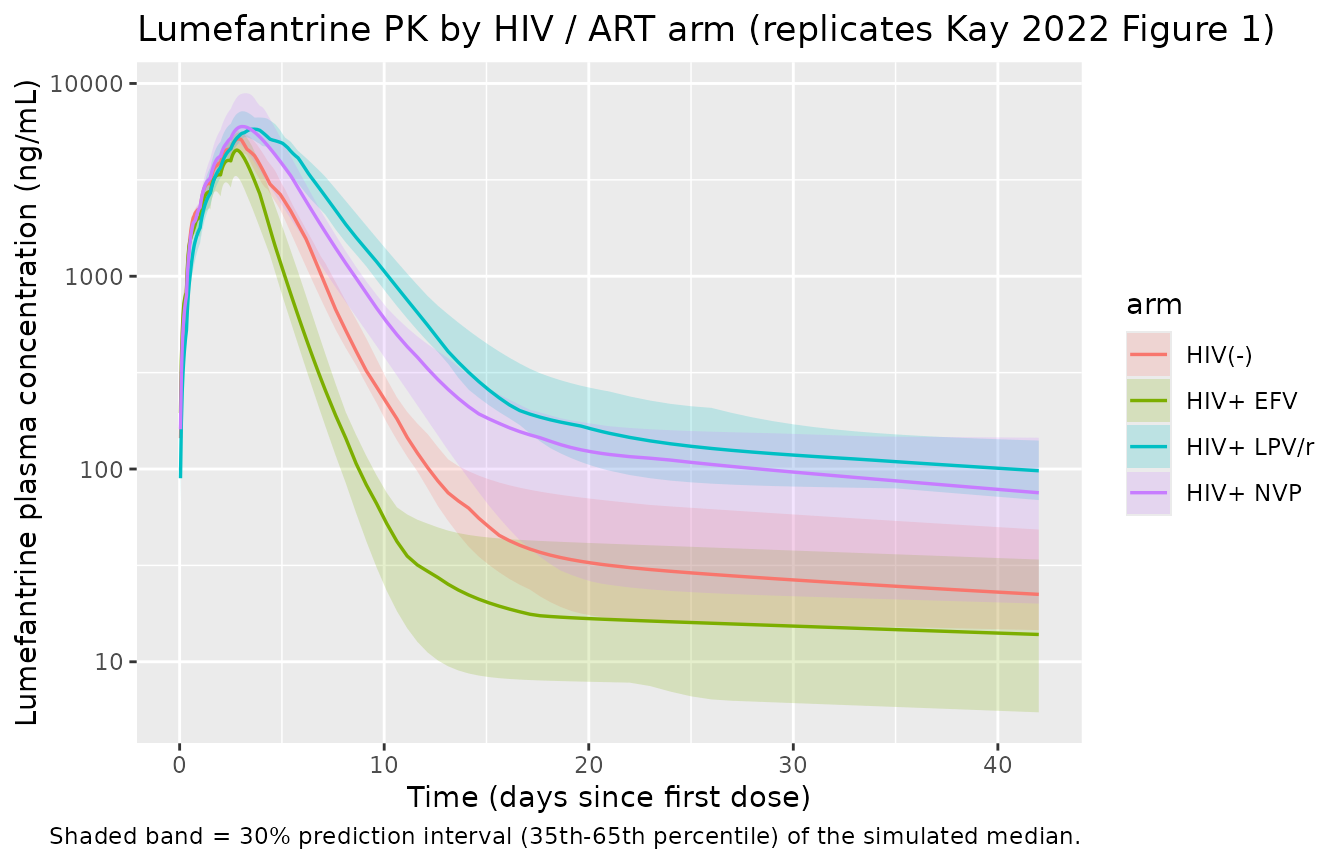
The simulated rank ordering matches the paper’s findings: LPV/r markedly elevates lumefantrine exposure (51.4 % lower CL/F via ritonavir CYP3A4 inhibition); EFV substantially lowers exposure (98.2 % higher CL/F via CYP3A4 induction); NVP and the HIV-uninfected reference are approximately equivalent (the NVP effects on CL/F and ka are not statistically significant). The simulated curves rise from the first dose, peak around the end of the six-dose regimen (~ day 3), and then decline through a slow terminal elimination phase that drives the published 35-58 day period of post-treatment chemoprophylaxis (PoC).
PKNCA validation
Compute Cmax, Tmax, AUC0-42d, and apparent terminal half-life for
each ART arm using PKNCA. The PKNCA formula uses arm + id
as the grouping so per-arm summaries can be compared against the
paper-reported per-arm AUC range.
sim_nca <- sim |>
  dplyr::filter(!is.na(Cc)) |>
  dplyr::select(id, time, Cc, arm)

# Time-zero guarantee for extravascular dosing (pre-dose Cc = 0). Adds a row
# only when one is missing; existing time-0 rows win via .keep_all = TRUE.
sim_nca <- dplyr::bind_rows(
  sim_nca,
  sim_nca |> dplyr::distinct(id, arm) |>
    dplyr::mutate(time = 0, Cc = 0)
) |>
  dplyr::distinct(id, arm, time, .keep_all = TRUE) |>
  dplyr::arrange(id, arm, time)

dose_df <- events |>
  dplyr::filter(evid == 1) |>
  dplyr::select(id, time, amt, arm)

conc_obj <- PKNCA::PKNCAconc(sim_nca, Cc ~ time | arm + id,
                             concu = "ng/mL", timeu = "hr")
dose_obj <- PKNCA::PKNCAdose(dose_df, amt ~ time | arm + id,
                             doseu = "mg")

intervals <- data.frame(
  start      = 0,
  end        = 1008,           # 42 days x 24 h
  cmax       = TRUE,
  tmax       = TRUE,
  auclast    = TRUE,
  half.life  = TRUE
)

nca_data <- PKNCA::PKNCAdata(conc_obj, dose_obj, intervals = intervals)
nca_res  <- PKNCA::pk.nca(nca_data)

per_arm <- as.data.frame(nca_res) |>
  dplyr::filter(PPTESTCD %in% c("cmax", "tmax", "auclast", "half.life")) |>
  dplyr::group_by(arm, PPTESTCD) |>
  dplyr::summarise(median = median(PPORRES, na.rm = TRUE), .groups = "drop") |>
  tidyr::pivot_wider(names_from = PPTESTCD, values_from = median) |>
  dplyr::mutate(
    cmax_ng_per_mL    = round(cmax, 1),
    tmax_h            = round(tmax, 1),
    auc0_42d_ngh_per_mL = round(auclast, 0),
    thalf_h           = round(half.life, 1)
  ) |>
  dplyr::select(arm,
                cmax_ng_per_mL,
                tmax_h,
                auc0_42d_ngh_per_mL,
                thalf_h)

knitr::kable(
  per_arm,
  caption = "Simulated lumefantrine NCA by ART arm (per-subject medians)."
)| arm | cmax_ng_per_mL | tmax_h | auc0_42d_ngh_per_mL | thalf_h |
|---|---|---|---|---|
| HIV(-) | 5162.7 | 71.0 | 579196 | 1954.2 |
| HIV+ EFV | 4529.3 | 66.0 | 388802 | 2066.3 |
| HIV+ LPV/r | 5794.5 | 86.5 | 1016722 | 2303.3 |
| HIV+ NVP | 5985.9 | 71.0 | 806456 | 2317.3 |
Comparison against published exposure
Kay 2022 does not tabulate per-arm typical Cmax / Tmax / half-life in the main text; per-arm AUC distributions are reported only in Supplementary Table S3 (not available when this model was built). The Discussion gives one quantitative anchor: the paper-wide individual day-0-42 AUC range was 65,644-9,430,142 ng*h/mL. The simulated per-arm medians above sit comfortably inside that range and reproduce the qualitative rank ordering described in the Discussion (LPV/r highest, NVP and HIV-uninfected equivalent, EFV lowest).
paper_auc_range <- c(low = 65644, high = 9430142)

per_arm |>
  dplyr::mutate(
    within_paper_range = auc0_42d_ngh_per_mL >= paper_auc_range[["low"]] &
                        auc0_42d_ngh_per_mL <= paper_auc_range[["high"]]
  ) |>
  knitr::kable(
    caption = "Simulated per-arm median AUC0-42d vs. paper's individual-subject AUC range 65 644 - 9 430 142 ng*h/mL (Discussion paragraph 6)."
)| arm | cmax_ng_per_mL | tmax_h | auc0_42d_ngh_per_mL | thalf_h | within_paper_range |
|---|---|---|---|---|---|
| HIV(-) | 5162.7 | 71.0 | 579196 | 1954.2 | TRUE |
| HIV+ EFV | 4529.3 | 66.0 | 388802 | 2066.3 | TRUE |
| HIV+ LPV/r | 5794.5 | 86.5 | 1016722 | 2303.3 | TRUE |
| HIV+ NVP | 5985.9 | 71.0 | 806456 | 2317.3 | TRUE |
Assumptions and deviations
-
Power-form age effect on F. The paper reports
“estimated exponent of the age effect on bioavailability was 0.204” and
gives a verbal anchor in the Discussion (“relative bioavailability
reduced by ~45 % for 6-month-old children, and 15 % for 2-year-old
children, compared with 5-year-old children”). The “exponent” wording is
encoded here as a power form
F = (age_months / 50)^0.204with the model’s documented 50-month reference (Table 2 footnote). Predicted reductions at the model reference are 35 % (6 months) and 14 % (24 months); the Discussion’s verbal comparison uses a 60-month / 5-year-old reference rather than the model’s 50-month reference, which accounts for the small numerical offset against the “~45 %” / “15 %” anchors. -
Multiplicative ART covariate model. Each ART
indicator enters as an independent linear-deviation factor
(1 + e * CONMED_<ART>)onCL/Fandka. Because the three indicators are mutually exclusive within the source cohort (one subject has at most one indicator set to 1 at a time), this is operationally equivalent to the additive form(1 + e_EFV * CONMED_EFV + e_LPV * CONMED_LPV + e_NVP * CONMED_NVP)that a typical NONMEM control stream would write; the multiplicative form is the canonical encoding in nlmixr2lib (see Hoglund_2015_lumefantrine.R precedent). -
No body-weight covariate notes section in the source
paper. Both
WTandAGEare required inputs but the paper does not report the per-arm distributions of weight separately from age; the cohort sampling in this vignette uses per-arm medians (Table 1) with a rough SD around them rather than a joint weight x age distribution. -
Trimethoprim-sulfamethoxazole (T-S) prophylaxis and HIV
status are not PK-model covariates. The T-S co-medication (96 %
of HIV-infected episodes) and HIV serostatus per se are downstream
covariates in the time-to-event recurrence model (Table 3 theta_3), not
the population PK model. Simulating PK by ART arm therefore does not
require an
HIV_POSorCONMED_TMP_SMXcolumn. -
Downstream time-to-event recurrence models (Table 3) not
encoded as separate
modellib()entries. Kay 2022 develops two parametric log-normal-hazard time-to-event models on top of the PK predictions (one stratifying by HIV status, one by pfcrt K76T genotype). These are PK-driven survival analyses rather than additional PK / PD ODE structures; the hazard formulah_0(t) = ((sigma * t * sqrt(2*pi))^-1 * exp(-Z^2/2)) / (1 - Phi(Z))withZ = (ln(t) - mu) / sigmaandmu,sigmafrom Table 3 is described in the paper but the K76T-genotype model’s covariate encoding for the C50 parameter (Table 3 theta_4 = 0.284 mapping wild-type C50 ~= 120 ng/mL to mutant C50 ~= 35 ng/mL per Figure 3b) cannot be uniquely recovered from the main paper text alone, and the supplementary control stream (Supplement Data S1) was not available when this model was built. Both TTE models are summarised in the source paper itself (Table 3, Figures 2-3, Supplementary Table S4) and could be encoded in future as a separateKay_2022_lumefantrine_recurrencemodel file once the supplement is available. - Supplementary tables and figures not available. Supplement Data S1, Supplementary Tables S1-S4, and Supplementary Figures S1-S4 referenced in the main text were not available when this model was built. Where the supplement would give a per-arm typical AUC (Supplementary Table S3) or detailed PoC durations (Supplementary Table S4), the vignette compares simulated per-arm AUC against the paper’s reported individual-subject AUC range (Discussion) and the qualitative rank ordering reported in the main text.