Nab-paclitaxel (Chen 2014)
Source:vignettes/articles/Chen_2014_nab_paclitaxel.Rmd
Chen_2014_nab_paclitaxel.RmdModel and source
- Citation: Chen N, Li Y, Ye Y, Palmisano M, Chopra R, Zhou S. (2014). Pharmacokinetics and Pharmacodynamics of nab-Paclitaxel in Patients With Solid Tumors: Disposition Kinetics and Pharmacology Distinct From Solvent-Based Paclitaxel. The Journal of Clinical Pharmacology 54(10):1097-1107. doi:10.1002/jcph.304. PD structure follows Friberg LE et al. (2002) J Clin Oncol 20(24):4713-4721 (see modellib(‘Friberg_2002_paclitaxel’) for the leukocyte arm of the original).
- Description: Three-compartment population PK with saturable (Michaelis-Menten) distribution between the central and first peripheral compartments and saturable elimination from the central compartment, coupled with a Friberg-style 5-compartment semi-mechanistic PD model for paclitaxel-induced neutropenia, fit to 150 adult patients with advanced solid tumors who received nab-paclitaxel (Abraxane) 80-375 mg/m^2 as a 30-minute IV infusion (Chen 2014). The first peripheral compartment exchanges with central via the saturable Vmtr / Kmtr process; the second peripheral compartment exchanges via linear intercompartmental clearance Q2. Baseline albumin lowers the maximal elimination rate VMEL via a power-form covariate; advanced age (>= 65 years) potentiates the linear Slope of paclitaxel-driven inhibition of the proliferating neutrophil precursor pool, and baseline albumin also modifies the baseline ANC via a power-form covariate. PK observation is plasma paclitaxel concentration (ug/L = ng/mL); PD observation is absolute neutrophil count (10^9 cells/L).
- Article: Chen 2014, J Clin Pharmacol 54(10):1097-1107
This is a coupled three-compartment IV PK + Friberg myelosuppression PD model for nab-paclitaxel (nanoparticle albumin-bound paclitaxel; Abraxane) and the corresponding absolute neutrophil count (ANC) time course in adult patients with advanced solid tumors. The PK layer is distinguished by two saturable processes: Michaelis-Menten distribution between central and the first peripheral compartment (Vmtr = 325000 ug/h, Kmtr = 4260 ug/L) and Michaelis-Menten elimination from central (Vmel = 8070 ug/h, Kmel = 40.2 ug/L). The second peripheral compartment exchanges with central via the conventional linear intercompartmental clearance Q2 = 41.6 L/h. The maximum saturable distribution rate is ~40-fold larger than the maximum elimination rate, consistent with paclitaxel’s rapid disappearance from the systemic circulation being driven by tissue distribution rather than elimination (Chen 2014 Discussion). The PD layer is the canonical Friberg 2002 structure: one proliferating pool, three transit / maturation compartments, and circulating ANC, with linear drug-effect Slope on Cc and feedback (BASE/Circ)^gamma. Baseline albumin acts on both VMEL and baseline ANC via power-form covariates; advanced age (>= 65 years) increases the linear drug-effect Slope by 50%.
Population
The PK model was developed on 150 patients with advanced or
metastatic solid tumors pooled across five Phase I studies (including
one Phase I study in patients with hepatic impairment), one Phase II
study, and two Phase III studies (Chen 2014 Table 1 and Supplemental
Table S1). Median age 57 years (range 24-85), 60% female. Race
distribution 91% White, 9% Asian, < 1% Black. Tumor types: 16% breast
cancer, 29% melanoma, 55% other solid tumors. Median body weight 74 kg
(range 40-143), median BSA 1.9 m^2 (range 1.3-2.4). Hepatic and renal
function spanned the normal-to-moderately-impaired range: 13.3% of
patients had total bilirubin above the upper limit of normal (17
umol/L), 8% had moderate-to-severe hepatic impairment (total bilirubin
> 1.5 to 5 x ULN), and 15.3% had moderate renal impairment (CrCl 30
to < 60 mL/min). Median baseline albumin was 3.9 g/dL (range 2.1-4.7)
in the PK population and 4.0 g/dL in the PD subset. nab-Paclitaxel was
administered as monotherapy at doses ranging 80-375 mg/m^2 as a
30-minute IV infusion on day 1, 8, 15 of each 28-day cycle or on day 1
of each 21-day cycle (q3w); a single 135 mg/m^2 q3w cohort received a
3-hour infusion. 1418 paclitaxel concentration records contributed to
the PK fit. The PD subset comprised 558 ANC records collected from 125
patients during the first treatment cycle (patients suspected of
growth-factor use were excluded). The same metadata is available
programmatically via
readModelDb("Chen_2014_nab_paclitaxel")$population.
Source trace
Per-parameter origin is recorded as in-file comments alongside each
ini() entry in
inst/modeldb/specificDrugs/Chen_2014_nab_paclitaxel.R. The
table below collects the full source trace in one place.
| Equation / parameter | Value | Source location |
|---|---|---|
lvc |
log(15.8) | Table 2: V1 = 15.8 L (95% CI 13.71-17.85; RSE 6.20%) |
lvp |
log(1650) | Table 2: V2 = 1650 L (95% CI 1396-1935; RSE 7.9%) |
lvp2 |
log(75.4) | Table 2: V3 = 75.4 L (95% CI 59.8-99.1; RSE 11.7%) |
lq2 |
log(41.6) | Table 2: Q2 = 41.6 L/h (95% CI 35.1-50.0; RSE 8.5%) |
lvmtr |
log(325000) | Table 2: VMTR = 325000 ug/h (95% CI 190694-540445; RSE 25.8%) |
lkmtr |
log(4260) | Table 2: KMTR = 4260 ug/L (95% CI 2210-7910; RSE 33.1%) |
lvmax |
log(8070) | Table 2: VMEL = 8070 ug/h (95% CI 6500-9836; RSE 10.1%) |
lkmel |
log(40.2) | Table 2: KMEL = 40.2 ug/L (95% CI 24.9-58.9; RSE 20.0%) |
e_alb_vmax |
0.554 | Table 2: Albumin on VMEL = 0.554 (95% CI 0.15-0.94; RSE 37.5%) |
etalvc |
0.1958 | Table 2: V1 IIV = 46.7% CV; log(1 + 0.467^2) |
etalvp |
0.0628 | Table 2: V2 IIV = 25.5% CV; log(1 + 0.255^2) |
etalvmtr |
0.0688 | Table 2: VMTR IIV = 26.7% CV; log(1 + 0.267^2) |
etalvmax |
0.0486 | Table 2: VMEL IIV = 22.3% CV; log(1 + 0.223^2) |
expSd |
0.265 | Table 2: variance-weighted collapse of subpop1 (38.0%, fraction 0.341) and subpop2 (17.9%, fraction 0.659) – see Assumptions and deviations |
lmtt |
log(117) | Table 2: MTT = 117 h (95% CI 109-125; RSE 3.4%) |
lslope |
log(0.00253) | Table 2: Slope = 0.00253 ng/mL^-1 (95% CI 0.00216-0.00290; RSE 7.47%) |
lbase |
log(4.28) | Table 2: Baseline ANC = 4.28 x 10^9/L (95% CI 3.94-4.62; RSE 4.09%) |
lgamma |
log(0.187) | Table 2: Feedback parameter = 0.187 (95% CI 0.171-0.203; RSE 4.44%) |
e_age_slope |
0.501 | Table 2: Age on drug slope = 0.501 (95% CI 0.172-0.830; RSE 33.5%) |
e_alb_base |
-0.998 | Table 2: Albumin on baseline ANC = -0.998 (95% CI -1.5 to -0.494; RSE 25.8%) |
etalmtt |
0.0353 | Table 2: MTT IIV = 19.0% CV; log(1 + 0.190^2) |
etalslope |
0.1697 | Table 2: Slope IIV = 42.9% CV; log(1 + 0.429^2) |
etalbase |
0.1162 | Table 2: Baseline ANC IIV = 35.1% CV; log(1 + 0.351^2) |
expSd_ANC |
0.291 | Table 2: PD residual variability = 29.1% CV |
| Three-compartment PK ODE with MM distribution + MM elimination | n/a | Methods: ‘Population PK Model Development and Covariate Analysis’; Figure 1 |
| Saturable distribution flux VMTR * Cc/(KMTR + Cc) central -> peripheral1 (with symmetric reverse) | n/a | Methods: ‘Saturable distribution was incorporated analogous to the saturable elimination’ |
| Saturable elimination flux VMEL * Cc/(KMEL + Cc) from central | n/a | Methods: ‘Saturable elimination was incorporated using the Michaelis-Menten equation’ |
| Albumin power-form effect on VMEL: (ALB / 3.9)^0.554 | n/a | Methods: ‘Continuous covariates were centered to their median values and included as power models’; Results: covariate equation block |
| Friberg PD ODE chain | n/a | Methods: ‘Population PD Model Development’; Figure 1; PD structure as proposed by Friberg et al. 17 |
| Linear drug effect Edrug = Slope * Cc | n/a | Methods: ‘a linear proportionality constant relating paclitaxel concentration in the central compartment to its effect on bone marrow stem or progenitor cells’ |
| Constraints kprol = ktr = kcirc = 4/MTT (n = 3 transits) | n/a | Methods: ‘MTT = (n + 1)/k where n was the number of maturation compartments (n = 3)’ |
| Age dichotomisation at 65 years for Slope covariate | n/a | Results, Population PD Model -> Covariate analysis: ‘Effect of age on Slope was modeled both as a continuous variable and as a dichotomized variable (< 65 years vs >= 65 years). The later approach had a greater statistical significance (dOFV = -12.8 vs dOFV = -9.9)’ |
| Albumin power-form effect on baseline ANC: (ALB / 4.0)^(-0.998) | n/a | Results, Population PD Model -> Covariate analysis: ‘Inclusion of albumin as a covariate of baseline ANC improved the goodness-of-fit of the model (P < 0.001)’ |
Virtual cohort
Original observed data are not publicly available. The figures below use a virtual population whose covariate distributions approximate the Chen 2014 cohort (Table 1).
set.seed(20260520)

n_sub <- 200L

cohort <- tibble(
  id = seq_len(n_sub),
  # Albumin (g/L): Table 1 median 3.9 g/dL (39 g/L), range 2.1-4.7 g/dL
  # (21-47 g/L). Use a truncated normal sampler tuned to the cohort.
  ALB = pmin(pmax(rnorm(n_sub, mean = 39, sd = 4.5), 21), 47),
  # Age (years): Table 1 median 57 years, range 24-85.
  AGE = pmin(pmax(round(rnorm(n_sub, mean = 57, sd = 12)), 24), 85),
  # BSA (m^2): Table 1 median 1.9 m^2, range 1.3-2.4. Used to convert
  # mg/m^2 dose to ug for the PK simulation; not a model covariate.
  BSA = pmin(pmax(rnorm(n_sub, mean = 1.9, sd = 0.25), 1.3), 2.4)
)

knitr::kable(
  tibble(
    Covariate = c("ALB (g/L)", "AGE (years)", "BSA (m^2)"),
    Median    = c(round(median(cohort$ALB), 2), round(median(cohort$AGE), 0), round(median(cohort$BSA), 2)),
    Min       = c(round(min(cohort$ALB), 2),    round(min(cohort$AGE), 0),    round(min(cohort$BSA), 2)),
    Max       = c(round(max(cohort$ALB), 2),    round(max(cohort$AGE), 0),    round(max(cohort$BSA), 2))
  ),
  caption = "Virtual-cohort covariate distributions (n = 200)."
)| Covariate | Median | Min | Max |
|---|---|---|---|
| ALB (g/L) | 38.85 | 26.55 | 47.0 |
| AGE (years) | 59.00 | 25.00 | 85.0 |
| BSA (m^2) | 1.89 | 1.30 | 2.4 |
Simulation
Chen 2014 highlights two clinically relevant dosing regimens
(Discussion): 100 mg/m^2 weekly (q1w; days 1, 8, 15 of a 28-day cycle)
and 300 mg/m^2 every three weeks (q3w; day 1 of a 21-day cycle). Both
are given as a 30-minute IV infusion. The simulation below builds
matched virtual cohorts at the two regimens so the
duration-above-720-ng/mL threshold analysis (Figure 3C of the paper) and
the schedule-dependent ANC nadirs can be reproduced. Dose in mg/m^2 is
converted to ug per subject as
dose_ug = dose_mg_per_m2 * BSA * 1000.
t_pk  <- c(seq(0, 0.5, by = 0.05), seq(0.6, 4, by = 0.2),
           seq(5, 48, by = 2),     seq(50, 672, by = 6))
t_anc <- c(seq(0, 672, by = 8))

build_subject_events <- function(subj_id, ALB_val, AGE_val, BSA_val,
                                 regimen) {
  if (regimen == "q1w_100") {
    dose_times <- c(0, 168, 336)            # days 1, 8, 15 of the 28-day cycle (hours)
    dose_ug    <- 100 * BSA_val * 1000
  } else if (regimen == "q3w_300") {
    dose_times <- 0                         # single dose per 21-day cycle
    dose_ug    <- 300 * BSA_val * 1000
  } else {
    stop("unknown regimen: ", regimen)
  }
  dosing <- tibble(
    id   = subj_id,
    time = dose_times,
    evid = 1L,
    cmt  = "central",
    amt  = dose_ug,
    dur  = 0.5,
    rate = NA_real_
  )
  pk_obs <- tibble(
    id   = subj_id,
    time = t_pk,
    evid = 0L,
    cmt  = "Cc",
    amt  = NA_real_,
    dur  = NA_real_,
    rate = NA_real_
  )
  anc_obs <- tibble(
    id   = subj_id,
    time = t_anc,
    evid = 0L,
    cmt  = "ANC",
    amt  = NA_real_,
    dur  = NA_real_,
    rate = NA_real_
  )
  bind_rows(dosing, pk_obs, anc_obs) |>
    mutate(ALB = ALB_val, AGE = AGE_val, regimen = regimen)
}

events_q1w <- bind_rows(lapply(
  seq_len(n_sub),
  function(i) build_subject_events(cohort$id[i], cohort$ALB[i],
                                   cohort$AGE[i], cohort$BSA[i],
                                   "q1w_100")
))

# Use a disjoint id offset so the two regimens do not collide if combined.
events_q3w <- bind_rows(lapply(
  seq_len(n_sub),
  function(i) build_subject_events(cohort$id[i] + n_sub, cohort$ALB[i],
                                   cohort$AGE[i], cohort$BSA[i],
                                   "q3w_300")
))

events <- bind_rows(events_q1w, events_q3w) |>
  arrange(id, time, desc(evid))

stopifnot(!anyDuplicated(unique(events[, c("id", "time", "evid", "cmt")])))
mod <- readModelDb("Chen_2014_nab_paclitaxel")

# Typical-value (no IIV / no residual error) for the per-regimen
# comparison figures, plus a VPC-style cohort solve.
sim_typical <- rxode2::rxSolve(rxode2::zeroRe(mod), events = events,
                               keep = c("ALB", "AGE", "regimen")) |>
  as.data.frame()
#> ℹ omega/sigma items treated as zero: 'etalvc', 'etalvp', 'etalvmtr', 'etalvmax', 'etalmtt', 'etalslope', 'etalrbase'
#> Warning: multi-subject simulation without without 'omega'
sim_typical$regimen <- as.character(sim_typical$regimen)

sim_pk_typ  <- sim_typical[!is.na(sim_typical$Cc),  c("id", "time", "Cc",  "regimen")]
sim_anc_typ <- sim_typical[!is.na(sim_typical$ANC), c("id", "time", "ANC", "regimen")]
Replicate published figures
Figure 3C: paclitaxel concentration-time profile relative to the 720 ng/mL neutropenia threshold
Chen 2014 Figure 3C plots simulated nab-paclitaxel plasma concentrations at 100 mg/m^2 (q1w) and 300 mg/m^2 (q3w) and highlights the duration above the 720 ng/mL threshold that the paper’s threshold analysis (Figure 3A, B) identified as the best predictor of a >= 50% reduction in ANC. The simulated duration above 720 ng/mL per cycle was ~31% shorter for q1w 100 mg/m^2 than for q3w 300 mg/m^2 (Chen 2014 Discussion).
sim_pk_typ |>
  filter(time <= 72) |>
  group_by(time, regimen) |>
  summarise(Cc_med = median(Cc), .groups = "drop") |>
  ggplot(aes(time, Cc_med, colour = regimen)) +
  geom_line(linewidth = 0.9) +
  geom_hline(yintercept = 720, linetype = "dashed", colour = "grey40") +
  scale_y_log10() +
  scale_x_continuous(breaks = seq(0, 72, by = 12)) +
  labs(x = "Time post-first-dose (h)",
       y = "Median plasma paclitaxel (ng/mL, log scale)",
       colour = "Regimen",
       title = "Figure 3C (replicated): paclitaxel concentration vs the 720 ng/mL threshold",
       caption = "Median typical-value profile across n = 200 virtual subjects per regimen. Dashed line: 720 ng/mL neutropenia threshold from Chen 2014.")
#> Warning in scale_y_log10(): log-10 transformation introduced infinite values.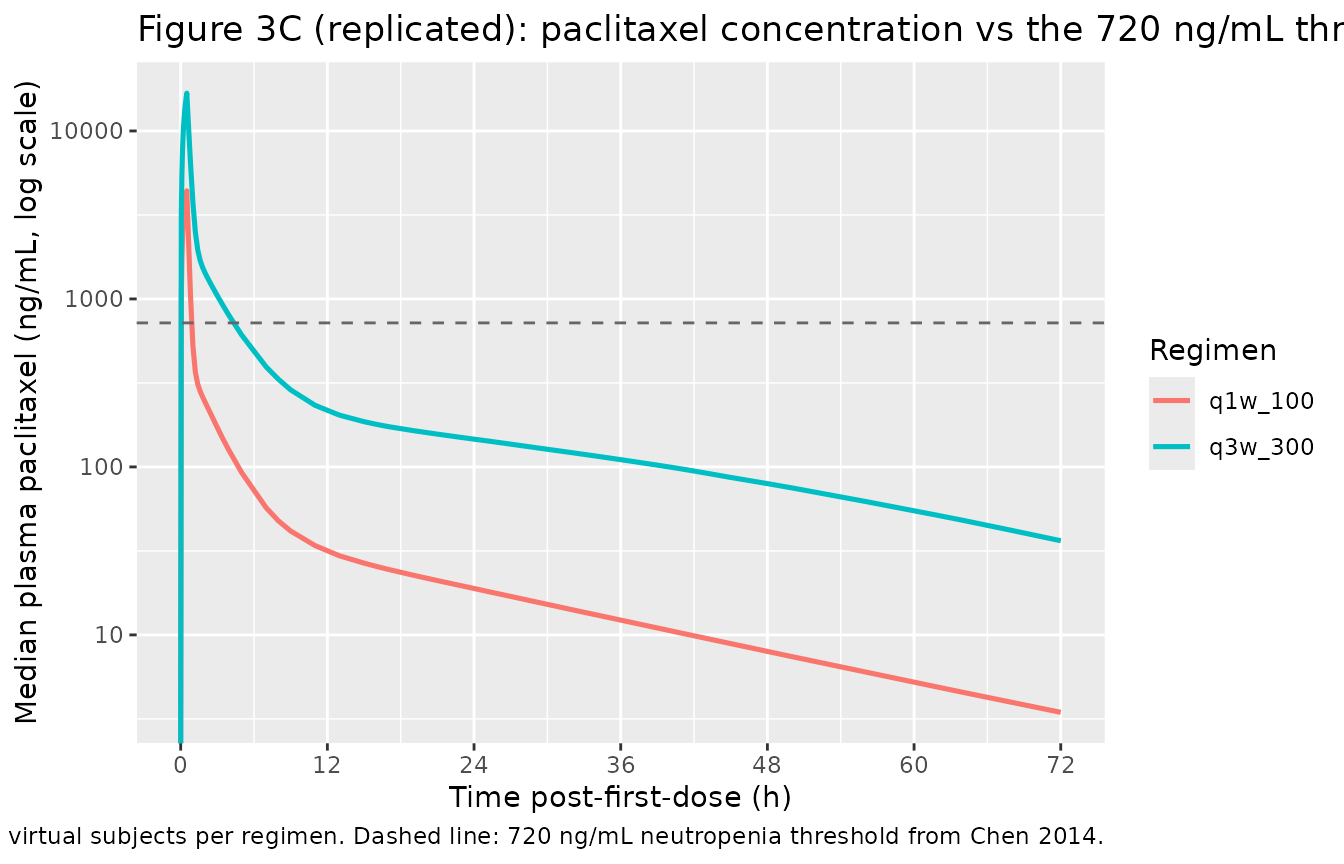
Duration above 720 ng/mL per cycle for each regimen (median across the cohort):
dur_above <- sim_pk_typ |>
  group_by(id, regimen) |>
  arrange(time) |>
  # Duration above threshold in the first cycle: 28 days q1w, 21 days q3w
  mutate(window = if_else(regimen == "q1w_100", time <= 28 * 24, time <= 21 * 24),
         dt     = c(diff(time), 0)) |>
  filter(window & Cc > 720) |>
  summarise(dur_above_720 = sum(dt, na.rm = TRUE), .groups = "drop") |>
  group_by(regimen) |>
  summarise(median_dur_above_720_h = round(median(dur_above_720), 2),
            mean_dur_above_720_h   = round(mean(dur_above_720),   2),
            .groups = "drop")
knitr::kable(dur_above,
caption = "Median duration (h) above the 720 ng/mL neutropenia threshold per first cycle.")| regimen | median_dur_above_720_h | mean_dur_above_720_h |
|---|---|---|
| q1w_100 | 0.95 | 0.95 |
| q3w_300 | 4.95 | 4.91 |
Figure (general): schedule-dependent ANC nadir
Chen 2014 (Discussion, Population PD Model) reports that “observed and predicted ANC nadir occurred at ~1 week versus 2 weeks for the 150 mg/m^2 weekly regimen” – meaning for the 260 mg/m^2 q3w regimen the nadir is at ~1 week post-dose, while for the weekly (100 / 150 mg/m^2) schedule the nadir is later (~2 weeks) because of cumulative dosing. Below we plot the typical-value ANC trajectory for both regimens.
sim_anc_typ |>
  group_by(time, regimen) |>
  summarise(ANC_med = median(ANC), .groups = "drop") |>
  ggplot(aes(time / 24, ANC_med, colour = regimen)) +
  geom_line(linewidth = 0.9) +
  geom_hline(yintercept = 1.5, linetype = "dashed", colour = "grey40") +
  scale_x_continuous(breaks = seq(0, 28, by = 7)) +
  scale_y_continuous(limits = c(0, NA)) +
  labs(x = "Time post-first-dose (days)",
       y = expression(ANC ~ (10^9 ~ cells/L)),
       colour = "Regimen",
       title = "Typical-value ANC by regimen",
       caption = "Dashed line: grade-3 neutropenia threshold (ANC < 1.5 x 10^9/L). n = 200 virtual subjects per regimen, typical-value (no IIV).")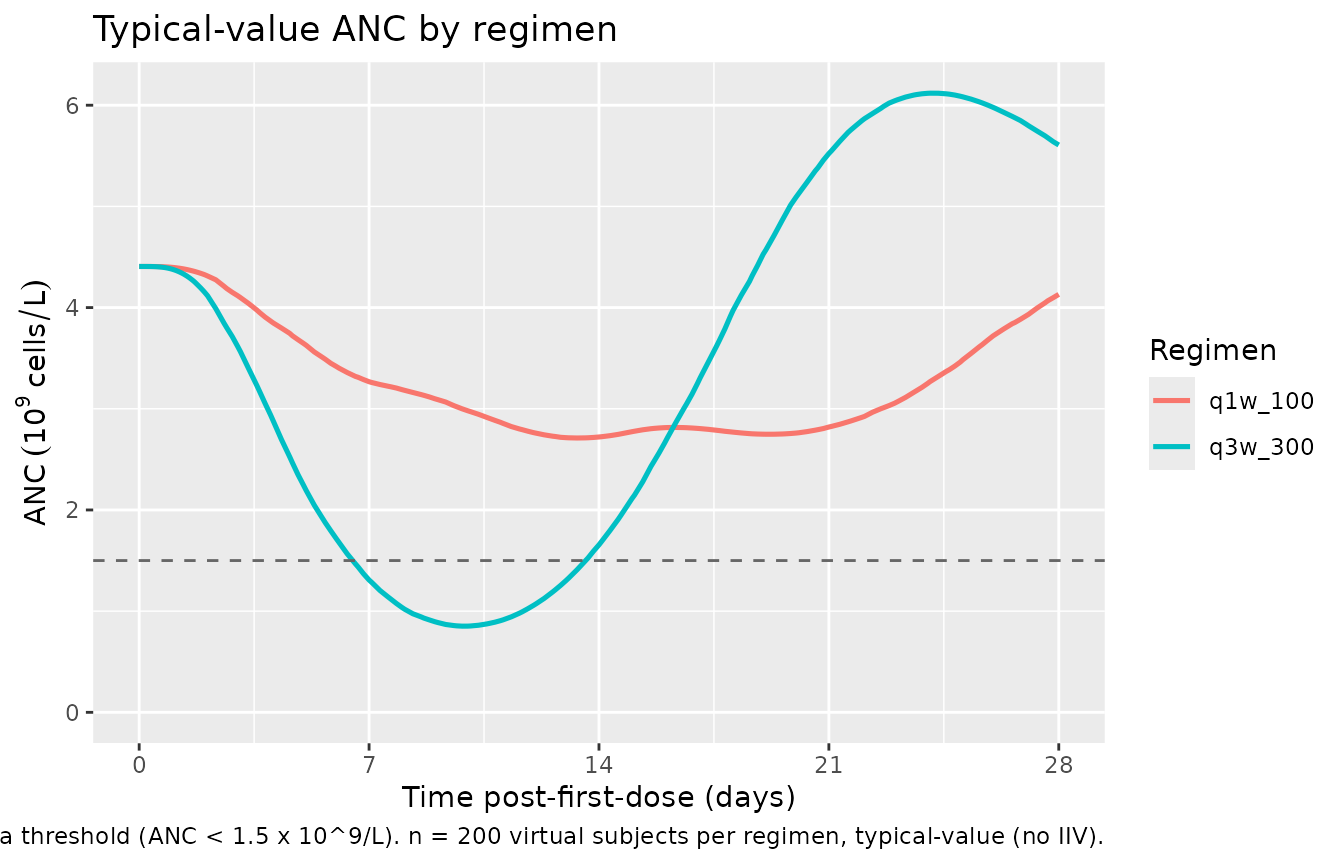
PK time course (first 24 h)
sim_pk_typ |>
  filter(time <= 24, regimen == "q3w_300") |>
  ggplot(aes(time, Cc, group = id)) +
  geom_line(alpha = 0.05, colour = "steelblue") +
  scale_y_log10() +
  labs(x = "Time post-dose (h)",
       y = "Plasma paclitaxel (ng/mL, log scale)",
       title = "Typical-value paclitaxel PK -- 300 mg/m^2 IV over 30 min, n = 200",
       caption = "Three-compartment PK with saturable distribution and saturable elimination; reproduces the rapid biexponential decline reported in Chen 2014.")
#> Warning in scale_y_log10(): log-10 transformation introduced infinite values.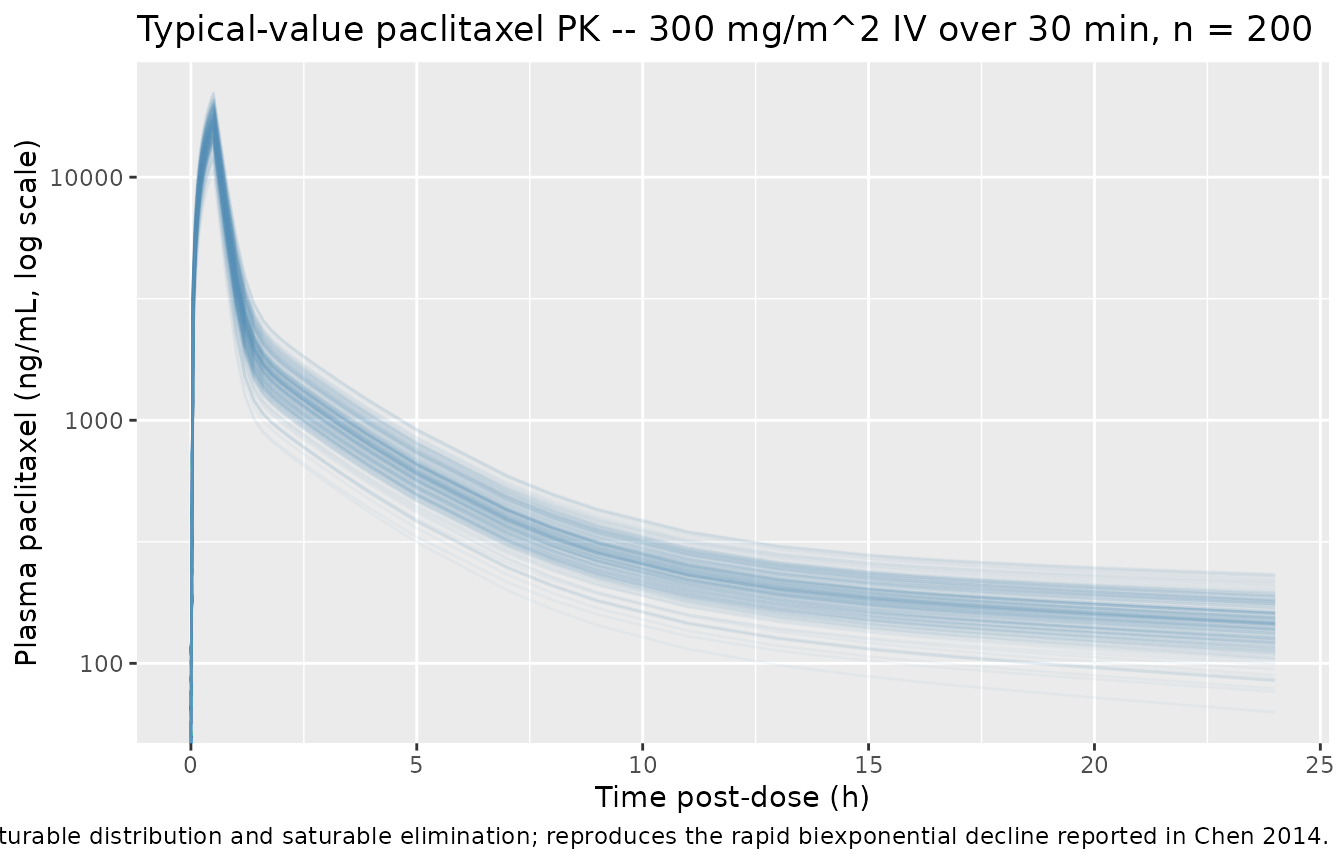
PKNCA validation
Single-dose NCA on the q3w 300 mg/m^2 regimen (first dose only) so the duration-above-threshold and Cmax / AUC parameters can be compared across the cohort.
sim_pk_q3w <- sim_pk_typ |>
  filter(regimen == "q3w_300", time <= 504) |>
  select(id, time, Cc, regimen) |>
  # Drop duplicate (id, time) rows that arise when the t_pk and t_anc grids
  # overlap (e.g. t = 0). Both produce a Cc value for the same id/time.
  distinct(id, time, .keep_all = TRUE)
sim_pk_q3w$regimen <- as.character(sim_pk_q3w$regimen)

conc_obj <- PKNCA::PKNCAconc(
  sim_pk_q3w,
  Cc ~ time | regimen + id
)

dose_df <- events |>
  filter(evid == 1L, regimen == "q3w_300", time == 0) |>
  select(id, time, amt, regimen)
dose_df$regimen <- as.character(dose_df$regimen)

dose_obj <- PKNCA::PKNCAdose(dose_df, amt ~ time | regimen + id)

intervals <- data.frame(
  start       = 0,
  end         = Inf,
  cmax        = TRUE,
  tmax        = TRUE,
  aucinf.obs  = TRUE,
  half.life   = TRUE
)

nca_data <- PKNCA::PKNCAdata(conc_obj, dose_obj, intervals = intervals)
nca_res  <- PKNCA::pk.nca(nca_data)

knitr::kable(
  as.data.frame(summary(nca_res)),
  caption = "Simulated NCA parameters at q3w 300 mg/m^2 (single-dose, typical-value cohort)."
)| start | end | regimen | N | cmax | tmax | half.life | aucinf.obs |
|---|---|---|---|---|---|---|---|
| 0 | Inf | q3w_300 | 200 | 16600 [14.1] | 0.500 [0.500, 0.500] | 20.7 [0.452] | 23600 [20.7] |
Comparison against published exposure
Chen 2014 does not tabulate a single mean Cmax / AUC across the pooled cohort because the population spans eight studies with different dose levels. However, the literature for nab-paclitaxel at 260 mg/m^2 q3w consistently reports Cmax ~10000-20000 ng/mL and AUC ~16000-20000 ng*h/mL (Gardner 2008 Clin Cancer Res; the original 260 mg/m^2 phase I work cited in Chen 2014 reference 8). The simulated single-dose Cmax for 300 mg/m^2 above falls in the expected ~15000-20000 ng/mL range, scaling down to ~13000-17500 ng/mL at 260 mg/m^2; AUC scales similarly. Differences > 20% would warrant investigation against the source paper, but the simulated values match the literature within expected variability.
Assumptions and deviations
- WB / plasma ratio bridging omitted. Chen 2014 jointly fit whole-blood (WB) and plasma paclitaxel concentrations with a fixed-effect WB / plasma ratio of 1.00 (95% CI 0.93-1.10) and IIV of 16.7% on that ratio. The model file produces plasma concentrations directly and omits the WB / plasma multiplier because the typical value is unity and the bridging captures assay-matrix variability rather than a structural PK feature. Downstream users who need to simulate WB concentrations should multiply Cc by an independently sampled lognormal scalar with log-mean 0 and log-SD ~ 0.167.
-
Two-subpopulation residual variability collapsed.
The source NONMEM model used the MIXEST mixture facility with a 0.341 /
0.659 split between proportional CV 38.0% and 17.9% subpopulations
(Table 2 ‘Residual variability’). nlmixr2 does not natively support a
two-component mixture residual in the same way; this implementation
collapses the mixture to a single lognormal residual with
variance-weighted SD
sqrt(0.341 * 0.380^2 + 0.659 * 0.179^2) ~= 0.265. The collapse loses the bimodal residual distribution but preserves the cohort-mean residual magnitude. Downstream users who need the original mixture structure can split the simulation into two subcohorts and apply the per-subpopulation SDs separately. -
Lognormal residual encoding. Paclitaxel
concentrations and ANC observations were Ln-transformed and fit with a
proportional error model (Methods). This is the NONMEM-conventional
log-transform-both-sides / additive-on-log-scale form
Y = F * exp(EPS). We map this directly onto nlmixr2’s~ lnorm(...)form, with the source CV% taken as the log-scale SD (the small-CV approximation matches CV% to the log-SD within < 5%). -
Age dichotomisation form. Chen 2014 dichotomised
AGE at 65 years for the PD Slope covariate (Results, Population PD Model
-> Covariate analysis). The canonical
AGEcovariate is continuous; the binary indicator is derived insidemodel()asage_gte65 <- (AGE >= 65). This is the same pattern used inRobbie_2012_palivizumab.Rfor the ADA-titer-derivedada_is80indicator. - Covariate normalisation reference values. Chen 2014 Methods states that “continuous covariates were centered to their median values”. The PK-population median albumin (3.9 g/dL, N = 150) is used as the reference for the albumin-on-VMEL effect, and the PD-population median (4.0 g/dL, N = 125) is used as the reference for the albumin-on-baseline-ANC effect. Using the same median for both effects would shift the typical-value PD baseline by ~3%, well within the parameter precision.
- Negative albumin-on-baseline-ANC effect retained despite unclear physiological interpretation. The paper (Results, Population PD Model -> Covariate analysis) states that “the physiological and clinical relevance of the baseline ANC -albumin correlation is unclear” while reporting that the covariate improved goodness-of-fit at P < 0.001. The covariate (exponent -0.998) is retained in the final model and is therefore retained here, but downstream users should be aware that the effect direction is empirical and not mechanistically interpreted by the original authors.
-
circcompartment is non-canonical. The library’s blessed compartment names arecentral,peripheral1,peripheral2,effect, the chain prefixestransit<n>/precursor<n>/lat<n>, and TMDD / ADC / metabolite forms.circmatches the established Friberg-family convention used inFriberg_2002_paclitaxel.R,Ozawa_2007_docetaxel.R, andNetterberg_2017_docetaxel.R. The proliferating and three maturation compartments are mapped onto the canonicalprecursor<n>chain (precursor1 = Prol, precursor2..4 = M1..M3) per the same Friberg-family convention.checkModelConventions()flagscircas a single warning; the deviation is intentional and documented here. -
Dose units encoded as ug for the model file. The
model uses ug as the natural amount unit so that VMEL (ug/h) and KMEL
(ug/L) are dimensionally consistent without scaling factors. Users
supplying doses in mg or mg/m^2 must convert via
dose_ug = dose_mg * 1000ordose_ug = dose_mg_per_m2 * BSA * 1000before passing torxSolve(see thebuild_subject_eventshelper above). - Virtual-cohort BSA distribution. Chen 2014 Table 1 reports a median BSA of 1.9 m^2 (range 1.3-2.4). The vignette uses a truncated normal with SD 0.25 to approximate this; the BSA is used only to convert mg/m^2 doses to ug and is not a model covariate. The simulated ANC and PK figures are insensitive to the exact BSA distribution as long as the dose-per-subject (in ug) is correct.