PFOS gestational and lactational PBPK in rats and humans (Chou and Lin 2021)
Source:vignettes/articles/Chou_2021_pfos_pbpk.Rmd
Chou_2021_pfos_pbpk.RmdModel and source
Chou and Lin (2021, Environ Health Perspect 129:037004, doi:10.1289/EHP7671) developed a life-stage physiologically based pharmacokinetic (PBPK) model for perfluorooctane sulfonate (PFOS) spanning the pre-pregnant, pregnant and lactating female, in both the Sprague-Dawley rat and the human. The distinctive feature relative to earlier PFOS models is an explicit, physiologically based description of transporter-mediated renal reabsorption (saturable basolateral Oat1/Oat3 and apical Oatp1a1 uptake in the proximal tubule cells) carried through gestation and lactation. The rat model was calibrated against toxicokinetic studies (Thibodeaux et al. 2003; Chang et al. 2009; Luebker et al. 2005a, 2005b) and the human model against worldwide maternal-plasma, cord-blood, placental and breast-milk biomonitoring data.
The paper contributes six models, extracted here as six files, all sharing the same maternal core structure:
| Model file | Role |
|---|---|
Chou_2021_pfos_rat_prepregnant_pbpk |
Non-pregnant female rat; seeds the gestational run |
Chou_2021_pfos_rat_gestational_pbpk |
Pregnant rat + litter (placenta, fetus, amniotic fluid) |
Chou_2021_pfos_rat_lactational_pbpk |
Lactating dam + nursing pups (milk transfer, coprophagy) |
Chou_2021_pfos_human_prepregnant_pbpk |
Non-pregnant woman; 30-year pre-conception burn-in |
Chou_2021_pfos_human_gestational_pbpk |
Pregnant woman + fetus |
Chou_2021_pfos_human_lactational_pbpk |
Lactating woman + breastfed neonate |
The maternal core is a two-compartment gastrointestinal tract (stomach, small intestine) feeding the liver by the portal vein; flow-limited plasma, liver, fat, mammary gland and rest-of-body compartments in which only the plasma-unbound fraction exchanges; and a three-subcompartment kidney (kidney blood, proximal tubule cells, filtrate) combining glomerular filtration with saturable basolateral and apical reabsorption, passive diffusion and first-order efflux back to plasma. PFOS is not metabolised; elimination is urinary and faecal (biliary plus unabsorbed). The gestational models add a placenta and a physically separate fetal circulation (fetal plasma, liver, rest of body) linked to the mother only by bidirectional placental diffusion, plus exchange with amniotic fluid. The lactational models replace the fetus with a milk compartment and a nursing pup/neonate submodel fed by suckled milk.
Model time is not time since dose. Every maternal,
fetal and neonatal volume and blood flow in the gestational and
lactational models is an explicit function of gestational or postnatal
age, so time is measured from GD0 / conception (gestation: GD = time/24
days, GA = time/168 weeks) or from delivery (lactation: PND = time/24
days). Body weight enters as the covariate WT, interpreted
as the pre-pregnancy maternal weight BW0 (gestation) or the delivery
weight (lactation) that anchors the growth equations.
Provenance
The paper prints the chemical parameters (Table 2) and describes the
growth equations in prose, but the polynomial coefficients live in
Supplemental Tables S1-S6 and the executable model is the authors’
openly published mrgsolve code (https://github.com/KSUICCM/PFOS-Ges-Lac, also deposited
as the EHP supplemental zip). The maintainers took the model structure,
the physiological growth equations and the as-run
calibrated parameters directly from that code and its fit objects
(GFit_R.rds, LFit_R.rds,
GFit_H.rds, LFit_H.rds). Where a fit object
and the printed Table 2 disagree, the code is treated as the source of
record because it is what generated the published simulations (see
Assumptions and deviations).
rat_pre  <- rxode2::rxode2(readModelDb("Chou_2021_pfos_rat_prepregnant_pbpk"))
rat_gest <- rxode2::rxode2(readModelDb("Chou_2021_pfos_rat_gestational_pbpk"))
rat_lact <- rxode2::rxode2(readModelDb("Chou_2021_pfos_rat_lactational_pbpk"))
hum_pre  <- rxode2::rxode2(readModelDb("Chou_2021_pfos_human_prepregnant_pbpk"))
hum_gest <- rxode2::rxode2(readModelDb("Chou_2021_pfos_human_gestational_pbpk"))
hum_lact <- rxode2::rxode2(readModelDb("Chou_2021_pfos_human_lactational_pbpk"))
c(rat_pre = length(rat_pre$state), rat_gest = length(rat_gest$state),
  rat_lact = length(rat_lact$state), hum_pre = length(hum_pre$state),
  hum_gest = length(hum_gest$state), hum_lact = length(hum_lact$state))
#>  rat_pre rat_gest rat_lact  hum_pre hum_gest hum_lact
#>       12       19       24       12       19       24
The models are stiff at early gestation and lactation, where the
growth equations make several fetal / neonatal volumes vanishingly
small. The default liblsoda solver with tightened
tolerances is used throughout; it is the most robust here (the
single-threaded lsoda and dop853 fail on the
rat gestational model).
Population
Rat (Chou and Lin 2021 Table 1). Sprague-Dawley rats from four toxicokinetic studies were dosed by oral gavage at 0.1-10 mg/kg per day before, during and after gestation; maternal plasma and liver, and fetal/pup plasma and liver, were sampled from GD7 through PND21. The reference pre-pregnant weight is 0.185 kg, the gestational dosing weight 0.225 kg, the lactational dosing weight 0.242 kg, and the litter is eight fetuses/pups.
Human (Chou and Lin 2021 Table 1). More than twenty human biomonitoring cohorts contributed maternal plasma, cord blood, placenta, fetal tissue and breast-milk PFOS concentrations across gestation and lactation. Exposure is chronic dietary intake; population-specific daily intakes of 0.19-4.4 ng/kg per day (Loccisano et al. 2013) were used. The reference pre-pregnant weight is 60 kg and the delivery weight excluding the fetus is 68.05 kg.
Source trace
| Component | Source |
|---|---|
| Oral uptake (stomach, small intestine) | Eqs 1-3 |
| Urinary and faecal elimination | Eqs 4-5 |
| Kidney: filtration, MM reabsorption, diffusion, efflux | Eqs 6-12 |
| Placental and amniotic-fluid transfer | Eqs 13-20 |
| Milk transfer and suckling | Eqs 21-23 |
| Chemical parameters, rat and human, per life stage | Table 2, Tables S1-S6 |
| Rat gestational calibrated set | GFit_R.rds |
| Rat lactational calibrated set | LFit_R.rds |
| Human gestational calibrated set | GFit_H.rds |
| Human lactational calibrated set | LFit_H.rds |
| Physiological growth equations | Kapraun et al. 2019; Loccisano et al. 2012, 2013; Yang et al. 2019 |
Mass-balance gate
Each model conserves mass: the administered PFOS equals the sum of drug in every tissue and excretion compartment (the AUC accumulators are not mass and are excluded). This is a numerical check on the ODE encoding, so a tight bound is used.
mass_states <- function(model) {
  st <- model$state
  st[!grepl("^auc_", st)]
}
mass_balance_err <- function(model, events, dose_mg, drop = character(0)) {
  s <- solve_model(model, events)
  last <- s[nrow(s), ]
  states <- setdiff(mass_states(model), drop)
  tot <- sum(vapply(states, function(v) last[[v]], numeric(1)))
  (dose_mg - tot) / dose_mg
}

# Rat prepregnant: single 1 mg/kg oral dose
ev_rp <- rxode2::et(amt = 0.185, cmt = "stomach") %>% rxode2::et(seq(0, 720, by = 24))
ev_rp$WT <- 0.185
err_rp <- mass_balance_err(rat_pre, ev_rp, 0.185)

# Rat gestational: 1 mg/kg/day GD2-GD20 (Thibodeaux 2003), dose ref 0.225 kg
ev_rg <- rxode2::et(amt = 0.225, cmt = "stomach", time = 48, ii = 24, addl = 18) %>%
  rxode2::et(seq(0, 504, by = 12))
ev_rg$WT <- 0.185
err_rg <- mass_balance_err(rat_gest, ev_rg, 19 * 0.225)

# Rat lactational: 1 mg/kg/day PND0-PND21, dose ref 0.242 kg. Pup urine is
# returned to the dam gut (coprophagy), so `urine_pup` is a throughput tracker
# whose mass has already re-entered the dam system; it is excluded from the
# closed-system total to avoid double counting.
ev_rl <- rxode2::et(amt = 0.242, cmt = "stomach", time = 0, ii = 24, addl = 21) %>%
  rxode2::et(seq(0, 504, by = 12))
ev_rl$WT <- 0.247
err_rl <- mass_balance_err(rat_lact, ev_rl, 22 * 0.242, drop = "urine_pup")

# Human prepregnant: single dietary dose
ev_hp <- rxode2::et(amt = 1e-4, cmt = "stomach") %>% rxode2::et(seq(0, 8760, by = 168))
ev_hp$WT <- 60
err_hp <- mass_balance_err(hum_pre, ev_hp, 1e-4)

# Human gestational: 2 ng/kg/day for 40 weeks
ev_hg <- rxode2::et(amt = 1.2e-4, cmt = "stomach", time = 0, ii = 24, addl = 279) %>%
  rxode2::et(seq(0, 280 * 24, by = 168))
ev_hg$WT <- 60
err_hg <- mass_balance_err(hum_gest, ev_hg, 280 * 1.2e-4)

# Human lactational: 2 ng/kg/day for 6 months. The output grid runs past the
# last dose (day 179) so every administered dose is inside the closed system.
ev_hl <- rxode2::et(amt = 1.36e-4, cmt = "stomach", time = 0, ii = 24, addl = 179) %>%
  rxode2::et(seq(0, 180 * 24, by = 24))
ev_hl$WT <- 68.05
err_hl <- mass_balance_err(hum_lact, ev_hl, 180 * 1.36e-4)

mb <- data.frame(
  model = c("rat prepregnant", "rat gestational", "rat lactational",
            "human prepregnant", "human gestational", "human lactational"),
  rel_err = c(err_rp, err_rg, err_rl, err_hp, err_hg, err_hl)
)
knitr::kable(mb, digits = 12, caption = "Relative mass-balance error, all six models.")| model | rel_err |
|---|---|
| rat prepregnant | 0.0e+00 |
| rat gestational | 0.0e+00 |
| rat lactational | 0.0e+00 |
| human prepregnant | 8.6e-11 |
| human gestational | 0.0e+00 |
| human lactational | -1.0e-12 |
Rat gestational model versus observed maternal plasma
The rat gestational model is checked against the maternal-plasma PFOS concentrations of Thibodeaux et al. (2003), in which dams were dosed 1-10 mg/kg per day from GD2 through GD20 (Chou and Lin 2021 Figure 3, calibration data in the authors’ repository). We simulate each dose and compare the predicted maternal plasma at GD7, GD14 and GD21 with the observed values.
# Observed maternal plasma (mg/L) from Thibodeaux 2003 (Study 1), as used in
# the authors' calibration (Data_R.csv). Rows: GD7, GD14, GD21.
obs_rat <- tibble::tribble(
  ~Dose, ~GD, ~Conc,
  1,  7, 14.82, 1, 14, 27.53, 1, 21, 20.65,
  2,  7, 25.94, 2, 14, 53.48, 2, 21, 45.53,
  3,  7, 53.47, 3, 14, 94.25, 3, 21, 70.42,
  5,  7, 76.25, 5, 14, 146.67, 5, 21, 81.54,
  10, 7, 154.82, 10, 14, 285.29, 10, 21, 188.59
)

pred_rat_gest <- function(dose_mgkg) {
  ev <- rxode2::et(amt = dose_mgkg * 0.225, cmt = "stomach", time = 48, ii = 24, addl = 18) %>%
    rxode2::et(c(7, 14, 21) * 24)
  ev$WT <- 0.185
  s <- solve_model(rat_gest, ev)
  s <- s[s$time %in% (c(7, 14, 21) * 24), ]
  data.frame(Dose = dose_mgkg, GD = s$time / 24, pred = s$Cc)
}
pred_rat <- do.call(rbind, lapply(c(1, 2, 3, 5, 10), pred_rat_gest))

gof_rat <- merge(obs_rat, pred_rat, by = c("Dose", "GD"))
gof_rat$ratio <- gof_rat$pred / gof_rat$Conc
knitr::kable(gof_rat, digits = 2,
caption = "Rat gestational: predicted vs observed maternal plasma PFOS (mg/L), Thibodeaux 2003.")| Dose | GD | Conc | pred | ratio |
|---|---|---|---|---|
| 1 | 14 | 27.53 | 28.31 | 1.03 |
| 1 | 21 | 20.65 | 22.38 | 1.08 |
| 1 | 7 | 14.82 | 15.18 | 1.02 |
| 10 | 14 | 285.29 | 285.73 | 1.00 |
| 10 | 21 | 188.59 | 222.18 | 1.18 |
| 10 | 7 | 154.82 | 152.66 | 0.99 |
| 2 | 14 | 53.48 | 56.65 | 1.06 |
| 2 | 21 | 45.53 | 44.75 | 0.98 |
| 2 | 7 | 25.94 | 30.38 | 1.17 |
| 3 | 14 | 94.25 | 85.03 | 0.90 |
| 3 | 21 | 70.42 | 67.09 | 0.95 |
| 3 | 7 | 53.47 | 45.58 | 0.85 |
| 5 | 14 | 146.67 | 141.96 | 0.97 |
| 5 | 21 | 81.54 | 111.67 | 1.37 |
| 5 | 7 | 76.25 | 76.05 | 1.00 |
within2 <- mean(gof_rat$ratio > 0.5 & gof_rat$ratio < 2)
cat(sprintf("Within 2-fold: %.0f%% (%d of %d points); median pred/obs = %.2f\n",
            100 * within2, sum(gof_rat$ratio > 0.5 & gof_rat$ratio < 2),
            nrow(gof_rat), stats::median(gof_rat$ratio)))
#> Within 2-fold: 100% (15 of 15 points); median pred/obs = 1.00
# The paper's acceptance criterion is prediction within a factor of 2.
stopifnot(within2 >= 0.8)
ggplot2::ggplot(gof_rat, ggplot2::aes(Conc, pred, colour = factor(Dose))) +
  ggplot2::geom_abline(slope = 1, intercept = 0) +
  ggplot2::geom_abline(slope = 2, intercept = 0, linetype = 2) +
  ggplot2::geom_abline(slope = 0.5, intercept = 0, linetype = 2) +
  ggplot2::geom_point(size = 2) +
  ggplot2::scale_x_log10() + ggplot2::scale_y_log10() +
  ggplot2::labs(x = "Observed maternal plasma PFOS (mg/L)",
                y = "Predicted (mg/L)", colour = "Dose (mg/kg/d)") +
  ggplot2::theme_bw()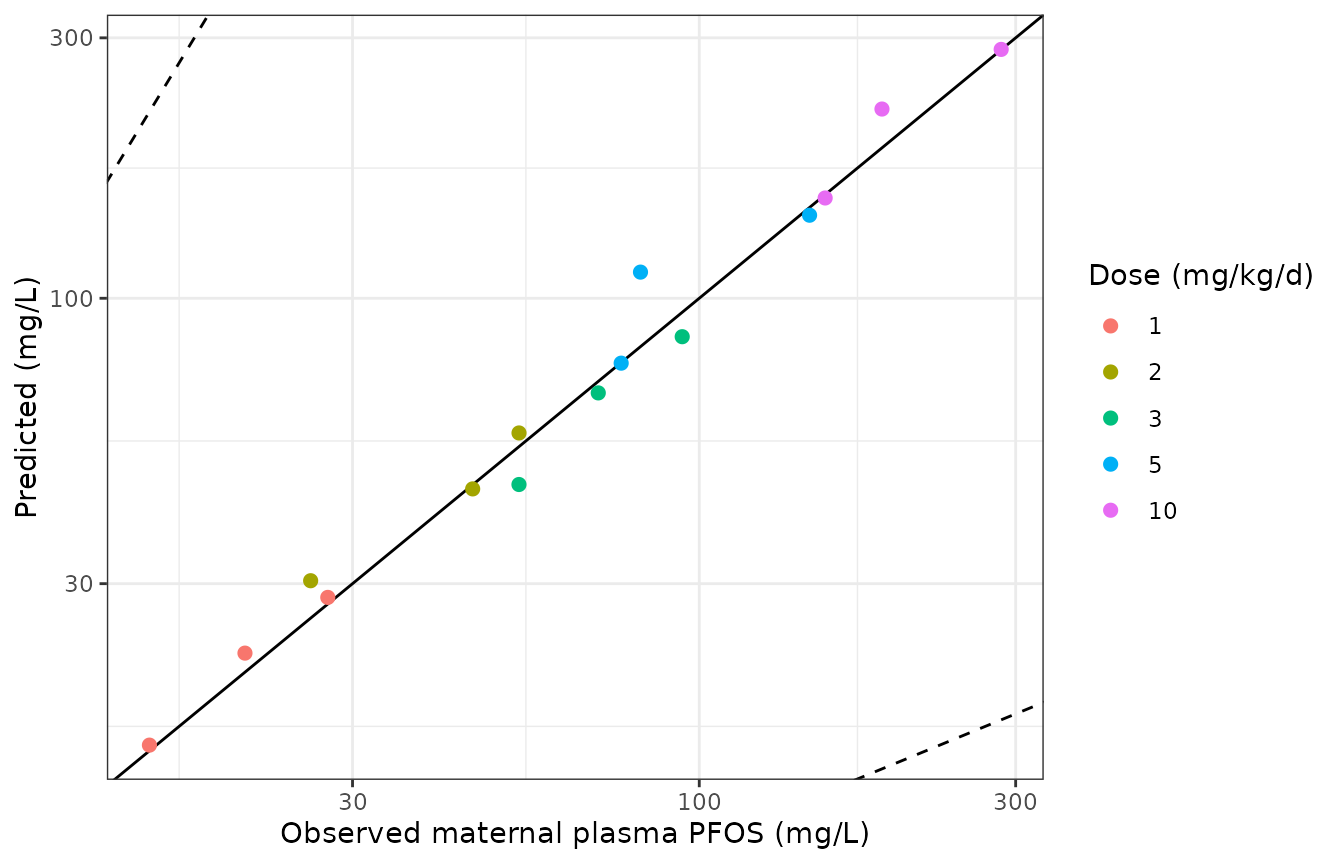
Rat gestational maternal-plasma PFOS: predicted (line of identity) versus observed (Thibodeaux 2003). Dashed lines bound the 2-fold envelope.
Rat lactational model: dam, milk and pups
The lactational dam is dosed 1 mg/kg per day PND0-PND21; PFOS reaches the nursing pups only through milk. The dam plasma stays near its gestational end value while pup plasma and liver accumulate over lactation.
ev_rl2 <- rxode2::et(amt = 0.242, cmt = "stomach", time = 0, ii = 24, addl = 21) %>%
  rxode2::et(seq(0, 504, by = 12))
ev_rl2$WT <- 0.247
s_rl <- solve_model(rat_lact, ev_rl2)
end_rl <- s_rl[nrow(s_rl), ]
cat(sprintf("PND21: dam plasma %.2f, milk %.4f, pup plasma %.2f, pup liver %.2f mg/L\n",
            end_rl$Cc, end_rl$Cmilk, end_rl$Cc_pup, end_rl$Cliver_pup))
#> PND21: dam plasma 22.91, milk 0.0945, pup plasma 15.38, pup liver 39.48 mg/L
# Pups accumulate PFOS from milk; pup liver exceeds pup plasma (PL_pup > 1).
stopifnot(end_rl$Cc_pup > 0, end_rl$Cliver_pup > end_rl$Cc_pup)
s_rl %>%
  dplyr::transmute(PND = time / 24, `Dam plasma` = Cc, `Pup plasma` = Cc_pup) %>%
  tidyr::pivot_longer(-PND) %>%
  ggplot2::ggplot(ggplot2::aes(PND, value, colour = name)) +
  ggplot2::geom_line() +
  ggplot2::labs(x = "Postnatal day", y = "PFOS (mg/L)", colour = NULL) +
  ggplot2::theme_bw()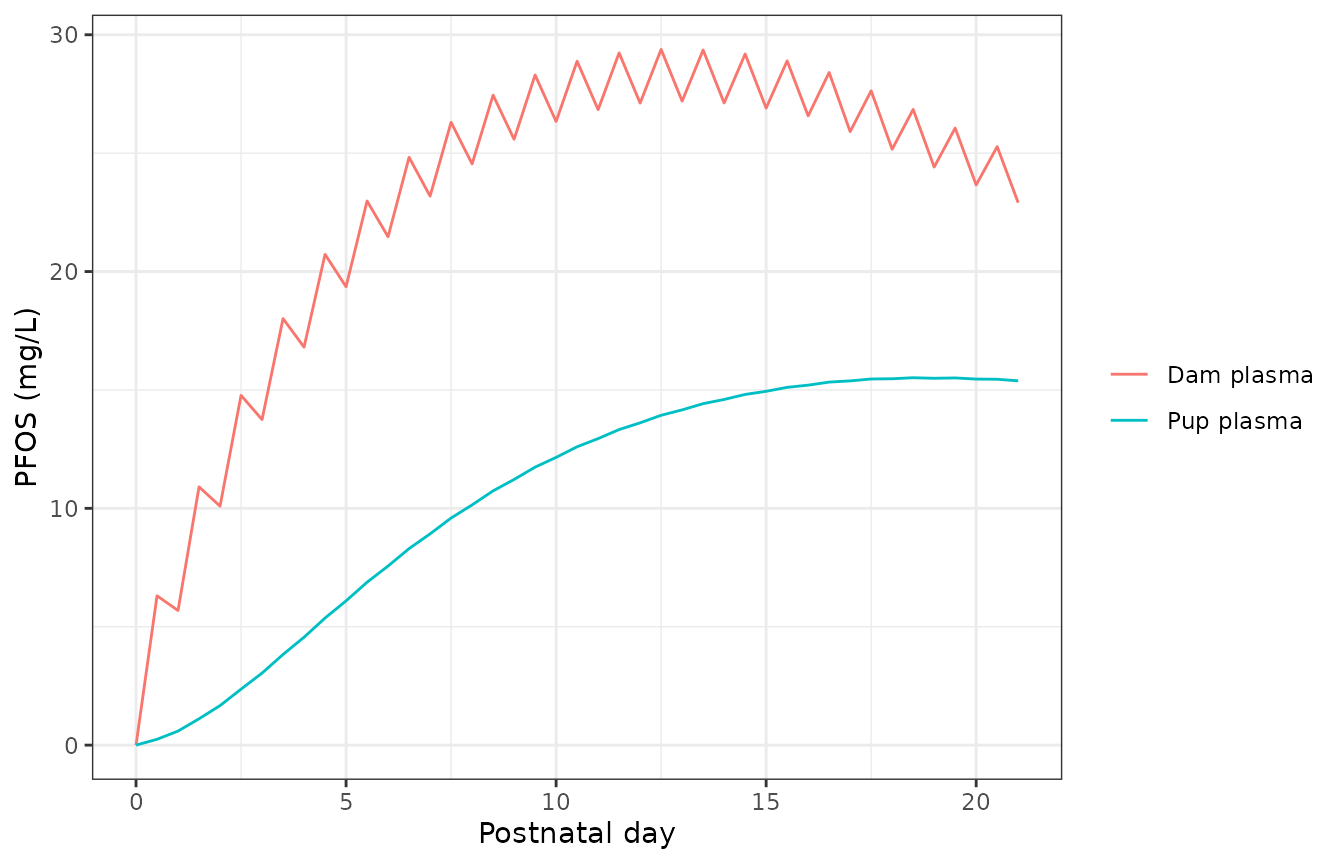
Rat lactational PFOS: dam plasma and nursing-pup plasma over PND0-21 at 1 mg/kg/day.
Human gestational model: cord-to-maternal ratio
The central quantitative feature of the human gestational model is transplacental transfer. The paper’s calibration cohorts report cord blood (fetal plasma) at roughly 0.3-0.4 times maternal plasma at term (e.g. Inoue 2004 CB/MP = 2.9/8.9 = 0.33; Fei 2007 = 11/29.2 = 0.38; Kato 2014 = 3.5/8.5 = 0.41). We reproduce a chronic dietary exposure over 40 weeks and read the term ratio, which is independent of the absolute intake.
ev_hg2 <- rxode2::et(amt = 1.2e-4, cmt = "stomach", time = 0, ii = 24, addl = 279) %>%
  rxode2::et(seq(0, 280 * 24, by = 168))
ev_hg2$WT <- 60
s_hg <- solve_model(hum_gest, ev_hg2)
term <- s_hg[nrow(s_hg), ]
cbmp <- term$Cc_fet / term$Cc
cat(sprintf("Term (GA 40 wk) cord:maternal plasma ratio = %.3f\n", cbmp))
#> Term (GA 40 wk) cord:maternal plasma ratio = 0.389
# Observed CB/MP across the calibration cohorts is ~0.33-0.41.
stopifnot(cbmp > 0.2, cbmp < 0.6)
s_hg %>%
  dplyr::transmute(GA = time / 168, `Maternal plasma` = Cc, `Fetal plasma` = Cc_fet) %>%
  ggplot2::ggplot(ggplot2::aes(GA)) +
  ggplot2::geom_line(ggplot2::aes(y = `Maternal plasma`, colour = "Maternal")) +
  ggplot2::geom_line(ggplot2::aes(y = `Fetal plasma`, colour = "Fetal")) +
  ggplot2::labs(x = "Gestational age (weeks)", y = "PFOS (mg/L)", colour = NULL) +
  ggplot2::theme_bw()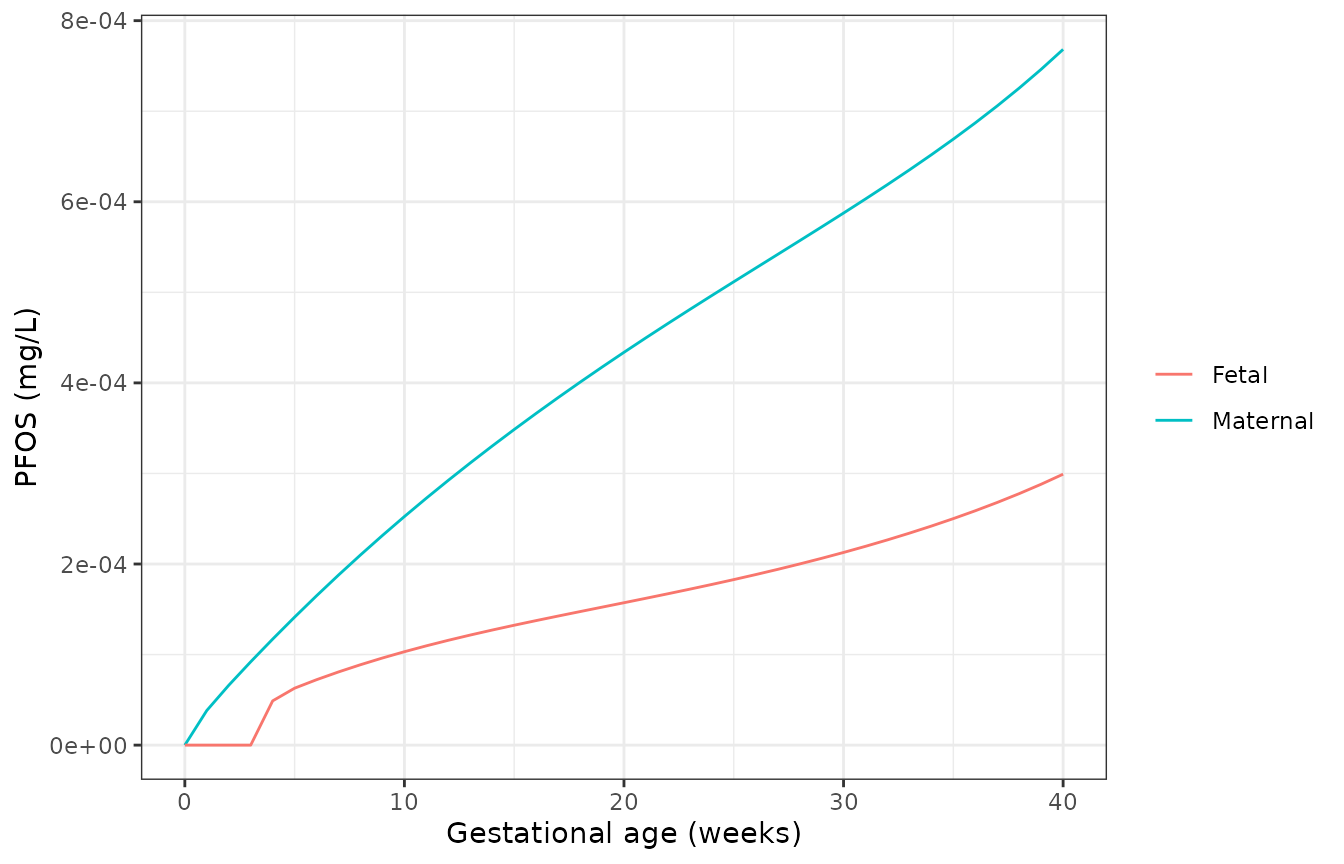
Human gestational PFOS: maternal and fetal (cord) plasma over 40 weeks of constant dietary intake.
Human pre-pregnant burn-in
The pre-pregnant model is run with constant dietary intake to steady state; the paper simulates birth to 30 years to seed the gestational run. Chronic dietary intake is represented as a continuous zero-order input into the stomach (smoother, and more faithful to a diet than daily boluses). A 20-year run reaches steady state.
years <- 20
Tend  <- years * 365 * 24
rate  <- 1.2e-4 / 24 # 1.2 ng/kg/day * 60 kg as a per-hour intake
ev_hp2 <- rxode2::et(amt = rate * Tend, rate = rate, cmt = "stomach") %>%
  rxode2::et(seq(0, Tend, by = 24 * 90))
ev_hp2$WT <- 60
s_hp <- solve_model(hum_pre, ev_hp2)
last2 <- tail(s_hp$Cc, 2)
cat(sprintf("Plasma at year %d = %.4f mg/L; change over last quarter = %.2f%%\n",
            years, tail(s_hp$Cc, 1), 100 * (last2[2] - last2[1]) / last2[2]))
#> Plasma at year 20 = 0.0064 mg/L; change over last quarter = 0.00%
# Approaching steady state: the last quarterly change is small, and PFOS has
# accumulated relative to early exposure.
stopifnot(abs((last2[2] - last2[1]) / last2[2]) < 0.02, tail(s_hp$Cc, 1) > s_hp$Cc[2])
Human lactational model: milk and neonate
The lactating mother transfers PFOS to the breastfed neonate through milk; milk feeding stops after month 6 in the model.
ev_hl2 <- rxode2::et(amt = 1.36e-4, cmt = "stomach", time = 0, ii = 24, addl = 179) %>%
  rxode2::et(seq(0, 180 * 24, by = 168))
ev_hl2$WT <- 68.05
s_hl <- solve_model(hum_lact, ev_hl2)
end_hl <- s_hl[nrow(s_hl), ]
cat(sprintf("Month 6: maternal plasma %.5f, milk %.6f, neonate plasma %.5f mg/L; milk:plasma = %.3f\n",
            end_hl$Cc, end_hl$Cmilk, end_hl$Cc_neo, end_hl$Cmilk / end_hl$Cc))
#> Month 6: maternal plasma 0.00071, milk 0.000009, neonate plasma 0.00015 mg/L; milk:plasma = 0.013
# Milk:plasma partitioning is of order PMilkP (~0.01); the neonate takes up PFOS.
stopifnot(end_hl$Cc_neo > 0, end_hl$Cmilk > 0)
Assumptions and deviations
-
Source of record. Structure, growth equations and
calibrated parameters were taken from the authors’ openly published
mrgsolve code and fit objects, not the paper text alone, because the
polynomial growth coefficients are in Supplemental Tables S1-S6 and the
executable model is the code. The calibrated values applied are the
sensitivity-selected subsets stored in
GFit_R/LFit_R/GFit_H/LFit_H; all other parameters keep the code’s$PARAMdefaults. -
Table 2 versus code Km labelling. In the rat and
human gestational fits the calibrated Michaelis constant is stored under
the code parameter named
Km_apical(rat 19.89 mg/L; human 247.8 mg/L), whereas Table 2 labels the calibrated valueKm_baso. The as-run code is reproduced faithfully (calibratedKm_apical, defaultKm_baso), which is what produced the published simulations; the labelling discrepancy is noted here rather than silently reconciled. -
Deterministic. The published Monte Carlo analysis
draws physiological and chemical parameters from external distributions
(typically 20-30% CV, truncated) around these point estimates; the model
files carry the point estimates only, with no random effects. A
propSdresidual-error placeholder is fixed and carries no information from the paper. -
Body weight.
WTis the single covariate. In the gestational models it is the pre-pregnancy weight BW0 that anchors the growth equations (gestational weight BW_P is computed internally); the authors dose against a separate gestational/lactational reference weight when converting a mg/kg dose to a mg amount, which the simulations above reproduce. The published human pre-pregnant model holds body weight constant rather than using the age-dependent equation described in the text. - Litter. The rat litter is modelled as a single fetal/pup compartment scaled by N = 8, and pup urine is returned to the dam gut (coprophagy), both as in the authors’ code.
-
Specimen metadata. Amniotic fluid and the AUC
accumulator compartments have no matching entry in the package specimen
vocabulary and are recorded as
not applicable; placental, fetal, pup and neonatal solid compartments are recorded astissue. - Absolute human concentrations depend on the assumed dietary intake, which is uncertain; the human checks above therefore assert on the intake-independent cord-to-maternal ratio and on approach to steady state rather than on absolute plasma levels.