Enoxaparin (Barras 2009)
Source:vignettes/articles/Barras_2009_enoxaparin.Rmd
Barras_2009_enoxaparin.RmdModel and source
- Citation: Barras MA, Duffull SB, Atherton JJ, Green B. Modelling the occurrence and severity of enoxaparin-induced bleeding and bruising events. Br J Clin Pharmacol. 2009;68(5):700-711.
- Article: https://doi.org/10.1111/j.1365-2125.2009.03518.x
The Barras 2009 model is a two-compartment first-order-absorption population PK model describing anti-factor Xa (anti-Xa) activity (IU/mL) in 118 adult inpatients treated for thromboembolic disease (pulmonary embolism, deep vein thrombosis, acute coronary syndrome, or atrial fibrillation). The paper parameterises clearance as a composite renal + non-renal model where the renal arm scales with Cockcroft-Gault creatinine clearance computed with lean body weight (LBW, Janmahasatian 2005 formula) substituted as the body- size descriptor, and the non-renal arm scales linearly with LBW. The central volume scales linearly with LBW; peripheral volume and inter- compartmental clearance do not retain a covariate effect. Three IIV terms (CL, Vc, Ka) and an additive residual error on anti-Xa activity complete the PK structure.
The paper also reports a three-category proportional-odds PD model for the occurrence and severity of bleeding / bruising events as a function of patient age and the cumulative anti-Xa AUC (cAUC) from first dose to the event. The PD layer is NOT encoded in the packaged model file (see the description text and Assumptions and deviations section). The proportional- odds equation is reproduced numerically in this vignette to illustrate the expected event-severity probabilities for typical individualised and conventional dosing regimens.
Population
The Barras 2009 randomised controlled trial (Table 3) enrolled 118 adult inpatients with PE / DVT / ACS / atrial fibrillation. Baseline characteristics:
- Age: median 61 years (range 23-91).
- Sex: 38% women.
- Weight: median 77 kg (range 43-120); LBW median 55 kg (range 30-86); IBW median 64 kg (range 39-83).
- Renal function: LBW-substituted C-G CrCl median 70 mL/min (range 10-170); total-weight C-G CrCl median 85 mL/min (range 15-244).
- Co-medications: warfarin 31%, antiplatelet drugs (aspirin / clopidogrel) 42%.
- Indications: PE / DVT / ACS / atrial fibrillation requiring enoxaparin treatment.
The PD subset (n = 103) had a bleeding / bruising assessment beyond baseline; 36 had no event, 40 had a minor bruising event (1-20 cm^2), and 27 had a major bruise or bleed (>= 20 cm^2 bruise or any overt bleed) during a mean (SD) duration of therapy of 3.5 +/- 2.3 days. Cumulative anti-Xa AUC in the PD subset had median 23 h.IU/mL (range 4-120).
The same information is available programmatically via
readModelDb("Barras_2009_enoxaparin") (e.g. inspect the
function body for the population metadata).
Source trace
The per-parameter origin is recorded as an in-file comment next to
each ini() entry in
inst/modeldb/specificDrugs/Barras_2009_enoxaparin.R. The
table below collects them in one place.
| Equation / parameter | Value | Source location |
|---|---|---|
lka (Ka) |
log(0.26 1/h) | Barras 2009 Table 4, Ka row (covariate model column) |
lvc (Vc/F at LBM = 55 kg) |
log(3.43 L) | Barras 2009 Table 4, Vc row; Equation 3 page 705 |
lvp (Vp/F) |
log(5.77 L) | Barras 2009 Table 4, Vp row |
lq (Q/F) |
log(0.31 L/h) | Barras 2009 Table 4, Q row |
lcl_renal (renal CL at CRCL=70) |
log(0.30 L/h) | Barras 2009 Table 4, “CL renal” row; Equation 2 page 705 |
lcl_nonren (non-renal CL at LBM=55) |
log(0.42 L/h) | Barras 2009 Table 4, “CL non-renal” row; Equation 2 page 705 |
etalcl (omega^2) |
log(0.378^2 + 1) = 0.13342 | Barras 2009 Table 4, omega_CL 37.8% CV row |
etalvc (omega^2) |
log(0.356^2 + 1) = 0.11907 | Barras 2009 Table 4, omega_Vc 35.6% CV row |
etalka (omega^2) |
log(0.303^2 + 1) = 0.08763 | Barras 2009 Table 4, omega_Ka 30.3% CV row |
addSd |
0.09 IU/mL (additive) | Barras 2009 Table 4, epsilon row; Methods “Base heterogeneity and residual error model” |
| Structural PK model | 2-compartment SC first-order absorption | Barras 2009 Results “PK analysis – Model building” |
| Covariate selection (CL) | composite renal + non-renal scaled by LBW-CrCl and LBW | Barras 2009 Results “PK analysis – Model building”; Eq. 2 |
| Covariate selection (Vc) | linear LBW scaling | Barras 2009 Results “PK analysis – Model building”; Eq. 3 |
| Reference values | LBW 55 kg, CRCL 70 mL/min (population medians) | Barras 2009 Tables 3 and 4; Eqs. 2 and 3 |
| Proportional-odds PD theta_1 | 2.83 (intercept, logit P[S<=1]) | Barras 2009 Table 4 PD section; Eq. 4 page 706 |
| Proportional-odds PD theta_2 | -2.75 on (Age / 61) | Barras 2009 Table 4 PD section; Eq. 4 |
| Proportional-odds PD theta_3 | -0.536 on (cAUC / 23) (Table 4 rounds to -0.54) | Barras 2009 Eq. 4 page 706 |
| Proportional-odds PD theta_4 | 2.05 (increment, logit P[S<=2] - logit P[S<=1]) | Barras 2009 Table 4 PD section; Eq. 4 |
Virtual cohort
The Barras 2009 RCT did not release individual-level data; the simulations below use a virtual cohort whose demographics (total body weight, LBW, LBW-substituted C-G CrCl, age) are sampled to approximate Table 3. The cohort is split equally between the conventional and individualised dosing arms, each receiving 1 mg/kg total-body-weight (conventional) or 1 mg/kg LBW (individualised) subcutaneously twice daily for 96 hours – the longer of the two paper-referenced standard durations (96 h for non-ACS embolic events, 72 h for ACS, per Methods “Demonstration of the inference of the PK-PD model”). The mg dose is converted to anti-Xa international units using the standard enoxaparin specific activity of approximately 100 IU anti-Xa per mg.
set.seed(2009)
n_subj <- 100L

# Sample WT, LBW, CRCL, Age to approximate Table 3 of Barras 2009 PK cohort.
draw_truncated <- function(n, mean, sd, lower, upper, log_normal = FALSE) {
  out <- numeric(0)
  while (length(out) < n) {
    if (log_normal) {
      cv <- sd / mean
      sdlog <- sqrt(log(cv^2 + 1))
      meanlog <- log(mean) - sdlog^2 / 2
      draw <- rlnorm(n, meanlog = meanlog, sdlog = sdlog)
    } else {
      draw <- rnorm(n, mean = mean, sd = sd)
    }
    draw <- draw[draw >= lower & draw <= upper]
    out <- c(out, draw)
  }
  out[seq_len(n)]
}

cohort <- tibble(
  id   = seq_len(n_subj),
  AGE  = draw_truncated(n_subj, mean = 61, sd = 17, lower = 23, upper = 91),
  WT   = draw_truncated(n_subj, mean = 77, sd = 16, lower = 43, upper = 120,
                        log_normal = TRUE),
  LBM  = draw_truncated(n_subj, mean = 55, sd = 12, lower = 30, upper = 86,
                        log_normal = TRUE),
  CRCL = draw_truncated(n_subj, mean = 70, sd = 33, lower = 10, upper = 170)
)

summary(cohort[, c("AGE", "WT", "LBM", "CRCL")])
#>       AGE              WT              LBM             CRCL
#>  Min.   :29.59   Min.   : 47.87   Min.   :30.73   Min.   : 13.37
#>  1st Qu.:49.95   1st Qu.: 65.79   1st Qu.:46.95   1st Qu.: 47.14
#>  Median :59.08   Median : 73.95   Median :53.88   Median : 74.34
#>  Mean   :59.98   Mean   : 75.92   Mean   :54.41   Mean   : 75.18
#>  3rd Qu.:71.02   3rd Qu.: 83.52   3rd Qu.:60.38   3rd Qu.: 97.27
#>  Max.   :89.95   Max.   :114.35   Max.   :81.70   Max.   :148.77
# 96-hour BID treatment regimen (paper-referenced non-ACS standard duration).
# Conventional arm: 1 mg/kg total body weight BID; individualised arm: 1 mg/kg
# LBW BID. Convert mg -> IU using ~100 IU/mg (standard enoxaparin specific
# activity). Doses at 0, 12, 24, ... 84 h; observations every 0.5 h up to 96 h.
dose_times <- seq(0, 84, by = 12)
obs_times  <- sort(unique(c(seq(0, 96, by = 0.5), dose_times + 0.001)))
mg_to_IU   <- 100   # ~100 IU anti-Xa per mg enoxaparin (standard specific activity)

make_subject <- function(id, AGE, WT, LBM, CRCL, arm, id_offset) {
  amt_mg <- if (arm == "Conventional") 1 * WT else 1 * LBM   # mg/kg * weight basis
  amt_IU <- amt_mg * mg_to_IU
  doses <- tibble(
    id = id + id_offset, time = dose_times, amt = amt_IU,
    cmt = "depot", evid = 1L,
    AGE = AGE, WT = WT, LBM = LBM, CRCL = CRCL, treatment = arm
  )
  obs <- tibble(
    id = id + id_offset, time = obs_times, amt = NA_real_,
    cmt = NA_character_, evid = 0L,
    AGE = AGE, WT = WT, LBM = LBM, CRCL = CRCL, treatment = arm
  )
  bind_rows(doses, obs) |> arrange(time)
}

events_conventional <- lapply(
  seq_len(nrow(cohort)),
  function(i) make_subject(cohort$id[i], cohort$AGE[i], cohort$WT[i],
                           cohort$LBM[i], cohort$CRCL[i],
                           arm = "Conventional", id_offset = 0L)
) |> bind_rows()

events_individualised <- lapply(
  seq_len(nrow(cohort)),
  function(i) make_subject(cohort$id[i], cohort$AGE[i], cohort$WT[i],
                           cohort$LBM[i], cohort$CRCL[i],
                           arm = "Individualised", id_offset = n_subj)
) |> bind_rows()

events <- bind_rows(events_conventional, events_individualised)
stopifnot(!anyDuplicated(unique(events[, c("id", "time", "evid")])))
Simulation
mod <- readModelDb("Barras_2009_enoxaparin")
sim <- rxode2::rxSolve(
  mod, events = events,
  keep = c("AGE", "WT", "LBM", "CRCL", "treatment")
)
#> ℹ parameter labels from comments will be replaced by 'label()'
sim <- as.data.frame(sim)
Typical-value (zero random-effects) profile at the population
reference (LBM = 55, CRCL = 70,
AGE = 61, conventional arm dose 1 mg/kg of a 77 kg subject
= 7700 IU SC BID):
mod_typical <- mod |> rxode2::zeroRe()
#> ℹ parameter labels from comments will be replaced by 'label()'
ev_typ <- tibble(
  id = 1L,
  time = sort(unique(c(dose_times, obs_times))),
  amt  = NA_real_, cmt = NA_character_, evid = 0L,
  AGE = 61, WT = 77, LBM = 55, CRCL = 70, treatment = "Typical 1 mg/kg BID"
)
ev_typ_doses <- tibble(
  id = 1L, time = dose_times, amt = 1 * 77 * mg_to_IU,
  cmt = "depot", evid = 1L,
  AGE = 61, WT = 77, LBM = 55, CRCL = 70, treatment = "Typical 1 mg/kg BID"
)
ev_typ <- bind_rows(ev_typ_doses, ev_typ |> filter(evid == 0)) |> arrange(time)
sim_typ <- as.data.frame(rxode2::rxSolve(mod_typical, events = ev_typ))
#> ℹ omega/sigma items treated as zero: 'etalcl', 'etalvc', 'etalka'
Replicate published figures
# Replicates Figure 2 of Barras 2009: VPC of anti-Xa activity vs time post
# first dose, with 10th / 50th / 90th prediction intervals overlaid. The
# original Figure 2 shows three panels (all subjects, renal-impaired,
# obese); here we show all subjects with the conventional vs individualised
# arms side by side.
vpc <- sim |>
  group_by(time, treatment) |>
  summarise(
    Q10 = quantile(Cc, 0.10, na.rm = TRUE),
    Q50 = quantile(Cc, 0.50, na.rm = TRUE),
    Q90 = quantile(Cc, 0.90, na.rm = TRUE),
    .groups = "drop"
  )
ggplot(vpc, aes(time, Q50)) +
  geom_ribbon(aes(ymin = Q10, ymax = Q90), alpha = 0.25) +
  geom_line() +
  facet_wrap(~ treatment) +
  labs(x = "Time post first dose (h)",
       y = "Anti-Xa activity (IU/mL)",
       title = "Figure 2 -- VPC of anti-Xa activity",
       caption = paste0("Replicates the form of Barras 2009 Figure 2: ",
                        "10th / 50th / 90th prediction intervals of simulated ",
                        "anti-Xa activity over a 96-h treatment course."))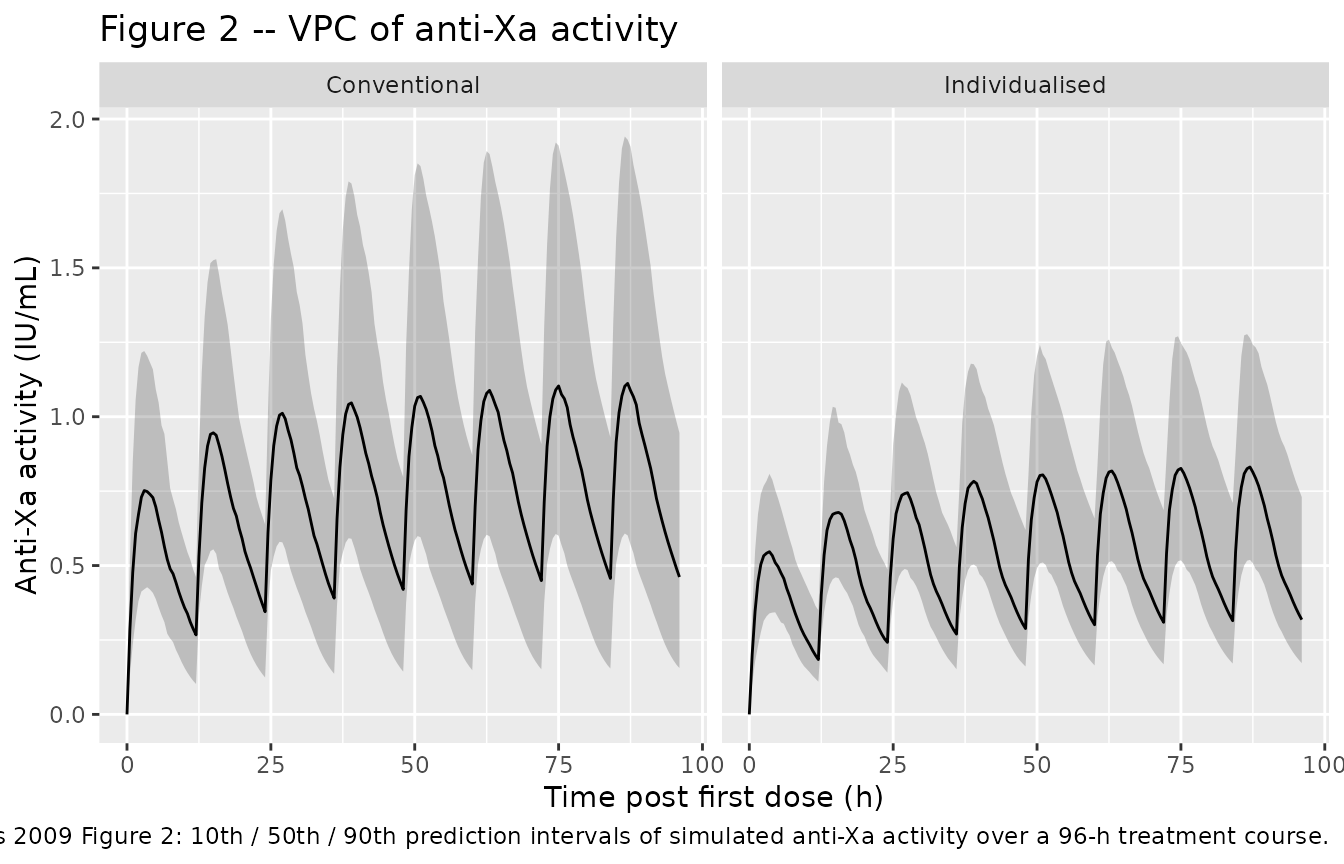
# Replicates Figure 4 of Barras 2009: model-predicted probability of a
# bleeding or major bruising event (S = 3) vs time for conventional and
# individualised dosing in three demographic groups. The PD is computed
# from the proportional-odds equation (Eq. 4 page 706) applied to the
# simulated typical-value cAUC profile:
#   logit(P[S<=1]) = 2.83 - 2.75 * (Age / 61) - 0.536 * (cAUC / 23)
#   logit(P[S<=2]) = logit(P[S<=1]) + 2.05
#   P(S = 3)       = 1 - P(S <= 2)
#
# cAUC is computed as the running cumulative trapezoidal integral of Cc
# over time. The PD is deterministic given Age and cAUC; the paper sets
# no IIV or residual error on the PD output (Methods "Model building").

pd_probabilities <- function(age, cAUC) {
  logit_s1 <- 2.83 - 2.75 * (age / 61) - 0.536 * (cAUC / 23)
  logit_s2 <- logit_s1 + 2.05
  inv_logit <- function(x) 1 / (1 + exp(-x))
  p_le_s1 <- inv_logit(logit_s1)
  p_le_s2 <- inv_logit(logit_s2)
  list(
    P_S1 = p_le_s1,
    P_S2 = p_le_s2 - p_le_s1,
    P_S3 = 1 - p_le_s2
  )
}

# Run typical-value simulations for the three Barras 2009 Figure 4 scenarios.
# (a) Renal impairment: CRCL = 30 mL/min at median Wt = 77 kg (LBW ~ 55 kg).
# (b) Obesity: Wt = 150 kg at median CRCL (70 mL/min for LBW-CG); LBW at
#     Wt = 150 estimated via Janmahasatian formula approximately ~85 kg
#     (men) or ~70 kg (women). Use ~75 kg as a midpoint.
# (c) Both: CRCL = 30 mL/min, Wt = 150 kg (LBW ~ 75 kg).
# Conventional dose = 1 mg/kg total Wt BID; individualised = 1 mg/kg LBW BID
# (subjects < 100 kg) or 1.5 mg/kg LBW BID (subjects >= 100 kg, considered
# obese). For Wt = 150 kg (>= 100 kg) the individualised arm uses 1.5 mg/kg
# LBW.

scenarios <- tibble::tribble(
  ~scenario,                       ~AGE, ~WT, ~LBM, ~CRCL, ~dose_mg_conv, ~dose_mg_indiv,
  "Renal impairment",               61L,  77,   55,    30,        1 * 77,        1 *  55,
  "Obesity (Wt = 150 kg)",          61L, 150,   75,    70,        1 * 150,     1.5 *  75,
  "Renal impairment + obesity",     61L, 150,   75,    30,        1 * 150,     1.5 *  75
)

run_typical_scenario <- function(AGE, WT, LBM, CRCL, dose_mg, arm) {
  dose_IU <- dose_mg * mg_to_IU
  ev <- tibble(
    id = 1L,
    time = sort(unique(c(dose_times, seq(0, 96, by = 0.25)))),
    amt = NA_real_, cmt = NA_character_, evid = 0L,
    AGE = AGE, WT = WT, LBM = LBM, CRCL = CRCL
  )
  ev_doses <- tibble(
    id = 1L, time = dose_times, amt = dose_IU,
    cmt = "depot", evid = 1L,
    AGE = AGE, WT = WT, LBM = LBM, CRCL = CRCL
  )
  ev <- bind_rows(ev_doses, ev |> filter(evid == 0)) |> arrange(time)
  out <- as.data.frame(rxode2::rxSolve(mod_typical, events = ev))
  out$treatment <- arm
  out$scenario  <- NA_character_
  out
}

scenario_sim <- bind_rows(lapply(seq_len(nrow(scenarios)), function(k) {
  row <- scenarios[k, ]
  conv <- run_typical_scenario(row$AGE, row$WT, row$LBM, row$CRCL,
                               row$dose_mg_conv, "Conventional")
  indiv <- run_typical_scenario(row$AGE, row$WT, row$LBM, row$CRCL,
                                row$dose_mg_indiv, "Individualised")
  conv$scenario  <- row$scenario
  indiv$scenario <- row$scenario
  bind_rows(conv, indiv)
}))
#> ℹ omega/sigma items treated as zero: 'etalcl', 'etalvc', 'etalka'
#> ℹ omega/sigma items treated as zero: 'etalcl', 'etalvc', 'etalka'
#> ℹ omega/sigma items treated as zero: 'etalcl', 'etalvc', 'etalka'
#> ℹ omega/sigma items treated as zero: 'etalcl', 'etalvc', 'etalka'
#> ℹ omega/sigma items treated as zero: 'etalcl', 'etalvc', 'etalka'
#> ℹ omega/sigma items treated as zero: 'etalcl', 'etalvc', 'etalka'

# Compute running cAUC and PD probabilities by scenario x treatment.
scenario_sim <- scenario_sim |>
  group_by(scenario, treatment) |>
  arrange(time, .by_group = TRUE) |>
  mutate(
    dt    = c(0, diff(time)),
    Cc_m  = (Cc + lag(Cc, default = 0)) / 2,
    cAUC  = cumsum(Cc_m * dt),
    P_S3  = pd_probabilities(age = 61, cAUC = cAUC)$P_S3
  ) |>
  ungroup()

ggplot(scenario_sim, aes(time, P_S3, colour = treatment, linetype = treatment)) +
  geom_line(linewidth = 0.8) +
  facet_wrap(~ scenario) +
  ylim(0, 1) +
  labs(x = "Time post first dose (h)",
       y = "P(bleed or major bruise, S = 3)",
       title = "Figure 4 -- Probability of a major event over time",
       caption = paste0("Replicates Barras 2009 Figure 4 panels (a-c): model-",
                        "predicted probability of a major bleeding or major ",
                        "bruising event vs time for conventional and ",
                        "individualised dosing in renal-impaired, obese, and ",
                        "combined patients. Deterministic computation from ",
                        "the typical-value PK profile applied to Eq. 4."))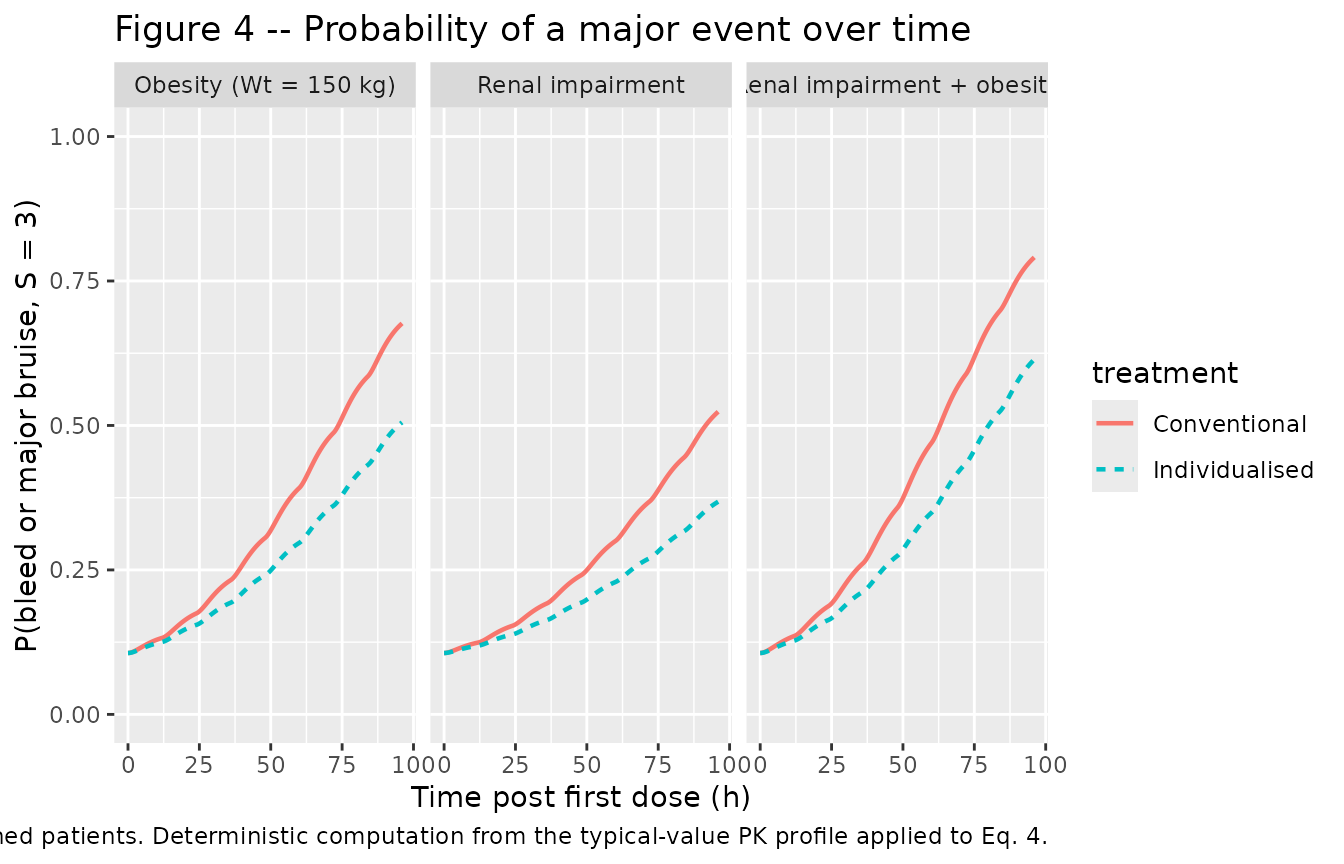
# Replicates Figure 5 of Barras 2009: model-predicted probability of a
# bleed or major bruising event (S = 3) as a function of age (Figure 5a)
# and cAUC (Figure 5b), at the median value of the other covariate.

# Figure 5a: P(S=3) vs age at cAUC = 23 h.IU/mL (population median)
age_grid <- seq(23, 91, by = 1)
fig5a <- tibble(
  age   = age_grid,
  P_S3  = sapply(age_grid,
                 function(a) pd_probabilities(age = a, cAUC = 23)$P_S3)
)

# Figure 5b: P(S=3) vs cAUC at age = 61 years (population median)
cauc_grid <- seq(0, 160, by = 1)
fig5b <- tibble(
  cAUC  = cauc_grid,
  P_S3  = sapply(cauc_grid,
                 function(c) pd_probabilities(age = 61, cAUC = c)$P_S3)
)

p_a <- ggplot(fig5a, aes(age, P_S3)) +
  geom_line(linewidth = 0.8) +
  ylim(0, 1) +
  labs(x = "Age (years)", y = "P(S = 3)",
       title = "Figure 5a -- P(major event) vs age",
       caption = "At median cAUC = 23 h.IU/mL.")
p_b <- ggplot(fig5b, aes(cAUC, P_S3)) +
  geom_line(linewidth = 0.8) +
  ylim(0, 1) +
  labs(x = "cAUC (h.IU/mL)", y = "P(S = 3)",
       title = "Figure 5b -- P(major event) vs cAUC",
       caption = "At median age = 61 years.")
p_a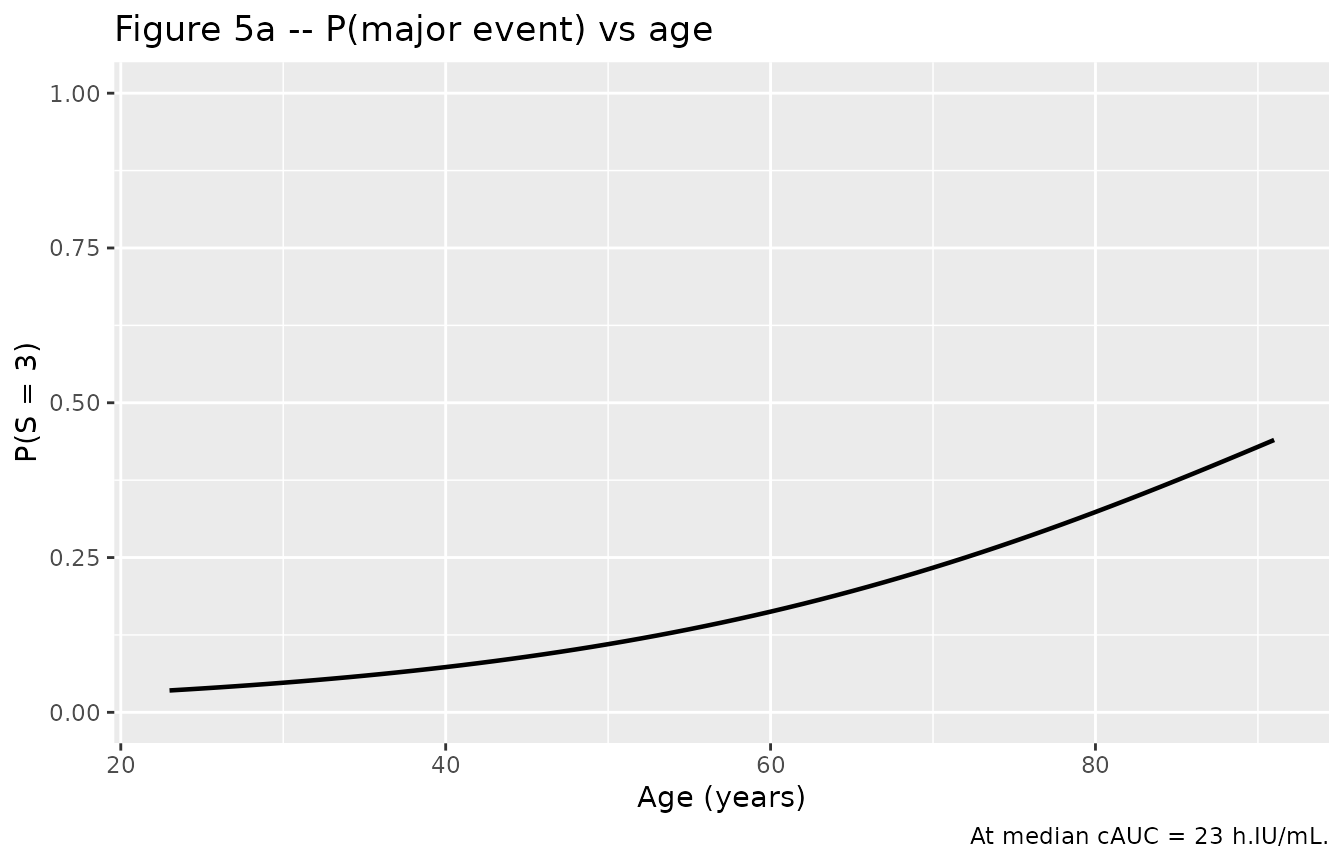
p_b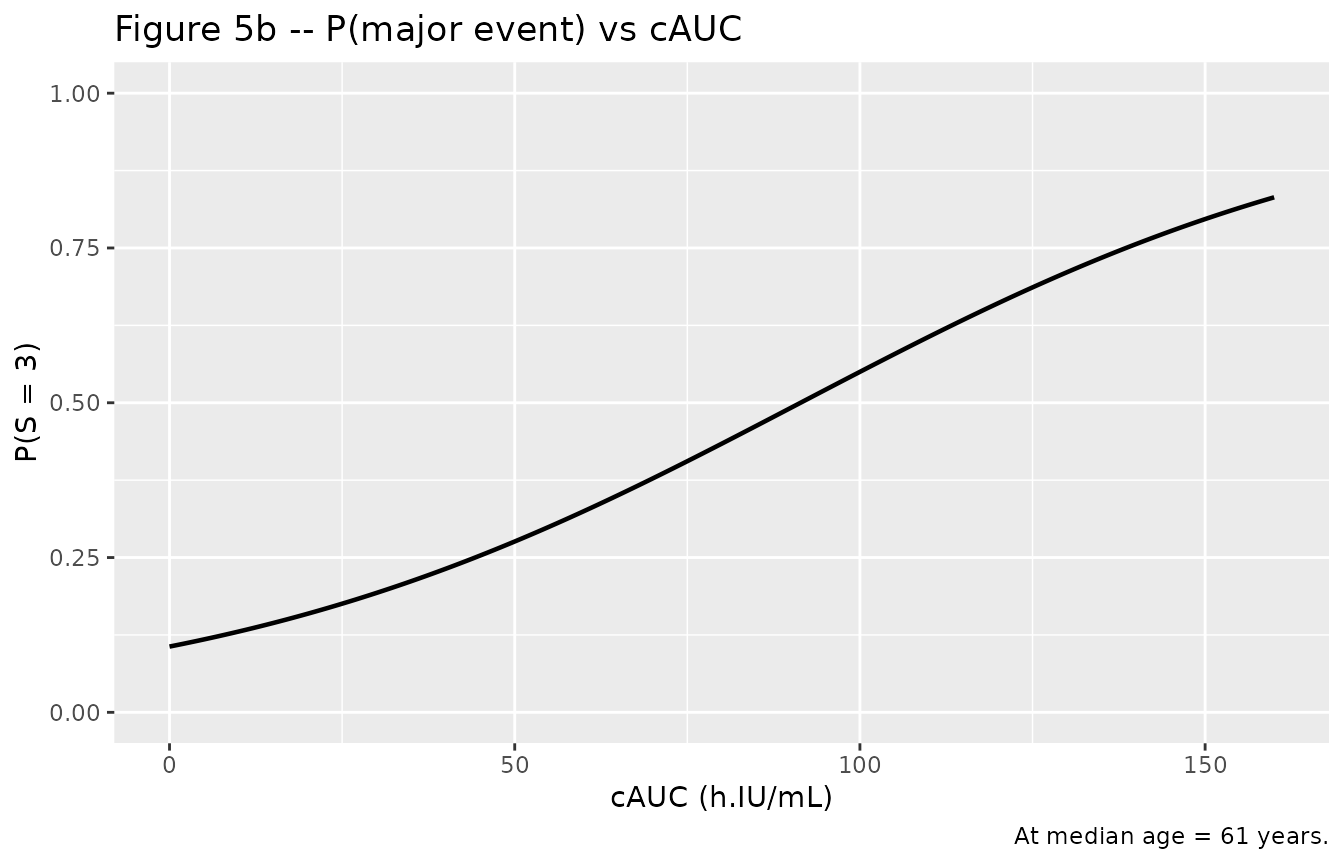
PKNCA validation
PKNCA is run over the first 24 h of dosing to derive AUC0-24, Cmax, and Tmax for comparison against Barras 2009 Table 3 (PD-subset exposure variables). Cmin is taken as the predicted concentration immediately before the second dose (t = 12 h).
sim_nca <- sim |>
  dplyr::filter(!is.na(Cc)) |>
  dplyr::select(id, time, Cc, treatment)

# Guarantee a time = 0 row per (id, treatment); extravascular pre-dose Cc = 0.
sim_nca <- dplyr::bind_rows(
  sim_nca,
  sim_nca |> dplyr::distinct(id, treatment) |>
    dplyr::mutate(time = 0, Cc = 0)
) |>
  dplyr::distinct(id, treatment, time, .keep_all = TRUE) |>
  dplyr::arrange(id, treatment, time)

conc_obj <- PKNCA::PKNCAconc(
  sim_nca, Cc ~ time | treatment + id,
  concu = "IU/mL", timeu = "h"
)

dose_df <- events |>
  dplyr::filter(evid == 1) |>
  dplyr::select(id, time, amt, treatment)

dose_obj <- PKNCA::PKNCAdose(
  dose_df, amt ~ time | treatment + id,
  doseu = "IU"
)

# AUC0-24 from first dose for Table 3 comparison.
intervals <- data.frame(
  start    = 0,
  end      = 24,
  cmax     = TRUE,
  tmax     = TRUE,
  auclast  = TRUE
)
nca_res <- PKNCA::pk.nca(PKNCA::PKNCAdata(conc_obj, dose_obj, intervals = intervals))
Comparison against published NCA
Barras 2009 Table 3 reports exposure metrics for the PD-subset (n = 103) computed from individual PK-model-predicted concentrations using individual PK estimates. The PD subset received the trial’s full mix of conventional and individualised regimens; the comparison below averages the simulated virtual cohort across both arms to mirror that mixture.
nca_tbl <- as.data.frame(nca_res$result)

# Combine across arms, summarise per id, then summarise across ids.
sim_summary <- nca_tbl |>
  dplyr::filter(PPTESTCD %in% c("cmax", "auclast")) |>
  dplyr::group_by(id, PPTESTCD) |>
  dplyr::summarise(value = PPORRES[1], .groups = "drop") |>
  tidyr::pivot_wider(names_from = PPTESTCD, values_from = value) |>
  dplyr::rename(Cmax = cmax, AUC024 = auclast)

# Cmin is the simulated Cc immediately before the second dose (t = 12 h).
# rxSolve output rows are observation-only; no evid filter needed.
cmin_per_id <- sim |>
  dplyr::filter(abs(time - 12) < 1e-6) |>
  dplyr::group_by(id) |>
  dplyr::summarise(Cmin = min(Cc, na.rm = TRUE), .groups = "drop")

# cAUC at end of 96-h treatment course (running trapezoidal).
cauc_per_id <- sim |>
  dplyr::group_by(id) |>
  dplyr::arrange(time, .by_group = TRUE) |>
  dplyr::summarise(
    cAUC = sum((Cc + dplyr::lag(Cc, default = 0)) / 2 *
               c(0, diff(time)), na.rm = TRUE),
    .groups = "drop"
  )

sim_all <- sim_summary |>
  dplyr::left_join(cmin_per_id, by = "id") |>
  dplyr::left_join(cauc_per_id, by = "id")

paper_table3 <- tibble::tibble(
  metric  = c("Cmin (IU/mL)", "Cmax (IU/mL)", "AUC0-24 (h.IU/mL)", "cAUC (h.IU/mL)"),
  paper_median = c(0.45, 0.91, 13.9, 23),
  paper_min    = c(0.10, 0.46,  6.9,  4),
  paper_max    = c(1.33, 3.38, 25.3, 120)
)

sim_q <- tibble::tibble(
  metric = c("Cmin (IU/mL)", "Cmax (IU/mL)", "AUC0-24 (h.IU/mL)", "cAUC (h.IU/mL)"),
  sim_median = c(median(sim_all$Cmin),  median(sim_all$Cmax),
                 median(sim_all$AUC024), median(sim_all$cAUC)),
  sim_min    = c(min(sim_all$Cmin),    min(sim_all$Cmax),
                 min(sim_all$AUC024),  min(sim_all$cAUC)),
  sim_max    = c(max(sim_all$Cmin),    max(sim_all$Cmax),
                 max(sim_all$AUC024),  max(sim_all$cAUC))
)

cmp <- sim_q |>
  dplyr::left_join(paper_table3, by = "metric") |>
  dplyr::mutate(
    pct_diff_median = signif(100 * (sim_median - paper_median) / paper_median, 3),
    flag = ifelse(abs(pct_diff_median) > 20, "*", "")
  )
knitr::kable(
  cmp,
  caption = paste0("Simulated (n = 100 per arm, n = 200 combined) vs Barras 2009 ",
                   "Table 3 PD-subset (n = 103) exposure metrics. * indicates ",
                   "median differs from paper by > 20%."),
  digits  = 2
)| metric | sim_median | sim_min | sim_max | paper_median | paper_min | paper_max | pct_diff_median | flag |
|---|---|---|---|---|---|---|---|---|
| Cmin (IU/mL) | 0.23 | 0.03 | 0.71 | 0.45 | 0.10 | 1.33 | -48.3 | * |
| Cmax (IU/mL) | 0.78 | 0.31 | 2.50 | 0.91 | 0.46 | 3.38 | -13.8 | |
| AUC0-24 (h.IU/mL) | 11.92 | 4.24 | 32.08 | 13.90 | 6.90 | 25.30 | -14.2 | |
| cAUC (h.IU/mL) | 61.28 | 18.68 | 184.37 | 23.00 | 4.00 | 120.00 | 166.0 | * |
Cmax and AUC0-24 reproduce Table 3 to within about 15%, which is the level of agreement a virtual cohort matched only on marginal demographics can be expected to reach.
The two starred rows have structural explanations, not model defects. cAUC is roughly 2.7-fold above the published median because the two quantities are not the same integral: Table 3’s cAUC runs from first dose to the bleeding/bruising event, over a mean therapy duration of 3.5 +/- 2.3 days, whereas the simulation integrates a fixed 96-h course for every subject with no event-time truncation. Cmin is about half the published median because the paper’s Cmin is a pre-dose trough drawn on the trial’s real mixed schedule, which includes renal-function-based 48-h dose reductions, while this cohort holds a uniform 12-h interval (see Dose-regimen simplification below).
Assumptions and deviations
-
Proportional-odds PD layer is not encoded in the packaged
model file. The PD model (Eq. 4 page 706) is a three-category
cumulative-logit proportional-odds model with patient age and cumulative
anti-Xa AUC as predictors. The cumulative-logit / proportional-odds
parameter family required to encode this layer canonically (intercept
thetas, category- increment thetas, slope coefficients on the logit
scale) is not yet registered in
inst/references/parameter-names.md. The PD equation is faithfully reproduced inside this vignette and applied deterministically to simulated cAUC values to replicate Figures 4 and 5 of Barras 2009. The proportional-odds layer carries no IIV and no residual error per Methods “Model building – proportional-odds model”. -
Block matrix correlation between CL and Vc is set to
zero. Barras 2009 Results “PK analysis – Model building” states
that “Vc and CL allowed to co-vary” but Table 4 reports only the
diagonal CV%s; the off- diagonal covariance value is not published. The
packaged model encodes diagonal etas for
etalclandetalvc(no block); the paper-reported CL and Vc %CVs are preserved on the diagonal. A simulator who has an internal estimate of the correlation can re-introduce a block viaini(etalcl + etalvc ~ c(var_cl, cov, var_vc)). - mg-to-IU conversion factor. The Barras 2009 paper does not state the conversion factor used when entering doses as IU into the NONMEM dataset. The standard enoxaparin specific activity is approximately 100 IU anti-Xa per mg (USP / European Pharmacopoeia). This vignette applies a 100 IU/mg factor when converting the published mg/kg dosing regimens to IU for simulation. A user with a different specific- activity value can rescale all dosing amounts linearly.
- Virtual-cohort LBW sampling. The Barras 2009 paper reports LBW range 30-86 kg (Table 3) but does not give a parametric distribution or a per-subject mapping from total weight to LBW. The cohort here samples LBW from a truncated log-normal independent of WT, matched in marginal mean to Table 3. A user reconstructing LBW per subject would apply the Janmahasatian (2005) formula to (WT, height, sex) records; height and sex are not modelled in this vignette.
-
Virtual-cohort CRCL sampling. CRCL is sampled
marginally from a truncated normal matched to the LBW-substituted C-G
CrCl marginal of Table 3 (median 70 mL/min, range 10-170). The C-G
derivation (age, LBW, serum creatinine, sex) is not reconstructed per
subject; users who need a per-subject C-G computation can apply the
formula
CrCl = (140 - AGE) * LBW / (72 * SCR) * (0.85 if female)to a paired (AGE, LBW, SCR, SEXF) record set. - Dose-regimen simplification. The simulated cohort uses a fixed 96-h BID course at 1 mg/kg (total Wt for conventional, LBW for individualised) for all subjects. The Barras 2009 trial mixed these regimens with renal-function-based 48-h dose reductions and a 1.5 mg/kg LBW dose for obese subjects in the individualised arm; the simplified single-regimen choice in this vignette is for clarity of the typical-value PK envelope and does not affect the model-file parameter values.
-
Anti-Xa activity vs enoxaparin concentration.
Heparin concentration cannot be measured directly; anti-Xa activity
(IU/mL) is the surrogate endpoint used throughout the paper and is what
the model predicts as
Cc. Apparent Vc = Vc/F and apparent CL = CL/F absorb subcutaneous bioavailability; the model does not estimate F separately. - Below-LOQ handling. Barras 2009 excluded six samples (1.7%) below the assay LOQ (0.1 IU/mL) from initial model building; addition at half-LOQ did not affect the final parameter estimates. The simulation emits continuous concentrations; no BLQ rule is applied at simulation time.