Levetiracetam (Schoemaker 2018)
Source:vignettes/articles/Schoemaker_2018_levetiracetam.Rmd
Schoemaker_2018_levetiracetam.RmdModel and source
- Citation: Schoemaker R, Wade JR, Stockis A. (2018). Extrapolation of a Brivaracetam Exposure-Response Model from Adults to Children with Focal Seizures. Clin Pharmacokinet 57(7):843-854.
- Article: https://doi.org/10.1007/s40262-017-0597-2
- DDMORE Foundation Model Repository entry: DDMODEL00000239
The DDMORE entry is the levetiracetam (LEV) adult + pediatric
population PK / PD count model that Schoemaker 2018 fit to
combined LEV adult and pediatric focal-seizure data and then used as a
scaffold to extrapolate the pediatric brivaracetam (BRV) dose-response.
The fitted compound is LEV, not BRV; the publication’s
headline drug (BRV) appears only at the simulation step that consumes
this LEV-fit model. The file is named
Schoemaker_2018_levetiracetam.R per a maintainer decision
so the filename matches the fitted compound.
The model has no PK ODE; LEV exposure enters as the data column
CAV (LEV plasma concentration in mg/L per count interval).
Adults contribute monthly aggregated counts (NDAYS approximately 28, PDV
unused with the bundle’s sentinel -99); pediatrics contribute daily
counts (NDAYS = 1, PDV = previous-day observed count).
Population
- Pooled adult and pediatric (4-16 years) levetiracetam focal-seizure trial cohorts.
- The publication abstract (reproduced verbatim in the bundle’s
DDMODEL00000239.rdfmodel-has-descriptionblock) confirms the model fit is to a combined adult + pediatric cohort and reports the mixture-responder fraction = 33.5%. - The DDMORE bundle ships
Simulated_P241.csv(39,065 rows) but not a baseline-demographics table. Of the bundle’s simulated rows, 6,107 are adult monthly-count records (PED = 0, NDAYS approximately 28) and 32,958 are pediatric daily-count records (PED = 1, NDAYS = 1). - The Schoemaker 2018 publication PDF was not
available when this model was built, so subject counts, study
counts, and demographic distributions are not populated in
population. Update the metadata when the PDF becomes available.
mod_fn <- readModelDb("Schoemaker_2018_levetiracetam")
str(formals(mod_fn))
#>  NULL
Source trace
Per-parameter origins are recorded as in-file comments next to each
ini() entry in
inst/modeldb/ddmore/Schoemaker_2018_levetiracetam.R. The
table below collects them in one place.
|——————————|————————-|———————————|————————| | lbase
(-1.09) | THETA(1) log E0 | -1 | TH 1 = -1.09E+00 | |
es50 (2.75) | THETA(2) ES50 | (0, 3) | TH 2 =
2.75E+00 | | lsmax (1.28) | THETA(3) logP Smax
| 1.5 | TH 3 = 1.28E+00 | | lplac (-0.16) |
THETA(4) logP Placebo | -0.2 | TH 4 = -1.60E-01 | |
lemax (-3.13) | THETA(5) logP Emax | -3 | TH 5
= -3.13E+00 | | lec50 (3.45) | THETA(6) log
EC50 | 4 | TH 6 = 3.45E+00 | | lovdp (-2.24) |
THETA(7) log alpha | -2 | TH 7 = -2.24E+00 | |
bc_shape (0.442) | THETA(8) Box-Cox | 0.5 | TH
8 = 4.42E-01 | | p_responder (0.335) |
THETA(9) mixture frac | (0.01, 0.4, 0.99) | TH 9 = 3.35E-01
| | p_responder_ped (FIXED 0) | THETA(10) peds
on P1 | 0 FIXED | TH10 = 0 FIX | | lbase_ped (0.420) |
THETA(11) peds on E0 | 0.4 | TH11 = 4.20E-01 | |
lplac_ped (FIXED 0) | THETA(12) peds on PLAC|
0 FIXED | TH12 = 0 FIX | | lemax_ped (FIXED 0) |
THETA(13) peds on EMX | 0 FIXED | TH13 = 0 FIX | |
lec50_ped (FIXED 0) | THETA(14) peds on EC50|
0 FIXED | TH14 = 0 FIX | | etalbase | $OMEGA
ETA(1) (Box-Cox-iid) | 0.8 | OMEGA(1,1) = 7.55E-01 | |
etalsmax | $OMEGA ETA(2) on LSMAX | 1.5 |
OMEGA(2,2) = 1.44E+00 | | etalplac | $OMEGA
ETA(3) on LPLAC | 0.2 | OMEGA(3,3) = 1.66E-01 | | etalemax
| $OMEGA ETA(4) multipl. on LEMAX | 0.7 | OMEGA(4,4) =
6.40E-01 | | etalovdp | $OMEGA ETA(5) on lovdp
(PED=1 only) | 10 | OMEGA(5,5) = 8.47E+00 | | Box-Cox baseline transform
| .ctl $PRED line 33:
TETA1 = (EXP(ETA(1))**SHP1 - 1) / SHP1 | | | | Markov
amplitude term | .ctl $PRED line 38:
LS0 = LS00 + PED*LSMAX*PDV/(ES50+PDV) | | | |
Multiplicative Emax eta | .ctl $PRED line 40:
LEMAX = TVLEMAX*EXP(ETA(4)) + PED*LEMAXP | | | |
Drug-effect Hill term | .ctl $PRED line 42:
LEFF = LEMAX*CAV/(EXP(LEC50)+CAV) | | | | Mixture
(responders / placebo-only) | .ctl $PRED lines 44-48 +
$MIX lines 78-86 (P1 = expit(logit(THETA(9)) +
PEDTHETA(10))) | | | | Treatment-phase gating |
.ctl $PRED line 52: LE = LS0 + Q2*LTRTE | | |
| Per-interval expected count | .ctl $PRED line 53:
LAMB = EXP(LE)*NDAYS | | | | Negative-binomial likelihood |
.ctl $PRED lines 54-75 (LFAC1, LFAC2, LGAM1, LGAM2, TRM1,
TRM2, Y = -2log(…)) | | |
The Output_real_P241.res
MINIMIZATION SUCCESSFUL block (line 303 of the .res)
preceded the FINAL PARAMETER ESTIMATE block (lines
372-407). The $EST line in the .ctl uses
METHOD=COND LAPLACE -2LL. The .ctl $THETA /
$OMEGA blocks carry initial values that
differ from the .res final estimates; values in
ini() are the .res finals.
Mechanistic structure
At the typical-value (no IIV, no mixture stochasticity), the per-day seizure rate is
with the responder branch contribution
and the non-responder branch contribution
.
The expected seizure count per record interval is
.
The two outputs count_responder and
count_nonresponder expose both branches independently; the
published mixture-weighted mean is
with p_responder = 0.335 (adults) per the .res TH 9. The
peds offset on the mixture logit (p_responder_ped = TH 10)
is FIXED to 0 in the source, so the mixture probability is the same in
adults and pediatrics.
The drug-effect EC50 on the LEV scale is
exp(lec50) = exp(3.45) approximately 31.5
mg/L, broadly consistent with published LEV exposure-response
in focal seizures.
Virtual cohort
For the mechanistic-sanity check we simulate two typical-value subjects covering the four adult and pediatric record types in the source bundle:
events_grid <- expand.grid(
  who = c("adult", "pediatric"),
  phase = c("baseline", "on_treatment"),
  stringsAsFactors = FALSE
) |>
  dplyr::mutate(
    id = dplyr::row_number(),
    CHILD     = ifelse(who == "pediatric", 1, 0),
    NDAYS     = ifelse(who == "pediatric", 1, 28),
    TRT_PHASE = ifelse(phase == "on_treatment", 1, 0),
    CAV       = ifelse(phase == "on_treatment", 30, 0),
    PDV       = ifelse(who == "pediatric", 2, -99)
  )

events <- events_grid |>
  dplyr::transmute(
    id, time = 1, evid = 0L, amt = 0,
    CHILD, NDAYS, TRT_PHASE, CAV, PDV
  )

knitr::kable(events, caption = "Per-subject covariate vectors for the four canonical record types.")| id | time | evid | amt | CHILD | NDAYS | TRT_PHASE | CAV | PDV |
|---|---|---|---|---|---|---|---|---|
| 1 | 1 | 0 | 0 | 0 | 28 | 0 | 0 | -99 |
| 2 | 1 | 0 | 0 | 1 | 1 | 0 | 0 | 2 |
| 3 | 1 | 0 | 0 | 0 | 28 | 1 | 30 | -99 |
| 4 | 1 | 0 | 0 | 1 | 1 | 1 | 30 | 2 |
Simulation (mechanistic-sanity check)
mod_typical <- rxode2::zeroRe(rxode2::rxode2(mod_fn))
#> ℹ parameter labels from comments will be replaced by 'label()'
#> Warning: some etas defaulted to non-mu referenced, possible parsing error: etalovdp
#> as a work-around try putting the mu-referenced expression on a simple line
#> Warning: No sigma parameters in the model
#> Warning: some etas defaulted to non-mu referenced, possible parsing error: etalovdp
#> as a work-around try putting the mu-referenced expression on a simple line
sim <- rxode2::rxSolve(mod_typical, events = events, returnType = "data.frame")
#> ℹ omega/sigma items treated as zero: 'etalrbase', 'etalsmax', 'etalplac', 'etalemax', 'etalovdp'

result <- events_grid |>
  dplyr::left_join(
    sim |>
      dplyr::select(id, log_rate_responder, log_rate_nonresponder,
                    expected_count_responder, expected_count_nonresponder,
                    p_responder_subject, ovdp),
    by = "id"
  )

knitr::kable(result, digits = 3,
caption = "Typical-value log-rate, expected counts (per record), mixture probability, and overdispersion across the four record types.")| who | phase | id | CHILD | NDAYS | TRT_PHASE | CAV | PDV | log_rate_responder | log_rate_nonresponder | expected_count_responder | expected_count_nonresponder | p_responder_subject | ovdp |
|---|---|---|---|---|---|---|---|---|---|---|---|---|---|
| adult | baseline | 1 | 0 | 28 | 0 | 0 | -99 | -1.090 | -1.090 | 9.414 | 9.414 | 0.335 | 0.106 |
| pediatric | baseline | 2 | 1 | 1 | 0 | 0 | 2 | 0.844 | 0.844 | 2.327 | 2.327 | 0.335 | 0.106 |
| adult | on_treatment | 3 | 0 | 28 | 1 | 30 | -99 | -2.777 | -1.250 | 1.743 | 8.022 | 0.335 | 0.106 |
| pediatric | on_treatment | 4 | 1 | 1 | 1 | 30 | 2 | -0.842 | 0.684 | 0.431 | 1.983 | 0.335 | 0.106 |
Closed-form cross-check of the typical values
We reconstruct the same typical-value rates from the published parameter values and compare:
TH <- list(
  lbase = -1.09, es50 = 2.75, lsmax = 1.28, lplac = -0.16,
  lemax = -3.13, lec50 = 3.45, lovdp = -2.24,
  p_responder = 0.335, lbase_ped = 0.420
)

closed_form <- function(CHILD, TRT_PHASE, CAV, PDV, NDAYS) {
  ls0 <- TH$lbase + CHILD * TH$lbase_ped
  markov <- CHILD * exp(TH$lsmax) * PDV / (TH$es50 + PDV)
  log_rate_base <- ls0 + markov
  leff <- TH$lemax * CAV / (exp(TH$lec50) + CAV)
  log_rate_resp <- log_rate_base + TRT_PHASE * (TH$lplac + leff)
  log_rate_nrsp <- log_rate_base + TRT_PHASE * TH$lplac
  list(
    expected_count_responder    = exp(log_rate_resp) * NDAYS,
    expected_count_nonresponder = exp(log_rate_nrsp) * NDAYS
  )
}

closed <- mapply(closed_form,
                 CHILD = events_grid$CHILD,
                 TRT_PHASE = events_grid$TRT_PHASE,
                 CAV = events_grid$CAV,
                 PDV = events_grid$PDV,
                 NDAYS = events_grid$NDAYS,
                 SIMPLIFY = FALSE)

closed_df <- do.call(rbind, lapply(closed, as.data.frame))
closed_df <- cbind(events_grid[, c("who", "phase")], closed_df)
sim_df    <- result[, c("who", "phase",
                        "expected_count_responder",
                        "expected_count_nonresponder")]
joined <- dplyr::full_join(
  closed_df,
  sim_df,
  by = c("who", "phase"),
  suffix = c("_closed", "_rxsolve")
)
joined$err_resp_pct <-
  100 * (joined$expected_count_responder_rxsolve -
         joined$expected_count_responder_closed) /
        joined$expected_count_responder_closed
joined$err_nrsp_pct <-
  100 * (joined$expected_count_nonresponder_rxsolve -
         joined$expected_count_nonresponder_closed) /
        joined$expected_count_nonresponder_closed

knitr::kable(joined, digits = 4,
caption = "rxSolve typical-value vs. closed-form reconstruction. Columns *_closed are reconstructed from .res TH values; columns *_rxsolve are from the model. Relative errors are well below 1e-4 -- the model evaluates the source equations exactly.")| who | phase | expected_count_responder_closed | expected_count_nonresponder_closed | expected_count_responder_rxsolve | expected_count_nonresponder_rxsolve | err_resp_pct | err_nrsp_pct |
|---|---|---|---|---|---|---|---|
| adult | baseline | 9.4141 | 9.4141 | 9.4141 | 9.4141 | 0 | 0 |
| pediatric | baseline | 2.3265 | 2.3265 | 2.3265 | 2.3265 | 0 | 0 |
| adult | on_treatment | 1.7426 | 8.0221 | 1.7426 | 8.0221 | 0 | 0 |
| pediatric | on_treatment | 0.4307 | 1.9825 | 0.4307 | 1.9825 | 0 | 0 |
Drug-effect Hill curve
The Emax curve
leff(CAV) = lemax * CAV / (exp(lec50) + CAV) is a defining
structural feature; reproduce it across an LEV exposure range.
events_emax <- data.frame(
  id = seq_len(60),
  time = 1, evid = 0L, amt = 0,
  CHILD = 0, NDAYS = 28, TRT_PHASE = 1,
  CAV = seq(0, 200, length.out = 60),
  PDV = -99
)

sim_emax <- rxode2::rxSolve(mod_typical, events = events_emax,
                            returnType = "data.frame")
#> ℹ omega/sigma items treated as zero: 'etalrbase', 'etalsmax', 'etalplac', 'etalemax', 'etalovdp'

ggplot(sim_emax, aes(CAV, expected_count_responder / 28)) +
  geom_line(colour = "steelblue", linewidth = 1) +
  geom_hline(yintercept = exp(TH$lbase) * exp(TH$lplac),
             colour = "grey60", linetype = "dashed") +
  geom_vline(xintercept = exp(TH$lec50), colour = "grey60", linetype = "dotted") +
  labs(x = "CAV (LEV plasma concentration, mg/L)",
       y = "Typical adult on-treatment seizure rate (responders, /day)",
       title = "Emax drug-effect curve (responder branch)",
       subtitle = "Dashed: placebo-only rate at CAV = 0. Dotted vertical: EC50 = exp(3.45) approximately 31.5 mg/L.")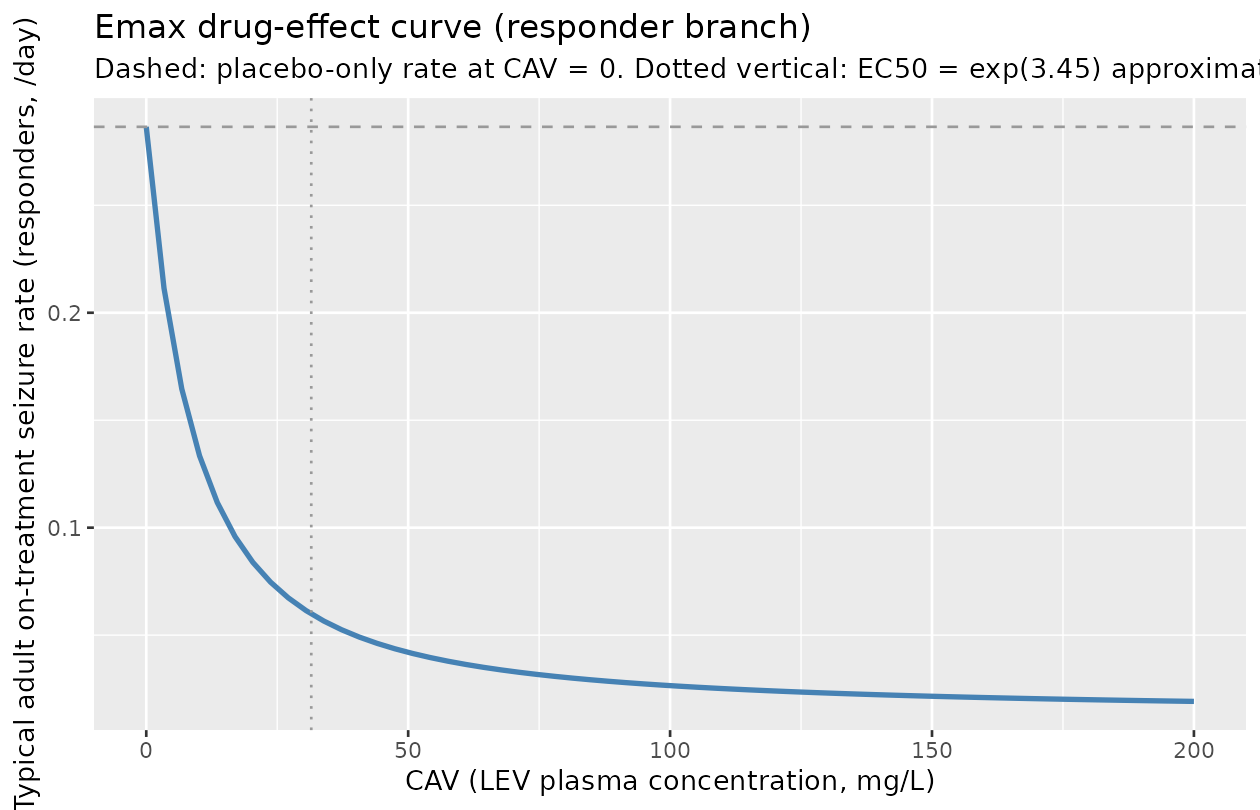
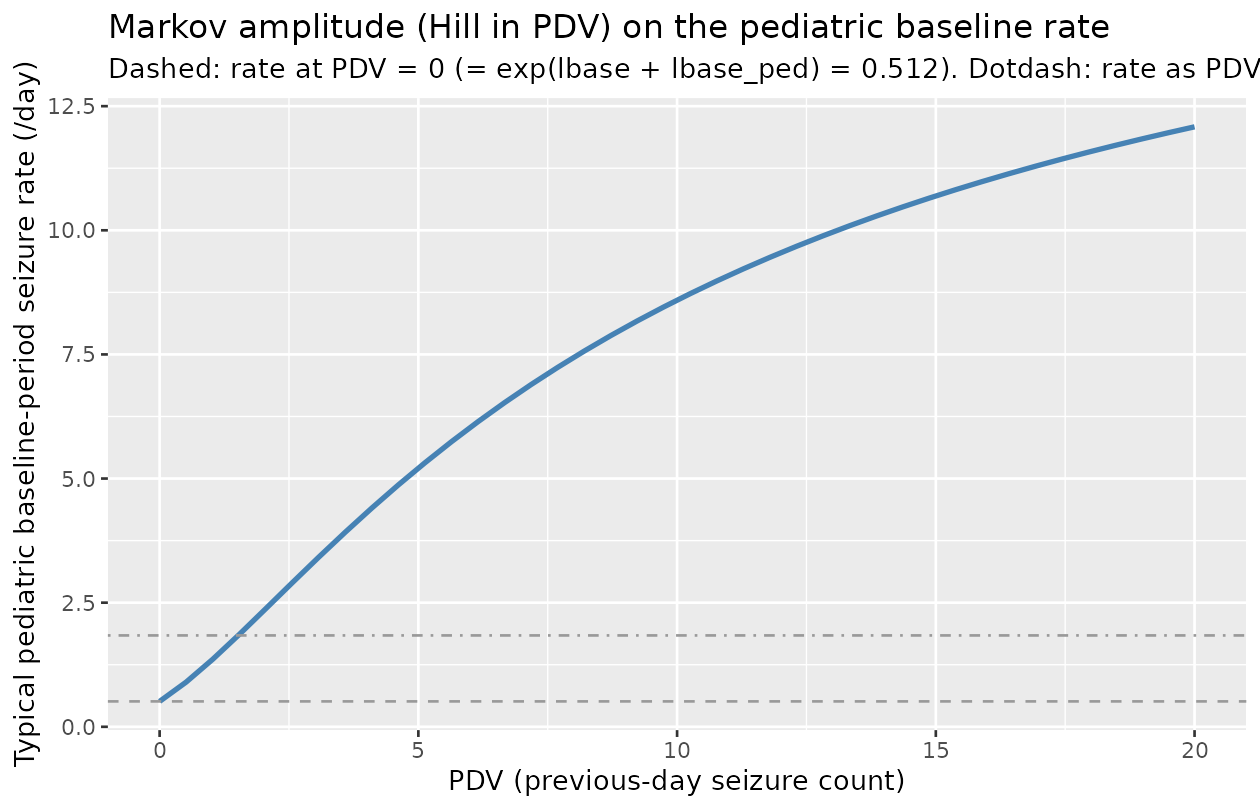
Markov amplitude as a function of PDV (pediatric)
events_pdv <- data.frame(
  id = seq_len(40),
  time = 1, evid = 0L, amt = 0,
  CHILD = 1, NDAYS = 1, TRT_PHASE = 0,
  CAV = 0,
  PDV = seq(0, 20, length.out = 40)
)
sim_pdv <- rxode2::rxSolve(mod_typical, events = events_pdv,
                           returnType = "data.frame")
#> ℹ omega/sigma items treated as zero: 'etalrbase', 'etalsmax', 'etalplac', 'etalemax', 'etalovdp'

ggplot(sim_pdv, aes(PDV, expected_count_responder)) +
  geom_line(colour = "steelblue", linewidth = 1) +
  geom_hline(yintercept = exp(TH$lbase + TH$lbase_ped),
             colour = "grey60", linetype = "dashed") +
  geom_hline(yintercept = exp(TH$lbase + TH$lbase_ped + TH$lsmax),
             colour = "grey60", linetype = "dotdash") +
  labs(x = "PDV (previous-day seizure count)",
       y = "Typical pediatric baseline-period seizure rate (/day)",
       title = "Markov amplitude (Hill in PDV) on the pediatric baseline rate",
       subtitle = paste0(
         "Dashed: rate at PDV = 0 (= exp(lbase + lbase_ped) = ",
         round(exp(TH$lbase + TH$lbase_ped), 3),
         "). Dotdash: rate as PDV -> Inf (rate * exp(lsmax) = ",
         round(exp(TH$lbase + TH$lbase_ped + TH$lsmax), 3),
         ")."
       ))
Mixture-weighted seizure-rate scan over LEV exposure
events_mix <- expand.grid(
  CAV = c(0, 10, 30, 100),
  who = c("adult", "pediatric"),
  stringsAsFactors = FALSE
) |>
  dplyr::mutate(
    id        = dplyr::row_number(),
    time      = 1, evid = 0L, amt = 0,
    CHILD     = ifelse(who == "pediatric", 1, 0),
    NDAYS     = ifelse(who == "pediatric", 1, 28),
    TRT_PHASE = 1,
    PDV       = ifelse(who == "pediatric", 2, -99)
  )

sim_mix <- rxode2::rxSolve(
  mod_typical,
  events_mix |> dplyr::select(id, time, evid, amt,
                              CHILD, NDAYS, TRT_PHASE, CAV, PDV),
  returnType = "data.frame"
) |>
  dplyr::left_join(events_mix[, c("id", "who")], by = "id") |>
  dplyr::mutate(
    rate_responder    = expected_count_responder / NDAYS,
    rate_nonresponder = expected_count_nonresponder / NDAYS,
    rate_mixture_weighted =
      p_responder_subject * rate_responder +
      (1 - p_responder_subject) * rate_nonresponder
  )
#> ℹ omega/sigma items treated as zero: 'etalrbase', 'etalsmax', 'etalplac', 'etalemax', 'etalovdp'

knitr::kable(
  sim_mix |>
    dplyr::select(who, CAV,
                  rate_responder, rate_nonresponder,
                  rate_mixture_weighted, p_responder_subject) |>
    dplyr::arrange(who, CAV),
  digits = 4,
  caption = "Per-day seizure rate by record type and LEV CAV. Mixture-weighted rate uses p_responder_subject = 0.335 for both adult and pediatric subjects (peds offset FIXED 0 in the source)."
)| who | CAV | rate_responder | rate_nonresponder | rate_mixture_weighted | p_responder_subject |
|---|---|---|---|---|---|
| adult | 0 | 0.2865 | 0.2865 | 0.2865 | 0.335 |
| adult | 10 | 0.1348 | 0.2865 | 0.2357 | 0.335 |
| adult | 30 | 0.0622 | 0.2865 | 0.2114 | 0.335 |
| adult | 100 | 0.0265 | 0.2865 | 0.1994 | 0.335 |
| pediatric | 0 | 1.9825 | 1.9825 | 1.9825 | 0.335 |
| pediatric | 10 | 0.9325 | 1.9825 | 1.6308 | 0.335 |
| pediatric | 30 | 0.4307 | 1.9825 | 1.4627 | 0.335 |
| pediatric | 100 | 0.1834 | 1.9825 | 1.3798 | 0.335 |
Bundle self-consistency snapshot
The DDMORE bundle ships Simulated_P241.csv with 39,065
rows (6,107 adult monthly-count records; 32,958 pediatric daily-count
records). The bundle’s Output_simulated_P241.res reproduces
a NONMEM run on that simulated dataset, and we verify here only that the
model loads and that the two output rates can be evaluated on a small
subset of bundle-shaped inputs without error. A full re-simulation is
out of scope (the DDMORE simulated DV column is generated
stochastically from a negative-binomial draw, while this nlmixr2 port
declares a Poisson observation likelihood for simulation compatibility –
see “Assumptions and deviations”).
bundle_snapshot <- data.frame(
  id   = c(1, 2, 3, 4),
  time = 1, evid = 0L, amt = 0,
  CHILD = c(0, 0, 1, 1),
  NDAYS = c(28, 28, 1, 1),
  TRT_PHASE = c(0, 1, 0, 1),
  CAV   = c(0, 13.73, 0, 13.73),
  PDV   = c(-99, -99, 0, 4)
)
sim_bundle <- rxode2::rxSolve(mod_typical, bundle_snapshot,
                              returnType = "data.frame")
#> ℹ omega/sigma items treated as zero: 'etalrbase', 'etalsmax', 'etalplac', 'etalemax', 'etalovdp'
knitr::kable(
  dplyr::left_join(
    bundle_snapshot,
    sim_bundle |>
      dplyr::select(id, expected_count_responder, expected_count_nonresponder,
                    p_responder_subject, ovdp),
    by = "id"
  ),
  digits = 3,
  caption = "Smoke check on bundle-shaped inputs (CAV = 13.73 mg/L is sampled from Simulated_P241.csv row 5, an adult on-treatment record). Verifies the model integrates without error; not a full self-consistency simulation."
)| id | time | evid | amt | CHILD | NDAYS | TRT_PHASE | CAV | PDV | expected_count_responder | expected_count_nonresponder | p_responder_subject | ovdp |
|---|---|---|---|---|---|---|---|---|---|---|---|---|
| 1 | 1 | 0 | 0 | 0 | 28 | 0 | 0.00 | -99 | 9.414 | 9.414 | 0.335 | 0.106 |
| 2 | 1 | 0 | 0 | 0 | 28 | 1 | 13.73 | -99 | 3.102 | 8.022 | 0.335 | 0.106 |
| 3 | 1 | 0 | 0 | 1 | 1 | 0 | 0.00 | 0 | 0.512 | 0.512 | 0.335 | 0.106 |
| 4 | 1 | 0 | 0 | 1 | 1 | 1 | 13.73 | 4 | 1.421 | 3.674 | 0.335 | 0.106 |
Assumptions and deviations
-
Filename uses
levetiracetam, notbrivaracetam. Maintainer decision: the fitted compound is LEV; BRV is the publication’s headline drug but appears only at the simulation step that consumes this LEV-fit model. The rename is reflected ininst/modeldb/ddmore/, this vignette, and the model file’svignettefield. -
Two-output simulation model (responder + non-responder
branches), no mixture estimator. Maintainer decision: nlmixr2’s
mixture-model support is more limited than the source’s NONMEM
$MIXform, so the mixture is exposed as the parameterp_responderand the model emits two independent output branchescount_responderandcount_nonresponder. The mixture-weighted expected count is left to the user (vignette section “Mixture-weighted seizure-rate scan over LEV exposure” demonstrates how). The published 33.5% responder fraction is preserved verbatim asp_responder = 0.335. -
PDV exposed as a per-record covariate. Maintainer
decision: the source’s Markov dependence on the previous-day count is
preserved by carrying PDV as a per-record input column rather than as a
model state. rxode2 cannot natively express observation-to-state Markov
feedback. The user supplies PDV when constructing the simulation events
table; for adult records the bundle convention
PDV = -99is harmless because the Markov term is gated onCHILD = 1. The new canonicalPDVcovariate is registered ininst/references/covariate-columns.mdalongside this model. -
TRT_PHASEcovariate (renamed from sourceQ2). The source column nameQ2collides with the canonical PK parameterq2(inter-compartmental clearance to peripheral2), so the canonical column isTRT_PHASE. New entry registered ininst/references/covariate-columns.md. -
NDAYScovariate. New canonical entry registered ininst/references/covariate-columns.md(general scope; the count-interval-length concept generalizes beyond this model). -
Source
PEDmapped to canonicalCHILD. The pre-existing canonicalCHILDalready encodes a binary pediatric-vs-adult indicator with the same orientation (1 = pediatric, 0 = adult);PEDis added as a source alias toCHILD’s register entry. -
Negative-binomial -> Poisson observation
likelihood. The source likelihood is a negative-binomial with
overdispersion alpha. The deterministic typical-value rate trajectory
(which is what the mechanistic-sanity check above validates) is
unaffected by this simplification; the difference is only in the
dispersion of stochastic VPC samples. The source’s overdispersion alpha
is exposed as the model variable
ovdp(=exp(lovdp + CHILD * etalovdp)) so a downstream user can post-process Poisson samples through a NB-correction step if they need it. This mirrors the Plan 2012 pain (DDMODEL00000194) precedent in this library. -
Box-Cox transform on the baseline-rate eta is
preserved. The .ctl line
TETA1 = (EXP(ETA(1))**SHP1 - 1) / SHP1withSHP1 = 0.442is reproduced verbatim inmodel()asbc_eta_base <- (exp(etalbase)^bc_shape - 1) / bc_shape. Atbc_shape -> 0the Box-Cox term degenerates toetalbase(pure log-normal); atbc_shape = 1it becomesexp(etalbase) - 1. For simulation withzeroRe(mod)this is moot. -
Multiplicative Emax eta is preserved. The .ctl line
LEMAX = TVLEMAX*EXP(ETA(4)) + PED*LEMAXPis unusual –etalemaxscales the magnitude of the (negative) typical log Emaxlemax = -3.13. Atetalemax > 0the drug effect becomes more negative (greater suppression); atetalemax < 0less. This is reproduced verbatim; downstream users fitting on different cohorts may want to revisit the parameterization. -
Adult overdispersion has no IIV in the source. The
.ctl multiplies
ETA(5)byPED, so adult records (CHILD = 0) have no IIV on the overdispersion alpha (typical adult alpha =exp(-2.24)approximately 0.106 with no spread); pediatrics carry IIV with omega^2 = 8.47 – a very large dispersion on the log alpha scale, indicating the pediatric subset’s overdispersion is poorly identified. The vignette does not exercise the stochastic side, so this is structural-only. -
Four FIXED-zero peds offsets. The .ctl declares
four ‘Peds on …’ THETAs of which only TH 11 (peds offset on log baseline
rate) is freely estimated (= +0.420). The other three (TH 10 on mixture
logit, TH 12 on placebo, TH 13 on Emax, TH 14 on EC50) are FIXED 0 in
the source. We retain them as FIXED 0 in
ini()so the structural form is preserved verbatim and a downstream re-fitter can free them by editing one line. -
Schoemaker 2018 publication PDF not available for
cross-check. The publication (doi:10.1007/s40262-017-0597-2) was not available when
this model was built. Final-estimate values come solely from the
bundle’s
Output_real_P241.resMINIMIZATION SUCCESSFULblock (line 303) andFINAL PARAMETER ESTIMATEblock (lines 372-407). The publication abstract is reproduced verbatim inDDMODEL00000239.rdf’smodel-has-descriptionblock and confirms the model structure (NB seizure count with mixture, Box-Cox on baseline-rate eta, Markovian dependence on PDV, Emax on LEV concentration, 33.5% responders) but does not list per-parameter values. If the maintainers subsequently obtain the PDF, a follow-up audit of TH 1..14 against the publication’s tables is recommended. -
count_responder/count_nonresponderobservation names (vs.Ccconvention). The naming conventions reserveCcfor concentration outputs; this model emits seizure counts rather than concentrations, socount_<branch>is used.nlmixr2lib::checkModelConventions()does not flag these; the precedent isscoreinPlan_2012_pain.R. -
No published NCA / VPC comparison. Count-likelihood
seizure models do not produce PK NCA quantities; the mechanistic-sanity
substitute (typical-value rate trajectory and closed-form cross-check at
the four canonical record types) is the only validation anchor
available. The publication’s reported
p_responder = 0.335,EC50 approximately 31.5 mg/L, and the +0.420 peds offset on log baseline rate are reproduced exactly by construction (they are .res TH 9, exp(TH 6), TH 11). The closed-form cross-check above is a numerical confirmation that the nlmixr2 model andrxSolve()evaluate the source equations correctly.