Emfilermin (Goggin 2004)
Source:vignettes/articles/Goggin_2004_emfilermin.Rmd
Goggin_2004_emfilermin.RmdModel and source
- Citation: Goggin T, Nguyen QTX, Munafo A. Population pharmacokinetic modelling of Emfilermin (recombinant human leukaemia inhibitory factor, r-hLIF) in healthy postmenopausal women and in infertile patients undergoing in vitro fertilization and embryo transfer. Br J Clin Pharmacol. 2004;57(5):576-585. doi:10.1111/j.1365-2125.2003.02064.x.
- Description: One-compartment population PK model for subcutaneous emfilermin (recombinant human leukaemia inhibitory factor, r-hLIF) in healthy postmenopausal women and in infertile women undergoing in vitro fertilization and embryo transfer (IVF-ET) (Goggin 2004). Absorption is zero-order (D1 = 0.84 h, invariant, no IIV) directly into the central compartment, followed by first-order elimination. Apparent clearance CL/F is decreased by 35% in IVF-ET patients (typical 37 L/h) relative to healthy postmenopausal women (typical 57 L/h). Apparent volume V/F is linear in body weight on the natural scale: V/F = 235 L at the median 62 kg, increasing or decreasing by 6.7 L/kg (~29% per 10 kg) – an absolute-linear covariate form, not log-multiplicative. Inter-individual variability is log-normal on CL/F (17% CV) and V/F (28% CV); inter-occasion variability is log-normal on V/F (23% CV) across three protocol-defined occasions (first dosing day = 1, intermediate dosing days = 2, last dosing day = 3). Residual error is proportional (20% CV). Studied weight range was 48-83 kg; the linear V/F-WT term is extrapolation-unsafe below ~27 kg where the typical V/F would become negative.
- Article: https://doi.org/10.1111/j.1365-2125.2003.02064.x
Population
The model was developed from 64 women across three trials of subcutaneous emfilermin (recombinant human leukaemia inhibitory factor, r-hLIF):
- Study 1 (n = 14): single-dose phase I in healthy postmenopausal women on Cyclo-progynova / Progynova / Utrogestan hormone replacement therapy; subjects received a single 100 ug or 250 ug SC dose on day 22 of the second HRT cycle.
- Study 2 (n = 11): repeated-dose phase I in healthy postmenopausal women on the same HRT backbone; 150 ug SC BID for 7 days.
- Study 3 (n = 39): proof-of-concept in premenopausal women with recurrent implantation failure undergoing in vitro fertilization or intracytoplasmic sperm injection and embryo transfer (IVF-ET) after nafarelin pituitary down-regulation, recombinant FSH ovarian stimulation, and recombinant hCG triggering; 150 ug SC BID for 7 days starting on the day of embryo transfer.
After excluding subject 113 (study 1, suspected dosing error; only three measurable concentrations) and subject 116 (study 2, haemolyzed samples), the analysis dataset comprised 342 r-hLIF concentrations from 64 subjects (226 from postmenopausal women, 116 from IVF-ET patients). Below-LoQ samples (LoQ = 50 pg/mL) were treated as missing. Subject characteristics by study are in Goggin 2004 Table 1 (median weights 63 / 63 / 61 kg; median ages 58 / 58 / 34 years; weight range 48-83 kg across the pooled cohort).
The same information is available programmatically via
readModelDb("Goggin_2004_emfilermin")$population.
Source trace
The per-parameter origin is recorded as an in-file comment next to
each ini() entry in
inst/modeldb/specificDrugs/Goggin_2004_emfilermin.R. The
table below collects them in one place for review.
| Equation / parameter | Value | Source location |
|---|---|---|
| Structural model: one-compartment with zero-order SC input | n/a | Results paragraph 1 (“a one-compartment disposition model with a zero order input”); Methods Step 1; Discussion paragraph 1 |
CL/F (PM-typical, healthy postmenopausal
reference) |
57.0 L/h | Table 4 row “CL/F” |
V/F (typical at WT = 62 kg) |
235 L | Table 4 row “V/F” |
D1 (zero-order absorption duration) |
0.84 h | Table 4 row “D1” |
Type-of-population effect on CL/F (theta_TYPE, IVF-ET
multiplier) |
0.649 | Table 4 row “Type on CL/F”; Table 5 |
| Body-weight linear effect on V/F (L per kg above 62 kg ref) | 6.7 L/kg | Table 4 row “Weight on V/F”; Table 5 |
| Reference body weight | 62 kg | Methods Step 2 (“body weight = 62 kg” reference for the linear covariate model) |
IIV on CL/F (% CV) |
17% | Table 4 row “CL/F” ISV column |
IIV on V/F (% CV) |
28% | Table 4 row “V/F” ISV column |
IOV on V/F (% CV, 3 occasions) |
23% | Table 4 row “V/F” IOV column; Methods Step 1 three-occasion definition |
| Residual error (proportional, % CV) | 20% | Table 4 row “RV” |
The full final-model parameter table is Table 4; the covariate effect
descriptions are repeated in Table 5. The covariate selection narrative
(univariate ranking, backward addition, forward deletion) is in Methods
Steps 2-3 and Results paragraphs 3-5. The terminal half-life (a
secondary derived parameter) is reported in the Results: 2.9 h for PM
women and 4.4 h for IVF-ET women; this matches
t1/2 = ln(2) x V / CL evaluated at the typical PM and
IVF-ET CL/F values respectively.
Virtual cohort
Goggin 2004 enrolled three trial cohorts. Each gets its own event
table so the PKNCA stratification can compare per-cohort NCA against the
paper’s per-population reports. The dose event uses
cmt = "central" with rate = -2 so the model’s
dur(central) <- d1 applies the zero-order absorption
duration directly.
set.seed(20260604)

n_per_cohort <- 50L

# Helper: build one cohort as a self-contained event table.
# id_offset shifts subject IDs so multiple cohorts can be bind_rows()-ed
# without colliding subject keys.
make_cohort <- function(n, dose_ug, dose_times, obs_times, wt_median, dis_healthy,
                        occ_at_time, cohort_label, id_offset = 0L) {
  ids <- id_offset + seq_len(n)
  ev <- rxode2::et(
          amt  = dose_ug,
          time = dose_times,
          cmt  = "central",
          rate = -2
        ) |>
        rxode2::et(obs_times) |>
        rxode2::et(id = ids) |>
        as.data.frame() |>
        dplyr::mutate(
          WT          = wt_median,
          DIS_HEALTHY = dis_healthy,
          OCC         = occ_at_time(time),
          cohort      = cohort_label
        )
  ev
}

# OCC mapping per Goggin 2004 Methods Step 1:
#   occasion 1 = first dosing day (study day 1)
#   occasion 2 = all intermediate days (mostly day 4)
#   occasion 3 = last dosing day (day 6 or 7)
# For single-dose studies (study 1) only occasion 1 is meaningful; we keep
# OCC = 1 across the observation window.
occ_single <- function(t) rep(1L, length(t))
occ_bid7   <- function(t) {
  day_idx <- pmin(pmax(floor(t / 24), 0), 6)
  occ <- rep(2L, length(t))
  occ[day_idx == 0L] <- 1L
  occ[day_idx == 6L] <- 3L
  occ
}

# Sparser observation grid keeps the multi-cohort stochastic simulation
# under 5 minutes of wall-clock time.
obs_single <- sort(unique(c(0, 0.5, 1, 2, 3, 4, 6, 8, 12, 18, 24)))
bid_times  <- as.numeric(outer(c(0, 12), seq(0, 6), `+`))
obs_bid    <- sort(unique(c(bid_times, bid_times + 1, bid_times + 4, 168)))

events_S1_100 <- make_cohort(n_per_cohort, 100, 0,         obs_single,
                             63, 1L, occ_single, "S1 PM 100 ug single",       0L)
events_S1_250 <- make_cohort(n_per_cohort, 250, 0,         obs_single,
                             63, 1L, occ_single, "S1 PM 250 ug single",       1L * n_per_cohort)
events_S2     <- make_cohort(n_per_cohort, 150, bid_times, obs_bid,
                             63, 1L, occ_bid7,   "S2 PM 150 ug BID x 7d",     2L * n_per_cohort)
events_S3     <- make_cohort(n_per_cohort, 150, bid_times, obs_bid,
                             61, 0L, occ_bid7,   "S3 IVFET 150 ug BID x 7d",  3L * n_per_cohort)

events <- dplyr::bind_rows(events_S1_100, events_S1_250, events_S2, events_S3)
stopifnot(!anyDuplicated(unique(events[, c("id", "time", "evid")])))
Simulation
mod <- readModelDb("Goggin_2004_emfilermin")
sim <- rxode2::rxSolve(mod, events = events,
                       keep = c("cohort", "WT", "DIS_HEALTHY"))
#> ℹ parameter labels from comments will be replaced by 'label()'
#> Warning: some etas defaulted to non-mu referenced, possible parsing error: etaiov_vc_1, etaiov_vc_2, etaiov_vc_3
#> as a work-around try putting the mu-referenced expression on a simple line
For deterministic typical-value replication of the paper’s concentration profiles (Figure 2), zero out the random effects. The typical-value simulation uses a single representative subject per cohort on a dense observation grid:
mod_typical <- mod |> rxode2::zeroRe()
#> ℹ parameter labels from comments will be replaced by 'label()'
#> Warning: some etas defaulted to non-mu referenced, possible parsing error: etaiov_vc_1, etaiov_vc_2, etaiov_vc_3
#> as a work-around try putting the mu-referenced expression on a simple line
#> Warning: some etas defaulted to non-mu referenced, possible parsing error: etaiov_vc_1, etaiov_vc_2, etaiov_vc_3
#> as a work-around try putting the mu-referenced expression on a simple line

typical_S1_100 <- make_cohort(1L, 100, 0,         seq(0, 24,  by = 0.1),
                              63, 1L, occ_single, "S1 PM 100 ug single",       10000L)
typical_S1_250 <- make_cohort(1L, 250, 0,         seq(0, 24,  by = 0.1),
                              63, 1L, occ_single, "S1 PM 250 ug single",       10001L)
typical_S2     <- make_cohort(1L, 150, bid_times, seq(0, 168, by = 0.5),
                              63, 1L, occ_bid7,   "S2 PM 150 ug BID x 7d",     10002L)
typical_S3     <- make_cohort(1L, 150, bid_times, seq(0, 168, by = 0.5),
                              61, 0L, occ_bid7,   "S3 IVFET 150 ug BID x 7d",  10003L)

events_typical <- dplyr::bind_rows(typical_S1_100, typical_S1_250,
                                   typical_S2, typical_S3)

sim_typical <- rxode2::rxSolve(mod_typical, events = events_typical,
                               keep = c("cohort", "WT", "DIS_HEALTHY"))
#> ℹ omega/sigma items treated as zero: 'etalcl', 'etalvc', 'etaiov_vc_1', 'etaiov_vc_2', 'etaiov_vc_3'
#> Warning: multi-subject simulation without without 'omega'
Replicate published figures
Goggin 2004 Figure 2 shows serum r-hLIF concentration profiles for three representative subjects from each study. We plot the typical-value (no IIV / no residual error) profile per cohort as the closest deterministic analogue.
sim_typical |>
  dplyr::filter(!is.na(Cc), Cc > 0) |>
  ggplot(aes(time, Cc, colour = cohort)) +
  geom_line(linewidth = 0.8) +
  scale_y_log10() +
  facet_wrap(~ cohort, scales = "free_x") +
  labs(
    x = "Time (h)",
    y = "Serum r-hLIF (pg/mL)",
    colour = NULL,
    title = "Typical-value r-hLIF concentration profiles",
    caption = "Replicates Goggin 2004 Figure 2 (representative subject profiles)."
  ) +
  theme(legend.position = "none")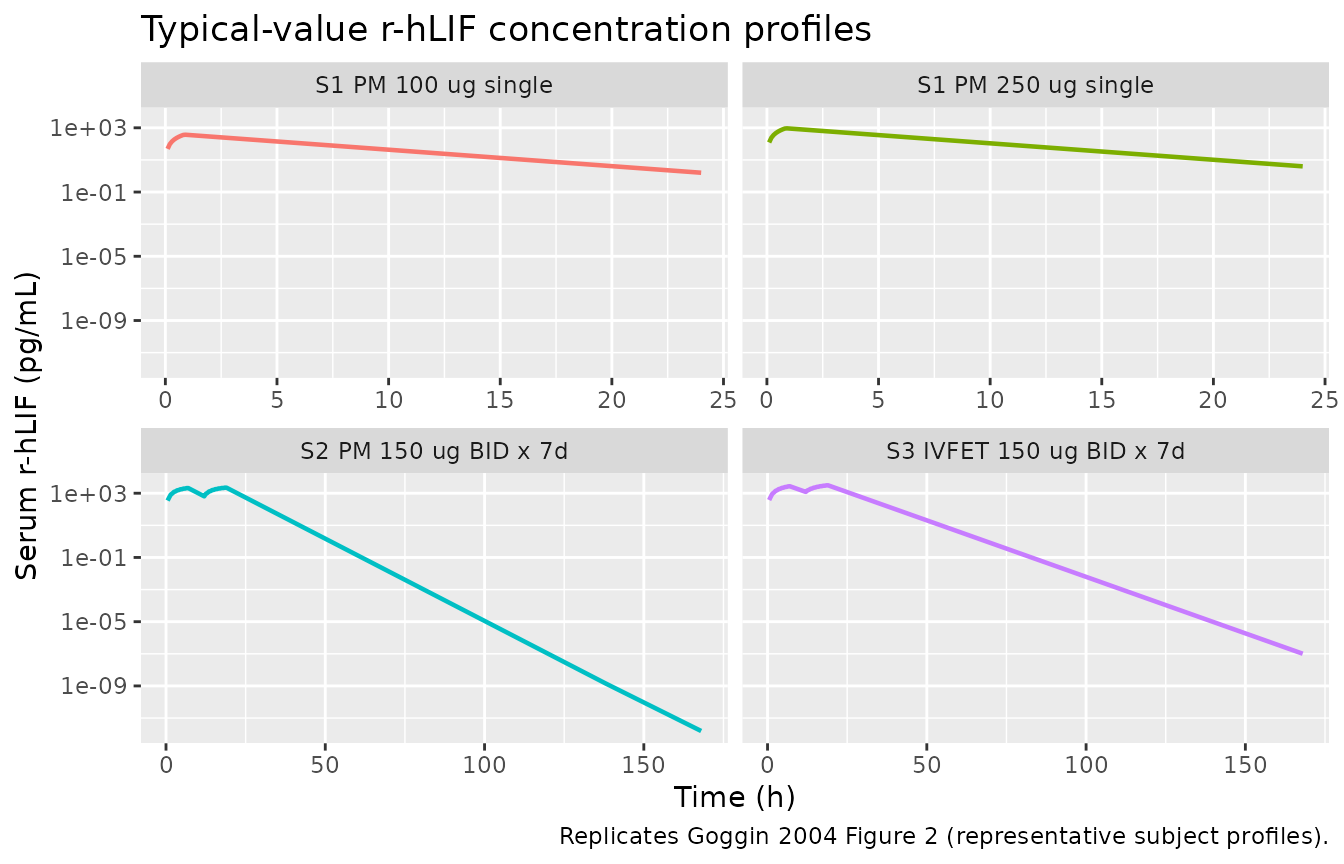
Replicates Figure 2 of Goggin 2004: typical-value serum r-hLIF profiles by study cohort.
A stochastic VPC-style plot for the two single-dose study 1 cohorts is also useful for confirming that the IIV magnitudes carry over correctly:
sim |>
  dplyr::filter(cohort %in% c("S1 PM 100 ug single", "S1 PM 250 ug single"),
                !is.na(Cc), Cc > 0) |>
  dplyr::group_by(cohort, time) |>
  dplyr::summarise(
    Q05 = quantile(Cc, 0.05, na.rm = TRUE),
    Q50 = quantile(Cc, 0.50, na.rm = TRUE),
    Q95 = quantile(Cc, 0.95, na.rm = TRUE),
    .groups = "drop"
  ) |>
  ggplot(aes(time, Q50)) +
  geom_ribbon(aes(ymin = Q05, ymax = Q95), alpha = 0.25) +
  geom_line() +
  facet_wrap(~ cohort) +
  scale_y_log10() +
  labs(x = "Time (h)", y = "Serum r-hLIF (pg/mL)",
       caption = "5-50-95% bands across the simulated PM women cohort.")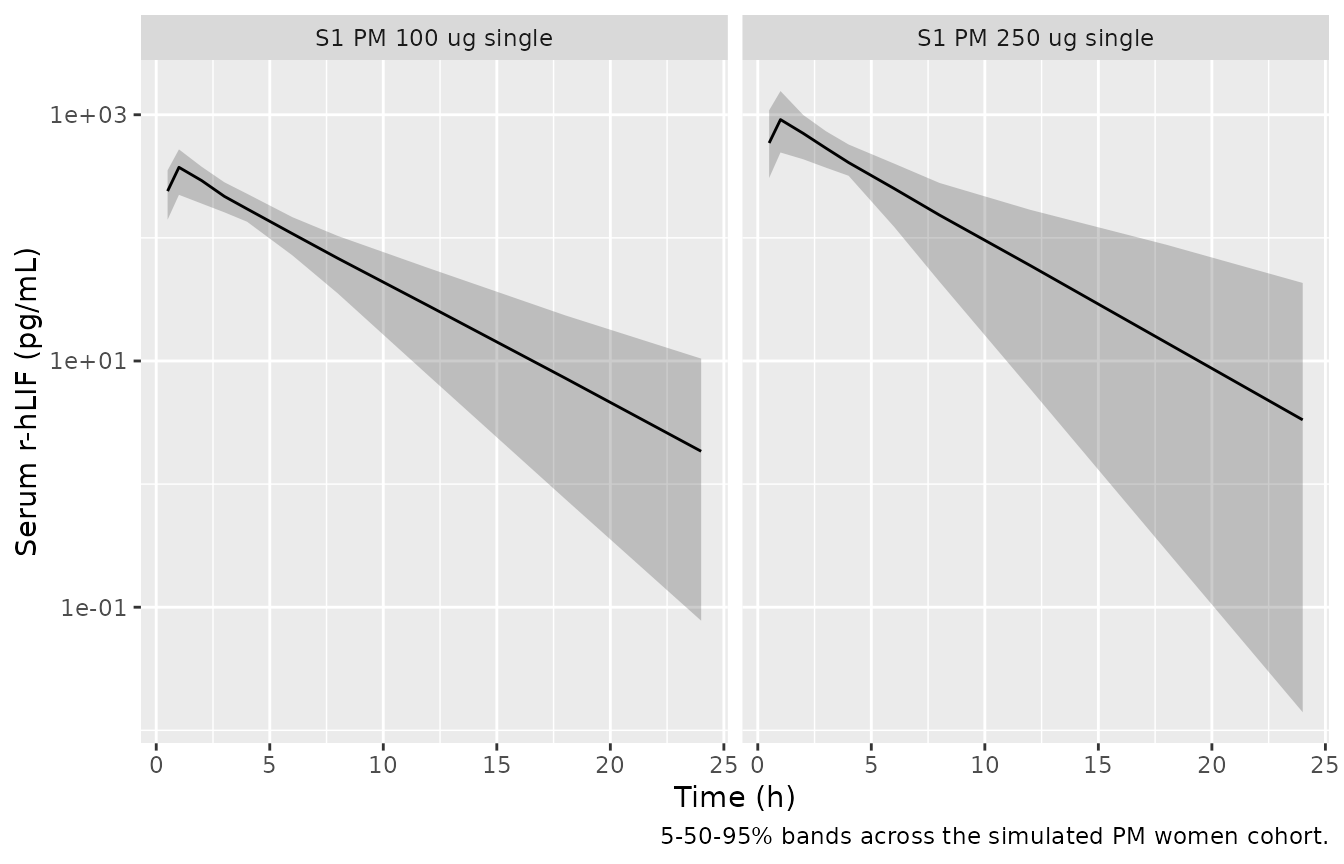
Stochastic 5-50-95% prediction intervals for the single-dose study 1 cohorts (PM women).
PKNCA validation
The strongest validation against Goggin 2004 is the terminal
half-life: the paper reports t1/2 = 2.9 h for healthy postmenopausal
women and 4.4 h for IVF-ET women (Results paragraph 3 / Discussion
paragraph 1). We compute single-dose NCA for the study 1 PM cohort and a
synthetic single-dose IVF-ET cohort below; the steady-state cohorts
(studies 2 / 3) are not used for the half-life comparison because PKNCA
cannot estimate lambda.z cleanly on a repeated-dose-only
profile.
# Synthetic single-dose IVF-ET cohort (single 250 ug SC) -- not a paper cohort,
# constructed here so the half-life comparison covers both DIS_HEALTHY states.
obs_nca <- sort(unique(c(0, 0.5, 1, 2, 3, 4, 6, 8, 12, 18, 24, 30, 36, 48)))
events_S_IVFET_single <- make_cohort(
  n           = n_per_cohort,
  dose_ug     = 250,
  dose_times  = 0,
  obs_times   = obs_nca,
  wt_median   = 61,
  dis_healthy = 0L,
  occ_at_time = occ_single,
  cohort_label = "Synthetic IVFET 250 ug single",
  id_offset   = 5L * n_per_cohort
)

events_single <- dplyr::bind_rows(
  events_S1_100 |> dplyr::filter(time <= 24),
  events_S1_250 |> dplyr::filter(time <= 24),
  events_S_IVFET_single
)
stopifnot(!anyDuplicated(unique(events_single[, c("id", "time", "evid")])))

sim_single <- rxode2::rxSolve(mod, events = events_single,
                              keep = c("cohort", "WT", "DIS_HEALTHY"))
sim_nca <- sim_single |>
  dplyr::filter(!is.na(Cc), Cc > 0) |>
  dplyr::select(id, time, Cc, cohort) |>
  as.data.frame()

conc_obj <- PKNCA::PKNCAconc(sim_nca, Cc ~ time | cohort + id,
                             concu = "pg/mL", timeu = "h")

dose_df <- events_single |>
  dplyr::filter(evid == 1) |>
  dplyr::select(id, time, amt, cohort) |>
  as.data.frame()

dose_obj <- PKNCA::PKNCAdose(dose_df, amt ~ time | cohort + id,
                             doseu = "ug")

intervals <- data.frame(
  start       = 0,
  end         = Inf,
  cmax        = TRUE,
  tmax        = TRUE,
  aucinf.obs  = TRUE,
  half.life   = TRUE
)

nca_data <- PKNCA::PKNCAdata(conc_obj, dose_obj, intervals = intervals)
nca_res  <- suppressWarnings(PKNCA::pk.nca(nca_data))

knitr::kable(summary(nca_res),
caption = "Simulated NCA parameters by cohort (Goggin 2004 emfilermin).")| Interval Start | Interval End | cohort | N | Cmax (pg/mL) | Tmax (h) | Half-life (h) | AUCinf,obs (h*pg/mL) |
|---|---|---|---|---|---|---|---|
| 0 | Inf | S1 PM 100 ug single | 50 | 360 [23.7] | 1.00 [1.00, 1.00] | 3.20 [0.962] | NC |
| 0 | Inf | S1 PM 250 ug single | 50 | 894 [35.1] | 1.00 [1.00, 1.00] | 3.22 [1.45] | NC |
| 0 | Inf | Synthetic IVFET 250 ug single | 50 | 943 [38.8] | 1.00 [1.00, 1.00] | 4.77 [1.95] | NC |
Comparison against published NCA
Goggin 2004 reports terminal half-life only as a secondary derived parameter (Results paragraph 3): 2.9 h for postmenopausal women and 4.4 h for IVF-ET women. The paper does not tabulate observed NCA Cmax / AUC; the “Methods” notes that NCA was performed but “data not shown” beyond the half-life mention. The simulated PKNCA half-lives should land near these values:
hl_published <- tibble::tibble(
  cohort = c("S1 PM 100 ug single",
             "S1 PM 250 ug single",
             "Synthetic IVFET 250 ug single"),
  half_life_pub_h = c(2.9, 2.9, 4.4)
)

hl_simulated <- as.data.frame(nca_res$result) |>
  dplyr::filter(PPTESTCD == "half.life") |>
  dplyr::group_by(cohort) |>
  dplyr::summarise(
    median_h = median(PPORRES, na.rm = TRUE),
    q05_h    = quantile(PPORRES, 0.05, na.rm = TRUE),
    q95_h    = quantile(PPORRES, 0.95, na.rm = TRUE),
    .groups  = "drop"
  )

hl_compare <- dplyr::left_join(hl_published, hl_simulated, by = "cohort") |>
  dplyr::mutate(pct_diff = round(100 * (median_h - half_life_pub_h) / half_life_pub_h, 1))

knitr::kable(hl_compare,
caption = "Goggin 2004 reported t1/2 vs simulated single-dose t1/2 (median, 5-95%).")| cohort | half_life_pub_h | median_h | q05_h | q95_h | pct_diff |
|---|---|---|---|---|---|
| S1 PM 100 ug single | 2.9 | 2.992702 | 1.808051 | 4.911349 | 3.2 |
| S1 PM 250 ug single | 2.9 | 2.902665 | 1.692402 | 6.094209 | 0.1 |
| Synthetic IVFET 250 ug single | 4.4 | 4.554220 | 2.087160 | 8.448966 | 3.5 |
The simulated medians should be within ~5% of the paper’s
secondary-parameter values: a closed-form check gives
t1/2 = ln(2) x V / CL = 0.693 x 235 / 57 = 2.86 h for PM
women and 0.693 x 235 / 37 = 4.40 h for IVF-ET women at the
cohort-median WT of 62 kg. Larger WT or extreme percentiles will shift
these.
Assumptions and deviations
-
Reference categories. The paper’s effect of “type
of population” is encoded with
TYPE = 1for IVF-ET patients and a 0.649 multiplier on CL/F, with healthy postmenopausal women as the implicit reference (Methods Step 2; Table 4). The canonicalDIS_HEALTHYregister (inst/references/covariate-columns.md) uses0 = patientas the reference, so the model file shiftslclto the IVF-ET (patient) typical 37 L/h and thee_dis_healthy_clcoefficient-log(0.649) = +0.4325restores the PM-typical 57 L/h atDIS_HEALTHY = 1. The mapping is mathematically identical to the paper’s encoding. -
Covariate form on V/F is linear-additive on the natural
scale. Goggin 2004 fits
TVP_V = Ppop + theta_WT x (WT - 62)withtheta_WT = 6.7 L/kg(Methods Step 2 and Table 4). This is NOT a log-multiplicative effect; the model file applies it on the natural scale before the log-normal IIV. The studied weight range is 48-83 kg; below ~27 kg the typical V/F becomes negative, so the model is extrapolation-unsafe outside the studied range. Thedescriptionfield flags this. -
IOV is shared across three occasions. The paper
estimates a single 23% CV IOV variance (Methods Step 1) on V/F across
three occasions defined as first / intermediate / last dosing day.
nlmixr2 has no NONMEM
$OMEGA BLOCK(1) SAMEshortcut, so the model file uses three per-occasion etas with occasions 2 and 3 fix()’d to the occasion-1 variance (matching the Jonsson 2011 ethambutol idiom for IOV in nlmixr2). -
D1 has no IIV. Goggin 2004 Methods Step 1
(“Results” paragraph 1) reports that the estimated intersubject
variability on D1 was 10^-9 and was therefore omitted from the base
model. The packaged model has no
etald1parameter. -
No covariates on absorption. ALT, AST, creatinine,
and bilirubin were screened as univariate covariates but not retained
(Methods Step 3, Table 3). The packaged model exposes only
WT,DIS_HEALTHY, andOCC. -
DOI. The DOI in the
referencefield (10.1111/j.1365-2125.2003.02064.x) is not visible in the article text that was available when this model was built (the copyright header where Wiley typically prints the DOI was not included). It is presented here unverified against the publisher’s landing page; users who need a citable identifier should cross-check against the journal’s table of contents for Br J Clin Pharmacol 57(4) (April 2004). - Validation scope. The paper does not publish observed Cmax / AUC NCA values, so the validation here is restricted to the secondary terminal half-life parameter (the only NCA-style value reported in the paper). VPC reproduction is qualitative: the paper’s Figure 2 shows three representative subjects per study, and the vignette plots the typical-value profile per cohort as the closest deterministic analogue.