Cebranopadol (Kleideiter 2018)
Source:vignettes/articles/Kleideiter_2018_cebranopadol.Rmd
Kleideiter_2018_cebranopadol.Rmd
library(nlmixr2lib)
library(PKNCA)
#>
#> Attaching package: 'PKNCA'
#> The following object is masked from 'package:stats':
#>
#>     filter
library(rxode2)
#> rxode2 5.1.8 using 2 threads (see ?getRxThreads)
#>   no cache: create with `rxCreateCache()`
library(dplyr)
#>
#> Attaching package: 'dplyr'
#> The following objects are masked from 'package:stats':
#>
#>     filter, lag
#> The following objects are masked from 'package:base':
#>
#>     intersect, setdiff, setequal, union
library(tidyr)
library(ggplot2)
Model and source
- Citation: Kleideiter E, Piana C, Wang S, Nemeth R, Gautrois M. Clinical pharmacokinetic characteristics of cebranopadol, a novel first-in-class analgesic. Clin Pharmacokinet. 2018;57(1):31-50.
- DOI: https://doi.org/10.1007/s40262-017-0545-1
- Article: https://link.springer.com/article/10.1007/s40262-017-0545-1
- Erratum: https://doi.org/10.1007/s40262-018-0686-x (Clin Pharmacokinet. 2018;57(8):1057-1058)
The erratum corrects Table 14 covariate-effect simulation results and several paragraphs of the Section 3 discussion. Where erratum-corrected values differ from the original article, the corrected values are the source of record for the model and this vignette.
Population
Kleideiter 2018 fits a two-compartment population PK model with two lagged transition compartments and first-order elimination to 14 pooled clinical trials of oral cebranopadol (a novel first-in-class NOP / opioid receptor agonist analgesic) in healthy adults and adult chronic-pain patients:
- Phase I (8 trials, n = 287 pooled). Healthy adults receiving single oral doses of 0.8-800 ug or once-daily multiple doses up to 1600 ug. Three formulations (oral solution, film-coated tablet, liquid-filled capsule) were investigated and pooled in the population PK analysis (Table 12).
- Phase IIa / II (6 trials, n = 1006 pooled). Adult patients with chronic pain across four indications: chronic low back pain (cLBP, two trials), osteoarthritis (OA) of the knee, painful diabetic polyneuropathy (DPN, three trials), and post-bunionectomy acute pain (one trial), each at multiple dose levels with 4-14 weeks of once-daily dosing.
The pooled analysis cohort is 1293 subjects (617 men and 676 women
per the Discussion paragraph 4). Phase I subjects have median age 33 y
(range 18-64) and phase II subjects have median age 58 y (range 18-79);
pooled weight range is approximately 45-197 kg (Table 12 minimum to
maximum across trials). Genotype-derived CYP2C9 phenotype is available
for 38.3% of subjects; the remaining 61.7% are coded as
unknown and form the model’s CYP2C9 reference category.
Reference covariate values (Kleideiter 2018 Table 14 footnote, erratum-corrected) used for the parameter-estimation typical-value computation:
- sex = male (Table 14 simulation reference) / sex = female (Table 13 parameter-estimation reference: the most-common category)
- formulation = tablet
- CYP2C9 status = unknown
- disease status = LBP and OA patients (nociceptive pain)
- age = 55 years
- CrCl = 106.4 mL/min
- body weight = 82 kg
- ALT = 19 U/L
Note that the Table 13 typical-value reference for sex (female)
differs from the Table 14 simulation reference (male). The model file
encodes parameters with female (SEXF = 1) as the reference and applies
the +17.6% male-vs-female CL ratio via
e_male_cl^(1 - SEXF); this matches the Table 13
typical-value column directly and reproduces the Table 14 sex effect
after the simulation reference is switched.
Programmatic access to the population summary:
readModelDb("Kleideiter_2018_cebranopadol")$population.
Source trace
The per-parameter origin is recorded as an in-file comment next to
each ini() entry in
inst/modeldb/specificDrugs/Kleideiter_2018_cebranopadol.R.
The table below collects them in one place for review.
| Equation / parameter | Value | Source location |
|---|---|---|
lcl (CL/F, L/h) |
log(74.3) | Kleideiter 2018 Table 13 Clearance Reference value |
lvc (Vc/F, L) |
log(225) | Kleideiter 2018 Table 13 Volume central compartment Reference value |
lvp (Vp/F, L) |
log(6750) | Kleideiter 2018 Table 13 Volume peripheral compartment Reference value |
lq (Q/F, L/h) |
log(84.2) | Kleideiter 2018 Table 13 Intercompartmental clearance |
lka (Ka, 1/h) |
log(0.864) | Kleideiter 2018 Table 13 Absorption rate constant Reference value |
lklag (klag, 1/h) |
log(0.087) | Kleideiter 2018 Table 13 klag Reference value |
e_male_cl |
1.176 | Kleideiter 2018 Table 13 Male CL 87.4 / Female CL 74.3 |
e_em_cl |
1.109 | Kleideiter 2018 Table 13 CYP2C9 EM CL 82.4 / Reference CL 74.3 |
e_pim_cl |
0.790 | Kleideiter 2018 Table 13 CYP2C9 PIM CL 58.7 / Reference CL 74.3 |
e_alt_cl |
-0.156 | Kleideiter 2018 Table 13 Effect of ALT (exponential) |
e_crcl_cl |
0.349 | Kleideiter 2018 Table 13 Effect of CrCl (exponential) |
e_age_vc |
-0.446 | Kleideiter 2018 Table 13 Effect of age (exponential) on Vc |
e_wt_vp |
0.604 | Kleideiter 2018 Table 13 Effect of body weight (exponential) on Vp |
e_solution_ka |
2.813 | Kleideiter 2018 Table 13 Oral-solution Ka 2.43 / Reference Ka 0.864 |
e_capsule_ka |
2.419 | Kleideiter 2018 Table 13 Capsules Ka 2.09 / Reference Ka 0.864 |
e_solution_klag |
0.885 | Kleideiter 2018 Table 13 Oral-solution klag 0.077 / Reference klag 0.087 |
e_capsule_klag |
0.885 | Kleideiter 2018 Table 13 Capsules klag 0.077 / Reference klag 0.087 |
e_solution_f |
1.045 | Kleideiter 2018 Table 13 Bioavailability Oral solution |
e_capsule_f |
1.174 | Kleideiter 2018 Table 13 Bioavailability Capsules |
e_healthy_f |
0.837 | Kleideiter 2018 Table 13 Bioavailability Healthy volunteers |
e_bun_f |
1.801 | Kleideiter 2018 Table 13 (erratum-corrected; original Table-13 row labeled ‘DPN patients’) |
e_dpn_f |
1.132 | Kleideiter 2018 Table 13 (erratum-corrected; original Table-13 row labeled ‘Bunionectomy patients’) |
| IIV CL (omega^2) | 0.412 (RSE 10.1%) | Kleideiter 2018 Table 13 IIV column |
| IIV Vc (omega^2) | 0.559 (RSE 20.6%) | Kleideiter 2018 Table 13 IIV column |
| IIV Ka (omega^2) | 0.519 (RSE 11.2%) | Kleideiter 2018 Table 13 IIV column |
| IIV klag (omega^2) | 0.0626 (RSE 18.8%) | Kleideiter 2018 Table 13 IIV column |
propSd |
0.35 (approximated; see Assumptions) | Class-typical popPK value; Kleideiter 2018 does not report a residual-error magnitude in Table 13 or the Results narrative |
| Equations: 2-cmt + 2 transit + 1st-order elimination | n/a | Kleideiter 2018 Methods 2.4.1 + Results 3.2.7 |
Virtual cohort
The original observed dataset is not publicly available. This vignette constructs a typical-value simulation cohort matched to the Table 14 erratum reference scenario (male, tablet, CYP2C9 unknown, LBP / OA, age 55 y, CrCl 106.4 mL/min, weight 82 kg, ALT 19 U/L), plus the Table 14 covariate perturbation arms (female sex, lower CrCl, healthy / DPN / bunionectomy disease status), to reproduce the Table 14 erratum-corrected steady-state exposure metrics under the published 600 ug titration regimen.
set.seed(545L) # last 3 digits of original DOI 10.1007/s40262-017-0545-1

ref_covariates <- list(
  SEXF          = 0L,    # male = Table 14 simulation reference
  AGE           = 55,
  WT            = 82,
  CRCL          = 106.4,
  ALT           = 19,
  FORM_CAPSULE  = 0L,
  FORM_SOLUTION = 0L,
  CYP2C9_EM     = 0L,
  CYP2C9_PIM    = 0L,
  DIS_HEALTHY   = 0L,
  DIS_DPN       = 0L,
  DIS_BUNIONECTOMY = 0L
)

# One subject per arm, deterministic (zero between-subject variance) so the
# typical-value Cmax,ss and AUCss can be compared directly against Table 14
# erratum-corrected numbers.
make_arm <- function(arm_label, override = list(), id_offset = 0L) {
  cov <- modifyList(ref_covariates, override)
  data.frame(
    id            = id_offset + 1L,
    arm           = arm_label,
    SEXF          = cov$SEXF,
    AGE           = cov$AGE,
    WT            = cov$WT,
    CRCL          = cov$CRCL,
    ALT           = cov$ALT,
    FORM_CAPSULE  = cov$FORM_CAPSULE,
    FORM_SOLUTION = cov$FORM_SOLUTION,
    CYP2C9_EM     = cov$CYP2C9_EM,
    CYP2C9_PIM    = cov$CYP2C9_PIM,
    DIS_HEALTHY   = cov$DIS_HEALTHY,
    DIS_DPN       = cov$DIS_DPN,
    DIS_BUNIONECTOMY = cov$DIS_BUNIONECTOMY
  )
}

arms <- bind_rows(
  make_arm("Reference (male, LBP/OA)",  id_offset =  0L),
  make_arm("Female",                    list(SEXF = 1L),                id_offset =  1L),
  make_arm("Age 40 y",                  list(AGE = 40),                 id_offset =  2L),
  make_arm("Age 75 y",                  list(AGE = 75),                 id_offset =  3L),
  make_arm("CrCl 45 mL/min",            list(CRCL = 45),                id_offset =  4L),
  make_arm("CrCl 60 mL/min",            list(CRCL = 60),                id_offset =  5L),
  make_arm("CrCl 80 mL/min",            list(CRCL = 80),                id_offset =  6L),
  make_arm("WT 70 kg",                  list(WT = 70),                  id_offset =  7L),
  make_arm("WT 100 kg",                 list(WT = 100),                 id_offset =  8L),
  make_arm("WT 120 kg",                 list(WT = 120),                 id_offset =  9L),
  make_arm("Healthy",                   list(DIS_HEALTHY = 1L),         id_offset = 10L),
  make_arm("DPN",                       list(DIS_DPN = 1L),             id_offset = 11L),
  make_arm("Bunionectomy",              list(DIS_BUNIONECTOMY = 1L),    id_offset = 12L)
)
stopifnot(!anyDuplicated(arms$id))
n_arms <- nrow(arms)
Simulation
Each arm receives the published 600 ug titration regimen (100 ug x 6 days, 200 ug x 6 days, 400 ug x 6 days, then 600 ug q24h) for 40 days of total treatment, by which point the steady state is reached per the Table 14 erratum footnote (“the steady-state was defined to be achieved on Day 40”).
dose_schedule <- bind_rows(
  data.frame(day = 1:6,   amt = 100),
  data.frame(day = 7:12,  amt = 200),
  data.frame(day = 13:18, amt = 400),
  data.frame(day = 19:40, amt = 600)
)
dose_times <- (dose_schedule$day - 1) * 24

# Day 40 (last 24 h dosing interval) dense sampling for Cmax,ss and AUCss.
ss_dose_time   <- 39 * 24    # start of the day-40 dose
ss_obs_times   <- ss_dose_time + c(0, 0.5, 1, 2, 3, 4, 5, 6, 7, 8, 10, 12, 16, 20, 24)

# Trough sampling across the titration to show the approach to steady state.
trough_times   <- (seq(0, 40, by = 1)) * 24

all_obs_times  <- sort(unique(c(trough_times, ss_obs_times)))

# Replicate each arm row across dose events
dose_recs <- arms[rep(seq_len(n_arms), each = nrow(dose_schedule)), ] |>
  mutate(
    time = rep(dose_times,         times = n_arms),
    amt  = rep(dose_schedule$amt,  times = n_arms),
    evid = 1L,
    cmt  = "depot"
  )

obs_recs <- arms[rep(seq_len(n_arms), each = length(all_obs_times)), ] |>
  mutate(
    time = rep(all_obs_times, times = n_arms),
    amt  = 0,
    evid = 0L,
    cmt  = "central"
  )

events <- bind_rows(dose_recs, obs_recs) |>
  arrange(id, time, desc(evid)) |>
  select(id, time, amt, evid, cmt, arm,
         SEXF, AGE, WT, CRCL, ALT,
         FORM_CAPSULE, FORM_SOLUTION,
         CYP2C9_EM, CYP2C9_PIM,
         DIS_HEALTHY, DIS_DPN, DIS_BUNIONECTOMY)

stopifnot(!anyDuplicated(unique(events[, c("id", "time", "evid")])))
mod <- readModelDb("Kleideiter_2018_cebranopadol")
# Typical-value (zero between-subject variance) simulation so the simulated
# Cmax,ss and AUCss can be compared head-to-head against the Table 14 erratum
# typical-patient predictions.
mod_typical <- rxode2::zeroRe(mod)
#> ℹ parameter labels from comments will be replaced by 'label()'
sim <- rxode2::rxSolve(mod_typical, events = events, keep = c("arm")) |>
  as.data.frame()
#> ℹ omega/sigma items treated as zero: 'etalcl', 'etalvc', 'etalka', 'etalklag'
#> Warning: multi-subject simulation without without 'omega'
Approach to steady state during the 600 ug titration
trough_sim <- sim |>
  filter(time %in% trough_times) |>
  mutate(day = time / 24)

ggplot(
  trough_sim |> filter(arm == "Reference (male, LBP/OA)"),
  aes(day, Cc)
) +
  geom_line(linewidth = 0.8, colour = "steelblue") +
  geom_vline(xintercept = c(6, 12, 18), linetype = "dashed", colour = "grey60") +
  annotate("text", x = c(3, 9, 15, 30), y = max(trough_sim$Cc) * 0.9,
           label = c("100 ug", "200 ug", "400 ug", "600 ug"), size = 3) +
  labs(
    x       = "Day after first dose",
    y       = "Trough cebranopadol concentration (pg/mL)",
    title   = "Typical-value trough profile during the 600 ug titration",
    caption = "Reference covariate set: male, tablet, CYP2C9 unknown, LBP/OA, age 55 y, CrCl 106.4 mL/min, WT 82 kg, ALT 19 U/L."
  ) +
  theme_bw()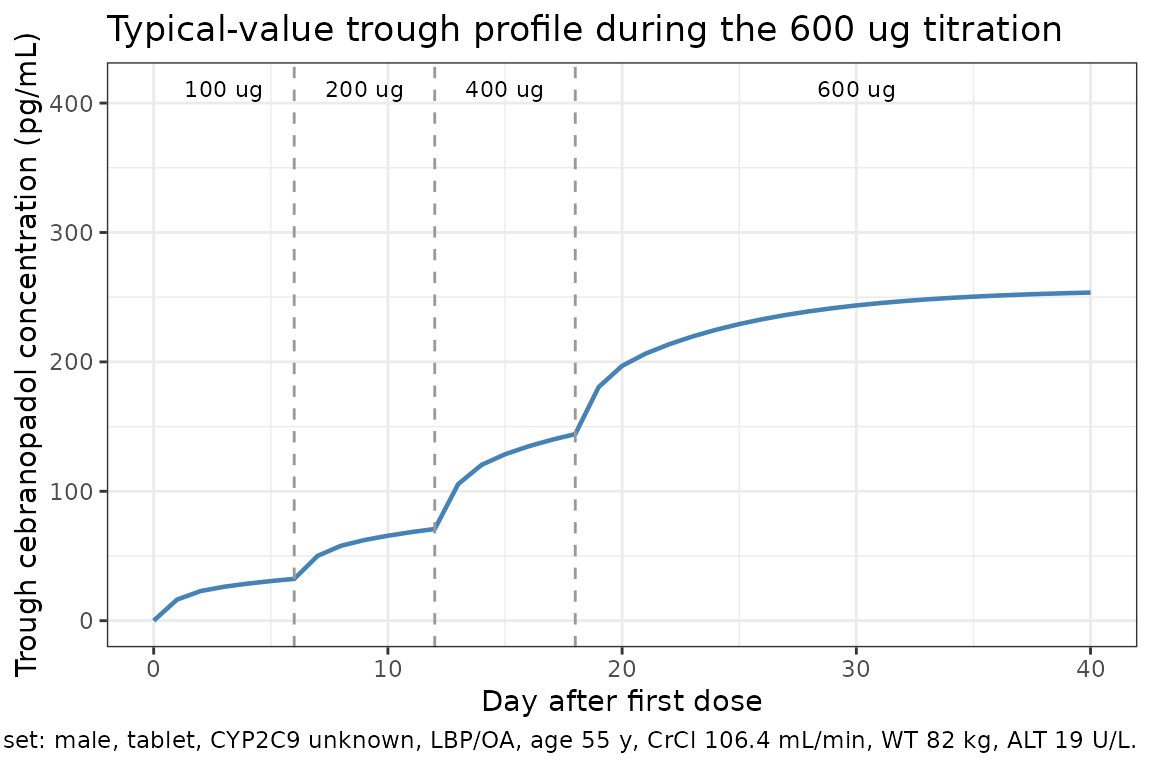
Replicate Kleideiter 2018 Table 14 (erratum-corrected) covariate effects
Table 14 (erratum) tabulates typical-patient Cmax,ss and AUCss values under the 600 ug titration regimen for each covariate-perturbation arm, expressed as % change relative to the reference patient.
# Day 40 (last 24-h interval) dense observations, time shifted so each arm has
# a t = 0 at the start of the day-40 dose.
ss_block <- sim |>
  filter(time %in% ss_obs_times) |>
  mutate(time = time - ss_dose_time) |>
  select(id, time, Cc, arm)

# Dose record at t = 0 of the shifted interval (600 ug on the steady-state day).
dose_block <- ss_block |>
  group_by(id) |>
  summarise(time = 0, amt = 600, arm = first(arm), .groups = "drop")

conc_obj <- PKNCA::PKNCAconc(
  ss_block,
  Cc ~ time | arm + id,
  concu = "pg/mL", timeu = "hr"
)
dose_obj <- PKNCA::PKNCAdose(
  dose_block,
  amt ~ time | arm + id,
  doseu = "ug"
)

intervals <- data.frame(
  start    = 0,
  end      = 24,
  cmax     = TRUE,
  auclast  = TRUE
)

nca_res <- PKNCA::pk.nca(PKNCA::PKNCAdata(conc_obj, dose_obj, intervals = intervals))

table14_sim <- as.data.frame(nca_res$result) |>
  filter(PPTESTCD %in% c("cmax", "auclast")) |>
  select(arm, PPTESTCD, PPORRES) |>
  pivot_wider(names_from = PPTESTCD, values_from = PPORRES) |>
  rename(Cmax_ss_sim = cmax, AUC_ss_sim = auclast)

ref_row <- table14_sim |> filter(arm == "Reference (male, LBP/OA)")
ref_cmax <- ref_row$Cmax_ss_sim
ref_auc  <- ref_row$AUC_ss_sim

table14_sim <- table14_sim |>
  mutate(
    Cmax_pct_sim = 100 * (Cmax_ss_sim - ref_cmax) / ref_cmax,
    AUC_pct_sim  = 100 * (AUC_ss_sim  - ref_auc ) / ref_auc
  )

# Published Table 14 erratum values (Cmax,ss in pg/mL, AUCss in pg*h/mL, percent
# change relative to the male reference patient).
table14_pub <- tibble::tribble(
  ~arm,                       ~Cmax_ss_pub, ~Cmax_pct_pub, ~AUC_ss_pub, ~AUC_pct_pub,
  "Reference (male, LBP/OA)",        378,          0,           6790,         0,
  "Female",                          432,         14,           7960,        17,
  "Age 40 y",                        375,         -1,           6790,         0,
  "Age 75 y",                        381,          1,           6790,         0,
  "CrCl 45 mL/min",                  483,         28,           9080,        34,
  "CrCl 60 mL/min",                  446,         18,           8250,        21,
  "CrCl 80 mL/min",                  410,          9,           7480,        10,
  "WT 70 kg",                        379,          0,           6810,         0,
  "WT 100 kg",                       377,          0,           6760,        -1,
  "WT 120 kg",                       375,         -1,           6720,        -1,
  "Healthy",                         316,        -16,           5690,       -16,
  "DPN",                             428,         13,           7690,        13,
  "Bunionectomy",                    681,         80,          12200,        80
)

table14_compare <- table14_pub |>
  left_join(table14_sim, by = "arm") |>
  select(arm,
         Cmax_ss_pub, Cmax_ss_sim, Cmax_pct_pub, Cmax_pct_sim,
         AUC_ss_pub,  AUC_ss_sim,  AUC_pct_pub,  AUC_pct_sim)

knitr::kable(
  table14_compare,
  digits  = c(0, 0, 0, 0, 1, 0, 0, 0, 1),
  caption = paste(
    "Simulated typical-value Cmax,ss (pg/mL) and AUCss (pg*h/mL) under the",
    "600 ug titration regimen vs Kleideiter 2018 Table 14 erratum-corrected",
    "published values. Percent changes are relative to the reference patient."
  )
)| arm | Cmax_ss_pub | Cmax_ss_sim | Cmax_pct_pub | Cmax_pct_sim | AUC_ss_pub | AUC_ss_sim | AUC_pct_pub | AUC_pct_sim |
|---|---|---|---|---|---|---|---|---|
| Reference (male, LBP/OA) | 378 | 306 | 0 | 0.0 | 6790 | 6786 | 0 | 0.0 |
| Female | 432 | 356 | 14 | 16.3 | 7960 | 7943 | 17 | 17.0 |
| Age 40 y | 375 | 306 | -1 | -0.1 | 6790 | 6785 | 0 | 0.0 |
| Age 75 y | 381 | 306 | 1 | 0.2 | 6790 | 6786 | 0 | 0.0 |
| CrCl 45 mL/min | 483 | 404 | 28 | 32.2 | 9080 | 9069 | 34 | 33.7 |
| CrCl 60 mL/min | 446 | 369 | 18 | 20.5 | 8250 | 8237 | 21 | 21.4 |
| CrCl 80 mL/min | 410 | 336 | 9 | 9.7 | 7480 | 7476 | 10 | 10.2 |
| WT 70 kg | 379 | 307 | 0 | 0.3 | 6810 | 6807 | 0 | 0.3 |
| WT 100 kg | 377 | 304 | 0 | -0.5 | 6760 | 6750 | -1 | -0.5 |
| WT 120 kg | 375 | 303 | -1 | -1.1 | 6720 | 6707 | -1 | -1.2 |
| Healthy | 316 | 256 | -16 | -16.3 | 5690 | 5680 | -16 | -16.3 |
| DPN | 428 | 346 | 13 | 13.2 | 7690 | 7681 | 13 | 13.2 |
| Bunionectomy | 681 | 551 | 80 | 80.1 | 12200 | 12221 | 80 | 80.1 |
The simulated percent-change column should reproduce the Table 14 erratum percent-change column closely for the categorical covariate arms (sex, disease status); the absolute Cmax,ss and AUCss values may differ from the published numbers because the structural interpretation of the transit- compartment absorption chain affects the entire concentration-time profile shape. See Assumptions and deviations for details.
Assumptions and deviations
-
Transit-compartment structural interpretation.
Kleideiter 2018 Section 3.2.7 describes the absorption model as “a
two-compartment disposition model with two lagged transition
compartments” without writing out the explicit ODEs, and Table 13
reports two formulation-dependent rate constants
Kaandklagwhose individual roles in the chain are not stated. The model file uses the biologically-motivated reading in whichKagoverns the depot-to- transit1 step (dissolution-limited absorption from the dosage form; values vary ~2.8-fold across tablet, capsule, and oral solution) andklaggoverns both subsequent transit steps (transit1 -> transit2 -> central; uniform 0.077- 0.087 1/h across formulations). The alternative reading -klagat the depot + transit1 steps andKaat the final transit2 -> central step (the Bienczak 2016 nevirapine convention used elsewhere in nlmixr2lib) - is equally consistent with the paper’s prose; without the NONMEM control stream or appendix, the ambiguity cannot be resolved from the available sources. Either reading places the rate-limiting step at the slowklagrate, so the simulated peak time and concentration-time-profile shape will not precisely reproduce the paper’s reported Tmax of 4-6 h (the NCA-derived Tmax from the single-dose trials). The Table 14 covariate-percent-change comparison is more robust to this structural ambiguity than the absolute Cmax,ss / AUCss numbers because percent changes within an arm cancel the common transit-time scale. -
Residual-error magnitude. Kleideiter 2018 Section
2.4.1 specifies the residual-error model as additive on log-transformed
cebranopadol concentrations (equivalent to proportional residual error
on the linear scale in the nlmixr2 idiom), but Table 13 and the Results
narrative do not report the residual-error variance estimate. The model
file uses a class-typical approximation
propSd = 0.35(about 35% proportional CV on the linear scale, a representative value for orally-dosed small-molecule analgesics with mixed intensive + sparse-sampling popPK datasets). This value affects the width of stochastic VPCs (irrelevant for the deterministic Table 14 reproduction above) but not the typical- value Cmax,ss / AUCss predictions. -
Sex reference category divergence between Table 13 and Table
14. The Table 13 parameter-estimation reference uses female sex
(the most-common category in the analysis cohort), while the Table 14
simulation reference uses male sex (the typical-patient simulation
choice). The model file preserves the Table 13 reference - female
corresponds to SEXF = 1, the typical-value CL is 74.3 L/h, and male is
encoded as the +17.6% multiplier applied via
e_male_cl^(1 - SEXF). This vignette’s reference-arm simulation switches to the Table 14 male reference for side-by-side comparison. -
CYP2C9 unknown-phenotype reference. Only 38.3% of
the analysis cohort had a known CYP2C9 phenotype; the remaining 61.7%
are coded as
unknownand form the model’s CYP2C9 reference category. The canonicalCYP2C9_EMcovariate’s standard reference (in Jeong 2022) is IM/PM only, not unknown. In the Kleideiter 2018 model, the 0-level ofCYP2C9_EMpools unknown + non-EM phenotypes, and a sibling new canonicalCYP2C9_PIMcarries the PIM-vs-unknown contrast. Both indicators are 0 for the reference-arm simulations above. -
Four-level disease-state encoding via three
indicators. The model encodes the four-category disease factor
(LBP and OA reference + healthy, DPN, bunionectomy) using three binary
indicators
DIS_HEALTHY,DIS_DPN, andDIS_BUNIONECTOMY, two of which (DIS_DPN,DIS_BUNIONECTOMY) are registered as new canonical covariates alongside this model. When all three are 0 the subject is in the LBP / OA reference category (the Table 13 most-common-category reference). -
Three-level formulation encoding via two
indicators. The model encodes the three-category formulation
factor (tablet reference + oral solution + liquid-filled capsule) using
two binary indicators
FORM_SOLUTION(new canonical registered alongside this model) andFORM_CAPSULE(existing canonical, reused with the tablet reference documented per-model). When both are 0 the subject is in the tablet reference category. -
Food and CYP2D6 effects not retained. Kleideiter
2018 Methods Section 2.4.1 tested food intake on the absorption rate
constant and CYP2D6 phenotype on CL during covariate selection; neither
was retained in the final model (Results 3.2.7 paragraphs 5-7). The
model file therefore does not include
FEDorCYP2D6_*covariates. Future cebranopadol simulations that require a food-effect term should consult the paper’s Section 3.2.6 single-dose ANOVA estimates (mean Cmax and AUCt ~30% higher under fed vs fasted conditions) rather than the population PK model. - Erratum supersedes original Table 14. The Cmax,ss / AUCss percent- change values in the published-vs-simulated comparison above are taken from the 2018 erratum’s revised Table 14, not the original 2018 article Table 14, per the package’s errata-handling convention.