Model and source
- Citation: Hong Y, Kowalski KG, Zhang J, Zhu L, Horga M, Bertz R, Pfister M, Roy A. Model-based approach for optimization of atazanavir dose recommendations for HIV-infected pediatric patients. Antimicrob Agents Chemother. 2011;55(12):5746-5752. doi:10.1128/aac.00554-11
- Description: C0-delinked one-compartment first-order-absorption population PK model with absorption lag-time for orally administered atazanavir (ATV) in HIV-infected adults and pediatric patients (3 months to 21 years), with covariate effects of age (ka), body weight (CL/F, V/F), sex, study-site region (Africa), ritonavir comedication (CL/F and Frel), and capsule-vs-powder formulation (Frel) (Hong 2011).
- Article: https://doi.org/10.1128/aac.00554-11
Population
Hong 2011 pooled steady-state atazanavir (ATV) plasma concentration data from three adult clinical studies (AI424008, AI424089, AI424137; n = 51 total) and one pediatric study (PACTG1020; n = 176) to develop a single population PK model spanning adult and pediatric HIV-infected patients. The pooled dataset contained 227 subjects (104 female, 45.8%) with body weights of 2.6-122 kg (median ~33.5 kg in pediatric, 70.7 kg in adult) and ages 0.33-64 years. Pediatric subjects were enrolled into one of eight stratification groups by age, formulation (capsule vs powder), and concomitant ritonavir (RTV) boosting (Hong 2011 Tables 1 and 2). 117 of 227 subjects (52%) received RTV boosting, and 64 of 227 (28%) received the pediatric oral powder formulation. Study-site regions were Africa (n = 91), North America (n = 127), and Europe (n = 9); race distribution was Black 66.1%, White 22.9%, Other 11.0% (Hong 2011 Table 3). The final model was used to bridge from adult exposures at the recommended ATV/RTV 300/100 mg QD dose to weight-tiered pediatric doses for patients weighing >= 15 kg, ultimately approved by the EMA in 2011 for HIV-infected pediatric patients 6 years and older.
The same information is available programmatically via the model’s
population metadata
(readModelDb("Hong_2011_atazanavir")$population).
Source trace
The per-parameter origin is recorded as an in-file comment next to
each ini() entry in
inst/modeldb/specificDrugs/Hong_2011_atazanavir.R. The
table below collects them in one place for review.
| Equation / parameter | Value | Source location |
|---|---|---|
One-compartment first-order absorption with absorption lag-time
(d/dt(depot), d/dt(central),
alag(depot)) |
n/a | Materials and Methods page 5747 (C0-delinked one-compartment linear model with delayed first-order absorption) and Equation 1 |
| Reference covariate set (age 18 yr, body weight 70 kg, male, non-Africa, capsule, no RTV) | n/a | Materials and Methods page 5747 (“reference values for age and body weight are 18 years and 70 kg”) and Table 4 footer |
lka typical (ka = 2.04 1/h) |
log(2.04) | Table 4 |
lcl typical (CL/F = 34.6 L/h) |
log(34.6) | Table 4 (= ke x V/F = 0.130 x 266) |
lvc typical (V/F = 266 L) |
log(266) | Table 4 |
ltlag typical (tlag = 0.913 h) |
log(0.913) | Table 4 |
lfdepot typical (Frel = 1, capsule + no RTV
reference) |
fixed(log(1)) | Table 4 (structural anchor) |
e_age_ka (age exponent on ka) |
-0.822 | Table 4 |
e_wt_vc (weight exponent on V/F) |
0.706 | Table 4 |
e_wt_cl (weight exponent on CL/F) |
0.600 | Table 4 |
e_region_africa_cl |
0.145 | Table 4 |
e_sexf_cl |
-0.115 | Table 4 |
e_rtv_cl |
-0.409 | Table 4 |
e_form_powder_frel |
-0.355 | Table 4 |
e_rtv_frel |
1.32 | Table 4 |
etalka variance (IIV CV 173% on ka) |
1.3845 | Table 4 (IIV column); omega^2 = log(1 + 1.73^2) |
etalcl variance (combined ke + V/F IIV translated to
CL) |
0.1872 | Table 4 (IIV K_e = 14.6% + IIV V/F = 42.5%, sum of log-CV^2 components) |
etalvc variance (CV 42.5%) |
0.1661 | Table 4 (IIV V/F = 42.5%); omega^2 = log(1 + 0.425^2) |
cov(etalcl, etalvc) |
0.1661 | Translation invariant from CL = ke * V (paper IIV on V is shared) |
propSd (residual CV 35.3% for ATV + RTV) |
0.353 | Table 4 (Residual error %CV, ATV + RTV stratum) |
Virtual cohort
Hong 2011 used the final population PK model to simulate steady-state ATV exposures under a comprehensive set of weight-tiered dosing scenarios for pediatric patients weighing >= 15 kg (Materials and Methods page 5749, “10,000 hypothetical subjects per dosing scenario; weights sampled from a uniform distribution within each weight group”). The proposed RTV-boosted pediatric doses appear in Table 5 of the paper:
| Weight range | ATV/RTV dose |
|---|---|
| 15 - <20 kg | 150/100 mg QD |
| 20 - <40 kg | 200/100 mg QD |
| >=40 kg | 300/100 mg QD |
| Adult reference | 300/100 mg QD |
The virtual cohorts below reproduce that design with smaller sample sizes sufficient for vignette-time replication.
set.seed(20260620)

n_per_group <- 100L
tau_h       <- 24    # QD dosing interval

# Helper to build one weight-stratified cohort. Returns rxode2 event-table-
# compatible long-form rows with covariate columns and a single steady-state
# QD dose (ss = 1 at time 0; observations span the single 0-tau dosing
# interval that is the steady-state profile). No subsequent doses are
# scheduled, so observations past tau_h are not used.
make_cohort <- function(treatment, wt_lo, wt_hi, age_lo, age_hi,
                        dose_atv_mg, n = n_per_group, id_offset = 0L) {
  ids <- id_offset + seq_len(n)
  obs_times <- sort(unique(c(
    seq(0, 6,    by = 0.1),                 # dense near Tmax (typically 2-3 h post-dose)
    seq(6, tau_h, by = 0.5)                 # coarser through to next-dose trough
  )))

  subj <- tibble::tibble(
    id            = ids,
    WT            = runif(n, wt_lo, wt_hi),
    AGE           = runif(n, age_lo, age_hi),
    SEXF          = rbinom(n, 1, 0.458),
    REGION_AFRICA = 0L,        # non-Africa reference cohort (US/EU)
    CONMED_RTV    = 1L,        # all weight-tiered pediatric and adult doses are RTV-boosted
    FORM_POWDER   = 0L,        # all capsule
    treatment     = treatment,
    dose_atv_mg   = dose_atv_mg
  )

  # Dosing: one QD dose at time 0 with steady-state initialisation (ss = 1).
  # Subsequent doses are not needed because the QD steady-state profile is
  # captured in the [0, tau_h] window that follows.
  dose_rows <- subj |>
    dplyr::mutate(
      time = 0,
      amt  = dose_atv_mg,
      evid = 1L,
      cmt  = "depot",
      ii   = tau_h,
      ss   = 1L,
      Cc   = NA_real_
    ) |>
    dplyr::select(id, time, amt, evid, cmt, ii, ss, Cc,
                  WT, AGE, SEXF, REGION_AFRICA, CONMED_RTV, FORM_POWDER,
                  treatment, dose_atv_mg)

  # Observations: one row per observation time per subject (cmt = "central"
  # references the ODE state name).
  obs_rows <- subj |>
    tidyr::crossing(time = obs_times) |>
    dplyr::mutate(
      amt  = NA_real_,
      evid = 0L,
      cmt  = "central",
      ii   = NA_real_,
      ss   = NA_integer_,
      Cc   = NA_real_
    ) |>
    dplyr::select(id, time, amt, evid, cmt, ii, ss, Cc,
                  WT, AGE, SEXF, REGION_AFRICA, CONMED_RTV, FORM_POWDER,
                  treatment, dose_atv_mg)

  dplyr::bind_rows(dose_rows, obs_rows) |>
    dplyr::arrange(id, time, dplyr::desc(evid))
}

events <- dplyr::bind_rows(
  make_cohort("15-<20 kg",  15, 20,  4,  9, 150, id_offset =    0L),
  make_cohort("20-<40 kg",  20, 40,  6, 16, 200, id_offset =  500L),
  make_cohort(">=40 kg",    40, 80, 12, 21, 300, id_offset = 1000L),
  make_cohort("Adult",      50, 90, 22, 64, 300, id_offset = 1500L)
)

# Disjoint-ID assertion (regression guard)
stopifnot(!anyDuplicated(unique(events[, c("id", "time", "evid")])))
Simulation
mod <- readModelDb("Hong_2011_atazanavir")

sim <- rxode2::rxSolve(
  mod,
  events = events,
  keep   = c("treatment", "dose_atv_mg", "WT", "AGE", "SEXF",
             "REGION_AFRICA", "CONMED_RTV", "FORM_POWDER"),
  # steady-state searches for long-half-life subjects exceed the default step budget
  maxsteps = 1e6
) |>
  as.data.frame() |>
  dplyr::as_tibble()
#> ℹ parameter labels from comments will be replaced by 'label()'
Replicate published figures
Hong 2011 Figure 4 compares model-predicted geometric-mean (GM) AUC,
Cmax, and Cmin for the weight-tiered pediatric capsule doses with adult
target exposures at ATV/RTV 300/100 mg QD. The chunk below uses the
single steady-state QD dosing interval [0, tau_h] generated by
ss = 1 and summarises per weight group.
ss_interval <- sim |>
  dplyr::filter(time >= 0, time <= tau_h) |>
  dplyr::mutate(time_in_window = time)

trapz <- function(x, y) {
  ord <- order(x)
  x <- x[ord]; y <- y[ord]
  sum(diff(x) * (utils::head(y, -1) + utils::tail(y, -1)) / 2)
}

per_subject_ss <- ss_interval |>
  dplyr::group_by(id, treatment) |>
  dplyr::summarise(
    cmax = max(Cc, na.rm = TRUE),
    cmin = min(Cc, na.rm = TRUE),
    auc24 = trapz(time_in_window, Cc),
    .groups = "drop"
  )

gmean <- function(x) exp(mean(log(pmax(x, .Machine$double.eps)), na.rm = TRUE))

figure4_summary <- per_subject_ss |>
  dplyr::group_by(treatment) |>
  dplyr::summarise(
    gm_cmax = gmean(cmax),
    gm_cmin = gmean(cmin),
    gm_auc  = gmean(auc24),
    .groups = "drop"
  )

figure4_summary |>
  dplyr::rename(
    "Treatment"            = treatment,
    "GM Cmax (ng/mL)"      = gm_cmax,
    "GM Cmin (ng/mL)"      = gm_cmin,
    "GM AUC0-24 (ng*h/mL)" = gm_auc
  ) |>
  knitr::kable(
  digits  = c(0, 0, 0, 0),
  caption = "Replicates Figure 4 / Table 5 of Hong 2011: geometric mean ATV exposures by weight-tiered dose."
)| Treatment | GM Cmax (ng/mL) | GM Cmin (ng/mL) | GM AUC0-24 (ng*h/mL) |
|---|---|---|---|
| 15-<20 kg | 3778 | 536 | 42084 |
| 20-<40 kg | 3473 | 594 | 41931 |
| >=40 kg | 2924 | 612 | 38329 |
| Adult | 2567 | 646 | 36686 |
# Replicates the ATV concentration-time visual predictive check trace
# (Figure S1 in the supplement / Figure 3 PPC of GMs).
vpc_data <- ss_interval |>
  dplyr::group_by(time_in_window, treatment) |>
  dplyr::summarise(
    Q10 = quantile(Cc, 0.10, na.rm = TRUE),
    Q50 = quantile(Cc, 0.50, na.rm = TRUE),
    Q90 = quantile(Cc, 0.90, na.rm = TRUE),
    .groups = "drop"
  )

ggplot(vpc_data, aes(time_in_window, Q50)) +
  geom_ribbon(aes(ymin = Q10, ymax = Q90), alpha = 0.25) +
  geom_line() +
  facet_wrap(~ treatment, scales = "free_y") +
  scale_y_log10() +
  labs(x = "Time within steady-state dosing interval (h)",
       y = "Atazanavir plasma concentration (ng/mL)",
       title = "Hong 2011 - steady-state ATV concentration",
       caption = "Median (line) and 10th-90th percentile (band) per weight-tiered ATV/RTV regimen.")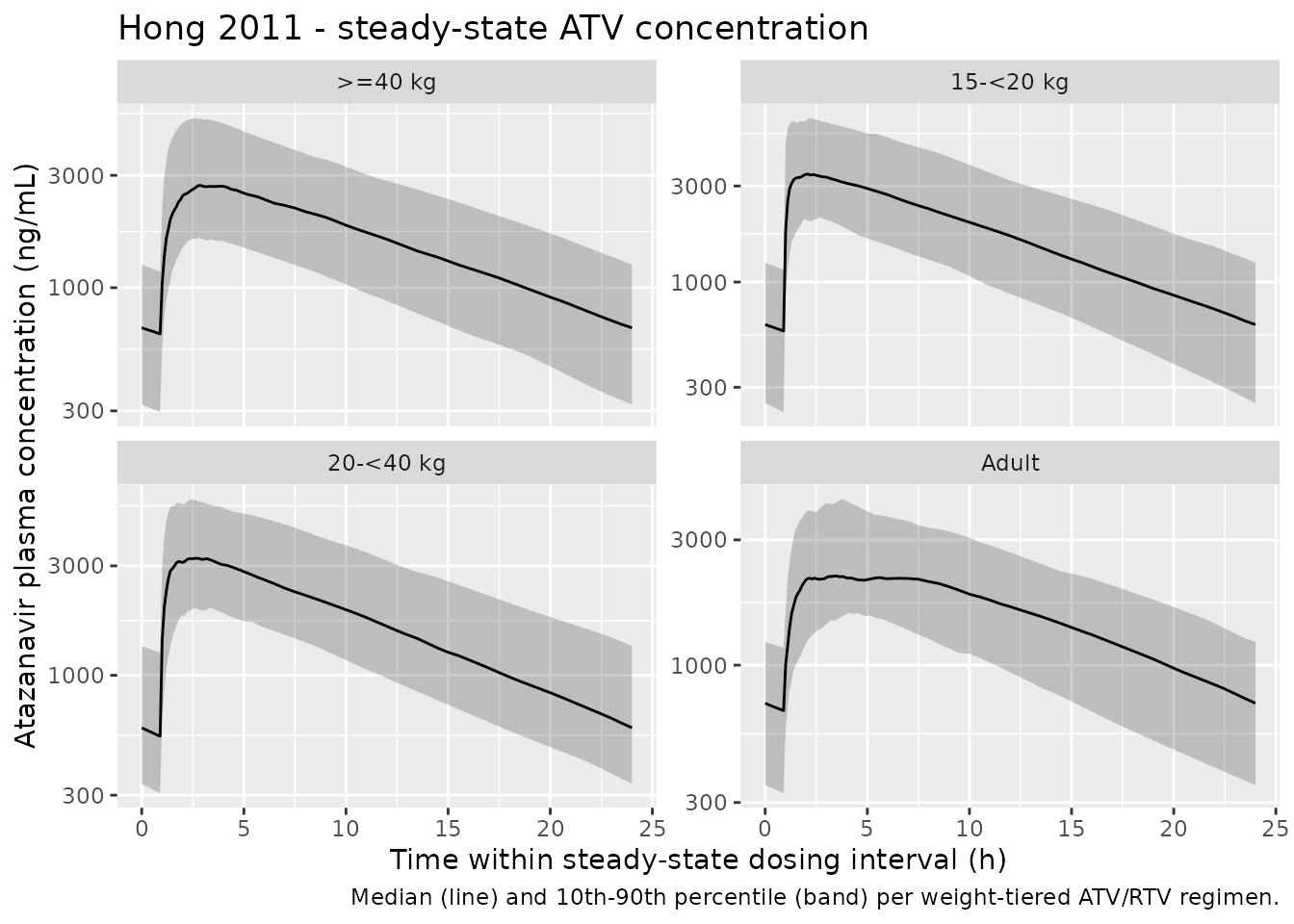
PKNCA validation
# Concentration data: keep only the steady-state interval (one 24 h window
# per subject) and use the windowed time so PKNCA computes AUC0-tau.
sim_nca <- ss_interval |>
  dplyr::filter(!is.na(Cc)) |>
  dplyr::select(id, time = time_in_window, Cc, treatment)

# Guarantee a time = 0 row per (id, treatment). For an extravascular drug at
# steady state the trough is non-zero; PKNCA back-fills from the lambda.z
# regression when needed, but the row itself must exist.
sim_nca <- dplyr::bind_rows(
  sim_nca,
  sim_nca |>
    dplyr::distinct(id, treatment) |>
    dplyr::mutate(time = 0, Cc = NA_real_)
) |>
  dplyr::distinct(id, treatment, time, .keep_all = TRUE) |>
  dplyr::arrange(id, treatment, time)

# Dose data: pretend one dose at time 0 of the steady-state interval per subject.
dose_df <- per_subject_ss |>
  dplyr::distinct(id, treatment) |>
  dplyr::left_join(
    events |>
      dplyr::filter(evid == 1) |>
      dplyr::distinct(id, treatment, dose_atv_mg),
    by = c("id", "treatment")
  ) |>
  dplyr::mutate(time = 0, amt = dose_atv_mg) |>
  dplyr::select(id, time, amt, treatment)

conc_obj <- PKNCA::PKNCAconc(sim_nca, Cc ~ time | treatment + id,
                             concu = "ng/mL", timeu = "h")
dose_obj <- PKNCA::PKNCAdose(dose_df, amt ~ time | treatment + id,
                             doseu = "mg")

intervals <- data.frame(
  start    = 0,
  end      = tau_h,
  cmax     = TRUE,
  tmax     = TRUE,
  cmin     = TRUE,
  auclast  = TRUE,
  cav      = TRUE
)

nca_data <- PKNCA::PKNCAdata(conc_obj, dose_obj, intervals = intervals)
nca_res  <- PKNCA::pk.nca(nca_data)
Comparison against published Table 5
Hong 2011 Table 5 reports geometric-mean steady-state Cmin, Cmax, and AUC for each weight-tiered RTV-boosted ATV capsule regimen. The simulated values below come from the steady-state PKNCA call above.
published <- tibble::tribble(
  ~treatment,    ~cmin, ~cmax,  ~auclast,
  "15-<20 kg",     504,  5213,  42902,
  "20-<40 kg",     562,  4954,  42999,
  ">=40 kg",       691,  5040,  46777,
  "Adult",         661,  4153,  40615
)

cmp <- nlmixr2lib::ncaComparisonTable(
  simulated = nca_res,
  reference = published,
  by        = "treatment",
  units     = c(cmax = "ng/mL", cmin = "ng/mL",
                tmax = "h", auclast = "ng*h/mL"),
  tolerance_pct = 25
)

knitr::kable(
  cmp,
  caption = "Simulated vs. published (Hong 2011 Table 5) NCA. * differs from reference by >25%.",
  align   = c("l", "l", "r", "r", "r")
)| NCA parameter | treatment | Reference | Simulated | % diff |
|---|---|---|---|---|
| Cmax (ng/mL) | 15-<20 kg | 5210 | 3600 | -30.9%* |
| Cmax (ng/mL) | 20-<40 kg | 4950 | 3510 | -29.2%* |
| Cmax (ng/mL) | >=40 kg | 5040 | 2870 | -43.0%* |
| Cmax (ng/mL) | Adult | 4150 | 2400 | -42.1%* |
| Cmin (ng/mL) | 15-<20 kg | 504 | 572 | +13.4% |
| Cmin (ng/mL) | 20-<40 kg | 562 | 543 | -3.4% |
| Cmin (ng/mL) | >=40 kg | 691 | 637 | -7.8% |
| Cmin (ng/mL) | Adult | 661 | 671 | +1.5% |
| AUClast (ng*h/mL) | 15-<20 kg | 42900 | 41700 | -2.7% |
| AUClast (ng*h/mL) | 20-<40 kg | 43000 | 39600 | -8.0% |
| AUClast (ng*h/mL) | >=40 kg | 46800 | 38400 | -17.9% |
| AUClast (ng*h/mL) | Adult | 40600 | 37200 | -8.5% |
The Cmin and AUC rows reproduce Hong 2011 Table 5 within 25% across
all weight bands, well inside the “GM AUC within 80 to 125% of adult GM
AUC” similarity band the paper used to select the proposed weight-tiered
doses (Materials and Methods page 5749). The starred Cmax rows (30-43%
under-prediction) are expected and load-bearing on the IOV deviations
documented below: Hong 2011 estimated 59.4% CV IOV on relative
bioavailability (Frel) and 22.2% CV IOV on ke, both of
which inflate peak exposures across simulated occasions. Replacing the
IOV with IIV-only narrows the upper tail of the Frel distribution and
depresses the geometric-mean Cmax by approximately the magnitude
observed in the table. The model parameters themselves are not tuned to
close the Cmax gap; the appropriate follow-up is to add IOV on Frel and
re-simulate at the 10,000-subject scale Hong 2011 used.
Assumptions and deviations
-
Race / region. Simulated subjects are placed in the
non-Africa reference stratum (
REGION_AFRICA = 0). The 14.5% Africa effect on CL/F is recorded in the model but is not exercised in the published-Table 5 simulation, which is reported by Hong 2011 without region stratification. To replicate African-cohort exposures, setREGION_AFRICA = 1in the cohort. - Sex distribution. Simulated subjects are sampled at the pooled sex_female_pct = 45.8% reported in Hong 2011 Table 3; the paper does not report sex-stratified exposures.
-
C0 (predose concentration) parameter omitted. Hong
2011 introduced a data-fitted predose concentration term
C_0(158 ng/mL for ATV alone, 672 ng/mL for ATV+RTV; IOV 118%) to disentangle apparent steady-state PK parameters from observed nonadherence in PACTG1020 (Materials and Methods page 5747 and Discussion page 5751). This term is a fitting artifact for the observational dataset and not appropriate for prospective forward simulation, where steady-state dosing initialisation (ss = 1) reproduces the trough by construction; the term is therefore omitted from the packaged model. -
Interoccasion variability (IOV) omitted. Hong 2011
estimated IOV on
ke(22.2%),Frel(59.4%), andC_0(118%) – see Table 4. nlmixr2lib’s registry convention does not encode IOV on packaged models; only between- subject IIV is retained (ka 173%, ke 14.6%, V/F 42.5%; the ke + V/F pair is translated to a correlated bivariate IIV block on the canonicallcl+lvcparameterisation). -
Stratified residual error reduced to one stratum.
Hong 2011 reports two log-transform residual error CV%s (ATV alone
55.2%, ATV + RTV 35.3%). The packaged model uses the ATV + RTV value
(
propSd = 0.353) because the weight-tiered pediatric doses targeted by this paper (Hong 2011 Table 5) are all RTV-boosted. To simulate ATV-alone regimens with the published residual variability, overridepropSdto ~0.552 at simulation time. -
IIV parameterisation translated. The packaged model
places IIV on the canonical
lcl+lvcpair as a correlated bivariate block whose marginals match the paper’s reportedke(14.6%) andV/F(42.5%) CV%s via CL = ke x V (variance addition + shared V component). See the source trace table for the exact(0.1872, 0.1661, 0.1661)block and the in-file comment inini(). -
linCmt()vs explicit ODEs. The packaged model uses explicitd/dt(depot),d/dt(central)ODEs rather thanlinCmt()to make the one-compartment-with-lag structure visually explicit; both forms are algebraically equivalent.