Model and source
- Citation: Wang C, Peeters MYM, Allegaert K, Blusse van Oud-Alblas HJ, Krekels EHJ, Tibboel D, Danhof M, Knibbe CAJ. (2012). A bodyweight-dependent allometric exponent for scaling clearance across the human life-span. Pharmaceutical Research 29(6):1570-1581. doi:10.1007/s11095-012-0668-x.
- Description: Three-compartment intravenous population PK model for propofol across the human life-span (Wang 2012; 174 subjects pooled across seven previously published studies covering preterm and term neonates, infants, toddlers, children, adolescents, and adults; body weight 0.68-122.7 kg, age 1 day-81 years). Final ‘bodyweight-dependent exponent (BDE)’ model (Model IV / Final PK model, Table IV): clearance is scaled by total body weight via a power function whose exponent k changes sigmoidally with body weight from k0 = 1.34 at a theoretical 0 kg to k0 - kmax = 0.55 at large body weights, with k50 = 3.78 kg and a Hill coefficient gamma = 5.24 governing the steepness of the decline. The slow inter-compartmental clearance Q3 and the second peripheral volume V3 scale linearly with body weight (BW/70); the first peripheral volume V2 scales as (BW/70)^0.55; the fast inter-compartmental clearance Q2 is independent of body weight. The central volume V1 = 7.58 L is constant for subjects with postnatal age >= 100 days and scales linearly as V1 * (BW/70) for younger subjects. Inter-individual variability (log-normal) was retained on CL, V1, V2, V3, and Q3; no IIV on Q2. Additive residual error on log-transformed concentrations was used, equivalent to a proportional error on the linear concentration scale.
- Article: Pharmaceutical Research 2012;29(6):1570-1581
Wang et al. (2012) pooled propofol pharmacokinetic data from seven previously published studies that together span the entire human life-span – preterm and term neonates, infants, toddlers, children, adolescents, and adults – and used NONMEM VI (FOCEI) to compare four bodyweight-based allometric scaling models for propofol clearance. The “bodyweight-dependent exponent” model (Model IV) identifies a single continuous covariate equation in which the allometric exponent on body weight changes sigmoidally with body weight, varying from 1.34 at a hypothetical body weight of 0 kg down to 0.55 at large body weights. Model IV was further refined into the Final PK model by adding a postnatal-age indicator on V1 and a power-form body weight effect on V2; the Final PK model parameter values (Wang 2012 Table IV) are the values packaged here.
Population
The pooled cohort comprised 174 subjects contributing 4,396 propofol concentration observations across seven studies (Wang 2012 Table I):
- Neonates (n = 25): postnatal age median 8 days (range 1-25), gestational age 37 weeks (26-40), body weight 2.93 kg (0.68-4.03). 3 mg/kg IV bolus for chest-tube removal / placement or endotracheal intubation.
- Infants (n = 20 of 22 originally enrolled): age 10 months (3.8-17.3), body weight 9 kg (4.8-12.5). 2-4 mg/kg/h IV infusion for ~12.5 h after major craniofacial surgery.
- Toddlers (n = 12): age 18 months (12-31), body weight 11.2 kg (8.7-18.9). 4 mg/kg IV bolus before bathing of minor burns.
- Children (n = 53): age 7 years (3-11), body weight 23.3 kg (15-60.5). 3 mg/kg IV bolus (subset n = 20), or 3.5 mg/kg loading dose followed by maintenance infusion at 0.15 or 0.20 then 0.125 mg/kg/min (subset n = 33).
- Adolescents (n = 14): age 14.7 years (9.8-20.1), body weight 51 kg (36.6-82). 2-10 mg/kg/h IV infusion during scoliosis surgery (~6.8 h).
- Female adults (n = 24): age 45.5 years (33-57), body weight 68.5 kg (55-80). 2.5 mg/kg IV bolus over 60 s for gynaecological-surgery induction.
- Healthy adult volunteers (n = 24): age 53 years (26-81), body weight 79.4 kg (44.4-122.7). IV bolus followed 1 h later by a 60-min infusion at 25, 50, 100, or 200 mg/kg/min.
The same demographic block is available programmatically via
readModelDb("Wang_2012_propofol")$population.
Source trace
The per-parameter origin is recorded as an in-file comment next to
each ini() entry in
inst/modeldb/specificDrugs/Wang_2012_propofol.R. This table
collects them in one place.
| Equation / parameter | Value | Source location |
|---|---|---|
lcl = log(2.02) |
Cl_p = 2.02 L/min at 70 kg | Wang 2012 Table IV Final model |
lvc = log(7.58) |
V1_p = 7.58 L | Wang 2012 Table IV Final model |
lq = log(1.77) |
Q2 = 1.77 L/min | Wang 2012 Table IV Final model |
lvp = log(15.5) |
V2_p = 15.5 L at 70 kg | Wang 2012 Table IV Final model |
lq2 = log(1.65) |
Q3_p = 1.65 L/min at 70 kg | Wang 2012 Table IV Final model |
lvp2 = log(221) |
V3_p = 221 L at 70 kg | Wang 2012 Table IV Final model |
k0_cl = 1.34 FIX |
BDE exponent at WT = 0 kg | Wang 2012 Table IV Final model |
kmax_cl = 0.79 |
BDE max decrement | Wang 2012 Table IV Final model |
k50_cl = 3.78 kg |
BDE half-decrement weight | Wang 2012 Table IV Final model |
hill_cl = 5.24 FIX |
BDE Hill coefficient | Wang 2012 Table IV Final model |
e_wt_vp = 0.55 |
Power exponent of WT/70 on V2 | Wang 2012 Table IV Final model |
etalcl = 0.09 |
omega^2 CL | Wang 2012 Table IV Final model |
etalvc = 1.19 |
omega^2 V1 | Wang 2012 Table IV Final model |
etalvp = 0.52 |
omega^2 V2 | Wang 2012 Table IV Final model |
etalvp2 = 0.71 |
omega^2 V3 | Wang 2012 Table IV Final model |
etalq2 = 0.25 |
omega^2 Q3 | Wang 2012 Table IV Final model |
propSd = sqrt(0.06) |
sigma^2 = 0.06 additive on log scale | Wang 2012 Table IV Final model |
| CL covariate equation |
CL_i = Cl_p * (WT/70)^k with
k = k0 - kmax * WT^hill / (k50^hill + WT^hill)
|
Wang 2012 Eq. 5 (Methods, “Covariate Models” -> Model IV) |
| V1 covariate equation |
V1_i = V1_p * (WT/70) if PNA < 100 days, else
V1_i = V1_p
|
Wang 2012 Table IV V1 row (Results paragraph identifying the V1 linear-body-weight relationship for children younger than 100 days) |
| V2 covariate equation |
V2_i = V2_p * (WT/70)^m, m = 0.55 |
Wang 2012 Table IV Final model V2 row |
| Q3 / V3 covariate equation |
Q3_i = Q3_p * (WT/70),
V3_i = V3_p * (WT/70)
|
Wang 2012 Table IV Final model Q3 / V3 rows |
| Q2 covariate equation |
Q2_i = Q2 (no body-weight scaling) |
Wang 2012 Table IV Final model Q2 row |
| Three-compartment ODE |
d/dt(central), d/dt(peripheral1), d/dt(peripheral2) for
a 3-cmt IV mass-balance system |
Wang 2012 Methods, “Structural Model” |
| Residual error form | additive on log-transformed concentrations = proportional on linear | Wang 2012 Methods, “Statistical Model” |
Virtual cohort
The original observed data are not publicly available. Three virtual cohorts are constructed below to exercise the model across the published body weight and age ranges: a “neonate” cohort (PNA = 8 days, dosed with a 3 mg/kg IV bolus), a “toddler” cohort (PNA = 18 months, dosed with a 4 mg/kg IV bolus), and a “healthy adult volunteer” cohort (PNA approximately 53 years converted to months, dosed with a 1.5 mg/kg IV bolus followed by a 60-min infusion at 100 mg/kg/min). All times are in minutes; PNA values supplied in the canonical register’s units of months.
set.seed(20260522)

days_per_month <- 30.4375

make_cohort <- function(n, wt_mean, wt_sd, pna_days,
                        bolus_mg_per_kg = NA_real_,
                        bolus_mg_fixed = NA_real_,
                        infusion_mg_per_kg_per_min = 0,
                        infusion_duration_min = 0,
                        obs_end_min,
                        treatment_label,
                        id_offset = 0L) {
  per_subject <- tibble::tibble(
    id        = id_offset + seq_len(n),
    WT        = pmax(0.5, rnorm(n, wt_mean, wt_sd)),
    PNA       = pna_days / days_per_month,
    treatment = treatment_label
  ) |>
    dplyr::mutate(
      bolus_amt = ifelse(is.na(bolus_mg_fixed),
                         bolus_mg_per_kg * WT,
                         bolus_mg_fixed),
      infusion_rate_mg_per_min = infusion_mg_per_kg_per_min * WT
    )

  bolus_rows <- per_subject |>
    dplyr::transmute(id, time = 0, evid = 1L, cmt = "central",
                     amt = bolus_amt, rate = 0, WT, PNA, treatment)

  if (infusion_duration_min > 0) {
    infusion_rows <- per_subject |>
      dplyr::transmute(
        id,
        time = 60,  # Wang 2012 healthy-volunteer protocol: infusion 1 h after bolus
        evid = 1L, cmt = "central",
        amt  = infusion_rate_mg_per_min * infusion_duration_min,
        rate = infusion_rate_mg_per_min,
        WT, PNA, treatment
      )
  } else {
    infusion_rows <- bolus_rows[0, ]
  }

  obs_grid <- sort(unique(c(0.25, 0.5, 1, 2, 3, 5, 7.5, 10, 15, 20, 30,
                            45, 60, 90, 120, 180, 240, 360, obs_end_min)))
  obs_grid <- obs_grid[obs_grid <= obs_end_min]

  obs_rows <- per_subject |>
    tidyr::expand_grid(time = obs_grid) |>
    dplyr::transmute(id, time, evid = 0L, cmt = "central",
                     amt = 0, rate = 0, WT, PNA, treatment)

  dplyr::bind_rows(bolus_rows, infusion_rows, obs_rows) |>
    dplyr::arrange(id, time, dplyr::desc(evid))
}

events <- dplyr::bind_rows(
  # Neonate: PNA below the 100-day V1-scaling threshold; V1 = V1p * (WT/70).
  make_cohort(
    n = 40,
    wt_mean = 2.93, wt_sd = 0.6,
    pna_days = 8,
    bolus_mg_per_kg = 3,
    obs_end_min = 240,
    treatment_label = "neonate",
    id_offset = 0L
  ),
  # Toddler: PNA above the 100-day V1-scaling threshold; V1 = V1p constant.
  make_cohort(
    n = 40,
    wt_mean = 11.2, wt_sd = 2,
    pna_days = 18 * days_per_month,
    bolus_mg_per_kg = 4,
    obs_end_min = 240,
    treatment_label = "toddler",
    id_offset = 1000L
  ),
  # Healthy adult volunteer: bolus 1 h before a 60-min 100 mg/kg/min infusion.
  make_cohort(
    n = 40,
    wt_mean = 79.4, wt_sd = 15,
    pna_days = 53 * 365.25,
    bolus_mg_per_kg = 1.5,
    infusion_mg_per_kg_per_min = 0.100,
    infusion_duration_min = 60,
    obs_end_min = 360,
    treatment_label = "adult_volunteer",
    id_offset = 2000L
  )
)

stopifnot(!anyDuplicated(unique(events[, c("id", "time", "evid")])))
Simulation
mod <- readModelDb("Wang_2012_propofol")
sim <- rxode2::rxSolve(
  mod,
  events = events,
  keep   = c("treatment", "WT", "PNA")
) |>
  as.data.frame() |>
  tibble::as_tibble()
#> ℹ parameter labels from comments will be replaced by 'label()'
For deterministic replication (no inter-individual variability), zero out the random effects:
mod_typical <- mod |> rxode2::zeroRe()
#> ℹ parameter labels from comments will be replaced by 'label()'
sim_typical <- rxode2::rxSolve(
  mod_typical,
  events = events,
  keep   = c("treatment", "WT", "PNA")
) |>
  as.data.frame() |>
  tibble::as_tibble()
#> ℹ omega/sigma items treated as zero: 'etalcl', 'etalvc', 'etalvp', 'etalvp2', 'etalq2'
#> Warning: multi-subject simulation without without 'omega'
Replicate published figures
Figure 2 – bodyweight-dependent allometric exponent k vs body weight
Wang 2012 Figure 2 plots the value of the bodyweight-dependent
allometric exponent k for CL as a function of body weight.
With the Final model parameters (k0 = 1.34, kmax = 0.79, k50 = 3.78 kg,
gamma = 5.24), k declines sigmoidally from 1.34 at WT = 0
kg to 0.55 (= 1.34 - 0.79) at large body weights, with the
half-decrement reached at 3.78 kg.
k0   <- 1.34
kmax <- 0.79
k50  <- 3.78
hill <- 5.24

wt_grid <- seq(0.5, 130, length.out = 400)
fig2_df <- tibble::tibble(
  WT = wt_grid,
  k  = k0 - kmax * WT^hill / (k50^hill + WT^hill)
)

ggplot(fig2_df, aes(WT, k)) +
  geom_line(linewidth = 0.7) +
  geom_hline(yintercept = c(0.75, k0, k0 - kmax),
             linetype = "dashed", colour = "grey60") +
  annotate("text", x = 100, y = 0.78, label = "k = 0.75 (3/4 allometric reference)",
           hjust = 1, vjust = 0, size = 3, colour = "grey40") +
  labs(x = "Body weight (kg)",
       y = "Bodyweight-dependent allometric exponent k",
       title = "Figure 2 -- BDE exponent k vs body weight",
       caption = "Replicates Figure 2 of Wang 2012.") +
  coord_cartesian(xlim = c(0, 130), ylim = c(0.4, 1.4))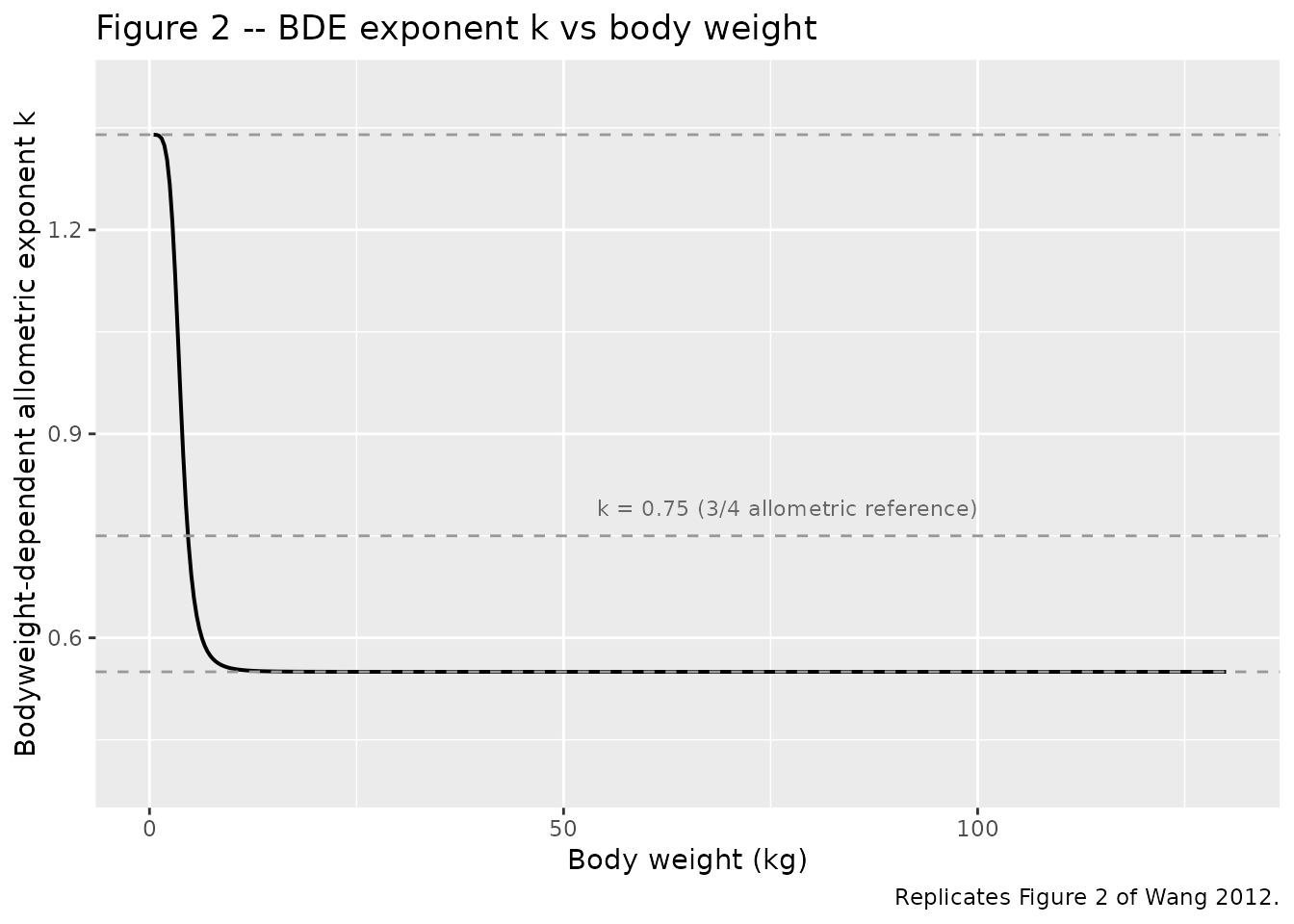
Figure 1 (Model IV panel) – typical-value propofol CL vs body weight
Wang 2012 Figure 1 shows the population-predicted clearance curve for the bodyweight-dependent exponent model (Model IV) overlaid against post-hoc clearances. The typical-value CL curve recovered from the structural model matches the Model IV panel of Figure 1.
cl_pop <- 2.02

fig1_df <- tibble::tibble(
  WT = wt_grid,
  k  = k0 - kmax * WT^hill / (k50^hill + WT^hill)
) |>
  dplyr::mutate(CL_pop_Lmin = cl_pop * (WT / 70)^k)

ggplot(fig1_df, aes(WT, CL_pop_Lmin)) +
  geom_line(linewidth = 0.7) +
  scale_x_log10() +
  scale_y_log10() +
  labs(x = "Body weight (kg, log scale)",
       y = "Population propofol clearance (L/min, log scale)",
       title = "Figure 1 (Model IV) -- typical-value CL vs body weight",
       caption = "Replicates the Model IV panel of Figure 1 of Wang 2012.")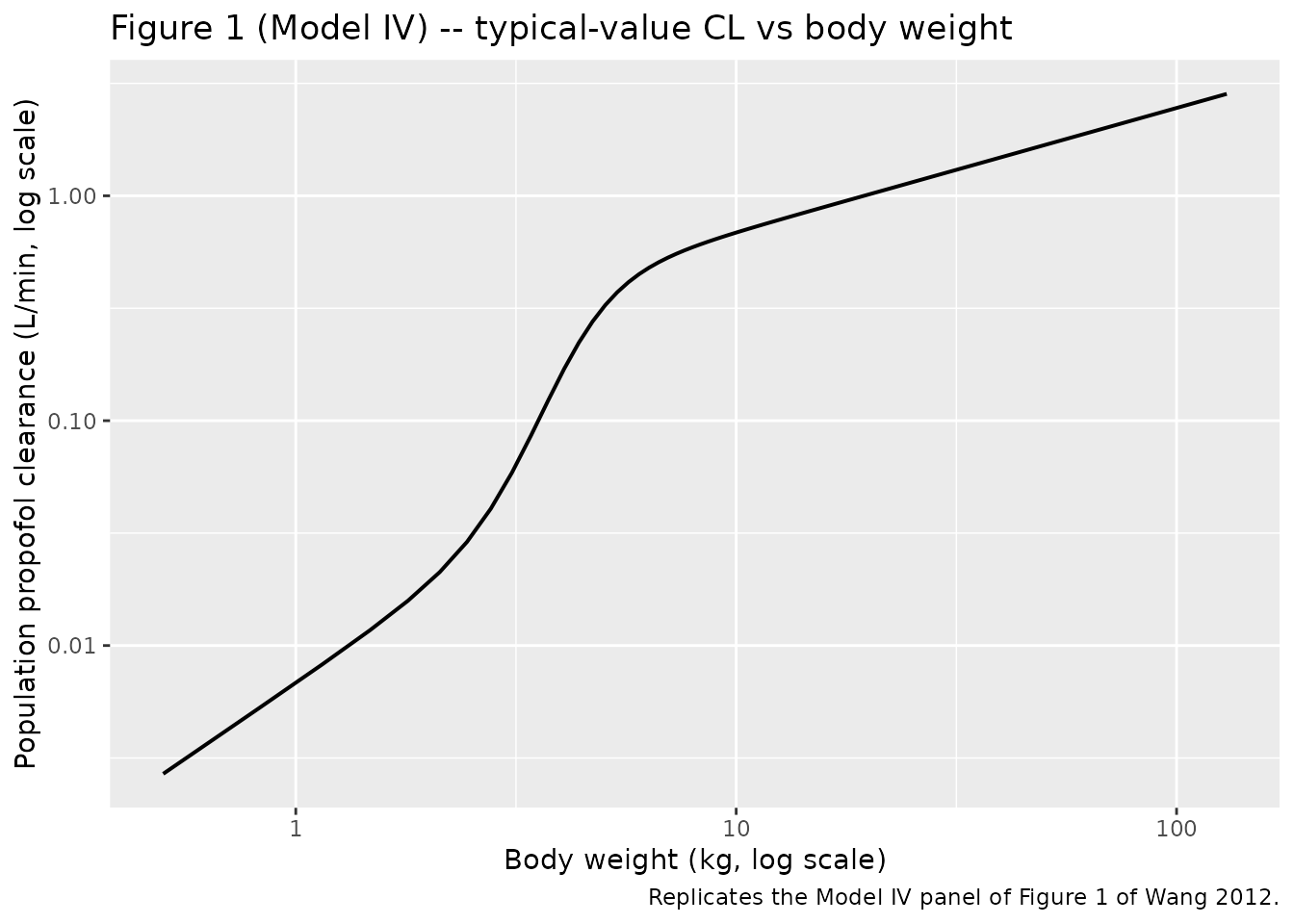
Whole-blood concentration-time profiles by cohort
sim |>
  dplyr::filter(time > 0) |>
  dplyr::group_by(time, treatment) |>
  dplyr::summarise(
    Q05 = quantile(Cc, 0.05, na.rm = TRUE),
    Q50 = quantile(Cc, 0.50, na.rm = TRUE),
    Q95 = quantile(Cc, 0.95, na.rm = TRUE),
    .groups = "drop"
  ) |>
  ggplot(aes(time, Q50, colour = treatment, fill = treatment)) +
  geom_ribbon(aes(ymin = Q05, ymax = Q95), alpha = 0.20, colour = NA) +
  geom_line(linewidth = 0.7) +
  scale_y_log10() +
  labs(x = "Time after first dose (minutes)",
       y = "Simulated propofol Cc (mg/L)",
       title = "Simulated propofol Cc profiles by cohort",
       caption = "Neonate 3 mg/kg IV bolus; toddler 4 mg/kg IV bolus; adult 1.5 mg/kg IV bolus + 60-min 0.1 mg/kg/min infusion 1 h later.")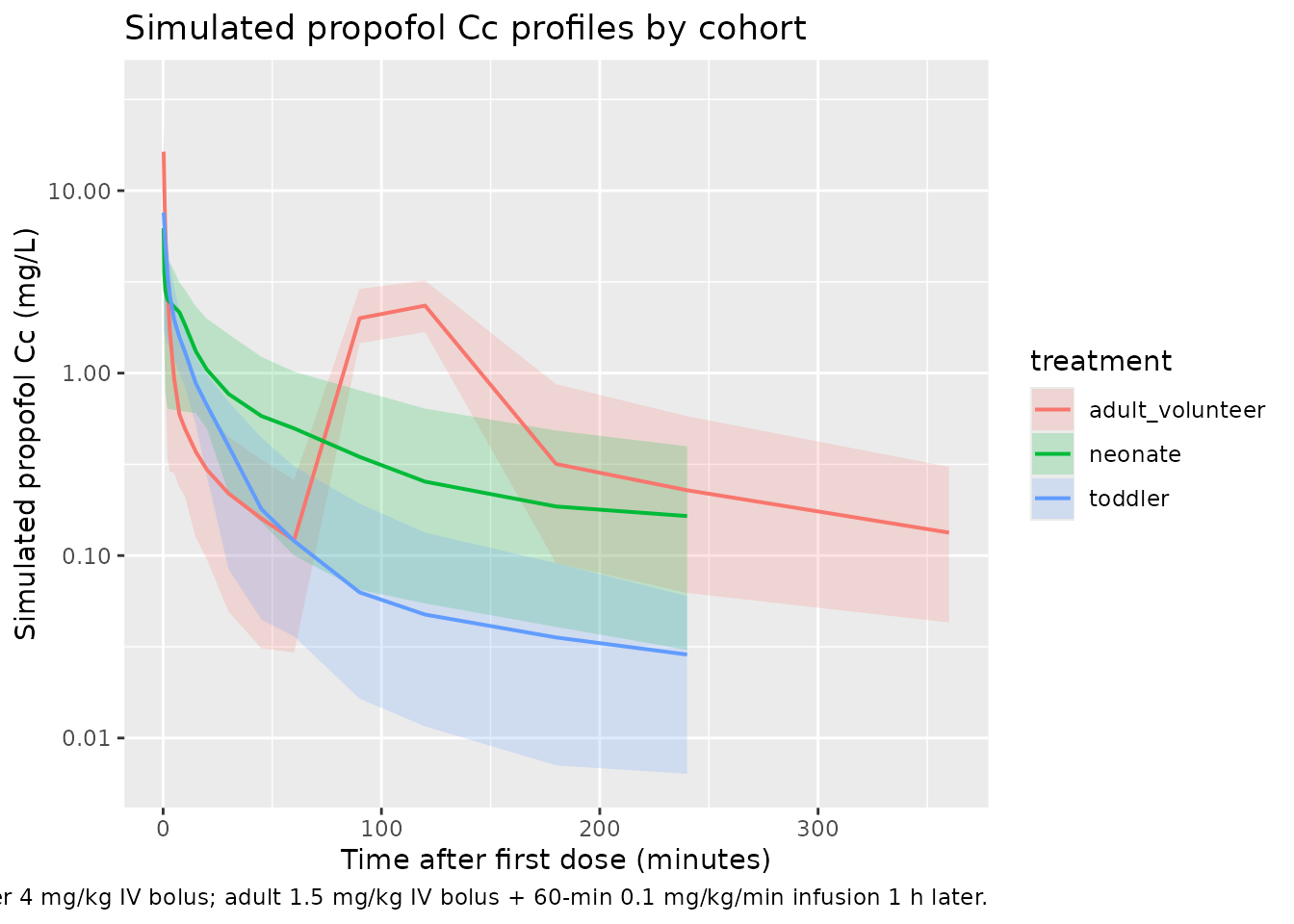
PKNCA validation
Wang 2012 does not tabulate NCA parameters (Cmax / AUC / half-life) by cohort, so this section computes simulated NCA values per cohort as a sanity check on the implementation. The values should fall within the range expected for IV propofol whole-blood concentrations.
sim_nca <- sim |>
  dplyr::filter(!is.na(Cc)) |>
  dplyr::select(id, time, Cc, treatment)

dose_df <- events |>
  dplyr::filter(evid == 1) |>
  dplyr::group_by(id, treatment) |>
  dplyr::summarise(time = min(time), amt = sum(amt), .groups = "drop")

conc_obj <- PKNCA::PKNCAconc(
  sim_nca,
  Cc ~ time | treatment + id,
  concu = "mg/L",
  timeu = "min"
)
dose_obj <- PKNCA::PKNCAdose(
  dose_df,
  amt ~ time | treatment + id,
  doseu = "mg"
)

intervals <- data.frame(
  start       = 0,
  end         = Inf,
  cmax        = TRUE,
  tmax        = TRUE,
  aucinf.obs  = TRUE,
  half.life   = TRUE
)

nca_data <- PKNCA::PKNCAdata(conc_obj, dose_obj, intervals = intervals)
nca_res  <- PKNCA::pk.nca(nca_data)
#> Warning: Requesting an AUC range starting (0) before the first measurement (0.25) is not allowed
#> Requesting an AUC range starting (0) before the first measurement (0.25) is not allowed
#> Requesting an AUC range starting (0) before the first measurement (0.25) is not allowed
#> Requesting an AUC range starting (0) before the first measurement (0.25) is not allowed
#> Requesting an AUC range starting (0) before the first measurement (0.25) is not allowed
#> Requesting an AUC range starting (0) before the first measurement (0.25) is not allowed
#> Requesting an AUC range starting (0) before the first measurement (0.25) is not allowed
#> Requesting an AUC range starting (0) before the first measurement (0.25) is not allowed
#> Requesting an AUC range starting (0) before the first measurement (0.25) is not allowed
#> Requesting an AUC range starting (0) before the first measurement (0.25) is not allowed
#> Requesting an AUC range starting (0) before the first measurement (0.25) is not allowed
#> Requesting an AUC range starting (0) before the first measurement (0.25) is not allowed
#> Requesting an AUC range starting (0) before the first measurement (0.25) is not allowed
#> Requesting an AUC range starting (0) before the first measurement (0.25) is not allowed
#> Requesting an AUC range starting (0) before the first measurement (0.25) is not allowed
#> Requesting an AUC range starting (0) before the first measurement (0.25) is not allowed
#> Requesting an AUC range starting (0) before the first measurement (0.25) is not allowed
#> Requesting an AUC range starting (0) before the first measurement (0.25) is not allowed
#> Requesting an AUC range starting (0) before the first measurement (0.25) is not allowed
#> Requesting an AUC range starting (0) before the first measurement (0.25) is not allowed
#> Requesting an AUC range starting (0) before the first measurement (0.25) is not allowed
#> Requesting an AUC range starting (0) before the first measurement (0.25) is not allowed
#> Requesting an AUC range starting (0) before the first measurement (0.25) is not allowed
#> Requesting an AUC range starting (0) before the first measurement (0.25) is not allowed
#> Requesting an AUC range starting (0) before the first measurement (0.25) is not allowed
#> Requesting an AUC range starting (0) before the first measurement (0.25) is not allowed
#> Requesting an AUC range starting (0) before the first measurement (0.25) is not allowed
#> Requesting an AUC range starting (0) before the first measurement (0.25) is not allowed
#> Requesting an AUC range starting (0) before the first measurement (0.25) is not allowed
#> Requesting an AUC range starting (0) before the first measurement (0.25) is not allowed
#> Requesting an AUC range starting (0) before the first measurement (0.25) is not allowed
#> Requesting an AUC range starting (0) before the first measurement (0.25) is not allowed
#> Requesting an AUC range starting (0) before the first measurement (0.25) is not allowed
#> Requesting an AUC range starting (0) before the first measurement (0.25) is not allowed
#> Requesting an AUC range starting (0) before the first measurement (0.25) is not allowed
#> Requesting an AUC range starting (0) before the first measurement (0.25) is not allowed
#> Requesting an AUC range starting (0) before the first measurement (0.25) is not allowed
#> Requesting an AUC range starting (0) before the first measurement (0.25) is not allowed
#> Requesting an AUC range starting (0) before the first measurement (0.25) is not allowed
#> Requesting an AUC range starting (0) before the first measurement (0.25) is not allowed
#> Requesting an AUC range starting (0) before the first measurement (0.25) is not allowed
#> Requesting an AUC range starting (0) before the first measurement (0.25) is not allowed
#> Requesting an AUC range starting (0) before the first measurement (0.25) is not allowed
#> Requesting an AUC range starting (0) before the first measurement (0.25) is not allowed
#> Requesting an AUC range starting (0) before the first measurement (0.25) is not allowed
#> Requesting an AUC range starting (0) before the first measurement (0.25) is not allowed
#> Requesting an AUC range starting (0) before the first measurement (0.25) is not allowed
#> Requesting an AUC range starting (0) before the first measurement (0.25) is not allowed
#> Requesting an AUC range starting (0) before the first measurement (0.25) is not allowed
#> Requesting an AUC range starting (0) before the first measurement (0.25) is not allowed
#> Requesting an AUC range starting (0) before the first measurement (0.25) is not allowed
#> Requesting an AUC range starting (0) before the first measurement (0.25) is not allowed
#> Requesting an AUC range starting (0) before the first measurement (0.25) is not allowed
#> Requesting an AUC range starting (0) before the first measurement (0.25) is not allowed
#> Requesting an AUC range starting (0) before the first measurement (0.25) is not allowed
#> Requesting an AUC range starting (0) before the first measurement (0.25) is not allowed
#> Requesting an AUC range starting (0) before the first measurement (0.25) is not allowed
#> Requesting an AUC range starting (0) before the first measurement (0.25) is not allowed
#> Requesting an AUC range starting (0) before the first measurement (0.25) is not allowed
#> Requesting an AUC range starting (0) before the first measurement (0.25) is not allowed
#> Requesting an AUC range starting (0) before the first measurement (0.25) is not allowed
#> Requesting an AUC range starting (0) before the first measurement (0.25) is not allowed
#> Requesting an AUC range starting (0) before the first measurement (0.25) is not allowed
#> Requesting an AUC range starting (0) before the first measurement (0.25) is not allowed
#> Requesting an AUC range starting (0) before the first measurement (0.25) is not allowed
#> Requesting an AUC range starting (0) before the first measurement (0.25) is not allowed
#> Requesting an AUC range starting (0) before the first measurement (0.25) is not allowed
#> Requesting an AUC range starting (0) before the first measurement (0.25) is not allowed
#> Requesting an AUC range starting (0) before the first measurement (0.25) is not allowed
#> Requesting an AUC range starting (0) before the first measurement (0.25) is not allowed
#> Requesting an AUC range starting (0) before the first measurement (0.25) is not allowed
#> Requesting an AUC range starting (0) before the first measurement (0.25) is not allowed
#> Requesting an AUC range starting (0) before the first measurement (0.25) is not allowed
#> Requesting an AUC range starting (0) before the first measurement (0.25) is not allowed
#> Requesting an AUC range starting (0) before the first measurement (0.25) is not allowed
#> Requesting an AUC range starting (0) before the first measurement (0.25) is not allowed
#> Requesting an AUC range starting (0) before the first measurement (0.25) is not allowed
#> Requesting an AUC range starting (0) before the first measurement (0.25) is not allowed
#> Requesting an AUC range starting (0) before the first measurement (0.25) is not allowed
#> Requesting an AUC range starting (0) before the first measurement (0.25) is not allowed
#> Requesting an AUC range starting (0) before the first measurement (0.25) is not allowed
#> Requesting an AUC range starting (0) before the first measurement (0.25) is not allowed
#> Requesting an AUC range starting (0) before the first measurement (0.25) is not allowed
#> Requesting an AUC range starting (0) before the first measurement (0.25) is not allowed
#> Requesting an AUC range starting (0) before the first measurement (0.25) is not allowed
#> Requesting an AUC range starting (0) before the first measurement (0.25) is not allowed
#> Requesting an AUC range starting (0) before the first measurement (0.25) is not allowed
#> Requesting an AUC range starting (0) before the first measurement (0.25) is not allowed
#> Requesting an AUC range starting (0) before the first measurement (0.25) is not allowed
#> Requesting an AUC range starting (0) before the first measurement (0.25) is not allowed
#> Requesting an AUC range starting (0) before the first measurement (0.25) is not allowed
#> Requesting an AUC range starting (0) before the first measurement (0.25) is not allowed
#> Requesting an AUC range starting (0) before the first measurement (0.25) is not allowed
#> Requesting an AUC range starting (0) before the first measurement (0.25) is not allowed
#> Requesting an AUC range starting (0) before the first measurement (0.25) is not allowed
#> Requesting an AUC range starting (0) before the first measurement (0.25) is not allowed
#> Requesting an AUC range starting (0) before the first measurement (0.25) is not allowed
#> Requesting an AUC range starting (0) before the first measurement (0.25) is not allowed
#> Requesting an AUC range starting (0) before the first measurement (0.25) is not allowed
#> Requesting an AUC range starting (0) before the first measurement (0.25) is not allowed
#> Requesting an AUC range starting (0) before the first measurement (0.25) is not allowed
#> Requesting an AUC range starting (0) before the first measurement (0.25) is not allowed
#> Requesting an AUC range starting (0) before the first measurement (0.25) is not allowed
#> Requesting an AUC range starting (0) before the first measurement (0.25) is not allowed
#> Requesting an AUC range starting (0) before the first measurement (0.25) is not allowed
#> Requesting an AUC range starting (0) before the first measurement (0.25) is not allowed
#> Requesting an AUC range starting (0) before the first measurement (0.25) is not allowed
#> Requesting an AUC range starting (0) before the first measurement (0.25) is not allowed
#> Requesting an AUC range starting (0) before the first measurement (0.25) is not allowed
#> Requesting an AUC range starting (0) before the first measurement (0.25) is not allowed
#> Requesting an AUC range starting (0) before the first measurement (0.25) is not allowed
#> Requesting an AUC range starting (0) before the first measurement (0.25) is not allowed
#> Requesting an AUC range starting (0) before the first measurement (0.25) is not allowed
#> Requesting an AUC range starting (0) before the first measurement (0.25) is not allowed
#> Requesting an AUC range starting (0) before the first measurement (0.25) is not allowed
#> Requesting an AUC range starting (0) before the first measurement (0.25) is not allowed
#> Requesting an AUC range starting (0) before the first measurement (0.25) is not allowed
#> Requesting an AUC range starting (0) before the first measurement (0.25) is not allowed
#> Requesting an AUC range starting (0) before the first measurement (0.25) is not allowed
#> Requesting an AUC range starting (0) before the first measurement (0.25) is not allowed
nca_summary <- summary(nca_res)
knitr::kable(
  nca_summary,
  caption = "Simulated propofol NCA parameters by cohort (no per-cohort published reference)."
)| Interval Start | Interval End | treatment | N | Cmax (mg/L) | Tmax (min) | Half-life (min) | AUCinf,obs (min*mg/L) |
|---|---|---|---|---|---|---|---|
| 0 | Inf | adult_volunteer | 40 | 14.1 [87.6] | 0.250 [0.250, 120] | 166 [111] | NC |
| 0 | Inf | neonate | 40 | 5.50 [43.8] | 0.250 [0.250, 0.250] | 209 [213] | NC |
| 0 | Inf | toddler | 40 | 7.48 [99.3] | 0.250 [0.250, 0.250] | 176 [127] | NC |
Assumptions and deviations
- Variance vs CV%. Wang 2012 Table IV reports inter-individual variability directly as omega^2 (the variance of the eta normal distribution on the log scale) in the column labelled “omega^2”; the percentages in parentheses are the bootstrap-derived CV% on the variance estimate itself, NOT the log-normal CV of the parameter (Methods, “Statistical Model”: theta_i = theta_TV * exp(eta_i), eta_i ~ N(0, omega^2); the values 0.09 / 1.19 / 0.52 / 0.71 / 0.25 reproduce the variance entries verbatim). The omega^2 = 1.19 on V1 corresponds to a log-normal CV of approximately 113%, reflecting the large variability in V1 across the highly heterogeneous neonate-to-adult pooled cohort.
-
Residual error. Wang 2012 fits the residual error
as additive on log-transformed concentrations:
log(C_ij) = log(C_pred,ij) + eps_ijwitheps ~ N(0, sigma^2), sigma^2 = 0.06, equivalent to a proportional error of sqrt(0.06) = 0.2449 on the linear concentration scale (Methods, “Statistical Model”). This is encoded aspropSd = sqrt(0.06)with aprop(propSd)residual. - Fixed parameters. k0 = 1.34 and gamma = 5.24 are fixed in the Final model because the covariance step did not succeed when they were estimated; the values come from the successful run without covariance step (Wang 2012 Results paragraph on Model IV: “the exponent of bodyweight at 0 kg (k_0) and the hill factor (gamma) were fixed to the estimated values from a successful run without covariance step, which were 1.35 and 5.24”). The Table IV Final model row gives k0 = 1.34 (slightly different from the 1.35 in Table II Model IV); the encoding here uses the Table IV Final value.
-
V1 cut-point threshold. The source paper reports
the V1-by-body-weight relationship as “PNA < 100 days”. The canonical
PNAregister stores postnatal age in months; the 100-day threshold is converted internally as100 / 30.4375so that callers supplyPNAin months (consistent with the rest of the nlmixr2lib paediatric models). - No covariate other than WT and PNA. Methods reports that bodyweight proved superior over age as a covariate for CL, and that the Final model retained only WT (on CL, V2, Q3, V3) and the binary PNA < 100-day indicator (on V1). No age, sex, race, gestational-age, or cohort-of-origin covariate is retained.
-
Q2 has no IIV. Table IV Final model leaves the Q2
IIV row blank, meaning IIV on Q2 was not estimated. The model file
therefore omits
etalqentirely. - Concentration assay. Methods does not state whether the assayed concentrations are plasma or whole blood; published propofol popPK literature is split between the two. The blood-to-plasma ratio of propofol is approximately 1 in adult human, so the distinction is small for downstream simulations but worth flagging when comparing against external plasma-PK studies.
- Simulated regimens follow the cohort-specific dosing descriptions in Wang 2012 Methods but are generic representatives chosen to exercise the published body-weight and age ranges; the original individual-patient dosing records and concentration data are not public.