Model and source
- Citation: Xu C, Su Y, Paccaly A, Kanamaluru V. Population Pharmacokinetics of Sarilumab in Patients with Rheumatoid Arthritis. Clin Pharmacokinet. 2019;58(11):1455-1467. doi:10.1007/s40262-019-00765-1
- Description: Two-compartment population PK model for sarilumab in adults with rheumatoid arthritis (Xu 2019), with first-order SC absorption and parallel linear plus Michaelis-Menten (target-mediated) elimination from the central compartment.
- Article: Clin Pharmacokinet. 2019;58(11):1455-1467 (open access via PMC6856490)
Population
Xu 2019 pooled 12 clinical studies (7 phase I, 1 phase II, 4 phase III) into a final population PK dataset of 1770 adults with moderate-to-severe rheumatoid arthritis (RA) who had inadequate response to methotrexate, TNF inhibitors, or other DMARDs. The dataset contained 7676 serum sarilumab concentrations after SC doses spanning 50-200 mg as single or repeated administrations (weekly or every-2-weeks). The marketed regimen is 200 mg SC every 2 weeks (Q2W), with reduction to 150 mg Q2W available for safety management.
Baseline demographics from Table 2: median age 53 years (range 18-87), 83% female, median body weight 71.0 kg (range 31.5-176.9), 88% White / 6% Asian / 3% Black / 3% other, median baseline serum albumin 38 g/L, median creatinine clearance 104.8 mL/min, median baseline CRP 14.2 mg/L, ADA-positive 18%, concomitant methotrexate 91%. Drug-product formulations: DP1 4%, DP2 20%, DP3 (commercial) 76%.
The same information is available programmatically via
readModelDb("Xu_2019_sarilumab")$population.
Source trace
Every structural parameter, covariate effect, IIV element, and residual-error term below is taken from Xu 2019 Table 3. The reference covariate values are a 71 kg female, ADA-negative, non-DP2 formulation, albumin/ULN ratio of 0.78 (i.e. 38 g/L over a typical ULN of 48.7 g/L), 1.73 x CrCl / BSA of 100 mL/min/1.73 m^2, and baseline CRP of 14.2 mg/L.
| Equation / parameter | Value | Source location |
|---|---|---|
lka (Ka) |
log(0.136) 1/day |
Table 3, Ka row |
lcl (CLO/F) |
log(0.260) L/day |
Table 3, CLO/F row |
lvc (Vc/F) |
log(2.08) L |
Table 3, Vc/F row |
lvp (Vp/F) |
log(5.23) L |
Table 3, Vp/F row |
lq (Q/F) |
log(0.156) L/day |
Table 3, Q/F row |
lvmax (Vmax) |
log(8.06) mg/day |
Table 3, Vm row |
lkm (Km) |
log(0.939) mg/L |
Table 3, Km row |
e_wt_cl (WT/71 exponent on CLO/F) |
0.885 |
Table 3, theta10 / WT effect on CLO/F |
e_wt_vmax (WT/71 exponent on Vmax) |
0.516 |
Table 3, theta9 / WT effect on Vm |
e_albr_vmax (ALBR/0.78 exponent on Vmax) |
-0.844 |
Table 3, theta11 / ALBR effect on Vm |
e_crcl_vmax (CRCL/100 exponent on Vmax) |
0.212 |
Table 3, theta13 / CrCl effect on Vm |
e_crp_vmax (CRP/14.2 exponent on Vmax) |
0.0299 |
Table 3, theta12 / CRP effect on Vm |
e_dp2_ka (DP2 multiplier on Ka) |
0.663 |
Table 3, theta15 / DP2 effect on Ka |
e_ada_cl (ADA multiplier on CLO/F) |
1.43 |
Table 3, theta14 / ADA effect on CLO/F |
e_dp2_cl (DP2 multiplier on CLO/F) |
1.30 |
Table 3, theta16 / DP2 effect on CLO/F |
e_sexf_cl (SEX multiplier on CLO/F) |
0.846 |
Table 3, theta17; SEX=1=female (maintainer-confirmed) |
var(etalvmax) |
log(0.324^2 + 1) = 0.0998 |
Table 3: Vm IIV 32.4% CV |
var(etalcl) |
log(0.553^2 + 1) = 0.2669 |
Table 3: CLO/F IIV 55.3% CV |
cov(etalvmax, etalcl) |
-0.566 * sqrt(0.0998 * 0.2669) = -0.0924 |
Table 3: Vm-CLO/F correlation -0.566 |
var(etalvc) |
log(0.373^2 + 1) = 0.1302 |
Table 3: Vc/F IIV 37.3% CV |
var(etalka) |
log(0.321^2 + 1) = 0.0981 |
Table 3: Ka IIV 32.1% CV |
propSd |
sqrt(0.395) = 0.6285 |
Table 3: log-additive residual sigma^2 = 0.395 |
| Structure (2-cmt + first-order SC absorption + linear + MM elimination) | n/a | Methods p. 1457, Figure 2 / final-model equations |
Parameterization notes
-
Michaelis-Menten plus linear clearance. Xu 2019
parameterizes elimination from the central compartment as a sum of
first-order linear clearance (
CL/F) and saturable Michaelis-Menten elimination with apparent parametersVm(mg/day) andKm(mg/L). The ODE is therefore implemented explicitly rather than vialinCmt(). -
CV% to log-normal variance. Xu 2019 Table 3 reports
between-subject variability as CV% on the linear-parameter scale. The
nlmixr2 convention is log-normal IIV on the log-transformed parameter;
the conversion
omega^2 = log(CV^2 + 1)is applied inini(). -
Vm / CLO/F correlation. Table 3 reports a -0.566
correlation between the etas on Vm and CLO/F, which is encoded as a 2x2
block in
ini()with the off-diagonal computed as r timessqrt(var_vmax * var_cl). -
Log-additive residual error. Xu 2019 fit
log-transformed concentrations with an additive residual error on the
log scale (NONMEM log-EPS,
sigma^2 = 0.395). On the linear scale this maps to a proportional residual error withpropSd = sqrt(0.395) = 0.6285. -
SEX encoding. Xu 2019 codes
SEX=1for female in the final CLO/F equation and reports that male patients have higher CL and lower AUC0-14d. This gives a multiplicative effect of 0.846 whenSEXF=1(female), which was maintainer-confirmed during model extraction (see theSEXFentry incovariateData). The canonicalSEXFcolumn in nlmixr2lib uses 1 = female, so the effect is applied ase_sexf_cl^SEXF. -
CRCL canonical column. Xu 2019 defines the Vm
covariate term as
(1.73 * CrCl / BSA / 100)^theta13whereCrClis in mL/min andBSAin m^2. The canonicalCRCLcolumn carries the precomputed1.73 * CrCl / BSAvalue (units mL/min/1.73 m^2) with reference value 100.
Virtual cohort
The simulations below use a virtual cohort whose covariate distributions approximate the Xu 2019 Table 2 demographics. No subject-level observed data were released with the paper.
set.seed(20260419)
# Cohort size: 200 subjects is enough to stabilise the 5/50/95 percentile
# bands in the VPC (Figure 3 reproduction) and the PKNCA distribution
# summaries. Doubling to 400 did not visibly change the published bands
# but made the simulation the largest in the package (~28 min on a single
# core), which caps pkgdown's parallel-article build via Amdahl's law.
n_subj <- 200

cohort <- tibble::tibble(
  id       = seq_len(n_subj),
  WT       = pmin(pmax(rnorm(n_subj, mean = 71, sd = 17),   40), 165),
  SEXF     = rbinom(n_subj, 1, 0.83),
  ADA_POS  = rbinom(n_subj, 1, 0.18),
  FORM_SAR_DP2 = 0L,                          # commercial DP3 formulation for labelled regimen
  ALBR     = pmin(pmax(rnorm(n_subj, mean = 0.78, sd = 0.08), 0.50), 1.05),
  CRCL = pmin(pmax(rnorm(n_subj, mean = 100,  sd = 25),   40),  200),
  CRP    = pmax(rlnorm(n_subj, log(14.2) - 0.5 * 0.9^2, 0.9), 0.5)
)
Two regimens are simulated in parallel: the labelled 200 mg SC Q2W adult RA dose and the dose-reduced 150 mg SC Q2W option. The dosing horizon is extended well past the nominal half-life (~8-10 days in the linear range) to ensure the final Q2W cycle is at steady state.
tau <- 14                # Q2W dosing interval (days)
# Dose count: the linear-range half-life is ~8-10 days, so the 4-5
# half-lives needed for >95% steady-state are reached by dose 7-8. Twelve
# Q2W doses (168 days, ~17 half-lives) puts the last cycle safely at SS
# with no signal from earlier cycles, while the previous value of 50
# doses (700 days) was a 10x oversample that dominated run time.
n_doses <- 12
dose_days <- seq(0, tau * (n_doses - 1), by = tau)

build_events <- function(cohort, dose_amt, treatment) {
  ev_dose <- cohort |>
    tidyr::crossing(time = dose_days) |>
    dplyr::mutate(amt = dose_amt, cmt = "depot", evid = 1L,
                  treatment = treatment)
  # Observation grid: dense only where the published figures need
  # resolution. Days 0-84 (six cycles) reproduce the Xu 2019 Figure 3
  # VPC; the final 14-day interval (ss_start to ss_end, days 154-168)
  # feeds the steady-state plot and the PKNCA computations. Between
  # those two windows a weekly grid is enough to keep the ODE solver
  # moving without contributing to any figure. The earlier uniform
  # daily-plus-4-per-dose grid over all 700 days produced ~900
  # observations per subject per arm, which (x 400 subjects x 2 arms)
  # pushed the event table past 750k rows and drove most of the cost.
  ss_start <- tau * (n_doses - 1)
  ss_end   <- ss_start + tau
  early_doses <- dose_days[dose_days <= 84]
  obs_days <- sort(unique(c(
    seq(0, 84, by = 1),            # daily through the VPC window
    early_doses + 0.25,            # keep fine near-dose structure
    early_doses + 1,               #   so the SC absorption peak is
    early_doses + 3,               #   resolved in Figure 3
    early_doses + 7,
    seq(84, ss_start, by = 7),     # coarse bridge between windows
    seq(ss_start, ss_end, by = 0.5) # dense SS cycle for NCA / plot
  )))
  ev_obs <- cohort |>
    tidyr::crossing(time = obs_days) |>
    dplyr::mutate(amt = 0, cmt = NA_character_, evid = 0L,
                  treatment = treatment)
  dplyr::bind_rows(ev_dose, ev_obs) |>
    dplyr::arrange(id, time, dplyr::desc(evid)) |>
    dplyr::select(id, time, amt, cmt, evid, treatment,
                  WT, SEXF, ADA_POS, FORM_SAR_DP2, ALBR, CRCL, CRP)
}

events_200 <- build_events(cohort, 200, "200mg_Q2W")
events_150 <- build_events(cohort, 150, "150mg_Q2W")
events <- dplyr::bind_rows(events_200, events_150)
Simulation
mod <- rxode2::rxode2(readModelDb("Xu_2019_sarilumab"))
#> ℹ parameter labels from comments will be replaced by 'label()'
conc_unit <- mod$units[["concentration"]]
keep_cols <- c("WT", "SEXF", "ADA_POS", "FORM_SAR_DP2",
               "ALBR", "CRCL", "CRP", "treatment")

sim <- lapply(split(events, events$treatment), function(ev) {
  out <- rxode2::rxSolve(mod, events = ev, keep = keep_cols)
  as.data.frame(out)
}) |> dplyr::bind_rows()
Replicate published figures
Concentration-time profile (labelled regimen)
Xu 2019 Figure 3 shows model-predicted mean +/- SD serum concentrations over the first few dosing cycles for 150 mg and 200 mg Q2W SC regimens. The block below reproduces that comparison using 5th/50th/95th percentile bands over the first 84 days (6 dosing cycles).
vpc <- sim |>
  dplyr::filter(!is.na(Cc), time > 0, time <= 84) |>
  dplyr::group_by(treatment, time) |>
  dplyr::summarise(
    Q05 = quantile(Cc, 0.05, na.rm = TRUE),
    Q50 = quantile(Cc, 0.50, na.rm = TRUE),
    Q95 = quantile(Cc, 0.95, na.rm = TRUE),
    .groups = "drop"
  )

ggplot(vpc, aes(time, Q50, colour = treatment, fill = treatment)) +
  geom_ribbon(aes(ymin = Q05, ymax = Q95), alpha = 0.2, colour = NA) +
  geom_line(linewidth = 0.8) +
  labs(
    x = "Time (days)",
    y = paste0("Sarilumab Cc (", conc_unit, ")"),
    title = "Simulated 5-50-95 percentile profiles: 150 vs 200 mg SC Q2W",
    caption = "Virtual RA cohort (N = 200); first 6 dosing cycles."
  ) +
  theme_minimal()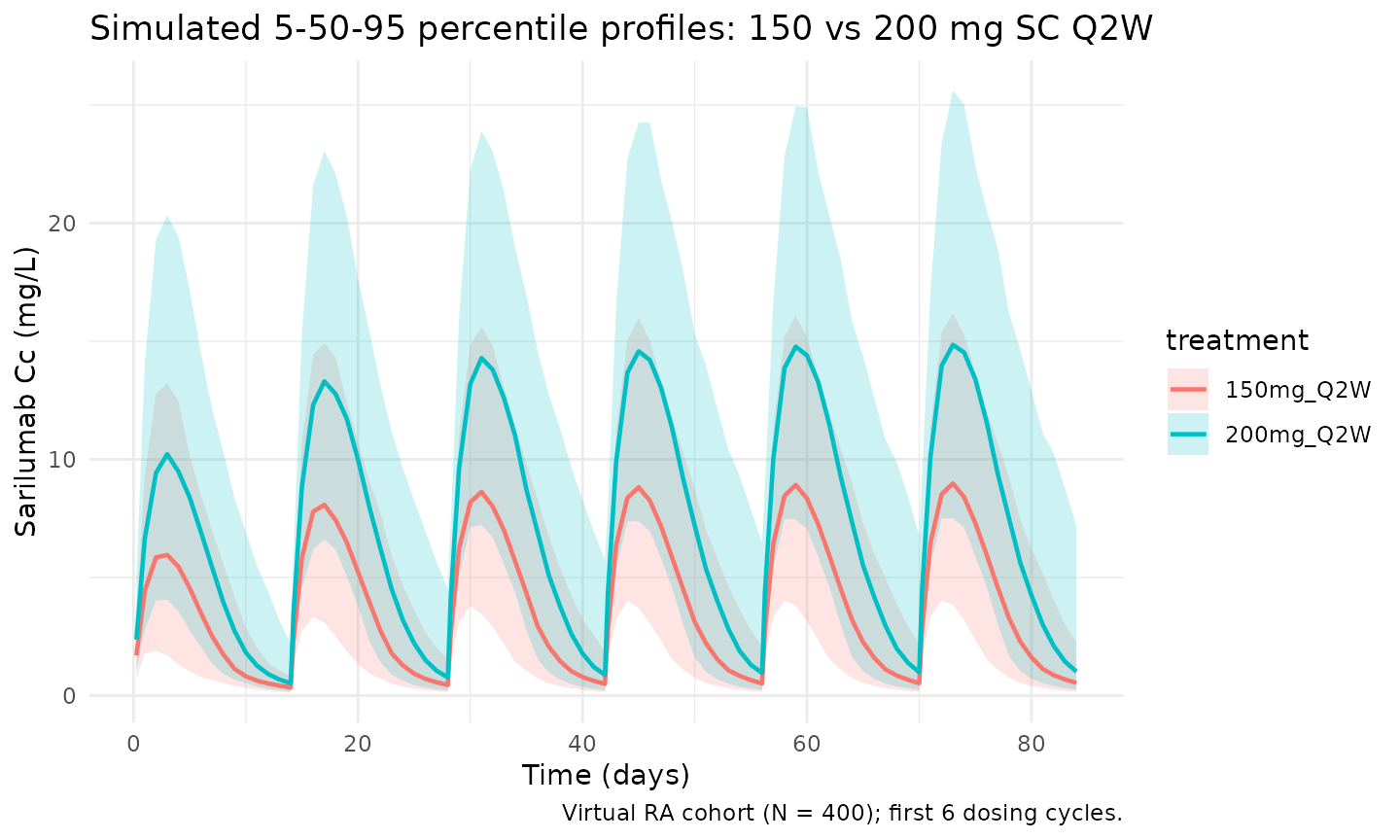
Steady-state cycle
The final dosing interval in the simulation window (days 154 to 168) is used for the steady-state NCA below.
ss_start <- tau * (n_doses - 1)
ss_end   <- ss_start + tau

ss_summary <- sim |>
  dplyr::filter(time >= ss_start, time <= ss_end, !is.na(Cc)) |>
  dplyr::group_by(treatment, time) |>
  dplyr::summarise(
    Q05 = quantile(Cc, 0.05, na.rm = TRUE),
    Q50 = quantile(Cc, 0.50, na.rm = TRUE),
    Q95 = quantile(Cc, 0.95, na.rm = TRUE),
    .groups = "drop"
  )

ggplot(ss_summary, aes(time - ss_start, Q50, colour = treatment, fill = treatment)) +
  geom_ribbon(aes(ymin = Q05, ymax = Q95), alpha = 0.2, colour = NA) +
  geom_line(linewidth = 0.8) +
  labs(
    x = "Time within dosing interval (days)",
    y = paste0("Sarilumab Cc (", conc_unit, ")"),
    title = "Steady-state Q2W cycle",
    caption = "Median and 90% prediction interval over the final 14-day interval."
  ) +
  theme_minimal()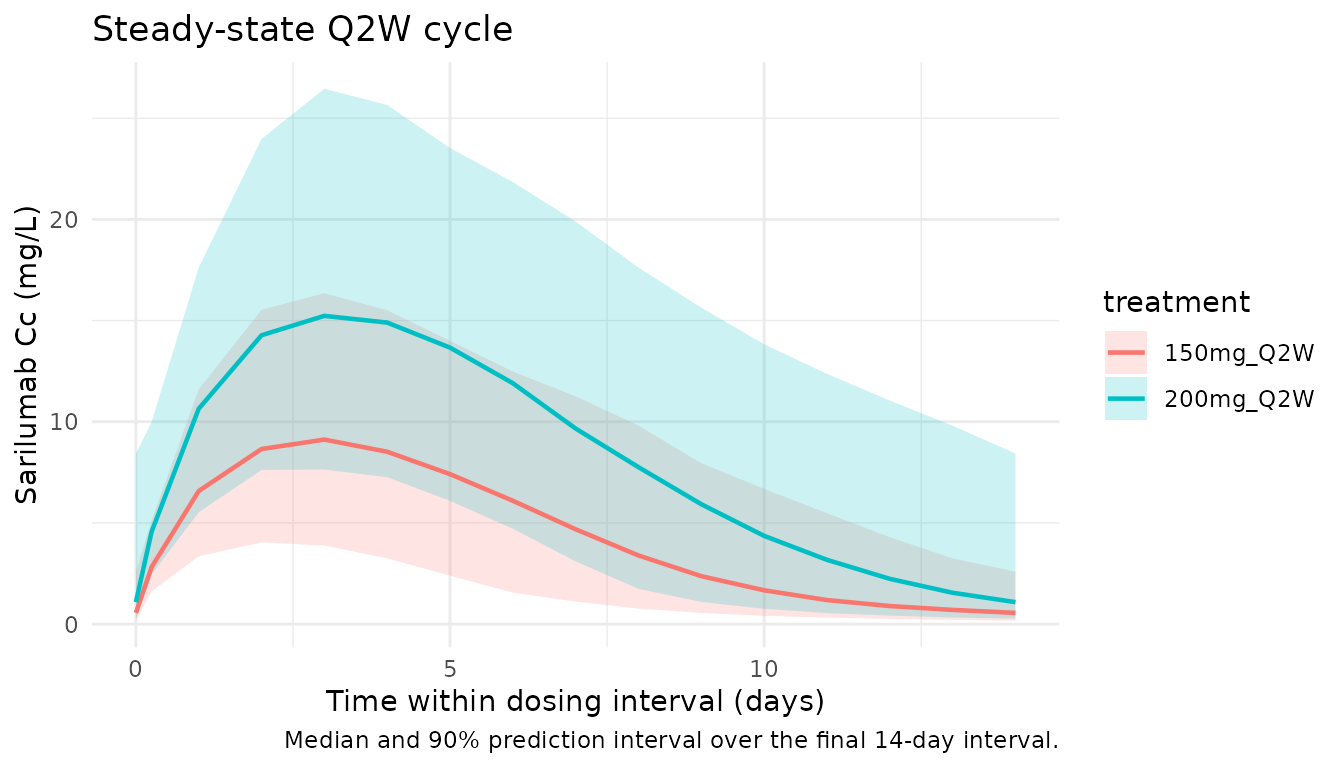
PKNCA validation
Non-compartmental analysis of the final (steady-state) Q2W dosing interval. Compute Cmax, Cmin/Ctrough, AUC0-tau, and Cavg per simulated subject and treatment.
nca_conc <- sim |>
  dplyr::filter(time >= ss_start, time <= ss_end, !is.na(Cc)) |>
  dplyr::mutate(time_nom = time - ss_start) |>
  dplyr::select(id, time = time_nom, Cc, treatment)

nca_dose <- dplyr::bind_rows(
  cohort |> dplyr::mutate(time = 0, amt = 200, treatment = "200mg_Q2W"),
  cohort |> dplyr::mutate(time = 0, amt = 150, treatment = "150mg_Q2W")
) |>
  dplyr::select(id, time, amt, treatment)

conc_obj <- PKNCA::PKNCAconc(nca_conc, Cc ~ time | treatment + id)
dose_obj <- PKNCA::PKNCAdose(nca_dose, amt ~ time | treatment + id)

intervals <- data.frame(
  start   = 0,
  end     = tau,
  cmax    = TRUE,
  cmin    = TRUE,
  tmax    = TRUE,
  auclast = TRUE,
  cav     = TRUE
)

nca_res <- PKNCA::pk.nca(PKNCA::PKNCAdata(conc_obj, dose_obj, intervals = intervals))
summary(nca_res)
#>  start end treatment   N    auclast        cmax       cmin              tmax
#>      0  14 150mg_Q2W 200 175 [66.8] 18.9 [50.4] 3.26 [237] 4.00 [2.00, 5.50]
#>      0  14 200mg_Q2W 200 311 [67.1] 29.9 [53.4] 9.11 [182] 4.50 [1.00, 6.00]
#>          cav
#>  12.5 [66.8]
#>  22.2 [67.1]
#>
#> Caption: auclast, cmax, cmin, cav: geometric mean and geometric coefficient of variation; tmax: median and range; N: number of subjects
Typical-patient steady-state exposures
To compare against the published Table 4 mean exposures the block below simulates the typical patient (IIV zeroed, reference covariate values: 71 kg female, ADA-negative, DP3 formulation, ALBR = 0.78, CRCL = 100, CRP = 14.2) and extracts Cmax, Ctrough, and AUC0-14d at steady state.
mod_typical <- mod |> rxode2::zeroRe()

typical_cov <- tibble::tibble(
  id = 1L, WT = 71, SEXF = 1L, ADA_POS = 0L, FORM_SAR_DP2 = 0L,
  ALBR = 0.78, CRCL = 100, CRP = 14.2
)

ev_typ <- function(dose) {
  ev_dose <- typical_cov |>
    tidyr::crossing(time = dose_days) |>
    dplyr::mutate(amt = dose, cmt = "depot", evid = 1L)
  obs_times <- sort(unique(c(
    seq(ss_start, ss_end, by = 0.05),
    dose_days
  )))
  ev_obs <- typical_cov |>
    tidyr::crossing(time = obs_times) |>
    dplyr::mutate(amt = 0, cmt = NA_character_, evid = 0L)
  dplyr::bind_rows(ev_dose, ev_obs) |>
    dplyr::arrange(id, time, dplyr::desc(evid)) |>
    dplyr::select(id, time, amt, cmt, evid,
                  WT, SEXF, ADA_POS, FORM_SAR_DP2, ALBR, CRCL, CRP)
}

sim_typ_200 <- as.data.frame(rxode2::rxSolve(mod_typical, events = ev_typ(200)))
#> ℹ omega/sigma items treated as zero: 'etalvmax', 'etalcl', 'etalvc', 'etalka'
sim_typ_150 <- as.data.frame(rxode2::rxSolve(mod_typical, events = ev_typ(150)))
#> ℹ omega/sigma items treated as zero: 'etalvmax', 'etalcl', 'etalvc', 'etalka'

ss_metrics <- function(sim_df, label) {
  ss <- sim_df |>
    dplyr::filter(time >= ss_start, time <= ss_end, !is.na(Cc)) |>
    dplyr::arrange(time)
  tibble::tibble(
    treatment   = label,
    Cmax_sim    = max(ss$Cc),
    Ctrough_sim = ss$Cc[which.max(ss$time)],
    AUC_sim     = sum(diff(ss$time) *
                      (head(ss$Cc, -1) + tail(ss$Cc, -1)) / 2)
  )
}

typ_tbl <- dplyr::bind_rows(
  ss_metrics(sim_typ_200, "200 mg Q2W"),
  ss_metrics(sim_typ_150, "150 mg Q2W")
)

published <- tibble::tibble(
  treatment   = c("200 mg Q2W", "150 mg Q2W"),
  Cmax_pub    = c(35.6, 20.0),
  Ctrough_pub = c(16.5, 6.35),
  AUC_pub     = c(395,  202)
)

comparison <- published |>
  dplyr::left_join(typ_tbl, by = "treatment") |>
  dplyr::mutate(
    Cmax_pct_diff    = 100 * (Cmax_sim - Cmax_pub) / Cmax_pub,
    Ctrough_pct_diff = 100 * (Ctrough_sim - Ctrough_pub) / Ctrough_pub,
    AUC_pct_diff     = 100 * (AUC_sim - AUC_pub) / AUC_pub
  )

worst <- comparison |>
  tidyr::pivot_longer(c(Cmax_pct_diff, Ctrough_pct_diff, AUC_pct_diff),
                      names_to = "metric", values_to = "pct_diff") |>
  dplyr::slice_max(abs(pct_diff), n = 1, with_ties = FALSE)

knitr::kable(comparison, digits = 2,
  caption = paste0("Typical-patient steady-state exposures (IIV zeroed) vs. ",
                   "Xu 2019 Table 4 mean values. All differences within ",
                   sprintf("%.0f%%", ceiling(abs(worst$pct_diff))),
                   " (largest: ", sub("_pct_diff$", "", worst$metric),
", ", worst$treatment, ")."))| treatment | Cmax_pub | Ctrough_pub | AUC_pub | Cmax_sim | Ctrough_sim | AUC_sim | Cmax_pct_diff | Ctrough_pct_diff | AUC_pct_diff |
|---|---|---|---|---|---|---|---|---|---|
| 200 mg Q2W | 35.6 | 16.50 | 395 | 35.81 | 16.60 | 398.87 | 0.58 | 0.64 | 0.98 |
| 150 mg Q2W | 20.0 | 6.35 | 202 | 19.68 | 5.46 | 198.61 | -1.60 | -14.09 | -1.68 |
Assumptions and deviations
-
SEX encoding (maintainer-confirmed). Xu 2019
reports the SEX covariate multiplier theta17 = 0.846 in the CLO/F
equation and narrates that male patients had higher apparent clearance
(lower AUC0-14d). Because
theta17 < 1reduces clearance, SEX in the final-model equation must indicate female (SEX=1=female). This interpretation was confirmed by the maintainers during extraction and is applied via the canonicalSEXFcovariate (1 = female). - Supplement not reviewed. The Clinical Pharmacokinetics electronic supplementary material (NONMEM control stream and supplementary tables) was not available when this model was built. All parameters in this model are therefore sourced from the published main text (Tables 2-4 and the covariate-model equations on p. 1458-1459). If the supplement exposes different digits of precision, an update may be warranted.
-
CRCL pre-computation. Xu 2019 writes the renal
covariate term as
(1.73 * CrCl / BSA / 100)^theta13. The canonicalCRCLcolumn in nlmixr2lib carries the pre-computed1.73 * CrCl / BSAvalue in mL/min/1.73 m^2, with reference 100. -
ALBR reference. The typical-patient reference
ALBR = 0.78corresponds to a median serum albumin of 38 g/L and a typical laboratory ULN of 48.7 g/L (per Xu 2019 Table 2 and the Vm covariate-model narrative). Users applying this model to a cohort with a different reference ULN should supplyALBR = observed albumin / ULNdirectly. -
Virtual-cohort covariate distributions. Body weight
is drawn from
N(71, 17)kg truncated to [40, 165]; albumin ratio fromN(0.78, 0.08)truncated to [0.50, 1.05]; CRCL fromN(100, 25)truncated to [40, 200]; baseline CRP from a log-normal with median 14.2 mg/L and geometric SDexp(0.9) ~ 2.5x. These ranges approximate Xu 2019 Table 2 but are not drawn from observed subject-level data, which are not publicly released. - Typical-patient NCA. The comparison table uses a typical-patient simulation (IIV zeroed out) because Table 4 of Xu 2019 reports mean exposures for a labelled / dose-reduced typical patient rather than a distribution. The full-cohort PKNCA block documents subject-level variability and aggregates via median +/- 90% interval.
-
No unit conversion needed. Dose units are mg and
concentration units are mg/L;
central / vctherefore yields mg/L directly, matching Xu 2019.