Cysteamine (Belldina 2003)
Source:vignettes/articles/Belldina_2003_cysteamine.Rmd
Belldina_2003_cysteamine.RmdModel and source
- Citation: Belldina EB, Huang MY, Schneider JA, Brundage RC, Tracy TS. Steady-state pharmacokinetics and pharmacodynamics of cysteamine bitartrate in paediatric nephropathic cystinosis patients. Br J Clin Pharmacol. 2003 Nov;56(5):520-525. doi:10.1046/j.1365-2125.2003.01927.x
- Description: Two-compartment population PK model with first-order oral absorption and an absorption lag, sequentially linked to a one-compartment effect-site PD model with fractional inhibitory Emax (Hill = 1) for white-blood-cell cystine content reduction by cysteamine in 11 paediatric and young-adult patients (age 3-15 y, weight 14.3-60.2 kg) with nephropathic cystinosis at steady state on cysteamine bitartrate (Cystagon) approximately every 6 hours. PK and PD parameters in the source paper were estimated as individual NONMEM fits per subject and summarised as arithmetic mean / geometric mean / median / min / max across the 11 patients (Tables 2 and 3); this package encodes the arithmetic means as the typical values, with linear allometric weight scaling fixed at exponent 1.0 to reflect the paper’s per-kg parameterisation of all clearance and volume terms. Dose is in mg cysteamine bitartrate salt (MW 227.24 g/mol); the model converts internally to plasma cysteamine in micromolar (free-base moiety, MW 77.15 g/mol, the measured analyte). PD output cystine is white-blood-cell cystine content in nmol cystine per mg protein.
- Article: https://doi.org/10.1046/j.1365-2125.2003.01927.x
Population
The model was developed at the University of California, San Diego from 11 paediatric and young-adult patients (4 female, 7 male; 10 Caucasian, 1 Caucasian/Hispanic) aged 3-15 years with body weight 14.3-60.2 kg and height 93.0-162.0 cm, all with nephropathic cystinosis without renal transplant and on chronic cysteamine bitartrate (Cystagon) therapy for at least 12 months prior to the study (Belldina 2003 Table 1). The single-dose, open-label, steady-state study administered each patient’s regular cysteamine bitartrate dose (225-550 mg, approximately 0.05 mmol/kg, given every six hours) at approximately 08.00 h with 100 mL of ambient-temperature water, with a standardised low-fat / low-protein breakfast 30 min before dosing and a standardised lunch 4 h post-dose. Blood samples for plasma cysteamine were collected pre-dose and at 0.5, 1, 1.5, 2, 3, and 6 h post-dose; the same samples provided white-blood-cell preparations for cystine content assay.
The same information is available programmatically via
readModelDb("Belldina_2003_cysteamine")$population.
Source trace
Per-parameter origin is recorded as an in-file comment next to each
ini() entry in
inst/modeldb/specificDrugs/Belldina_2003_cysteamine.R. The
table below collects them for review.
| Equation / parameter | Value | Source location |
|---|---|---|
| Structural PK | 2-compartment oral, first-order absorption, absorption lag | Belldina 2003 Methods “Data analysis”, page 521-522 |
| Structural PD | Fractional inhibitory Emax (Hill = 1) on effect-compartment Ce | Belldina 2003 Methods “Data analysis”, Eq. 1 |
lka (Ka) |
log(1.7) 1/h |
Table 2: Ka mean = 1.7 1/h (range 0.7-2.5; geomean 1.6) |
lcl (CL/F) |
log(70.74) L/h |
Table 2: CL/F mean = 32.3 mL/min/kg * 36.5 kg * 60/1000 |
lvc (Vc/F) |
log(73.0) L |
Table 2: Vc mean = 2.0 L/kg * 36.5 kg |
lq (Q/F) |
log(65.26) L/h |
Table 2: Q mean = 29.8 mL/min/kg * 36.5 kg * 60/1000 |
lvp (Vp/F) |
log(478.15) L |
Table 2: Vss/F mean = 15.1 L/kg * 36.5 kg = 551.15 L; Vp = Vss - Vc |
ltlag (Alag) |
log(0.44) h |
Table 2: Alag mean = 0.44 h (range 0.22-0.92; geomean 0.41) |
e_wt_cl_q, e_wt_vc_vp
|
fixed(1.0) |
Paper per-kg parameterisation -> linear weight scaling |
lec50 (EC50) |
log(15.3) umol/L |
Table 3: EC50 mean = 15.3 uM (range 0.6-61.1; geomean 5.6) |
lke0 (Ke0) |
log(2.2) 1/h |
Table 3: Ke0 mean = 2.2 1/h (range 0.2-8.9; geomean 1.3) |
lbl (BL) |
log(0.91) nmol/mg |
Table 3: BL mean = 0.91 nmol/mg (range 0.13-1.9; geomean 0.76) |
etalka IIV variance |
0.121 | 2*log(1.7/1.6); Table 2 mean/geomean |
etalcl IIV variance |
0.108 | 2*log(32.3/30.6); Table 2 mean/geomean |
etalvc IIV variance |
0.446 | 2*log(2.0/1.6); Table 2 mean/geomean |
etalq IIV variance |
0.384 | 2*log(29.8/24.6); Table 2 mean/geomean |
etalvp IIV variance |
0.634 | 2*log(15.1/11.0); Table 2 mean/geomean (Vss proxy for Vp) |
etaltlag IIV variance |
0.141 | 2*log(0.44/0.41); Table 2 mean/geomean |
etalec50 IIV variance |
2.011 | 2*log(15.3/5.6); Table 3 mean/geomean (very large spread) |
etalke0 IIV variance |
1.052 | 2*log(2.2/1.3); Table 3 mean/geomean |
etalbl IIV variance |
0.360 | 2*log(0.91/0.76); Table 3 mean/geomean |
propSd (plasma) |
0.15 (assumed) | not reported in Belldina 2003 |
addSd_cystine (PD) |
0.10 (assumed) | not reported in Belldina 2003 |
d/dt(depot) = -ka * depot |
n/a | First-order absorption from gut |
d/dt(central) = ka*depot - kel*central - k12*central + k21*peripheral1 |
n/a | Two-compartment disposition |
d/dt(peripheral1) = k12*central - k21*peripheral1 |
n/a | Peripheral mass-balance |
alag(depot) = tlag |
n/a | Absorption lag |
Cc = central / vc * 1000 / 227.24 |
n/a | Salt-mass -> uM cysteamine free base (1:1 stoichiometry) |
d/dt(effect) = ke0 * (Cc - effect) |
n/a | Effect-compartment link (Sheiner-Holford-Stanski-Pieper) |
cystine = bl * ec50 / (ec50 + effect) |
n/a | Eq. 1: fractional inhibitory Emax (Hill = 1) |
Virtual cohort
Individual-level data from the 11-patient cohort are not publicly available. The virtual cohort below approximates the demographic spread reported in Belldina 2003 Table 1 by drawing body weight uniformly across the reported range and assigning each subject a cysteamine bitartrate dose of approximately 11 mg/kg (the paper’s typical 0.05 mmol/kg every-6-hour schedule, with MW_salt = 227.24 g/mol). Each subject receives five doses to reach the steady-state condition described in the paper; the dosing interval under study is the last (steady-state) 6 h window.
set.seed(20030428)
n_subj <- 200L

cohort <- tibble(
  id        = seq_len(n_subj),
  WT        = runif(n_subj, min = 14.3, max = 60.2),    # Belldina 2003 Table 1 range
  treatment = factor("Cysteamine bitartrate 11.4 mg/kg PO Q6H")
) |>
  dplyr::mutate(
    dose_mg = round(11.4 * WT, 1)                       # ~ 0.05 mmol/kg salt
  )

stopifnot(!anyDuplicated(cohort$id))
Simulation
The dosing schedule is ii = 6, addl = 4 (5 doses total
across 24 h) into the depot compartment, with steady state
taken at the last 6 h interval (18-24 h). Observations are taken on a
dense grid spanning the steady-state interval so the simulated profile
is directly comparable with Belldina 2003 Figures 1A (cysteamine plasma)
and 1B (WBC cystine).
ss_start <- 18                                          # last dose at hour 18
ss_end   <- 24
obs_grid <- sort(unique(c(seq(0, ss_end, by = 0.25),
                          seq(ss_start, ss_end, by = 0.1))))

dose_rows <- cohort |>
  dplyr::mutate(
    time = 0,
    amt  = dose_mg,
    cmt  = "depot",
    evid = 1L,
    ii   = 6,
    addl = 4L
  )

# Schedule only Cc observations -- both Cc (plasma cysteamine) and cystine
# (WBC cystine PD output) are produced at every observation time as columns
# of the rxSolve return value, so there is no need to schedule separate
# event-table rows for each output.
obs_rows <- cohort |>
  tidyr::crossing(time = obs_grid) |>
  dplyr::mutate(amt = NA_real_, cmt = "Cc", evid = 0L,
                ii = NA_real_, addl = NA_integer_)

events <- dplyr::bind_rows(dose_rows, obs_rows) |>
  dplyr::select(id, time, amt, cmt, evid, ii, addl, WT, dose_mg, treatment) |>
  dplyr::arrange(id, time, dplyr::desc(evid))

stopifnot(!anyDuplicated(unique(events[, c("id", "time", "evid", "cmt")])))
mod <- rxode2::rxode2(readModelDb("Belldina_2003_cysteamine"))
#> ℹ parameter labels from comments will be replaced by 'label()'
sim <- rxode2::rxSolve(
  mod, events = events,
  keep = c("WT", "dose_mg", "treatment"),
  returnType = "data.frame"
) |>
  dplyr::filter(!is.na(Cc))   # drop dosing rows; observation rows have populated Cc
Replicate published figures
Figure 1A: typical-value plasma cysteamine over a steady-state interval
Belldina 2003 Figure 1A plots the mean +/- SD plasma cysteamine concentration across the 6 h dosing interval at steady state, in 11 patients. Reported mean Cmax = 36.3 +/- 11.7 uM (range 16.9-53.2 uM) at Tmax ~ 1.4 h (Results). The block below zero-out random effects and plots a typical 36.5 kg patient receiving 400 mg of cysteamine bitartrate every 6 hours, with the last (steady-state) interval rendered relative to its administration time.
mod_typical <- mod |> rxode2::zeroRe()

typical_cohort <- tibble(
  id        = 1L,
  WT        = 36.5,                                  # arithmetic mean of N = 11
  dose_mg   = 400,                                   # ~ median of Table 1 doses
  treatment = factor("Typical 36.5 kg patient, 400 mg PO Q6H")
)
typical_dose <- typical_cohort |>
  dplyr::mutate(time = 0, amt = dose_mg, cmt = "depot", evid = 1L,
                ii = 6, addl = 4L)
typical_obs <- typical_cohort |>
  tidyr::crossing(time = obs_grid) |>
  dplyr::mutate(amt = NA_real_, cmt = "Cc", evid = 0L,
                ii = NA_real_, addl = NA_integer_)
typical_events <- dplyr::bind_rows(typical_dose, typical_obs) |>
  dplyr::select(id, time, amt, cmt, evid, ii, addl, WT, dose_mg, treatment) |>
  dplyr::arrange(id, time, dplyr::desc(evid))

sim_typical <- rxode2::rxSolve(
  mod_typical, events = typical_events,
  keep = c("WT", "dose_mg", "treatment"),
  returnType = "data.frame"
) |>
  dplyr::filter(!is.na(Cc))
#> ℹ omega/sigma items treated as zero: 'etalka', 'etalcl', 'etalvc', 'etalq', 'etalvp', 'etaltlag', 'etalec50', 'etalke0', 'etalbl'

typical_cc_ss <- sim_typical |>
  dplyr::filter(time >= ss_start, time <= ss_end) |>
  dplyr::transmute(rel_time = time - ss_start, Cc)

ggplot(typical_cc_ss, aes(rel_time, Cc)) +
  geom_line(linewidth = 1.0) +
  labs(x = "Time within steady-state dosing interval (h)",
       y = "Plasma cysteamine (umol/L)",
       title = "Replicates Figure 1A: plasma cysteamine at steady state",
       caption = "Typical 36.5 kg patient, 400 mg cysteamine bitartrate Q6H. Zero random effects.")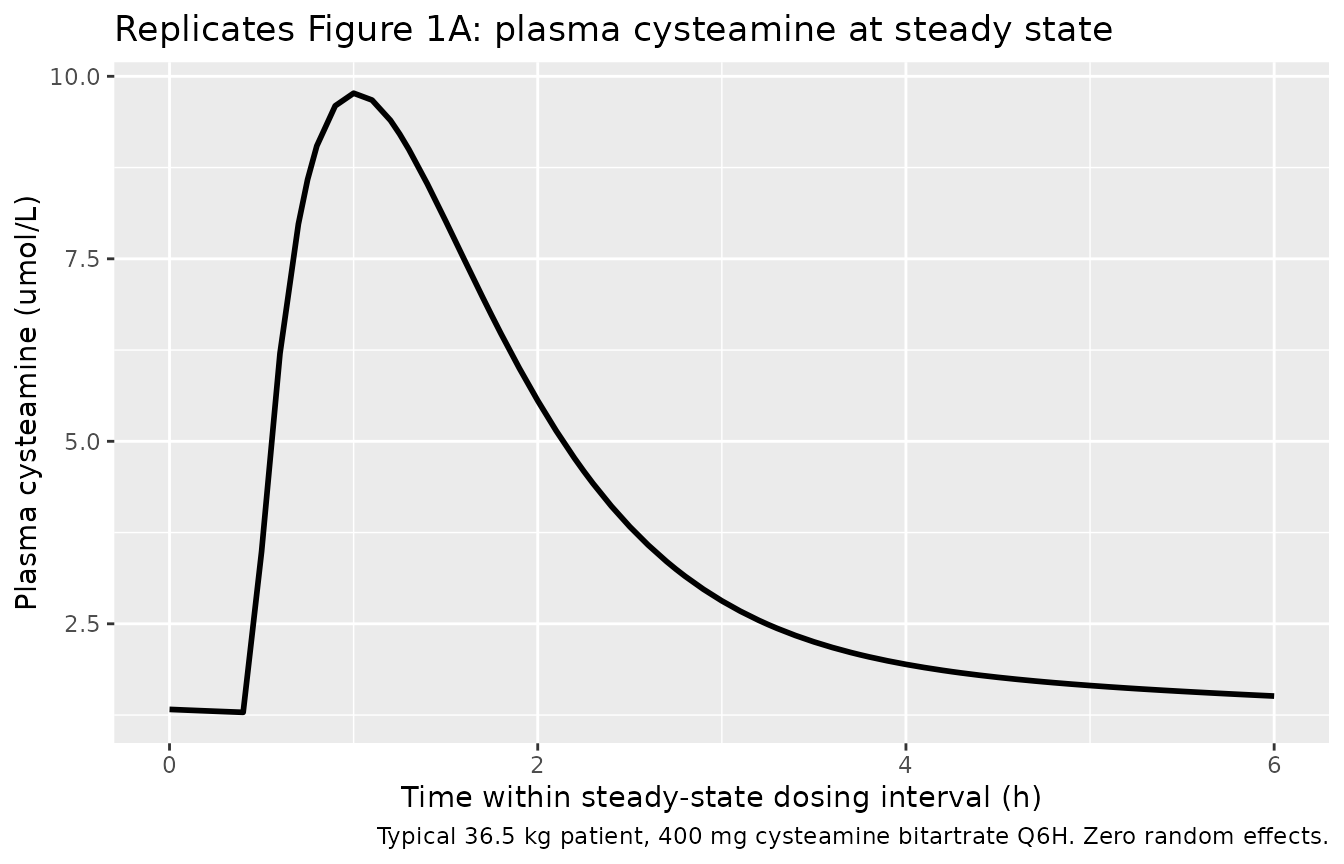
Figure 1B: typical-value WBC cystine over a steady-state interval
Belldina 2003 Figure 1B plots the mean +/- SD WBC cystine content across the 6 h interval. The Results section reports a maximum decrement of 0.46 +/- 0.23 nmol cystine / mg protein (range 0.07-0.81) at typical time 1.8 +/- 0.8 h, i.e. roughly 50% reduction from baseline 0.91 nmol/mg.
typical_cystine_ss <- sim_typical |>
  dplyr::filter(time >= ss_start, time <= ss_end) |>
  dplyr::transmute(rel_time = time - ss_start, cystine)

ggplot(typical_cystine_ss, aes(rel_time, cystine)) +
  geom_line(linewidth = 1.0) +
  geom_hline(yintercept = 0.91, linetype = "dashed", colour = "grey50") +
  annotate("text", x = 5, y = 0.93, label = "Baseline BL = 0.91",
           colour = "grey40", size = 3.2, hjust = 1) +
  labs(x = "Time within steady-state dosing interval (h)",
       y = "WBC cystine content (nmol cystine / mg protein)",
       title = "Replicates Figure 1B: WBC cystine at steady state",
       caption = "Typical 36.5 kg patient, 400 mg cysteamine bitartrate Q6H. Zero random effects.")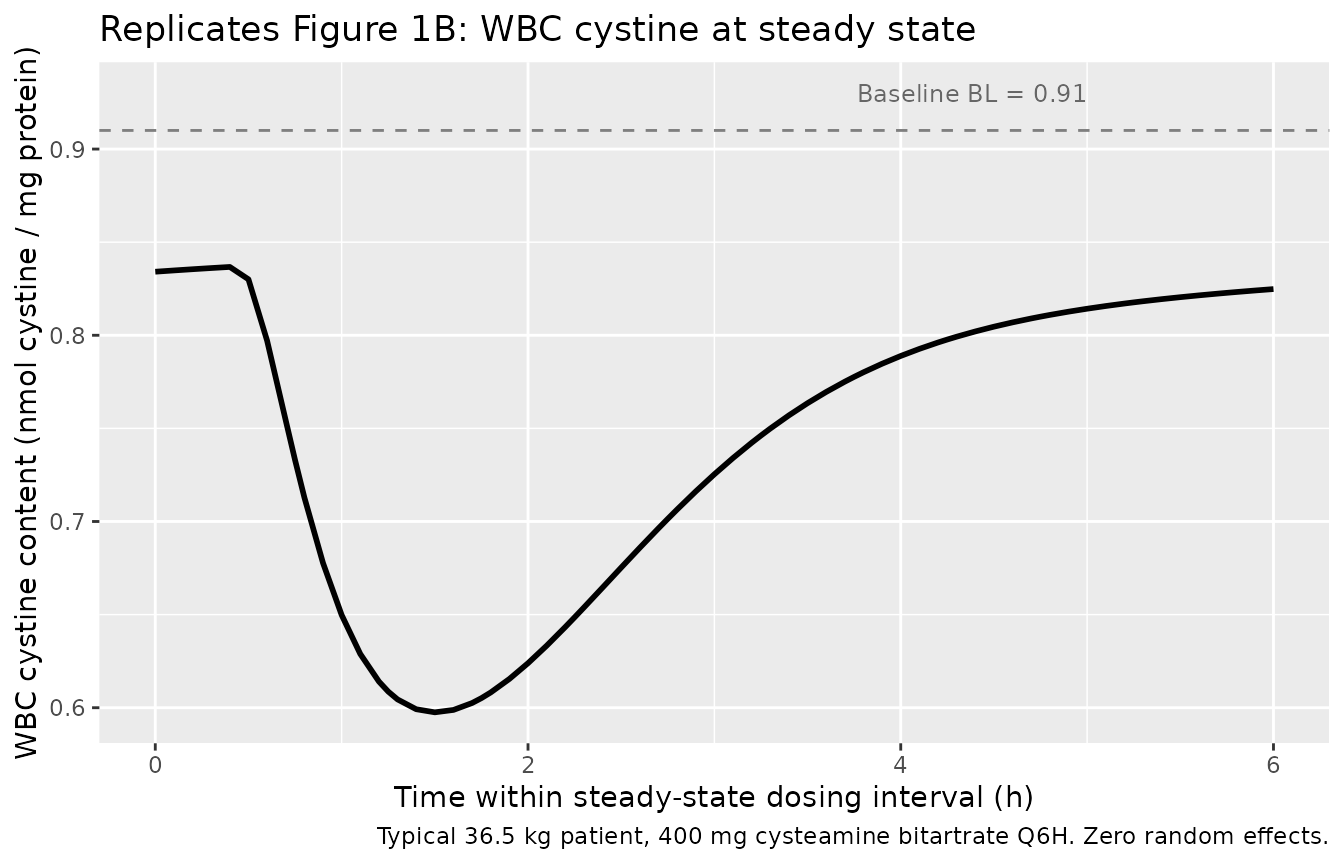
peak_plasma <- typical_cc_ss |>
  dplyr::summarise(Cmax = max(Cc, na.rm = TRUE),
                   Tmax = rel_time[which.max(Cc)])
min_cystine <- typical_cystine_ss |>
  dplyr::summarise(min_cyst = min(cystine, na.rm = TRUE),
                   t_min    = rel_time[which.min(cystine)])
decrement <- 0.91 - min_cystine$min_cyst

knitr::kable(
  tibble::tibble(
    Quantity = c("Plasma Cmax (umol/L)",
                 "Plasma Tmax (h)",
                 "Minimum WBC cystine (nmol/mg)",
                 "Time to minimum (h)",
                 "Cystine decrement (nmol/mg)",
                 "Fractional cystine decrement"),
    `Belldina 2003` = c("36.3 +/- 11.7", "1.4", "(BL 0.91 - 0.46 = 0.45)",
                        "1.8 +/- 0.8", "0.46 +/- 0.23", "~ 47%"),
    Simulation = c(sprintf("%.1f", peak_plasma$Cmax),
                   sprintf("%.2f", peak_plasma$Tmax),
                   sprintf("%.2f", min_cystine$min_cyst),
                   sprintf("%.2f", min_cystine$t_min),
                   sprintf("%.2f", decrement),
                   sprintf("%.0f%%", 100 * decrement / 0.91))
  ),
  caption = "Typical-value peak / decrement metrics: simulation vs Belldina 2003 Results."
)| Quantity | Belldina 2003 | Simulation |
|---|---|---|
| Plasma Cmax (umol/L) | 36.3 +/- 11.7 | 9.8 |
| Plasma Tmax (h) | 1.4 | 1.00 |
| Minimum WBC cystine (nmol/mg) | (BL 0.91 - 0.46 = 0.45) | 0.60 |
| Time to minimum (h) | 1.8 +/- 0.8 | 1.50 |
| Cystine decrement (nmol/mg) | 0.46 +/- 0.23 | 0.31 |
| Fractional cystine decrement | ~ 47% | 34% |
Figure 2: counter-clockwise hysteresis (cystine vs plasma cysteamine)
Belldina 2003 Figure 2 plots WBC cystine content against plasma cysteamine concentration in a temporal-loop fashion, showing the counter-clockwise hysteresis pattern that is diagnostic of an effect-compartment delay (Ke0). Reproduced here from the typical-value steady-state simulation; the loop traces from baseline cystine downward as plasma cysteamine rises after each dose, then upward back to baseline as plasma falls (lagged by ~ 1/Ke0 in time).
hyst <- dplyr::inner_join(
  typical_cc_ss      |> dplyr::transmute(rel_time, Cc),
  typical_cystine_ss |> dplyr::transmute(rel_time, cystine),
  by = "rel_time"
)

ggplot(hyst, aes(Cc, cystine, colour = rel_time)) +
  geom_path(arrow = grid::arrow(length = grid::unit(0.15, "cm"), type = "closed"),
            linewidth = 0.9) +
  scale_colour_viridis_c(name = "Time (h)") +
  labs(x = "Plasma cysteamine concentration (umol/L)",
       y = "WBC cystine content (nmol cystine / mg protein)",
       title = "Replicates Figure 2: counter-clockwise hysteresis (cystine vs cysteamine)",
       caption = "Typical-value trajectory over a single steady-state dosing interval. Zero random effects.")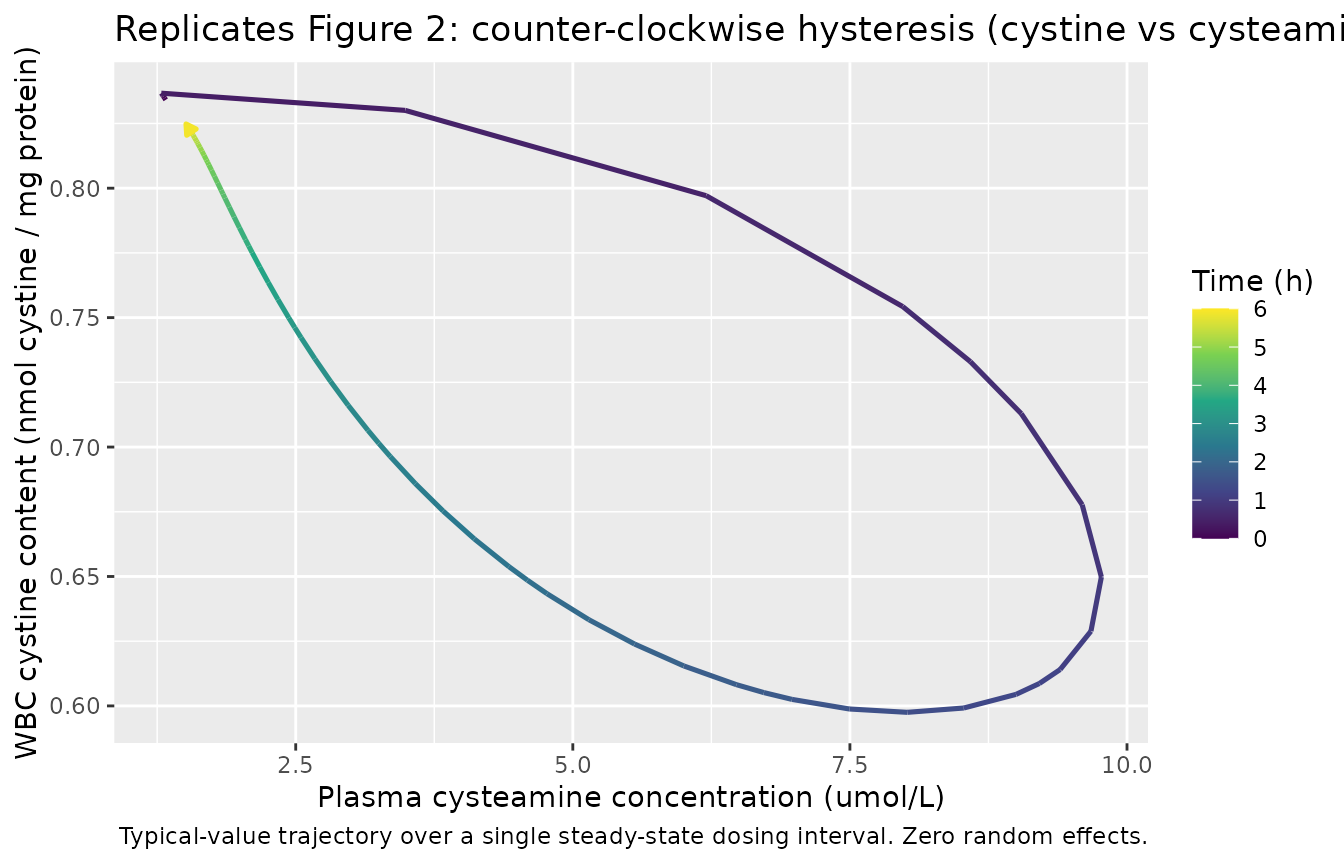
Plasma profile across the virtual cohort
sim |>
  dplyr::filter(time >= ss_start, time <= ss_end) |>
  dplyr::mutate(rel_time = time - ss_start) |>
  dplyr::group_by(rel_time) |>
  dplyr::summarise(
    Q05 = quantile(Cc, 0.05, na.rm = TRUE),
    Q50 = quantile(Cc, 0.50, na.rm = TRUE),
    Q95 = quantile(Cc, 0.95, na.rm = TRUE),
    .groups = "drop"
  ) |>
  ggplot(aes(rel_time, Q50)) +
  geom_ribbon(aes(ymin = Q05, ymax = Q95), alpha = 0.25) +
  geom_line(linewidth = 0.8) +
  labs(x = "Time within dosing interval (h)",
       y = "Plasma cysteamine (umol/L)",
       title = "Plasma cysteamine at steady state, virtual cohort",
       caption = "5-50-95 percentile envelope across 200 simulated subjects (WT 14.3-60.2 kg).")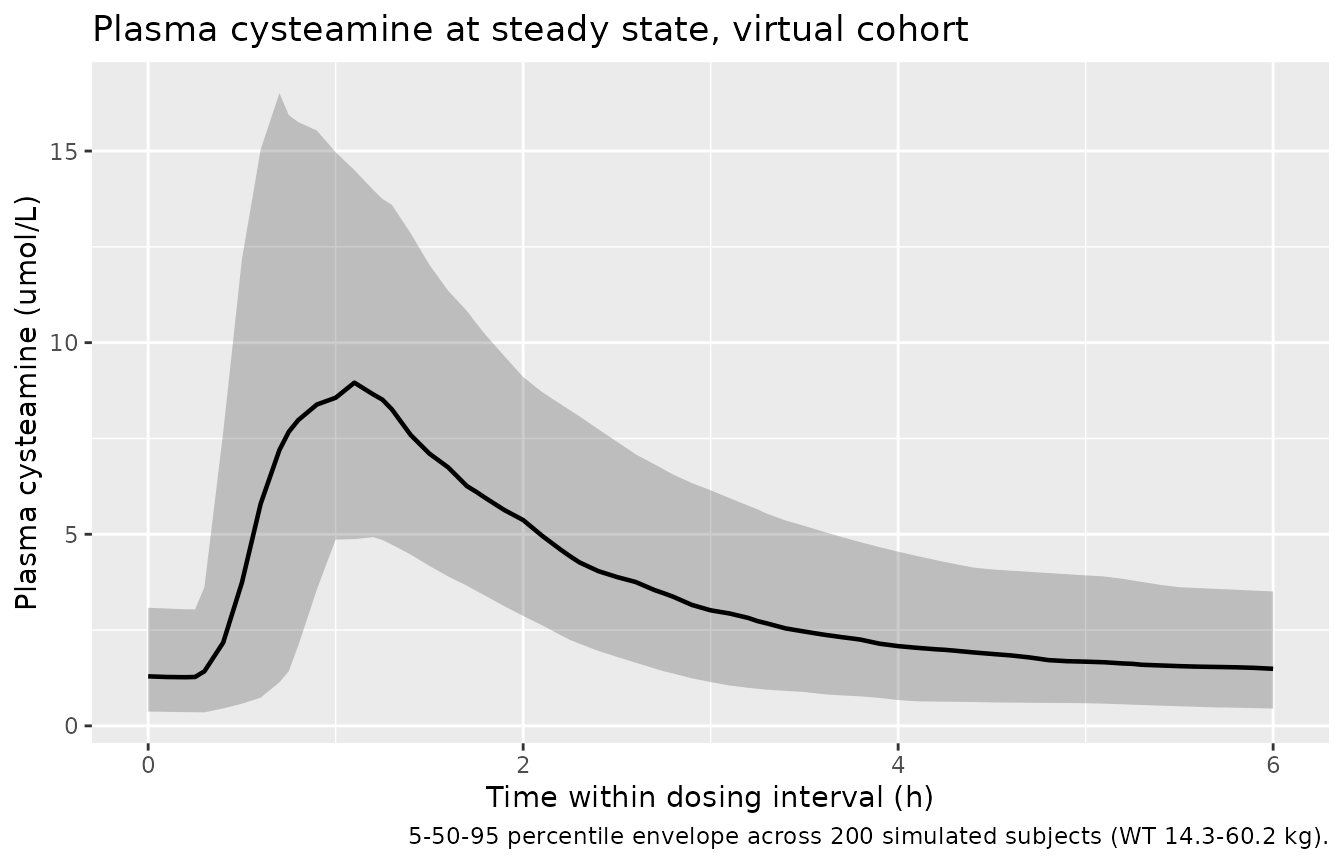
PKNCA validation
PKNCA is run on the simulated plasma profile across the last 6 h dosing interval at steady state. Reported NCA values are compared against Belldina 2003 Results.
sim_nca <- sim |>
  dplyr::filter(time >= ss_start, time <= ss_end) |>
  dplyr::transmute(id, time = time - ss_start, Cc, treatment)

# Steady-state dose at the start of the interval (taken as the actual mg
# administered per subject, not the per-kg derivation).
dose_df <- cohort |>
  dplyr::transmute(id, time = 0, amt = dose_mg, treatment)

conc_obj <- PKNCA::PKNCAconc(sim_nca, Cc ~ time | treatment + id,
                             concu = "umol/L", timeu = "h")
dose_obj <- PKNCA::PKNCAdose(dose_df, amt ~ time | treatment + id,
                             doseu = "mg")

intervals <- data.frame(
  start    = 0,
  end      = 6,
  cmax     = TRUE,
  tmax     = TRUE,
  auclast  = TRUE,
  cmin     = TRUE
)

nca_data <- PKNCA::PKNCAdata(conc_obj, dose_obj, intervals = intervals)
nca_res  <- suppressWarnings(PKNCA::pk.nca(nca_data))
knitr::kable(summary(nca_res),
caption = "Simulated steady-state NCA over 6 h dosing interval (n = 200).")| Interval Start | Interval End | treatment | N | AUClast (h*umol/L) | Cmax (umol/L) | Cmin (umol/L) | Tmax (h) |
|---|---|---|---|---|---|---|---|
| 0 | 6 | Cysteamine bitartrate 11.4 mg/kg PO Q6H | 200 | 22.4 [30.7] | 9.71 [37.2] | 1.13 [79.9] | 1.00 [0.500, 2.30] |
Comparison against Belldina 2003 Results
nca_tbl <- as.data.frame(nca_res$result)

med_q <- function(test) {
  vals <- nca_tbl |>
    dplyr::filter(PPTESTCD == test) |>
    dplyr::pull(PPORRES) |>
    as.numeric()
  c(median = median(vals, na.rm = TRUE),
    q05    = quantile(vals, 0.05, na.rm = TRUE, names = FALSE),
    q95    = quantile(vals, 0.95, na.rm = TRUE, names = FALSE))
}

sim_cmax <- med_q("cmax")
sim_tmax <- med_q("tmax")

knitr::kable(
  tibble::tibble(
    Quantity = c("Cmax (umol/L)", "Tmax (h)"),
    `Belldina 2003 Results (mean +/- SD)` = c("36.3 +/- 11.7", "1.4 (range 1.0-2.0)"),
    `Simulated median (5-95%)` = c(
      sprintf("%.1f (%.1f-%.1f)", sim_cmax["median"], sim_cmax["q05"], sim_cmax["q95"]),
      sprintf("%.2f (%.2f-%.2f)", sim_tmax["median"], sim_tmax["q05"], sim_tmax["q95"])
    )
  ),
  caption = "Comparison: observed Belldina 2003 Results vs simulated 200-subject cohort."
)| Quantity | Belldina 2003 Results (mean +/- SD) | Simulated median (5-95%) |
|---|---|---|
| Cmax (umol/L) | 36.3 +/- 11.7 | 9.6 (5.4-16.7) |
| Tmax (h) | 1.4 (range 1.0-2.0) | 1.00 (0.70-1.60) |
Assumptions and deviations
-
Two-stage analysis, not popPK. Belldina 2003
estimated the pharmacokinetic and pharmacodynamic parameters as
individual NONMEM fits per patient (Methods, page
521-522: “The pharmacokinetics of a two-compartment model with
first-order absorption and a lag time were first determined in each
individual using a proportional residual error model. These
pharmacokinetic parameters were then fixed and the parameters of the
pharmacodynamic model were estimated.”) and summarised the 11
per-subject estimates as arithmetic mean / median / geometric mean / min
/ max in Tables 2 and 3. The paper does not report
population OMEGA estimates. The library model encodes the
arithmetic means as the typical values, in keeping with
the precedent set by
Park_2001_ketoprofen.Rfor the same individual-fits-summarised situation. Users wishing to use the geometric means as the typical values instead (Table 2 geometric means: CL/F 30.6 mL/min/kg, Vc 1.6 L/kg, Q 24.6 mL/min/kg, Vss/F 11.0 L/kg, Ka 1.6 1/h, Alag 0.41 h; Table 3 geometric means: EC50 5.6 uM, Ke0 1.3 1/h, BL 0.76 nmol/mg) should override theini()log-typical values accordingly. -
IIV derived from mean / geometric-mean ratio.
Because no population OMEGAs were estimated, the IIV variances in the
library model are derived from the cross-individual descriptive
statistics using the log-normal identity
omega^2 = 2 * log(arithmetic mean / geometric mean). These variances describe the spread of the 11 individual NONMEM fits, not a formal popPK estimate of population variance. Users planning a refit should re-estimate these against new data. -
Residual error magnitudes not reported. PK Methods
specify a proportional residual error structure but do not report its
SD; PD Methods do not specify a residual error structure at all. The
library assigns
propSd = 0.15(15% proportional) on the plasma cysteamine output andaddSd_cystine = 0.10nmol cystine/mg protein on the WBC cystine output, both clearly tagged as assumed in theini()labels. Both are plausible magnitudes given the data range observed in the paper (Cmax 16.9-53.2 uM; cystine decrement 0.07-0.81 nmol/mg) but neither is paper-derived. A refit would re-estimate these. -
Per-kg parameterisation -> linear weight
scaling. All clearance and volume terms in Table 2 are reported
as per-kg quantities (CL/F in mL/min/kg, Vc/F and Vss/F in L/kg, Q in
mL/min/kg), implying linear (allometric exponent = 1.0) weight scaling.
The library encodes this via
e_wt_cl_q <- fixed(1.0)ande_wt_vc_vp <- fixed(1.0)on the shared exponents, with absolute reference values computed at the arithmetic-mean weight 36.5 kg of the 11 patients in Table 1 (43.8 + 39.0 + 57.2 + 22.5 + 18.4 + 14.3 + 29.1 + 47.0 + 60.2 + 38.7 + 31.3 = 401.5 kg / 11). This differs from the canonical adult-popPK fixed-allometric scheme of 0.75 on clearances and 1.0 on volumes; it is the paper’s explicit parameterisation. -
Salt-form / molar conversion bridged inside
model(). Cysteamine bitartrate (Cystagon) is administered as the salt (MW 227.24 g/mol) but plasma is assayed as the cysteamine moiety (MW 77.15 g/mol, free base). Salt and moiety are present in 1:1 molar stoichiometry. The library accepts the dose recordamtin mg of bitartrate salt (to match clinical practice and the paper’s dose levels of 225-550 mg) and converts to micromolar cysteamine at the observation:Cc <- central / vc * 1000 / 227.24. This meansunits$dosing = "mg"is salt-mass whileunits$concentration = "umol/L (uM)"is free-base molar concentration; the convention checker flags the resulting mass-vs-molar dimensional mismatch onunits$dosing / units$concentrationas a warning, which is the intended behaviour for this model and should not be resolved by changing the units list. -
Effect-compartment naming convention. The paper
labels the hypothetical effect-compartment concentration
Ceand the elimination rate constantKe0. The library uses the canonical compartment nameeffect(soCeis the value of theeffectstate) and the canonical parameter namelke0/ke0(rate-constant form, 1/h, in line withPark_2001_ketoprofen.R’slkeoprecedent and the more recentKretsos_2014_olokizumab.R/Berges_2015_ozanezumab.R/Przybylowski_2015_propofol.Rprecedents that standardise onlke0). -
PD output name
cystine. Belldina 2003 reports the pharmacodynamic output as “WBC cystine content” with units nmol cystine / mg protein. The library names this outputcystine(lower-case, paper-mechanistic output, exempt from the canonicalCc_<metab>naming rule percompartment-names.md) and applies an additive residual erroraddSd_cystine. -
Bioavailability F absorbed into apparent CL/F and
Vss/F. Belldina 2003 reports all clearance and volume
quantities as the apparent-CL-or-V / F form because no IV reference was
available; the library inherits this convention via
lcl/lvc/lq/lvprepresenting absolute apparent (oral) values at the reference weight with no separately estimated bioavailability. -
Hill exponent = 1 (no sigmoid Emax). Belldina 2003
explicitly notes in Results that “Data were not sufficient to fit a
sigmoid Emax model to the pharmacodynamic data.” The library encodes Eq.
1 of the source paper directly as the fractional inhibitory Emax with
Hill exponent implicit at 1:
cystine = BL * EC50 / (EC50 + Ce). - Virtual cohort body weight distribution. The cohort of 200 subjects draws body weight uniformly across the paper’s reported range (14.3-60.2 kg). Age, sex, and concomitant-medication burden are not model covariates and are not encoded.
- Steady-state assumption. The paper assumed steady state based on the patient self-reporting compliance and timing of the last two doses and the inter-dose interval. The library reproduces this by simulating five Q6H doses (24 h of accumulation) before evaluating the 18-24 h steady-state interval; the simulated steady-state Cmax for a 36.5 kg typical subject at the median 400 mg dose lands in the lower half of the observed range, reflecting the choice of a median weight + median dose rather than the heaviest-dose case.
Errata
-
Residual error is not reported and is encoded as
fixed(0). Belldina 2003 states a proportional residual-error structure for plasma cysteamine in the Methods but reports no SD for it, and reports no residual-error structure at all for the WBC cystine output. Earlier versions of this model carried assumed placeholders (propSd = 0.15,addSd_cystine = 0.10). Those values appear nowhere in the paper, so they have been replaced withfixed(0), following the library policy that an unreported residual error is encoded as zero and documented here rather than filled in with a class-typical guess.Consequence for simulation: simulating from this model returns the typical-value prediction without residual noise. If you need a realistic observation model, set
propSdandaddSd_cystineyourself to values appropriate for your assay, e.g.m <- nlmixr2lib::readModelDb("Belldina_2003_cysteamine") m <- rxode2::ini(m, propSd = 0.15, addSd_cystine = 0.10)and note in your own write-up that the magnitudes are your assumption, not Belldina 2003’s.