Nicotine whole-body PBPK (Rostami 2022)
Source:vignettes/articles/Rostami_2022_nicotine_pbpk.Rmd
Rostami_2022_nicotine_pbpk.RmdModel and source
Citation: Rostami AA, Campbell JL, Pithawalla YB, Pourhashem H, Muhammad-Kah RS, Sarkar MA, Liu J, McKinney WJ, Gentry R, Gogova M. (2022). A comprehensive physiologically based pharmacokinetic (PBPK) model for nicotine in humans from using nicotine-containing products with different routes of exposure. Sci Rep 12:1091. doi:10.1038/s41598-022-05108-y. PMCID PMC8776883. Author Correction Sci Rep 12:2436, doi:10.1038/s41598-022-06693-8 (bibliography fix only, no parameter impact). Whole-body disposition structure and chemical parameters trace to Robinson DE, Balter NJ, Schwartz SL (1992) J Pharmacokinet Biopharm 20:591-609 and Teeguarden JG et al. (2013) Regul Toxicol Pharmacol 65:12-28.
Description: PBPK (whole-body, MCSim/deSolve). Nicotine, cotinine and nicotine glucuronide disposition in humans, the parent nicotine PBPK model of Rostami 2022 in its originally published parameterization (Robinson / Teeguarden lineage). Carries eleven flow-limited nicotine tissues plus a nicotine-driven heart-rate feedback on cardiac output, a five-tissue cotinine sub-model and a one-compartment nicotine-glucuronide sub-model. Two administration routes are reproducible from the published sources and are implemented: an intravenous infusion directly into arterial blood (the paper’s own primary validation, Figure 11) and a first-order oral / gastrointestinal input with bioavailability. Deterministic typical-value model: the sources report no between-subject variability and no residual-error model. The four product-specific routes of the paper (conventional cigarette, ENDS, vapor inhaler and smokeless tobacco) are NOT implemented because their respiratory-tract deposition fractions and buccal / airway permeation coefficients are unreported zero placeholders in the published MCSim listing and are tabulated in no available source; see the vignette Errata. This is the un-adjusted parent of the Salehi 2025 nicotine-pouch model, which halved the hepatic and urinary clearances and rebuilt the buccal front-end.
Author Correction (bibliography only): https://doi.org/10.1038/s41598-022-06693-8
Rostami 2022 is a whole-body physiologically based pharmacokinetic (PBPK) model for nicotine and its metabolites cotinine and nicotine glucuronide in humans. It extends the Robinson 1992 and Teeguarden 2013 nicotine models with buccal-cavity and respiratory-tract compartments so that product-specific uptake from cigarettes, ENDS, a vapor inhaler and smokeless tobacco can be simulated. The whole-body disposition core, the nicotine-driven heart-rate feedback on cardiac output, and the cotinine and glucuronide sub-models are the reusable, fully specified part of that work, and are what this extraction implements.
This is the original, un-adjusted parent of the Salehi 2025 nicotine-pouch model (also in this package): Salehi 2025 later halved the four hepatic and urinary clearances and rebuilt the buccal front-end as a fitted diffusion chain. This model keeps the clearances at their originally published Rostami / Robinson values.
Population
The model is a deterministic mechanistic structure, not a fit to individual data. Its reference adult is 73.0 kg (Rostami 2022 Table 1); physiological volumes and flows are fractions of that body weight, drawn from ICRP and (for the buccal and airway tissues) Corley et al. Chemical parameters – partition coefficients, clearances, the metabolite split and the heart-rate feedback – come from Robinson 1992 and Teeguarden 2013 (Rostami 2022 Table 2).
str(ui$population)
#> List of 7
#>  $ species      : chr "human"
#>  $ age_range    : chr "adults"
#>  $ weight_median: chr "73.0 kg (Rostami 2022 Table 1 reference adult)"
#>  $ disease_state: chr "healthy adults; validation cohorts are habitual tobacco users"
#>  $ dose_range   : chr "intravenous nicotine 2 ug/kg/min over 30 min (Figure 11 validation arm); oral nicotine (first-order gastrointes"| __truncated__
#>  $ regions      : chr "United States"
#>  $ notes        : chr "The PBPK model is not fitted to individual-level data; it is a mechanistic structural model with parameters ado"| __truncated__
Source trace
Every ini() entry in
inst/modeldb/specificDrugs/Rostami_2022_nicotine_pbpk.R
carries an in-file comment naming its source location. The table below
collects them.
| Equation / parameter | Value | Source location |
|---|---|---|
| Whole-body flow-limited disposition | n/a | Rostami 2022 Figure 10; supplementary MCSim listing |
| Nicotine metabolism split (cotinine / glucuronide / other) | n/a | Rostami 2022 supplementary MCSim listing |
Heart-rate feedback
EOUT = HRO + S*Cv/(1 + CANT/CANT50)
|
n/a | Rostami 2022 supplementary MCSim listing (Teeguarden et al.) |
KA1 (oral / GI absorption rate) |
1.34 /h | Rostami 2022 Table 2 (KA) |
FA (oral bioavailability) |
0.67 | Rostami 2022 Table 2 |
| Hepatic / urinary clearances |
CLMC 2.70, CLKC 0.42, CLLMC
0.14, CLKMC 0.025 |
Rostami 2022 Table 2 |
FNC (fraction to cotinine) |
0.80 | Rostami 2022 Table 2 |
FNG, VGDC, GCLC (glucuronide
sub-model) |
0.10, 1.0, 0.1 | Rostami 2022 supplementary MCSim listing |
| Tissue volumes and blood flows | see ini()
|
Rostami 2022 Table 1 |
| Surface areas and epithelial widths | see ini()
|
Rostami 2022 Table 1 |
| Partition coefficients (nicotine, cotinine) | see ini()
|
Rostami 2022 Table 2 |
Tissue binding BMLURC, BMHRC,
KBLU, KBH
|
0.00235, 0.00427, 0, 0 | Rostami 2022 supplementary MCSim listing |
Heart-rate feedback SPD, KANT,
CANT50
|
933.66, 1.6617, 0.0152 | Rostami 2022 Table 2 |
| Cotinine / glucuronide molecular weights | 178, 338 | Rostami 2022 supplementary MCSim listing (hard-coded literals) |
Simulation setup
The model is deterministic: Rostami 2022 reports neither
between-subject variability nor a residual-error model, so there are no
eta terms and every arm below is a single typical-value
profile. Two administration routes are reproducible from the published
sources and are exercised here: an intravenous infusion into arterial
blood, and an oral dose into the gastrointestinal compartment.
Replicate published figures
Figure 11 – intravenous nicotine infusion
Figure 11 is the paper’s own primary validation and the one arm that needs no dosimetry or permeation front-end, because nicotine is injected directly into arterial blood. Subjects received 2 ug/kg/min for 30 min (Rostami 2022, Results, “nicotine PK profile from intravenous administration”). Figure 11a,b show arterial (red) and venous (blue) nicotine and cotinine; Figure 11c shows the change in heart rate.
mod <- readModelDb("Rostami_2022_nicotine_pbpk")

wt <- 73 # Rostami 2022 Table 1 reference adult
iv_dose <- 2e-3 * wt * 30 # 2 ug/kg/min for 30 min, in mg

ev_iv <- rxode2::et(amt = iv_dose, dur = 0.5, cmt = "a_arterial") |>
  rxode2::et(seq(0, 6, by = 1 / 120), cmt = "a_venous")

sim_iv <- rxode2::rxSolve(mod, ev_iv, params = c(WT = wt),
                          atol = 1e-10, rtol = 1e-8) |>
  as.data.frame() |>
  dplyr::filter(!duplicated(time))

sim_iv |>
  dplyr::select(time, Venous = Cc, Arterial = Cart) |>
  tidyr::pivot_longer(-time, names_to = "Site", values_to = "conc") |>
  ggplot(aes(time, conc, colour = Site)) +
  geom_line(linewidth = 0.7) +
  geom_vline(xintercept = 0.5, linetype = "dashed", colour = "grey50") +
  scale_colour_manual(values = c(Arterial = "red", Venous = "blue")) +
  labs(x = "Time (h)", y = "Plasma nicotine (ng/mL)",
       title = "Figure 11a -- 2 ug/kg/min intravenous nicotine over 30 min",
       caption = paste("Replicates Figure 11a of Rostami 2022.",
                       "Dashed line = end of infusion."))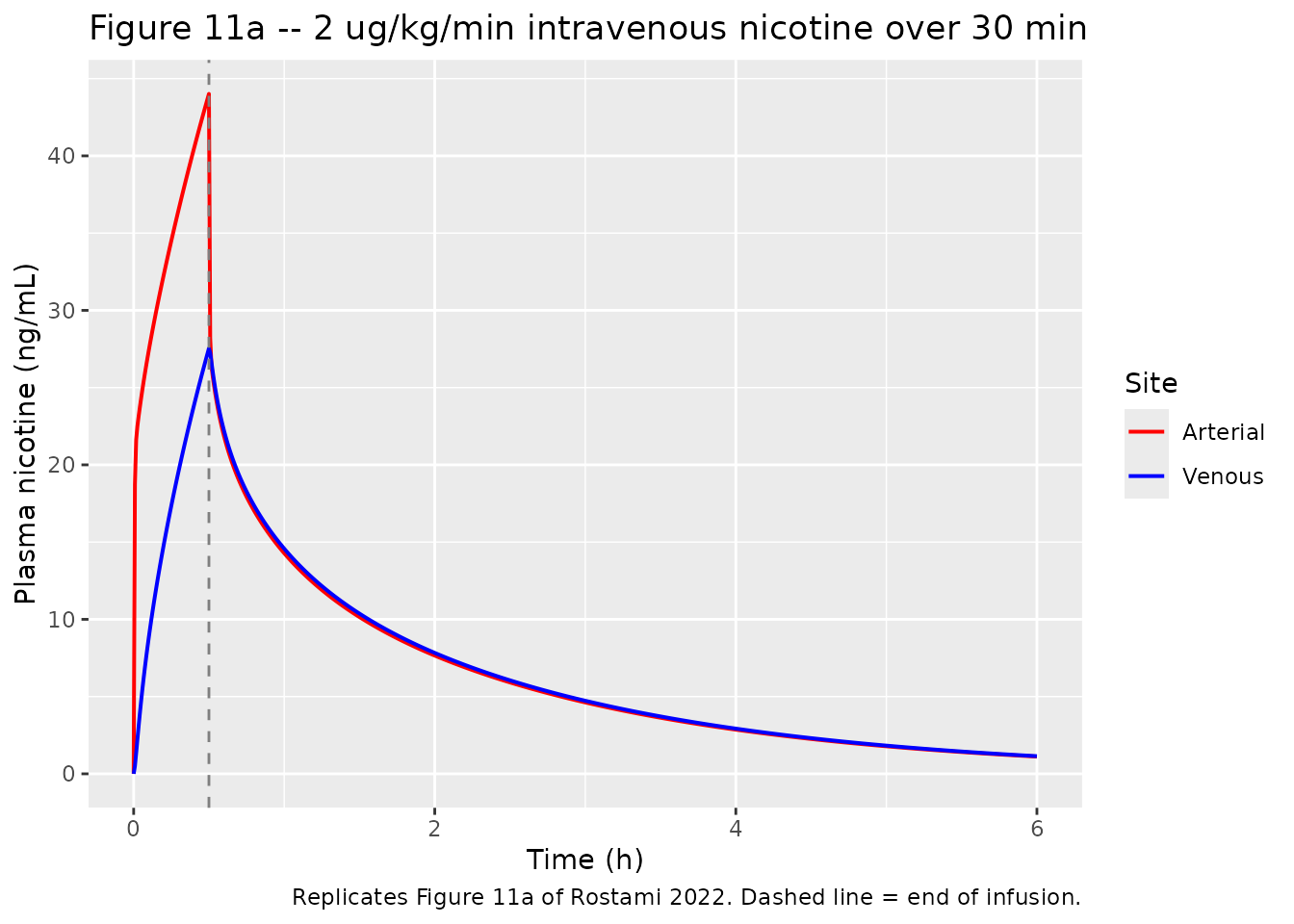
# Figure 11b: the cotinine metabolite rises slowly over hours.
ggplot(sim_iv, aes(time, Cc_cot)) +
  geom_line(linewidth = 0.7, colour = "blue") +
  labs(x = "Time (h)", y = "Venous plasma cotinine (ng/mL)",
       title = "Figure 11b -- cotinine following intravenous nicotine",
       caption = "Replicates Figure 11b of Rostami 2022.")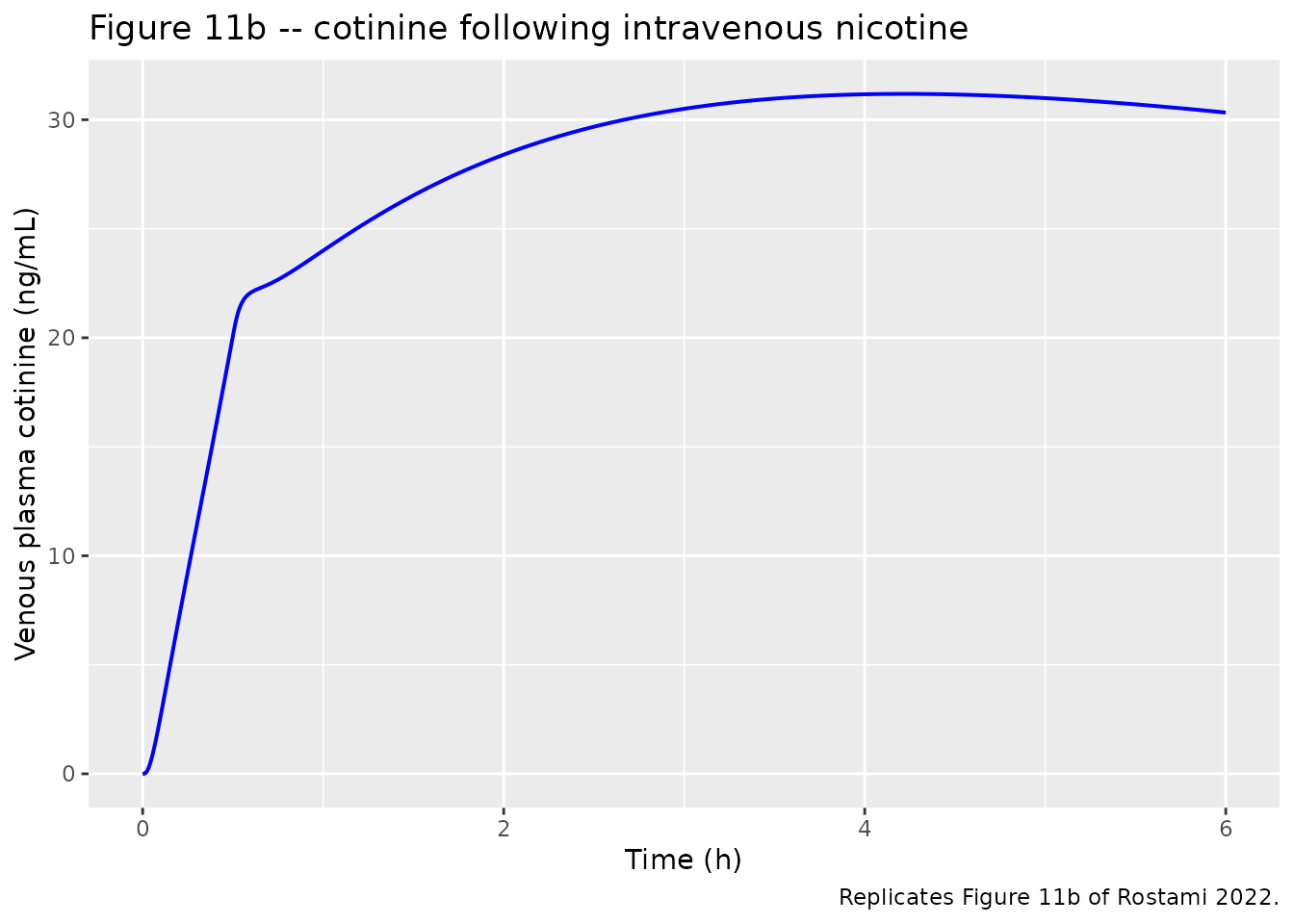
# Figure 11c: nicotine transiently raises heart rate above its 61.1 bpm basal.
ggplot(sim_iv, aes(time, HR)) +
  geom_line(linewidth = 0.7) +
  geom_hline(yintercept = 61.1, linetype = "dashed", colour = "grey50") +
  labs(x = "Time (h)", y = "Heart rate (beats/min)",
       title = "Figure 11c -- heart-rate response to intravenous nicotine",
       caption = paste("Replicates Figure 11c of Rostami 2022.",
                       "Dashed line = 61.1 bpm basal heart rate."))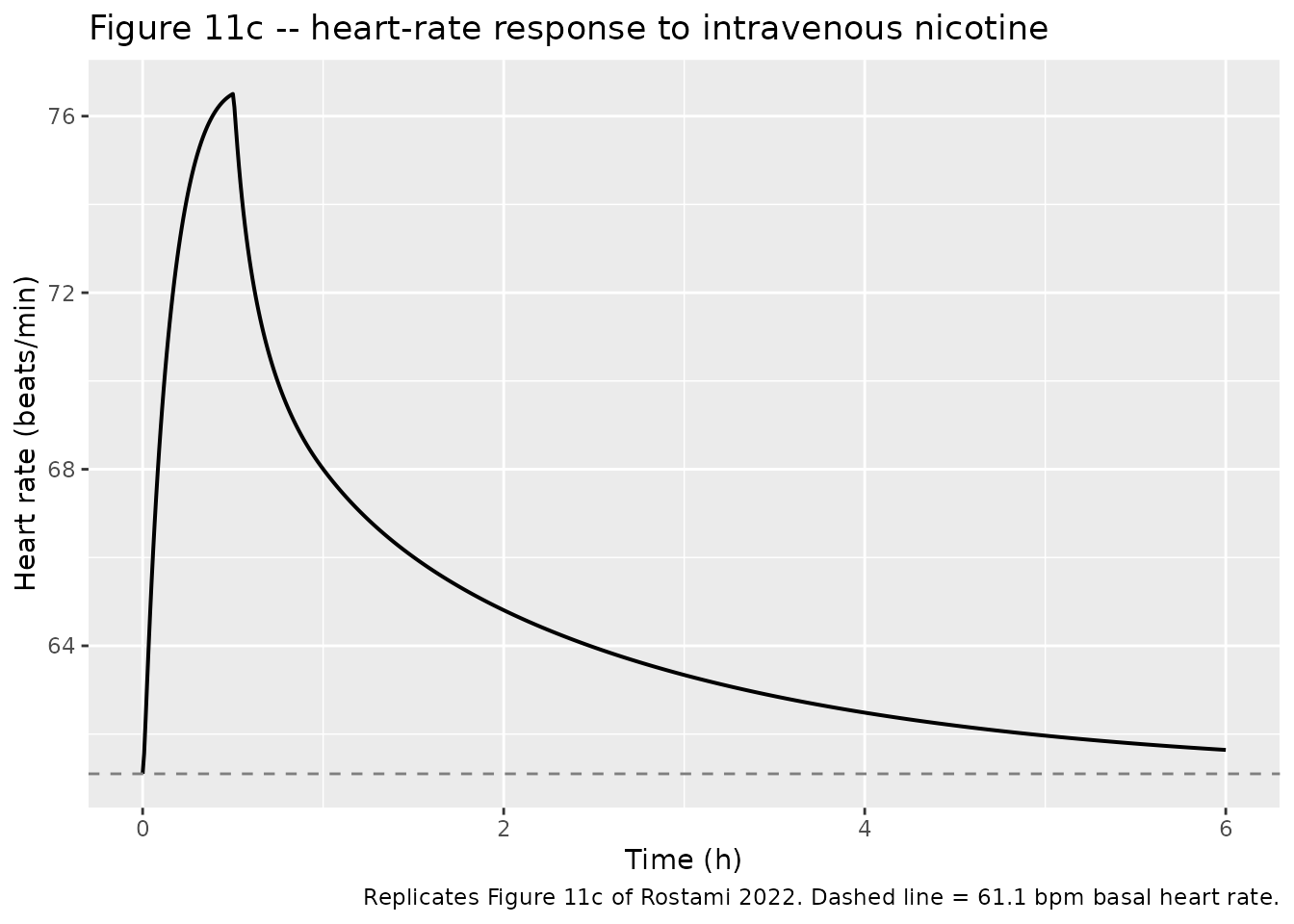
# Structural signatures of Figure 11, asserted rather than eyeballed:
#  - arterial runs above venous DURING the infusion and they converge after it
#    (Figure 11a; the paper notes arterial over-prediction in the first minutes);
#  - the heart rate rises above basal during exposure and relaxes back toward it
#    (Figure 11c);
#  - cotinine is the slow metabolite: it peaks well after nicotine (its peak is
#    hours in, not during the 30 min infusion) and is still near that plateau at
#    6 h, the flat-topped signature of Figure 11b.
during <- dplyr::filter(sim_iv, time > 0.05, time <= 0.5)
after  <- dplyr::filter(sim_iv, time >= 2)
cot_tmax <- sim_iv$time[which.max(sim_iv$Cc_cot)]
stopifnot(
  nrow(during) > 0, nrow(after) > 0,
  all(during$Cart > during$Cc),
  max(abs(after$Cart - after$Cc) / after$Cc) < 0.05,
  max(sim_iv$HR) > 61.1,
  dplyr::last(sim_iv$HR) < max(sim_iv$HR),
  cot_tmax > 1,
  dplyr::last(sim_iv$Cc_cot) > 0.9 * max(sim_iv$Cc_cot)
)
c(
  venous_peak_ng_mL   = round(max(sim_iv$Cc), 2),
  arterial_peak_ng_mL = round(max(sim_iv$Cart), 2),
  heart_rate_peak_bpm = round(max(sim_iv$HR), 1),
  cotinine_6h_ng_mL   = round(dplyr::last(sim_iv$Cc_cot), 2)
)
#>   venous_peak_ng_mL arterial_peak_ng_mL heart_rate_peak_bpm   cotinine_6h_ng_mL
#>               27.54               44.01               76.50               30.33
Oral nicotine
The oral route (Rostami 2022 Table 2: FA = 0.67,
KA = 1.34 /h) is a first-order gastrointestinal uptake of
the bioavailable fraction directly into the liver. It is shown here for
a single 6 mg oral dose to demonstrate the first- pass metabolism the
whole-body model captures: the oral profile peaks later and lower than
the same dose given intravenously.
oral_dose <- 6 # mg
ev_oral <- rxode2::et(amt = oral_dose, cmt = "a_gut", time = 0) |>
  rxode2::et(seq(0, 6, by = 1 / 120), cmt = "a_venous")
sim_oral <- rxode2::rxSolve(mod, ev_oral, params = c(WT = wt),
                            atol = 1e-10, rtol = 1e-8) |>
  as.data.frame() |>
  dplyr::filter(!duplicated(time))

ev_ivc <- rxode2::et(amt = oral_dose, cmt = "a_arterial", time = 0) |>
  rxode2::et(seq(0, 6, by = 1 / 120), cmt = "a_venous")
sim_ivc <- rxode2::rxSolve(mod, ev_ivc, params = c(WT = wt),
                           atol = 1e-10, rtol = 1e-8) |>
  as.data.frame() |>
  dplyr::filter(!duplicated(time))

dplyr::bind_rows(
  sim_oral |> dplyr::transmute(time, Cc, route = "Oral 6 mg (FA = 0.67)"),
  sim_ivc  |> dplyr::transmute(time, Cc, route = "Bolus 6 mg (arterial)")
) |>
  ggplot(aes(time, Cc, colour = route)) +
  geom_line(linewidth = 0.7) +
  labs(x = "Time (h)", y = "Venous plasma nicotine (ng/mL)", colour = NULL,
       title = "Oral versus bolus nicotine, same 6 mg dose") +
  theme(legend.position = "bottom")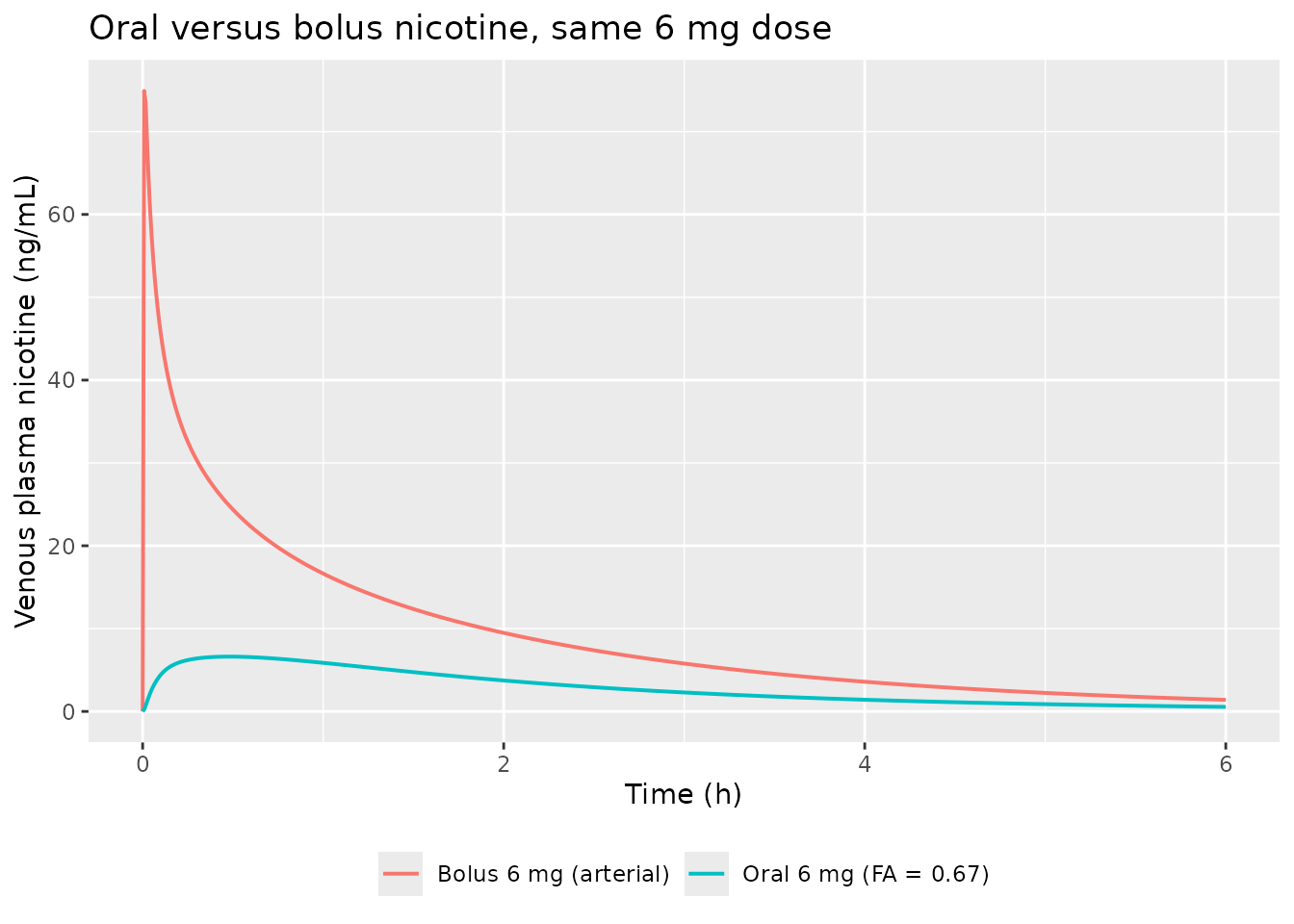
# Oral first-order absorption with FA < 1 must peak later and lower than the
# same dose given directly to blood.
tmax_oral <- sim_oral$time[which.max(sim_oral$Cc)]
tmax_iv   <- sim_ivc$time[which.max(sim_ivc$Cc)]
stopifnot(
  tmax_oral > tmax_iv,
  max(sim_oral$Cc) < max(sim_ivc$Cc)
)
c(
  oral_tmax_h = round(tmax_oral, 3),
  oral_cmax_ng_mL = round(max(sim_oral$Cc), 2)
)
#>     oral_tmax_h oral_cmax_ng_mL
#>           0.483           6.620
PKNCA validation
Rostami 2022 reports the intravenous PK graphically (Figure 11) and gives no numeric NCA table, so the block below computes NCA on the simulated intravenous profile to characterise it and to confirm the exposure is finite and well-behaved, rather than to compare against a published number.
sim_nca <- sim_iv |>
  dplyr::filter(!is.na(Cc)) |>
  dplyr::mutate(id = 1L) |>
  dplyr::select(id, time, Cc)

# Guarantee a time = 0 row; pre-dose nicotine is 0 by construction.
sim_nca <- dplyr::bind_rows(
  sim_nca,
  sim_nca |> dplyr::distinct(id) |> dplyr::mutate(time = 0, Cc = 0)
) |>
  dplyr::distinct(id, time, .keep_all = TRUE) |>
  dplyr::arrange(id, time)

conc_obj <- PKNCA::PKNCAconc(sim_nca, Cc ~ time | id)

dose_df <- data.frame(id = 1L, time = 0, amt = iv_dose)
dose_obj <- PKNCA::PKNCAdose(dose_df, amt ~ time | id)

intervals <- data.frame(
  start = 0, end = 6,
  cmax = TRUE, tmax = TRUE, auclast = TRUE, aucinf.obs = TRUE, half.life = TRUE
)

nca_res <- PKNCA::pk.nca(PKNCA::PKNCAdata(conc_obj, dose_obj,
                                          intervals = intervals))

as.data.frame(nca_res) |>
  dplyr::select(PPTESTCD, PPORRES) |>
  dplyr::mutate(PPORRES = round(PPORRES, 3)) |>
  dplyr::rename("NCA parameter" = PPTESTCD, "Value" = PPORRES) |>
  knitr::kable(caption = paste("NCA of the simulated 2 ug/kg/min 30 min",
"intravenous nicotine profile (venous plasma)."))| NCA parameter | Value |
|---|---|
| auclast | 41.976 |
| cmax | 27.542 |
| tmax | 0.500 |
| tlast | 6.000 |
| clast.obs | 1.144 |
| lambda.z | 0.477 |
| r.squared | 1.000 |
| adj.r.squared | 1.000 |
| lambda.z.time.first | 2.175 |
| lambda.z.time.last | 6.000 |
| lambda.z.n.points | 460.000 |
| clast.pred | 1.134 |
| half.life | 1.454 |
| span.ratio | 2.631 |
| aucinf.obs | 44.375 |
# Sanity guards: the venous nicotine exposure is finite and positive, and the
# terminal half-life is in the few-hours range reported for nicotine.
nca_wide <- as.data.frame(nca_res) |>
  dplyr::select(PPTESTCD, PPORRES) |>
  tidyr::pivot_wider(names_from = PPTESTCD, values_from = PPORRES)
stopifnot(
  is.finite(nca_wide$auclast), nca_wide$auclast > 0,
  nca_wide$half.life > 0.5, nca_wide$half.life < 6
)
Assumptions and deviations
Scope – the four product-specific routes are not implemented
Rostami 2022’s headline contribution is product-specific uptake from cigarettes, ENDS, a vapor inhaler and smokeless tobacco. Every one of those routes reaches the blood through a respiratory-tract or buccal permeation model whose inputs are not reported in any available source:
- The aerosol and vapor routes need per-compartment deposition
fractions (
DEPFRACBUC/DEPFRACCA/DEPFRACTA/DEPFRACPU) and respiratory mass-transfer coefficients. All are0placeholders in the published MCSim listing; the paper attributes them to Adrian 2006, Asgharian 2011 and Corley 2012 (none open access) and, being outputs of an unpublished CFD model, they are tabulated nowhere. The main text (“about 95% of retained cigarette nicotine is absorbed in the lower respiratory tract”) and the example figures give different splits and never the four-way vector the code requires. - The buccal permeation model needs a nicotine tissue diffusivity
(attributed to Adrian et al.) that the paper does not print, and the
code’s diffusion coefficients
DIFFMUandDIFFTIare0placeholders.
These are reporting gaps that no further source can close, so the product arms are omitted rather than guessed at. The reproducible whole-body disposition core and the two administration routes that do not depend on the missing permeation inputs – intravenous and oral – are implemented in full. (The Salehi 2025 model in this package reaches the buccal route by re-fitting an effective diffusivity and tissue thickness against clinical pouch data; that is Salehi’s contribution, not a value published by Rostami.)
The parent model’s parallel perfused-lung and nasal compartments are
likewise dropped: their blood-flow fractions QLNGC and
QNC are absent from Table 1 (whose fractions already sum to
~1.0) and are 0 in the code, so both are mathematically
inert. The buccal, conducting-airway and transitional-airway
perfused compartments are retained, because their flows
(QBUC, QCAC, QTAC) are part of
the cardiac-output partition; with no dosimetry input they simply
equilibrate with arterial blood.
Errata and known inconsistencies in the source
CLM is assigned twice in the published MCSim
listing. The code reads CLM = CLMC*pow(BW,0.75)
and then, four lines later, CLM = CLMC*BW. MCSim’s
generated C keeps the last assignment, so hepatic metabolic clearance is
linear in body weight while every other clearance is allometric. The
model reproduces the as-coded (linear) reading; at the 73 kg reference
weight the two readings differ only in how clearance scales to other
body weights.
Fat uses a multiplication where every other tissue
divides. The listing has CVF = CF*PF against
CVM = CM/PM, CVL = CL/PL, and so on. Fat is
25.8% of body weight, so this is not cosmetic. It is reproduced as
coded, consistent with the sibling Salehi 2025 extraction, where testing
against a published AUC key confirmed the as-coded reading fits better
than the “corrected” CF/PF form.
FNC conflicts between the table and the
code. Rostami 2022 Table 2 gives 0.80 (citing Robinson et al.);
the MCSim listing carries 0.72. The published table value is adopted.
This is immaterial to nicotine itself – FNC only splits
already-metabolized nicotine between cotinine and other routes and does
not enter nicotine’s own kinetics – but it does shift the cotinine
sub-model by about 10%.
Unreported values
- No between-subject variability and no residual-error model are reported, so none is encoded. The model is deterministic typical-value only.
-
Nicotine molecular weight is declared as a
0placeholder in the published MCSim listing (whose.ininput files were never published) and is set here to the physical constant 162.23 g/mol. Cotinine and glucuronide use the listing’s own hard-coded literals of 178 and 338 g/mol. - The intravenous validation cohort’s body weight is not restated where the profile is shown; the Table 1 reference adult of 73.0 kg is used. The delivered dose scales with body weight (2 ug/kg/min), so this sets the absolute concentration level but not the shape of the profile.