Lahu_2010_roflumilast
Source:vignettes/articles/Lahu_2010_roflumilast.Rmd
Lahu_2010_roflumilast.RmdModel and source
- Citation: Lahu G, Hunnemeyer A, Diletti E, Elmlinger M, Ruth P, Zech K, McCracken N, Facius A. Population pharmacokinetic modelling of roflumilast and roflumilast N-oxide by total phosphodiesterase-4 inhibitory activity and development of a population pharmacodynamic-adverse event model. Clin Pharmacokinet. 2010;49(9):589-606. doi:10.2165/11536600-000000000-00000
- Article: https://doi.org/10.2165/11536600-000000000-00000
The packaged model is Lahu_2010_roflumilast, a joint
parent-metabolite population PK model for oral roflumilast and its
primary active metabolite roflumilast N-oxide. Roflumilast is described
by a two-compartment model with first-order absorption (rate
ka, lag time tlag_parent); roflumilast N-oxide
is described by a one-compartment model with zero-order absorption
(duration d1_noxide, lag time tlag_noxide).
The two analytes are fitted independently in the source paper because
the apparent fraction absorbed for roflumilast (F1) and the
apparent fraction metabolised for roflumilast N-oxide
(Frel) are non-identifiable without IV data; both are fixed
at 1 in the null-covariate reference and Frel is allowed to
vary with age, sex, and race covariates.
The packaged model exposes both compartments to the user dosing event
table: each roflumilast administration must produce two rows in the
event table, one targeting cmt = "depot" (which feeds
roflumilast first-order absorption) and one targeting
cmt = "central_noxide" (which feeds the metabolite
zero-order absorption via dur()/f()
modifiers). The user-supplied amt should be the same on
both rows and is interpreted as micrograms of roflumilast
administered.
Population
The pooled phase I + phase II / III analysis dataset comprised (Lahu 2010 Methods page 591):
- 21 phase I index studies: 7 705 roflumilast and 7 112 roflumilast N-oxide plasma concentrations in 338 healthy-volunteer subjects, used for the base / full / final model selection.
- 5 phase I validation studies: independent dataset used to evaluate predictive performance.
- 1 phase II (IN-108) + 1 phase III (BY217 / M2-110, ClinicalTrials.gov NCT00062582): 771 roflumilast and 703 roflumilast N-oxide plasma concentrations in 228 / 208 moderate-to-severe COPD patients, used to fit the COPD-specific covariate effects on parent CL and V1 and on N-oxide CL and Vd.
Subjects received once-daily oral roflumilast tablets at doses of 250-1000 micrograms (dose-proportionality / dose-escalation phase I studies) and at the standard 500 micrograms once-daily dose in the majority of phase I studies and in the phase II / III COPD trials. The Lahu 2010 Methods text reports the standard dose as “500 mg” which is a typographical error in the source – the marketed product (Daxas / Daliresp) is 500 micrograms (0.5 mg) once daily.
The covariates retained in the final model are food state at the time
of dose (FED), age (years; reference 40), body weight (kg; reference
70), sex (canonical SEXF, with paper’s SEX = 1 = male inverted via
(1 - SEXF)), current-smoker indicator (SMOKE), Black and
Hispanic race indicators (RACE_BLACK, RACE_HISPANIC; reference White),
and COPD-vs-healthy indicator (DIS_COPD). The same metadata is available
programmatically:
nlmixr2lib::readModelDb("Lahu_2010_roflumilast")$populationDemographic table S-2 of the source supplement (per-subject covariate distributions across the 28 studies) is in Supplemental Digital Content 1 and was not available when this model was built. Its phase I equivalent was instead recovered from the FDA NDA 22-522 Clinical Pharmacology review (Table 5, printed page 75), which reprints the sponsor’s own population PK study report 114/2005 – the same analysis Lahu published. For the n = 338 phase I model-building dataset:
| Stratum | n | Percent |
|---|---|---|
| Female | 87 | 25.7 |
| Male | 251 | 74.3 |
| Non-smokers | 229 | 67.8 |
| Smokers | 109 | 32.2 |
| Alcohol non-users | 104 | 30.8 |
| Alcohol users | 234 | 69.2 |
| Non-Black, non-Hispanic | 296 | 87.6 |
| Black | 27 | 7.99 |
| Hispanic | 15 | 4.44 |
Age 38.2 +/- 14.7 years and weight 75.4 +/- 11.2 kg (mean +/- SD; no
individual minima or maxima are reported). Every stratum sums to 338,
matching population$n_subjects. The 40-year reference age
used in the covariate equations therefore sits essentially at the cohort
mean, whereas the 70 kg reference weight is a round allometric anchor
rather than the cohort mean of 75.4 kg.
That table also reveals a covariate the published paper never
mentions: alcohol use was tested and dropped. The FDA
review’s full-model columns carry Alcohol on N-oxide CL (theta_11 =
0.00354, SE 0.0626) and on N-oxide Frel (theta_17 = -0.0239, SE 0.0338),
both indistinguishable from zero. Alcohol is consequently absent from
the model’s covariateData, since it is not a covariate of
the shipped model. See “Assumptions and deviations” below.
Source trace
Per-parameter origin is recorded inline next to each
ini() entry in
inst/modeldb/specificDrugs/Lahu_2010_roflumilast.R. The
table below collects the same provenance for review.
| Equation / parameter | Value (final-for-COPD column) | Source location |
|---|---|---|
| Roflumilast 2-cmt with first-order absorption + tlag | n/a | Lahu 2010 equation 6 |
| Roflumilast N-oxide 1-cmt with zero-order absorption + tlag | n/a | Lahu 2010 equation 7 |
ltlag |
log(0.158 h) | Lahu 2010 Table I theta_1 (parent) |
lka |
log(0.533 1/h) | Lahu 2010 Table I theta_2 (parent) |
lcl |
log(10.5 L/h) | Lahu 2010 Table I theta_3 (parent) |
lvc |
log(14.3 L) | Lahu 2010 Table I theta_4 (parent) |
lq |
log(20.3 L/h) | Lahu 2010 Table I theta_5 (parent) |
lvp |
log(201 L) | Lahu 2010 Table I theta_6 (parent) |
lfdepot |
log(1) FIXED | Lahu 2010 Methods page 591 (F1 non-identifiable) |
e_fed_tlag |
-0.308 | Lahu 2010 Table I theta_9 (parent) |
e_fed_ka |
-0.699 | Lahu 2010 Table I theta_11 (parent) |
e_sex_m_cl |
0.191 | Lahu 2010 Table I theta_13 (parent) |
e_smoke_cl |
0.307 | Lahu 2010 Table I theta_15 (parent) |
e_race_black_cl |
-0.140 | Lahu 2010 Table I theta_20 (parent) |
e_race_hisp_cl |
-0.297 | Lahu 2010 Table I theta_21 (parent) |
e_copd_cl |
-0.394 | Lahu 2010 Table I theta_22 (parent) |
e_copd_vc |
1.84 | Lahu 2010 Table I theta_25 (parent) |
ltlag_noxide |
log(0.156 h) | Lahu 2010 Table I theta_1 (N-oxide) |
ld1_noxide |
log(2.21 h) | Lahu 2010 Table I theta_2 (N-oxide) |
lcl_noxide |
log(0.883 L/h) | Lahu 2010 Table I theta_3 (N-oxide) |
lvd_noxide |
log(65.8 L) | Lahu 2010 Table I theta_4 (N-oxide) |
e_fed_d1_noxide |
2.36 | Lahu 2010 Table I theta_6 (N-oxide) |
e_age_cl_noxide |
-0.471 | Lahu 2010 Table I theta_7 (N-oxide) |
e_sex_m_cl_noxide |
0.467 | Lahu 2010 Table I theta_8 (N-oxide) |
e_smoke_cl_noxide |
0.235 | Lahu 2010 Table I theta_10 (N-oxide) |
e_wt_vd_noxide |
1.00 | Lahu 2010 Table I theta_12 (N-oxide) |
e_age_frel |
-0.269 | Lahu 2010 Table I theta_13 (N-oxide) |
e_sex_m_frel |
0.231 | Lahu 2010 Table I theta_14 (N-oxide) |
e_race_black_frel |
0.431 | Lahu 2010 Table I theta_21 (N-oxide) |
e_race_hisp_frel |
0.267 | Lahu 2010 Table I theta_22 (N-oxide) |
e_copd_cl_noxide |
-0.0785 | Lahu 2010 Table I theta_25 (N-oxide) |
e_copd_vd_noxide |
-0.214 | Lahu 2010 Table I theta_26 (N-oxide) |
| IIV omega^2(tlag) (parent) | 1.73 | Lahu 2010 Table I |
| IIV omega^2(ka) (parent) | 0.154 | Lahu 2010 Table I |
| IIV omega^2(CL) (parent) | 0.136 | Lahu 2010 Table I |
| IIV omega^2(V1) (parent) | 0.734 | Lahu 2010 Table I |
| IIV omega^2(Q) (parent) | 0.0726 | Lahu 2010 Table I |
| IIV omega^2(V2) (parent) | 0.117 | Lahu 2010 Table I |
| IIV omega(Q, V2) (parent) | 0.0703 | Lahu 2010 Table I |
| IIV omega^2(D1) (N-oxide) | 0.268 | Lahu 2010 Table I |
| IIV omega^2(CL) (N-oxide) | 0.150 | Lahu 2010 Table I |
| IIV omega^2(Vd) (N-oxide) | 0.0449 | Lahu 2010 Table I |
| IIV omega(D1, CL) (N-oxide) | 0.0221 | Lahu 2010 Table I |
| IIV omega(D1, Vd) (N-oxide) | 0.0536 | Lahu 2010 Table I |
| IIV omega(CL, Vd) (N-oxide) | -0.0110 | Lahu 2010 Table I |
| Proportional residual (parent) | 25.1 percent CV | Lahu 2010 Table I (“Final with race”) |
| Proportional residual (N-oxide) | 24.1 percent CV | Lahu 2010 Table I (“Final with race”) |
Reference covariate values: age 40 years (Lahu 2010 equation 7); body weight 70 kg (Lahu 2010 equation 7). Reference category for binary covariates: SEXF = 1 (female), SMOKE = 0 (non-smoker), RACE_BLACK = 0 / RACE_HISPANIC = 0 (White), FED = 0 (fasted), DIS_COPD = 0 (healthy).
Independent corroboration: FDA NDA 22-522
Every non-COPD value in the table above has a second, independent source. The FDA Clinical Pharmacology review for NDA 22-522 (roflumilast; Nycomed, submitted 2009) reprints the sponsor’s population PK study report 114/2005 as its Table 6 (roflumilast parent, printed page 77; sponsor’s Table 9) and Table 7 (roflumilast N-oxide, printed page 79; sponsor’s Table 12). Lahu was the sponsor’s modeller, so the NDA review and the Clin Pharmacokinet article report the same fit rather than two analyses.
All 40 shipped parent and N-oxide values reproduce the FDA “Final With Race” columns exactly – zero disagreements. No parameter required an authority determination and none was altered. The FDA tables add three things the journal article’s Table I does not carry:
- Standard errors on every final parameter. For example parent CL 10.5 (SE 0.490), N-oxide CL 0.883 (SE 0.0472), N-oxide Vd 65.8 (SE 1.94), N-oxide Vd weight exponent 1.00 (SE 0.117). The food-on-parent-tlag coefficient’s SE of 0.296 against an estimate of -0.308 independently confirms the data-poor status the paper’s bootstrap flagged.
-
The model-building ladder – Base / Full / Initial
Final / Final With Race, with objective function values (parent
-9023.112 / -9391.524 / -9383.408 / -9397.811; N-oxide -10,310.430 /
-10,982.441 / -10,974.671 / -11,064.271) and the WAM “drop from base”
and “nearness to full” statistics. This makes the covariate selection
the paper describes narratively auditable, and it is what exposes the
tested-and-dropped covariates recorded in
covariateData(parent age on CL, parent and N-oxide weight, the Frel food and smoking terms, and alcohol). -
Confirmation that the omegas are variances, not
SDs. The reviewer quotes inter-subject variability as CV
percent, and each value reproduces
100 * sqrt(omega^2)against the tabulated variance: parent CL 41.5 percent base to 36.9 percent final (sqrt(0.172), sqrt(0.136)); N-oxide CL 44.0 to 38.7 percent (sqrt(0.194), sqrt(0.150)); N-oxide Vd 28.5 to 21.2 percent (sqrt(0.0814), sqrt(0.0449)). Six of six exact – an external falsifier for the variance-scale parameterisation used inini().
The reviewer also works six numerical covariate examples, all of
which reproduce against the packaged model() block rather
than merely against ini(), so they validate the
(1 + theta * covariate) linear form and the
ref_age <- 40 / ref_wt <- 70 constants
as well as the parameter values:
| FDA worked example | Packaged model |
|---|---|
| Parent tlag fed = 0.109 h | 0.158 * (1 - 0.308) = 0.109 |
| Parent ka fed = 0.160 1/h | 0.533 * (1 - 0.699) = 0.160 |
| N-oxide D1 fed = 7.43 h | 2.21 * (1 + 2.36) = 7.43 |
| N-oxide CL at age 75 = 0.657 L/h | 0.883 * (75/40)^-0.471 = 0.657 |
| N-oxide Vd at 100 kg = 94.0 L | 65.8 * (100/70)^1.00 = 94.0 |
| N-oxide Frel at age 75 = 0.844 | (75/40)^-0.269 = 0.844 |
The COPD coefficients are the exception. The FDA
review’s COPD section (printed pages 85-88) contains goodness-of-fit
figures and narrative only – there is no COPD parameter table. Its
narrative is consistent with the shipped values (parent CL “reduced by
39.4 percent” against e_copd_cl = -0.394; central volume
“increased by nearly two-fold” against e_copd_vc = 1.84;
N-oxide volume “decreased by 21 percent” against -0.214; N-oxide
clearance “decreased by … 8 percent” against -0.0785) but supplies no
independent digits or SEs. The shipped COPD block therefore remains
sourced solely from Lahu 2010 Table I.
Source: FDA Center for Drug Evaluation and Research, Clinical Pharmacology and Biopharmaceutics Review, NDA 22-522 (roflumilast / DALIRESP), 348 pages. Tables 6 and 7 are page images in the released PDF; they were digitised for this vignette by rendering the containing pages at 200-400 dpi.
Virtual cohort
The original observed data are not publicly available. The figures below use a virtual cohort whose covariate distribution approximates a healthy-volunteer phase I population dosed once-daily with 500 micrograms roflumilast for 14 days (long enough for steady state in both parent and metabolite; Lahu 2010 Background page 590 reports that steady state is reached within 3-4 days for roflumilast and within 6 days for roflumilast N-oxide).
set.seed(20260509)

n_sub <- 50L

cohort <- tibble::tibble(
  id            = seq_len(n_sub),
  AGE           = pmax(18, pmin(75,
                                 round(rnorm(n_sub, mean = 40, sd = 12)))),
  WT            = pmax(45, pmin(120,
                                 round(rnorm(n_sub, mean = 75, sd = 12)))),
  SEXF          = as.integer(runif(n_sub) < 0.50),  # 50 / 50 female / male
  SMOKE         = as.integer(runif(n_sub) < 0.30),  # 30 percent current smokers
  FED           = 0L,                                # all subjects dosed fasted
  RACE_BLACK    = as.integer(runif(n_sub) < 0.10),  # 10 percent Black
  RACE_HISPANIC = 0L,                                # all non-Hispanic
  DIS_COPD      = 0L                                 # all healthy
)
# Black and Hispanic should be mutually exclusive in the source paper's
# encoding (White is the reference; the residual non-Black / non-
# Hispanic is the implicit reference category). Ensure the virtual cohort
# satisfies that exclusion.
cohort$RACE_HISPANIC[cohort$RACE_BLACK == 1L] <- 0L

dose_amt <- 500    # micrograms; standard roflumilast dose
dose_int <- 24     # hours
n_doses  <- 14L

# Two dose rows per administration: one targeting depot (parent first-
# order absorption) and one targeting central_noxide (metabolite zero-
# order absorption). Both rows have the same amt and time; the model's
# f(depot) = 1 and f(central_noxide) = frel handle the relative scaling.
dose_times <- (seq_len(n_doses) - 1L) * dose_int

dose_rows_parent <- tidyr::expand_grid(id = cohort$id, time = dose_times) |>
  dplyr::mutate(evid = 1L, amt = dose_amt, cmt = "depot")
dose_rows_noxide <- tidyr::expand_grid(id = cohort$id, time = dose_times) |>
  dplyr::mutate(evid = 1L, amt = dose_amt, cmt = "central_noxide")

# Observation grid: dense over day 0 (single-dose absorption phase) and
# over the final 24 h interval (steady state); daily troughs in between.
ss_start <- (n_doses - 1L) * dose_int

obs_times <- sort(unique(c(
  c(0.25, 0.5, 0.75, 1, 1.5, 2, 3, 4, 6, 8, 10, 12, 16, 20, 24),
  seq(48, ss_start - dose_int, by = 24),
  ss_start + c(0, 0.25, 0.5, 1, 1.5, 2, 3, 4, 6, 8, 10, 12, 16, 20, 24)
)))

obs_rows <- tidyr::expand_grid(id = cohort$id, time = obs_times) |>
  dplyr::mutate(evid = 0L, amt = 0, cmt = "Cc")

events <- dplyr::bind_rows(dose_rows_parent, dose_rows_noxide, obs_rows) |>
  dplyr::left_join(cohort, by = "id") |>
  dplyr::arrange(id, time, dplyr::desc(evid))
Simulation
mod <- nlmixr2lib::readModelDb("Lahu_2010_roflumilast")

# Stochastic VPC over the cohort.
sim <- rxode2::rxSolve(mod, events = events,
                       keep = c("AGE", "WT", "SEXF", "SMOKE",
                                "FED", "RACE_BLACK", "RACE_HISPANIC",
                                "DIS_COPD"))
#> ℹ parameter labels from comments will be replaced by 'label()'

# Typical-value (no IIV) replication of the published reference subject:
# 40-year-old, 70 kg, male (SEXF = 0), non-smoker, White, healthy, fasted.
typical_cohort <- tibble::tibble(
  id = 1L,
  AGE = 40, WT = 70, SEXF = 0L, SMOKE = 0L, FED = 0L,
  RACE_BLACK = 0L, RACE_HISPANIC = 0L, DIS_COPD = 0L
)
typical_dose_parent <- tibble::tibble(
  id = 1L, time = dose_times, evid = 1L, amt = dose_amt, cmt = "depot"
)
typical_dose_noxide <- tibble::tibble(
  id = 1L, time = dose_times, evid = 1L, amt = dose_amt, cmt = "central_noxide"
)
typical_obs <- tibble::tibble(
  id = 1L, time = obs_times, evid = 0L, amt = 0, cmt = "Cc"
)
typical_events <- dplyr::bind_rows(typical_dose_parent, typical_dose_noxide,
                                    typical_obs) |>
  dplyr::left_join(typical_cohort, by = "id") |>
  dplyr::arrange(id, time, dplyr::desc(evid))

mod_typical <- mod |> rxode2::zeroRe()
#> ℹ parameter labels from comments will be replaced by 'label()'
sim_typical <- rxode2::rxSolve(mod_typical, events = typical_events,
                               keep = c("AGE", "WT", "SEXF", "SMOKE",
                                        "FED", "RACE_BLACK", "RACE_HISPANIC",
                                        "DIS_COPD"))
#> ℹ omega/sigma items treated as zero: 'etaltlag', 'etalka', 'etalcl', 'etalvc', 'etalq', 'etalvp', 'etald1_noxide', 'etalcl_noxide', 'etalvd_noxide'
Replicate the single-dose and steady-state PK profiles
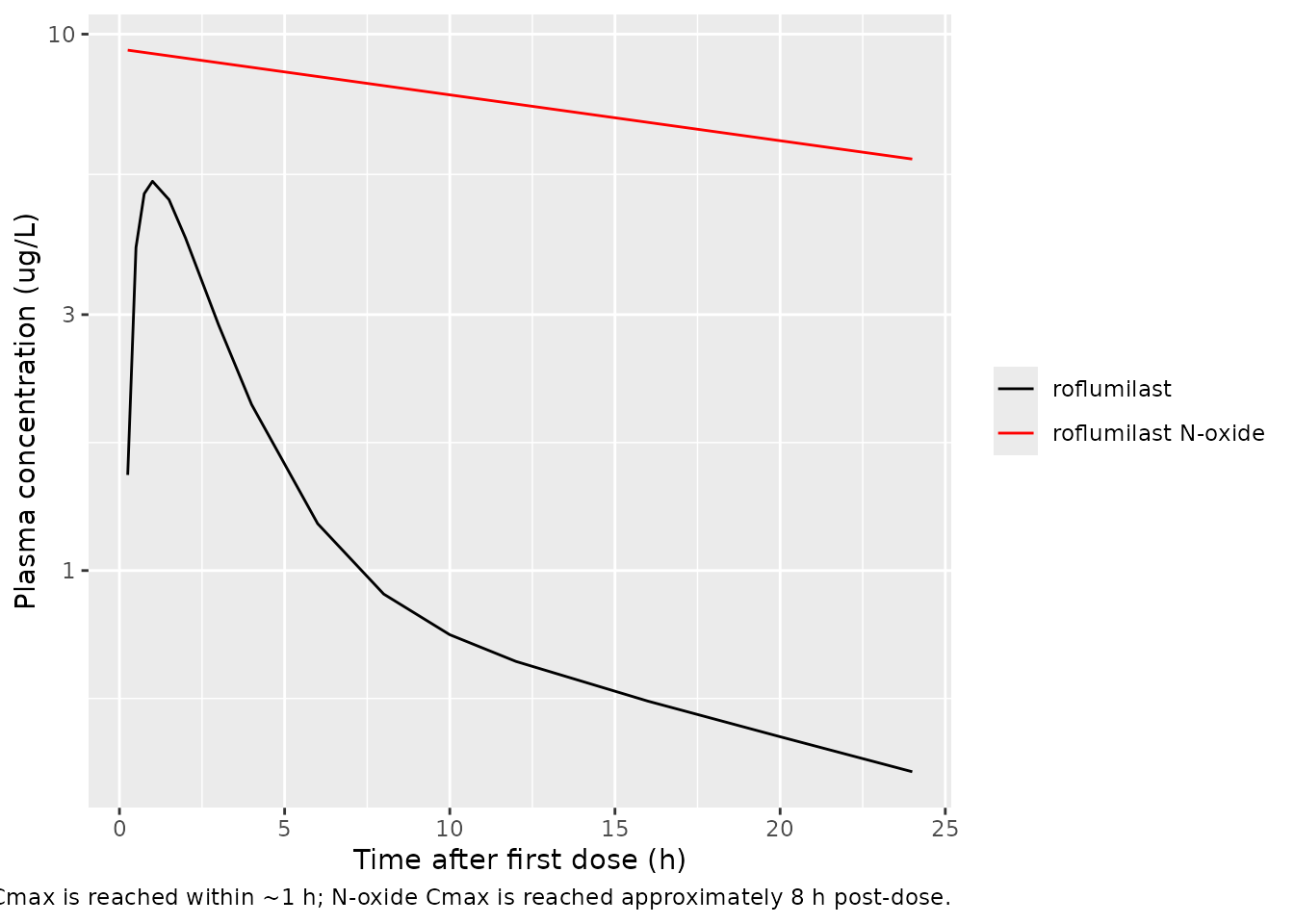
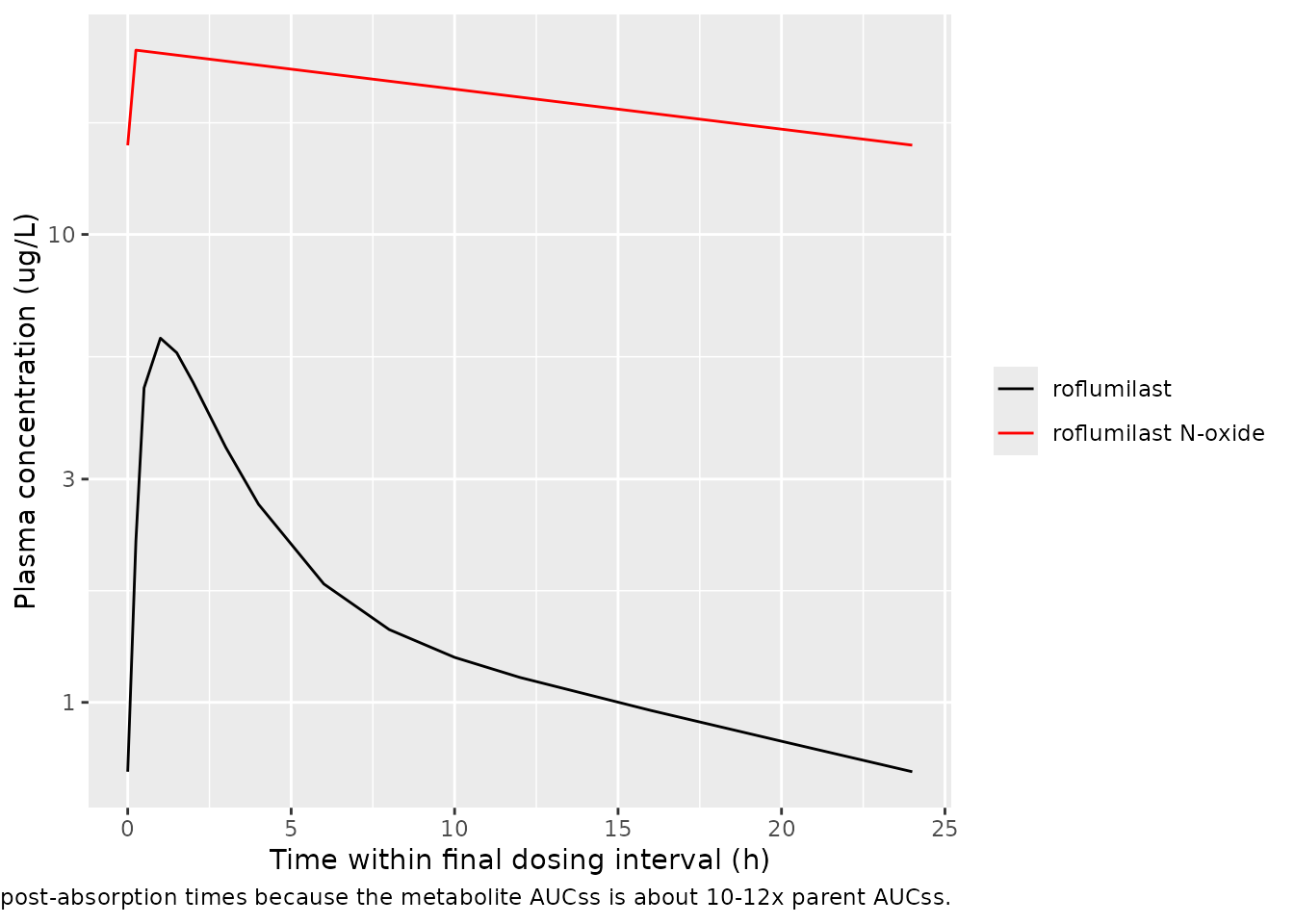
Lahu 2010 Figure 1 shows the median and 5-95 percent ranges of roflumilast and roflumilast N-oxide plasma concentrations after (a, c) a single dose and (b, d) at steady state on day 7, with concentrations plotted on a log scale in ug/L. The figures below show the simulated typical-value time-course (reference subject: male, non-smoker, White, healthy, age 40, weight 70 kg, fasted) over the first 24 h after the first dose and over the final 24 h interval (steady state).
sim_typical |>
  dplyr::filter(time <= 24) |>
  ggplot(aes(time)) +
  geom_line(aes(y = Cc,        colour = "roflumilast")) +
  geom_line(aes(y = Cc_noxide, colour = "roflumilast N-oxide")) +
  scale_y_log10() +
  scale_colour_manual(values = c("roflumilast" = "black",
                                  "roflumilast N-oxide" = "red")) +
  labs(x = "Time after first dose (h)",
       y = "Plasma concentration (ug/L)",
       colour = NULL,
       caption = paste(
         "Single-dose 500 ug typical-value trajectory; replicates the",
         "concentration scale and time-course shape of Lahu 2010 Figure 1a / 1c.",
         "Roflumilast (parent) Cmax is reached within ~1 h; N-oxide Cmax",
         "is reached approximately 8 h post-dose."
       ))
sim_typical |>
  dplyr::filter(time >= ss_start, time <= ss_start + 24) |>
  dplyr::mutate(time_ss = time - ss_start) |>
  ggplot(aes(time_ss)) +
  geom_line(aes(y = Cc,        colour = "roflumilast")) +
  geom_line(aes(y = Cc_noxide, colour = "roflumilast N-oxide")) +
  scale_y_log10() +
  scale_colour_manual(values = c("roflumilast" = "black",
                                  "roflumilast N-oxide" = "red")) +
  labs(x = "Time within final dosing interval (h)",
       y = "Plasma concentration (ug/L)",
       colour = NULL,
       caption = paste(
         "Steady-state 24 h interval after 13 days of 500 ug QD;",
         "replicates Lahu 2010 Figure 1b / 1d. N-oxide concentrations",
         "exceed parent at all post-absorption times because the metabolite",
         "AUCss is about 10-12x parent AUCss."
       ))
PKNCA validation
Steady-state NCA over the final 24 h interval for both analytes.
sim_nca_parent <- sim |>
  dplyr::filter(time >= ss_start, time <= ss_start + 24) |>
  dplyr::transmute(id = factor(id), time = time - ss_start,
                   conc = Cc, treatment = "500 ug QD")

sim_nca_noxide <- sim |>
  dplyr::filter(time >= ss_start, time <= ss_start + 24) |>
  dplyr::transmute(id = factor(id), time = time - ss_start,
                   conc = Cc_noxide, treatment = "500 ug QD")

dose_df <- tibble::tibble(id = factor(unique(sim_nca_parent$id)),
                          time = 0, amt = dose_amt, treatment = "500 ug QD")

intervals <- data.frame(
  start    = 0,
  end      = 24,
  cmax     = TRUE,
  tmax     = TRUE,
  cmin     = TRUE,
  auclast  = TRUE,
  cav      = TRUE
)

conc_obj_parent <- PKNCA::PKNCAconc(sim_nca_parent,
                                     conc ~ time | treatment + id,
                                     concu = "ug/L", timeu = "h")
conc_obj_noxide <- PKNCA::PKNCAconc(sim_nca_noxide,
                                     conc ~ time | treatment + id,
                                     concu = "ug/L", timeu = "h")
dose_obj <- PKNCA::PKNCAdose(dose_df, amt ~ time | treatment + id,
                             doseu = "ug")

nca_parent <- PKNCA::pk.nca(PKNCA::PKNCAdata(conc_obj_parent, dose_obj,
                                              intervals = intervals))
nca_noxide <- PKNCA::pk.nca(PKNCA::PKNCAdata(conc_obj_noxide, dose_obj,
                                              intervals = intervals))

knitr::kable(as.data.frame(summary(nca_parent)),
caption = "Simulated steady-state NCA - roflumilast (ug/L, h).")| Interval Start | Interval End | treatment | N | AUClast (h*ug/L) | Cmax (ug/L) | Cmin (ug/L) | Tmax (h) | Cav (ug/L) |
|---|---|---|---|---|---|---|---|---|
| 0 | 24 | 500 ug QD | 50 | 39.7 [40.1] | 5.07 [42.1] | 0.729 [68.4] | 1.50 [0.250, 6.00] | 1.65 [40.1] |
knitr::kable(as.data.frame(summary(nca_noxide)),
caption = "Simulated steady-state NCA - roflumilast N-oxide (ug/L, h).")| Interval Start | Interval End | treatment | N | AUClast (h*ug/L) | Cmax (ug/L) | Cmin (ug/L) | Tmax (h) | Cav (ug/L) |
|---|---|---|---|---|---|---|---|---|
| 0 | 24 | 500 ug QD | 50 | 519 [39.0] | 26.7 [28.7] | 17.0 [54.7] | 0.250 [0.250, 0.250] | 21.6 [39.0] |
Comparison against published predictions
Lahu 2010 does not tabulate explicit AUC24 / Cmax / Cmin point values in the main text; supplemental table S-6 reports geometric mean percentage deviations between model-predicted and noncompartmental observed AUC24 values stratified by dose group and covariate cohort, but the absolute AUC24 values are in the supplement (not available when this model was built). The published statement is that the geometric mean percentage deviations of dose-normalised observed AUCs from model-predicted AUCs were no greater than 6.57 percent for the index dataset (Results page 597).
The self-consistency check below uses the steady-state mass balance implied by the model parameters as the validation target:
| Quantity | Predicted (model parameters) | Simulated steady-state AUCss | Notes |
|---|---|---|---|
| Roflumilast AUCss (ug*h/L) at 500 ug QD (typical male healthy adult) | F1 * Dose / CL_parent = 1 * 500 / (10.5 * 1.191) = 39.97 | see PKNCA auclast for parent |
Reference male healthy fasted, CL = 12.5 L/h |
| Roflumilast N-oxide AUCss (ug*h/L) at 500 ug QD (typical male healthy adult) | Frel * Dose / CL_noxide where Frel = 1 * (1+0.231) and CL_noxide = 0.883 * (1+0.467) = 1.296, so 1.231 * 500 / 1.296 = 474.8 | see PKNCA auclast for N-oxide |
Same reference subject |
| t1/2 (roflumilast) | ln(2) * (V1 + V2) / CL = 0.693 * (14.3 + 201) / 12.5 = 11.9 h | n/a | Paper Background: “8-31 h, median 17 h” |
| t1/2 (roflumilast N-oxide) | ln(2) * Vd / CL_noxide = 0.693 * 65.8 / 1.296 = 35.2 h | n/a | Paper Background: “approximately 30 h” |
The simulated typical-value AUCss should reproduce the closed-form predicted values within a few percent for the reference subject (any larger deviation indicates a parameter or covariate-equation transcription error).
Assumptions and deviations
Frel baseline fixed at 1 (non-identifiability). The apparent fraction metabolised for roflumilast N-oxide is non-identifiable without IV roflumilast or directly-administered N-oxide data (Lahu 2010 Methods page 591). The packaged model implements this by not declaring a free Frel parameter; the covariate-dependent expression
frelin themodel()block has a baseline of 1 with multiplicative covariate effects on age, sex, and race.Parent bioavailability F1 fixed at 1. The apparent fraction absorbed for roflumilast is also non-identifiable without IV data. The absolute oral bioavailability is reported as 79 percent in the underlying study (David 2004; cited in Lahu 2010 Background), but the popPK model normalises to F1 = 1. The model file uses
lfdepot <- fixed(log(1))to record the structural anchoring.Phase I residual error used in the packaged model. Table I reports two residual-error values per analyte: a phase I value (parent 25.1 percent CV, N-oxide 24.1 percent CV in the “Final with race” column) fitted on the larger phase I dataset (7705 / 7112 observations), and a phase II / III COPD-extension value (parent 54.5 percent CV, N-oxide 20.9 percent CV in the “Final for COPD patients” column) re-fitted on the smaller COPD dataset (771 / 703 observations). The packaged model carries the phase I values because they reflect the dominant data source and are the typical residual magnitudes for the analytical-method noise; the increase in the parent COPD residual is plausibly driven by sparse-sampling design in the phase II / III studies rather than a different intrinsic noise mechanism. Users reproducing a COPD-only simulation may prefer to substitute the COPD-extension residuals.
Food on parent tlag sign convention. Lahu 2010 reports theta_9 = -0.308 (the coefficient on FED in the parent tlag equation), which under the canonical FED = 1 / fasted = 0 convention gives shorter tlag in the fed state (0.158 * (1 - 0.308) = 0.109 h fed vs 0.158 h fasted). The paper’s own robustness analysis flags this effect as poorly identified (only 61 percent of bootstrap replicates had negative sign, 44 percent passed the same-sign test; Lahu 2010 page 599) but retains it on the grounds that tlag does not influence steady-state exposure. The packaged model preserves the published sign; consumers concerned about food-effect predictions should be aware that this particular coefficient is data-poor.
-
Sex-coding inversion vs canonical SEXF (resolved; the paper’s prose is wrong). Lahu 2010 equations 6 and 7 use Sex = 1 for male and Sex = 0 for female. The canonical SEXF column inverts this (1 = female, 0 = male). The model() block applies the source coefficients via (1 - SEXF) so that the model-equation intercept (when SEXF = 1) is the female reference. The paper’s narrative text describes the reference population as “male, non-smoking, White, healthy, 40-year-old” (Methods page 591 and Results page 599), which would conventionally suggest a male-baseline encoding, but the model equations clearly use female as the intercept (so a male subject has CL_parent = 10.5 * 1.191 = 12.5 L/h, consistent with the paper’s own statement on page 602 that “clearance of roflumilast was 19 percent greater in men than in women”).
This was previously carried here as an unresolved internal contradiction. It is now settled in favour of the equation reading. The FDA NDA 22-522 Clinical Pharmacology review, reproducing the sponsor’s own population PK study report 114/2005, states the female reference three separate times: “the clearance (theta_3) is 10.5 +/- 0.490 L/hr for nonsmoking, non-black, non-Hispanic females” (printed page 77); “the metabolite CL (theta_3) is 0.883 +/- 0.0472 L/hr for a 40-year-old, 70 kg, nonsmoking female” (printed page 79); and “The bioavailability (FRel) … was fixed to 1 for a 40-year-old non-black, non-Hispanic female” (printed page 80). An independent regulatory reviewer working from the sponsor’s source report read the intercept exactly as this extraction does, so the journal article’s prose – not its equations – is the erroneous side. The vignette and downstream simulations use the equation-derived female-as-intercept convention.
-
No IIV reported for roflumilast N-oxide tlag. Lahu 2010 equation 7 displays the structural form
tlag_i = theta_1 * exp(eta_tlag,i)for the N-oxide model, but Table I does not report an omega^2(tlag) value for N-oxide. The packaged model omits the eta on N-oxide tlag entirely (noetaltlag_noxideparameter); the typical tlag = 0.156 h is used for every subject. This is consistent with the WAM-based parsimony selection in the source: the N-oxide IIV(tlag) was removed during model reduction.The omission is real rather than a typesetting loss in the journal article. The FDA NDA 22-522 review’s Table 7 (printed page 79), an independent reproduction of the sponsor’s study report 114/2005, likewise lists an omega block over D1, CL and V only – and does so across all four of its Base, Full, Initial Final and Final With Race columns, so the eta was absent from the base model onward rather than dropped partway through covariate selection.
-
Supplement not available; demographics recovered from the FDA review instead. Supplemental Digital Content 1 (table S-2 demographic distributions, table S-6 NCA predictive-performance AUC24 deviations, figure S-1 goodness-of-fit plots, figures S-2 to S-5 bootstrap distributions, etc.) was not available when this model was built. The “Source trace” table and the PKNCA validation comparison values were derived from the main paper text and Table I.
The demographic distributions that table S-2 would have supplied for the phase I model-building dataset were subsequently recovered from the FDA NDA 22-522 review’s Table 5 and are tabulated in the “Population” section above; they now populate
population$age_range,population$weight_range,population$sex_female_pctandpopulation$race_ethnicityin the model file. Note that Table 5 reports mean and SD only – individual age and weight minima and maxima are still unavailable, so the virtual cohort below continues to use approximated ranges. No equivalent demographic table exists for the phase II / III COPD extension in either source. Two dose events per administration. Because the parent and the N-oxide are fitted with independent absorption processes, each user-supplied roflumilast administration must produce two dose rows in the event table: one with
cmt = "depot"(parent first-order absorption) and one withcmt = "central_noxide"(N-oxide zero-order absorption). Both rows must have the sameamtandtime; the model’sf(depot) = 1andf(central_noxide) = frel(withfrelcovariate-dependent) handle the relative scaling. This is a faithful representation of the Lahu 2010 NONMEM ADVAN1 / ADVAN4 decoupled-parent-metabolite parameterisation, but it is unusual relative to the more common mass-conserving parent -> metabolite formation model (e.g. Brown 2017 osimertinib / AZ5104).-
tPDE4i, adverse-event logistic-regression layer not packaged. Lahu 2010 also reports (i) a total PDE4-inhibitory activity composite parameter
tPDE4i(equation 4:AUC_parent * fu_parent / (IC50_parent * tau) + AUC_metab * fu_metab / (IC50_metab * tau)) and (ii) logistic-regression PD models predicting the probability of diarrhoea, nausea, and headache in COPD patients as a function of tPDE4i, AUC_parent, and AUC_metab. These exposure-response and outcome layers are downstream of the PK simulation and are not packaged in this model file; consumers wanting the tPDE4i composite can compute it from the simulated AUC trajectories using equation 4 with the cited IC50 and fu values (paper Methods page 595, citing Hermann 2006).The FDA NDA 22-522 review was checked as a possible second source for the adverse-event coefficients the paper withholds, and does not supply them. The string “logistic” does not occur anywhere in the 348-page review. Its exposure-response-for-safety section is a plain dose-versus-incidence table (diarrhoea, nausea and weight loss at 0, 250 and 500 micrograms) with no model and no fitted coefficients; for effectiveness the review states outright that the relationship between exposure and the primary endpoints “was not characterized” because concentrations were not measured in the registration trials. tPDE4i appears only as an ANOVA endpoint in a drug-interaction summary (sponsor report 252/2008), which reports treatment ratios of mean tPDE4i but not the composite’s defining constants. This gap therefore stands, and the FDA review does not need to be revisited for it.
No erratum located. A targeted PubMed and Clin Pharmacokinet landing-page search in May 2026 did not surface any erratum, corrigendum, or correction notice for this article. Should one be published in future, the model file’s
referencefield and the corresponding# Lahu 2010 Table Isource-trace comments should be updated to point at the corrected values.