Ustekinumab (Aguiar 2021)
Source:vignettes/articles/Aguiar_2021_ustekinumab.Rmd
Aguiar_2021_ustekinumab.Rmd
library(nlmixr2lib)
library(rxode2)
#> rxode2 5.1.8 using 2 threads (see ?getRxThreads)
#>   no cache: create with `rxCreateCache()`
library(dplyr)
#>
#> Attaching package: 'dplyr'
#> The following objects are masked from 'package:stats':
#>
#>     filter, lag
#> The following objects are masked from 'package:base':
#>
#>     intersect, setdiff, setequal, union
library(tidyr)
library(ggplot2)
library(PKNCA)
#>
#> Attaching package: 'PKNCA'
#> The following object is masked from 'package:stats':
#>
#>     filter
Ustekinumab popPK-PD in Crohn’s disease (Aguiar 2021)
Replicate the population pharmacokinetic-pharmacodynamic model reported by Aguiar Zdovc et al. (2021) for ustekinumab in adults with Crohn’s disease. Ustekinumab is an IgG1k monoclonal antibody that binds the p40 subunit shared by interleukin-12 and interleukin-23. The structural model is a two-compartment quasi-equilibrium target-mediated drug disposition (QE-TMDD) model for the unbound drug and the unbound IL-12/IL-23 p40 target, both distributing in two-compartment systems and binding only in the central compartment, linked to fecal calprotectin via an indirect-response model in which the unbound target stimulates FC production.
- Citation: Aguiar Zdovc J, Hanzel J, Kurent T, Sever N, Kozelj M, Smrekar N, Novak G, Stabuc B, Dreesen E, Thomas D, Vovk T, Ostanek B, Drobne D, Grabnar I. Ustekinumab Dosing Individualization in Crohn’s Disease Guided by a Population Pharmacokinetic-Pharmacodynamic Model. Pharmaceutics. 2021;13(10):1587. doi:10.3390/pharmaceutics13101587.
- Article: https://doi.org/10.3390/pharmaceutics13101587
Population
The Aguiar 2021 cohort comprised 57 adults with active Crohn’s disease starting ustekinumab at a single Slovenian tertiary referral center, followed for 32 weeks. Baseline demographics (Aguiar 2021 Table 1): 56% female; median age 49 years (IQR 32-56); median weight 70 kg (IQR 59-84); median fat-free mass 45 kg (IQR 39-62) derived per subject via the Janmahasatian 2005 model; median disease duration 14 years (IQR 7-22); 66.7% had been exposed to a prior biologic (38/57 prior anti-TNF; 10/57 prior vedolizumab); 77.2% had endoscopically active luminal disease at baseline; median serum CRP 3 mg/L (IQR 3-11), albumin 43 g/L (IQR 41-44), fecal calprotectin 134 mg/kg (IQR 53-213). FCGR3A rs396991 genotype distribution: V/V 8.8% (5/57), V/F 54.4% (31/57), F/F 36.8% (21/57).
Standard ustekinumab dosing (which the simulations below use) is weight-tiered IV induction (260 mg if WT 55 kg, 390 mg if 55 < WT 85 kg, 520 mg if WT > 85 kg) at week 0, followed by 90 mg subcutaneous maintenance every 8 weeks.
The same demographics are available programmatically via the model’s
metadata
(readModelDb("Aguiar_2021_ustekinumab")$population).
Source trace
The per-parameter origin is recorded as an in-file comment next to
each ini() entry in
inst/modeldb/specificDrugs/Aguiar_2021_ustekinumab.R. The
table below collects them in one place. Concentrations are in nmol/L;
the source paper converted ustekinumab concentrations to nmol/L using a
molecular weight of 149 kDa (Aguiar 2021 Methods section 2.3).
| Parameter / equation | Value | Source |
|---|---|---|
ka |
0.381 /day | Table 2 final-model Ka |
CL (typical, reference covariates) |
0.277 L/day | Table 2 final-model CL |
Vc (reference FFM = 45 kg) |
3.57 L | Table 2 final-model Vc |
Vp (reference FFM = 45 kg) |
3.30 L | Table 2 final-model Vp |
Q |
1.89 L/day | Table 2 final-model Q |
F (V/F or F/F) |
0.710 (logit 0.8954) | Table 2 final-model F (V/F, F/F) |
F (V/V) |
0.888 (logit 2.0705) | Table 2 final-model F (V/V) |
| FFM effect on CL | power exponent 0.598, reference 45 kg | Table 2 footnote a |
| FFM effect on Vc, Vp | power exponents 0.590 (Vc), 0.586 (Vp), reference 45 kg | Table 2 footnotes b, c |
| ALB linear effect on CL | (1 - 0.0165 * (ALB - 43)) | Table 2 footnote a |
| Bio-naive effect on CL | (1 - 0.227 * bio_naive); bio_naive = 1 - PRIOR_BIO | Table 2 footnote a |
| FCGR3A V/V effect on F | logit shift 1.1751 | Table 2 final-model |
Ksyn (typical, reference CRP) |
9.86e-9 nmol/L/day | Table 2 final-model Ksyn |
Kdeg |
9.26e-10 /day | Table 2 final-model Kdeg |
| CRP linear effect on Ksyn | (1 + 0.0846 * (CRP - 3)) | Table 2 footnote d |
Vc-target |
2.44 L | Table 2 final-model Vc-target |
Qtarget |
0.493 L/day | Table 2 final-model Qtarget |
Vp-target |
11.0 L | Table 2 final-model Vp-target |
Kint |
2.83e-6 /day | Table 2 final-model Kint |
Kd |
0.168 nmol/L | Table 2 final-model Kd |
Kout |
0.0581 /day | Table 3 final-model Kout |
FC0 (no ulcers) |
102 mg/kg | Table 3 final-model FC0 |
FC0 (ulcers) |
213 mg/kg | Table 3 final-model FC0 with ulcers |
Emax (FC stim) |
2.19 (= 219%) | Table 3 final-model Emax |
C50 (FC stim) |
2.46 nmol/L | Table 3 final-model C50 |
| Drug ODEs | n/a, see model file | Figure 1 + Table 2 footnotes |
| Target ODEs | n/a, see model file | Figure 1 |
| Indirect-response PD | dFC/dt = (FC0 * Kout / stim_baseline) * stim_fc - Kout * FC | Table 3 footnote a |
| IIV CL | omega^2 = log(0.18^2 + 1) = 0.03188 | Table 2 (18.0% CV) |
| IIV Vc | omega^2 = log(0.0979^2 + 1) = 0.00954 | Table 2 (9.79% CV) |
| IIV Vp | omega^2 = log(0.241^2 + 1) = 0.05645 | Table 2 (24.1% CV) |
| IIV logit(F) | omega^2 = 0.173^2 = 0.02993 | Table 2 (SD = 0.173 on logit scale) |
| IIV Ksyn | omega^2 = log(0.992^2 + 1) = 0.68522 | Table 2 (99.2% CV) |
| IIV FC0 | omega^2 = log(0.99^2 + 1) = 0.68309 | Table 3 (99.0% CV) |
| Residual on Cc | additive 4.55 nmol/L + proportional 7.77% | Table 2 |
| Residual on FC | proportional 57.3% | Table 3 |
Covariate column naming
| Source column | Canonical column used here | Notes |
|---|---|---|
| FFM (kg) | FFM |
Reference 45 kg (cohort median); derived per subject via Janmahasatian 2005. |
| Serum albumin |
ALB (g/L) |
Reference 43 g/L (cohort median). |
| C-reactive protein |
CRP (mg/L) |
Standard CRP assay; reference 3 mg/L (cohort median). |
| bio-naive (1 = no prior biologic) |
PRIOR_BIO (1 = previously exposed) |
Inverted: model derives bio_naive <- 1 - PRIOR_BIO
to preserve the paper’s coefficient. |
| FCGR3A-158 V/V | FCGR3A_VV |
1 = V/V, 0 = V/F or F/F. |
| Endoscopically active disease at baseline | ENDO_ULCER |
1 = mucosal ulcers at baseline ileocolonoscopy, 0 otherwise. |
FFM, PRIOR_BIO, FCGR3A_VV, and
ENDO_ULCER are added to the canonical register in
inst/references/covariate-columns.md alongside this model.
ALB and CRP are pre-existing canonical
columns.
Virtual cohort
Original subject-level data are not publicly available. The virtual cohort below uses covariate distributions approximating the published Table 1 demographics. Covariates are sampled independently (the paper does not publish joint distributions); FCGR3A genotype frequencies match the cohort’s Hardy-Weinberg distribution (V/V 8.8%, V/F + F/F 91.2%).
set.seed(20260425)

n_subj <- 200
mw_ust <- 149  # ustekinumab molecular weight in kDa, per Aguiar 2021 Methods.

# 1 mg ustekinumab = 1000 / mw_ust nmol = 6.711 nmol.
mg_to_nmol <- function(mg) mg * 1000 / mw_ust

# Build a virtual Crohn's-disease cohort approximating Aguiar 2021 Table 1.
cohort <- tibble(
  ID  = seq_len(n_subj),
  # Weight: median 70 kg, IQR 59-84; lognormal covers the right skew.
  WT  = pmin(pmax(rlnorm(n_subj, log(70), 0.22), 40), 130)
) |>
  mutate(
    # FFM: median 45 kg, IQR 39-62; correlated with weight in the source cohort.
    # Approximated as 0.65 * WT for males (44%) and 0.55 * WT for females (56%).
    SEXF = rbinom(n_subj, 1, 0.56),
    FFM  = pmin(pmax(WT * if_else(SEXF == 1, 0.55, 0.65) +
                       rnorm(n_subj, 0, 3), 25), 90),
    # Albumin: median 43 g/L, IQR 41-44; tight distribution in CD remission/active.
    ALB = pmin(pmax(rnorm(n_subj, 42.5, 3.5), 28), 52),
    # CRP in CD skews right; median 3 mg/L, IQR 3-11; log-normal shape.
    CRP = pmin(pmax(rlnorm(n_subj, log(4), 1.0), 0.3), 80),
    # Prior biologic exposure: 66.7% in cohort (Table 1).
    PRIOR_BIO = rbinom(n_subj, 1, 0.667),
    # FCGR3A genotype: 8.8% V/V (Table 1).
    FCGR3A_VV = rbinom(n_subj, 1, 0.088),
    # Endoscopically active disease: 77.2% at baseline (Table 1).
    ENDO_ULCER = rbinom(n_subj, 1, 0.772)
  )
Standard ustekinumab dosing regimen
Aguiar 2021 simulated the licensed regimen: weight-tiered IV
induction at week 0 (260 mg if WT
55 kg, 390 mg if 55 < WT
85 kg, 520 mg if WT > 85 kg) followed by 90 mg subcutaneous every 8
weeks (Methods section 2.4 scenario a). The dosing dataset is in nmol
because the model is parameterized in nmol / nmol/L; the helper
mg_to_nmol converts.
week  <- 7  # days
ind_t <- 0
sc_times <- c(8, 16, 24) * week  # SC maintenance at 8, 16, 24 weeks

induction_dose_mg <- function(wt) {
  ifelse(wt <= 55, 260,
         ifelse(wt <= 85, 390, 520))
}

iv_induction <- cohort |>
  mutate(
    TIME = ind_t,
    AMT  = mg_to_nmol(induction_dose_mg(WT)),
    EVID = 1L,
    CMT  = "central",
    DV   = NA_real_,
    phase = "induction_IV"
  )

sc_maintenance <- cohort |>
  tidyr::crossing(TIME = sc_times) |>
  mutate(
    AMT  = mg_to_nmol(90),
    EVID = 1L,
    CMT  = "depot",
    DV   = NA_real_,
    phase = "maintenance_SC"
  )

# Observation grid: dense early, weekly through 32 weeks.
obs_days <- sort(unique(c(
  c(0, 0.05, 1, 2, 3, 5, 7),
  seq(7, 32 * week, by = 3.5)
)))

obs <- cohort |>
  tidyr::crossing(TIME = obs_days) |>
  mutate(
    AMT  = 0,
    EVID = 0L,
    CMT  = "central",
    DV   = NA_real_,
    phase = NA_character_
  )

# Use the variable-name CMT for observations: "Cc" for ustekinumab
# concentration, "fc" for fecal calprotectin. Aguiar 2021's PD output is on
# the fc compartment; observing only "Cc" plus "fc" gives both endpoints.
obs_cc <- obs |> mutate(CMT = "Cc")
obs_fc <- cohort |>
  tidyr::crossing(TIME = c(0, 8, 16, 24, 32) * week) |>
  mutate(AMT = 0, EVID = 0L, CMT = "fc", DV = NA_real_, phase = NA_character_)

events <- bind_rows(iv_induction, sc_maintenance, obs_cc, obs_fc) |>
  arrange(ID, TIME, desc(EVID)) |>
  select(ID, TIME, AMT, EVID, CMT, DV,
         FFM, ALB, CRP, PRIOR_BIO, FCGR3A_VV, ENDO_ULCER, phase)

stopifnot(!anyDuplicated(unique(events[, c("ID", "TIME", "EVID", "CMT")])))
Simulate
By default rxSolve() samples between-subject random
effects per subject when the model defines omega-style
etas; the stochastic simulation is what the VPC plots below use. The
published-value comparison further down uses
rxode2::zeroRe() to remove between-subject variability so
the typical-value trajectory can be compared head-to-head with Aguiar
2021’s reported point estimates.
mod <- readModelDb("Aguiar_2021_ustekinumab")
sim <- rxode2::rxSolve(mod, events = events, returnType = "data.frame")
#> ℹ parameter labels from comments will be replaced by 'label()'
Concentration-time profile (free ustekinumab)
sim_cc <- sim |> filter(CMT == 7L)  # CMT 7 = Cc observations

sim_summary <- sim_cc |>
  filter(time > 0) |>
  group_by(time) |>
  summarise(
    Q05 = quantile(Cc, 0.05, na.rm = TRUE),
    Q50 = quantile(Cc, 0.50, na.rm = TRUE),
    Q95 = quantile(Cc, 0.95, na.rm = TRUE),
    .groups = "drop"
  ) |>
  mutate(Cc_ugmL_05 = Q05 * mw_ust / 1000,
         Cc_ugmL_50 = Q50 * mw_ust / 1000,
         Cc_ugmL_95 = Q95 * mw_ust / 1000)

ggplot(sim_summary, aes(x = time / week, y = Cc_ugmL_50)) +
  geom_ribbon(aes(ymin = Cc_ugmL_05, ymax = Cc_ugmL_95),
              alpha = 0.25, fill = "steelblue") +
  geom_line(colour = "steelblue", linewidth = 0.8) +
  scale_y_log10() +
  scale_x_continuous(breaks = seq(0, 32, by = 4)) +
  labs(
    x = "Time (weeks)",
    y = expression("Free ustekinumab ("*mu*"g/mL)"),
    title = "Standard ustekinumab regimen: weight-tiered IV induction + 90 mg SC Q8W",
    subtitle = paste0("Median and 90% prediction interval (N = ", n_subj,
                      " virtual CD patients)"),
    caption = "Replicates Aguiar 2021 Figure 2A (free ustekinumab VPC structure)."
  ) +
  theme_bw()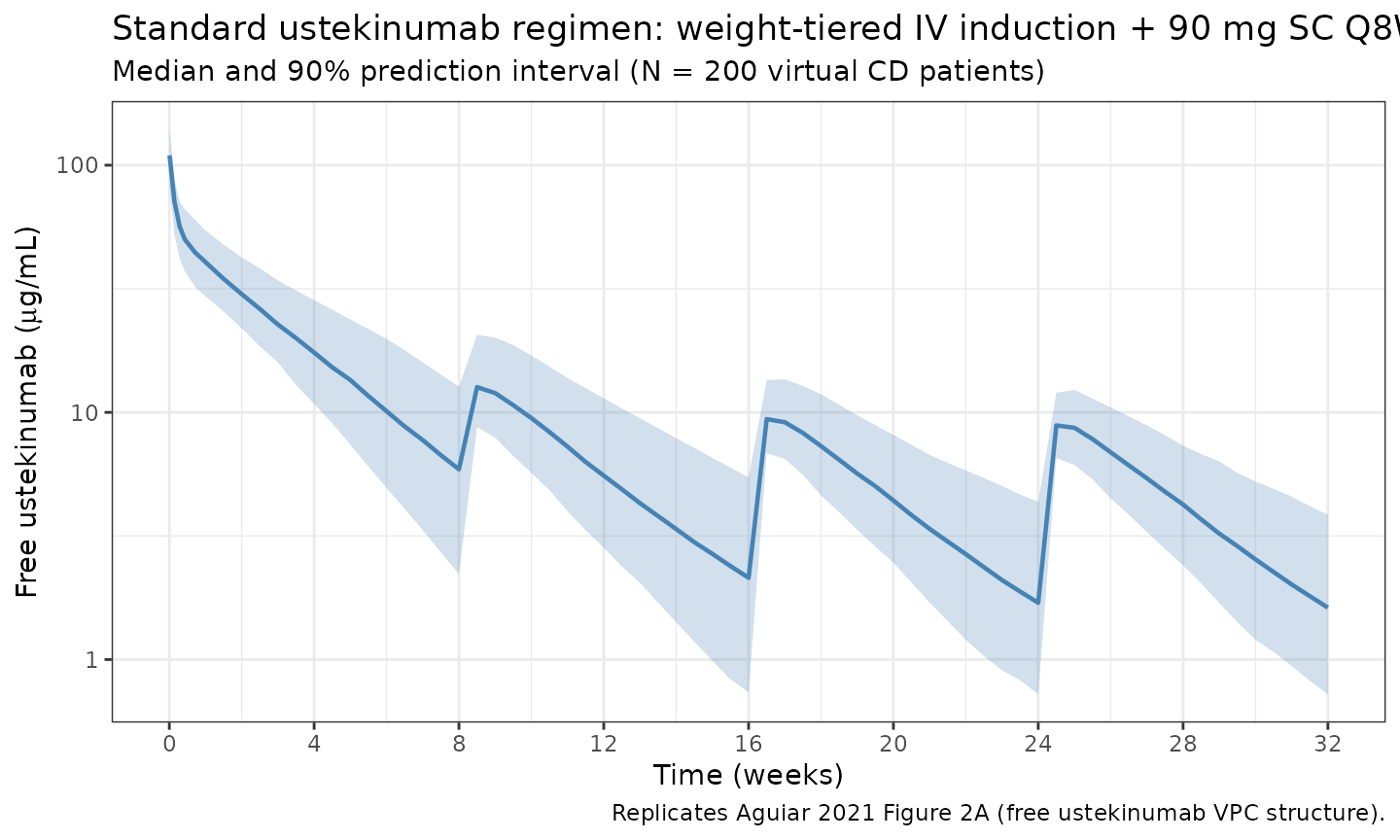
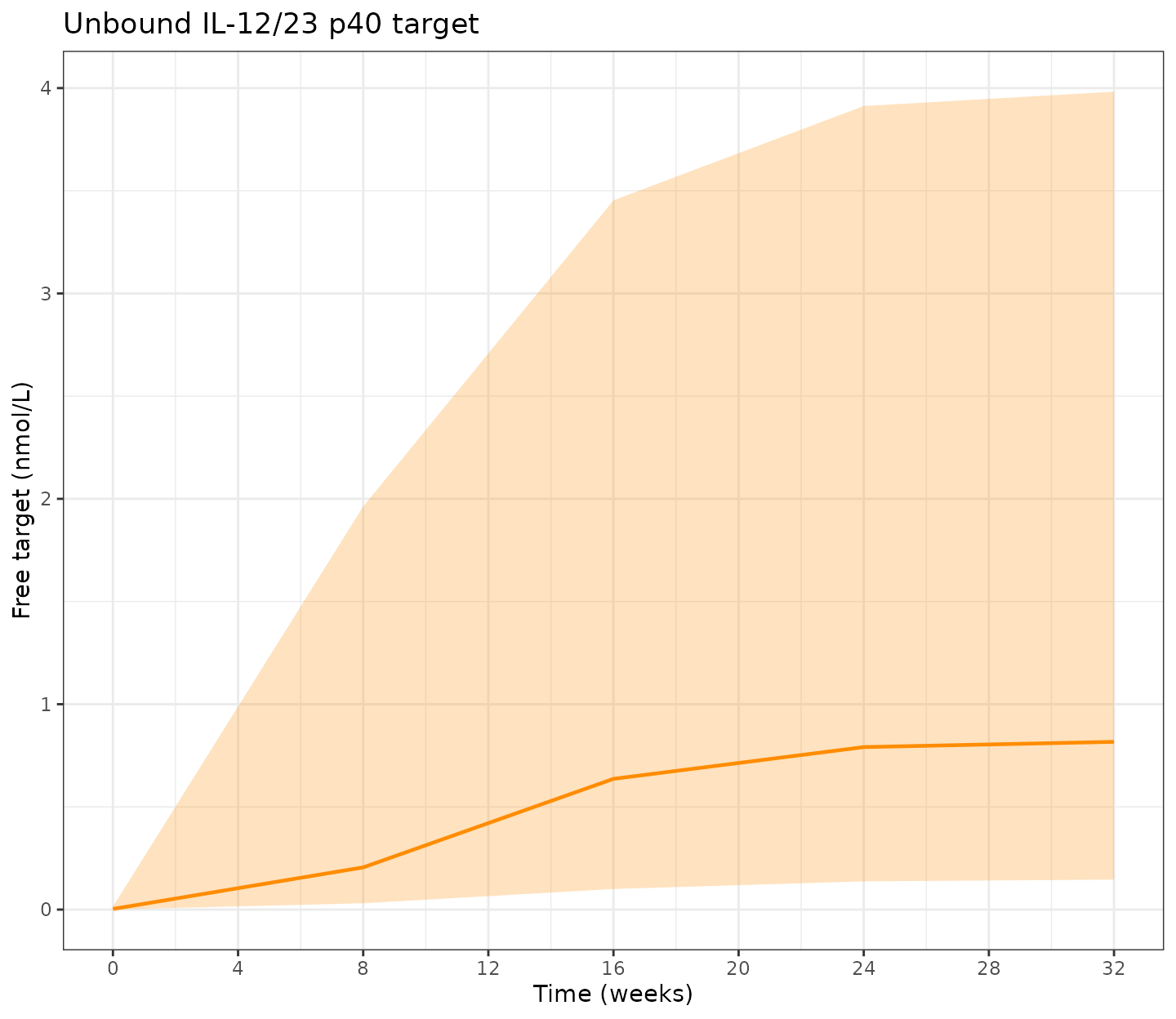
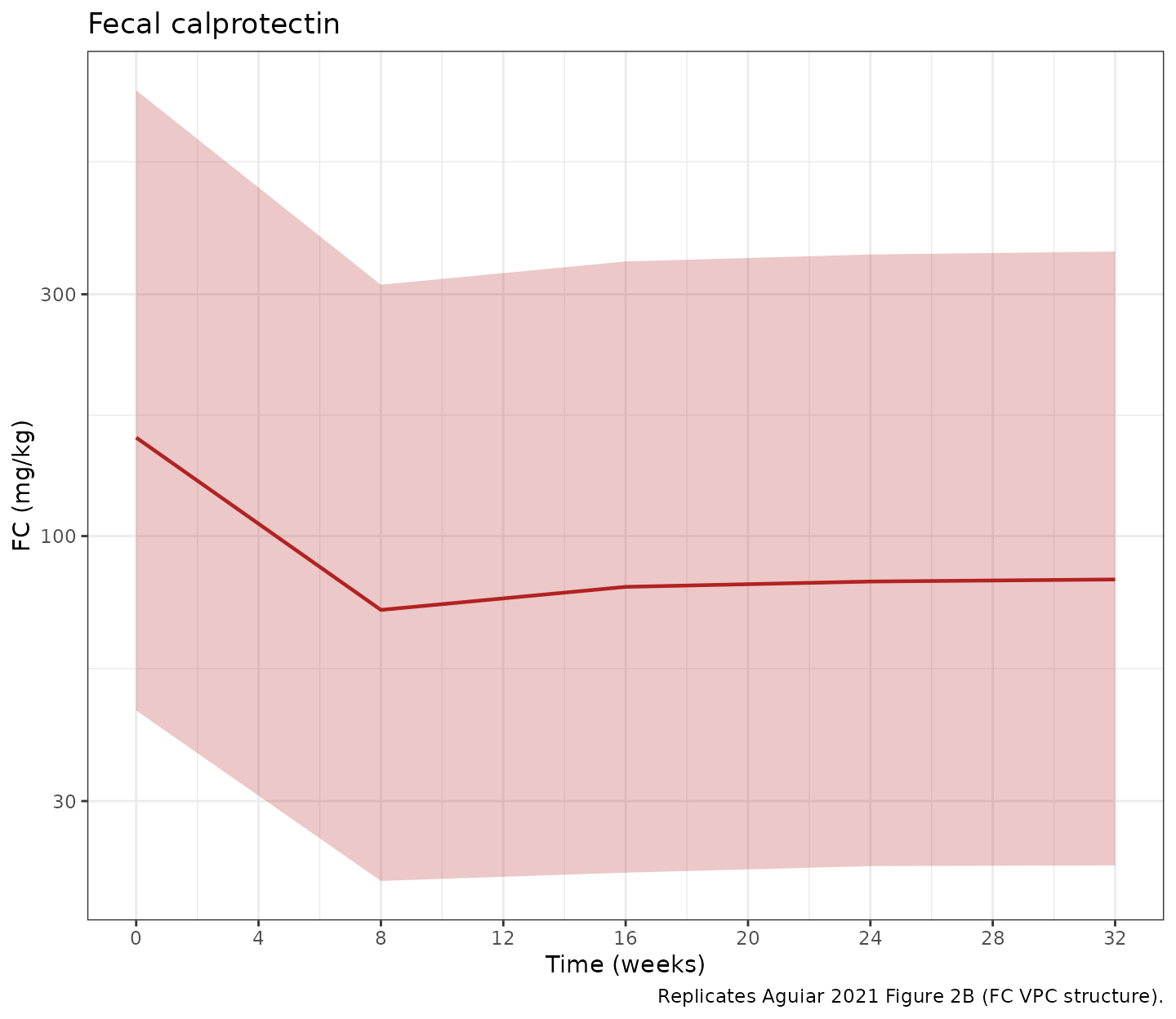
Target and FC profiles
tfree (unbound target in central, nmol/L) and
fc (fecal calprotectin, mg/kg) are emitted by the model
alongside Cc and can be read directly from the simulation
output.
sim_fc <- sim |> filter(CMT == 6L)  # CMT 6 = fc observations

sim_pd <- sim_fc |>
  filter(time >= 0) |>
  group_by(time) |>
  summarise(
    target_Q05 = quantile(tfree, 0.05, na.rm = TRUE),
    target_Q50 = quantile(tfree, 0.50, na.rm = TRUE),
    target_Q95 = quantile(tfree, 0.95, na.rm = TRUE),
    fc_Q05 = quantile(fc, 0.05, na.rm = TRUE),
    fc_Q50 = quantile(fc, 0.50, na.rm = TRUE),
    fc_Q95 = quantile(fc, 0.95, na.rm = TRUE),
    .groups = "drop"
  )

p_target <- ggplot(sim_pd, aes(x = time / week, y = target_Q50)) +
  geom_ribbon(aes(ymin = target_Q05, ymax = target_Q95),
              alpha = 0.25, fill = "darkorange") +
  geom_line(colour = "darkorange", linewidth = 0.8) +
  scale_x_continuous(breaks = seq(0, 32, by = 4)) +
  labs(x = "Time (weeks)", y = "Free target (nmol/L)",
       title = "Unbound IL-12/23 p40 target") +
  theme_bw()

p_fc <- ggplot(sim_pd, aes(x = time / week, y = fc_Q50)) +
  geom_ribbon(aes(ymin = fc_Q05, ymax = fc_Q95),
              alpha = 0.25, fill = "firebrick") +
  geom_line(colour = "firebrick", linewidth = 0.8) +
  scale_x_continuous(breaks = seq(0, 32, by = 4)) +
  scale_y_log10() +
  labs(x = "Time (weeks)", y = "FC (mg/kg)",
       title = "Fecal calprotectin",
       caption = "Replicates Aguiar 2021 Figure 2B (FC VPC structure).") +
  theme_bw()

if (requireNamespace("patchwork", quietly = TRUE)) {
  patchwork::wrap_plots(p_target, p_fc, ncol = 1)
} else {
  print(p_target)
  print(p_fc)
}
PKNCA validation
PKNCA is run on the steady-state SC dosing interval (last 8-week interval, weeks 24-32) and on the IV induction dose (week 0 - week 8, the first SC maintenance dose at week 8 closes the interval). Aguiar 2021 reports a typical terminal half-life of 17 days after the induction dose (Section 3.3).
ind_window_start <- 0
ind_window_end   <- 8 * week

ss_window_start  <- 24 * week
ss_window_end    <- 32 * week

# Pull only Cc observations from the simulation.
sim_cc_only <- sim |> filter(CMT == 7L)

iv_conc <- sim_cc_only |>
  filter(time >= ind_window_start, time <= ind_window_end, !is.na(Cc)) |>
  transmute(ID = id, time_rel = time - ind_window_start, Cc,
            treatment = "IV_induction")

sc_ss_conc <- sim_cc_only |>
  filter(time >= ss_window_start, time <= ss_window_end, !is.na(Cc)) |>
  transmute(ID = id, time_rel = time - ss_window_start, Cc,
            treatment = "SC_90mg_Q8W_ss")

nca_conc <- bind_rows(iv_conc, sc_ss_conc)

iv_doses <- iv_induction |>
  transmute(ID, time_rel = TIME - ind_window_start, AMT,
            treatment = "IV_induction")

sc_ss_dose <- sc_maintenance |>
  filter(TIME == 24 * week) |>
  transmute(ID, time_rel = TIME - ss_window_start, AMT,
            treatment = "SC_90mg_Q8W_ss")

nca_dose <- bind_rows(iv_doses, sc_ss_dose)
conc_obj <- PKNCA::PKNCAconc(nca_conc, Cc ~ time_rel | treatment + ID)
dose_obj <- PKNCA::PKNCAdose(nca_dose, AMT ~ time_rel | treatment + ID)

intervals <- data.frame(
  start     = 0,
  end       = 8 * week,
  cmax      = TRUE,
  tmax      = TRUE,
  cmin      = TRUE,
  auclast   = TRUE,
  half.life = TRUE
)

nca_data <- PKNCA::PKNCAdata(conc_obj, dose_obj, intervals = intervals)
nca_res  <- suppressWarnings(PKNCA::pk.nca(nca_data))

knitr::kable(
  summary(nca_res),
  digits  = 3,
  caption = "Simulated NCA: IV induction (0-8 weeks) and SC steady-state interval (weeks 24-32)."
)| start | end | treatment | N | auclast | cmax | cmin | tmax | half.life |
|---|---|---|---|---|---|---|---|---|
| 0 | 56 | IV_induction | 200 | 8500 [25.7] | 770 [16.7] | 35.4 [78.7] | 0.000 [0.000, 0.000] | 17.9 [5.24] |
| 0 | 56 | SC_90mg_Q8W_ss | 200 | 1710 [33.5] | 60.7 [21.8] | 10.3 [60.5] | 3.50 [3.50, 7.00] | 21.9 [4.57] |
Comparison against published values
Aguiar 2021 reports the typical terminal half-life of ustekinumab after the induction dose at 17 days (Section 3.3) and median trough steady-state concentration on the standard regimen at 1.5 ug/mL (Section 4 discussion of Wang et al. comparison).
For the head-to-head comparison against published point estimates,
run a typical-value simulation (zeroRe()) on a single
subject with reference covariates so the result is deterministic.
ref_subj <- tibble::tibble(
  ID = 1L,
  FFM = 45, ALB = 43, CRP = 3,
  PRIOR_BIO = 1L, FCGR3A_VV = 0L, ENDO_ULCER = 1L
)

ref_iv <- ref_subj |>
  mutate(TIME = 0, AMT = mg_to_nmol(390), EVID = 1L,
         CMT = "central", DV = NA_real_)
ref_sc <- ref_subj |>
  tidyr::crossing(TIME = c(8, 16, 24) * week) |>
  mutate(AMT = mg_to_nmol(90), EVID = 1L,
         CMT = "depot", DV = NA_real_)
ref_obs <- ref_subj |>
  tidyr::crossing(
    TIME = c(0.5, 1, 7, 14, 21, 28, 42, 56,
             seq(56, 32 * week, by = 7))
  ) |>
  mutate(AMT = 0, EVID = 0L, CMT = "Cc", DV = NA_real_)

ref_events <- bind_rows(ref_iv, ref_sc, ref_obs) |>
  arrange(ID, TIME, desc(EVID))

mod_typical <- rxode2::zeroRe(mod)
#> ℹ parameter labels from comments will be replaced by 'label()'
sim_typical <- rxode2::rxSolve(mod_typical, events = ref_events,
                               returnType = "data.frame") |>
  filter(CMT == 7L)
#> ℹ omega/sigma items treated as zero: 'etalcl', 'etalvc', 'etalvp', 'etalogitfdepot', 'etalksyn', 'etalfc0'

# Terminal half-life from the IV induction phase (days 7-56 after dose):
typical_late <- sim_typical |>
  filter(time >= 7, time <= 56)
fit_thalf <- lm(log(Cc) ~ time, data = typical_late)
typical_thalf <- as.numeric(log(2) / -coef(fit_thalf)[2])

# Steady-state trough at week 32 (typical value, single reference subject):
typical_trough <- sim_typical |>
  filter(time == 32 * week) |>
  pull(Cc)
typical_trough_ugmL <- typical_trough * mw_ust / 1000

comparison <- tibble::tribble(
  ~Metric,                                          ~Published, ~Simulated,
  "Terminal half-life after IV induction (days)",   17,         round(typical_thalf, 1),
  "SC SS trough free ustekinumab (ug/mL)",          1.5,        round(typical_trough_ugmL, 2)
)

knitr::kable(
  comparison,
  caption = "Typical-value simulation vs published values (Aguiar 2021 Section 3.3 and Discussion comparison with Wang et al.)."
)| Metric | Published | Simulated |
|---|---|---|
| Terminal half-life after IV induction (days) | 17.0 | 17.00 |
| SC SS trough free ustekinumab (ug/mL) | 1.5 | 1.29 |
The simulated terminal half-life and SC steady-state trough should agree with the published values within ~20%. Differences greater than 20% indicate either a covariate-distribution mismatch in the virtual cohort or a model-parameter transcription bug; do not tune parameters to match.
Assumptions and deviations
-
PK assay is for unbound (free) drug. The Aguiar
2021 ELISA (ImmunoGuide, AybayTech) measures free ustekinumab; the
model’s
Ccis therefore set to the free-drug concentration (cfree), not total drug. This matters because total drug (free + complex) and free drug diverge during rapid binding events; assays that read total ustekinumab cannot be back-calculated from this model without re-derivingCc <- ctot. - FFM derivation. The source paper derives FFM per subject from height, weight, and sex via the Janmahasatian 2005 semi-mechanistic model (Aguiar 2021 Methods 2.2). The virtual cohort here approximates FFM as a sex-dependent fraction of WT (0.55 for women, 0.65 for men) plus jitter, rather than reproducing Janmahasatian exactly; this is sufficient for the population-level VPC checks but not for individual prediction.
- Joint covariate distributions are not published. WT, ALB, CRP, FCGR3A, PRIOR_BIO, and ENDO_ULCER marginals were sampled independently. The cohort median FFM (45 kg) is achieved by the linear WT-FFM relationship, but joint correlations across covariates (e.g., albumin and CRP, or FFM and prior biologic exposure) are not preserved.
-
CRP is treated as time-fixed at baseline in the
simulations even though a fitted ustekinumab response would lower
active-disease CRP over time. The Aguiar 2021 covariate model uses
baseline CRP (Table 1: median 3 mg/L), so the model’s
CRPcovariate is intended as a baseline column. -
Initial target distribution at SS. Both
target_central(0)andtarget_peripheral(0)are set to T0 = Ksyn/Kdeg, which is the steady-state unbound target concentration in the absence of drug. Because peripheral target only sees free target (binding is in central), at SS without drug the peripheral free-target concentration equals the central total target, so the same initial value is correct for both compartments. -
No model-derived helper for Janmahasatian FFM is
exported. Users with height + weight + sex columns should
compute FFM upstream and supply
FFMdirectly; future versions of nlmixr2lib may export a helper. -
CV-to-omega convention. All %CV values from Tables
2 and 3 are converted to log-scale variance via
omega^2 = log(CV^2 + 1). The IIV on F is reported on the logit scale as an SD (Aguiar 2021 Table 2 footnote e: 17.3); that value is squared directly without log transformation. -
Non-canonical compartment names.
total_targetmatches the canonical QSS / MM TMDD compartment name ininst/references/compartment-names.md. The companiontarget_peripheral(free peripheral target) andfc(fecal calprotectin) compartments are not in the canonical list;checkModelConventions()emits two warnings for them. Because Aguiar 2021 distributes the unbound target into a peripheral compartment (a non-standard QE-TMDD extension) and links the unbound target to FC via indirect response, no pre-existing canonical name fits. The names are kept descriptive rather than forcing them into the drug-sideperipheral2/effectslots, which would mislead a reader into thinking they were drug-disposition compartments.