Bevacizumab + chemotherapy tumor growth inhibition in NSCLC (Schneider 2025)
Source:vignettes/articles/Schneider_2025_bevacizumab_nsclc_tgi.Rmd
Schneider_2025_bevacizumab_nsclc_tgi.RmdModel and source
Schneider 2025 pooled individual lesion measurements from 11 bevacizumab trials in non-small cell lung cancer (NSCLC) and fitted one semi-mechanistic tumor growth inhibition model covering every agent in those trials. It then used the model to ask whether giving bevacizumab some hours before pemetrexed-cisplatin, instead of concomitantly, would shrink tumors further.
- Citation: Schneider BK, Benzekry S, Mochel JP. Optimizing First-Line Therapeutics in Non-Small Cell Lung Cancer: Insights From Joint Modeling and Large-Scale Data Analysis. CPT Pharmacometrics Syst Pharmacol. 2025;14(10):1637-1649. doi:10.1002/psp4.70079. Structural equations and parameter mapping from the deposited Monolix Mlxtran model (Supporting Information, PSP-2024-0266-s03.txt); pharmacodynamic estimates from Table 3; pharmacokinetic values from Table 2 and the deposited code (PK fixed from Lu 2008 bevacizumab, Urien 2005 cisplatin, Latz 2006 pemetrexed, Camidge 2010 drozitumab, Henningsson 2001 paclitaxel, Joerger 2007 carboplatin, Jiang 2008 gemcitabine, Slaviero 2004 docetaxel, Lu 2006 / Frohna 2006 erlotinib).
- Description: QSP (semi-mechanistic tumor growth inhibition). Joint model of non-small cell lung cancer lesion growth and response to bevacizumab plus cisplatin, carboplatin, pemetrexed, paclitaxel, docetaxel, gemcitabine, erlotinib and drozitumab (apomab), fitted to individual lesion longest diameters from 11 pooled clinical trials (Schneider 2025). Each drug has a fixed literature PK model without IIV. The proliferating tumor volume follows Gompertz growth scaled to its own baseline; cytotoxic drugs move cells irreversibly into a three-compartment death chain (Q_gamma), and microtubule agents plus the direct bevacizumab effect move cells into a reversibly injured pool (Q_rho) from which a fraction repairs. Every drug effect is a weighted concentration attenuated by acquired resistance exp(-lambda * AUC). Bevacizumab additionally amplifies both kill terms through a copy of its PK delayed by tau (transient vascular normalisation). Each lesion is a separate subject; the observation is the lesion longest diameter of a sphere of the summed tumor volume.
- Article: https://doi.org/10.1002/psp4.70079 (open access, PMC12521054)
- Supplement: Data S1 (supplementary methods, diagnostic figures and
the Monolix Mlxtran model file
PSP-2024-0266-s03.txt).
The packaged model is a transcription of the deposited Mlxtran file, with the pharmacodynamic estimates of Table 3 and the pharmacokinetic values of Table 2.
Structure
-
Pharmacokinetics. Each drug has a literature PK
model held fixed, with no between-subject variability (Table 2):
two-compartment models for bevacizumab, cisplatin, pemetrexed,
drozitumab (apomab, PRO95780), carboplatin, gemcitabine and docetaxel, a
three-compartment model for paclitaxel and a one-compartment oral model
for erlotinib. Concentrations that drive the tumor model are in mg/mL
(the deposited code uses volumes in mL); the model reports them as
Cc_<drug>. -
Tumor. The proliferating volume
cycling_cellsgrows by Gompertz growth scaled to the lesion’s own baseline,(alpha - beta * log(v / v0)) * v(Equation 2). Cytotoxic drugs move cells at rateQ_gammainto a three-compartment death chain (damaged_cells1..3, ratekk). Microtubule agents and the direct bevacizumab effect move cells at rateQ_rhointo a reversibly injured pool (injured_cells), which empties at ratekkinj; a fractionprepairs and returns to proliferation and the rest enters the death chain. -
Drug effects. Every mechanism of action contributes
a weighted concentration attenuated by acquired resistance,
w * C * exp(-lambda * AUC)(Equations 4 and 6). Cisplatin and carboplatin share one platinum term, and paclitaxel and docetaxel share one microtubule term, each with the second drug weighted relative to the first. -
Vascular normalisation. A second copy of the
bevacizumab PK, lagged by
tau, multiplies both kill rates by1 + w * C_bev(t - tau). -
Observation. The lesion longest diameter (mm) is
that of a sphere holding the total volume (Equation 3), with Monolix
combined1residual error.
Dosing the packaged model
-
Bevacizumab has to be dosed twice per
administration, with identical records into
central_bevacizumabandcentral_bevacizumab_lagged. In Monolix one administration feeds both compartments; in rxode2 each dose record targets one compartment. -
Erlotinib is dosed orally into
depot_erlotinib. All other drugs are given as infusions intocentral_<drug>. -
Carboplatin dosed to a target AUC. The deposited
code has a second carboplatin compartment for AUC-targeted doses, with
bioavailability equal to carboplatin clearance. Its kinetics are
identical to the mg-dosed compartment, and both feed the same
carboplatin concentration, so here an AUC-targeted dose is given as an
amount:
amt = AUC_target * 177.12mg, withAUC_targetin mg*day/L. -
Baseline. Each lesion is a subject.
TUM_VOLis the volume of the lesion at time 0 computed from its baseline longest diameterD0(mm),pi / 6 * D0^3.
mod <- readModelDb("Schneider_2025_bevacizumab_nsclc_tgi")
ui <- rxode2::rxode2(mod)
#> ℹ parameter labels from comments will be replaced by 'label()'
mod_typ <- rxode2::zeroRe(ui)
Population
The model was fitted to 4450 lesions from 1963 patients (26,515 longest diameter measurements) in 11 phase 2-4 trials shared through the CSDR and Vivli platforms (Table 1). Of 3686 candidate patients, 2586 had complete dosing and tumor records; the analysis then kept lesions with at least three measurements and removed monotonic non-responders. About 85% of lesions were used for estimation and 15% kept for external validation (Figures 2 and 3). Every lesion was treated as a separate subject. The paper does not report demographics. The regimens combined bevacizumab with cisplatin or carboplatin plus pemetrexed, paclitaxel, gemcitabine or docetaxel, with erlotinib, or with drozitumab.
str(readModelDb("Schneider_2025_bevacizumab_nsclc_tgi")()$population)
#> List of 7
#>  $ species      : chr "human"
#>  $ n_subjects   : int 1963
#>  $ n_studies    : int 11
#>  $ disease_state: chr "non-small cell lung cancer treated with bevacizumab-containing first- and later-line regimens"
#>  $ dose_range   : chr "bevacizumab with platinum doublets (cisplatin or carboplatin plus pemetrexed, paclitaxel, gemcitabine or doceta"| __truncated__
#>  $ regions      : chr "multinational (Roche and Eli Lilly sponsored trials shared through CSDR / Vivli)"
#>  $ notes        : chr "Eleven phase 2-4 trials (Table 1: NCT00800202, AVF0757G, NCT01004250, NCT00312728, NCT00480831, NCT00700180, NC"| __truncated__
Source trace
Every ini() value carries an in-file comment pointing to
its source. The table below gathers them.
| Quantity | Value | Source |
|---|---|---|
| Equations (growth, injury, death chain, observation) | – | Equations 1-3; deposited Mlxtran EQUATION: block |
| Effect weights and resistance (Equations 4, 6) | – | Equations 4 and 6; deposited code (plat_eff …
anti_vegf_eff) |
| Bevacizumab PK: CL, V1, k12, k21 | 0.216291 L/day, 2.80412 L, 0.223, 0.215 /day | Table 2; code cl_bev, v1_bev,
k12_bev, k21_bev
|
| Cisplatin PK: CL, V1, Q, V2 | 6.48, 22.3, 456, 77 | Table 2; code *_cis
|
| Pemetrexed PK: CL, V1, Q, V2 | 131.904, 12.9, 20.736, 3.38 | Table 2; code *_pem
|
| Drozitumab PK: CL, V1, Q, V2 | 0.328, 3.97, 0.793, 3.84 | Table 2 (apomab); code *_apo
|
| Paclitaxel PK: CL, V1, Q1, V2, Q2, V3 | 10296, 229, 3216, 856, 5112, 30.3 | Table 2; code *_pac
|
| Carboplatin PK: CL, V1, Q, V2 | 177.12, 11.9, 2172, 8.23 | Table 2; code *_car
|
| Gemcitabine PK: CL, V1, Q, V2 | 3888, 15, 1008, 15 | Table 2; code *_gem
|
| Docetaxel PK: CL, V1, k12, k21 | 723.12, 7.9, 27.12, 3.6 | Table 2; code *_doc
|
| Erlotinib PK: ka, CL, V, F | 21.36 /day, 102.96, 210, 0.6 | Table 2 and footnote; code *_erl
|
| alpha, beta | 0.00304, 0.0398 /day | Table 3 |
| tau | 0.254 day | Table 3 |
| kk | 28 /day | Table 3 |
| w: cisplatin (rel.), carboplatin, pemetrexed, apomab, erlotinib, gemcitabine, paclitaxel (rel.), docetaxel | 0.917, 0.257, 23.8, 0.75, 0.62, 1, 0.758, 0.939 | Table 3 |
| w bevacizumab (direct), w bevacizumab gamma, w bevacizumab rho | 4.14, 0.727, 1.39 | Table 3 (the two rows printed as ‘w bevacizumab,rho’ and the ‘gamma’ row, mapped through the code’s input order) |
| lambda: cisplatin (rel.), carboplatin, pemetrexed, apomab, erlotinib, gemcitabine, paclitaxel (rel.), docetaxel, bevacizumab | 0.00101, 0.000995, 0.000796, 0.000656, 0.00119, 0.00152, 0.00111, 0.00134, 0.0164 | Table 3 |
| kkinj, p | 0.0746 /day, 0.364 | Table 3 |
| IIV (SD of each random effect; variance = SD^2) | 0.0877 to 3.59 | Table 3 ‘IIV’ column and footnote |
| Residual error a, b | 0.0457 mm, 0.105 | Table 3; ‘combined 1’ in Model Building |
Table 3 lists its rows in the same order as the parameter inputs of
the deposited code
(alpha, beta, tau, kk, w_cis_rel, w_car, ..., kk_i, imv_r_perc;
v0_err is the per-lesion baseline, not an estimate). That
order fixes which of the two rows printed ‘w bevacizumab,rho’ is the
direct anti-VEGF weight (w_bev = 4.14) and which multiplies
the reversible-injury rate (w_bev_rho = 1.39).
Pharmacokinetic sanity check with PKNCA
The PK models are fixed, so a PKNCA check confirms the transcription: after a single infusion the area under the curve to infinity must equal dose / CL for every drug.
pk_drugs <- tibble::tribble(
  ~drug,         ~cmt,                  ~amt, ~dur_min, ~cl,
  "bevacizumab", "central_bevacizumab", 795,  30,       0.216291,
  "cisplatin",   "central_cisplatin",   135,  30,       6.48,
  "pemetrexed",  "central_pemetrexed",  945,  10,       131.904,
  "drozitumab",  "central_drozitumab",  1000, 60,       0.328,
  "paclitaxel",  "central_paclitaxel",  350,  180,      10296,
  "carboplatin", "central_carboplatin", 700,  30,       177.12,
  "gemcitabine", "central_gemcitabine", 1800, 30,       3888,
  "docetaxel",   "central_docetaxel",   140,  60,       723.12,
  "erlotinib",   "depot_erlotinib",     150,  0,        102.96
)
obs_times <- sort(unique(c(seq(0, 0.5, by = 0.001), seq(0.5, 3, by = 0.05), seq(3, 200, by = 1))))

pk_ev <- bind_rows(lapply(seq_len(nrow(pk_drugs)), function(i) {
  d <- pk_drugs[i, ]
  dose <- data.frame(
    id = i, time = 0, evid = 1, amt = d$amt, cmt = d$cmt,
    dur = if (d$dur_min > 0) d$dur_min / 1440 else 0
  )
  obs <- data.frame(id = i, time = obs_times, evid = 0, amt = 0, cmt = d$cmt, dur = 0)
  bind_rows(dose, obs)
})) |>
  mutate(TUM_VOL = pi / 6 * 40^3)

# One typical-value solve per drug (one subject each).
pk_sim <- bind_rows(lapply(split(pk_ev, pk_ev$id), function(e) {
  rxode2::rxSolve(mod_typ, e, returnType = "data.frame", addDosing = FALSE) |>
    mutate(id = e$id[1])
}))
#> ℹ omega/sigma items treated as zero: 'etalalpha', 'etalbeta', 'etaltau', 'etalkk', 'etalw_cisplatin_rel', 'etalw_carboplatin', 'etalw_pemetrexed', 'etalw_drozitumab', 'etalw_erlotinib', 'etalw_gemcitabine', 'etalw_paclitaxel_rel', 'etalw_docetaxel', 'etalw_bevacizumab', 'etalres_cisplatin_rel', 'etalres_carboplatin', 'etalres_pemetrexed', 'etalres_drozitumab', 'etalres_erlotinib', 'etalres_gemcitabine', 'etalres_paclitaxel_rel', 'etalres_docetaxel', 'etalres_bevacizumab', 'etalw_bevacizumab_gamma', 'etalw_bevacizumab_rho', 'etalkinj', 'etalogitfrepair'
#> ℹ omega/sigma items treated as zero: 'etalalpha', 'etalbeta', 'etaltau', 'etalkk', 'etalw_cisplatin_rel', 'etalw_carboplatin', 'etalw_pemetrexed', 'etalw_drozitumab', 'etalw_erlotinib', 'etalw_gemcitabine', 'etalw_paclitaxel_rel', 'etalw_docetaxel', 'etalw_bevacizumab', 'etalres_cisplatin_rel', 'etalres_carboplatin', 'etalres_pemetrexed', 'etalres_drozitumab', 'etalres_erlotinib', 'etalres_gemcitabine', 'etalres_paclitaxel_rel', 'etalres_docetaxel', 'etalres_bevacizumab', 'etalw_bevacizumab_gamma', 'etalw_bevacizumab_rho', 'etalkinj', 'etalogitfrepair'
#> ℹ omega/sigma items treated as zero: 'etalalpha', 'etalbeta', 'etaltau', 'etalkk', 'etalw_cisplatin_rel', 'etalw_carboplatin', 'etalw_pemetrexed', 'etalw_drozitumab', 'etalw_erlotinib', 'etalw_gemcitabine', 'etalw_paclitaxel_rel', 'etalw_docetaxel', 'etalw_bevacizumab', 'etalres_cisplatin_rel', 'etalres_carboplatin', 'etalres_pemetrexed', 'etalres_drozitumab', 'etalres_erlotinib', 'etalres_gemcitabine', 'etalres_paclitaxel_rel', 'etalres_docetaxel', 'etalres_bevacizumab', 'etalw_bevacizumab_gamma', 'etalw_bevacizumab_rho', 'etalkinj', 'etalogitfrepair'
#> ℹ omega/sigma items treated as zero: 'etalalpha', 'etalbeta', 'etaltau', 'etalkk', 'etalw_cisplatin_rel', 'etalw_carboplatin', 'etalw_pemetrexed', 'etalw_drozitumab', 'etalw_erlotinib', 'etalw_gemcitabine', 'etalw_paclitaxel_rel', 'etalw_docetaxel', 'etalw_bevacizumab', 'etalres_cisplatin_rel', 'etalres_carboplatin', 'etalres_pemetrexed', 'etalres_drozitumab', 'etalres_erlotinib', 'etalres_gemcitabine', 'etalres_paclitaxel_rel', 'etalres_docetaxel', 'etalres_bevacizumab', 'etalw_bevacizumab_gamma', 'etalw_bevacizumab_rho', 'etalkinj', 'etalogitfrepair'
#> ℹ omega/sigma items treated as zero: 'etalalpha', 'etalbeta', 'etaltau', 'etalkk', 'etalw_cisplatin_rel', 'etalw_carboplatin', 'etalw_pemetrexed', 'etalw_drozitumab', 'etalw_erlotinib', 'etalw_gemcitabine', 'etalw_paclitaxel_rel', 'etalw_docetaxel', 'etalw_bevacizumab', 'etalres_cisplatin_rel', 'etalres_carboplatin', 'etalres_pemetrexed', 'etalres_drozitumab', 'etalres_erlotinib', 'etalres_gemcitabine', 'etalres_paclitaxel_rel', 'etalres_docetaxel', 'etalres_bevacizumab', 'etalw_bevacizumab_gamma', 'etalw_bevacizumab_rho', 'etalkinj', 'etalogitfrepair'
#> ℹ omega/sigma items treated as zero: 'etalalpha', 'etalbeta', 'etaltau', 'etalkk', 'etalw_cisplatin_rel', 'etalw_carboplatin', 'etalw_pemetrexed', 'etalw_drozitumab', 'etalw_erlotinib', 'etalw_gemcitabine', 'etalw_paclitaxel_rel', 'etalw_docetaxel', 'etalw_bevacizumab', 'etalres_cisplatin_rel', 'etalres_carboplatin', 'etalres_pemetrexed', 'etalres_drozitumab', 'etalres_erlotinib', 'etalres_gemcitabine', 'etalres_paclitaxel_rel', 'etalres_docetaxel', 'etalres_bevacizumab', 'etalw_bevacizumab_gamma', 'etalw_bevacizumab_rho', 'etalkinj', 'etalogitfrepair'
#> ℹ omega/sigma items treated as zero: 'etalalpha', 'etalbeta', 'etaltau', 'etalkk', 'etalw_cisplatin_rel', 'etalw_carboplatin', 'etalw_pemetrexed', 'etalw_drozitumab', 'etalw_erlotinib', 'etalw_gemcitabine', 'etalw_paclitaxel_rel', 'etalw_docetaxel', 'etalw_bevacizumab', 'etalres_cisplatin_rel', 'etalres_carboplatin', 'etalres_pemetrexed', 'etalres_drozitumab', 'etalres_erlotinib', 'etalres_gemcitabine', 'etalres_paclitaxel_rel', 'etalres_docetaxel', 'etalres_bevacizumab', 'etalw_bevacizumab_gamma', 'etalw_bevacizumab_rho', 'etalkinj', 'etalogitfrepair'
#> ℹ omega/sigma items treated as zero: 'etalalpha', 'etalbeta', 'etaltau', 'etalkk', 'etalw_cisplatin_rel', 'etalw_carboplatin', 'etalw_pemetrexed', 'etalw_drozitumab', 'etalw_erlotinib', 'etalw_gemcitabine', 'etalw_paclitaxel_rel', 'etalw_docetaxel', 'etalw_bevacizumab', 'etalres_cisplatin_rel', 'etalres_carboplatin', 'etalres_pemetrexed', 'etalres_drozitumab', 'etalres_erlotinib', 'etalres_gemcitabine', 'etalres_paclitaxel_rel', 'etalres_docetaxel', 'etalres_bevacizumab', 'etalw_bevacizumab_gamma', 'etalw_bevacizumab_rho', 'etalkinj', 'etalogitfrepair'
#> ℹ omega/sigma items treated as zero: 'etalalpha', 'etalbeta', 'etaltau', 'etalkk', 'etalw_cisplatin_rel', 'etalw_carboplatin', 'etalw_pemetrexed', 'etalw_drozitumab', 'etalw_erlotinib', 'etalw_gemcitabine', 'etalw_paclitaxel_rel', 'etalw_docetaxel', 'etalw_bevacizumab', 'etalres_cisplatin_rel', 'etalres_carboplatin', 'etalres_pemetrexed', 'etalres_drozitumab', 'etalres_erlotinib', 'etalres_gemcitabine', 'etalres_paclitaxel_rel', 'etalres_docetaxel', 'etalres_bevacizumab', 'etalw_bevacizumab_gamma', 'etalw_bevacizumab_rho', 'etalkinj', 'etalogitfrepair'

conc_cols <- c(
  bevacizumab = "Cc_bevacizumab", cisplatin = "Cc_cisplatin",
  pemetrexed = "Cc_pemetrexed", drozitumab = "Cc_drozitumab",
  paclitaxel = "Cc_paclitaxel", carboplatin = "Cc_carboplatin",
  gemcitabine = "Cc_gemcitabine", docetaxel = "Cc_docetaxel",
  erlotinib = "Cc_erlotinib"
)
sim_id <- as.integer(pk_sim$id)
pk_conc <- data.frame(
  id = sim_id,
  drug = pk_drugs$drug[sim_id],
  time = pk_sim$time,
  # Each subject's own drug column, converted from mg/mL to mg/L
  Cc = as.matrix(pk_sim[, conc_cols[pk_drugs$drug]])[cbind(seq_along(sim_id), sim_id)] * 1000
) |>
  # Rapidly cleared drugs decay to solver round-off, which can be slightly
  # negative; PKNCA's log-down AUC needs non-negative concentrations.
  mutate(Cc = pmax(Cc, 0))
ggplot(pk_conc |> filter(time <= 21, Cc > 0), aes(time, Cc)) +
  geom_line() +
  facet_wrap(~drug, scales = "free_y") +
  scale_y_log10() +
  labs(x = "Time (day)", y = "Concentration (mg/L)",
       title = "Single-dose concentration profiles of the fixed PK models")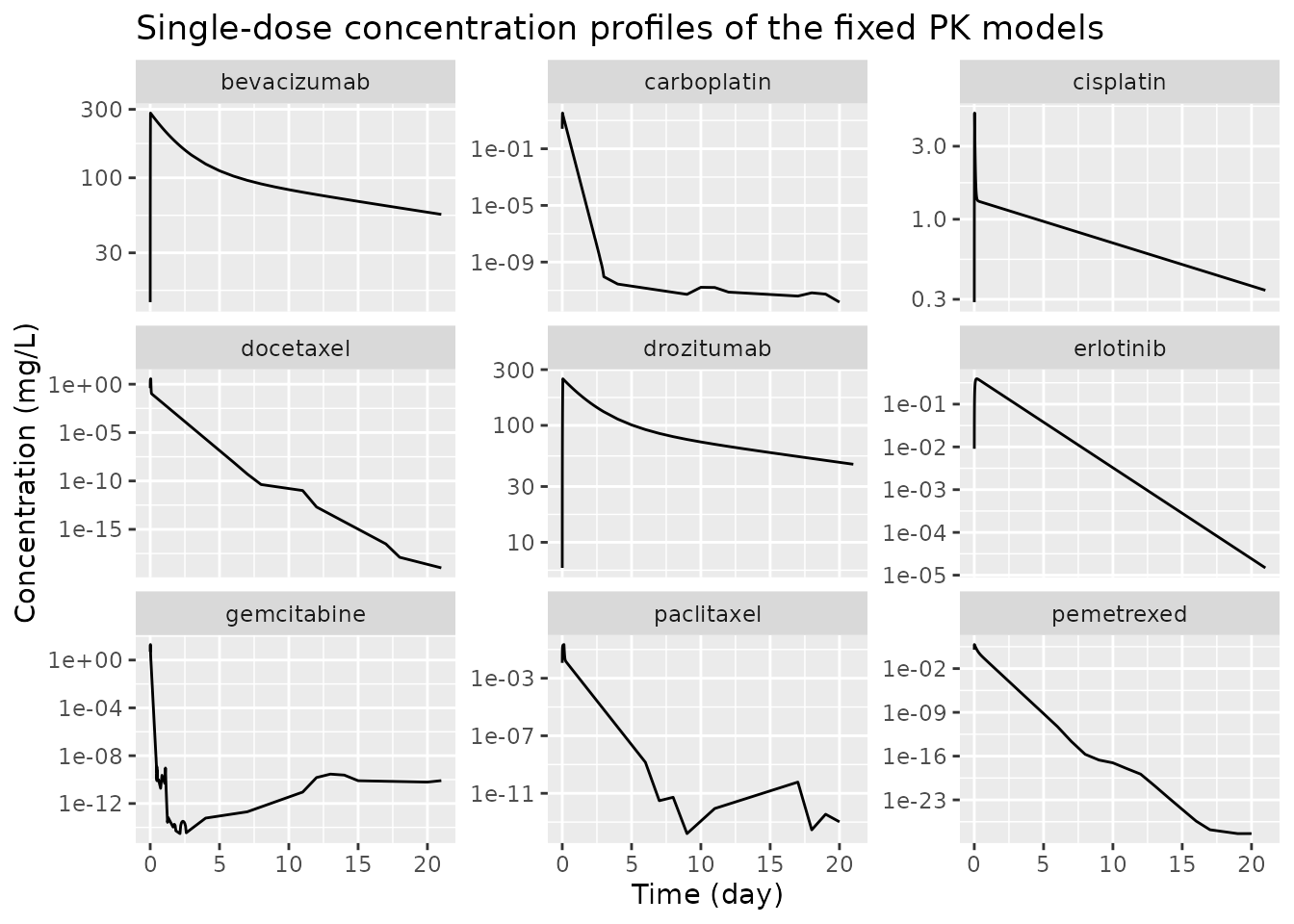
conc_obj <- PKNCA::PKNCAconc(
  pk_conc |> filter(!is.na(Cc)), Cc ~ time | drug + id
)
dose_obj <- PKNCA::PKNCAdose(
  pk_drugs |> mutate(id = seq_len(n()), time = 0), amt ~ time | drug + id
)
intervals <- data.frame(start = 0, end = 200, cmax = TRUE, auclast = TRUE)
nca <- PKNCA::pk.nca(PKNCA::PKNCAdata(conc_obj, dose_obj, intervals = intervals))
nca_res <- as.data.frame(nca$result) |>
  filter(PPTESTCD %in% c("auclast", "cmax")) |>
  select(drug, PPTESTCD, PPORRES) |>
  pivot_wider(names_from = PPTESTCD, values_from = PPORRES) |>
  left_join(pk_drugs |> select(drug, amt, cl), by = "drug") |>
  mutate(
    f = ifelse(drug == "erlotinib", 0.6, 1),
    auc_expected = f * amt / cl,
    pct_diff = 100 * (auclast - auc_expected) / auc_expected
  )
nca_res |>
  dplyr::rename(
    "Drug" = drug, "Cmax (mg/L)" = cmax,
    "AUC0-200 day PKNCA (mg*day/L)" = auclast, "F * dose / CL (mg*day/L)" = auc_expected,
    "Difference (%)" = pct_diff
  ) |>
  select(-amt, -cl, -f) |>
knitr::kable(digits = 3)| Drug | AUC0-200 day PKNCA (mg*day/L) | Cmax (mg/L) | F * dose / CL (mg*day/L) | Difference (%) |
|---|---|---|---|---|
| bevacizumab | 3673.417 | 282.614 | 3675.604 | -0.059 |
| carboplatin | 3.952 | 33.351 | 3.952 | -0.006 |
| cisplatin | 20.833 | 4.941 | 20.833 | -0.001 |
| docetaxel | 0.194 | 3.626 | 0.194 | -0.040 |
| drozitumab | 3048.383 | 250.393 | 3048.780 | -0.013 |
| erlotinib | 0.874 | 0.392 | 0.874 | 0.000 |
| gemcitabine | 0.462 | 19.903 | 0.463 | -0.160 |
| paclitaxel | 0.034 | 0.221 | 0.034 | -0.002 |
| pemetrexed | 7.164 | 70.286 | 7.164 | -0.003 |
Every drug’s exposure is cleared well within 200 days, so the AUC to day 200 equals the AUC to infinity. The paclitaxel PK of Table 2 is the linear model used by the paper.
Untreated growth against the closed form
Without drugs,
d log(v) / dt = alpha - beta * log(v / v0), so
v(t) = v0 * exp(alpha / beta * (1 - exp(-beta * t))). A
typical untreated lesion therefore grows only by the factor
exp(alpha / beta) = 1.08 in volume.
tt <- seq(0, 200, by = 5)
d0 <- 40
untreated <- rxode2::rxSolve(
  mod_typ,
  rxode2::et(tt, cmt = "cycling_cells"),
  params = data.frame(TUM_VOL = pi / 6 * d0^3),
  returnType = "data.frame"
)
#> ℹ omega/sigma items treated as zero: 'etalalpha', 'etalbeta', 'etaltau', 'etalkk', 'etalw_cisplatin_rel', 'etalw_carboplatin', 'etalw_pemetrexed', 'etalw_drozitumab', 'etalw_erlotinib', 'etalw_gemcitabine', 'etalw_paclitaxel_rel', 'etalw_docetaxel', 'etalw_bevacizumab', 'etalres_cisplatin_rel', 'etalres_carboplatin', 'etalres_pemetrexed', 'etalres_drozitumab', 'etalres_erlotinib', 'etalres_gemcitabine', 'etalres_paclitaxel_rel', 'etalres_docetaxel', 'etalres_bevacizumab', 'etalw_bevacizumab_gamma', 'etalw_bevacizumab_rho', 'etalkinj', 'etalogitfrepair'
closed <- d0 * exp(0.00304 / 0.0398 * (1 - exp(-0.0398 * untreated$time)))^(1 / 3)
stopifnot(max(abs(untreated$tumor_size - closed) / closed) < 1e-5)
Because every tumor term is proportional to volume and growth is
scaled to the baseline, the relative time course does not depend on
TUM_VOL:
reg <- function(gap = 0, horizon = 154) {
  rbind(
    data.frame(time = 0, amt = 795, dur = 30 / 1440, ii = 22, addl = 6,
               cmt = c("central_bevacizumab", "central_bevacizumab_lagged"), evid = 1),
    data.frame(time = gap, amt = c(945, 135), dur = c(10, 30) / 1440, ii = 22,
               addl = c(6, 2), cmt = c("central_pemetrexed", "central_cisplatin"), evid = 1),
    data.frame(time = seq(0, horizon, by = 1), amt = NA, dur = NA, ii = NA, addl = NA,
               cmt = "cycling_cells", evid = 0)
  )
}
rel <- sapply(c(10, 40, 80), function(d) {
  s <- rxode2::rxSolve(mod_typ, reg(), params = data.frame(TUM_VOL = pi / 6 * d^3),
                       returnType = "data.frame", addDosing = FALSE)
  s$tumor_size / d
})
#> ℹ omega/sigma items treated as zero: 'etalalpha', 'etalbeta', 'etaltau', 'etalkk', 'etalw_cisplatin_rel', 'etalw_carboplatin', 'etalw_pemetrexed', 'etalw_drozitumab', 'etalw_erlotinib', 'etalw_gemcitabine', 'etalw_paclitaxel_rel', 'etalw_docetaxel', 'etalw_bevacizumab', 'etalres_cisplatin_rel', 'etalres_carboplatin', 'etalres_pemetrexed', 'etalres_drozitumab', 'etalres_erlotinib', 'etalres_gemcitabine', 'etalres_paclitaxel_rel', 'etalres_docetaxel', 'etalres_bevacizumab', 'etalw_bevacizumab_gamma', 'etalw_bevacizumab_rho', 'etalkinj', 'etalogitfrepair'
#> ℹ omega/sigma items treated as zero: 'etalalpha', 'etalbeta', 'etaltau', 'etalkk', 'etalw_cisplatin_rel', 'etalw_carboplatin', 'etalw_pemetrexed', 'etalw_drozitumab', 'etalw_erlotinib', 'etalw_gemcitabine', 'etalw_paclitaxel_rel', 'etalw_docetaxel', 'etalw_bevacizumab', 'etalres_cisplatin_rel', 'etalres_carboplatin', 'etalres_pemetrexed', 'etalres_drozitumab', 'etalres_erlotinib', 'etalres_gemcitabine', 'etalres_paclitaxel_rel', 'etalres_docetaxel', 'etalres_bevacizumab', 'etalw_bevacizumab_gamma', 'etalw_bevacizumab_rho', 'etalkinj', 'etalogitfrepair'
#> ℹ omega/sigma items treated as zero: 'etalalpha', 'etalbeta', 'etaltau', 'etalkk', 'etalw_cisplatin_rel', 'etalw_carboplatin', 'etalw_pemetrexed', 'etalw_drozitumab', 'etalw_erlotinib', 'etalw_gemcitabine', 'etalw_paclitaxel_rel', 'etalw_docetaxel', 'etalw_bevacizumab', 'etalres_cisplatin_rel', 'etalres_carboplatin', 'etalres_pemetrexed', 'etalres_drozitumab', 'etalres_erlotinib', 'etalres_gemcitabine', 'etalres_paclitaxel_rel', 'etalres_docetaxel', 'etalres_bevacizumab', 'etalw_bevacizumab_gamma', 'etalw_bevacizumab_rho', 'etalkinj', 'etalogitfrepair'
stopifnot(max(abs(rel[, 1] - rel[, 3])) < 1e-4)
Typical response to bevacizumab plus pemetrexed-cisplatin
The clinical trial simulation of the paper used pemetrexed 945 mg over 10 min every 22 days for 7 cycles, cisplatin 135 mg over 30 min every 22 days for 3 cycles, and bevacizumab 795 mg over 30 min every 22 days for 7 cycles. The figure shows a typical 40 mm lesion with concomitant dosing and with bevacizumab given 0.4 day before the chemotherapy, and an untreated lesion.
typ <- bind_rows(
  rxode2::rxSolve(mod_typ, reg(0), params = data.frame(TUM_VOL = pi / 6 * 40^3),
                  returnType = "data.frame", addDosing = FALSE) |>
    mutate(scenario = "concomitant"),
  rxode2::rxSolve(mod_typ, reg(0.4), params = data.frame(TUM_VOL = pi / 6 * 40^3),
                  returnType = "data.frame", addDosing = FALSE) |>
    mutate(scenario = "bevacizumab 0.4 day before chemotherapy"),
  untreated |> filter(time <= 154) |> mutate(scenario = "untreated")
)
#> ℹ omega/sigma items treated as zero: 'etalalpha', 'etalbeta', 'etaltau', 'etalkk', 'etalw_cisplatin_rel', 'etalw_carboplatin', 'etalw_pemetrexed', 'etalw_drozitumab', 'etalw_erlotinib', 'etalw_gemcitabine', 'etalw_paclitaxel_rel', 'etalw_docetaxel', 'etalw_bevacizumab', 'etalres_cisplatin_rel', 'etalres_carboplatin', 'etalres_pemetrexed', 'etalres_drozitumab', 'etalres_erlotinib', 'etalres_gemcitabine', 'etalres_paclitaxel_rel', 'etalres_docetaxel', 'etalres_bevacizumab', 'etalw_bevacizumab_gamma', 'etalw_bevacizumab_rho', 'etalkinj', 'etalogitfrepair'
#> ℹ omega/sigma items treated as zero: 'etalalpha', 'etalbeta', 'etaltau', 'etalkk', 'etalw_cisplatin_rel', 'etalw_carboplatin', 'etalw_pemetrexed', 'etalw_drozitumab', 'etalw_erlotinib', 'etalw_gemcitabine', 'etalw_paclitaxel_rel', 'etalw_docetaxel', 'etalw_bevacizumab', 'etalres_cisplatin_rel', 'etalres_carboplatin', 'etalres_pemetrexed', 'etalres_drozitumab', 'etalres_erlotinib', 'etalres_gemcitabine', 'etalres_paclitaxel_rel', 'etalres_docetaxel', 'etalres_bevacizumab', 'etalw_bevacizumab_gamma', 'etalw_bevacizumab_rho', 'etalkinj', 'etalogitfrepair'
ggplot(typ, aes(time, tumor_size, colour = scenario)) +
  geom_line() +
  labs(x = "Time (day)", y = "Lesion longest diameter (mm)", colour = NULL,
       title = "Typical lesion (baseline 40 mm)") +
  theme(legend.position = "bottom")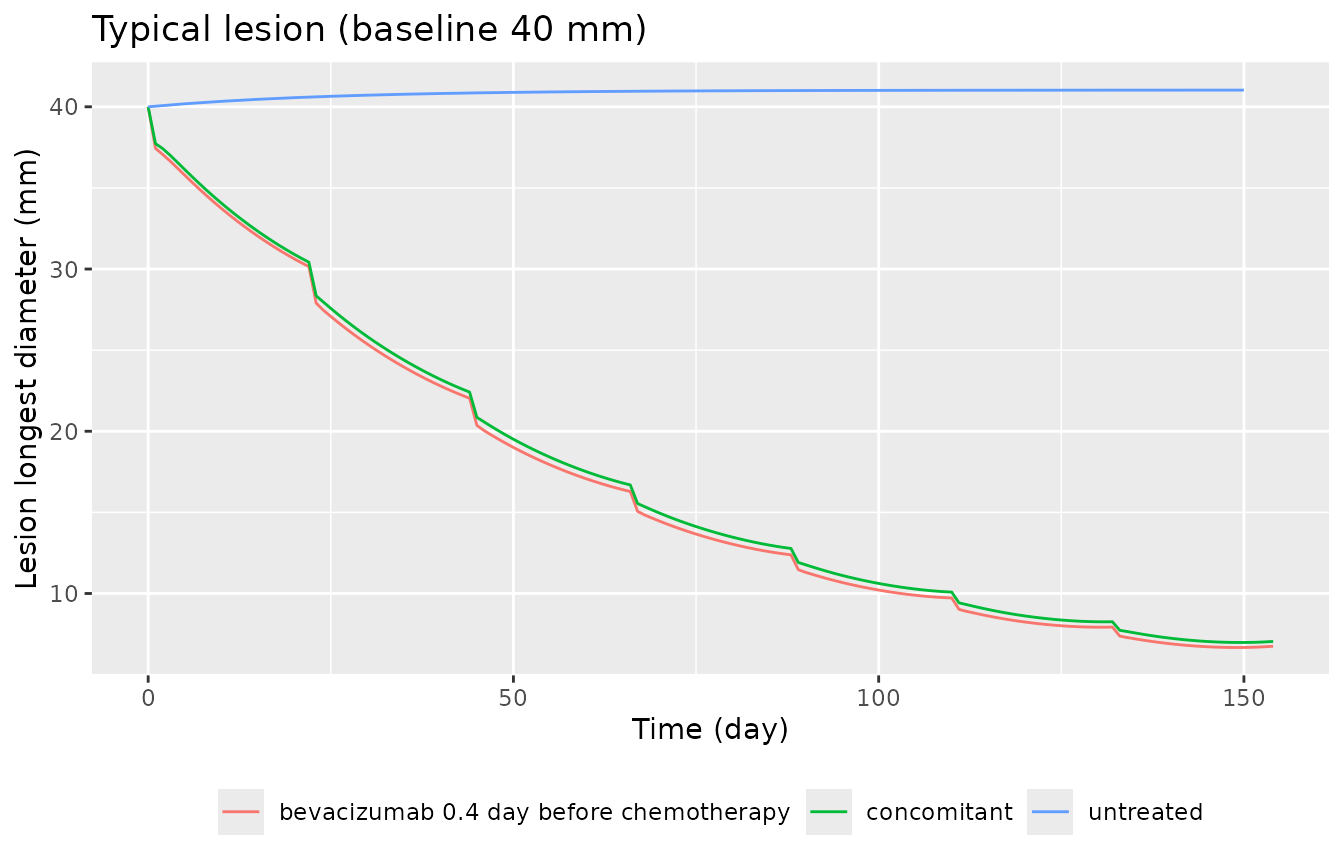
Replicating Figure 4: the bevacizumab-chemotherapy gap
The paper simulated 5000 virtual lesions for gaps of 0 to 3 days in
steps of 0.1 day and found the largest benefit at 0.4 day (9.6 h). Both
the typical lesion and the stochastic cohort below reproduce that
optimum. The Methods text says that bevacizumab followed the
chemotherapy, but the Results and Discussion describe bevacizumab given
before pemetrexed-cisplatin, and only the latter reproduces an
optimum near 0.4 day: the delayed vascular normalisation
(tau = 0.254 day) then coincides with the short pemetrexed
exposure. The chemotherapy is therefore delayed by the gap here.
gaps <- round(seq(0, 3, by = 0.1), 1)
final_typ <- sapply(gaps, function(g) {
  s <- rxode2::rxSolve(mod_typ, reg(g), params = data.frame(TUM_VOL = pi / 6 * 40^3),
                       returnType = "data.frame", addDosing = FALSE)
  s$tumor_size[s$time == 154]
})
#> ℹ omega/sigma items treated as zero: 'etalalpha', 'etalbeta', 'etaltau', 'etalkk', 'etalw_cisplatin_rel', 'etalw_carboplatin', 'etalw_pemetrexed', 'etalw_drozitumab', 'etalw_erlotinib', 'etalw_gemcitabine', 'etalw_paclitaxel_rel', 'etalw_docetaxel', 'etalw_bevacizumab', 'etalres_cisplatin_rel', 'etalres_carboplatin', 'etalres_pemetrexed', 'etalres_drozitumab', 'etalres_erlotinib', 'etalres_gemcitabine', 'etalres_paclitaxel_rel', 'etalres_docetaxel', 'etalres_bevacizumab', 'etalw_bevacizumab_gamma', 'etalw_bevacizumab_rho', 'etalkinj', 'etalogitfrepair'
#> ℹ omega/sigma items treated as zero: 'etalalpha', 'etalbeta', 'etaltau', 'etalkk', 'etalw_cisplatin_rel', 'etalw_carboplatin', 'etalw_pemetrexed', 'etalw_drozitumab', 'etalw_erlotinib', 'etalw_gemcitabine', 'etalw_paclitaxel_rel', 'etalw_docetaxel', 'etalw_bevacizumab', 'etalres_cisplatin_rel', 'etalres_carboplatin', 'etalres_pemetrexed', 'etalres_drozitumab', 'etalres_erlotinib', 'etalres_gemcitabine', 'etalres_paclitaxel_rel', 'etalres_docetaxel', 'etalres_bevacizumab', 'etalw_bevacizumab_gamma', 'etalw_bevacizumab_rho', 'etalkinj', 'etalogitfrepair'
#> ℹ omega/sigma items treated as zero: 'etalalpha', 'etalbeta', 'etaltau', 'etalkk', 'etalw_cisplatin_rel', 'etalw_carboplatin', 'etalw_pemetrexed', 'etalw_drozitumab', 'etalw_erlotinib', 'etalw_gemcitabine', 'etalw_paclitaxel_rel', 'etalw_docetaxel', 'etalw_bevacizumab', 'etalres_cisplatin_rel', 'etalres_carboplatin', 'etalres_pemetrexed', 'etalres_drozitumab', 'etalres_erlotinib', 'etalres_gemcitabine', 'etalres_paclitaxel_rel', 'etalres_docetaxel', 'etalres_bevacizumab', 'etalw_bevacizumab_gamma', 'etalw_bevacizumab_rho', 'etalkinj', 'etalogitfrepair'
#> ℹ omega/sigma items treated as zero: 'etalalpha', 'etalbeta', 'etaltau', 'etalkk', 'etalw_cisplatin_rel', 'etalw_carboplatin', 'etalw_pemetrexed', 'etalw_drozitumab', 'etalw_erlotinib', 'etalw_gemcitabine', 'etalw_paclitaxel_rel', 'etalw_docetaxel', 'etalw_bevacizumab', 'etalres_cisplatin_rel', 'etalres_carboplatin', 'etalres_pemetrexed', 'etalres_drozitumab', 'etalres_erlotinib', 'etalres_gemcitabine', 'etalres_paclitaxel_rel', 'etalres_docetaxel', 'etalres_bevacizumab', 'etalw_bevacizumab_gamma', 'etalw_bevacizumab_rho', 'etalkinj', 'etalogitfrepair'
#> ℹ omega/sigma items treated as zero: 'etalalpha', 'etalbeta', 'etaltau', 'etalkk', 'etalw_cisplatin_rel', 'etalw_carboplatin', 'etalw_pemetrexed', 'etalw_drozitumab', 'etalw_erlotinib', 'etalw_gemcitabine', 'etalw_paclitaxel_rel', 'etalw_docetaxel', 'etalw_bevacizumab', 'etalres_cisplatin_rel', 'etalres_carboplatin', 'etalres_pemetrexed', 'etalres_drozitumab', 'etalres_erlotinib', 'etalres_gemcitabine', 'etalres_paclitaxel_rel', 'etalres_docetaxel', 'etalres_bevacizumab', 'etalw_bevacizumab_gamma', 'etalw_bevacizumab_rho', 'etalkinj', 'etalogitfrepair'
#> ℹ omega/sigma items treated as zero: 'etalalpha', 'etalbeta', 'etaltau', 'etalkk', 'etalw_cisplatin_rel', 'etalw_carboplatin', 'etalw_pemetrexed', 'etalw_drozitumab', 'etalw_erlotinib', 'etalw_gemcitabine', 'etalw_paclitaxel_rel', 'etalw_docetaxel', 'etalw_bevacizumab', 'etalres_cisplatin_rel', 'etalres_carboplatin', 'etalres_pemetrexed', 'etalres_drozitumab', 'etalres_erlotinib', 'etalres_gemcitabine', 'etalres_paclitaxel_rel', 'etalres_docetaxel', 'etalres_bevacizumab', 'etalw_bevacizumab_gamma', 'etalw_bevacizumab_rho', 'etalkinj', 'etalogitfrepair'
#> ℹ omega/sigma items treated as zero: 'etalalpha', 'etalbeta', 'etaltau', 'etalkk', 'etalw_cisplatin_rel', 'etalw_carboplatin', 'etalw_pemetrexed', 'etalw_drozitumab', 'etalw_erlotinib', 'etalw_gemcitabine', 'etalw_paclitaxel_rel', 'etalw_docetaxel', 'etalw_bevacizumab', 'etalres_cisplatin_rel', 'etalres_carboplatin', 'etalres_pemetrexed', 'etalres_drozitumab', 'etalres_erlotinib', 'etalres_gemcitabine', 'etalres_paclitaxel_rel', 'etalres_docetaxel', 'etalres_bevacizumab', 'etalw_bevacizumab_gamma', 'etalw_bevacizumab_rho', 'etalkinj', 'etalogitfrepair'
#> ℹ omega/sigma items treated as zero: 'etalalpha', 'etalbeta', 'etaltau', 'etalkk', 'etalw_cisplatin_rel', 'etalw_carboplatin', 'etalw_pemetrexed', 'etalw_drozitumab', 'etalw_erlotinib', 'etalw_gemcitabine', 'etalw_paclitaxel_rel', 'etalw_docetaxel', 'etalw_bevacizumab', 'etalres_cisplatin_rel', 'etalres_carboplatin', 'etalres_pemetrexed', 'etalres_drozitumab', 'etalres_erlotinib', 'etalres_gemcitabine', 'etalres_paclitaxel_rel', 'etalres_docetaxel', 'etalres_bevacizumab', 'etalw_bevacizumab_gamma', 'etalw_bevacizumab_rho', 'etalkinj', 'etalogitfrepair'
#> ℹ omega/sigma items treated as zero: 'etalalpha', 'etalbeta', 'etaltau', 'etalkk', 'etalw_cisplatin_rel', 'etalw_carboplatin', 'etalw_pemetrexed', 'etalw_drozitumab', 'etalw_erlotinib', 'etalw_gemcitabine', 'etalw_paclitaxel_rel', 'etalw_docetaxel', 'etalw_bevacizumab', 'etalres_cisplatin_rel', 'etalres_carboplatin', 'etalres_pemetrexed', 'etalres_drozitumab', 'etalres_erlotinib', 'etalres_gemcitabine', 'etalres_paclitaxel_rel', 'etalres_docetaxel', 'etalres_bevacizumab', 'etalw_bevacizumab_gamma', 'etalw_bevacizumab_rho', 'etalkinj', 'etalogitfrepair'
#> ℹ omega/sigma items treated as zero: 'etalalpha', 'etalbeta', 'etaltau', 'etalkk', 'etalw_cisplatin_rel', 'etalw_carboplatin', 'etalw_pemetrexed', 'etalw_drozitumab', 'etalw_erlotinib', 'etalw_gemcitabine', 'etalw_paclitaxel_rel', 'etalw_docetaxel', 'etalw_bevacizumab', 'etalres_cisplatin_rel', 'etalres_carboplatin', 'etalres_pemetrexed', 'etalres_drozitumab', 'etalres_erlotinib', 'etalres_gemcitabine', 'etalres_paclitaxel_rel', 'etalres_docetaxel', 'etalres_bevacizumab', 'etalw_bevacizumab_gamma', 'etalw_bevacizumab_rho', 'etalkinj', 'etalogitfrepair'
#> ℹ omega/sigma items treated as zero: 'etalalpha', 'etalbeta', 'etaltau', 'etalkk', 'etalw_cisplatin_rel', 'etalw_carboplatin', 'etalw_pemetrexed', 'etalw_drozitumab', 'etalw_erlotinib', 'etalw_gemcitabine', 'etalw_paclitaxel_rel', 'etalw_docetaxel', 'etalw_bevacizumab', 'etalres_cisplatin_rel', 'etalres_carboplatin', 'etalres_pemetrexed', 'etalres_drozitumab', 'etalres_erlotinib', 'etalres_gemcitabine', 'etalres_paclitaxel_rel', 'etalres_docetaxel', 'etalres_bevacizumab', 'etalw_bevacizumab_gamma', 'etalw_bevacizumab_rho', 'etalkinj', 'etalogitfrepair'
#> ℹ omega/sigma items treated as zero: 'etalalpha', 'etalbeta', 'etaltau', 'etalkk', 'etalw_cisplatin_rel', 'etalw_carboplatin', 'etalw_pemetrexed', 'etalw_drozitumab', 'etalw_erlotinib', 'etalw_gemcitabine', 'etalw_paclitaxel_rel', 'etalw_docetaxel', 'etalw_bevacizumab', 'etalres_cisplatin_rel', 'etalres_carboplatin', 'etalres_pemetrexed', 'etalres_drozitumab', 'etalres_erlotinib', 'etalres_gemcitabine', 'etalres_paclitaxel_rel', 'etalres_docetaxel', 'etalres_bevacizumab', 'etalw_bevacizumab_gamma', 'etalw_bevacizumab_rho', 'etalkinj', 'etalogitfrepair'
#> ℹ omega/sigma items treated as zero: 'etalalpha', 'etalbeta', 'etaltau', 'etalkk', 'etalw_cisplatin_rel', 'etalw_carboplatin', 'etalw_pemetrexed', 'etalw_drozitumab', 'etalw_erlotinib', 'etalw_gemcitabine', 'etalw_paclitaxel_rel', 'etalw_docetaxel', 'etalw_bevacizumab', 'etalres_cisplatin_rel', 'etalres_carboplatin', 'etalres_pemetrexed', 'etalres_drozitumab', 'etalres_erlotinib', 'etalres_gemcitabine', 'etalres_paclitaxel_rel', 'etalres_docetaxel', 'etalres_bevacizumab', 'etalw_bevacizumab_gamma', 'etalw_bevacizumab_rho', 'etalkinj', 'etalogitfrepair'
#> ℹ omega/sigma items treated as zero: 'etalalpha', 'etalbeta', 'etaltau', 'etalkk', 'etalw_cisplatin_rel', 'etalw_carboplatin', 'etalw_pemetrexed', 'etalw_drozitumab', 'etalw_erlotinib', 'etalw_gemcitabine', 'etalw_paclitaxel_rel', 'etalw_docetaxel', 'etalw_bevacizumab', 'etalres_cisplatin_rel', 'etalres_carboplatin', 'etalres_pemetrexed', 'etalres_drozitumab', 'etalres_erlotinib', 'etalres_gemcitabine', 'etalres_paclitaxel_rel', 'etalres_docetaxel', 'etalres_bevacizumab', 'etalw_bevacizumab_gamma', 'etalw_bevacizumab_rho', 'etalkinj', 'etalogitfrepair'
#> ℹ omega/sigma items treated as zero: 'etalalpha', 'etalbeta', 'etaltau', 'etalkk', 'etalw_cisplatin_rel', 'etalw_carboplatin', 'etalw_pemetrexed', 'etalw_drozitumab', 'etalw_erlotinib', 'etalw_gemcitabine', 'etalw_paclitaxel_rel', 'etalw_docetaxel', 'etalw_bevacizumab', 'etalres_cisplatin_rel', 'etalres_carboplatin', 'etalres_pemetrexed', 'etalres_drozitumab', 'etalres_erlotinib', 'etalres_gemcitabine', 'etalres_paclitaxel_rel', 'etalres_docetaxel', 'etalres_bevacizumab', 'etalw_bevacizumab_gamma', 'etalw_bevacizumab_rho', 'etalkinj', 'etalogitfrepair'
#> ℹ omega/sigma items treated as zero: 'etalalpha', 'etalbeta', 'etaltau', 'etalkk', 'etalw_cisplatin_rel', 'etalw_carboplatin', 'etalw_pemetrexed', 'etalw_drozitumab', 'etalw_erlotinib', 'etalw_gemcitabine', 'etalw_paclitaxel_rel', 'etalw_docetaxel', 'etalw_bevacizumab', 'etalres_cisplatin_rel', 'etalres_carboplatin', 'etalres_pemetrexed', 'etalres_drozitumab', 'etalres_erlotinib', 'etalres_gemcitabine', 'etalres_paclitaxel_rel', 'etalres_docetaxel', 'etalres_bevacizumab', 'etalw_bevacizumab_gamma', 'etalw_bevacizumab_rho', 'etalkinj', 'etalogitfrepair'
#> ℹ omega/sigma items treated as zero: 'etalalpha', 'etalbeta', 'etaltau', 'etalkk', 'etalw_cisplatin_rel', 'etalw_carboplatin', 'etalw_pemetrexed', 'etalw_drozitumab', 'etalw_erlotinib', 'etalw_gemcitabine', 'etalw_paclitaxel_rel', 'etalw_docetaxel', 'etalw_bevacizumab', 'etalres_cisplatin_rel', 'etalres_carboplatin', 'etalres_pemetrexed', 'etalres_drozitumab', 'etalres_erlotinib', 'etalres_gemcitabine', 'etalres_paclitaxel_rel', 'etalres_docetaxel', 'etalres_bevacizumab', 'etalw_bevacizumab_gamma', 'etalw_bevacizumab_rho', 'etalkinj', 'etalogitfrepair'
#> ℹ omega/sigma items treated as zero: 'etalalpha', 'etalbeta', 'etaltau', 'etalkk', 'etalw_cisplatin_rel', 'etalw_carboplatin', 'etalw_pemetrexed', 'etalw_drozitumab', 'etalw_erlotinib', 'etalw_gemcitabine', 'etalw_paclitaxel_rel', 'etalw_docetaxel', 'etalw_bevacizumab', 'etalres_cisplatin_rel', 'etalres_carboplatin', 'etalres_pemetrexed', 'etalres_drozitumab', 'etalres_erlotinib', 'etalres_gemcitabine', 'etalres_paclitaxel_rel', 'etalres_docetaxel', 'etalres_bevacizumab', 'etalw_bevacizumab_gamma', 'etalw_bevacizumab_rho', 'etalkinj', 'etalogitfrepair'
#> ℹ omega/sigma items treated as zero: 'etalalpha', 'etalbeta', 'etaltau', 'etalkk', 'etalw_cisplatin_rel', 'etalw_carboplatin', 'etalw_pemetrexed', 'etalw_drozitumab', 'etalw_erlotinib', 'etalw_gemcitabine', 'etalw_paclitaxel_rel', 'etalw_docetaxel', 'etalw_bevacizumab', 'etalres_cisplatin_rel', 'etalres_carboplatin', 'etalres_pemetrexed', 'etalres_drozitumab', 'etalres_erlotinib', 'etalres_gemcitabine', 'etalres_paclitaxel_rel', 'etalres_docetaxel', 'etalres_bevacizumab', 'etalw_bevacizumab_gamma', 'etalw_bevacizumab_rho', 'etalkinj', 'etalogitfrepair'
#> ℹ omega/sigma items treated as zero: 'etalalpha', 'etalbeta', 'etaltau', 'etalkk', 'etalw_cisplatin_rel', 'etalw_carboplatin', 'etalw_pemetrexed', 'etalw_drozitumab', 'etalw_erlotinib', 'etalw_gemcitabine', 'etalw_paclitaxel_rel', 'etalw_docetaxel', 'etalw_bevacizumab', 'etalres_cisplatin_rel', 'etalres_carboplatin', 'etalres_pemetrexed', 'etalres_drozitumab', 'etalres_erlotinib', 'etalres_gemcitabine', 'etalres_paclitaxel_rel', 'etalres_docetaxel', 'etalres_bevacizumab', 'etalw_bevacizumab_gamma', 'etalw_bevacizumab_rho', 'etalkinj', 'etalogitfrepair'
#> ℹ omega/sigma items treated as zero: 'etalalpha', 'etalbeta', 'etaltau', 'etalkk', 'etalw_cisplatin_rel', 'etalw_carboplatin', 'etalw_pemetrexed', 'etalw_drozitumab', 'etalw_erlotinib', 'etalw_gemcitabine', 'etalw_paclitaxel_rel', 'etalw_docetaxel', 'etalw_bevacizumab', 'etalres_cisplatin_rel', 'etalres_carboplatin', 'etalres_pemetrexed', 'etalres_drozitumab', 'etalres_erlotinib', 'etalres_gemcitabine', 'etalres_paclitaxel_rel', 'etalres_docetaxel', 'etalres_bevacizumab', 'etalw_bevacizumab_gamma', 'etalw_bevacizumab_rho', 'etalkinj', 'etalogitfrepair'
#> ℹ omega/sigma items treated as zero: 'etalalpha', 'etalbeta', 'etaltau', 'etalkk', 'etalw_cisplatin_rel', 'etalw_carboplatin', 'etalw_pemetrexed', 'etalw_drozitumab', 'etalw_erlotinib', 'etalw_gemcitabine', 'etalw_paclitaxel_rel', 'etalw_docetaxel', 'etalw_bevacizumab', 'etalres_cisplatin_rel', 'etalres_carboplatin', 'etalres_pemetrexed', 'etalres_drozitumab', 'etalres_erlotinib', 'etalres_gemcitabine', 'etalres_paclitaxel_rel', 'etalres_docetaxel', 'etalres_bevacizumab', 'etalw_bevacizumab_gamma', 'etalw_bevacizumab_rho', 'etalkinj', 'etalogitfrepair'
#> ℹ omega/sigma items treated as zero: 'etalalpha', 'etalbeta', 'etaltau', 'etalkk', 'etalw_cisplatin_rel', 'etalw_carboplatin', 'etalw_pemetrexed', 'etalw_drozitumab', 'etalw_erlotinib', 'etalw_gemcitabine', 'etalw_paclitaxel_rel', 'etalw_docetaxel', 'etalw_bevacizumab', 'etalres_cisplatin_rel', 'etalres_carboplatin', 'etalres_pemetrexed', 'etalres_drozitumab', 'etalres_erlotinib', 'etalres_gemcitabine', 'etalres_paclitaxel_rel', 'etalres_docetaxel', 'etalres_bevacizumab', 'etalw_bevacizumab_gamma', 'etalw_bevacizumab_rho', 'etalkinj', 'etalogitfrepair'
#> ℹ omega/sigma items treated as zero: 'etalalpha', 'etalbeta', 'etaltau', 'etalkk', 'etalw_cisplatin_rel', 'etalw_carboplatin', 'etalw_pemetrexed', 'etalw_drozitumab', 'etalw_erlotinib', 'etalw_gemcitabine', 'etalw_paclitaxel_rel', 'etalw_docetaxel', 'etalw_bevacizumab', 'etalres_cisplatin_rel', 'etalres_carboplatin', 'etalres_pemetrexed', 'etalres_drozitumab', 'etalres_erlotinib', 'etalres_gemcitabine', 'etalres_paclitaxel_rel', 'etalres_docetaxel', 'etalres_bevacizumab', 'etalw_bevacizumab_gamma', 'etalw_bevacizumab_rho', 'etalkinj', 'etalogitfrepair'
#> ℹ omega/sigma items treated as zero: 'etalalpha', 'etalbeta', 'etaltau', 'etalkk', 'etalw_cisplatin_rel', 'etalw_carboplatin', 'etalw_pemetrexed', 'etalw_drozitumab', 'etalw_erlotinib', 'etalw_gemcitabine', 'etalw_paclitaxel_rel', 'etalw_docetaxel', 'etalw_bevacizumab', 'etalres_cisplatin_rel', 'etalres_carboplatin', 'etalres_pemetrexed', 'etalres_drozitumab', 'etalres_erlotinib', 'etalres_gemcitabine', 'etalres_paclitaxel_rel', 'etalres_docetaxel', 'etalres_bevacizumab', 'etalw_bevacizumab_gamma', 'etalw_bevacizumab_rho', 'etalkinj', 'etalogitfrepair'
#> ℹ omega/sigma items treated as zero: 'etalalpha', 'etalbeta', 'etaltau', 'etalkk', 'etalw_cisplatin_rel', 'etalw_carboplatin', 'etalw_pemetrexed', 'etalw_drozitumab', 'etalw_erlotinib', 'etalw_gemcitabine', 'etalw_paclitaxel_rel', 'etalw_docetaxel', 'etalw_bevacizumab', 'etalres_cisplatin_rel', 'etalres_carboplatin', 'etalres_pemetrexed', 'etalres_drozitumab', 'etalres_erlotinib', 'etalres_gemcitabine', 'etalres_paclitaxel_rel', 'etalres_docetaxel', 'etalres_bevacizumab', 'etalw_bevacizumab_gamma', 'etalw_bevacizumab_rho', 'etalkinj', 'etalogitfrepair'
#> ℹ omega/sigma items treated as zero: 'etalalpha', 'etalbeta', 'etaltau', 'etalkk', 'etalw_cisplatin_rel', 'etalw_carboplatin', 'etalw_pemetrexed', 'etalw_drozitumab', 'etalw_erlotinib', 'etalw_gemcitabine', 'etalw_paclitaxel_rel', 'etalw_docetaxel', 'etalw_bevacizumab', 'etalres_cisplatin_rel', 'etalres_carboplatin', 'etalres_pemetrexed', 'etalres_drozitumab', 'etalres_erlotinib', 'etalres_gemcitabine', 'etalres_paclitaxel_rel', 'etalres_docetaxel', 'etalres_bevacizumab', 'etalw_bevacizumab_gamma', 'etalw_bevacizumab_rho', 'etalkinj', 'etalogitfrepair'
#> ℹ omega/sigma items treated as zero: 'etalalpha', 'etalbeta', 'etaltau', 'etalkk', 'etalw_cisplatin_rel', 'etalw_carboplatin', 'etalw_pemetrexed', 'etalw_drozitumab', 'etalw_erlotinib', 'etalw_gemcitabine', 'etalw_paclitaxel_rel', 'etalw_docetaxel', 'etalw_bevacizumab', 'etalres_cisplatin_rel', 'etalres_carboplatin', 'etalres_pemetrexed', 'etalres_drozitumab', 'etalres_erlotinib', 'etalres_gemcitabine', 'etalres_paclitaxel_rel', 'etalres_docetaxel', 'etalres_bevacizumab', 'etalw_bevacizumab_gamma', 'etalw_bevacizumab_rho', 'etalkinj', 'etalogitfrepair'
#> ℹ omega/sigma items treated as zero: 'etalalpha', 'etalbeta', 'etaltau', 'etalkk', 'etalw_cisplatin_rel', 'etalw_carboplatin', 'etalw_pemetrexed', 'etalw_drozitumab', 'etalw_erlotinib', 'etalw_gemcitabine', 'etalw_paclitaxel_rel', 'etalw_docetaxel', 'etalw_bevacizumab', 'etalres_cisplatin_rel', 'etalres_carboplatin', 'etalres_pemetrexed', 'etalres_drozitumab', 'etalres_erlotinib', 'etalres_gemcitabine', 'etalres_paclitaxel_rel', 'etalres_docetaxel', 'etalres_bevacizumab', 'etalw_bevacizumab_gamma', 'etalw_bevacizumab_rho', 'etalkinj', 'etalogitfrepair'
#> ℹ omega/sigma items treated as zero: 'etalalpha', 'etalbeta', 'etaltau', 'etalkk', 'etalw_cisplatin_rel', 'etalw_carboplatin', 'etalw_pemetrexed', 'etalw_drozitumab', 'etalw_erlotinib', 'etalw_gemcitabine', 'etalw_paclitaxel_rel', 'etalw_docetaxel', 'etalw_bevacizumab', 'etalres_cisplatin_rel', 'etalres_carboplatin', 'etalres_pemetrexed', 'etalres_drozitumab', 'etalres_erlotinib', 'etalres_gemcitabine', 'etalres_paclitaxel_rel', 'etalres_docetaxel', 'etalres_bevacizumab', 'etalw_bevacizumab_gamma', 'etalw_bevacizumab_rho', 'etalkinj', 'etalogitfrepair'
#> ℹ omega/sigma items treated as zero: 'etalalpha', 'etalbeta', 'etaltau', 'etalkk', 'etalw_cisplatin_rel', 'etalw_carboplatin', 'etalw_pemetrexed', 'etalw_drozitumab', 'etalw_erlotinib', 'etalw_gemcitabine', 'etalw_paclitaxel_rel', 'etalw_docetaxel', 'etalw_bevacizumab', 'etalres_cisplatin_rel', 'etalres_carboplatin', 'etalres_pemetrexed', 'etalres_drozitumab', 'etalres_erlotinib', 'etalres_gemcitabine', 'etalres_paclitaxel_rel', 'etalres_docetaxel', 'etalres_bevacizumab', 'etalw_bevacizumab_gamma', 'etalw_bevacizumab_rho', 'etalkinj', 'etalogitfrepair'
best_gap_typ <- gaps[which.min(final_typ)]
best_gap_typ
#> [1] 0.3
stopifnot(best_gap_typ >= 0.3, best_gap_typ <= 0.5)
For the cohort, 200 virtual lesions (all starting at 40 mm, which does not change relative results) receive the same random effects at every gap. Each gap is compared with concomitant dosing on the final (day 154) lesion volume; lesions eradicated under concomitant dosing (final diameter below 1 mm, the paper’s limit of detection) are excluded, as the paper restricted the comparison to patients without complete remission.
n_sub <- 200
cohort_ev <- function(gap) {
  e <- reg(gap, horizon = 154)
  e <- e[e$evid == 1 | e$time == 154, ]
  bind_rows(lapply(seq_len(n_sub), function(i) mutate(e, id = i))) |>
    mutate(TUM_VOL = pi / 6 * 40^3)
}
cohort <- bind_rows(lapply(gaps, function(g) {
  rxode2::rxSetSeed(20251006)
  # The large IIV of kk (SD 3.41 on the log scale) draws death-chain transit
  # rates above 10,000 /day for a few lesions; the stiff solve needs more
  # steps than the default to finish.
  s <- rxode2::rxSolve(ui, cohort_ev(g), returnType = "data.frame", addDosing = FALSE,
                       maxsteps = 5e5)
  data.frame(gap = g, id = s$id, d_final = s$tumor_size)
}))
# Keep only lesions solved at every gap, so each gap compares the same lesions.
solved_ids <- cohort |>
  group_by(id) |>
  filter(all(!is.na(d_final))) |>
  pull(id) |>
  unique()
gap_cmp <- cohort |>
  filter(id %in% solved_ids) |>
  left_join(cohort |> filter(gap == 0) |> select(id, d_conc = d_final), by = "id") |>
  filter(gap > 0, d_conc >= 1) |>
  mutate(improvement = 1 - (d_final / d_conc)^3)

gap_summary <- gap_cmp |>
  group_by(gap) |>
  summarise(
    pct_improved = 100 * mean(improvement > 0),
    mean_improvement_if_improved = 100 * mean(improvement[improvement > 0]),
    pct_over_33 = 100 * mean(improvement > 0.33),
    .groups = "drop"
  )
gap_summary |>
  filter(gap %in% c(0.1, 0.2, 0.3, 0.4, 0.5, 1, 2, 3)) |>
  dplyr::rename(
    "Gap (day)" = gap, "Lesions improved (%)" = pct_improved,
    "Mean volume improvement among improved (%)" = mean_improvement_if_improved,
    "Improvement > 33% (%)" = pct_over_33
  ) |>
knitr::kable(digits = 1)| Gap (day) | Lesions improved (%) | Mean volume improvement among improved (%) | Improvement > 33% (%) |
|---|---|---|---|
| 0.1 | 100.0 | 2.6 | 0.6 |
| 0.2 | 100.0 | 7.1 | 3.8 |
| 0.3 | 100.0 | 10.8 | 8.9 |
| 0.4 | 99.4 | 12.5 | 11.4 |
| 0.5 | 99.4 | 12.5 | 10.8 |
| 1.0 | 99.4 | 11.4 | 8.9 |
| 2.0 | 97.5 | 10.0 | 7.6 |
| 3.0 | 95.6 | 9.2 | 5.7 |
gap_cmp |>
  mutate(category = cut(improvement, c(0, 0.33, 0.66, 0.95, 1),
                        labels = c("low", ">33%", ">66%", ">95%"))) |>
  filter(!is.na(category)) |>
  count(gap, category) |>
  mutate(pct = 100 * n / n_distinct(gap_cmp$id)) |>
  mutate(category = factor(category, levels = rev(levels(category)))) |>
  ggplot(aes(gap, pct, fill = category)) +
  geom_col(width = 0.1, position = "stack") +
  labs(x = "Gap (days)", y = "Simulated lesions (%)",
       fill = "Improvement over no gap",
       title = "Replicates Figure 4 of Schneider 2025 (volume-based improvement)") +
  theme(legend.position = "bottom")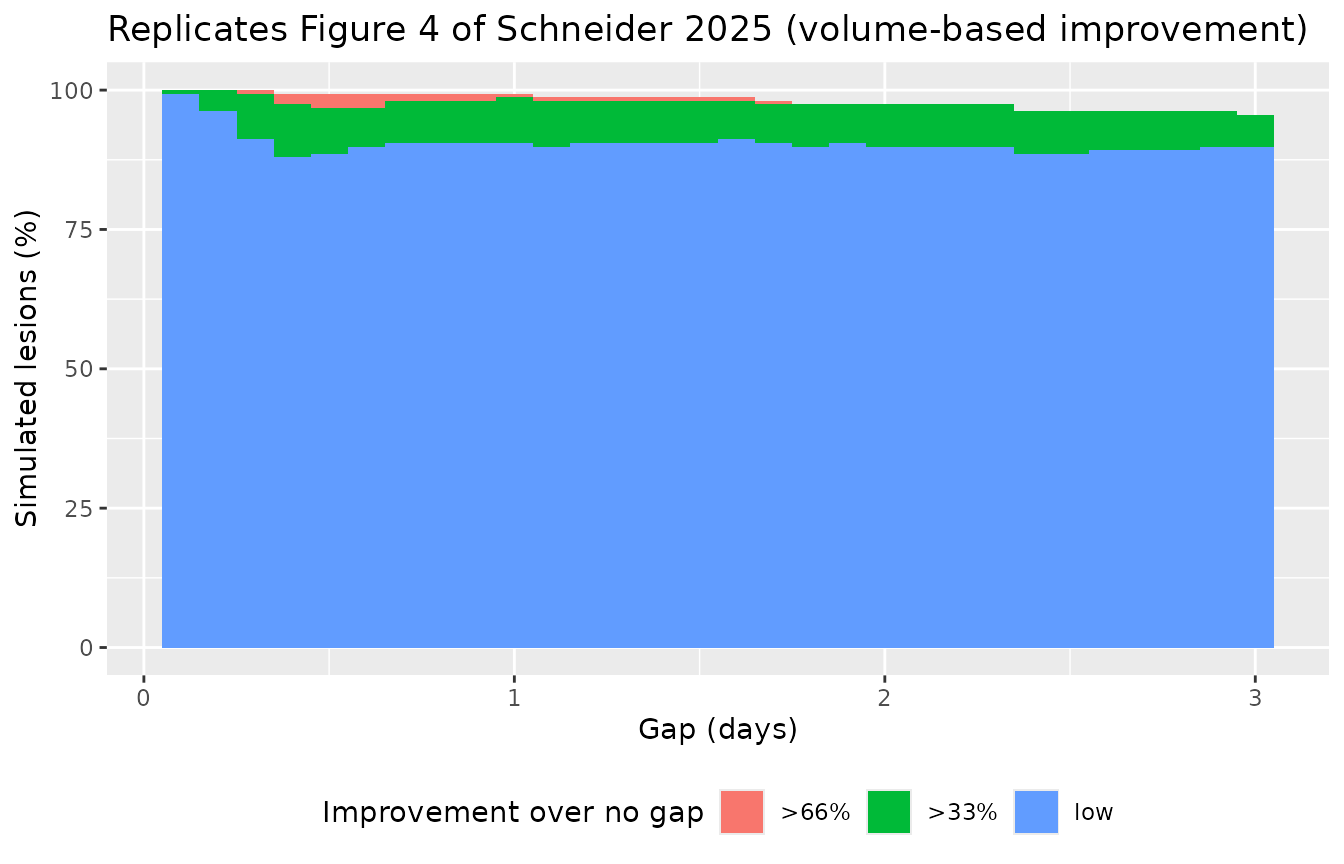
best_gap_cohort <- gap_summary$gap[which.max(gap_summary$mean_improvement_if_improved)]
best_gap_cohort
#> [1] 0.5
imp <- setNames(gap_summary$mean_improvement_if_improved, gap_summary$gap)
stopifnot(
  # Nearly every lesion must solve; a solver failure must not shrink the cohort.
  length(solved_ids) >= 0.95 * n_sub,
  # Benefit rises steeply once the gap exceeds tau and then falls slowly.
  imp[["0.4"]] > 2 * imp[["0.1"]],
  imp[["0.4"]] > imp[["3"]],
  # The share of improved lesions falls from short to long gaps (Figure 4).
  gap_summary$pct_improved[gap_summary$gap == 0.4] >
    gap_summary$pct_improved[gap_summary$gap == 3]
)
The packaged model reproduces the location of the optimal gap and the shape of Figure 4: a sharp rise between 0.1 and 0.3 day, a maximum near 0.4 day and a slow decline to 3 days, with the share of improved lesions falling as the gap lengthens. The share of improved lesions is higher than the paper’s (about 93.5% at 0.4 day falling to about 84% at 3 days), and the size of the improvement is smaller than the paper’s 20.7% mean. The paper does not define its improvement metric beyond “reduction in final tumor size”, it drew individual parameters from the conditional distributions of the fitted lesions rather than from the population distribution, and it does not state the baseline sizes or the time of the final assessment.
Assumptions and deviations
-
Model taken from the deposited code. Where the
equations printed in the paper and the deposited Mlxtran code differ,
the code is followed. In particular, the paired-drug effects are
w_cis_rel * (C_cis + w_car * C_car) * exp(-lambda_cis_rel * (AUC_cis + lambda_car * AUC_car))(and the same form for paclitaxel and docetaxel), and the inverse-logit bound of Equation 5 is not part of the final model. -
Table 3 labelling. Two rows are printed as ‘w
bevacizumab,rho’; the mapping to the code’s inputs is set by the row
order (see Source trace). Table 3 also lists
kkinjas unitless andpin day^-1; in the codekkinjis a rate constant (1/day) andpis a fraction, and the model uses those units. - Units. The deposited PK block uses mL and mL/day, so drug concentrations, AUCs and the effect weights are on the mg/mL scale. The model keeps volumes in L (Table 2) and divides by 1000 when forming concentrations. Doses are in mg, as in the paper’s clinical trial simulation.
-
Growth reference. The code writes the Gompertz term
with a scaling constant
Vc = 1e-3that cancels exactly; the model uses the equivalentlog(v / v0)form of Equation 2. - Placebo and AUC-dosed carboplatin compartments. The code’s placebo compartment has no effect and is omitted. Its separate carboplatin compartment for AUC-targeted doses has the same kinetics as the mg-dosed one and is replaced by converting the target AUC to an amount (see Dosing).
-
Negative volumes. After eradication the solver can
return a slightly negative total volume; the observed diameter is then
0, which is what the code’s
max(D, 0)gives for the real cube root. - No covariates. The paper tested none; weight, body surface area and sex are not in the model.
- Below-quantification data. The paper used a 1 mm limit of detection for the diameter; the model’s observation is not censored.
- Simulation of Figure 4. The cohort uses 200 lesions instead of 5000 and random effects from the population distribution. The improvement is computed on the final lesion volume relative to concomitant dosing.