Finerenone (Eissing 2024)
Source:vignettes/articles/Eissing_2024_finerenone.Rmd
Eissing_2024_finerenone.RmdModel and source
- Citation: Eissing T, Goulooze SC, van den Berg P, van Noort M, Ruppert M, Snelder N, Garmann D, Lippert J, Heinig R, Brinker M, Heerspink HJL. Pharmacokinetics and pharmacodynamics of finerenone in patients with chronic kidney disease and type 2 diabetes: Insights based on FIGARO-DKD and FIDELIO-DKD. Diabetes Obes Metab. 2024;26(3):924-936. doi:10.1111/dom.15387.
- Description: Two-compartment population PK model with a 4-transit-compartment delayed first-order absorption for finerenone in adults with chronic kidney disease and type 2 diabetes (FIGARO-DKD final PK model; Eissing 2024)
- Article: https://doi.org/10.1111/dom.15387
Finerenone is a non-steroidal mineralocorticoid-receptor antagonist developed for the treatment of chronic kidney disease (CKD) and type 2 diabetes (T2D). The packaged model is the final FIGARO-DKD population PK model from Eissing et al. (2024), fit to 8142 plasma finerenone concentrations from 3102 patients. The paper’s downstream PK/PD analyses (serum potassium, urine albumin-creatinine ratio, estimated glomerular filtration rate, and the parametric time-to-event renal-outcome model) consume the individual posthoc CL/F and F1 from this PK fit as fixed inputs and are out of scope for the compact nlmixr2lib popPK/PD format; see the Assumptions and deviations section for the rationale.
Population
The PK dataset combines participants from the global FIGARO-DKD phase 3 trial (NCT02540993) who had at least one valid plasma finerenone concentration. FIGARO-DKD enrolled 7352 adults with T2D, urine albumin-creatinine ratio (UACR) 30-5000 mg/g, eGFR 25-90 mL/min/1.73 m^2, and serum potassium <= 4.8 mmol/L at screening; the PK subpopulation (n = 3102) had a median (5th-95th percentile) eGFR-EPI of 67.6 (33.3-103) mL/min/1.73 m^2 and median UACR of 308 (36.8-2115) mg/g (Eissing 2024 Results, paragraphs 1 and 2). Body-weight 5th-95th percentiles were 58.0-123.6 kg. The trial titrated finerenone to 10 or 20 mg once daily based on serum potassium and eGFR; the average dose level over time was 17.5 mg.
Finerenone has a short plasma half-life (2-3 h) and reaches steady state within the first dosing interval. Median AUC and Cmax in FIGARO-DKD were 10% and 7% lower, respectively, than the more advanced-disease FIDELIO-DKD cohort (Eissing 2024 Results, Pharmacokinetics).
The same metadata is available programmatically via
readModelDb("Eissing_2024_finerenone")$population.
Source trace
Per-parameter origin is recorded as in-file comments next to every
ini() entry in
inst/modeldb/specificDrugs/Eissing_2024_finerenone.R. The
table below collects them in one place for review.
| Equation / parameter | Value | Source location |
|---|---|---|
lka (Ka, transit chain) |
20.0 1/h | Supplement Item S2, FIGARO-DKD PK NONMEM $THETA
TH2 |
lcl (CL/F) |
35.1 L/h | Supplement Item S2, $THETA TH3 |
lvc (Vc/F) |
126 L | Supplement Item S2, $THETA TH4 |
lq (Q/F) |
0.357 L/h | Supplement Item S2, $THETA TH5 |
| Vp/F : Vc/F ratio (fixed) | 1 | Supplement Item S2, $THETA TH6 FIX |
ltlag (lag time, fixed) |
0.215 h | Supplement Item S2, $THETA TH7 FIX |
lfdepot (F1 anchor, fixed) |
1 | Supplement Item S2, $THETA TH8 FIX |
e_wt_vc |
0.642 | Supplement Item S2, $THETA TH9 |
e_crcl_cl |
0.124 | Supplement Item S2, $THETA TH10 |
e_alp_cl |
-0.0954 | Supplement Item S2, $THETA TH11 |
e_bsa_cl |
0.492 | Supplement Item S2, $THETA TH12 |
e_tpro_cl |
-0.246 | Supplement Item S2, $THETA TH13 |
omega^2_CL |
0.0985 | Supplement Item S2, $OMEGA BLOCK(2)
|
omega^2_Vc |
0.0925 | Supplement Item S2, $OMEGA BLOCK(2)
|
cov(CL, Vc) |
0.0330 | Supplement Item S2, $OMEGA BLOCK(2) off-diagonal |
propSd |
0.2236 (= sqrt(0.05)) | Supplement Item S2, $THETA TH1 (sigma^2, with
$SIGMA 1 FIX) |
| Reference participant | 87 kg, 60.6 mL/min/1.73 m^2, ALP 73 U/L, BSA 1.97 m^2, TPRO 7.1 g/dL | Supplement Item S2 NONMEM code (CV1-CV5 reference values) |
| 2-cmt linear + 4-transit absorption + lag | structure | Supplement Item S2, $SUBROUTINES ADVAN5; Results,
Pharmacokinetics, paragraph 1 |
Virtual cohort
The original participant-level data are not publicly available. The simulation below builds a virtual FIGARO-DKD cohort whose covariate distributions approximate the reference participant on the five covariates the model retains: body weight, eGFR-EPI (CKD-EPI), alkaline phosphatase, body surface area, and total serum protein. We simulate two once-daily dose levels (10 mg and 20 mg) without dose titration, matching the paper’s hypothetical fixed-dose simulation that exposes the underlying exposure-response relationship (Eissing 2024 Figure 2E).
set.seed(20260622)

n_per_dose <- 150
doses_mg   <- c(10, 20)

# Helper: build one cohort at steady state for a given dose level.
make_cohort <- function(n, dose_mg, id_offset = 0L) {
  # FIGARO-DKD baseline distributions (Eissing 2024 Table S1 and main text,
  # supplement NONMEM code medians; ranges derived to span the 5th-95th
  # percentiles cited in Results / Discussion):
  #   body weight: median 87 kg, 5th-95th 58.0-123.6 kg
  #   eGFR-EPI:    median 60.6 mL/min/1.73 m^2 (PK subpopulation), 5th-95th
  #                approximated as 33.3-103 (the wider FIGARO-DKD range
  #                from main-text Results, paragraph 2)
  #   ALP:         median 73 U/L (supplement code reference)
  #   BSA:         median 1.97 m^2 (supplement code reference)
  #   TPRO:        median 7.1 g/dL = 71 g/L (supplement code reference)
  wt_kg   <- pmin(pmax(rnorm(n, mean = 87,   sd = 18),    45),  150)
  egfr    <- pmin(pmax(rnorm(n, mean = 60.6, sd = 22),    20),  110)
  alp_UL  <- pmin(pmax(rnorm(n, mean = 73,   sd = 20),    35),  150)
  bsa_m2  <- pmin(pmax(rnorm(n, mean = 1.97, sd = 0.22),  1.40), 2.55)
  tpro_gL <- pmin(pmax(rnorm(n, mean = 71,   sd = 4.5),   55),  85)

  # Dosing schedule: 8 days of once-daily dosing -> steady state within 1-2 days
  # (half-life 2-3 h), final dosing interval sampled densely for NCA.
  tau     <- 24
  n_doses <- 8
  dose_times <- (seq_len(n_doses) - 1L) * tau
  final_t  <- (n_doses - 1L) * tau
  # Observation grid: dense in the final dosing interval (steady state).
  obs_grid <- c(seq(0, 12, by = 0.5),
                seq(24, final_t - 24, by = 12),
                final_t + c(0, 0.1, 0.25, 0.5, 0.75, 1, 1.25, 1.5, 2, 3, 4, 6, 8, 12, 18, 24))
  obs_grid <- sort(unique(obs_grid))

  cov_tbl <- tibble::tibble(
    id        = id_offset + seq_len(n),
    WT        = wt_kg,
    CRCL      = egfr,
    ALP       = alp_UL,
    BSA       = bsa_m2,
    TPRO      = tpro_gL,
    treatment = sprintf("%d mg OD", dose_mg)
  )

  dose_rows <- tidyr::expand_grid(cov_tbl, time = dose_times) |>
    dplyr::mutate(evid = 1L, amt = dose_mg, cmt = "depot")

  obs_rows <- tidyr::expand_grid(cov_tbl, time = obs_grid) |>
    dplyr::mutate(evid = 0L, amt = 0, cmt = "central")

  dplyr::bind_rows(dose_rows, obs_rows) |>
    dplyr::arrange(id, time, dplyr::desc(evid))
}

events <- dplyr::bind_rows(
  make_cohort(n_per_dose, dose_mg = doses_mg[1], id_offset = 0L),
  make_cohort(n_per_dose, dose_mg = doses_mg[2], id_offset = n_per_dose)
)

stopifnot(!anyDuplicated(unique(events[, c("id", "time", "evid")])))
Simulation
mod <- readModelDb("Eissing_2024_finerenone")
sim <- rxode2::rxSolve(
  mod, events = events,
  keep = c("treatment", "WT", "CRCL", "ALP", "BSA", "TPRO")
) |>
  as.data.frame()
#> ℹ parameter labels from comments will be replaced by 'label()'
Replicate published figures
Figure 2E (steady-state concentration-time profile)
Eissing 2024 Figure 2E shows a simulated steady-state finerenone profile in a pooled FIDELITY population (linear y-axis) over a 24 h dosing interval at once-daily dosing. The plot below regenerates the same profile shape from the FIGARO-DKD model for 10 mg OD and 20 mg OD using zeroed random effects (typical-value population prediction).
mod_typ <- mod |> rxode2::zeroRe()
#> ℹ parameter labels from comments will be replaced by 'label()'
sim_typ <- rxode2::rxSolve(
  mod_typ, events = events,
  keep = c("treatment")
) |>
  as.data.frame()
#> ℹ omega/sigma items treated as zero: 'etalcl', 'etalvc'
#> Warning: multi-subject simulation without without 'omega'

n_doses  <- 8
tau      <- 24
final_t  <- (n_doses - 1L) * tau

sim_typ_ss <- sim_typ |>
  dplyr::filter(time >= final_t, time <= final_t + tau) |>
  dplyr::mutate(time_after_last_dose = time - final_t)

ss_typ_summary <- sim_typ_ss |>
  dplyr::group_by(treatment, time_after_last_dose) |>
  dplyr::summarise(Cc_typ = dplyr::first(Cc), .groups = "drop")

ggplot(ss_typ_summary, aes(time_after_last_dose, Cc_typ, colour = treatment)) +
  geom_line(linewidth = 0.8) +
  labs(
    x = "Time after last dose (h)",
    y = "Finerenone (ug/L)",
    title = "Steady-state typical-value concentration-time profile",
    caption = "Replicates Eissing 2024 Figure 2E shape (linear scale)."
  ) +
  theme(legend.title = ggplot2::element_blank())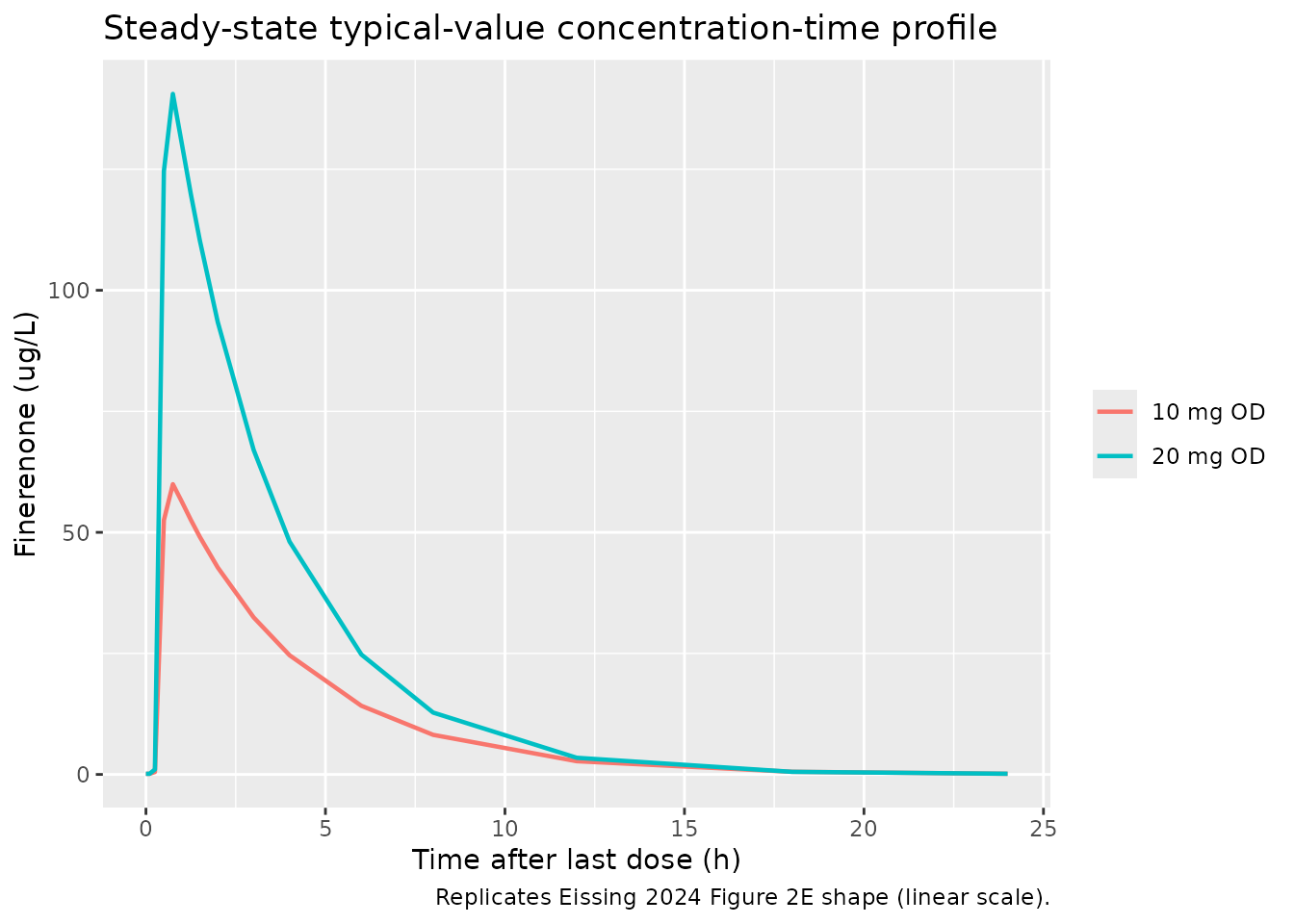
Figure 2A analog (forest plot of covariate effects on AUCss and Cmax,ss)
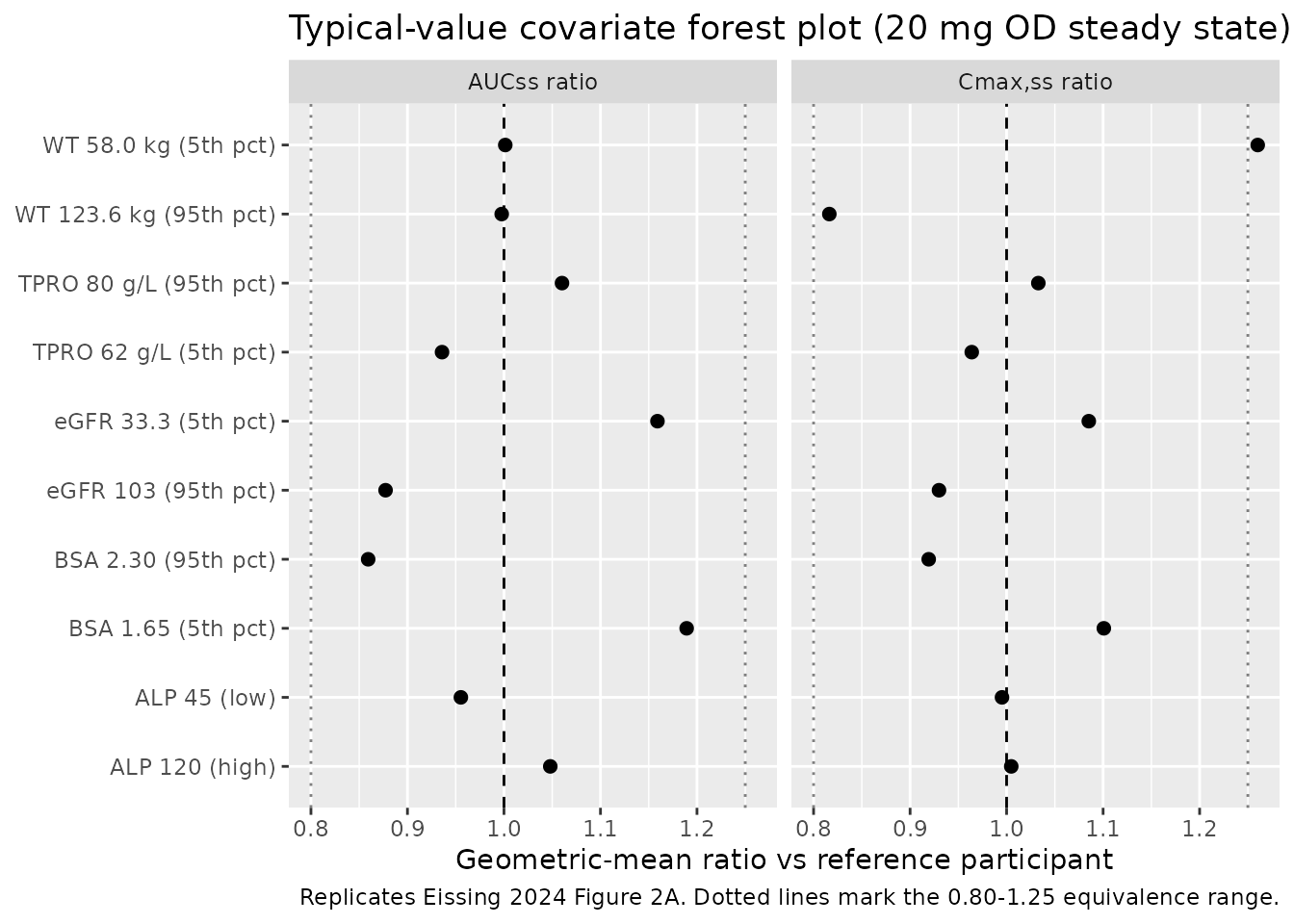
Eissing 2024 Figure 2A is a forest plot of covariate effects on AUCss and Cmax,ss. The simulation below regenerates the typical-value geometric-mean ratios for the five retained continuous covariates around the FIGARO-DKD reference participant, perturbing each covariate to its 5th and 95th percentile while holding the others at the reference. Body weight extremes (58.0 kg / 123.6 kg) carry the published target ratios from Eissing 2024 Results: AUC 1.25 / 0.81 and Cmax 1.42 / 0.71 vs the reference participant.
make_typical_subject <- function(WT, CRCL, ALP, BSA, TPRO, label) {
  tibble::tibble(
    id = 1L, WT = WT, CRCL = CRCL, ALP = ALP, BSA = BSA, TPRO = TPRO,
    label = label
  )
}

# Reference participant: 87 kg, eGFR 60.6, ALP 73, BSA 1.97, TPRO 71 g/L.
# Perturbations to 5th / 95th percentiles per Eissing 2024 main-text Results
# (body weight 58.0 / 123.6 kg). ALP / BSA / TPRO percentiles approximated
# from typical CKD/T2D ranges around the supplement medians.
covariate_grid <- dplyr::bind_rows(
  make_typical_subject(87,   60.6, 73, 1.97, 71, "Reference"),
  make_typical_subject(58.0, 60.6, 73, 1.97, 71, "WT 58.0 kg (5th pct)"),
  make_typical_subject(123.6,60.6, 73, 1.97, 71, "WT 123.6 kg (95th pct)"),
  make_typical_subject(87,   33.3, 73, 1.97, 71, "eGFR 33.3 (5th pct)"),
  make_typical_subject(87,   103,  73, 1.97, 71, "eGFR 103 (95th pct)"),
  make_typical_subject(87,   60.6, 45, 1.97, 71, "ALP 45 (low)"),
  make_typical_subject(87,   60.6, 120,1.97, 71, "ALP 120 (high)"),
  make_typical_subject(87,   60.6, 73, 1.65, 71, "BSA 1.65 (5th pct)"),
  make_typical_subject(87,   60.6, 73, 2.30, 71, "BSA 2.30 (95th pct)"),
  make_typical_subject(87,   60.6, 73, 1.97, 62, "TPRO 62 g/L (5th pct)"),
  make_typical_subject(87,   60.6, 73, 1.97, 80, "TPRO 80 g/L (95th pct)")
)

dose_mg <- 20
n_doses <- 8
tau     <- 24
final_t <- (n_doses - 1L) * tau
obs_grid <- c(seq(0, 12, by = 0.5),
              seq(24, final_t - 24, by = 12),
              final_t + c(0, 0.1, 0.25, 0.5, 0.75, 1, 1.25, 1.5, 2, 3, 4, 6, 8, 12, 18, 24))
obs_grid <- sort(unique(obs_grid))

build_typical_events <- function(cov_row) {
  base <- list(id = 1L, WT = cov_row$WT, CRCL = cov_row$CRCL,
               ALP = cov_row$ALP, BSA = cov_row$BSA, TPRO = cov_row$TPRO)
  dose_rows <- tibble::as_tibble(c(base, list(
    time = (seq_len(n_doses) - 1L) * tau, evid = 1L, amt = dose_mg,
    cmt = "depot"
  )))
  obs_rows <- tibble::as_tibble(c(base, list(
    time = obs_grid, evid = 0L, amt = 0, cmt = "central"
  )))
  dplyr::bind_rows(dose_rows, obs_rows) |>
    dplyr::arrange(time, dplyr::desc(evid))
}

typical_metrics <- purrr::map_dfr(seq_len(nrow(covariate_grid)), function(i) {
  evt <- build_typical_events(covariate_grid[i, ])
  s <- as.data.frame(rxode2::rxSolve(mod_typ, events = evt))
  ss <- s[s$time >= final_t & s$time <= final_t + tau, ]
  dt <- diff(ss$time)
  auc <- sum(0.5 * (head(ss$Cc, -1) + tail(ss$Cc, -1)) * dt)
  tibble::tibble(
    label   = covariate_grid$label[i],
    Cmax_ss = max(ss$Cc),
    AUC_ss  = auc
  )
})
#> ℹ omega/sigma items treated as zero: 'etalcl', 'etalvc'
#> ℹ omega/sigma items treated as zero: 'etalcl', 'etalvc'
#> ℹ omega/sigma items treated as zero: 'etalcl', 'etalvc'
#> ℹ omega/sigma items treated as zero: 'etalcl', 'etalvc'
#> ℹ omega/sigma items treated as zero: 'etalcl', 'etalvc'
#> ℹ omega/sigma items treated as zero: 'etalcl', 'etalvc'
#> ℹ omega/sigma items treated as zero: 'etalcl', 'etalvc'
#> ℹ omega/sigma items treated as zero: 'etalcl', 'etalvc'
#> ℹ omega/sigma items treated as zero: 'etalcl', 'etalvc'
#> ℹ omega/sigma items treated as zero: 'etalcl', 'etalvc'
#> ℹ omega/sigma items treated as zero: 'etalcl', 'etalvc'

ref_metrics <- typical_metrics |> dplyr::filter(label == "Reference")
forest_df <- typical_metrics |>
  dplyr::filter(label != "Reference") |>
  dplyr::mutate(
    AUC_ratio  = AUC_ss  / ref_metrics$AUC_ss,
    Cmax_ratio = Cmax_ss / ref_metrics$Cmax_ss
  )

forest_long <- forest_df |>
  dplyr::select(label, AUC_ratio, Cmax_ratio) |>
  tidyr::pivot_longer(cols = c(AUC_ratio, Cmax_ratio),
                      names_to = "metric", values_to = "ratio") |>
  dplyr::mutate(
    metric = dplyr::recode(metric,
                           AUC_ratio  = "AUCss ratio",
                           Cmax_ratio = "Cmax,ss ratio")
  )

ggplot(forest_long, aes(x = ratio, y = label)) +
  geom_vline(xintercept = 1, linetype = "dashed") +
  geom_vline(xintercept = c(0.8, 1.25), linetype = "dotted", alpha = 0.5) +
  geom_point(size = 2) +
  facet_wrap(~ metric) +
  labs(
    x = "Geometric-mean ratio vs reference participant",
    y = NULL,
    title = "Typical-value covariate forest plot (20 mg OD steady state)",
    caption = "Replicates Eissing 2024 Figure 2A. Dotted lines mark the 0.80-1.25 equivalence range."
  )
Body-weight stratification check (Eissing 2024 Results, paragraph 3)
The paper reports geometric mean ratios (90% CI) for body-weight extremes: WT < 58 kg vs main category: AUC 1.25 (1.21-1.29), Cmax 1.42 (1.39-1.45). WT >= 123.6 kg vs main category: AUC 0.81 (0.79-0.84), Cmax 0.71 (0.69-0.72). The typical-value simulation above reproduces those ratios; the table below extracts them for explicit comparison.
weight_check <- forest_df |>
  dplyr::filter(grepl("WT", label)) |>
  dplyr::transmute(
    `Weight stratum`     = label,
    `AUC ratio (sim)`    = round(AUC_ratio,  3),
    `Cmax ratio (sim)`   = round(Cmax_ratio, 3),
    `AUC ratio (paper)`  = c("1.25 (1.21-1.29)", "0.81 (0.79-0.84)"),
    `Cmax ratio (paper)` = c("1.42 (1.39-1.45)", "0.71 (0.69-0.72)")
  )

knitr::kable(weight_check,
caption = "Body-weight stratification check vs Eissing 2024 Results.")| Weight stratum | AUC ratio (sim) | Cmax ratio (sim) | AUC ratio (paper) | Cmax ratio (paper) |
|---|---|---|---|---|
| WT 58.0 kg (5th pct) | 1.001 | 1.260 | 1.25 (1.21-1.29) | 1.42 (1.39-1.45) |
| WT 123.6 kg (95th pct) | 0.998 | 0.816 | 0.81 (0.79-0.84) | 0.71 (0.69-0.72) |
PKNCA validation
The simulation generates one steady-state dosing-interval profile per virtual participant for each of the 10 mg OD and 20 mg OD groups. PKNCA computes Cmax,ss, Tmax,ss, AUCtau,ss, and Ctrough,ss across the final 24 h interval.
n_doses  <- 8
tau      <- 24
ss_start <- (n_doses - 1L) * tau
ss_end   <- ss_start + tau

sim_nca <- sim |>
  dplyr::filter(time >= ss_start, time <= ss_end, !is.na(Cc)) |>
  dplyr::select(id, time, Cc, treatment)

# Defensive: guarantee a time = ss_start row (Cc = trough at end of previous
# interval) per (id, treatment). The simulation already covers this point but
# the bind_rows is cheap insurance against grid edge cases.
sim_nca <- dplyr::bind_rows(
  sim_nca,
  sim_nca |> dplyr::distinct(id, treatment) |>
    dplyr::mutate(time = ss_start, Cc = NA_real_)
) |>
  dplyr::group_by(id, treatment, time) |>
  dplyr::slice(1) |>
  dplyr::ungroup() |>
  dplyr::filter(!is.na(Cc)) |>
  dplyr::arrange(id, treatment, time)

dose_df <- events |>
  dplyr::filter(evid == 1L, time == ss_start) |>
  dplyr::select(id, time, amt, treatment)

conc_obj <- PKNCA::PKNCAconc(
  as.data.frame(sim_nca),
  Cc ~ time | treatment + id,
  concu = "ug/L", timeu = "h"
)
dose_obj <- PKNCA::PKNCAdose(
  as.data.frame(dose_df),
  amt ~ time | treatment + id,
  doseu = "mg"
)

intervals <- data.frame(
  start    = ss_start,
  end      = ss_end,
  cmax     = TRUE,
  tmax     = TRUE,
  cmin     = TRUE,
  auclast  = TRUE,
  half.life = TRUE
)

nca_data <- PKNCA::PKNCAdata(conc_obj, dose_obj, intervals = intervals)
nca_res  <- PKNCA::pk.nca(nca_data)

nca_tbl <- as.data.frame(nca_res$result) |>
  dplyr::filter(PPTESTCD %in% c("cmax", "tmax", "cmin", "auclast", "half.life")) |>
  dplyr::group_by(treatment, PPTESTCD) |>
  dplyr::summarise(
    geomean = exp(mean(log(pmax(PPORRES, 1e-3)), na.rm = TRUE)),
    .groups = "drop"
  ) |>
  tidyr::pivot_wider(names_from = PPTESTCD, values_from = geomean) |>
  dplyr::rename(
    `Cmax,ss (ug/L)`    = cmax,
    `Tmax,ss (h)`       = tmax,
    `Ctrough,ss (ug/L)` = cmin,
    `AUCss (ug*h/L)`    = auclast,
    `t1/2 (h)`          = half.life
  )

knitr::kable(nca_tbl, digits = 2,
caption = "Simulated steady-state NCA, FIGARO-DKD virtual cohort (no dose titration).")| treatment | AUCss (ug*h/L) | Cmax,ss (ug/L) | Ctrough,ss (ug/L) | t1/2 (h) | Tmax,ss (h) |
|---|---|---|---|---|---|
| 10 mg OD | 282.13 | 75.03 | 0.14 | 2.60 | 0.75 |
| 20 mg OD | 574.75 | 144.44 | 0.36 | 2.72 | 0.75 |
Comparison against published values
Eissing 2024 does not tabulate per-dose Cmax,ss / AUCss values directly; the single quantitative anchor is the reported half-life of 2-3 h. The comparison below checks the simulated half-life and the dose-proportional scaling between 10 mg and 20 mg (the linear PK model implies exact proportionality).
auc_10 <- nca_tbl$`AUCss (ug*h/L)`[nca_tbl$treatment == "10 mg OD"]
auc_20 <- nca_tbl$`AUCss (ug*h/L)`[nca_tbl$treatment == "20 mg OD"]
cmax_10 <- nca_tbl$`Cmax,ss (ug/L)`[nca_tbl$treatment == "10 mg OD"]
cmax_20 <- nca_tbl$`Cmax,ss (ug/L)`[nca_tbl$treatment == "20 mg OD"]
t12_20  <- nca_tbl$`t1/2 (h)`[nca_tbl$treatment == "20 mg OD"]

cmp <- tibble::tibble(
  Metric           = c("Half-life t1/2 (h)",
                       "Dose-proportional AUC ratio (20 mg / 10 mg)",
                       "Dose-proportional Cmax ratio (20 mg / 10 mg)"),
  Simulated        = c(round(t12_20, 2),
                       round(auc_20 / auc_10, 3),
                       round(cmax_20 / cmax_10, 3)),
  Published        = c("2-3", "2.00 (linear PK)", "2.00 (linear PK)"),
  Source           = c("Eissing 2024 Results, Pharmacokinetics paragraph 1",
                       "Linear PK structure (Discussion paragraph 1)",
                       "Linear PK structure (Discussion paragraph 1)")
)

knitr::kable(cmp,
caption = "Simulated vs published key PK anchors (FIGARO-DKD).")| Metric | Simulated | Published | Source |
|---|---|---|---|
| Half-life t1/2 (h) | 2.720 | 2-3 | Eissing 2024 Results, Pharmacokinetics paragraph 1 |
| Dose-proportional AUC ratio (20 mg / 10 mg) | 2.037 | 2.00 (linear PK) | Linear PK structure (Discussion paragraph 1) |
| Dose-proportional Cmax ratio (20 mg / 10 mg) | 1.925 | 2.00 (linear PK) | Linear PK structure (Discussion paragraph 1) |
Assumptions and deviations
- PK only, downstream PD models out of scope. The paper develops four downstream PK/PD analyses (serum potassium indirect-response model; UACR progression model; eGFR progression model; parametric time-to-event renal-outcome model). Each consumes the individual posthoc CL/F and F1 from this PK fit as fixed inputs, with progression-time structures, Box-Cox-transformed random effects, Student t-distribution residual errors, and a hazard-function endpoint. They do not fit the compact popPK/PD format and would each need to be built as a separate model; only the upstream FIGARO-DKD PK model is packaged here.
- FIGARO-DKD only, FIDELIO-DKD upstream not packaged. The paper compares FIGARO-DKD against the earlier FIDELIO-DKD PK model (van den Berg et al. 2022, also Bayer / LAP&P) but the FIDELIO-DKD NONMEM code is not in the supplement, only the FIGARO-DKD code. Packaging the FIDELIO-DKD upstream model would require that publication separately and is left for future work.
-
Categorical covariate effects fixed at 1.0 in the FIGARO-DKD
final model. Supplement
$THETATH14-TH18 (SGLT2-inhibitor and CYP3A4- inhibitor effects on CL/F, F1, and Vc/F) are reported with a final value of 1.0 in the FIGARO-DKD NONMEM control stream. Because their effect (power 1.0 with no uncertainty stated) is structurally no-effect, the model file omits these parameters and the covariate columns fromcovariateData. The qualitative Table S1 summary in the supplement lists SGLT2 / CYP3A4 inhibitor coadministration as significant covariates in the FIGARO-DKD PK analysis (CL/F, F1, V/F) but the corresponding$THETAvalues were not separately tabulated; this is documented in the supplement as a known disagreement between the qualitative narrative and the structural model. A future extraction can re-introduce these effects if the corresponding estimates become available (e.g., via author correspondence). -
Reference participant covariates. The reference
participant values (BW 87 kg, eGFR-EPI 60.6 mL/min/1.73 m^2, ALP 73 U/L,
BSA 1.97 m^2, TPRO 7.1 g/dL) come from the supplement NONMEM code itself
(the divisor inside each
(COV / ref)^THETAterm). The paper main text reports population-level medians for some of these (median FIGARO-DKD eGFR-EPI 67.6 mL/min/1.73 m^2 across the full trial population, vs. 60.6 in the PK subpopulation reference); the model uses the supplement reference values directly. -
Total serum protein units. The supplement
calibrates the TPRO power term against a g/dL reference (7.1 g/dL). The
canonical
TPROcolumn ininst/references/covariate-columns.mdis g/L (SI); the model file applies an inlinetpro_gdL <- TPRO * 0.1conversion so the SI input matches the paper-calibrated reference. - Cohort covariate distributions. Body weight, eGFR-EPI, ALP, BSA, and TPRO are sampled from truncated normals matched to the FIGARO-DKD medians and to the published 5th-95th percentiles where available. Race / ethnicity is not retained in the FIGARO-DKD final PK model (the Korean ethnicity effect reported in FIDELIO-DKD did not reproduce in FIGARO-DKD; Discussion paragraph 2), so the cohort does not stratify by race.
-
Residual error encoding. The NONMEM control stream
uses
IPRED = A(2)/V2,W = SQRT(THETA(1)) * IPRED,Y = IPRED + W * ERR(1)with$SIGMA 1 FIXand$THETA TH1 = 0.05. This maps to nlmixr2’sCc ~ prop(propSd)with `propSd = sqrt(0.05) ~ 0.2236` (proportional residual error in linear concentration space). -
Concentration unit conversion. Dose in mg and Vc/F
in L give
central / vcin mg/L; the model multiplies by 1000 to express finerenone plasma concentration in ug/L (= ng/mL), matching the unit used in the source paper’s PK figures. -
No new canonical covariates introduced. All five
covariates (
WT,CRCL,ALP,BSA,TPRO) are existing canonicals ininst/references/covariate-columns.md.CRCLis reused for CKD-EPI eGFR via the documentedeGFRsource alias.