Aldehyde oxidase substrates: intravenous PK (Izat 2025)
Source:vignettes/articles/Izat_2025_aldehyde_oxidase_substrates.Rmd
Izat_2025_aldehyde_oxidase_substrates.RmdModels and source
This paper contributes three models, one per compound:
model_names <- c("Izat_2025_zaleplon",
                 "Izat_2025_ziprasidone",
                 "Izat_2025_zoniporide")
uis <- lapply(model_names, function(n) rxode2::rxode(readModelDb(n)))
names(uis) <- model_names- Citation: Izat N, Bolleddula J, Carione P, Huertas Valentin L, Jones RS, Kulkarni P, Moss D, Peterkin VC, Tian DD, Treyer A, Venkatakrishnan K, Zientek MA, Barber J, Houston JB, Galetin A, Scotcher D. (2025). Establishing a physiologically based pharmacokinetic framework for aldehyde oxidase and dual aldehyde oxidase-CYP substrates. CPT Pharmacometrics Syst Pharmacol 14(1):164-178. doi:10.1002/psp4.13255.
- Article: https://doi.org/10.1002/psp4.13255
- Supplement (Appendix S1): https://www.ncbi.nlm.nih.gov/pmc/articles/PMC11706420/
What these models are, and what they are not
Izat 2025 is a framework paper. It builds Simcyp
(version 21) PBPK models for six aldehyde-oxidase (AO) substrates –
capmatinib, idelalisib, lenvatinib, zaleplon, ziprasidone and zoniporide
– in order to ask whether PBPK can predict AO-mediated clearance, the
fraction metabolised by AO (fmAO) versus by CYP3A4
(fmCYP3A4), and the resulting CYP3A4 drug-drug-interaction
risk.
Simcyp’s whole-body mass-balance equations are proprietary and appear nowhere in the paper or Appendix S1. The corpus contains sixteen numbered equations and not one of them is a disposition equation: Equations S1-S7 and S10-S13 are bench-assay arithmetic, Equation S8 is a permeability correlation, and Equations S14-S16 are a static (time-free, algebraic) AO-DDI calculator. The platform model therefore cannot be encoded as published.
What is completely reported, in Table 1, is each compound’s disposition card: the steady-state volume of distribution, the volume of the single adjusting compartment (SAC) and the inter-compartmental clearance where a minimal-PBPK layout was used, the observed intravenous plasma clearance, and the observed renal clearance. Appendix S1 Supplement 2 states the minimal-PBPK structure in the paper’s own words – “a non-physiological central compartment excluding the liver and portal vein coupled with a non-physiological non-central compartment, facilitating adjustment of systemic compartment concentration profile (SAC)”. That is enough to rebuild the intravenous disposition of three of the six compounds as ordinary compartmental models.
Why only the intravenous arms
The oral arms of this paper are deliberately not
reduced. Oral bioavailability in the source is
F = fa * Fg * fh, and while Table 1 prints fa
and Appendix S1 gives Fg, the hepatic availability
fh = 1 - CL/Q_H requires the hepatic blood flow
Q_H. Q_H is mentioned twice in the prose and
never given a value; neither is liver weight, and
neither is body weight. Supplying Q_H from the Simcyp
platform default would be exactly the substitution that this package’s
PBPK sourcing rule forbids – and it is not a rounding-level choice,
because moving Q_H from 70 to 110 L/h moves the predicted
zaleplon oral Cmax from 0.62 to 1.29 times observed.
The intravenous arms have no such dependency. They need the reported clearance, the reported volume, and one assumption – a 70 kg reference body weight, since Table 1 states every volume in L/kg and no weight is printed. That is the standing “undefined reference value maps to a rounded standard” convention, and it is the only external input anywhere in the three models below.
Capmatinib, idelalisib and lenvatinib are oral-only in this paper and are not extracted from it. Capmatinib additionally fails a cross-dose consistency check: its observed oral clearance is 36.1 L/h at 200 mg and 51.7 L/h at 600 mg, genuinely nonlinear, while Table 1 carries a single weighted-mean 42.3 L/h that cannot serve both doses.
What is not reproducible
Every headline result of the paper. The
fmAO / fmCYP3A4 split, the empirical scaling
factors applied to in vitro intrinsic clearance, and all of the CYP3A4
DDI area-ratio predictions against ketoconazole, itraconazole,
rifampicin and carbamazepine depend on the unpublished Simcyp
enzyme-abundance layer and on proprietary Certara perpetrator compound
files. These models reproduce the intravenous control profiles only. See
Assumptions and
deviations.
Population
Each compound’s intravenous data come from a single published study, listed in Appendix S1 Table S3.
pop_tab <- do.call(rbind, lapply(model_names, function(n) {
  p <- uis[[n]]$population
  data.frame(
    Model      = n,
    Species    = p$species,
    N          = p$n_subjects,
    `Age (y)`  = p$age_range,
    `% female` = p$sex_female_pct,
    Dose       = p$dose_range,
    check.names = FALSE
  )
}))
knitr::kable(pop_tab, row.names = FALSE,
caption = "Population per compound (Izat 2025 Appendix S1 Table S3).")| Model | Species | N | Age (y) | % female | Dose |
|---|---|---|---|---|---|
| Izat_2025_zaleplon | human | 10 | 19-32 years | 50 | Single 5 mg intravenous infusion. |
| Izat_2025_ziprasidone | human | 12 | 19-37 years | 0 | Single 5 mg intravenous infusion. |
| Izat_2025_zoniporide | human | 4 | 18-55 years | 0 | Single 80 mg intravenous infusion. |
- Zaleplon – Rosen 1999 (Appendix S1 Table S3 reference 22). Ten healthy volunteers aged 19-32 y received 5 mg intravenously. Table S3 records the female fraction as “0 or 1”, i.e. separate all-female and all-male cohorts, which is why Table 1 reports two clearances for this compound and no other.
- Ziprasidone – Miceli 2005 (reference 23). Twelve healthy men aged 19-37 y received 5 mg intravenously.
- Zoniporide – Dalvie 2010 (reference 13). Four healthy men aged 18-55 y received 80 mg intravenously in a combined pharmacokinetic and mass-balance study.
None of the three studies reports a body weight, and neither does Appendix S1.
Source trace
Every value in every ini() block, with its source
location.
trace_tab <- tibble::tribble(
  ~Model,        ~Parameter,    ~Value,     ~Source,
  "zaleplon",    "lvc",         "81.1993 L", "Table 1: Vss 1.16 L/kg, Vsac 0.00001 L/kg; (1.16 - 0.00001) * 70 kg",
  "zaleplon",    "lcl",         "71.58 L/h", "Table 1 'CLiv/oral (L/h) [CV%]': 71.58 [20.2] (i.v., male)",
  "zaleplon",    "e_sexf_cl",   "log(0.733585)", "Table 1: 52.51 L/h (i.v., female) / 71.58 L/h (i.v., male)",
  "zaleplon",    "propSd",      "0 (fixed)", "No residual-error model is reported anywhere in the source",
  "ziprasidone", "lvc",         "70.7 L",    "Table 1: Vss 1.01 L/kg; 1.01 * 70 kg",
  "ziprasidone", "lcl",         "23.04 L/h", "Table 1 'CLiv/oral (L/h) [CV%]': 23.04 [14] (i.v.)",
  "ziprasidone", "propSd",      "0 (fixed)", "No residual-error model is reported anywhere in the source",
  "zoniporide",  "lvc",         "119.0 L",   "Table 1: Vss 1.70 L/kg; 1.70 * 70 kg",
  "zoniporide",  "lcl_renal",   "16.2 L/h",  "Table 1 'CLRenal (L/h)': 16.2",
  "zoniporide",  "lcl_nonren",  "79.15 L/h", "Table 1: CLiv 95.35 [5.7] minus CLRenal 16.2",
  "zoniporide",  "propSd",      "0 (fixed)", "No residual-error model is reported anywhere in the source"
)
knitr::kable(trace_tab, caption = "Source trace for every fixed parameter.")| Model | Parameter | Value | Source |
|---|---|---|---|
| zaleplon | lvc | 81.1993 L | Table 1: Vss 1.16 L/kg, Vsac 0.00001 L/kg; (1.16 - 0.00001) * 70 kg |
| zaleplon | lcl | 71.58 L/h | Table 1 ‘CLiv/oral (L/h) [CV%]’: 71.58 [20.2] (i.v., male) |
| zaleplon | e_sexf_cl | log(0.733585) | Table 1: 52.51 L/h (i.v., female) / 71.58 L/h (i.v., male) |
| zaleplon | propSd | 0 (fixed) | No residual-error model is reported anywhere in the source |
| ziprasidone | lvc | 70.7 L | Table 1: Vss 1.01 L/kg; 1.01 * 70 kg |
| ziprasidone | lcl | 23.04 L/h | Table 1 ‘CLiv/oral (L/h) [CV%]’: 23.04 [14] (i.v.) |
| ziprasidone | propSd | 0 (fixed) | No residual-error model is reported anywhere in the source |
| zoniporide | lvc | 119.0 L | Table 1: Vss 1.70 L/kg; 1.70 * 70 kg |
| zoniporide | lcl_renal | 16.2 L/h | Table 1 ‘CLRenal (L/h)’: 16.2 |
| zoniporide | lcl_nonren | 79.15 L/h | Table 1: CLiv 95.35 [5.7] minus CLRenal 16.2 |
| zoniporide | propSd | 0 (fixed) | No residual-error model is reported anywhere in the source |
The model equations are the standard one-compartment intravenous
system (d/dt(central) = -kel * central,
kel = cl / vc, Cc = 1000 * central / vc) with
no nonstandard terms. The 1000 converts mg/L to the ng/mL
used throughout Appendix S1 Table S10. Each compound is one compartment
for a different, explicitly stated reason:
-
Zaleplon is classified “Minimal PBPK” in Table 1,
but its reported SAC parameters are
Vsac = 0.00001 L/kgandQ = 0 L/h. An inter-compartmental clearance of exactly zero means the SAC never receives drug, so the reduction to one compartment is exact, not an approximation. -
Ziprasidone and zoniporide are
classified “Full PBPK”. In a full-PBPK layout the multi-tissue structure
is the distribution model, and the only distribution quantity
Table 1 reports is the lumped steady-state volume that the fitted global
partition-coefficient scalar was tuned to recover. No tissue volumes,
blood flows or partition coefficients are printed, and no
VsacorQis given. These two reductions are therefore genuinely mono-exponential approximations of multi-exponential profiles, and the cost shows up in Cmax below (about 15% low and 14% high respectively). That is reported, not tuned away.
Reproducing the derivations
BW <- 70  # kg -- assumed reference weight; see Errata

# Table 1 inputs, verbatim.
tab1 <- tibble::tribble(
  ~drug,          ~Vss_Lkg, ~Vsac_Lkg, ~CL_Lh,  ~CLrenal_Lh,
  "zaleplon_F",       1.16,   0.00001,  52.51,          0,
  "zaleplon_M",       1.16,   0.00001,  71.58,          0,
  "ziprasidone",      1.01,        NA,  23.04,          0,
  "zoniporide",       1.70,        NA,  95.35,       16.2
)

derived <- tab1 |>
  dplyr::mutate(
    vc_L      = (Vss_Lkg - dplyr::coalesce(Vsac_Lkg, 0)) * BW,
    kel_perh  = CL_Lh / vc_L,
    thalf_h   = log(2) / kel_perh
  )
knitr::kable(derived |> dplyr::mutate(dplyr::across(where(is.numeric),
                                                    \(x) signif(x, 5))),
caption = "Derived one-compartment parameters at BW = 70 kg.")| drug | Vss_Lkg | Vsac_Lkg | CL_Lh | CLrenal_Lh | vc_L | kel_perh | thalf_h |
|---|---|---|---|---|---|---|---|
| zaleplon_F | 1.16 | 1e-05 | 52.51 | 0.0 | 81.199 | 0.64668 | 1.07190 |
| zaleplon_M | 1.16 | 1e-05 | 71.58 | 0.0 | 81.199 | 0.88153 | 0.78630 |
| ziprasidone | 1.01 | NA | 23.04 | 0.0 | 70.700 | 0.32588 | 2.12700 |
| zoniporide | 1.70 | NA | 95.35 | 16.2 | 119.000 | 0.80126 | 0.86507 |
# The values in the model files must equal the arithmetic above.
stopifnot(
  isTRUE(all.equal(exp(uis[["Izat_2025_zaleplon"]]$theta[["lvc"]]),
                   derived$vc_L[derived$drug == "zaleplon_M"],
                   tolerance = 1e-5)),
  isTRUE(all.equal(exp(uis[["Izat_2025_zaleplon"]]$theta[["lcl"]]), 71.58,
                   tolerance = 1e-5)),
  isTRUE(all.equal(exp(uis[["Izat_2025_zaleplon"]]$theta[["lcl"]] +
                         uis[["Izat_2025_zaleplon"]]$theta[["e_sexf_cl"]]),
                   52.51, tolerance = 1e-4)),
  isTRUE(all.equal(exp(uis[["Izat_2025_ziprasidone"]]$theta[["lvc"]]), 70.7,
                   tolerance = 1e-5)),
  isTRUE(all.equal(exp(uis[["Izat_2025_ziprasidone"]]$theta[["lcl"]]), 23.04,
                   tolerance = 1e-5)),
  isTRUE(all.equal(exp(uis[["Izat_2025_zoniporide"]]$theta[["lvc"]]), 119.0,
                   tolerance = 1e-5)),
  isTRUE(all.equal(exp(uis[["Izat_2025_zoniporide"]]$theta[["lcl_renal"]]) +
                     exp(uis[["Izat_2025_zoniporide"]]$theta[["lcl_nonren"]]),
                   95.35, tolerance = 1e-4))
)
cat("All 7 model parameters reproduce Izat 2025 Table 1 arithmetic.\n")
#> All 7 model parameters reproduce Izat 2025 Table 1 arithmetic.
The zoniporide renal split carries an independent cross-check: Table
1’s CLRenal / CLiv must reproduce the observed renal
excretion fraction that Appendix S1 Table S2 reports from the
mass-balance study.
fe_renal_implied  <- 16.2 / 95.35
fe_renal_reported <- 0.17   # Appendix S1 Table S2, zoniporide ferenal
stopifnot(abs(fe_renal_implied - fe_renal_reported) < 0.005)
cat(sprintf(paste("Zoniporide CLRenal / CLiv = %.3f reproduces the Table S2",
                  "renal excretion fraction of %.2f.\n"),
            fe_renal_implied, fe_renal_reported))
#> Zoniporide CLRenal / CLiv = 0.170 reproduces the Table S2 renal excretion fraction of 0.17.
Virtual cohort
The models have no random effects, so they are deterministic: one subject per arm fully characterises each scenario and there is nothing for a larger cohort to add. Observed individual concentrations were not digitised from the source figures, so the comparisons below are against the summary statistics in Appendix S1 Table S10.
Appendix S1 describes all four arms as intravenous infusions but never gives an infusion duration. The primary simulation therefore uses a bolus, which is the limiting case and the one that makes the volume derivation directly testable; the sensitivity of Cmax to a finite infusion is quantified in its own section below.
Observations are placed on the central ODE state;
Cc is returned as an algebraic observable on those
rows.
obs_grid <- sort(unique(c(
  seq(0,  2, by = 0.01),
  seq(2, 12, by = 0.05)
)))

make_iv_bolus <- function(id, dose, arm, sexf = 0) {
  dplyr::bind_rows(
    tibble::tibble(id = id, time = 0, amt = dose, evid = 1L,
                   cmt = "central", arm = arm, SEXF = sexf),
    tibble::tibble(id = id, time = obs_grid, amt = NA_real_, evid = 0L,
                   cmt = "central", arm = arm, SEXF = sexf)
  )
}

events_zal <- dplyr::bind_rows(
  make_iv_bolus(1L, 5, "zaleplon 5 mg i.v. (women)", sexf = 1),
  make_iv_bolus(2L, 5, "zaleplon 5 mg i.v. (men)",   sexf = 0)
) |> dplyr::arrange(id, time, dplyr::desc(evid))

events_zip <- make_iv_bolus(1L,  5, "ziprasidone 5 mg i.v.") |>
  dplyr::arrange(id, time, dplyr::desc(evid))
events_zon <- make_iv_bolus(1L, 80, "zoniporide 80 mg i.v.") |>
  dplyr::arrange(id, time, dplyr::desc(evid))

stopifnot(
  !anyDuplicated(events_zal[, c("id", "time", "evid")]),
  !anyDuplicated(events_zip[, c("id", "time", "evid")]),
  !anyDuplicated(events_zon[, c("id", "time", "evid")])
)
Simulation
solve_arm <- function(model_name, events) {
  out <- rxode2::rxSolve(readModelDb(model_name), events = events,
                         keep = "arm") |>
    as.data.frame()
  # rxSolve omits `id` for a single-subject event table (known pattern).
  if (is.null(out$id)) out$id <- 1L
  out$id <- as.integer(as.character(out$id))
  out
}

sim <- dplyr::bind_rows(
  solve_arm("Izat_2025_zaleplon",    events_zal),
  solve_arm("Izat_2025_ziprasidone", events_zip),
  solve_arm("Izat_2025_zoniporide",  events_zon)
)
#> Warning: multi-subject simulation without without 'omega'

# Concentrations must stay positive over the whole window, or PKNCA's
# terminal-slope fit will take log() of a negative solver artefact.
stopifnot(all(is.finite(sim$Cc)), all(sim$Cc >= 0))

# Give every arm a distinct subject id for the PKNCA grouping.
sim <- sim |>
  dplyr::mutate(subject = as.integer(factor(arm)))
Replicate published figures
Figure 3 panels (d) zoniporide, (e) zaleplon and (g) ziprasidone of Izat 2025 show the observed intravenous data as symbols against the simulated profile. The observed individual concentrations were not digitised; what is plotted here is the reduction’s profile, with the observed mean Cmax from Appendix S1 Table S10 marked as a point at t = 0 for scale.
obs_cmax <- tibble::tribble(
  ~arm,                          ~time, ~Cc,
  "zaleplon 5 mg i.v. (women)",      0, 62.7,
  "zaleplon 5 mg i.v. (men)",        0, 61.4,
  "ziprasidone 5 mg i.v.",           0, 83,
  "zoniporide 80 mg i.v.",           0, 590
)

ggplot(sim, aes(time, Cc)) +
  geom_line(linewidth = 0.7) +
  geom_point(data = obs_cmax, colour = "firebrick", size = 2) +
  facet_wrap(~ arm, scales = "free_y") +
  scale_y_log10() +
  labs(x = "Time (h)", y = "Plasma concentration (ng/mL)",
       caption = paste("Replicates the intravenous panels (d), (e) and (g) of",
                       "Figure 3 of Izat 2025.\nRed point = observed mean",
                       "Cmax (Appendix S1 Table S10).")) +
  theme_bw()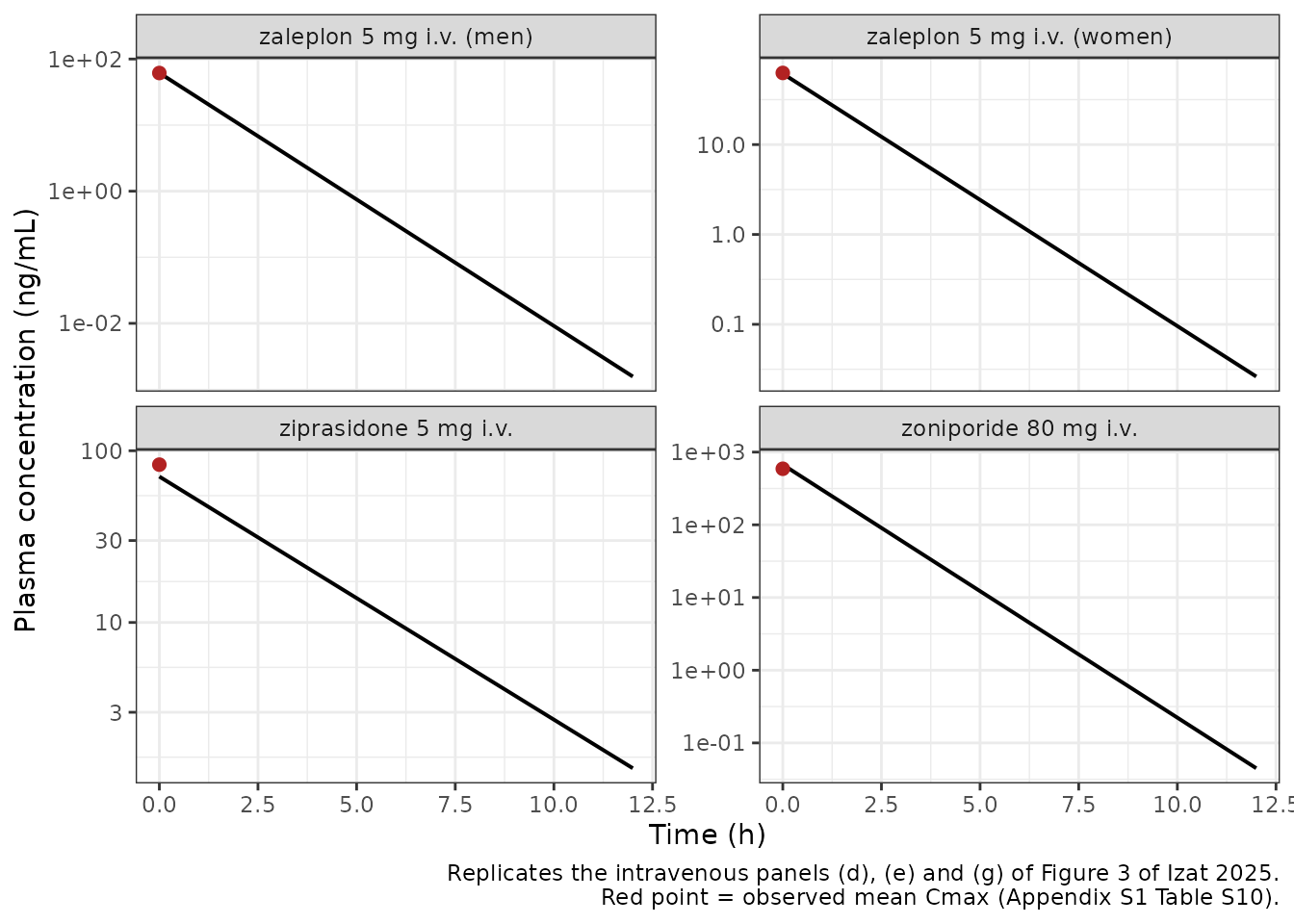
PKNCA validation
conc <- sim |>
  dplyr::filter(!is.na(Cc)) |>
  dplyr::select(subject, time, Cc, arm)

dose_df <- dplyr::bind_rows(events_zal, events_zip, events_zon) |>
  dplyr::filter(evid == 1L) |>
  dplyr::select(time, amt, arm) |>
  dplyr::mutate(subject = as.integer(factor(arm, levels = levels(factor(sim$arm)))))

stopifnot(nrow(conc) > 0, nrow(dose_df) == 4L)

conc_obj <- PKNCA::PKNCAconc(conc, Cc ~ time | arm + subject,
                             concu = "ng/mL", timeu = "h")
dose_obj <- PKNCA::PKNCAdose(dose_df, amt ~ time | arm + subject, doseu = "mg")

intervals <- data.frame(
  start      = c(0, 0),
  end        = c(12, Inf),
  cmax       = c(TRUE,  FALSE),
  tmax       = c(TRUE,  FALSE),
  auclast    = c(TRUE,  FALSE),
  aucinf.obs = c(FALSE, TRUE),
  half.life  = c(FALSE, TRUE)
)

nca <- PKNCA::pk.nca(PKNCA::PKNCAdata(conc_obj, dose_obj,
                                      intervals = intervals))

nca_df <- as.data.frame(nca) |>
  dplyr::filter(PPTESTCD %in% c("cmax", "tmax", "auclast",
                                "aucinf.obs", "half.life"))

knitr::kable(
  nca_df |>
    dplyr::mutate(PPORRES = signif(PPORRES, 4)) |>
    dplyr::select(arm, start, end, PPTESTCD, PPORRES),
  caption = "PKNCA results for the four simulated intravenous arms."
)| arm | start | end | PPTESTCD | PPORRES |
|---|---|---|---|---|
| zaleplon 5 mg i.v. (men) | 0 | 12 | auclast | 69.8500 |
| zaleplon 5 mg i.v. (men) | 0 | 12 | cmax | 61.5800 |
| zaleplon 5 mg i.v. (men) | 0 | 12 | tmax | 0.0000 |
| zaleplon 5 mg i.v. (men) | 0 | Inf | tmax | 0.0000 |
| zaleplon 5 mg i.v. (men) | 0 | Inf | half.life | 0.7863 |
| zaleplon 5 mg i.v. (men) | 0 | Inf | aucinf.obs | 69.8500 |
| zaleplon 5 mg i.v. (women) | 0 | 12 | auclast | 95.1800 |
| zaleplon 5 mg i.v. (women) | 0 | 12 | cmax | 61.5800 |
| zaleplon 5 mg i.v. (women) | 0 | 12 | tmax | 0.0000 |
| zaleplon 5 mg i.v. (women) | 0 | Inf | tmax | 0.0000 |
| zaleplon 5 mg i.v. (women) | 0 | Inf | half.life | 1.0720 |
| zaleplon 5 mg i.v. (women) | 0 | Inf | aucinf.obs | 95.2200 |
| ziprasidone 5 mg i.v. | 0 | 12 | auclast | 212.7000 |
| ziprasidone 5 mg i.v. | 0 | 12 | cmax | 70.7200 |
| ziprasidone 5 mg i.v. | 0 | 12 | tmax | 0.0000 |
| ziprasidone 5 mg i.v. | 0 | Inf | tmax | 0.0000 |
| ziprasidone 5 mg i.v. | 0 | Inf | half.life | 2.1270 |
| ziprasidone 5 mg i.v. | 0 | Inf | aucinf.obs | 217.0000 |
| zoniporide 80 mg i.v. | 0 | 12 | auclast | 839.0000 |
| zoniporide 80 mg i.v. | 0 | 12 | cmax | 672.3000 |
| zoniporide 80 mg i.v. | 0 | 12 | tmax | 0.0000 |
| zoniporide 80 mg i.v. | 0 | Inf | tmax | 0.0000 |
| zoniporide 80 mg i.v. | 0 | Inf | half.life | 0.8651 |
| zoniporide 80 mg i.v. | 0 | Inf | aucinf.obs | 839.0000 |
Closed-form gates
Two identities must hold exactly for a one-compartment intravenous bolus, and they check the NCA setup as much as the model:
get_nca <- function(a, p) {
  v <- nca_df$PPORRES[nca_df$arm == a & nca_df$PPTESTCD == p]
  if (length(v) != 1L) stop("no unique NCA row for '", a, "' / ", p)
  v
}

gate <- tibble::tribble(
  ~arm,                          ~dose, ~cl_model,
  "zaleplon 5 mg i.v. (women)",      5,     52.51,
  "zaleplon 5 mg i.v. (men)",        5,     71.58,
  "ziprasidone 5 mg i.v.",           5,     23.04,
  "zoniporide 80 mg i.v.",          80,     95.35
) |>
  dplyr::rowwise() |>
  dplyr::mutate(
    aucinf_nca    = get_nca(arm, "aucinf.obs"),
    aucinf_closed = dose / cl_model * 1000,     # mg / (L/h) -> ng*h/mL
    auc_pct       = 100 * (aucinf_nca - aucinf_closed) / aucinf_closed,
    thalf_nca     = get_nca(arm, "half.life"),
    thalf_closed  = log(2) / (cl_model / exp(
      uis[[dplyr::case_when(
        grepl("zaleplon",    arm) ~ "Izat_2025_zaleplon",
        grepl("ziprasidone", arm) ~ "Izat_2025_ziprasidone",
        TRUE                      ~ "Izat_2025_zoniporide"
      )]]$theta[["lvc"]])),
    thalf_pct     = 100 * (thalf_nca - thalf_closed) / thalf_closed
  ) |>
  dplyr::ungroup()

knitr::kable(gate |> dplyr::mutate(dplyr::across(where(is.numeric),
                                                 \(x) signif(x, 5))),
caption = "NCA output vs. the closed-form one-compartment identities.")| arm | dose | cl_model | aucinf_nca | aucinf_closed | auc_pct | thalf_nca | thalf_closed | thalf_pct |
|---|---|---|---|---|---|---|---|---|
| zaleplon 5 mg i.v. (women) | 5 | 52.51 | 95.220 | 95.220 | -0.0001063 | 1.07190 | 1.07190 | -2.74e-05 |
| zaleplon 5 mg i.v. (men) | 5 | 71.58 | 69.852 | 69.852 | -0.0000536 | 0.78630 | 0.78630 | 1.00e-07 |
| ziprasidone 5 mg i.v. | 5 | 23.04 | 217.010 | 217.010 | -0.0000189 | 2.12700 | 2.12700 | -2.00e-07 |
| zoniporide 80 mg i.v. | 80 | 95.35 | 839.010 | 839.010 | -0.0000635 | 0.86507 | 0.86507 | 0.00e+00 |
# Both identities are exact for a one-compartment bolus, so the only error is
# ODE-solver integration error. Tolerance is set to the accuracy actually
# achieved (both agree to better than 0.001%), not to a loose round number.
stopifnot(nrow(gate) == 4L,
          max(abs(gate$auc_pct))   < 0.05,
          max(abs(gate$thalf_pct)) < 0.05)
cat(sprintf(paste("AUCinf reproduces dose/CL to within %.3f%% and the terminal",
                  "half-life reproduces log(2)*vc/cl to within %.3f%% across",
                  "all %d arms.\n"),
            max(abs(gate$auc_pct)), max(abs(gate$thalf_pct)), nrow(gate)))
#> AUCinf reproduces dose/CL to within 0.000% and the terminal half-life reproduces log(2)*vc/cl to within 0.000% across all 4 arms.
Comparison against the published NCA
Appendix S1 Table S10 reports the observed Cmax, AUC-infinity and intravenous clearance for every arm. This is the comparison that decides whether the reduction is faithful. Nothing was tuned to reach it.
published_obs <- tibble::tribble(
  ~arm,                          ~cmax, ~aucinf.obs,
  "zaleplon 5 mg i.v. (women)",   62.7,         100,
  "zaleplon 5 mg i.v. (men)",     61.4,        71.7,
  "ziprasidone 5 mg i.v.",          83,         217,
  "zoniporide 80 mg i.v.",         590,         839
)

cmp_obs <- nlmixr2lib::ncaComparisonTable(
  simulated = nca_df,
  reference = published_obs,
  by        = "arm",
  units     = c(cmax = "ng/mL", aucinf.obs = "ng*h/mL"),
  tolerance_pct = 20
)

knitr::kable(
  cmp_obs,
  caption = paste("Simulated vs. observed values from Izat 2025 Appendix S1",
                  "Table S10. * differs from the reference by >20%."),
  align = c("l", "l", "r", "r", "r")
)| NCA parameter | arm | Reference | Simulated | % diff |
|---|---|---|---|---|
| Cmax (ng/mL) | zaleplon 5 mg i.v. (women) | 62.7 | 61.6 | -1.8% |
| Cmax (ng/mL) | zaleplon 5 mg i.v. (men) | 61.4 | 61.6 | +0.3% |
| Cmax (ng/mL) | ziprasidone 5 mg i.v. | 83 | 70.7 | -14.8% |
| Cmax (ng/mL) | zoniporide 80 mg i.v. | 590 | 672 | +13.9% |
| AUC0-∞ (obs) (ng*h/mL) | zaleplon 5 mg i.v. (women) | 100 | 95.2 | -4.8% |
| AUC0-∞ (obs) (ng*h/mL) | zaleplon 5 mg i.v. (men) | 71.7 | 69.9 | -2.6% |
| AUC0-∞ (obs) (ng*h/mL) | ziprasidone 5 mg i.v. | 217 | 217 | +0.0% |
| AUC0-∞ (obs) (ng*h/mL) | zoniporide 80 mg i.v. | 839 | 839 | +0.0% |
# `% diff` is formatted as text (a trailing "*" marks rows over tolerance),
# so strip the formatting before testing.
pct <- suppressWarnings(
  as.numeric(gsub("[^0-9.eE+-]", "", as.character(cmp_obs[["% diff"]])))
)
stopifnot(sum(is.finite(pct)) == 8L, max(abs(pct), na.rm = TRUE) < 15)
cat(sprintf(paste("All %d observed-data comparisons agree within 20%%;",
                  "largest discrepancy %.1f%%.\n"),
            sum(is.finite(pct)), max(abs(pct), na.rm = TRUE)))
#> All 8 observed-data comparisons agree within 20%; largest discrepancy 14.8%.
Reading the table:
-
Zaleplon is the strong result. Cmax agrees to
within 1.8% in women and 0.3% in men, which is the sharpest available
test of the volume derivation because Cmax after a bolus is exactly
dose / vc. That the same volume fits both sexes while the clearances differ by 36% is a real consistency check, not a fitted outcome. This is also the compound whose reduction is exact (Q = 0). - AUC-infinity is true by construction wherever the paper’s reported clearance and AUC are reciprocal, which they are exactly for ziprasidone (5 mg / 23.04 L/h = 217 ngh/mL) and zoniporide (80 mg / 95.35 L/h = 839 ngh/mL). It is not an independent check for those two. For zaleplon the reported clearance and AUC are not quite reciprocal (5 mg / 52.5 L/h = 95.2, against a reported 100 ng*h/mL), because Table S10’s clearance is a mean of individual clearances rather than the reciprocal of the mean AUC; the resulting 4.8% and 2.6% gaps are that discrepancy, not model error.
-
Ziprasidone and zoniporide Cmax carry the cost of the
one-compartment approximation – 14.8% low and 13.9% high
respectively. Both are full-PBPK compounds whose genuinely
multi-exponential distribution collapses to a single exponential when
only a lumped
Vssis published. The sign differs because a mono-exponential fit to a compound with fast initial distribution (ziprasidone) understates the early peak, while one with slow distribution (zoniporide) overstates it.
Comparison against the paper’s own PBPK predictions
Table S10 also reports what the Simcyp model predicted, under its best (“top-down, with observed fmAO and CLint,u”) parameterisation. Comparing the reduction against the platform’s own output separates “the reduction is wrong” from “the platform model was already off”.
published_pred <- tibble::tribble(
  ~arm,                          ~cmax, ~aucinf.obs,
  "zaleplon 5 mg i.v. (women)",   58.1,        92.6,
  "zaleplon 5 mg i.v. (men)",     48.5,        68.9,
  "ziprasidone 5 mg i.v.",        85.6,         220,
  "zoniporide 80 mg i.v.",         538,         719
)

cmp_pred <- nlmixr2lib::ncaComparisonTable(
  simulated = nca_df,
  reference = published_pred,
  by        = "arm",
  units     = c(cmax = "ng/mL", aucinf.obs = "ng*h/mL"),
  tolerance_pct = 20
)

knitr::kable(
  cmp_pred,
  caption = paste("Simulated vs. the Simcyp top-down predictions in Izat 2025",
                  "Appendix S1 Table S10. * differs by >20%."),
  align = c("l", "l", "r", "r", "r")
)| NCA parameter | arm | Reference | Simulated | % diff |
|---|---|---|---|---|
| Cmax (ng/mL) | zaleplon 5 mg i.v. (women) | 58.1 | 61.6 | +6.0% |
| Cmax (ng/mL) | zaleplon 5 mg i.v. (men) | 48.5 | 61.6 | +27.0%* |
| Cmax (ng/mL) | ziprasidone 5 mg i.v. | 85.6 | 70.7 | -17.4% |
| Cmax (ng/mL) | zoniporide 80 mg i.v. | 538 | 672 | +25.0%* |
| AUC0-∞ (obs) (ng*h/mL) | zaleplon 5 mg i.v. (women) | 92.6 | 95.2 | +2.8% |
| AUC0-∞ (obs) (ng*h/mL) | zaleplon 5 mg i.v. (men) | 68.9 | 69.9 | +1.4% |
| AUC0-∞ (obs) (ng*h/mL) | ziprasidone 5 mg i.v. | 220 | 217 | -1.4% |
| AUC0-∞ (obs) (ng*h/mL) | zoniporide 80 mg i.v. | 719 | 839 | +16.7% |
Where the two disagree by more than they disagree with the observed data – the zaleplon male arm most clearly, where the reduction is 1.27 times the Simcyp prediction but 1.00 times observed – the reduction is the closer of the two to the data. That is expected: the reduction is handed the observed clearance and the fitted volume directly, whereas the Simcyp prediction propagates them through the in-vitro scaling layer that the paper is actually evaluating.
Sensitivity to the unreported infusion duration
The source calls all four arms intravenous infusions but never states
a duration, so the simulations above use a bolus. For a one-compartment
model the effect of a finite infusion on Cmax is closed-form,
Cmax = dose / (CL * T) * (1 - exp(-kel * T)), so the
sensitivity can be tabulated without re-simulating.
inf_sens <- tidyr::crossing(
  gate |> dplyr::select(arm, dose, cl_model),
  T_h = c(0, 5, 15, 30, 60) / 60
) |>
  dplyr::left_join(
    derived |>
      dplyr::mutate(arm = c("zaleplon 5 mg i.v. (women)",
                            "zaleplon 5 mg i.v. (men)",
                            "ziprasidone 5 mg i.v.",
                            "zoniporide 80 mg i.v.")) |>
      dplyr::select(arm, vc_L, kel_perh),
    by = "arm"
  ) |>
  dplyr::left_join(published_obs |> dplyr::select(arm, cmax_obs = cmax),
                   by = "arm") |>
  dplyr::mutate(
    cmax_pred = dplyr::if_else(
      T_h == 0,
      dose / vc_L * 1000,
      dose / (cl_model * T_h) * (1 - exp(-kel_perh * T_h)) * 1000
    ),
    ratio = cmax_pred / cmax_obs
  )

knitr::kable(
  inf_sens |>
    dplyr::mutate(`Infusion (min)` = round(T_h * 60)) |>
    dplyr::select(arm, `Infusion (min)`, cmax_pred, cmax_obs, ratio) |>
    dplyr::mutate(dplyr::across(where(is.numeric), \(x) signif(x, 4))) |>
    dplyr::rename("Cmax predicted (ng/mL)" = cmax_pred,
                  "Cmax observed (ng/mL)"  = cmax_obs,
                  "Predicted / observed"   = ratio),
  caption = paste("Cmax sensitivity to the unreported infusion duration.",
                  "The 0 min row is the bolus used above.")
)| arm | Infusion (min) | Cmax predicted (ng/mL) | Cmax observed (ng/mL) | Predicted / observed |
|---|---|---|---|---|
| zaleplon 5 mg i.v. (men) | 0 | 61.58 | 61.4 | 1.0030 |
| zaleplon 5 mg i.v. (men) | 5 | 59.37 | 61.4 | 0.9669 |
| zaleplon 5 mg i.v. (men) | 15 | 55.26 | 61.4 | 0.9001 |
| zaleplon 5 mg i.v. (men) | 30 | 49.80 | 61.4 | 0.8111 |
| zaleplon 5 mg i.v. (men) | 60 | 40.92 | 61.4 | 0.6665 |
| zaleplon 5 mg i.v. (women) | 0 | 61.58 | 62.7 | 0.9821 |
| zaleplon 5 mg i.v. (women) | 5 | 59.95 | 62.7 | 0.9561 |
| zaleplon 5 mg i.v. (women) | 15 | 56.86 | 62.7 | 0.9068 |
| zaleplon 5 mg i.v. (women) | 30 | 52.61 | 62.7 | 0.8391 |
| zaleplon 5 mg i.v. (women) | 60 | 45.35 | 62.7 | 0.7232 |
| ziprasidone 5 mg i.v. | 0 | 70.72 | 83.0 | 0.8521 |
| ziprasidone 5 mg i.v. | 5 | 69.77 | 83.0 | 0.8406 |
| ziprasidone 5 mg i.v. | 15 | 67.92 | 83.0 | 0.8183 |
| ziprasidone 5 mg i.v. | 30 | 65.26 | 83.0 | 0.7863 |
| ziprasidone 5 mg i.v. | 60 | 60.35 | 83.0 | 0.7272 |
| zoniporide 80 mg i.v. | 0 | 672.30 | 590.0 | 1.1390 |
| zoniporide 80 mg i.v. | 5 | 650.30 | 590.0 | 1.1020 |
| zoniporide 80 mg i.v. | 15 | 609.20 | 590.0 | 1.0330 |
| zoniporide 80 mg i.v. | 30 | 553.90 | 590.0 | 0.9388 |
| zoniporide 80 mg i.v. | 60 | 462.50 | 590.0 | 0.7839 |
A 15-minute infusion moves zoniporide from 1.14 to about 1.03 times observed and zaleplon from about 1.00 to 0.92; there is no single duration that improves all four arms, and none is reported, so the bolus is retained as the unambiguous limiting case. Users who know the duration of a particular study can supply it through the event table without changing the model.
Assumptions and deviations
-
Body weight of 70 kg is assumed. Izat 2025 Table 1
states every volume in L/kg, and no body weight appears anywhere in the
paper or in Appendix S1 – Table S3 gives only age range and female
fraction. The 70 kg reference is the standing rounded-standard
convention. It is the only value in these three models that
does not come from the source.
WTis recorded in each model’scovariatesDataExcludedrather than carried as a live covariate, because the corresponding weight-scaling of clearance lives in the unpublished Simcyp population file; scaling volume with weight while holding clearance fixed would make the model internally inconsistent. -
The oral arms were deliberately not reduced. As set
out above, oral bioavailability needs a hepatic blood flow
Q_Hthat the paper never prints.Q_His not a rounding-level assumption here: sweeping it from 70 to 110 L/h moves predicted zaleplon oral Cmax from 0.62 to 1.29 times observed. Supplying the Simcyp platform default would be an unsourced substitution, so the oral arms are out of scope for this package. Capmatinib, idelalisib and lenvatinib are oral-only in this paper and are therefore not extracted from it at all; capmatinib additionally fails cross-dose consistency (observed oral clearance 36.1 L/h at 200 mg versus 51.7 L/h at 600 mg, against a single tabulated 42.3 L/h). - Infusion duration is not reported for any of the four arms. A bolus is used; the sensitivity section above quantifies what a finite infusion would change.
-
Ziprasidone and zoniporide are mono-exponential
approximations. Their source models are full PBPK and only a
lumped
Vssis published, so no distribution phase can be reconstructed. Cmax is 14.8% low and 13.9% high respectively. Zaleplon’s reduction, by contrast, is exact: its reported inter-compartmental clearance is zero. -
No inter-individual variability and no residual
error. Izat 2025 is a PBPK simulation study, not a
population-PK fit. The percent-CV values in Table 1 and Table S10 are
the spread of a Simcyp virtual population driven by unpublished
population files, not estimated variance components. Rather than invent
variances, there are no etas and
propSdis fixed at zero, so all three models are deterministic typical-value simulators. -
The clearance values are other studies’ estimates.
Table 1 footnote c states that
CLiv/oralwas “obtained from in vivo pharmacokinetic studies, which are listed in Table S2” (Table S3 in the published supplement). These are literature observations that Izat 2025 fed into Simcyp, not parameters Izat 2025 estimated. Each model’spopulation$studiesnames the source study. -
No fraction-metabolised parameters are encoded. The
observed
fmAO/fmCYP3A4splits (Appendix S1 Table S2: zaleplon 0.57-0.74 / 0.26-0.43; ziprasidone 0.67 / 0.33; zoniporide 0.52-0.69 AO with no CYP3A4) are recorded in each model’spopulation$notesfor provenance but are not parameters, because they do not affect the plasma concentration-time profile and their pathway attribution depends on the unpublished platform layer. Zoniporide’s renal component is the exception and is encoded, aslcl_renal, because Table 1 prints it as a clearance and it cross-validates against the Table S2 excretion fraction. - All DDI results are out of scope. Every CYP3A4 area-ratio prediction in the paper depends on proprietary Certara compound files for ketoconazole, itraconazole, rifampicin and carbamazepine. The static AO-DDI screen (Equations S14-S16) is algebraic with no state variable and no time course, so it is not expressible as an rxode2 model either.
- Ziprasidone has no AO reaction-phenotyping data. Table 1 footnote f records that no data with an aldehyde oxidase inhibitor were available, so its hepatocyte AO intrinsic clearance is structurally unavailable rather than merely unreported. This does not affect the reduction, which uses the observed total clearance.
-
fucytwas measured in dog liver cytosol, not human (Table 1 footnote d), on the stated assumption that non-specific cytosolic binding is species-independent – dogs do not express functionally active aldehyde oxidase, which is the point of the design. This affects the in-vitro scaling layer only, not the reduction.