Pantoprazole (Pettersen 2009)
Source:vignettes/articles/Pettersen_2009_pantoprazole.Rmd
Pettersen_2009_pantoprazole.RmdModel and source
- Citation: Pettersen G, Mouksassi M-S, Theoret Y, Labbe L, Faure C, Nguyen B, Litalien C. Population pharmacokinetics of intravenous pantoprazole in paediatric intensive care patients. Br J Clin Pharmacol. 2009;67(2):216-227. doi:10.1111/j.1365-2125.2008.03328.x.
- Description: Two-compartment population PK model for intravenous pantoprazole in 20 paediatric intensive-care patients aged 10 days to 16.4 years (Pettersen 2009). Pantoprazole is given as a zero-order infusion (15-30 min) into the central compartment with first-order elimination. Body-weight allometric scaling is fixed (0.75 on CL/Q, 1 on Vc/V2, reference 20 kg). Clearance is further modified by age (power on AGE/5 years), and three binary clinical covariates retained at the forward-selection / backward-elimination step: systemic inflammatory response syndrome (DIS_SIRS), concomitant CYP2C19-inhibitor coadministration (CONMED_CYP2C19_INH, pooling fluconazole, voriconazole, and isoniazid), and clinically defined hepatic dysfunction (HEPIMP, paediatric criterion TBILI >= 4 mg/dL OR ALT > 2x ULN for age). Each of the three indicators reduces pantoprazole CL by 62.3%, 65.8%, and 50.5% respectively when present alone. The reference subject is a 20 kg / 5-year-old paediatric ICU patient without SIRS, hepatic dysfunction, or CYP2C19 inhibitor coadministration.
- Article: https://doi.org/10.1111/j.1365-2125.2008.03328.x
Pettersen et al. (2009) developed a two-compartment population PK model for intravenous pantoprazole in paediatric intensive care patients (10 days to 16.4 years of age) at risk for or with upper gastrointestinal bleeding. The structural model has zero-order infusion (15-30 min) into the central compartment and first-order elimination. Body-weight allometric scaling is fixed (0.75 on clearances, 1 on volumes, reference 20 kg). Clearance is further modified by age (power on AGE / 5 years) and three binary clinical covariates: SIRS, concomitant CYP2C19 inhibitor, and clinical hepatic dysfunction.
Population
The model was developed from 156 plasma pantoprazole concentrations obtained from 20 paediatric ICU patients (13 boys, 7 girls) at Centre Hospitalier Universitaire Sainte-Justine in Montreal, Canada. The cohort spans two arms: cohort I (n = 8) was a retrospective convenience sample of older children (median age 9.4 years, weight 30.6 kg) prescribed pantoprazole for refractory epigastric pain or active upper GI bleeding, many with hepatic disease or transplantation as the underlying condition; cohort II (n = 12) was a prospective open-label phase I / II study in younger, predominantly post-cardiac-surgery infants (median age 0.7 years, weight 6.8 kg) receiving pantoprazole for stress ulcer prophylaxis. Covariate prevalence in the full cohort: SIRS 7 / 20, hepatic dysfunction 5 / 20, concomitant CYP2C19 inhibitor 4 / 20 (fluconazole, voriconazole, isoniazid pooled), CYP2C19 inducer 1 / 20 (not retained in the final model). Demographics are summarised in Pettersen 2009 Table 1.
The same information is available programmatically via the model’s
population metadata
(readModelDb("Pettersen_2009_pantoprazole")$population).
Source trace
The per-parameter origin is recorded as an in-file comment next to
each ini() entry in
inst/modeldb/specificDrugs/Pettersen_2009_pantoprazole.R.
The table below collects the equation / parameter sources in one
place.
| Equation / parameter | Value | Source location |
|---|---|---|
| CL (reference) | 5.28 L/h | Pettersen 2009 Table 3 (RSE 10.9 %) |
| Vc (reference) | 2.22 L | Pettersen 2009 Table 3 (RSE 12.3 %) |
| Q (reference) | 1.10 L/h | Pettersen 2009 Table 3 (RSE 19.0 %) |
| V2 (reference) | 2.73 L | Pettersen 2009 Table 3 (RSE 25.3 %) |
| Allometric exponent CL, Q | 0.75 | Methods, Population PK analysis paragraph 4 (fixed) |
| Allometric exponent Vc, V2 | 1.00 | Methods, Population PK analysis paragraph 4 (fixed) |
| Reference body weight | 20 kg | Table 3 footnote |
| Reference age | 5 years | Table 3 footnote |
| Power exponent on AGE / 5 (CL) | 0.316 | Table 3 (RSE 12.4 %) |
| SIRS multiplicative factor (CL) | 0.377 | Table 3 (RSE 28.5 %); 62.3 % CL reduction when SIRS positive |
| CYP2C19 inhibitor factor (CL) | 0.342 | Table 3 (RSE 37.1 %); 65.8 % CL reduction when present |
| Hepatic dysfunction factor (CL) | 0.495 | Table 3 (RSE 20.9 %); 50.5 % CL reduction when present |
| IIV CL | 32.5 % = omega x 100; omega^2 = 0.105625 | Table 3 and footnote (“square root of the variance”); see Errata |
| IIV Vc | 40.6 % = omega x 100; omega^2 = 0.164836 | Table 3 and footnote (“square root of the variance”); see Errata |
| IIV Q | 24.7 % = omega x 100; omega^2 = 0.061009 | Table 3 and footnote (“square root of the variance”); see Errata |
| IIV V2 | 98.1 % = omega x 100; omega^2 = 0.962361 | Table 3 and footnote (“square root of the variance”); see Errata |
| Additive residual SD | 1e-5 mg/L | Table 3 (fixed) |
| Proportional residual SD | 19.5 % CV | Table 3 (RSE 22.5 %) |
| Final-model CL equation | n/a | Results, Population PK analysis paragraph 4 (boxed equations) |
| Two-compartment ODE structure | n/a | Methods, Population PK analysis paragraph 2 |
Virtual cohort
Original observed data are not publicly available. The figures below
use deterministic typical-value simulations (between-subject variability
set to zero via rxode2::zeroRe()) so the published Figure 3
panels can be reproduced exactly. A small stochastic cohort is also
generated to illustrate the residual-error structure.
set.seed(20260620)

# Helper: CDC 50th percentile body weight for boys (Pettersen 2009 used
# this curve for the Figure 3 simulations; the precise tabulated values
# 0-5 years are interpolated linearly between published anchors).
cdc_wt_boys <- function(age_years) {
  age <- pmax(0, pmin(age_years, 5))
  approx(
    x = c(0,   0.083, 0.25, 0.5, 1,  2,    3,    4,    5),
    y = c(3.5, 4.6,   6.0,  7.8, 10, 12.2, 14.3, 16.3, 18.4),
    xout = age, rule = 2
  )$y
}

# Helper: Mosteller body-surface-area estimate from weight (kg) and
# height (cm). Height is approximated from age using a simple paediatric
# growth model (50 + 6.5 * sqrt(age_years), capped at age 5).
height_cm_boys <- function(age_years) {
  age <- pmax(0, pmin(age_years, 5))
  50 + 25 * sqrt(age)
}
bsa_m2 <- function(wt_kg, ht_cm) sqrt(wt_kg * ht_cm / 3600)

# The eight covariate scenarios used in Pettersen 2009 Figure 3:
# (1) no covariates, (2-4) one comorbidity at a time, (5-7) two
# comorbidities, (8) all three.
scenario_table <- tibble::tribble(
  ~scenario,                                   ~DIS_SIRS, ~CONMED_CYP2C19_INH, ~HEPIMP,
  "No SIRS / no comorbidity",                  0L,        0L,                   0L,
  "SIRS alone",                                1L,        0L,                   0L,
  "CYP2C19 inhibitor alone",                   0L,        1L,                   0L,
  "Hepatic dysfunction alone",                 0L,        0L,                   1L,
  "SIRS + CYP2C19 inhibitor",                  1L,        1L,                   0L,
  "SIRS + hepatic dysfunction",                1L,        0L,                   1L,
  "CYP2C19 inhibitor + hepatic dysfunction",   0L,        1L,                   1L,
  "All three (SIRS + INH + HEP)",              1L,        1L,                   1L
)

# Age grid for the typical-value Figure 3A / 3B replication (1 month to
# 5 years; Pettersen 2009 restricted Figure 3 simulations to this range).
age_grid_years <- c(0.083, 0.25, 0.5, 1, 1.5, 2, 3, 4, 5)
n_ages         <- length(age_grid_years)
n_scenarios    <- nrow(scenario_table)

typical_cohort <- tidyr::crossing(
  scenario_table,
  AGE = age_grid_years
) |>
  mutate(
    id = seq_len(n()),
    WT = cdc_wt_boys(AGE),
    HT = height_cm_boys(AGE),
    BSA = bsa_m2(WT, HT),
    dose_mg = 40 * BSA / 1.73
  )

# Build the event table: a single 30-min infusion at time 0, followed by
# a fine observation grid out to 24 h. Use the ODE state name
# ("central") on observation rows -- the algebraic observable `Cc` is
# returned by rxode2 automatically regardless of which compartment the
# row points at.
obs_grid <- c(seq(0, 4, by = 0.25), seq(4.5, 12, by = 0.5), seq(13, 24, by = 1))

build_events <- function(cohort_df) {
  dose <- cohort_df |>
    mutate(time = 0, evid = 1L, cmt = "central", dur = 0.5) |>
    select(id, time, evid, cmt, amt = dose_mg, dur,
           WT, AGE, DIS_SIRS, CONMED_CYP2C19_INH, HEPIMP, scenario)
  obs <- tidyr::crossing(
    cohort_df |>
      select(id, WT, AGE, DIS_SIRS, CONMED_CYP2C19_INH, HEPIMP, scenario, dose_mg),
    time = obs_grid
  ) |>
    mutate(evid = 0L, cmt = "central", amt = NA_real_, dur = NA_real_) |>
    select(id, time, evid, cmt, amt, dur,
           WT, AGE, DIS_SIRS, CONMED_CYP2C19_INH, HEPIMP, scenario)
  dplyr::bind_rows(dose, obs) |>
    dplyr::arrange(id, time, evid)
}

events_typical <- build_events(typical_cohort)
Simulation
mod <- rxode2::rxode(readModelDb("Pettersen_2009_pantoprazole"))
#> ℹ parameter labels from comments will be replaced by 'label()'

# Typical-value simulation (random effects zeroed); reproduces Pettersen
# 2009 Figure 3 panels. Carry the scenario / covariate columns through
# rxSolve via `keep` so downstream plots and NCA use the same labels.
mod_typical <- mod |> rxode2::zeroRe()
sim_typical <- rxode2::rxSolve(
  mod_typical,
  events = events_typical,
  keep   = c("scenario", "WT", "AGE", "DIS_SIRS",
             "CONMED_CYP2C19_INH", "HEPIMP")
) |>
  as.data.frame()
#> ℹ omega/sigma items treated as zero: 'etalcl', 'etalvc', 'etalq', 'etalvp'
#> Warning: multi-subject simulation without without 'omega'
Variability scale check
The figures and NCA below use typical-value simulations, so they do not exercise the random effects. The Pettersen 2009 Table 3 footnote defines each IIV percentage as “an approximate CV (square root of the variance)”, i.e. omega x 100 (see the Errata section). The first check confirms that the packaged omega matrix holds exactly (P/100)^2 for each printed percentage P. It compares the file with the table, so the bound is tight.
The second check confirms that the etas reach the parameters on that scale. It solves 10000 reference patients (20 kg, 5 years, no comorbidity) at a single time point, so the per-subject SD of log(CL), log(Vc), log(Q) and log(V2) estimates omega directly. The SD of a sample of 10000 has about 0.7% sampling error, so the +/-4% band is about six standard errors wide and holds for any random-number stream. The bound is on the sample SD, a centre statistic, not on any per-subject extreme. It fails on the originally shipped V2 variance, whose SD of 0.821 is 0.837 times the printed 0.981.
omega <- rxode2::rxode(mod)$omega
printed_pct <- c(etalcl = 32.5, etalvc = 40.6, etalq = 24.7, etalvp = 98.1)
stopifnot(
  isTRUE(all.equal(unname(diag(omega)[names(printed_pct)]),
                   unname((printed_pct / 100)^2), tolerance = 1e-12))
)

ev_spread <- tibble::tibble(
  id = seq_len(10000L), time = 0, amt = NA_real_, evid = 0L,
  cmt = "central", WT = 20, AGE = 5, DIS_SIRS = 0L,
  CONMED_CYP2C19_INH = 0L, HEPIMP = 0L
)
per_subject <- rxode2::rxSolve(mod, events = ev_spread) |>
  as.data.frame() |>
  dplyr::distinct(id, cl, vc, q, vp)
#> [====|====|====|====|====|====|====|====|====|====] 0:00:00
spread <- tibble::tibble(
  quantity      = c("log(CL)", "log(Vc)", "log(Q)", "log(V2)"),
  printed_omega = unname(printed_pct / 100),
  simulated_sd  = c(stats::sd(log(per_subject$cl)),
                    stats::sd(log(per_subject$vc)),
                    stats::sd(log(per_subject$q)),
                    stats::sd(log(per_subject$vp)))
) |>
  dplyr::mutate(ratio = simulated_sd / printed_omega)
knitr::kable(spread, digits = 3,
             caption = paste0("Per-subject spread vs. printed omega (N = ",
nrow(per_subject), ", reference patient)."))| quantity | printed_omega | simulated_sd | ratio |
|---|---|---|---|
| log(CL) | 0.325 | 0.324 | 0.997 |
| log(Vc) | 0.406 | 0.406 | 0.999 |
| log(Q) | 0.247 | 0.251 | 1.017 |
| log(V2) | 0.981 | 0.992 | 1.011 |
Replicate published figures
Figure 3A: typical-value clearance as a function of age and covariate stratum
Pettersen 2009 Figure 3A plots predicted pantoprazole CL versus age
for children 1 month to 5 years old in the no-SIRS reference stratum
(dashed line), the SIRS-only stratum (solid line), and additional strata
layering in CYP2C19 inhibitor coadministration and / or hepatic
dysfunction. The typical-value CL is computed in model() as
cl; one row per subject suffices to read it off.
cl_table <- sim_typical |>
  group_by(id, scenario, AGE, WT, DIS_SIRS,
           CONMED_CYP2C19_INH, HEPIMP) |>
  summarise(CL_Lph = first(cl), .groups = "drop") |>
  mutate(scenario = factor(scenario, levels = scenario_table$scenario))

ggplot(cl_table, aes(AGE, CL_Lph, colour = scenario)) +
  geom_line(linewidth = 0.7) +
  geom_point(size = 1.5) +
  scale_x_continuous(breaks = c(0.083, 0.5, 1, 2, 3, 4, 5),
                     labels = c("1 mo", "6 mo", "1 yr", "2 yr",
                                "3 yr", "4 yr", "5 yr")) +
  labs(x = "Age",
       y = "Typical-value pantoprazole clearance (L/h)",
       colour = "Covariate stratum",
       title = "Figure 3A: typical CL by age and covariate stratum",
       caption = "Replicates Pettersen 2009 Figure 3A.") +
  theme_minimal() +
  theme(legend.position = "right")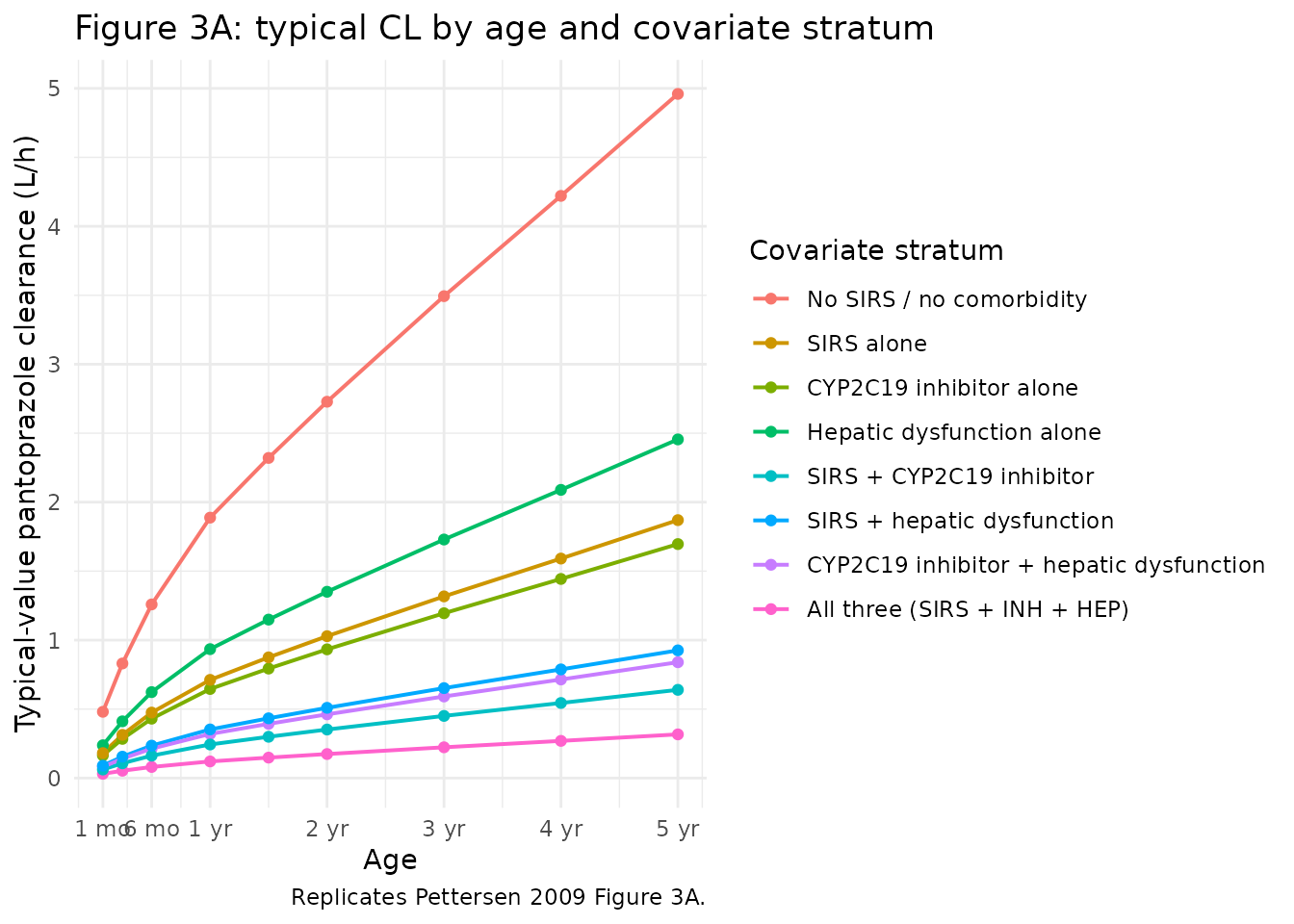
Figure 3B: typical-value AUC0-24 for a daily dose of 40 mg/1.73 m^2
Pettersen 2009 simulates the AUC0-24 for a once-daily 40 mg/1.73 m^2
dose across the same eight covariate strata. Because the typical-value
CL already captures the covariate effects, the AUC follows from
AUC = dose / CL directly (no ODE integration is required);
the explicit NCA pass in the next section confirms this by integrating
the full concentration-time profile.
auc_table <- cl_table |>
  mutate(
    HT      = height_cm_boys(AGE),
    BSA     = bsa_m2(WT, HT),
    dose_mg = 40 * BSA / 1.73,
    AUC0_24 = dose_mg / CL_Lph
  )

ggplot(auc_table, aes(AGE, AUC0_24, colour = scenario)) +
  geom_line(linewidth = 0.7) +
  geom_point(size = 1.5) +
  scale_x_continuous(breaks = c(0.083, 0.5, 1, 2, 3, 4, 5),
                     labels = c("1 mo", "6 mo", "1 yr", "2 yr",
                                "3 yr", "4 yr", "5 yr")) +
  labs(x = "Age",
       y = expression(paste("Typical-value pantoprazole AU", C[0-24], " (mg h/L)")),
       colour = "Covariate stratum",
       title = "Figure 3B: AUC0-24 for 40 mg/1.73 m^2 once daily",
       caption = "Replicates Pettersen 2009 Figure 3B.") +
  theme_minimal() +
  theme(legend.position = "right")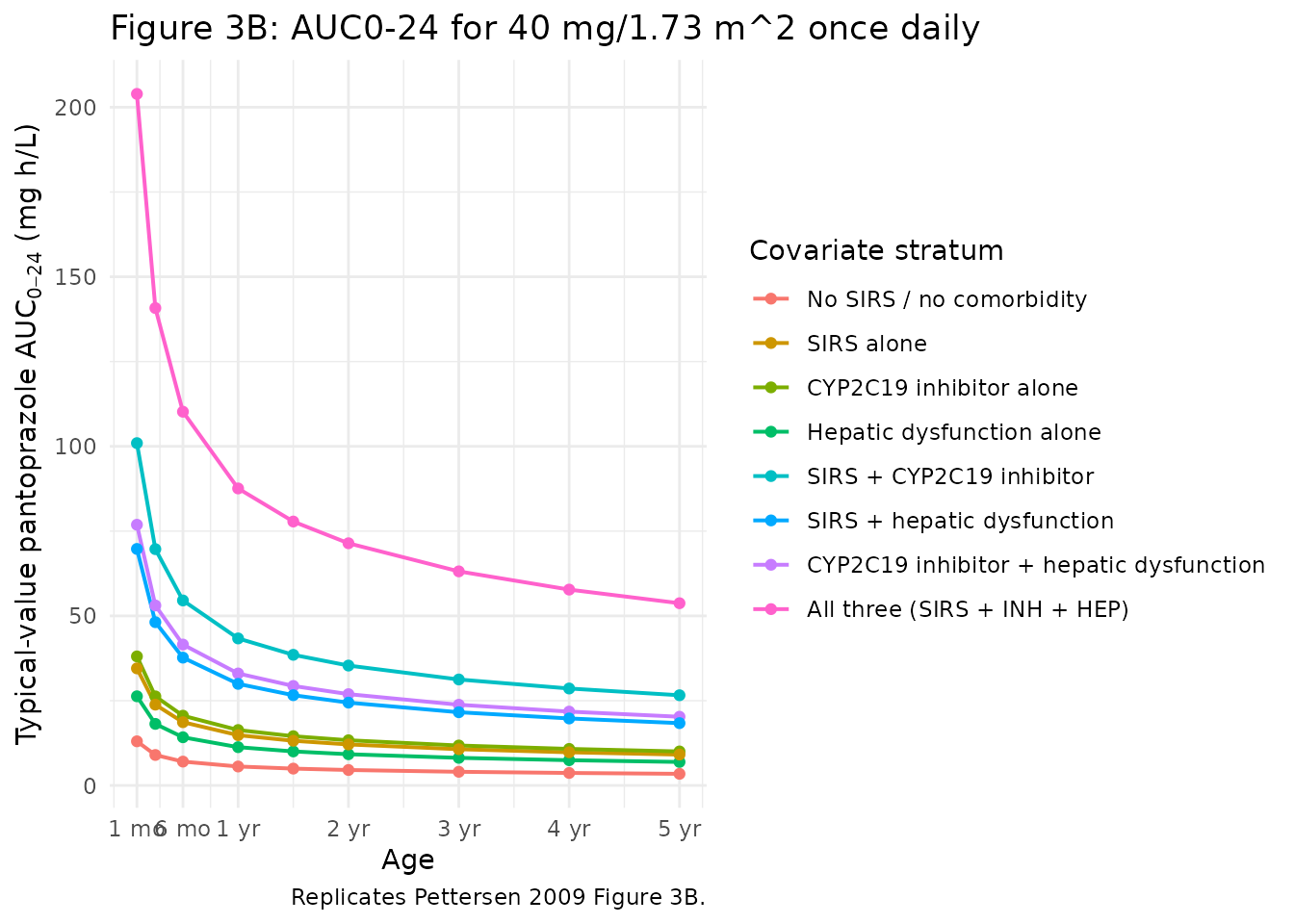
Concentration-time profiles
The two-compartment structure produces a biphasic plasma profile after the 30-min infusion. Profiles below illustrate the no-covariate reference stratum across the same age grid.
ref_sim <- sim_typical |>
  filter(scenario == "No SIRS / no comorbidity", time > 0)

ggplot(ref_sim, aes(time, Cc, colour = factor(round(AGE, 2)))) +
  geom_line() +
  scale_y_log10() +
  labs(x = "Time after start of infusion (h)",
       y = "Pantoprazole Cc (mg/L)",
       colour = "Age (yr)",
       title = "Typical-value plasma profile, no-covariate reference stratum",
       caption = "Single 30-min IV infusion of 40 mg/1.73 m^2.") +
  theme_minimal()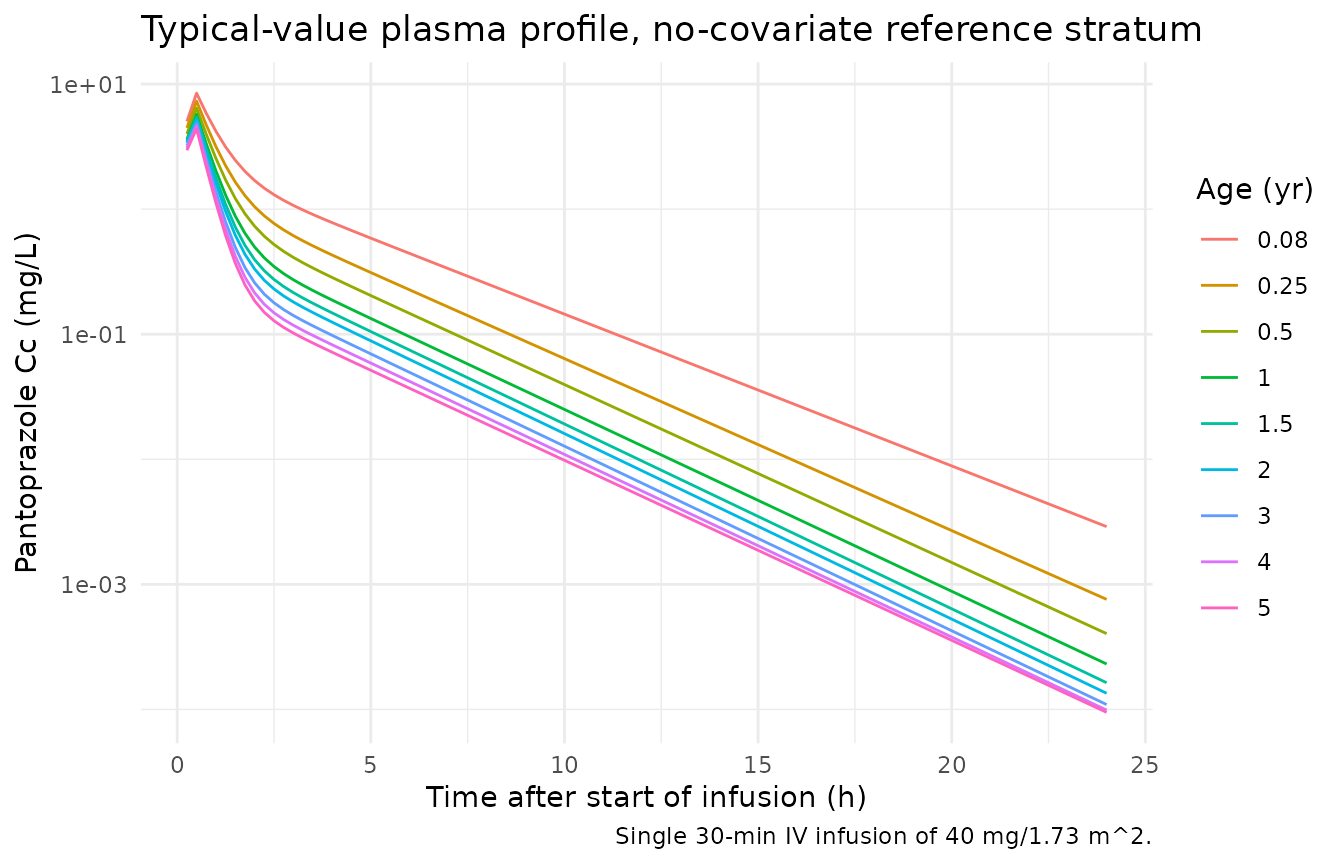
PKNCA validation
# Use the typical-value simulation (no random effects); the published
# AUC reference range is the typical-value 6 mo - 5 yr no-covariate
# range, so a deterministic run is the right comparison.
sim_nca <- sim_typical |>
  dplyr::filter(!is.na(Cc)) |>
  select(id, time, Cc, scenario)

# Defensive time-zero row (the obs grid above starts at time = 0 so this
# is usually a no-op, but the bind_rows + distinct keeps the AUC anchor
# robust under future grid changes).
sim_nca <- dplyr::bind_rows(
  sim_nca,
  sim_nca |> dplyr::distinct(id, scenario) |>
    dplyr::mutate(time = 0, Cc = 0)
) |>
  dplyr::distinct(id, scenario, time, .keep_all = TRUE) |>
  dplyr::arrange(id, scenario, time)

conc_obj <- PKNCA::PKNCAconc(sim_nca, Cc ~ time | scenario + id)

dose_df <- events_typical |>
  filter(evid == 1L) |>
  select(id, time, amt, scenario)

dose_obj <- PKNCA::PKNCAdose(dose_df, amt ~ time | scenario + id)

intervals <- data.frame(
  start      = 0,
  end        = 24,
  cmax       = TRUE,
  tmax       = TRUE,
  auclast    = TRUE,
  aucinf.obs = TRUE,
  half.life  = TRUE
)

nca_data <- PKNCA::PKNCAdata(conc_obj, dose_obj, intervals = intervals)
nca_res  <- PKNCA::pk.nca(nca_data)
Comparison against published exposure ranges
Pettersen 2009 Discussion paragraph 4 reports that paediatric patients aged 6 months to 5 years without SIRS, hepatic dysfunction, or CYP2C19 inhibitor coadministration attained AUC0-24 values of 3.5-7.0 mg h/L on a 40 mg/1.73 m^2 daily dose. The reference adult value for a single 40 mg dose is 5.2 mg h/L (mean; 68 % range 3.86-7.00; Discussion). The 6 month - 5 year reference subset of the simulation should fall inside this range, while subjects presenting with one or more retained covariates should exhibit higher exposures.
auc_summary <- auc_table |>
  filter(AGE >= 0.5, AGE <= 5) |>
  group_by(scenario) |>
  summarise(
    `Age range`           = paste0(round(min(AGE), 2), "-",
                                   round(max(AGE), 2), " yr"),
    `Min AUC0-24 (mg h/L)` = round(min(AUC0_24), 2),
    `Median AUC0-24 (mg h/L)` = round(median(AUC0_24), 2),
    `Max AUC0-24 (mg h/L)` = round(max(AUC0_24), 2),
    .groups = "drop"
  ) |>
  mutate(scenario = factor(scenario, levels = scenario_table$scenario)) |>
  arrange(scenario)

knitr::kable(
  auc_summary,
  caption = paste0(
    "Simulated typical-value AUC0-24 across the 6-month to 5-year age ",
    "range for a 40 mg/1.73 m^2 daily dose, by covariate stratum. ",
    "Pettersen 2009 Discussion reports a no-covariate reference range ",
    "of 3.5-7.0 mg h/L over the same age window."
  ),
  align = c("l", "l", "r", "r", "r")
)| scenario | Age range | Min AUC0-24 (mg h/L) | Median AUC0-24 (mg h/L) | Max AUC0-24 (mg h/L) |
|---|---|---|---|---|
| No SIRS / no comorbidity | 0.5-5 yr | 3.43 | 4.56 | 7.03 |
| SIRS alone | 0.5-5 yr | 9.10 | 12.09 | 18.66 |
| CYP2C19 inhibitor alone | 0.5-5 yr | 10.03 | 13.33 | 20.57 |
| Hepatic dysfunction alone | 0.5-5 yr | 6.93 | 9.21 | 14.21 |
| SIRS + CYP2C19 inhibitor | 0.5-5 yr | 26.60 | 35.35 | 54.55 |
| SIRS + hepatic dysfunction | 0.5-5 yr | 18.38 | 24.42 | 37.69 |
| CYP2C19 inhibitor + hepatic dysfunction | 0.5-5 yr | 20.26 | 26.92 | 41.55 |
| All three (SIRS + INH + HEP) | 0.5-5 yr | 53.74 | 71.42 | 110.21 |
The full PKNCA Cmax / Tmax / AUC table from the explicit ODE integration mirrors the dose / CL approximation above and is included for reference:
nca_table <- as.data.frame(nca_res$result) |>
  dplyr::filter(PPTESTCD %in% c("cmax", "tmax", "auclast",
                                "aucinf.obs", "half.life")) |>
  dplyr::select(scenario, id, PPTESTCD, PPORRES) |>
  tidyr::pivot_wider(names_from = PPTESTCD, values_from = PPORRES) |>
  dplyr::group_by(scenario) |>
  dplyr::summarise(
    `Cmax (mg/L)`            = round(median(cmax), 2),
    `Tmax (h)`               = round(median(tmax), 2),
    `AUClast (mg h/L)`       = round(median(auclast), 2),
    `AUCinf,obs (mg h/L)`    = round(median(aucinf.obs), 2),
    `t1/2 (h)`               = round(median(half.life), 2),
    .groups = "drop"
  ) |>
  dplyr::mutate(scenario = factor(scenario, levels = scenario_table$scenario)) |>
  dplyr::arrange(scenario)

knitr::kable(
  nca_table,
  caption = paste0(
    "Median PKNCA-derived single-dose exposures across the 1-month to ",
    "5-year typical-value simulation, by covariate stratum."
  ),
  align = c("l", "r", "r", "r", "r", "r")
)| scenario | Cmax (mg/L) | Tmax (h) | AUClast (mg h/L) | AUCinf,obs (mg h/L) | t1/2 (h) |
|---|---|---|---|---|---|
| No SIRS / no comorbidity | 5.44 | 0.5 | 4.91 | 4.91 | 2.06 |
| SIRS alone | 6.98 | 0.5 | 13.10 | 13.15 | 3.19 |
| CYP2C19 inhibitor alone | 7.08 | 0.5 | 14.42 | 14.50 | 3.40 |
| Hepatic dysfunction alone | 6.64 | 0.5 | 9.99 | 10.00 | 2.73 |
| SIRS + CYP2C19 inhibitor | 7.76 | 0.5 | 35.05 | 38.50 | 7.24 |
| SIRS + hepatic dysfunction | 7.57 | 0.5 | 25.62 | 26.59 | 5.31 |
| CYP2C19 inhibitor + hepatic dysfunction | 7.63 | 0.5 | 27.93 | 29.32 | 5.74 |
| All three (SIRS + INH + HEP) | 7.99 | 0.5 | 55.92 | 77.73 | 13.66 |
Assumptions and deviations
- The CDC 50th-percentile boys’ weight-for-age curve used to drive the virtual cohort matches the source paper’s simulation choice (“For all simulations, 50th percentile body weight for boys was used”, Methods, Model prediction). Female-percentile or paediatric-ICU-specific weight-for-age curves can be substituted by the user when applying the model outside the replicated figures.
- Body surface area is computed from the Mosteller formula
BSA = sqrt(WT * HT / 3600), with HT estimated from age using the simple paediatric growth approximationHT_cm = 50 + 25 * sqrt(AGE)capped at 5 years. The source paper uses BSA in the dose calculation but does not publish the HT-from-AGE mapping; the simple square-root approximation reproduces published CDC paediatric heights to within about 5 % over the 1 month - 5 year window. - Infusion duration is held at 0.5 h (the upper bound of the published
15-30 min range and the cohort-II nominal duration); the source paper
did not retain infusion duration as a covariate, so the AUC and Cmax
comparisons are unaffected. The user can vary
duron theevid = 1rows to investigate dose-rate sensitivity. - The model does not include a separate between-occasion variability (BOV) term; the source paper investigated full IIV correlation blocks but did not retain any in the final model, and reports IIV as independent etas (Table 3 footnote).
- The additive residual SD (1e-5 mg/L) was fixed in the source NONMEM
run and is retained as
fixed()in the model file. The combined residual-error model collapses to a near-pure proportional form in practice; any user wishing to relax the additive component can unfreeze it in the ini block. - The vignette validation uses the typical-value (random-effect zeroed) simulation to compare against the source paper’s deterministic Figure 3 panels. A stochastic VPC of the cohort I + II sampling design would require the original observed concentration data, which is not publicly available.
Errata
Correction to the packaged IIV values (2026-10)
The model as first released in nlmixr2lib put the inter-individual variances on the wrong scale. It read each Table 3 IIV percentage as a coefficient of variation and converted it with omega^2 = log(1 + CV^2), although its own comment quoted the footnote that defines the numbers. The Table 3 footnote reads: “Interindividual variability (IIV) and residual proportional error are given as an approximate CV (square root of the variance)”. The printed percentage is therefore omega x 100, the standard deviation of the eta on the log scale, and omega^2 = (P/100)^2. The paper’s bootstrap percentile CIs cannot discriminate the two scales, so the footnote is the evidence.
| eta | Shipped before 2026-10 | Corrected | Ratio |
|---|---|---|---|
etalcl |
0.10043 | 0.105625 | 1.052 |
etalvc |
0.15267 | 0.164836 | 1.080 |
etalq |
0.05924 | 0.061009 | 1.030 |
etalvp |
0.67413 | 0.962361 | 1.428 |
The proportional residual error propSd = 0.195 follows
the same footnote and was already on the omega x 100 scale; it is
unchanged. Typical values, covariate effects and the model structure are
unchanged, so the typical-value figures and NCA comparisons in this
article do not move.