Durvalumab (Ogasawara 2020)
Source:vignettes/articles/Ogasawara_2020_durvalumab.Rmd
Ogasawara_2020_durvalumab.Rmd
library(nlmixr2lib)
library(rxode2)
#> rxode2 5.1.8 using 2 threads (see ?getRxThreads)
#>   no cache: create with `rxCreateCache()`
library(dplyr)
#>
#> Attaching package: 'dplyr'
#> The following objects are masked from 'package:stats':
#>
#>     filter, lag
#> The following objects are masked from 'package:base':
#>
#>     intersect, setdiff, setequal, union
library(tidyr)
library(ggplot2)
library(PKNCA)
#>
#> Attaching package: 'PKNCA'
#> The following object is masked from 'package:stats':
#>
#>     filter
Model and source
- Citation: Ogasawara K, Newhall K, Maxwell SE, Dell’Aringa J, Komashko V, Kilavuz N, Delarue R, Czuczman M, Sternas L, Rose S, Beach CL, Novick S, Zhou S, Palmisano M, Li Y. Population Pharmacokinetics of an Anti-PD-L1 Antibody, Durvalumab in Patients with Hematologic Malignancies. Clin Pharmacokinet. 2020;59(2):217-227. doi:10.1007/s40262-019-00804-x.
- Description: Two compartment PK model of durvalumab (anti-PD-L1) in patients with hematologic malignancies (Ogasawara 2020)
- Article: https://doi.org/10.1007/s40262-019-00804-x
Durvalumab population PK simulation
Simulate durvalumab concentration-time profiles using the final population PK model from Ogasawara et al. (2020) in patients with hematologic malignancies (MDS/AML and multiple myeloma, N = 267).
Durvalumab is a human IgG1 kappa anti-PD-L1 checkpoint inhibitor. The model is a 2-compartment IV model with linear elimination and extensive covariate effects (11 covariate-parameter relationships). Anti-drug antibodies (ADA) were NOT examined as a covariate in this analysis.
Note: Time units are hours (matching the original publication).
Source: Table 3 of Ogasawara et al. (2020) Clin Pharmacokinet. 59(2):217-227. doi:10.1007/s40262-019-00804-x. Parameters and equations verified against PMC7007418 (Table 3 footnotes b and c).
Virtual population
set.seed(2020)
n_subj <- 200  # downsampled from 500 for vignette build budget; VPC band shape preserved

pop <- data.frame(
  ID     = seq_len(n_subj),
  WT     = rlnorm(n_subj, log(74.7), 0.25),  # Median 74.7 kg (Table 2)
  ALB    = rnorm(n_subj, 40, 5),              # Median 40 g/L (Table 2)
  IGG    = rlnorm(n_subj, log(7.6), 0.35),   # Median 7.6 g/L (Table 2)
  SPDL1  = rlnorm(n_subj, log(173.8), 0.8),  # Median 173.8 pg/mL (Table 2)
  LDH    = rlnorm(n_subj, log(216), 0.4),    # Median 216 U/L (Table 2)
  SEXF   = rbinom(n_subj, 1, 0.352),          # 35.2% female (Table 2)
  DIS_MDS_AML = rbinom(n_subj, 1, 0.37),           # 37% MDS/AML (Table 2)
  DIS_MM = 0
)
pop$ALB <- pmax(20, pmin(pop$ALB, 55))
# MM is complement of DIS_MDS_AML (simplified: NHL excluded)
pop$DIS_MM <- ifelse(pop$DIS_MDS_AML == 0, rbinom(n_subj, 1, 0.73), 0)
Dosing dataset
Simulate durvalumab 1500 mg IV every 4 weeks (q4w) for 24 weeks. Infusion over 1 hour.
dose_weeks <- seq(0, 20, by = 4)
dose_times_h <- dose_weeks * 7 * 24  # weeks to hours

obs_times_h <- sort(unique(c(
  seq(0, 48, by = 4),                            # Dense first 2 days
  seq(48, max(dose_times_h) + 28 * 24, by = 24)  # Daily to end
)))

d_dose <- pop %>%
  crossing(TIME = dose_times_h) %>%
  mutate(AMT = 1500, EVID = 1, CMT = 1, DUR = 1, DV = NA_real_)

d_obs <- pop %>%
  crossing(TIME = obs_times_h) %>%
  mutate(AMT = NA_real_, EVID = 0, CMT = 1, DUR = NA_real_, DV = NA_real_)

d_sim <- bind_rows(d_dose, d_obs) %>%
  arrange(ID, TIME, desc(EVID)) %>%
  as.data.frame()
Simulate
mod <- readModelDb("Ogasawara_2020_durvalumab")
conc_unit <- rxode2::rxode(mod)$units[["concentration"]]
#> ℹ parameter labels from comments will be replaced by 'label()'
sim <- rxSolve(mod, d_sim, returnType = "data.frame")
#> ℹ parameter labels from comments will be replaced by 'label()'
Concentration-time profiles
sim_summary <- sim %>%
  filter(time > 0) %>%
  group_by(time) %>%
  summarise(
    median = median(Cc, na.rm = TRUE),
    lo     = quantile(Cc, 0.05, na.rm = TRUE),
    hi     = quantile(Cc, 0.95, na.rm = TRUE),
    .groups = "drop"
  )

ggplot(sim_summary, aes(x = time / (24 * 7))) +
  geom_ribbon(aes(ymin = lo, ymax = hi), alpha = 0.2, fill = "purple4") +
  geom_line(aes(y = median), color = "purple4", linewidth = 1) +
  labs(
    x = "Time (weeks)",
    y = paste0("Durvalumab concentration (", conc_unit, ")"),
    title = "Simulated durvalumab PK (1500 mg IV q4w)",
    subtitle = "Median and 90% PI (N = 200 virtual hematologic malignancy patients)",
    caption = "Model: Ogasawara et al. (2020) Clin Pharmacokinet"
  ) +
  theme_bw()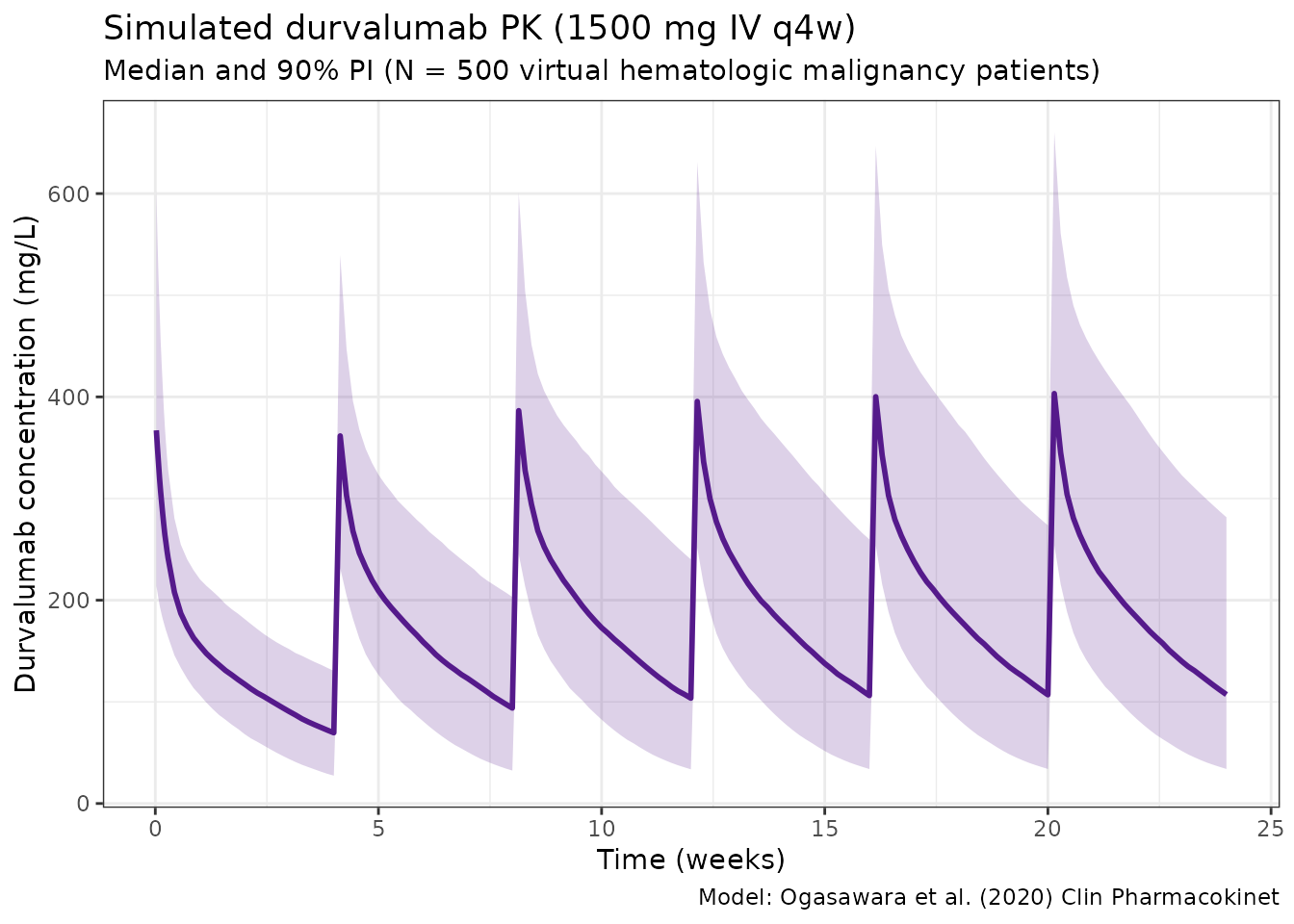
PK by disease type
# The rxSolve output carries covariates through, so DIS_MDS_AML is already in sim
sim_df_disease <- as.data.frame(sim)
sim_df_disease <- sim_df_disease[sim_df_disease$time > 0, ]
sim_df_disease$Disease <- ifelse(sim_df_disease$DIS_MDS_AML == 1, "MDS/AML", "Other")

sim_disease_summary <- sim_df_disease %>%
  group_by(time, Disease) %>%
  summarise(median = median(Cc, na.rm = TRUE), .groups = "drop")

ggplot(sim_disease_summary, aes(x = time / (24 * 7), y = median, color = Disease)) +
  geom_line(linewidth = 1) +
  scale_color_manual(values = c("MDS/AML" = "firebrick", "Other" = "navy")) +
  labs(
    x = "Time (weeks)",
    y = paste0("Durvalumab concentration (", conc_unit, ")"),
    title = "Durvalumab median concentrations by disease type",
    subtitle = "MDS/AML patients have 26% higher CL and lower exposures",
    caption = "Model: Ogasawara et al. (2020)"
  ) +
  theme_bw()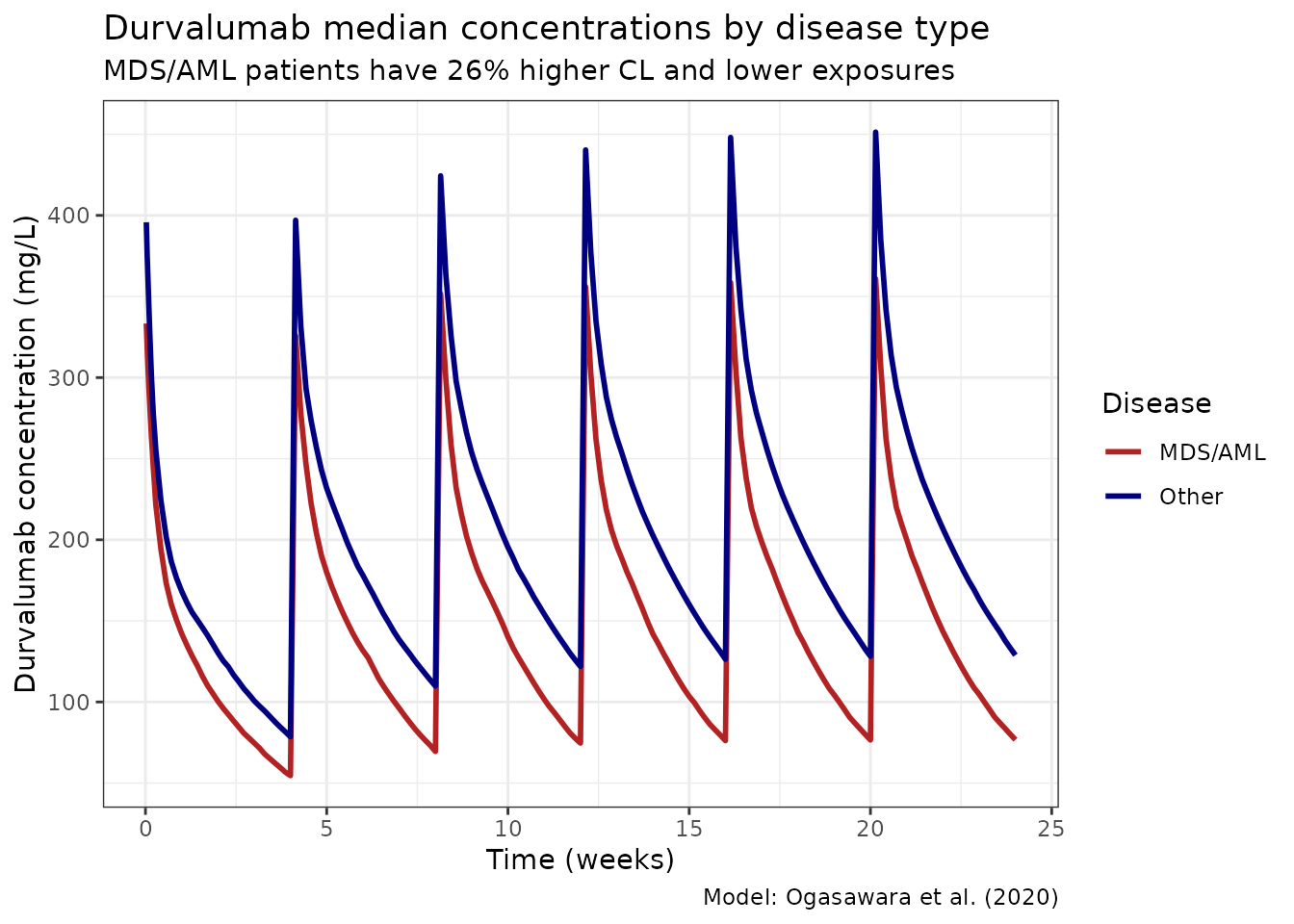
NCA analysis
# Use 3rd dosing interval (weeks 8-12 = hours 1344-2016)
sim_df <- as.data.frame(sim)
# Build unique subject key from sim.id and id
if (all(c("sim.id", "id") %in% names(sim_df))) {
  sim_df$subject <- paste(sim_df$sim.id, sim_df$id, sep = "_")
} else if ("id" %in% names(sim_df)) {
  sim_df$subject <- sim_df$id
} else {
  sim_df$subject <- sim_df$sim.id
}
sim_df$Disease <- ifelse(sim_df$DIS_MDS_AML == 1, "MDS/AML", "Other")
nca_data <- data.frame(
  subject  = sim_df$subject,
  Disease  = sim_df$Disease,
  time_rel = (sim_df$time - 1344) / 24,  # Convert to days relative to dose 3
  Cc       = sim_df$Cc
)
nca_data <- nca_data[nca_data$time_rel >= 0 & nca_data$time_rel <= 28 & nca_data$Cc > 0, ]

conc_obj <- PKNCAconc(nca_data, Cc ~ time_rel | Disease + subject)
dose_obj <- PKNCAdose(
  data.frame(subject = unique(nca_data$subject),
             Disease = nca_data$Disease[match(unique(nca_data$subject), nca_data$subject)],
             time_rel = 0, AMT = 1500),
  AMT ~ time_rel | Disease + subject
)
data_obj <- PKNCAdata(conc_obj, dose_obj,
                       intervals = data.frame(start = 0, end = 28,
                                              cmax = TRUE, tmax = TRUE,
                                              auclast = TRUE, half.life = TRUE))
nca_results <- pk.nca(data_obj)
nca_summary <- summary(nca_results)
knitr::kable(nca_summary, digits = 2,
caption = "NCA summary (3rd dosing interval, weeks 8-12)")| start | end | Disease | N | auclast | cmax | tmax | half.life |
|---|---|---|---|---|---|---|---|
| 0 | 28 | MDS/AML | 79 | 4400 [38.1] | 346 [28.1] | 1.00 [1.00, 1.00] | 17.3 [6.23] |
| 0 | 28 | Other | 121 | 5510 [38.6] | 408 [25.5] | 1.00 [1.00, 1.00] | 20.6 [8.30] |
Notes
- Model: 2-compartment IV with linear elimination. No TMDD.
- 11 covariate effects including soluble PD-L1 (the drug’s target) on CL.
- Log-additive residual error (concentrations log-transformed prior to modeling).
- Time in hours — unlike most mAb models that use days.
- ADA not examined as a covariate in this analysis.
- Reference values are Table 2 medians: ALB 40 g/L, IgG 7.61 g/L, sPD-L1 173.8 pg/mL, LDH 216 U/L, WT 74.7 kg.
- Albumin, IgG, sPD-L1, LDH were time-varying covariates in the model.
- MDS/AML effect: 26% higher CL (clinically meaningful).