Propofol (Ngamprasertwong 2016) -- maternal-fetal sheep
Source:vignettes/articles/Ngamprasertwong_2016_propofol_sheep.Rmd
Ngamprasertwong_2016_propofol_sheep.RmdModel and source
- Citation: Ngamprasertwong P, Dong M, Niu J, Venkatasubramanian R, Vinks AA, Sadhasivam S. Propofol pharmacokinetics and estimation of fetal propofol exposure during mid-gestational fetal surgery: a maternal-fetal sheep model. PLoS ONE 2016;11(1):e0146563. doi:10.1371/journal.pone.0146563.
- Description: Preclinical (sheep). Maternal-fetal population PK model of propofol in mid-gestational pregnant Dorset ewes (Ngamprasertwong 2016; N = 8 ewe-fetus pairs at 110-125 days gestation; term ~147-150 days). Two-compartment maternal disposition (central + peripheral1) linked to a single fetal compartment via a reversible inter-compartmental clearance QM-F; fetal clearance was tested but estimated near zero (<0.001 L/min, RSE >100%) and set to zero in the final model. Maternal clearance scales with heart rate via the normalised power model CL = theta1 * (HR/158)^theta2; no other covariate (gestational age, body weight, blood pressure, uterine blood flow) reached statistical significance. Inter-individual variability was estimated on CL and QM-F; IIV on Vc, Q, Vp, and VFetus was fixed to zero in the source and is omitted here. Residual error is purely proportional, with separate variances for maternal-ewe and fetal observations.
- Article (open access): doi:10.1371/journal.pone.0146563
- Data: doi:10.5281/zenodo.35672 – per-animal propofol concentration data deposited by the authors.
Population
Ngamprasertwong 2016 developed the propofol popPK model from 8 singleton pregnant Dorset ewes at 110-125 days gestation (term ~147-150 days, i.e. mid-gestation), used as a maternal-fetal model for open fetal surgery. Ewes were instrumented with maternal femoral arterial / venous catheters, fetal femoral arterial / venous catheters, an umbilical-artery flow probe, and bilateral uterine-artery flow probes; instrumentation methods are described in detail in the paper’s Methods (Instrumentation) and in the prior reference [2]. After a recovery of at least 4 days, the PK study was conducted under general anesthesia with propofol, remifentanil and desflurane. Mean body weight at the PK study was 71.6 kg (range 60-82 kg, median 72.5 kg); mean gestational age was 115.8 days (range 111-118 days, median 116.5 days).
The full population summary is available programmatically via
rxode2::rxode(readModelDb("Ngamprasertwong_2016_propofol_sheep"))$population.
Source trace
The per-parameter origin is recorded as an in-file comment next to
each ini() entry in
inst/modeldb/specificDrugs/Ngamprasertwong_2016_propofol_sheep.R.
The table below collects them in one place.
| Equation / parameter | Value | Source location |
|---|---|---|
lcl (theta1, CL at HR=158) |
4.17 L/min | Table 2 |
lvc (Vc) |
37.7 L | Table 2 |
lq (Q) |
1.22 L/min | Table 2 |
lvp (Vp) |
60.8 L | Table 2 |
lqmf (QM-F) |
0.0138 L/min | Table 2 |
lvfetus (VFetus) |
0.144 L | Table 2 + Fig 3 caption |
e_hr_cl (theta2) |
0.764 | Table 2 |
etalcl (omega1, CL IIV) |
21.8 %CV | Table 2 |
etalqmf (omega5, QM-F IIV) |
66.5 %CV | Table 2 |
propSd (sigma ewe) |
26.0 %CV | Table 2 |
propSd_Cfetus (sigma fetus) |
21.8 %CV | Table 2 |
CL = theta1 * (HR/158)^theta2 |
n/a | Table 2 (equation row) |
| Two maternal compartments + one fetal compartment, dosing into maternal central | n/a | Results page 4 + Fig 3 caption |
| Reversible inter-compartmental clearance between maternal central and fetus via QM-F; fetal clearance set to zero | n/a | Results page 4 (paragraph beginning “The maternal propofol plasma concentrations were best fitted”) |
| Combined proportional + additive residual error tested; final model uses proportional only with separate maternal-ewe and fetal variances | n/a | Methods Eq (2) + Table 2 |
| IIVs on Vc, Q, Vp, VFetus are 0 FIX in the source | n/a | Table 2 (rows omega2^2, omega3^2, omega4^2, omega6^2) |
Virtual cohort
The validation virtual cohort matches the cohort-mean ewe in
Ngamprasertwong 2016 Methods: body weight 71.6 kg, median heart rate 135
beats/min (the typical-subject median reported in the Results
narrative). Note that the Table 2 covariate equation
CL = theta1 * (HR/158)^theta2 normalises to HR = 158
beats/min, so the typical CL at HR = 135 in this model is
4.17 * (135/158)^0.764 = 3.69 L/min.
set.seed(2016L)

WT  <- 71.6   # cohort-mean ewe body weight, kg
HR0 <- 135    # cohort-median ewe heart rate, beats/min (Methods)

# Dosing protocol (Ngamprasertwong 2016 Methods / Anesthetic Regimen):
#   Induction:        propofol 3 mg/kg IV bolus.
#   Anesthesia phase 1 (0-60 min):  propofol 450 ug/kg/min IV infusion.
#   Anesthesia phase 2 (60-150 min): propofol  75 ug/kg/min IV infusion.
#   Stop infusion at 150 min; final sample at 180 min.
bolus_mg     <- 3 * WT                       # mg
inf1_rate_mg <- 450 * WT / 1000              # mg/min (450 ug/kg/min * WT kg)
inf1_amt_mg  <- inf1_rate_mg * 60            # mg total over 0-60 min
inf2_rate_mg <-  75 * WT / 1000              # mg/min
inf2_amt_mg  <- inf2_rate_mg * 90            # mg total over 60-150 min

obs_times <- c(0, 5, 15, 25, 60, 75, 100, 110, 150, 180)

# Observe at the ODE state `central` with dvid = 1L. The model body has
# two algebraic observables (Cc from central, Cfetus from the fetus
# state) in residual tildes; rxUi auto-injects compartment slots for
# them after the ODE-state slots, so `cmt = "Cc"` would target an
# injected slot rather than an ODE state. rxSolve still returns both Cc
# and Cfetus as columns on every observation row.
events <- dplyr::bind_rows(
  data.frame(id = 1L, time = 0L,  evid = 1L, amt = bolus_mg,    rate = 0,
             cmt  = "central", HR = HR0, dvid = NA_integer_),
  data.frame(id = 1L, time = 0L,  evid = 1L, amt = inf1_amt_mg, rate = inf1_rate_mg,
             cmt  = "central", HR = HR0, dvid = NA_integer_),
  data.frame(id = 1L, time = 60L, evid = 1L, amt = inf2_amt_mg, rate = inf2_rate_mg,
             cmt  = "central", HR = HR0, dvid = NA_integer_),
  data.frame(id = 1L, time = obs_times, evid = 0L, amt = 0, rate = 0,
             cmt = "central", HR = HR0, dvid = 1L)
) |>
  dplyr::arrange(id, time, dplyr::desc(evid))
Simulation
# NOTE: solve `$simulationModel` rather than the rxUi object. This model has TWO
# endpoints whose observables read from different ODE states; on the rxUi solve
# path the second endpoint's state is misclassified as an input parameter and
# rxSolve aborts with "parameter(s) are required for solving: <state>". The
# simulation model resolves the states correctly and returns both observables.
mod <- readModelDb("Ngamprasertwong_2016_propofol_sheep") |> rxode2::rxode()
#> ℹ parameter labels from comments will be replaced by 'label()'

# Typical-subject simulation: zero out random effects to reproduce the
# cohort-mean concentration time course shown in Table 1 / Fig 2.
mod_typ <- rxode2::zeroRe(mod)
sim_typ <- rxode2::rxSolve(mod_typ$simulationModel, events = events, keep = "HR") |>
  as.data.frame()
#> ℹ omega/sigma items treated as zero: 'etalcl', 'etalqmf'
Comparison against published mean concentrations (Table 1)
paper_table1 <- tibble::tibble(
  time         = c(5, 15, 25, 60, 75, 100, 110, 150, 180),
  Cc_paper     = c(5.43, 6.82, 8.71, 9.18, 4.47, 3.33, 3.05, 2.42, 0.70),
  Cc_paper_sd  = c(2.06, 2.57, 1.60, 3.25, 1.95, 1.75, 1.56, 0.93, 0.41),
  Cfetus_paper = c(0.35, 0.68, 0.95, 1.31, 0.81, 0.48, 0.40, 0.36, 0.20),
  Cfetus_paper_sd = c(0.21, 0.31, 0.41, 0.51, 0.25, 0.12, 0.15, 0.15, 0.06)
)

sim_at_sampling <- sim_typ |>
  dplyr::filter(time %in% paper_table1$time) |>
  dplyr::select(time, Cc_sim = Cc, Cfetus_sim = Cfetus)

comparison <- paper_table1 |>
  dplyr::left_join(sim_at_sampling, by = "time") |>
  dplyr::mutate(
    FM_paper = round(Cfetus_paper / Cc_paper, 3),
    FM_sim   = round(Cfetus_sim   / Cc_sim,   3)
  ) |>
  dplyr::select(time, Cc_paper, Cc_sim, Cfetus_paper, Cfetus_sim,
                FM_paper, FM_sim)

knitr::kable(
  comparison,
  digits  = 3,
  caption = paste(
    "Typical-subject simulation vs Ngamprasertwong 2016 Table 1.",
    "Concentrations in ug/mL (= mg/L). F/M is the fetal-to-maternal ratio."
  )
)| time | Cc_paper | Cc_sim | Cfetus_paper | Cfetus_sim | FM_paper | FM_sim |
|---|---|---|---|---|---|---|
| 5 | 5.43 | 6.138 | 0.35 | 2.266 | 0.064 | 0.369 |
| 15 | 6.82 | 6.655 | 0.68 | 4.853 | 0.100 | 0.729 |
| 25 | 8.71 | 6.978 | 0.95 | 6.085 | 0.109 | 0.872 |
| 60 | 9.18 | 7.680 | 1.31 | 7.474 | 0.143 | 0.973 |
| 75 | 4.47 | 3.100 | 0.81 | 4.990 | 0.181 | 1.610 |
| 100 | 3.33 | 2.168 | 0.48 | 2.575 | 0.144 | 1.188 |
| 110 | 3.05 | 2.058 | 0.40 | 2.284 | 0.131 | 1.109 |
| 150 | 2.42 | 1.789 | 0.36 | 1.851 | 0.149 | 1.035 |
| 180 | 0.70 | 0.529 | 0.20 | 0.750 | 0.286 | 1.416 |
Replicate Figure 2 – maternal and fetal concentration time profiles
sim_long <- sim_typ |>
  dplyr::select(time, Cc, Cfetus) |>
  tidyr::pivot_longer(c(Cc, Cfetus),
                      names_to  = "compartment",
                      values_to = "conc")

paper_long <- paper_table1 |>
  tidyr::pivot_longer(
    cols      = c(Cc_paper, Cfetus_paper),
    names_to  = "compartment",
    values_to = "conc"
  ) |>
  dplyr::mutate(
    compartment = dplyr::recode(compartment,
                                Cc_paper = "Cc",
                                Cfetus_paper = "Cfetus")
  )

ggplot() +
  geom_line(data = sim_long, aes(time, conc, colour = compartment), linewidth = 0.8) +
  geom_point(data = paper_long, aes(time, conc, colour = compartment), shape = 21,
             fill = "white", size = 2) +
  scale_colour_manual(values = c(Cc = "#1f77b4", Cfetus = "#d62728")) +
  scale_y_continuous() +
  labs(
    x = "Time (min)", y = "Propofol concentration (ug/mL)",
    colour = "Compartment",
    title  = "Maternal and fetal propofol time profiles",
    subtitle = "Lines: typical-subject simulation. Points: Ngamprasertwong 2016 Table 1 means.",
    caption  = "Replicates Figure 2 of Ngamprasertwong 2016."
  ) +
  theme_minimal()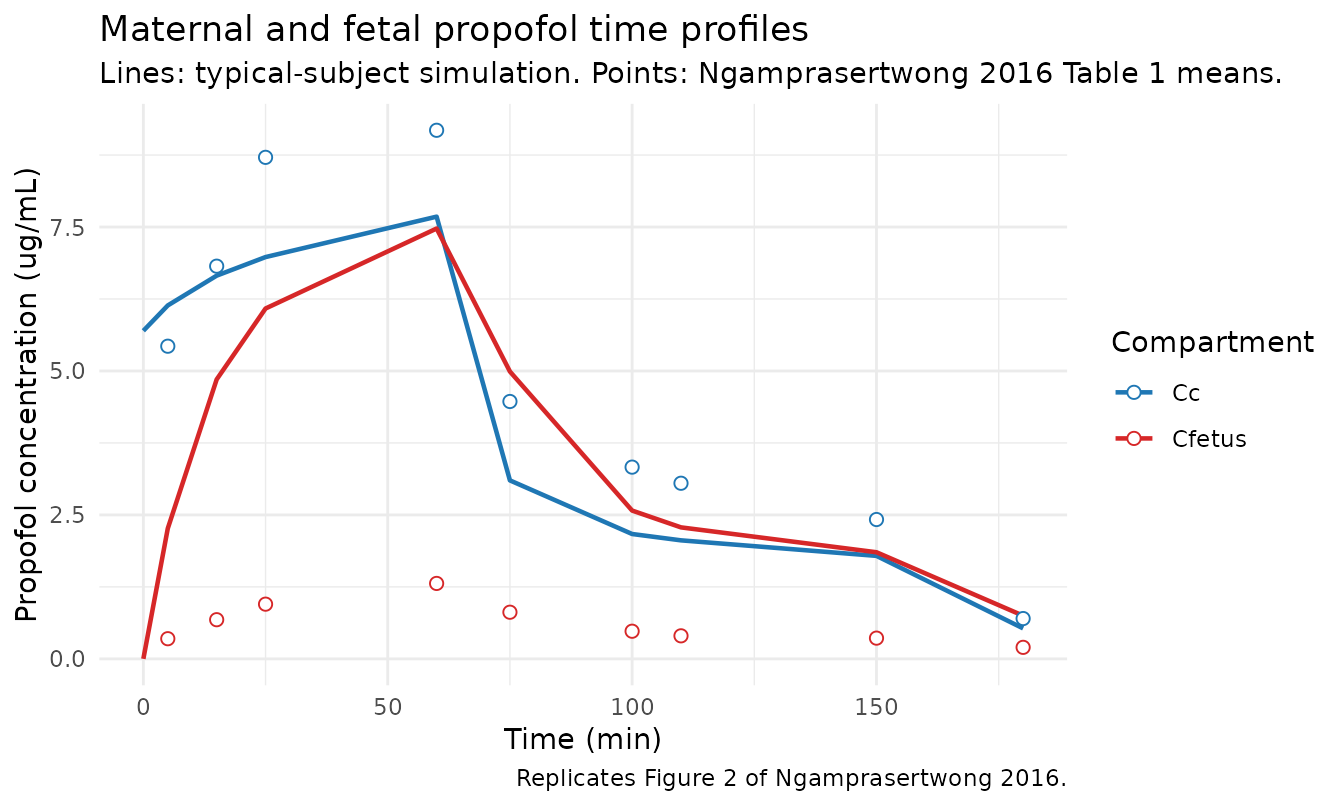
PKNCA validation – maternal Cc and fetal Cfetus
The source paper does not tabulate Cmax / Tmax / AUC NCA for the maternal or fetal observations, so the table below is a forward simulated NCA – not a side-by-side comparison against published NCA values.
# Simulate a stochastic cohort for the NCA. Use 50 virtual ewes at the
# cohort-mean weight and heart rate to keep the vignette's render
# time under 5 minutes.
set.seed(295L)
n_sim <- 50L
events_cohort <- purrr::map_dfr(seq_len(n_sim), function(i) {
  data.frame(id = i, time = 0L,  evid = 1L, amt = bolus_mg,    rate = 0,
             cmt = "central", HR = HR0, treatment = "ewe", dvid = NA_integer_) |>
    dplyr::bind_rows(
      data.frame(id = i, time = 0L,  evid = 1L, amt = inf1_amt_mg, rate = inf1_rate_mg,
                 cmt = "central", HR = HR0, treatment = "ewe", dvid = NA_integer_),
      data.frame(id = i, time = 60L, evid = 1L, amt = inf2_amt_mg, rate = inf2_rate_mg,
                 cmt = "central", HR = HR0, treatment = "ewe", dvid = NA_integer_),
      data.frame(id = i, time = c(0, seq(2, 180, by = 2)), evid = 0L, amt = 0, rate = 0,
                 cmt = "central", HR = HR0, treatment = "ewe", dvid = 1L)
    )
}) |>
  dplyr::arrange(id, time, dplyr::desc(evid))

sim_cohort <- rxode2::rxSolve(mod$simulationModel, events = events_cohort,
                              keep = c("HR", "treatment")) |>
  as.data.frame()

# Maternal Cc NCA: AUClast over 0-180 min (the observation window) plus
# Cmax and Tmax. PKNCA needs one row per observation.
maternal_nca <- sim_cohort |>
  dplyr::filter(!is.na(Cc)) |>
  dplyr::select(id, time, Cc, treatment)

dose_df <- events_cohort |>
  dplyr::filter(evid == 1L, time == 0, rate == 0) |>
  dplyr::select(id, time, amt, treatment)

maternal_conc_obj <- PKNCA::PKNCAconc(maternal_nca, Cc ~ time | treatment + id,
                                      concu = "ug/mL", timeu = "min")
dose_obj <- PKNCA::PKNCAdose(dose_df, amt ~ time | treatment + id,
                             doseu = "mg")

intervals <- data.frame(
  start    = 0,
  end      = max(maternal_nca$time),
  cmax     = TRUE,
  tmax     = TRUE,
  auclast  = TRUE,
  clast.obs = TRUE
)

maternal_res <- PKNCA::pk.nca(
  PKNCA::PKNCAdata(maternal_conc_obj, dose_obj, intervals = intervals)
)
maternal_summary <- summary(maternal_res)
knitr::kable(maternal_summary,
caption = "Simulated NCA on maternal Cc (50 typical-subject ewes, HR = 135).")| Interval Start | Interval End | treatment | N | AUClast (min*ug/mL) | Cmax (ug/mL) | Tmax (min) | Clast (ug/mL) |
|---|---|---|---|---|---|---|---|
| 0 | 180 | ewe | 50 | 705 [21.1] | 7.97 [18.5] | 60.0 [0.000, 60.0] | 0.581 [49.7] |
# Fetal Cfetus NCA: same intervals, separate concentration formula.
fetal_nca <- sim_cohort |>
  dplyr::filter(!is.na(Cfetus)) |>
  dplyr::select(id, time, Cfetus, treatment)

fetal_conc_obj <- PKNCA::PKNCAconc(fetal_nca, Cfetus ~ time | treatment + id,
                                   concu = "ug/mL", timeu = "min")
fetal_res <- PKNCA::pk.nca(
  PKNCA::PKNCAdata(fetal_conc_obj, dose_obj, intervals = intervals)
)
fetal_summary <- summary(fetal_res)
knitr::kable(fetal_summary,
caption = "Simulated NCA on fetal Cfetus (50 typical-subject ewes, HR = 135).")| Interval Start | Interval End | treatment | N | AUClast (min*ug/mL) | Cmax (ug/mL) | Tmax (min) | Clast (ug/mL) |
|---|---|---|---|---|---|---|---|
| 0 | 180 | ewe | 50 | 692 [21.2] | 7.58 [19.6] | 60.0 [60.0, 62.0] | 0.861 [43.9] |
Assumptions and deviations
Reference heart rate. Ngamprasertwong 2016 Table 2 normalises the CL-vs-HR covariate equation to HR = 158 beats/min (
CL = theta1 * (HR/158)^theta2), whereas the Results narrative describes the typical ewe as having a median heart rate of 135 beats/min (mean body weight 71.6 kg, typical CL reported as 4.17 L/min). The Table 2 equation is the authoritative form for the model; the typical CL at HR = 135 in this model is therefore4.17 * (135/158)^0.764 = 3.69L/min, slightly lower than the 4.17 L/min quoted in the Results narrative. This is a paper-internal inconsistency between the Table 2 equation reference (158 beats/min) and the typical-subject median reported in the text (135 beats/min); the modelled value used here follows the Table 2 equation.Residual error. Methods Eq (2) describes a combined proportional + additive residual error model; Table 2 reports only the proportional components for the final model fit, so the model file encodes proportional-only residual error per Table 2 (this is the standard pattern for popPK papers that test combined error and retain only the significant component in the final model).
Fixed IIVs. Inter-individual variability on Vc, Q, Vp, and VFetus is reported as 0 FIX in Ngamprasertwong 2016 Table 2; per the nlmixr2lib convention (see
Przybylowski_2015_propofol.R), those etas are omitted entirely from the model file. The corresponding fixed effects therefore have no per-subject variability in this implementation.Simulated F/M ratio diverges from the published F/M. Ngamprasertwong 2016 Results report a mean fetal/maternal propofol concentration ratio of 0.14 +/- 0.06 (range 0.03-0.32) during the propofol infusion, rising to 0.37 +/- 0.22 at 30 minutes after the end of the infusion. The typical-subject simulation in this vignette (table and figure above) gives an F/M ratio that approaches 1.0 within ~60 minutes of dosing, much higher than the published 0.14. Plotting Cc and Cfetus against the Table 1 paper means in the Figure 2 panel above makes the divergence visible: simulated Cfetus tracks Cc, whereas the paper’s Cfetus stays well below Cc throughout the observation window. This vignette reports the discrepancy without speculating about its source; the maintainers have flagged the fetal-vs-maternal figures for manual verification.