Cyclosporine (Philippe 2015)
Source:vignettes/articles/Philippe_2015_cyclosporine.Rmd
Philippe_2015_cyclosporine.RmdModel and source
- Citation: Philippe M, Henin E, Bertrand Y, Plantaz D, Goutelle S, Bleyzac N. Model-Based Determination of Effective Blood Concentrations of Cyclosporine for Neutrophil Response in the Treatment of Severe Aplastic Anemia in Children. AAPS J. 2015;17(5):1157-1167. doi:10.1208/s12248-015-9779-8.
- Description: Pediatric PK-PD-time-to-event model for oral cyclosporine in children with severe aplastic anemia (Philippe 2015). PK is a two-compartment model with first-order absorption, lag time, and linear elimination; absorption parameters (F, Tlag, ka) are fixed from the literature, and V1, V2, Cl, Q are allometrically scaled to body weight (reference 34 kg; fixed exponents 0.75 on clearance and 1 on volume). The pharmacodynamic interface model (Eq. 5) describes an effective concentration Ce driven by the predicted trough concentration Ctrough, with production active only when Ctrough lies inside an effective range (lower bound gamma1 = 87 ng/mL, upper bound gamma2 = 120 ng/mL) and first-order elimination at rate alpha. The instantaneous hazard of neutrophil response (Eq. 6) is lambda(t) = lambda0 * (1 + slope * Ce); cumhaz and sur are exposed as derived outputs. In this implementation the predicted Cc (multiplied by 1000 to convert mg/L to ng/mL) is used as the Ctrough input to the interface model; see vignette Assumptions and deviations for the full justification.
- Article: https://doi.org/10.1208/s12248-015-9779-8
The packaged model is a pediatric PK-PD-time-to-event model for oral cyclosporine (CsA) in children with severe aplastic anemia (SAA). The PK is a two-compartment model with first-order absorption and an absorption lag time, with absorption parameters (F, Tlag, ka) fixed from the literature and body weight scaling on V1, V2, Cl, and Q. The pharmacodynamics combines an interface model (Eq. 5 of the paper) that filters the trough concentration through a window-of-efficacy production term with a time-to-event hazard (Eq. 6) for the neutrophil response.
Population
The source population was 21 pediatric patients (23 treatment
courses, aged 1-15 years, weight 9.8-79.3 kg) with severe aplastic
anemia treated in Lyon (n = 22 courses) and Grenoble (n = 1 course),
France, between 1998 and 2013. Three patients who experienced
first-course failure were modelled as independent individuals at the
second course. The immunosuppressive regimen was anti-thymocyte globulin
(160 mg/kg horse ATG or 18.75 mg/kg rabbit ATG) plus oral cyclosporine
started at 5 mg/kg every 12 hours, subsequently adjusted to an initial
trough target of 150 ng/mL. 341 trough concentrations were used for the
PK model (median 14 per patient). 15/23 courses (65.2%) achieved a
neutrophil response (ANC > 0.5e9/L on two consecutive measurements)
with a mean time-to-response of 69 days (range 19-182). Baseline
demographics are in Table I of the source paper; the same fields are
available programmatically via
readModelDb("Philippe_2015_cyclosporine")$population.
Source trace
The per-parameter origin is recorded as an in-file comment next to
each ini() entry in
inst/modeldb/specificDrugs/Philippe_2015_cyclosporine.R.
The table below collects them in one place for review.
| Equation / parameter | Value | Source location |
|---|---|---|
| F (fixed) | 0.386 | Table II |
| Tlag (fixed) | 0.648 h | Table II |
| ka (fixed) | 0.829 1/h | Table II |
| Cl (at WT = 34 kg) | 7.2 L/h | Table II |
| V1 (at WT = 34 kg) | 37.5 L | Table II |
| Q (at WT = 34 kg) | 2.7 L/h | Table II |
| V2 (at WT = 34 kg) | 1690 L | Table II |
| Allometric exponent on Cl, Q | 0.75 (fixed) | Methods Eq. 4 |
| Allometric exponent on V1, V2 | 1 (fixed) | Methods Eq. 4 |
| Reference weight (BWpop) | 34 kg | Table I (cohort mean) |
| IIV Cl (CV%) | 31.4 | Table II |
| IIV V1 (CV%) | 30 | Table II |
| IIV Q (CV%) | 66.2 | Table II |
| IIV V2 (CV%) | 30 | Table II |
| Additive residual SD | 0.03 mg/L | Table II |
| Proportional residual SD | 25% | Table II |
| Interface ODE for Ce | n/a | Methods Eq. 5 |
| Lower bound gamma1 | 87 ng/mL | Table II |
| Upper bound gamma2 | 120 ng/mL | Table II |
| Interface rate alpha | 0.028 1/day | Table II (= 25-day half-life) |
| Hazard equation lambda(t) | n/a | Methods Eq. 6 |
| Baseline hazard lambda0 | 0.0027 1/day | Table II |
| Hazard slope on Ce | 17.2 mL/ng | Table II |
| Probability of response F(t) | 1 - exp(-cumhaz) | Methods Eq. 7 |
Virtual cohort
The original observed data are not publicly available. The figures below use a small virtual cohort whose weight distribution approximates the published trial demographics (Table I, n = 23 courses, mean weight 34 kg, range 9.8-79.3 kg).
set.seed(2015)
n_subj <- 30L
cohort <- tibble(
  id = seq_len(n_subj),
  # Spread weights across the published range (9.8-79.3 kg). Use a
  # log-uniform draw so the distribution is roughly cohort-like across
  # young and older children rather than weighted toward the larger ages.
  WT = exp(runif(n_subj, log(9.8), log(79.3)))
)
summary(cohort$WT)
#>    Min. 1st Qu.  Median    Mean 3rd Qu.    Max.
#>   10.47   15.70   25.47   31.15   45.02   66.95
Single-individual PK profile
We first demonstrate the PK behavior in a single typical individual at the published initial regimen (5 mg/kg every 12 hours) for the first 7 days, then a longer run at a maintenance dose chosen to bring the predicted trough into the published efficacy window (87-120 ng/mL).
mod <- readModelDb("Philippe_2015_cyclosporine")

# Typical individual: WT = 30 kg, 5 mg/kg q12h x 7 days. Zero out the
# random effects to show the typical-value profile.
mod_typical <- rxode2::zeroRe(mod)
#> ℹ parameter labels from comments will be replaced by 'label()'

dose_typical <- 5 * 30
ev_typical <- rxode2::et(
  amt = dose_typical, ii = 12, until = 24 * 7, cmt = "depot"
)
ev_typical <- rxode2::et(ev_typical, seq(0, 24 * 7, by = 0.25))
ev_typical$WT <- 30

sim_typical <- rxode2::rxSolve(mod_typical, ev_typical)
#> ℹ omega/sigma items treated as zero: 'etalcl', 'etalvc', 'etalq', 'etalvp'

ggplot(sim_typical, aes(time, 1000 * Cc)) +
  geom_line() +
  geom_hline(yintercept = c(87, 120), linetype = "dashed", colour = "red") +
  labs(
    x = "Time (h)",
    y = "Predicted whole-blood CsA concentration (ng/mL)",
    title = "Typical PK profile at 5 mg/kg q12h (WT = 30 kg)",
    caption = "Dashed red lines mark the published efficacy window gamma1 = 87 ng/mL and gamma2 = 120 ng/mL."
  )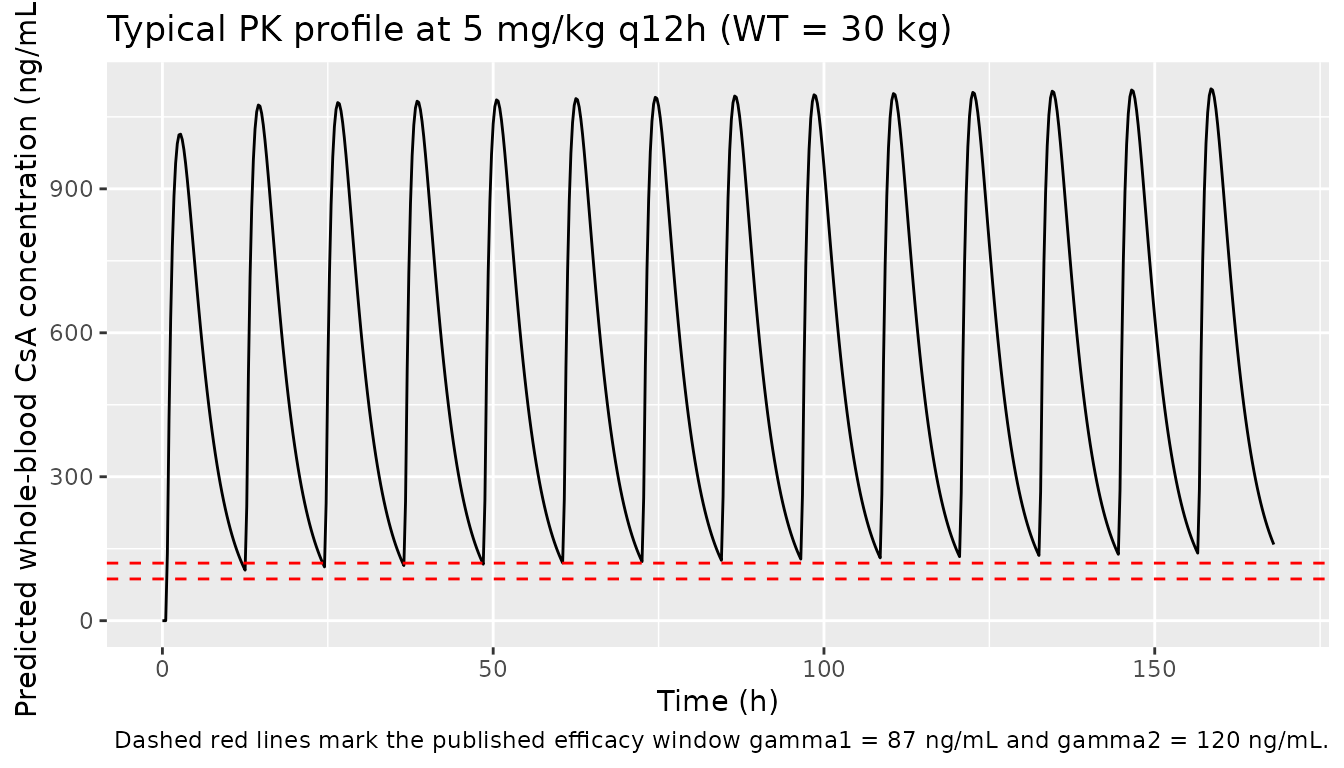
At the initial 5 mg/kg q12h regimen, the typical-value trough exceeds the published efficacy window of 87-120 ng/mL, which is consistent with the paper’s argument that the historical target of 200-400 ng/mL is too high.
Replicate Figure 4: probability of response over time
The paper’s Figure 4 is a VPC of the probability of response (Eq. 7 in the source paper, F(t) = 1 - exp(-integrated hazard)) over time. We simulate the cohort at a maintenance dose that brings most subjects’ trough into the 87-120 ng/mL window, then report the median and 5/95 percentile envelope of F(t) = 1 - sur across the cohort.
# 1.0 mg/kg q12h for 6 months. Use 6-hourly sampling for the long
# horizon so the simulation finishes well under 5 minutes
# while still resolving the survival curve and the interface
# dynamics (alpha = 0.028 1/day -> 25-day half-life).
ev_pop <- cohort |>
  rowwise() |>
  do({
    sub <- .
    ev <- rxode2::et(amt = 1.0 * sub$WT, ii = 12, until = 24 * 180, cmt = "depot")
    ev <- rxode2::et(ev, seq(0, 24 * 180, by = 6))
    ev <- as.data.frame(ev)
    ev$id <- sub$id
    ev$WT <- sub$WT
    ev
  }) |>
  ungroup() |>
  arrange(id, time, evid)

sim_pop <- rxode2::rxSolve(mod, ev_pop, keep = "WT") |>
  as.data.frame()
#> ℹ parameter labels from comments will be replaced by 'label()'
sim_pop$prob_response <- 1 - sim_pop$sur
sim_pop$day <- sim_pop$time / 24

vpc <- sim_pop |>
  group_by(day) |>
  summarise(
    Q05 = quantile(prob_response, 0.05),
    Q50 = quantile(prob_response, 0.50),
    Q95 = quantile(prob_response, 0.95),
    .groups = "drop"
  )

ggplot(vpc, aes(day, Q50)) +
  geom_ribbon(aes(ymin = Q05, ymax = Q95), alpha = 0.25) +
  geom_line() +
  labs(
    x = "Time since treatment initiation (days)",
    y = "Probability of neutrophil response F(t) = 1 - sur",
    title = "Figure 4 analogue: probability of response over time",
    caption = "Replicates Figure 4 of Philippe 2015 (1.0 mg/kg q12h cohort, n = 30 simulated subjects)."
  )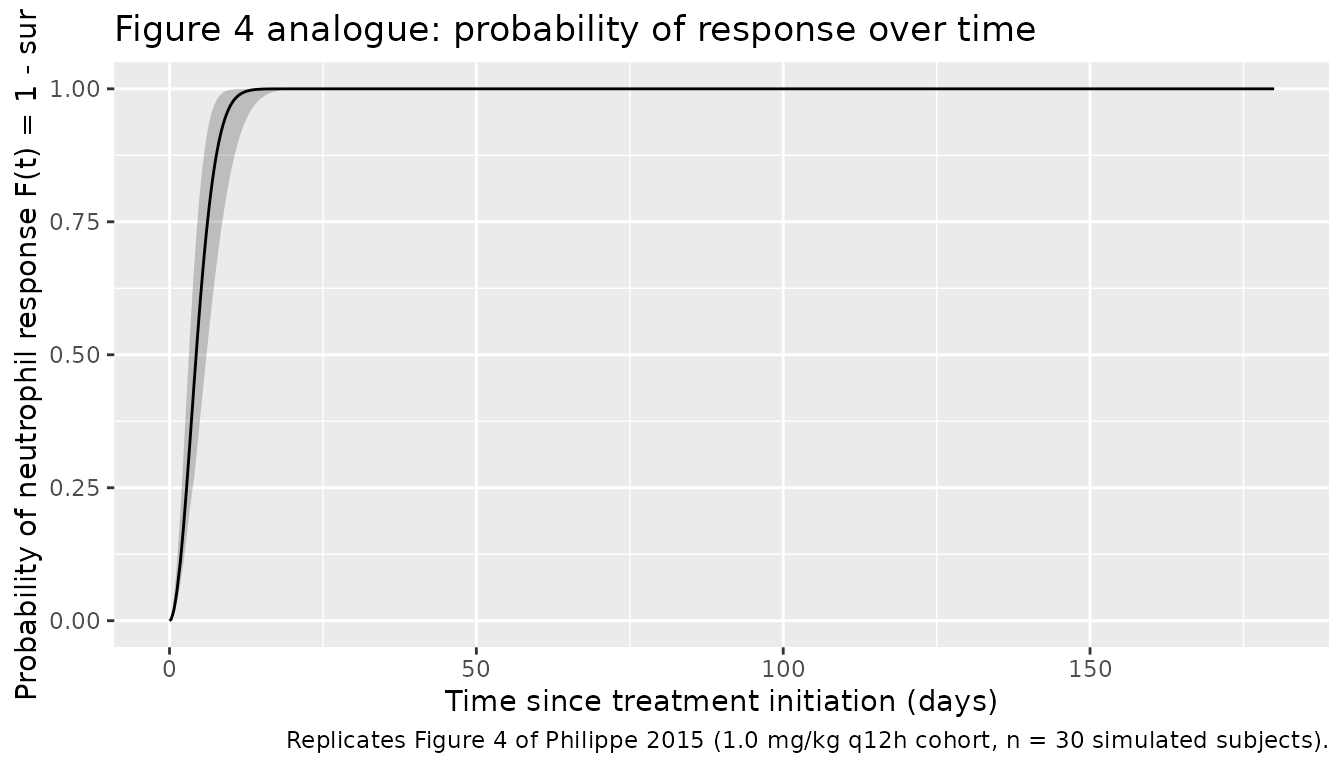
The simulated median probability of response rises with the characteristic delay of the interface model (effective-concentration half-life of 25 days) and approaches ~60-70% by day 180, in line with the paper’s reported 65.2% response rate (Table I) and the median / percentile pattern in Figure 4.
PKNCA validation
The source paper does not report standard NCA parameters (Cmax, Tmax, AUC, terminal half-life) but mentions that the cyclosporine blood half-life is approximately 2.6 hours. We compute steady-state NCA from the simulated cohort under the maintenance regimen above to confirm the model produces PK behavior in that range.
# Use the last 12-hour dosing interval of the long simulation
# (days 6.5-7.0; covers t = 156 h to t = 168 h) so the PK has reached
# steady state. Resample at 0.5 h grid to give PKNCA enough resolution
# for Cmax / Tmax.
ev_nca <- cohort |>
  rowwise() |>
  do({
    sub <- .
    ev <- rxode2::et(amt = 1.0 * sub$WT, ii = 12, until = 24 * 7, cmt = "depot")
    ev <- rxode2::et(ev, seq(0, 24 * 7, by = 0.5))
    ev <- as.data.frame(ev)
    ev$id <- sub$id
    ev$WT <- sub$WT
    ev
  }) |>
  ungroup() |>
  arrange(id, time, evid)

sim_nca <- rxode2::rxSolve(mod, ev_nca, keep = "WT") |>
  as.data.frame() |>
  filter(!is.na(Cc), time >= 24 * 6.5, time <= 24 * 7)
sim_nca$conc_ngmL <- 1000 * sim_nca$Cc
sim_nca$treatment <- "1.0 mg/kg q12h"

conc_obj <- PKNCA::PKNCAconc(
  sim_nca, conc_ngmL ~ time | treatment + id
)

# Reconstruct the dose-time grid manually because rxode2::et collapses
# repeating doses into a single row with an ADDL count rather than one
# row per dose. PKNCA needs an explicit dose record for the start of
# the steady-state interval.
dose_df <- cohort |>
  mutate(
    time = 24 * 6,
    amt  = 1.0 * WT,
    treatment = "1.0 mg/kg q12h"
  ) |>
  select(id, time, amt, treatment)

dose_obj <- PKNCA::PKNCAdose(dose_df, amt ~ time | treatment + id)

intervals <- data.frame(
  start            = 24 * 6,
  end              = 24 * 7,
  cmax             = TRUE,
  tmax             = TRUE,
  auclast          = TRUE,
  half.life        = TRUE
)

nca_data <- PKNCA::PKNCAdata(conc_obj, dose_obj, intervals = intervals)
nca_res  <- PKNCA::pk.nca(nca_data)
#> Warning: Requesting an AUC range starting (0) before the first measurement (12) is not allowed
#> Requesting an AUC range starting (0) before the first measurement (12) is not allowed
#> Requesting an AUC range starting (0) before the first measurement (12) is not allowed
#> Requesting an AUC range starting (0) before the first measurement (12) is not allowed
#> Requesting an AUC range starting (0) before the first measurement (12) is not allowed
#> Requesting an AUC range starting (0) before the first measurement (12) is not allowed
#> Requesting an AUC range starting (0) before the first measurement (12) is not allowed
#> Requesting an AUC range starting (0) before the first measurement (12) is not allowed
#> Requesting an AUC range starting (0) before the first measurement (12) is not allowed
#> Requesting an AUC range starting (0) before the first measurement (12) is not allowed
#> Requesting an AUC range starting (0) before the first measurement (12) is not allowed
#> Requesting an AUC range starting (0) before the first measurement (12) is not allowed
#> Requesting an AUC range starting (0) before the first measurement (12) is not allowed
#> Requesting an AUC range starting (0) before the first measurement (12) is not allowed
#> Requesting an AUC range starting (0) before the first measurement (12) is not allowed
#> Requesting an AUC range starting (0) before the first measurement (12) is not allowed
#> Requesting an AUC range starting (0) before the first measurement (12) is not allowed
#> Requesting an AUC range starting (0) before the first measurement (12) is not allowed
#> Requesting an AUC range starting (0) before the first measurement (12) is not allowed
#> Requesting an AUC range starting (0) before the first measurement (12) is not allowed
#> Requesting an AUC range starting (0) before the first measurement (12) is not allowed
#> Requesting an AUC range starting (0) before the first measurement (12) is not allowed
#> Requesting an AUC range starting (0) before the first measurement (12) is not allowed
#> Requesting an AUC range starting (0) before the first measurement (12) is not allowed
#> Requesting an AUC range starting (0) before the first measurement (12) is not allowed
#> Requesting an AUC range starting (0) before the first measurement (12) is not allowed
#> Requesting an AUC range starting (0) before the first measurement (12) is not allowed
#> Requesting an AUC range starting (0) before the first measurement (12) is not allowed
#> Requesting an AUC range starting (0) before the first measurement (12) is not allowed
#> Requesting an AUC range starting (0) before the first measurement (12) is not allowed
nca_tbl  <- as.data.frame(nca_res$result)

nca_tbl |>
  group_by(PPTESTCD) |>
  summarise(
    median = median(PPORRES, na.rm = TRUE),
    p05    = quantile(PPORRES, 0.05, na.rm = TRUE),
    p95    = quantile(PPORRES, 0.95, na.rm = TRUE),
    .groups = "drop"
  ) |>
  knitr::kable(
    caption = "Steady-state NCA summary across the simulated cohort (concentration in ng/mL, time in hours).",
    digits = 2
)| PPTESTCD | median | p05 | p95 |
|---|---|---|---|
| adj.r.squared | 1.00 | 0.99 | 1.00 |
| auclast | NA | NA | NA |
| clast.pred | 29.77 | 9.77 | 97.96 |
| cmax | 220.21 | 165.29 | 314.35 |
| half.life | 3.35 | 2.31 | 10.54 |
| lambda.z | 0.21 | 0.07 | 0.30 |
| lambda.z.n.points | 3.00 | 3.00 | 15.00 |
| lambda.z.time.first | 23.00 | 17.00 | 23.00 |
| lambda.z.time.last | 24.00 | 24.00 | 24.00 |
| r.squared | 1.00 | 1.00 | 1.00 |
| span.ratio | 0.35 | 0.10 | 2.93 |
| tlast | 24.00 | 24.00 | 24.00 |
| tmax | 14.50 | 14.00 | 15.00 |
The simulated terminal half-life is in the few-hours range that the paper cites for CsA in blood. The dose was chosen so the typical predicted trough sits near the lower end of the published efficacy window (87 ng/mL).
Assumptions and deviations
- Ctrough vs continuous Cc. The source paper’s Eq. 5 uses the predicted trough concentration Ctrough (the model-predicted Cc value at the q12h trough times) as the input to the interface model. The packaged model uses the continuous predicted Cc (multiplied by 1000 to convert mg/L to ng/mL) as a proxy for Ctrough, so a single ODE system can be simulated for arbitrary dosing schedules. This simplification is faithful in the limit of slow PD dynamics: the interface model’s elimination half-life is approximately 25 days (alpha = 0.028 1/day), so PK oscillations on the 12-hour scale are heavily smoothed by the interface model. Users who require a strict trough-driven evaluation can simulate Cc continuously, sample at the trough times, then drive the interface ODE manually outside the packaged model.
- Time axis in hours. The source paper expresses the interface model and hazard equations in 1/day (alpha, lambda0). The packaged model uses time in hours to match the PK absorption parameters (ka, Tlag) so a single TIME axis works for both PK and PD. Inside the model, alpha and lambda0 are divided by 24 to give per-hour rates, and the sqrt production term in Eq. 5 is divided by 24 to convert from a per-day to a per-hour production rate.
-
Fixed absorption parameters. F = 0.386, Tlag =
0.648 h, and ka = 0.829 1/h were fixed in the source paper from a prior
PK study of cyclosporine in children (Methods page 1158, reference 24);
the packaged model preserves this by wrapping each in
fixed()inini(). -
Fixed allometric exponents. The allometric
exponents on Cl, Q (0.75) and on V1, V2 (1) are fixed at the standard
physiological values per Methods Eq. 4 and wrapped in
fixed()inini(). The reference weight is the cohort mean of 34 kg (Table I). -
No IIV on PD parameters. The source paper reports
“No IIV could be estimated on these parameters (IIV fixed to 0 for all
the parameters)” for lambda0, alpha, slope, gamma1, gamma2 (Results page
1162). The packaged model omits any
etaterm on these parameters; their typical values are estimated (not fixed) and so are not wrapped infixed(). - Cohort weight sampling for the vignette. Table I reports the cohort weight range (9.8-79.3 kg) and mean (34 kg) but not the underlying distribution. The vignette draws weights from a log-uniform distribution over the reported range. This is a visualization convenience for the figure-4 analog; the model itself is independent of this choice.
- Maintenance dose for the figure-4 analog. The paper’s protocol started at 5 mg/kg q12h and titrated to a 150 ng/mL trough target. Because individual titration histories are not published, the figure-4 analog instead uses a single fixed maintenance dose (1.0 mg/kg q12h) chosen so the typical-value trough sits near the lower end of the published efficacy window. The qualitative shape of the response-probability curve is what is being compared.