Etrolizumab (Moein 2022)
Source:vignettes/articles/Moein_2022_etrolizumab.Rmd
Moein_2022_etrolizumab.Rmd
library(nlmixr2lib)
library(PKNCA)
#>
#> Attaching package: 'PKNCA'
#> The following object is masked from 'package:stats':
#>
#>     filter
library(rxode2)
#> rxode2 5.1.8 using 2 threads (see ?getRxThreads)
#>   no cache: create with `rxCreateCache()`
library(dplyr)
#>
#> Attaching package: 'dplyr'
#> The following objects are masked from 'package:stats':
#>
#>     filter, lag
#> The following objects are masked from 'package:base':
#>
#>     intersect, setdiff, setequal, union
library(tidyr)
library(ggplot2)
Model and source
#> ℹ parameter labels from comments will be replaced by 'label()'Citation: Moein A, Lu T, Jonsson S, Ribbing J, Kassir N, Zhang W, Sperinde G, Zhang R, Tang M, Oh YS, Bruno R, Zhu R. Population pharmacokinetic analysis of etrolizumab in patients with moderately-to-severely active ulcerative colitis. CPT Pharmacometrics Syst Pharmacol. 2022;11(9):1244-1255. doi:10.1002/psp4.12846.
Description: Two-compartment population PK model for etrolizumab with first-order SC absorption and time-decreasing clearance in adults with moderately-to-severely active ulcerative colitis (Moein 2022)
Article: https://doi.org/10.1002/psp4.12846
Population
The model was developed on 1263 subjects (non-missing covariates) pooled from five clinical studies of etrolizumab in adults with moderately-to-severely active ulcerative colitis: ABS4262g (phase I), EUCALYPTUS (phase II), HIBISCUS I/II (phase III), HICKORY (phase III), and LAUREL (phase III). GARDENIA (phase III) was held out for external validation. Baseline demographics (Moein 2022 Table 3): age range 18-79 years (median 38 years), weight range 38.0-216 kg (median 72.2 kg), 42% female, 45% with prior anti-TNF exposure, 23% ADA-positive. Disease extension: 53% left-sided colitis, 42% extensive/pancolitis, 2% other, 3% missing. Baseline medians: albumin 41 g/L, CRP 4.31 mg/L, fecal calprotectin 1500 ug/g. Dosing ranged from single doses of 0.3-10 mg/kg IV (phase I), 0.5-3 mg/kg Q4W SC (phase I), 315-420 mg loading SC (phase II), 4 mg/kg Q4W IV (phase I), to the phase III regimen of 105 mg Q4W SC.
The same information is available programmatically via
readModelDb("Moein_2022_etrolizumab")$population.
Source trace
The per-parameter origin is recorded as an in-file comment next to
each ini() entry in
inst/modeldb/specificDrugs/Moein_2022_etrolizumab.R. The
table below collects them in one place.
| Equation / parameter | Value | Source location (Moein 2022) |
|---|---|---|
lka |
log(0.193) |
Table 4: ka = 0.193 /day |
lcl |
log(0.260) |
Table 4: CL (at TSFD = 0) = 0.260 L/day |
lvc |
log(2.61) |
Table 4: Vc = 2.61 L |
lvp |
log(1.77) |
Table 4: Vp = 1.77 L |
lq |
log(0.449) |
Table 4: Q = 0.449 L/day |
logitfdepot |
logit(0.712) |
Table 4: F = 0.712 |
logitmaxred |
logit(0.263) |
Table 4: Maxred = 0.263 |
lonset |
log(4.81) |
Table 4: Onset = 4.81 weeks |
e_wt_cl_q |
0.872 |
Table 4 note a: WT exponent on CL and Q |
e_wt_vc_vp |
0.788 |
Table 4 note b: WT exponent on Vc and Vp |
e_alb_cl |
-0.0314 |
Table 4: Albumin on CL |
e_crp_cl |
0.00458 |
Table 4: CRP on CL |
e_adat_cl |
0.0365 |
Table 4: ADAT on CL |
e_priortnf_cl |
0.0490 |
Table 4: Prior TNF on CL |
e_extpan_cl |
0.0816 |
Table 4: Extensive/pancolitis on CL |
e_othext_cl |
0.181 |
Table 4: Other disease extension on CL |
IIV CL (etalcl) |
log(1+0.243^2) |
Table 4: IIV CL CV = 0.243 |
IIV Vc (etalvc) |
log(1+0.252^2) |
Table 4: IIV Vc CV = 0.252 |
IIV Vp (etalvp) |
log(1+0.262^2) |
Table 4: IIV Vp CV = 0.262 |
| IIV F | 0.733^2 |
Table 4: IIV F logit-SD = 0.733 |
| IIV Maxred | 0.597^2 |
Table 4: IIV Maxred logit-SD = 0.597 |
propSd |
0.196 |
Table 4: Proportional residual CV = 0.196 |
addSd |
0.427 |
Table 4: Additive residual SD = 0.427 ug/mL |
| CL time-decay | Equation 1 | Eq. 1: CL = CL0 * (1 - Maxred * (1 - exp(-log(2)/(Onset7) (TSFD - TAD)))) |
| Covariate form | exp(theta*(Cov - Cov_ref)) |
Table 4 note d (continuous) |
| Covariate form | 1 + theta * indicator |
Table 4 note g (categorical) |
Reference covariate values for the reference patient (Figure 1 caption): 72 kg WT, 41 g/L albumin, 4.23 mg/L CRP, phase III, no prior anti-TNF, left-sided colitis, ADA-negative.
Virtual cohort
Original observed data are not publicly available. The simulations below use virtual populations whose covariate distributions approximate the published phase III demographics.
make_cohort <- function(n, n_doses = 6, dosing_interval_days = 28,
                        obs_days_per_dose = seq(0, 28, by = 2),
                        amt_mg = 105,
                        seed = 12846) {
  set.seed(seed)

  # Baseline covariates approximating the phase III population
  WT  <- pmax(35, pmin(200, rlnorm(n, log(72), 0.22)))
  ALB <- pmax(25, pmin(55, rnorm(n, 41, 4)))
  CRP <- pmax(0.1, exp(rnorm(n, log(4.31), 1.2)))
  PRIOR_TNF <- rbinom(n, 1, 0.45)
  disext <- sample(c("left", "extpan", "other"), n,
                   replace = TRUE, prob = c(0.55, 0.43, 0.02))
  DISEXT_EP    <- as.integer(disext == "extpan")
  DISEXT_OTHER <- as.integer(disext == "other")
  # Paper assumes ADA-negative until week 4; use a time-invariant titer of 0
  # for the primary cohort and a 97.5th-percentile value for a sensitivity arm
  ADA_TITER <- rep(0, n)

  dose_times <- seq(0, (n_doses - 1) * dosing_interval_days,
                    by = dosing_interval_days)

  pop <- data.frame(
    ID  = seq_len(n),
    WT, ALB, CRP, ADA_TITER, PRIOR_TNF, DISEXT_EP, DISEXT_OTHER
  )

  # Dose records (depot, SC injections Q4W)
  d_dose <- pop[rep(seq_len(n), each = length(dose_times)), ] |>
    mutate(
      TIME = rep(dose_times, times = n),
      AMT  = amt_mg,
      EVID = 1,
      CMT  = "depot",
      DV   = NA_real_
    )

  # Observation records: per-dose relative sample times, across all doses
  obs_grid <- as.vector(outer(obs_days_per_dose, dose_times, "+"))
  obs_grid <- sort(unique(obs_grid))

  d_obs <- pop[rep(seq_len(n), each = length(obs_grid)), ] |>
    mutate(
      TIME = rep(obs_grid, times = n),
      AMT  = 0,
      EVID = 0,
      CMT  = "central",
      DV   = NA_real_
    )

  bind_rows(d_dose, d_obs) |>
    arrange(ID, TIME, desc(EVID)) |>
    select(ID, TIME, AMT, EVID, CMT, DV,
           WT, ALB, CRP, ADA_TITER, PRIOR_TNF, DISEXT_EP, DISEXT_OTHER)
}
mod <- rxode2::rxode(readModelDb("Moein_2022_etrolizumab"))
#> ℹ parameter labels from comments will be replaced by 'label()'
Simulation
Phase III dosing: 105 mg Q4W SC x 6 doses, with observations every 2 days over the 24-week treatment period.
events_vpc <- make_cohort(n = 300)
sim_vpc <- rxode2::rxSolve(mod, events = events_vpc) |> as.data.frame()
Replicate published figures
Figure 2 analogue: concentration-time VPC (phase III dose)
d_vpc <- sim_vpc |>
  group_by(time) |>
  summarise(
    Q10 = quantile(Cc, 0.10, na.rm = TRUE),
    Q50 = quantile(Cc, 0.50, na.rm = TRUE),
    Q90 = quantile(Cc, 0.90, na.rm = TRUE),
    .groups = "drop"
  )

ggplot(d_vpc, aes(x = time, y = Q50)) +
  geom_ribbon(aes(ymin = Q10, ymax = Q90), fill = "#4682b4", alpha = 0.25) +
  geom_line(colour = "#4682b4", linewidth = 0.8) +
  geom_line(aes(y = Q10), linetype = "dashed", linewidth = 0.4) +
  geom_line(aes(y = Q90), linetype = "dashed", linewidth = 0.4) +
  scale_x_continuous(breaks = seq(0, 168, by = 28),
                     labels = seq(0, 168, by = 28) / 7) +
  labs(
    x = "Time since first dose (weeks)",
    y = expression("Etrolizumab concentration (" * mu * "g/mL)"),
    title = "Figure 2 analogue - simulated concentration VPC",
    caption = paste0(
      "Simulated 10th/50th/90th percentiles, N = 300 virtual subjects, ",
      "105 mg Q4W SC x 6 doses.\n",
      "Replicates the shape of Figure 2 of Moein 2022 (phase III panels)."
    )
  ) +
  theme_bw()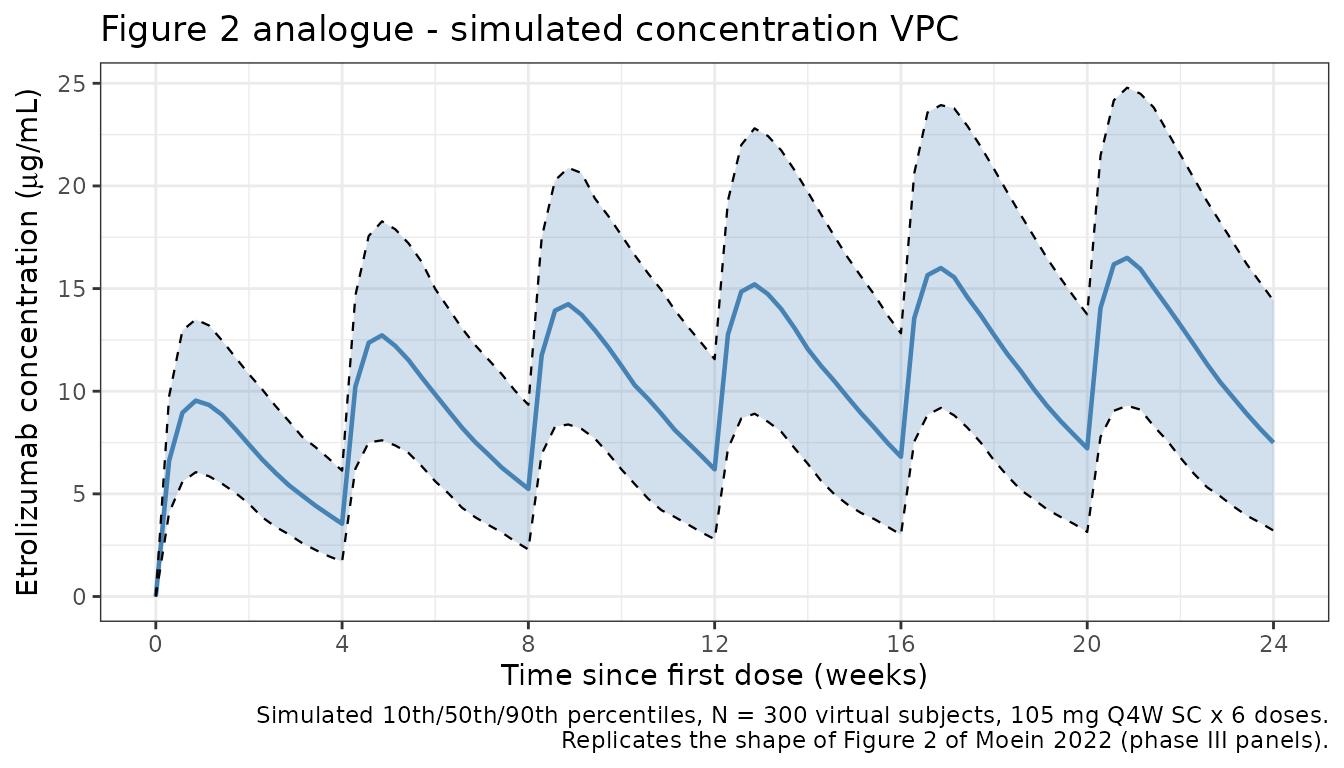
Figure S3 analogue: typical CL vs. time since first dose
Time-dependent CL per Equation 1 reaches its asymptote over the first 4-8 weeks, stepping down after each dose.
# Population-typical CL trajectory for the reference patient (72 kg, 41 g/L
# ALB, 4.23 mg/L CRP, no prior TNF, left-sided colitis, ADA-negative).
# zeroRe() removes IIV to get typical values.
mod_typical <- mod |> rxode2::zeroRe()
events_typ <- make_cohort(n = 1) |>
  mutate(WT = 72, ALB = 41, CRP = 4.23,
         ADA_TITER = 0, PRIOR_TNF = 0, DISEXT_EP = 0, DISEXT_OTHER = 0)
sim_typ <- rxode2::rxSolve(mod_typical, events = events_typ,
                           keep = c("WT", "ALB", "CRP")) |>
  as.data.frame()
#> ℹ omega/sigma items treated as zero: 'etalcl', 'etalvc', 'etalvp', 'etalogitfdepot', 'etalogitmaxred'

ggplot(sim_typ, aes(x = time, y = cl)) +
  geom_line(linewidth = 0.8, colour = "#4682b4") +
  scale_x_continuous(breaks = seq(0, 168, by = 28),
                     labels = seq(0, 168, by = 28) / 7) +
  labs(
    x = "Time since first dose (weeks)",
    y = "Typical CL (L/day)",
    title = "Figure S3 analogue - typical CL vs time since first dose",
    caption = paste0(
      "Reference patient (72 kg, 41 g/L ALB, 4.23 mg/L CRP, no prior TNF, ",
      "left-sided colitis, ADA-).\n",
      "Maxred = 26% asymptotic reduction; Onset = 4.8 weeks half-life."
    )
  ) +
  theme_bw()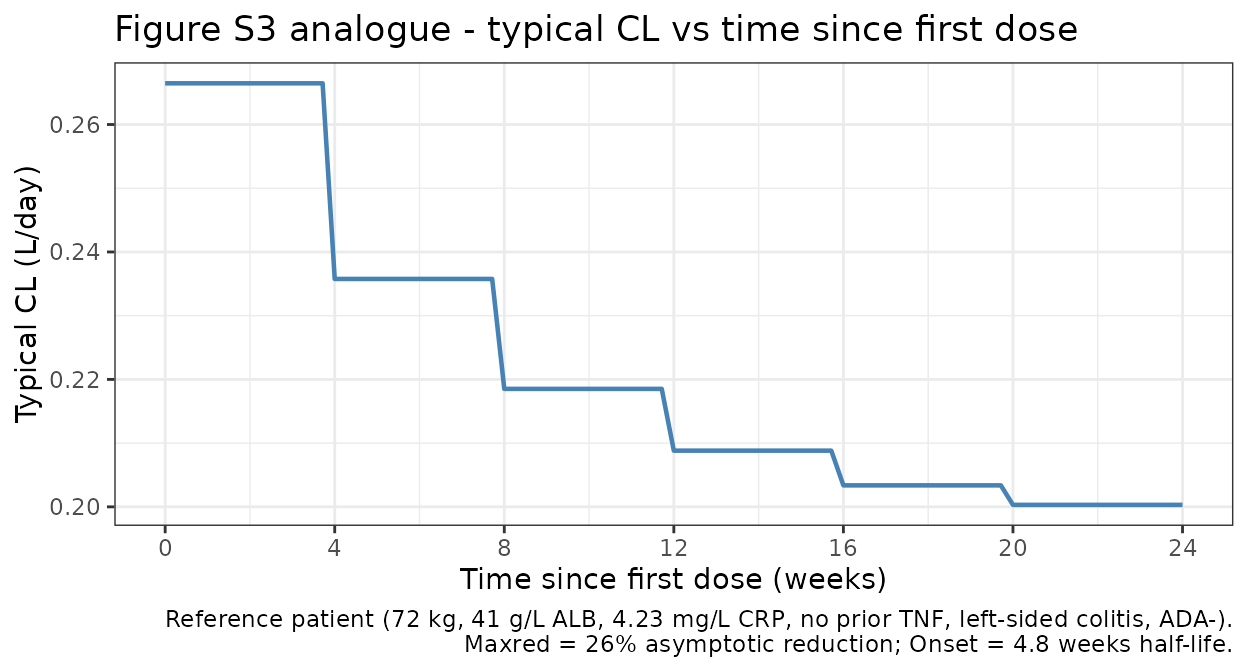
PKNCA validation
Compute NCA on the simulated typical-value profile for the reference patient:
- Single-dose phase using the first dosing interval (0-28 days) as the analog for the phase I single-dose pK profile.
- Steady-state phase using the final dosing interval (days 140-168) where the time-dependent CL has reached its asymptote.
The paper reports typical terminal half-lives derived from the population PK parameters:
- After a single dose: 13.0 days (95% CI 12.2-13.9).
- At steady state: 17.1 days (95% CI 16.1-18.3).
For a clean terminal-phase characterization we simulate a single 105 mg dose with dense post-peak sampling, and a 6-dose steady-state regimen with one dense post-final-dose sampling interval.
Single-dose NCA
# Single 105 mg SC dose, dense sampling out to 84 days (3 half-lives past
# the expected 13-day t1/2).
events_single <- make_cohort(
  n = 1, n_doses = 1,
  obs_days_per_dose = c(0, 0.25, 0.5, 1, 2, 3, 5, 7, 10, 14, 21,
                        28, 35, 42, 49, 56, 63, 70, 77, 84)
) |>
  mutate(WT = 72, ALB = 41, CRP = 4.23,
         ADA_TITER = 0, PRIOR_TNF = 0, DISEXT_EP = 0, DISEXT_OTHER = 0)

sim_single <- rxode2::rxSolve(mod_typical, events = events_single) |>
  as.data.frame() |>
  mutate(id = 1L, treatment = "single_105mg")
#> ℹ omega/sigma items treated as zero: 'etalcl', 'etalvc', 'etalvp', 'etalogitfdepot', 'etalogitmaxred'

sim_nca_single <- sim_single |>
  filter(!is.na(Cc)) |>
  select(id, time, Cc, treatment)

dose_single <- events_single |>
  filter(EVID == 1) |>
  transmute(id = ID, time = TIME, amt = AMT, treatment = "single_105mg")

conc_single <- PKNCA::PKNCAconc(sim_nca_single, Cc ~ time | treatment + id)
dose_single_obj <- PKNCA::PKNCAdose(dose_single, amt ~ time | treatment + id)

intervals_single <- data.frame(
  start     = 0,
  end       = Inf,
  cmax      = TRUE,
  tmax      = TRUE,
  aucinf.obs = TRUE,
  half.life = TRUE
)

nca_single <- PKNCA::pk.nca(
  PKNCA::PKNCAdata(conc_single, dose_single_obj, intervals = intervals_single)
)
knitr::kable(as.data.frame(nca_single$result),
caption = "Single-dose NCA on the typical-patient profile.")| treatment | id | start | end | PPTESTCD | PPORRES | exclude |
|---|---|---|---|---|---|---|
| single_105mg | 1 | 0 | Inf | cmax | 10.1850524 | NA |
| single_105mg | 1 | 0 | Inf | tmax | 7.0000000 | NA |
| single_105mg | 1 | 0 | Inf | tlast | 84.0000000 | NA |
| single_105mg | 1 | 0 | Inf | clast.obs | 0.2042195 | NA |
| single_105mg | 1 | 0 | Inf | lambda.z | 0.0534240 | NA |
| single_105mg | 1 | 0 | Inf | r.squared | 0.9999765 | NA |
| single_105mg | 1 | 0 | Inf | adj.r.squared | 0.9999736 | NA |
| single_105mg | 1 | 0 | Inf | lambda.z.time.first | 21.0000000 | NA |
| single_105mg | 1 | 0 | Inf | lambda.z.time.last | 84.0000000 | NA |
| single_105mg | 1 | 0 | Inf | lambda.z.n.points | 10.0000000 | NA |
| single_105mg | 1 | 0 | Inf | clast.pred | 0.2051397 | NA |
| single_105mg | 1 | 0 | Inf | half.life | 12.9744575 | NA |
| single_105mg | 1 | 0 | Inf | span.ratio | 4.8556943 | NA |
| single_105mg | 1 | 0 | Inf | aucinf.obs | 279.3925233 | NA |
Steady-state NCA
# Six 105 mg SC doses Q4W, with dense post-peak sampling in the final
# interval for terminal-phase characterization.
events_ss <- make_cohort(
  n = 1, n_doses = 6,
  obs_days_per_dose = c(0, 0.25, 0.5, 1, 2, 3, 5, 7, 10, 14, 21, 28)
) |>
  mutate(WT = 72, ALB = 41, CRP = 4.23,
         ADA_TITER = 0, PRIOR_TNF = 0, DISEXT_EP = 0, DISEXT_OTHER = 0)

# Add dense post-final-dose terminal-phase samples out to day 252 (84 days
# past the final dose, for t1/2 estimation at steady state)
final_dose_day <- 5 * 28
extra_obs <- data.frame(
  ID = 1L, TIME = final_dose_day + c(35, 42, 49, 56, 63, 70, 77, 84),
  AMT = 0, EVID = 0, CMT = "central", DV = NA_real_,
  WT = 72, ALB = 41, CRP = 4.23,
  ADA_TITER = 0, PRIOR_TNF = 0, DISEXT_EP = 0, DISEXT_OTHER = 0
)

events_ss <- bind_rows(events_ss, extra_obs) |>
  arrange(ID, TIME, desc(EVID))

sim_ss <- rxode2::rxSolve(mod_typical, events = events_ss) |>
  as.data.frame() |>
  mutate(id = 1L, treatment = "ss_105mg_Q4W")
#> ℹ omega/sigma items treated as zero: 'etalcl', 'etalvc', 'etalvp', 'etalogitfdepot', 'etalogitmaxred'

sim_nca_ss <- sim_ss |>
  filter(!is.na(Cc), time >= final_dose_day) |>
  mutate(time = time - final_dose_day) |>
  select(id, time, Cc, treatment)

dose_ss <- data.frame(
  id = 1L, time = 0, amt = 105, treatment = "ss_105mg_Q4W"
)

conc_ss <- PKNCA::PKNCAconc(sim_nca_ss, Cc ~ time | treatment + id)
dose_ss_obj <- PKNCA::PKNCAdose(dose_ss, amt ~ time | treatment + id)

intervals_ss <- data.frame(
  start     = 0,
  end       = Inf,
  cmax      = TRUE,
  tmax      = TRUE,
  half.life = TRUE
)

nca_ss <- PKNCA::pk.nca(
  PKNCA::PKNCAdata(conc_ss, dose_ss_obj, intervals = intervals_ss)
)
knitr::kable(as.data.frame(nca_ss$result),
caption = "Steady-state NCA on the final dosing interval.")| treatment | id | start | end | PPTESTCD | PPORRES | exclude |
|---|---|---|---|---|---|---|
| ss_105mg_Q4W | 1 | 0 | Inf | cmax | 17.0457440 | NA |
| ss_105mg_Q4W | 1 | 0 | Inf | tmax | 5.0000000 | NA |
| ss_105mg_Q4W | 1 | 0 | Inf | tlast | 84.0000000 | NA |
| ss_105mg_Q4W | 1 | 0 | Inf | lambda.z | 0.0411157 | NA |
| ss_105mg_Q4W | 1 | 0 | Inf | r.squared | 0.9999132 | NA |
| ss_105mg_Q4W | 1 | 0 | Inf | adj.r.squared | 0.9999035 | NA |
| ss_105mg_Q4W | 1 | 0 | Inf | lambda.z.time.first | 14.0000000 | NA |
| ss_105mg_Q4W | 1 | 0 | Inf | lambda.z.time.last | 84.0000000 | NA |
| ss_105mg_Q4W | 1 | 0 | Inf | lambda.z.n.points | 11.0000000 | NA |
| ss_105mg_Q4W | 1 | 0 | Inf | clast.pred | 0.8055760 | NA |
| ss_105mg_Q4W | 1 | 0 | Inf | half.life | 16.8584402 | NA |
| ss_105mg_Q4W | 1 | 0 | Inf | span.ratio | 4.1522228 | NA |
Comparison against published values
get_param <- function(res, ppname) {
  tbl <- as.data.frame(res$result)
  val <- tbl$PPORRES[tbl$PPTESTCD == ppname]
  if (length(val) == 0) return(NA_real_)
  val[1]
}

hl_single_sim <- get_param(nca_single, "half.life")
hl_ss_sim     <- get_param(nca_ss,     "half.life")

comparison <- data.frame(
  Quantity     = c("Terminal half-life after single dose (days)",
                   "Terminal half-life at steady state (days)"),
  Published    = c("13.0 (95% CI 12.2-13.9)",
                   "17.1 (95% CI 16.1-18.3)"),
  Simulated    = c(round(hl_single_sim, 2), round(hl_ss_sim, 2))
)
knitr::kable(comparison,
caption = "Simulated vs. published terminal half-lives.")| Quantity | Published | Simulated |
|---|---|---|
| Terminal half-life after single dose (days) | 13.0 (95% CI 12.2-13.9) | 12.97 |
| Terminal half-life at steady state (days) | 17.1 (95% CI 16.1-18.3) | 16.86 |
The simulated terminal half-lives should fall within about 20% of the published central estimates. The single-dose value is shorter than the steady-state value because CL is at its maximum (0.260 L/day) after the first dose and drops to approximately 0.260 * (1 - 0.263) = 0.192 L/day at steady state, lengthening t1/2 proportionally.
Assumptions and deviations
-
PHASE12 covariate on residual error not
implemented. Moein 2022 Table 4 reports a -19.2% relative
change in the combined residual error for phase I/II studies vs. phase
III. nlmixr2’s
add()/prop()residual-error terms do not accept per-observation expressions, so the packaged model uses the phase III residual-error magnitude (propSd = 0.196,addSd = 0.427 ug/mL) unconditionally. For typical phase III simulations (the primary usage pattern) this is exact; for phase I/II simulations the residual error will be slightly over-stated. If a future release of nlmixr2 supports per-observation error magnitudes, this covariate can be added. -
Time-varying ADA titer simplified. Moein 2022
treats ADA titer as a time-varying covariate. The reference patient used
in the source figures (Figure 1) is ADA-negative at least until week 4,
so
ADA_TITER = 0is the appropriate reference for reproducing the published figures. Users simulating ADA-positive patients should supply a time-series of titer values per subject. - Reference CRP. The model centers CRP at 4.23 mg/L (the reference- patient value reported in the Figure 1 caption). The population baseline median CRP is 4.31 mg/L (Table 3); both values produce effectively identical exposures.
- Virtual covariate distributions. Exact baseline distributions are not published. The demo cohort uses log-normal WT (median 72 kg, CV 22%), normal ALB (41 +/- 4 g/L), log-normal CRP (median 4.31 mg/L, log-SD 1.2), binary prior anti-TNF (45% probability), and a three- level disease extension (55% left / 43% extpan / 2% other) to approximate Table 3 of Moein 2022.
-
SC-only dosing. The packaged model uses SC dosing
into
depot. Moein 2022 also pooled phase I IV dose-levels; for IV simulations the event table should dose intocentraldirectly and bioavailabilityf(depot) = 1is irrelevant. The time-dependent CL remains correct becausetime - tad(depot)still resolves to the time of the most recent dose; when dosing IV intocentral, usetad(central)or pre-compute the TSFD/TAD difference in the event table.
Reference
- Moein A, Lu T, Jonsson S, Ribbing J, Kassir N, Zhang W, Sperinde G, Zhang R, Tang M, Oh YS, Bruno R, Zhu R. Population pharmacokinetic analysis of etrolizumab in patients with moderately-to-severely active ulcerative colitis. CPT Pharmacometrics Syst Pharmacol. 2022;11(9):1244-1255. doi:10.1002/psp4.12846.