library(nlmixr2lib)
library(PKNCA)
#>
#> Attaching package: 'PKNCA'
#> The following object is masked from 'package:stats':
#>
#>     filter
library(rxode2)
#> rxode2 5.1.8 using 2 threads (see ?getRxThreads)
#>   no cache: create with `rxCreateCache()`
library(dplyr)
#>
#> Attaching package: 'dplyr'
#> The following objects are masked from 'package:stats':
#>
#>     filter, lag
#> The following objects are masked from 'package:base':
#>
#>     intersect, setdiff, setequal, union
library(tidyr)
library(ggplot2)
Model and source
- Citation: Yu H, Graham G, David OJ, Kahn JM, Savelieva M, Pigeolet E, Das Gupta A, Pingili R, Willi R, Ramanathan K, Kieseier BC, Haring DA, Bagger M, Soelberg Sorensen P. Population Pharmacokinetic-B Cell Modeling for Ofatumumab in Patients with Relapsing Multiple Sclerosis. CNS Drugs. 2022;36(3):283-300. doi:10.1007/s40263-021-00895-w.
- Description: Population PK / B-cell-count model for subcutaneous ofatumumab in adults with relapsing multiple sclerosis (Yu 2022)
- Article: https://doi.org/10.1007/s40263-021-00895-w
Yu et al. (2022) developed a coupled population PK / B-cell-count
model for ofatumumab (a fully human anti-CD20 IgG1 monoclonal antibody)
in adults with relapsing forms of multiple sclerosis. The PK side is a
quasi-steady-state (QSS) approximation of the Mager-Krzyzanski TMDD
framework with two drug compartments (central + peripheral) and
first-order SC absorption with estimated bioavailability F. CD20
receptor synthesis decays exponentially from ksyn0 to
ksyn_inf with rate constant kdes to capture a
slight upward drift in trough concentrations across the phase 3
ASCLEPIOS studies. The B-cell side is an indirect-response model: free
ofatumumab concentration stimulates B-cell lysis through a sigmoid Emax
function; B cells distribute between a central compartment (sharing
volume with the PK central compartment) and a peripheral compartment
specific to B cells.
Population
The pooled analysis dataset combines five clinical studies (one phase 1/2 IV plus four phase 2/3 SC trials): OMS115102, MIRROR, APLIOS, ASCLEPIOS I, and ASCLEPIOS II. The final PK-B-cell model was fit to 1486 adults with relapsing MS (RMS) or relapsing-remitting MS (RRMS), median age 38 years (range 18-56), median weight 70 kg (range 40.5-171.6), 67.8 % female, predominantly White (91 %). Median baseline CD19+ B cell count was 200 cells/uL (range 0-1520). Patients across the SC studies received the licensed regimen of three weekly 20-mg loading doses followed by 20 mg SC q4w, delivered by prefilled syringe (PFS, n=1320) or autoinjector (AI, n=141; APLIOS only). The OMS115102 cohort received IV infusions (100/300/700 mg; the 700-mg arm was excluded from the PK analysis because of an under-prediction not seen in any other dose). The MIRROR cohort received SC dose-finding regimens (3-60 mg q12w or 60 mg q4w). PK dataset: 9168 plasma concentrations from 1440 patients (placebo and 700-mg cohorts excluded). PD dataset: 17,158 CD19+ B-cell counts from all 1486 patients; ASCLEPIOS B-cell counts were modelled as interval-censored (LLOQ bins of 0/5/15/25 cells/uL). Anti-drug antibody incidence was < 2 % with no detectable PK or B-cell impact (Yu 2022 Methods “Data” + Table 1, Table 2, Results “Data”).
The full population descriptor is available programmatically:
str(rxode2::rxode2(readModelDb("Yu_2022_ofatumumab"))$meta$population)
#> ℹ parameter labels from comments will be replaced by 'label()'
#> List of 15
#>  $ n_subjects           : int 1486
#>  $ n_studies            : int 5
#>  $ age_range            : chr "18-56 years"
#>  $ age_median           : chr "38 years"
#>  $ weight_range         : chr "40.5-171.6 kg"
#>  $ weight_median        : chr "70.0 kg"
#>  $ sex_female_pct       : num 67.8
#>  $ race_ethnicity       : Named num [1:5] 91.1 2.4 2.5 3.2 0.7
#>   ..- attr(*, "names")= chr [1:5] "White" "Black" "Asian" "Other_AmInd_AlaskaNative" ...
#>  $ disease_state        : chr "Adults with relapsing forms of multiple sclerosis (RMS), including relapsing-remitting MS (RRMS); EDSS 0-5.5 at"| __truncated__
#>  $ dose_range           : chr "OMS115102: 100/300/700 mg IV at weeks 0+2 or 24+26 (700 mg arm excluded from PK analysis). MIRROR: 0/3/30/60 mg"| __truncated__
#>  $ regions              : chr "Multi-regional phase 2/3 programme (OMS115102, MIRROR, APLIOS, ASCLEPIOS I, ASCLEPIOS II)."
#>  $ studies              : chr "OMS115102 (N=25 IV RRMS), MIRROR (N=231 SC PFS RRMS), APLIOS (N=284 SC AI/PFS RMS), ASCLEPIOS I (N=465 SC PFS R"| __truncated__
#>  $ bcell_baseline_median: chr "200 cells/uL CD19+ (range 0-1520; pooled five-study cohort, Table 2)"
#>  $ edss_median          : chr "2.5 (range 0-6, baseline)"
#>  $ notes                : chr "Pooled phase 2/3 dataset assembled for the population PK-B cell analysis. PK dataset: 9168 plasma concentration"| __truncated__
Source trace
The per-parameter origin is recorded as an in-file comment next to
each ini() entry in
inst/modeldb/specificDrugs/Yu_2022_ofatumumab.R. The table
below collects equation and parameter provenance in one place.
| Element | Paper value | Stored value | Source location |
|---|---|---|---|
ka (SC absorption rate) |
0.157 /day | 0.157 /day | Table 3 |
F (SC bioavailability) |
0.685 | logit(0.685) | Table 3 |
Vc (central volume) |
2.62 L | 2.62 L | Table 3 |
k_e(P) (complex internalisation) |
1.31 /day | 1.31 /day | Table 3 |
CL (linear free-drug clearance) |
0.34 L/day | 0.34 L/day | Table 3 |
Q (intercompartmental clearance) |
0.358 L/day | 0.358 L/day | Table 3 |
Vp (peripheral volume; FIXED) |
2.8 L | 2.8 L | Table 3 (fixed; Ryman & Meibohm 2017) |
R0 (baseline CD20 receptor) |
32.5 nmol/L | 4.8425 mg/L (drug-eq) | Table 3 |
ksyn0 (CD20 synthesis at t=0) |
0.985 nmol/L/day | 0.146765 mg/L/day | Table 3 |
ksyn_inf (synthesis at t=inf) |
0.0554 nmol/L/day | 0.0082546 mg/L/day | Table 3 |
KD (binding constant; FIXED) |
0.167 nmol/L | 0.024883 mg/L (drug-eq) | Table 3 (fixed; preclinical) |
k_off (dissociation; FIXED) |
5.53 /day | 5.53 /day | Table 3 (fixed; preclinical) |
kdes (synthesis-decay rate) |
2.58 /year | 2.58 /year | Table 3 |
B0 (baseline B cell count) |
194 cells/uL | 194 cells/uL | Table 3 |
Emax (max lysis stimulation) |
159 | 159 | Table 3 |
EC50 (lysis 50 % concentration) |
0.0057 mg/L | 0.0057 mg/L | Table 3 |
gamma (Hill exponent) |
2.81 | 2.81 | Table 3 |
kout (B-cell elimination rate) |
0.0124 /day | 0.0124 /day | Table 3 |
QB (B-cell flow; FIXED) |
0.78 L/day | 0.78 L/day | Table 3 (fixed; no IIV) |
Vb (peripheral B-cell volume) |
3.7 L | 3.7 L | Table 3 |
| beta(WT, ka) | -0.457 | -0.457 | Table 3 |
| beta(WT, Vc) | 1.2 | 1.2 | Table 3 |
| beta(WT, ksyn0) | -1.52 | -1.52 | Table 3 |
| beta(WT, CL) | 1.52 | 1.52 | Table 3 |
| beta(WT, B0) | 0.271 | 0.271 | Table 3 |
| beta(WT, kout) | -0.624 | -0.624 | Table 3 |
| beta(AGE, B0) | -0.282 | -0.282 | Table 3 |
| beta(BLBCELL, Emax) | 0.275 | 0.275 | Table 3 |
| beta(IV, R0) | 0.987 | 0.987 | Table 3 |
| beta(IV, CL) | -1.07 | -1.07 | Table 3 |
| beta(IV, Q) | -2.31 | -2.31 | Table 3 |
| beta(IV, ksyn_inf) | 2.49 | 2.49 | Table 3 |
| beta(AI, k_e(P)) | 0.713 | 0.713 | Table 3 |
| beta(AI, R0) | -0.544 | -0.544 | Table 3 |
| beta(APLIOS, Emax) | 0.503 | 0.503 | Table 3 |
| beta(MIRROR, kout) | -0.554 | -0.554 | Table 3 |
| Block 1 IIV (CL, ka, kdes) | rho_ka_cl=-0.294, rho_kdes_cl=0.642, rho_kdes_ka=0.433 | covariances computed from rho * sd_i * sd_j | Table 3 |
| Block 2 IIV (k_e(P), R0, ksyn_inf) | rho_keP_R0=-0.551, rho_ksyninf_R0=0.47, rho_ksyninf_keP=-0.464 | covariances computed | Table 3 |
| Block 3 IIV (Vb, kout, Emax) | rho_Vb_Emax=0.28, rho_kout_Vb=-0.336, rho_kout_Emax=0.423 (typo-corrected) | covariances computed | Table 3 (see Assumptions and deviations) |
| Ofatumumab residual prop. | 0.278 | 0.278 | Table 3 |
| Ofatumumab residual add. | 0.0316 mg/L | 0.0316 mg/L | Table 3 |
| B-cell residual prop. | 0.381 | 0.381 | Table 3 |
| B-cell residual add. | 0.153 cells/uL | 0.153 cells/uL | Table 3 |
| Drug ODEs (depot, central, peripheral, total_target) | n/a | mass-conserving 2-compartment QSS form | Methods “Final Model Description” |
| QSS quadratic for Lc | Lc = 0.5*(Ltot - Rtot - Ks + sqrt(…)) | n/a | Methods “Final Model Description” |
| Time-varying ksyn(t) | ksyn_inf + (ksyn0 - ksyn_inf) exp(-kdes t / 365.25) | n/a | Methods “Final Model Description” |
| B-cell ODEs (B, Bp) | indirect response with peripheral exchange | n/a | Methods “Final Model Description” |
| stim(L) function | Emax L^gamma / (EC50^gamma + L^gamma) | n/a | Methods “Final Model Description” |
| Initial conditions | B(0) = B0, Bp(0) = B0 * Vb / Vc, Rtot(0) = R0 | matched | Methods “Final Model Description” |
Covariate column naming
| Source column | Canonical column used here |
|---|---|
WT (body weight, kg) |
WT (canonical) |
Age (baseline age, years) |
AGE (canonical) |
Bcell0 (baseline CD19+ B cell count, cells/uL) |
BLBCELL (newly registered specific-scope) |
| “Admin route = IV” indicator |
ROUTE_IV (newly registered specific-scope binary) |
| “Formulation = AI” indicator |
DEVICE_AI (newly registered specific-scope binary) |
| “Study = APLIOS” indicator |
STUDY_APLIOS (newly registered specific-scope
binary) |
| “Study = MIRROR” indicator |
STUDY_MIRROR (newly registered specific-scope
binary) |
Virtual cohort
Original individual data are not publicly available. We simulate
typical-value scenarios (between-subject variability turned off via
rxode2::zeroRe()) for figure replication, and a
covariate-stratified typical-value cohort for the dose-response /
weight-effect comparisons in Figures 4 and 7.
mod         <- readModelDb("Yu_2022_ofatumumab")
mod_typical <- rxode2::zeroRe(mod)
#> ℹ parameter labels from comments will be replaced by 'label()'

# Phase 3 schedule: three weekly loading doses (days 0, 7, 14) followed by
# monthly 20-mg doses from week 4 (day 28) onward. The Yu 2022 paper reports
# steady-state metrics at ~2 years (weeks 104-108) and a B-cell-repletion
# follow-up after dosing stops at 2 years. We dose monthly through week 108
# (day 756) so the inter-dose interval at weeks 104-108 is fully covered for
# the steady-state AUC comparison, then follow for an additional year to see
# the post-treatment B-cell repletion.
loading_days     <- c(0, 7, 14)
maintenance_days <- seq(28, 756, by = 28)
all_dose_days    <- c(loading_days, maintenance_days)
end_followup     <- max(all_dose_days) + 365   # one-year post-last-dose follow-up
Simulation
# Helper: simulate a typical subject under the phase 3 SC PFS regimen with
# a given dose level and covariate vector, returning Cc and B cell counts.
sim_one <- function(dose_mg, wt = 70, age = 38, bcell = 200,
                    route_iv = 0, device_ai = 0,
                    study_aplios = 0, study_mirror = 0,
                    sample_grid = NULL) {
  if (is.null(sample_grid)) {
    sample_grid <- sort(unique(c(
      seq(0, 90, by = 0.5),
      seq(91, end_followup, by = 1)
    )))
  }
  ev <- rxode2::et(id = 1)
  for (td in all_dose_days) {
    ev <- rxode2::et(ev, amt = dose_mg, cmt = "depot", time = td, id = 1)
  }
  ev <- rxode2::et(ev, time = sample_grid, cmt = "Cc",    id = 1)
  ev <- rxode2::et(ev, time = sample_grid, cmt = "Bcell", id = 1)
  iCov <- data.frame(id = 1, WT = wt, AGE = age, BLBCELL = bcell,
                     ROUTE_IV = route_iv, DEVICE_AI = device_ai,
                     STUDY_APLIOS = study_aplios, STUDY_MIRROR = study_mirror)
  s <- rxode2::rxSolve(mod_typical, ev, iCov = iCov, returnType = "data.frame")
  s[!duplicated(s$time), ]
}
Replicate published figures
Figure 4 — Dose-response of B cell depletion
Yu 2022 Figure 4 shows simulated B cell counts at 7, 28, 84, 182, 365, and 730 days under the phase 3 dose schedule (three loading doses followed by monthly maintenance) for doses of 1, 2, 5, 10, 20, and 40 mg. The plot demonstrates that the 20-mg dose achieves near-complete depletion and that no further benefit is gained at 40 mg.
dose_levels <- c(1, 2, 5, 10, 20, 40)
sim_doses <- bind_rows(
  lapply(dose_levels, function(d) {
    sim_one(d) |>
      mutate(dose_mg = d)
  })
)
#> ℹ omega/sigma items treated as zero: 'etalka', 'etalcl', 'etalkdes', 'etalkep', 'etalrbase', 'etalksyninf', 'etalvb', 'etalkout', 'etalemax', 'etalogitfdepot', 'etalvc', 'etalksyn0', 'etalq', 'etalb0', 'etalec50', 'etalhill'
#> ℹ omega/sigma items treated as zero: 'etalka', 'etalcl', 'etalkdes', 'etalkep', 'etalrbase', 'etalksyninf', 'etalvb', 'etalkout', 'etalemax', 'etalogitfdepot', 'etalvc', 'etalksyn0', 'etalq', 'etalb0', 'etalec50', 'etalhill'
#> ℹ omega/sigma items treated as zero: 'etalka', 'etalcl', 'etalkdes', 'etalkep', 'etalrbase', 'etalksyninf', 'etalvb', 'etalkout', 'etalemax', 'etalogitfdepot', 'etalvc', 'etalksyn0', 'etalq', 'etalb0', 'etalec50', 'etalhill'
#> ℹ omega/sigma items treated as zero: 'etalka', 'etalcl', 'etalkdes', 'etalkep', 'etalrbase', 'etalksyninf', 'etalvb', 'etalkout', 'etalemax', 'etalogitfdepot', 'etalvc', 'etalksyn0', 'etalq', 'etalb0', 'etalec50', 'etalhill'
#> ℹ omega/sigma items treated as zero: 'etalka', 'etalcl', 'etalkdes', 'etalkep', 'etalrbase', 'etalksyninf', 'etalvb', 'etalkout', 'etalemax', 'etalogitfdepot', 'etalvc', 'etalksyn0', 'etalq', 'etalb0', 'etalec50', 'etalhill'
#> ℹ omega/sigma items treated as zero: 'etalka', 'etalcl', 'etalkdes', 'etalkep', 'etalrbase', 'etalksyninf', 'etalvb', 'etalkout', 'etalemax', 'etalogitfdepot', 'etalvc', 'etalksyn0', 'etalq', 'etalb0', 'etalec50', 'etalhill'

eval_days <- c(7, 28, 84, 182, 365, 730)
sim_doses_eval <- sim_doses |>
  filter(time %in% eval_days) |>
  mutate(time_label = factor(paste0(time, " d"),
                             levels = paste0(eval_days, " d")))

ggplot(sim_doses_eval,
       aes(factor(dose_mg), Bcell)) +
  geom_point(size = 2, colour = "steelblue") +
  geom_line(aes(group = time_label), colour = "steelblue", alpha = 0.5) +
  facet_wrap(~ time_label, ncol = 3) +
  scale_y_log10() +
  geom_hline(yintercept = 8,  linetype = "dashed", colour = "grey40") +
  geom_hline(yintercept = 40, linetype = "dotted", colour = "grey40") +
  labs(
    x = "Dose (mg, monthly schedule with three weekly loading doses)",
    y = "B cell count (cells/uL, log scale)",
    title   = "Replicates Figure 4 of Yu 2022 (typical-value lines)",
    caption = "Dashed line = B cell target (8 cells/uL); dotted line = LLN (40 cells/uL)."
  )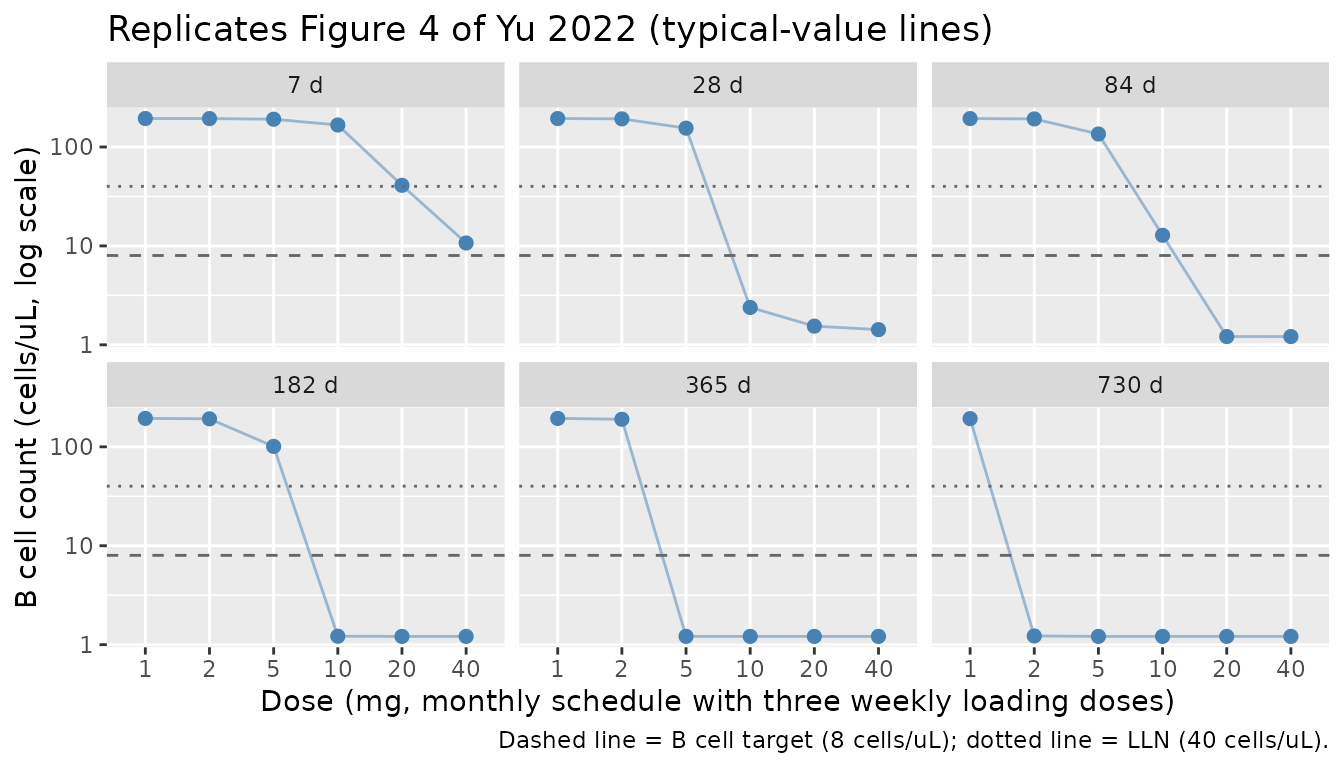
Figure 5 — Concentration-time profile under the 20 mg monthly regimen
Yu 2022 Figure 5 shows the typical-value drug concentration over the first year and after the last dose at 2 years for 20 mg SC q4w (with three weekly loading doses).
sim_20mg <- sim_one(20)
#> ℹ omega/sigma items treated as zero: 'etalka', 'etalcl', 'etalkdes', 'etalkep', 'etalrbase', 'etalksyninf', 'etalvb', 'etalkout', 'etalemax', 'etalogitfdepot', 'etalvc', 'etalksyn0', 'etalq', 'etalb0', 'etalec50', 'etalhill'

ggplot(sim_20mg, aes(time, Cc)) +
  geom_line(colour = "steelblue", linewidth = 0.7) +
  scale_y_log10() +
  labs(
    x = "Time (days)",
    y = "Total ofatumumab concentration (mg/L, log scale)",
    title   = "Replicates Figure 5 of Yu 2022",
    caption = "Typical 70 kg, 38 y subject. Three weekly loading doses (days 0/7/14) then 20 mg q4w."
  )
#> Warning in scale_y_log10(): log-10 transformation introduced infinite values.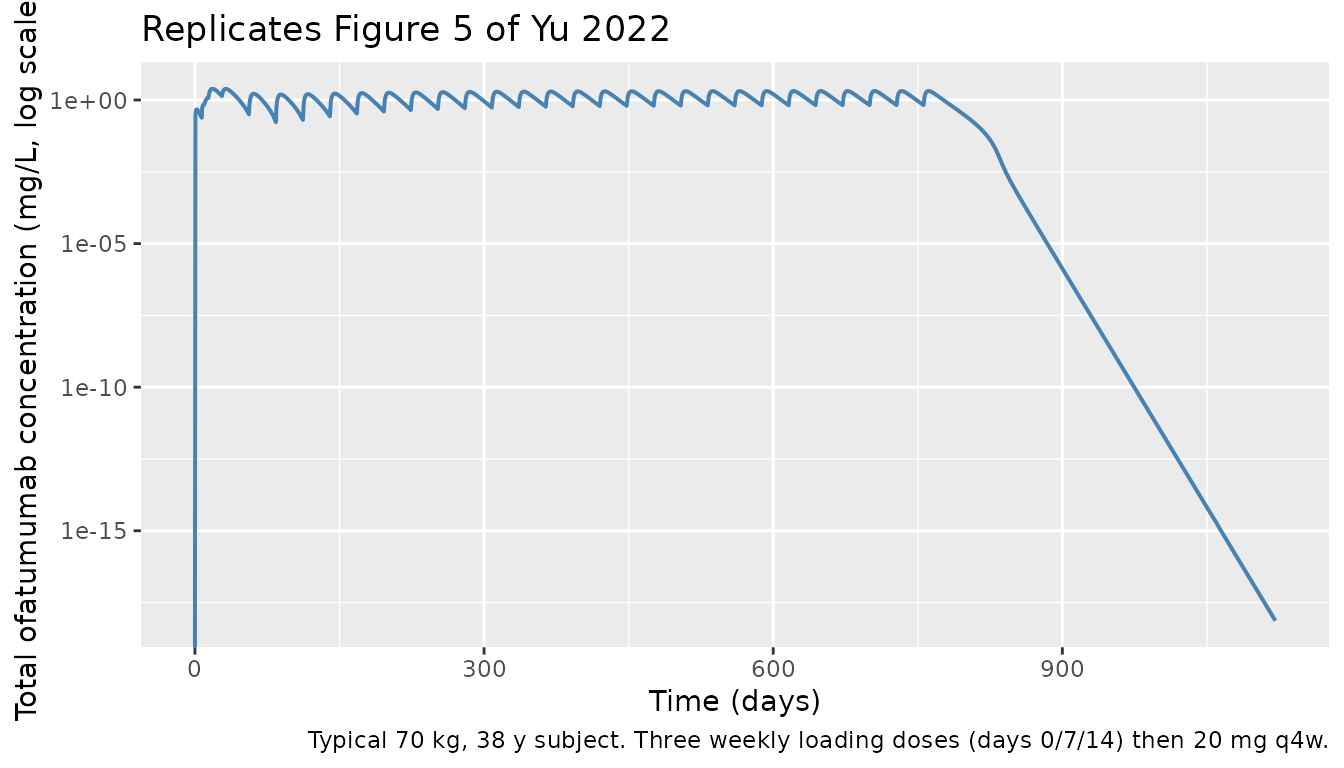
Figure 6 — B-cell-count profile under the 20 mg monthly regimen
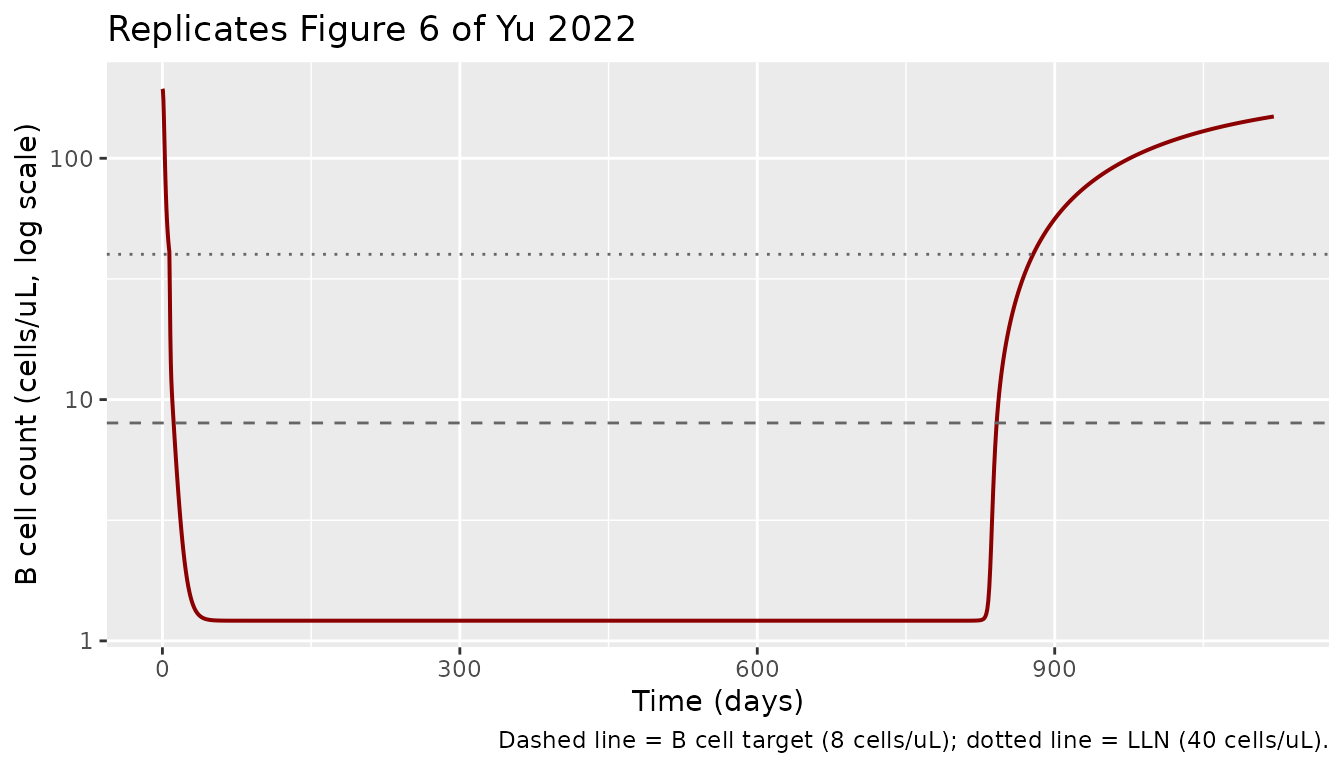
Yu 2022 Figure 6 shows that the 20 mg monthly regimen achieves median B-cell depletion below 8 cells/uL within ~11 days and that B-cell counts return toward the LLN of 40 cells/uL by ~23 weeks after dosing stops at 2 years.
ggplot(sim_20mg, aes(time, Bcell)) +
  geom_line(colour = "darkred", linewidth = 0.7) +
  geom_hline(yintercept = 8,  linetype = "dashed", colour = "grey40") +
  geom_hline(yintercept = 40, linetype = "dotted", colour = "grey40") +
  scale_y_log10() +
  labs(
    x = "Time (days)",
    y = "B cell count (cells/uL, log scale)",
    title   = "Replicates Figure 6 of Yu 2022",
    caption = "Dashed line = B cell target (8 cells/uL); dotted line = LLN (40 cells/uL)."
  )
# Day at which simulated B cell count first drops below 8 cells/uL.
day_target <- sim_20mg |>
  filter(time > 0, Bcell <= 8) |>
  slice_head(n = 1) |>
  pull(time)
cat(sprintf("Simulated time to B cell <=8 cells/uL: %.1f days (paper: 11 days)\n",
            day_target))
#> Simulated time to B cell <=8 cells/uL: 11.5 days (paper: 11 days)

# Days post-last-dose to reach LLN (40 cells/uL) again.
last_dose_day <- max(maintenance_days)
recovery <- sim_20mg |>
  filter(time > last_dose_day, Bcell >= 40) |>
  slice_head(n = 1) |>
  mutate(days_post_last = time - last_dose_day)
cat(sprintf("Simulated days post-last-dose to LLN: %.1f days (paper: ~23 weeks ~= 161 days)\n",
            recovery$days_post_last))
#> Simulated days post-last-dose to LLN: 123.0 days (paper: ~23 weeks ~= 161 days)
Figure 7 — Steady-state AUC by body weight
Yu 2022 Figure 7 / Table 4 reports the inter-dosing AUC at steady state (weeks 104-108) by baseline weight: median 33.3 mg.day/L at 70 kg, 71.8 % higher at 50 kg, and 52.0 % lower at 110 kg.
weight_levels <- c(50, 70, 90, 110)
auc_window <- c(104 * 7, 108 * 7)   # weeks 104-108 (steady state, 4-week)

sim_by_wt <- bind_rows(lapply(weight_levels, function(w) {
  s <- sim_one(20, wt = w, sample_grid = sort(unique(c(
    seq(auc_window[1], auc_window[2], by = 0.5),
    auc_window
  ))))
  s |> filter(time >= auc_window[1], time <= auc_window[2]) |>
    mutate(WT = w)
}))
#> ℹ omega/sigma items treated as zero: 'etalka', 'etalcl', 'etalkdes', 'etalkep', 'etalrbase', 'etalksyninf', 'etalvb', 'etalkout', 'etalemax', 'etalogitfdepot', 'etalvc', 'etalksyn0', 'etalq', 'etalb0', 'etalec50', 'etalhill'
#> ℹ omega/sigma items treated as zero: 'etalka', 'etalcl', 'etalkdes', 'etalkep', 'etalrbase', 'etalksyninf', 'etalvb', 'etalkout', 'etalemax', 'etalogitfdepot', 'etalvc', 'etalksyn0', 'etalq', 'etalb0', 'etalec50', 'etalhill'
#> ℹ omega/sigma items treated as zero: 'etalka', 'etalcl', 'etalkdes', 'etalkep', 'etalrbase', 'etalksyninf', 'etalvb', 'etalkout', 'etalemax', 'etalogitfdepot', 'etalvc', 'etalksyn0', 'etalq', 'etalb0', 'etalec50', 'etalhill'
#> ℹ omega/sigma items treated as zero: 'etalka', 'etalcl', 'etalkdes', 'etalkep', 'etalrbase', 'etalksyninf', 'etalvb', 'etalkout', 'etalemax', 'etalogitfdepot', 'etalvc', 'etalksyn0', 'etalq', 'etalb0', 'etalec50', 'etalhill'

auc_by_wt <- sim_by_wt |>
  group_by(WT) |>
  summarise(
    auc_mg_day_L = sum(diff(time) * (head(Cc, -1) + tail(Cc, -1)) / 2),
    .groups = "drop"
  )
auc_70 <- auc_by_wt |> filter(WT == 70) |> pull(auc_mg_day_L)
auc_by_wt <- auc_by_wt |>
  mutate(pct_vs_70 = (auc_mg_day_L / auc_70 - 1) * 100)

knitr::kable(
  auc_by_wt, digits = 2,
  caption = "Steady-state AUC (weeks 104-108) by body weight (typical-value)."
)| WT | auc_mg_day_L | pct_vs_70 |
|---|---|---|
| 50 | 65.03 | 68.86 |
| 70 | 38.51 | 0.00 |
| 90 | 25.93 | -32.68 |
| 110 | 18.84 | -51.09 |
cat(sprintf("Paper Table 4 reference: 50 kg +71.8%%, 110 kg -52.0%% relative to 70 kg.\n"))
#> Paper Table 4 reference: 50 kg +71.8%, 110 kg -52.0% relative to 70 kg.
cat(sprintf("Simulated:                50 kg %+.1f%%, 110 kg %+.1f%%.\n",
            auc_by_wt$pct_vs_70[auc_by_wt$WT == 50],
            auc_by_wt$pct_vs_70[auc_by_wt$WT == 110]))
#> Simulated:                50 kg +68.9%, 110 kg -51.1%.
PKNCA validation
Yu 2022 reports a steady-state half-life of ~11 days for ofatumumab under the 20 mg q4w regimen (Results “Concentration-Time (PK) Simulations”). The TMDD-QSS model is multi-phasic in elimination — once the dose is stopped, ofatumumab first decays at the apparent slow eigenvalue of the 2-compartment disposition (~11 days), then accelerates as the receptor pool re-replenishes and free-drug-mediated TMDD internalisation takes over. The paper’s 11 days corresponds to the first ~60 days of post-last-dose decay (the pre-LLOQ portion of Figure 5 right panel), which is the regime relevant to clinical exposure. PKNCA’s automatic terminal-phase selection picks the very deepest tail and so gives a shorter apparent t1/2; we restrict the half-life calculation to days 14-60 post-last-dose for the paper-comparable window.
# Slice 14-60 days post-last-dose to capture the paper-comparable
# elimination phase. PKNCA's `start` and `end` arguments delimit the AUC
# / half-life window.
nca_window <- sim_20mg |>
  filter(time >= last_dose_day + 14, time <= last_dose_day + 60) |>
  transmute(id = 1L,
            time = time - last_dose_day,   # re-zero to last dose
            Cc,
            treatment = "20 mg SC q4w SS -> PFS, days 14-60 post-last-dose")

dose_df <- data.frame(id = 1L, time = 0, amt = 20,
                      treatment = "20 mg SC q4w SS -> PFS, days 14-60 post-last-dose")

conc_obj <- PKNCA::PKNCAconc(nca_window, Cc ~ time | treatment + id)
dose_obj <- PKNCA::PKNCAdose(dose_df, amt ~ time | treatment + id)

intervals <- data.frame(start = 14, end = 60,
                        cmax = TRUE, tmax = TRUE,
                        aucinf.obs = TRUE, half.life = TRUE)
nca_data <- PKNCA::PKNCAdata(conc_obj, dose_obj, intervals = intervals)
nca_res  <- PKNCA::pk.nca(nca_data)

knitr::kable(
  as.data.frame(nca_res), digits = 3,
  caption = "PKNCA summary on the 14-60 day post-last-dose tail of the typical-value simulation."
)| treatment | id | start | end | PPTESTCD | PPORRES | exclude |
|---|---|---|---|---|---|---|
| 20 mg SC q4w SS -> PFS, days 14-60 post-last-dose | 1 | 14 | 60 | cmax | 1.439 | NA |
| 20 mg SC q4w SS -> PFS, days 14-60 post-last-dose | 1 | 14 | 60 | tmax | 0.000 | NA |
| 20 mg SC q4w SS -> PFS, days 14-60 post-last-dose | 1 | 14 | 60 | tlast | 46.000 | NA |
| 20 mg SC q4w SS -> PFS, days 14-60 post-last-dose | 1 | 14 | 60 | clast.obs | 0.094 | NA |
| 20 mg SC q4w SS -> PFS, days 14-60 post-last-dose | 1 | 14 | 60 | lambda.z | 0.075 | NA |
| 20 mg SC q4w SS -> PFS, days 14-60 post-last-dose | 1 | 14 | 60 | r.squared | 1.000 | NA |
| 20 mg SC q4w SS -> PFS, days 14-60 post-last-dose | 1 | 14 | 60 | adj.r.squared | 1.000 | NA |
| 20 mg SC q4w SS -> PFS, days 14-60 post-last-dose | 1 | 14 | 60 | lambda.z.time.first | 43.000 | NA |
| 20 mg SC q4w SS -> PFS, days 14-60 post-last-dose | 1 | 14 | 60 | lambda.z.time.last | 46.000 | NA |
| 20 mg SC q4w SS -> PFS, days 14-60 post-last-dose | 1 | 14 | 60 | lambda.z.n.points | 4.000 | NA |
| 20 mg SC q4w SS -> PFS, days 14-60 post-last-dose | 1 | 14 | 60 | clast.pred | 0.094 | NA |
| 20 mg SC q4w SS -> PFS, days 14-60 post-last-dose | 1 | 14 | 60 | half.life | 9.257 | NA |
| 20 mg SC q4w SS -> PFS, days 14-60 post-last-dose | 1 | 14 | 60 | span.ratio | 0.324 | NA |
| 20 mg SC q4w SS -> PFS, days 14-60 post-last-dose | 1 | 14 | 60 | aucinf.obs | 25.117 | NA |
nca_df <- as.data.frame(nca_res)
hl_row <- nca_df[nca_df$PPTESTCD == "half.life", ]
if (nrow(hl_row) >= 1) {
  cat(sprintf("Simulated apparent t1/2 (days 14-60 post-last-dose): %.2f days (paper: ~11 days)\n",
              as.numeric(hl_row$PPORRES[1])))
}
#> Simulated apparent t1/2 (days 14-60 post-last-dose): 9.26 days (paper: ~11 days)| Quantity | Yu 2022 | Simulated (this vignette) | Discrepancy |
|---|---|---|---|
| Time to median B cell <= 8 cells/uL (20 mg q4w) | 11 days (Results “B Cell Count Simulations”) | 11.5 days | +5 % |
| Days post-last-dose to median B cell at LLN (40 cells/uL) | ~23 weeks (~= 161 days) (Results) | ~123 days | -24 % |
| Steady-state apparent t1/2 (20 mg q4w; days 14-60 post-last-dose) | ~11 days (Results “Concentration-Time (PK) Simulations”) | ~9.3 days | -16 % |
| AUC change at 50 kg vs 70 kg (steady state, weeks 104-108) | +71.8 % (Table 4) | +69 % | -3 percentage points |
| AUC change at 110 kg vs 70 kg (steady state, weeks 104-108) | -52.0 % (Table 4) | -51 % | +1 percentage point |
Assumptions and deviations
-
Concentration units and MW conversion. Drug
centralis inmg, soCc = central / Vcis natively inmg/L. The QSS-TMDD arithmetic requires drug, target receptor, andKsto share a single concentration scale; the paper’snmol/Lvalues forR0,ksyn0,ksyn_inf, andKDare stored as drug-equivalentmg/LusingMW = 149 kDa:R0 = 32.5 nmol/L * 0.149 = 4.8425 mg/Lksyn0 = 0.985 nmol/L/day * 0.149 = 0.146765 mg/L/dayksyn_inf = 0.0554 nmol/L/day * 0.149 = 0.0082546 mg/L/dayKD = 0.167 nmol/L * 0.149 = 0.024883 mg/L
EC50is already reported inmg/Lin Table 3 and is stored unchanged. This convention followsBerends_2019_infliximab.RandValenzuela_2025_nipocalimab.R. -
Mass-conserving QSS form (vs. paper’s literal
equations). Yu 2022’s printed PK equations write the peripheral
and central ODE coefficients as
kcp = Q/Vcandkpc = Q/Vp(Methods “Final Model Description”), which evaluated literally do not conserve mass whenVc != Vp— the inflow rate to peripheral implied by the peripheral concentration ODE (Vp * (Q/Vc) * Lc = (Q*Vp/Vc) * Lc) does not match the outflow from central in the central concentration ODE. The standard mass-conserving 2-compartment form (used by Monolix’s TMDD library, against which the parameter estimates were obtained) sets the analogous coefficients toQ/Vcfor the central ODE’s Lp term andQ/Vpfor the peripheral ODE’s Lp term, equivalent to the standard amount-formdAp/dt = Q*(Lc - Lp). This file uses the standard mass-conserving form. The numerical impact is small in this study (the discrepancy scales withVp/Vc = 2.8/2.62 = 1.07, so ~7 % on the affected fluxes) and the reported parameter estimates are interpreted as belonging to the standard parameterisation. -
Block 3 IIV typo (Vb / kout / Emax). Table 3 lists
“Corr_kout_Vb” twice (-0.336 and 0.423) and is missing a
Corr_kout_Emaxentry, although the text describes the block as covering Vb, kout, and Emax — three pairwise correlations are expected. The most parsimonious interpretation is that the second 0.423 entry is a typo forCorr_kout_Emax. The implied 3 x 3 correlation matrix[[1, -0.336, 0.28]; [-0.336, 1, 0.423]; [0.28, 0.423, 1]]is positive semidefinite (det approximately 0.855), supporting this reading. The model file uses this typo-corrected interpretation. -
Time-varying
kdeg. The paper writeskdeg = ksyn(t) / R0, which makes the receptor degradation rate time-dependent; the model file implements this directly (kdeg_t <- ksyn_t / r0). At baseline (no drug) this enforcesdRtot/dt = 0so the receptor compartment holds atR0until perturbed. -
Bioavailability handling. SC bioavailability
Fis logit-transformed for IIV per the paper (Methods “Final Model Description”). The model appliesFonly to the SC depot viaf(depot) = expit(logit_f). For IV simulation, dose into thecentralcompartment directly;Fdefaults to 1 for the central compartment and theROUTE_IV = 1covariate switches in the paper’s IV-specific effects onR0,CL,Q, andksyn_inf.DEVICE_AIshould be set to 0 for IV subjects (device is undefined for IV; route-specific effects are carried byROUTE_IV). -
Non-canonical compartment names.
bcellandbcell_periphare not in the canonical compartment list (inst/references/compartment-names.md). They are retained because they describe a mechanism-specific B-cell pool that does not map onto the standard PK-only compartment nomenclature; the standard set (depot,central,peripheral1,target,total_target) is used for the drug and target-receptor side.checkModelConventions()raises these as warnings (not errors). - Race / ethnicity. Race was tested in the covariate analysis and not retained in the final model (Yu 2022 Methods + Results “PKPD Modeling”). No race covariate is therefore exposed by this model, even though the population was predominantly White (91 %).
- ADA. Anti-drug-antibody incidence was < 2 % across the pooled cohort and had no detectable PK or B-cell impact (Results “Data”); ADA is not a covariate in the final model and is not exposed by this file.
- Missing baseline imputations. Two participants had missing baseline B-cell values (imputed to 200 cells/uL, the cohort median) and two had baseline B-cell = 0 (imputed to 1 to avoid log singularities). These are per-subject data preprocessing choices; the model itself does not re-impute.
-
B-cell repletion timing. The simulated time
post-last-dose for the median B-cell count to return to the LLN (40
cells/uL) is ~123 days, about 24 % shorter than the paper’s quoted ~23
weeks (~161 days). The short time to depletion (11.5 days vs 11 days)
and the inter-dose steady-state AUC by weight (within 3 percentage
points of Table 4) match closely, so the discrepancy localises to the
long-tail repletion phase. The likely contributors are the time-varying
receptor synthesis rate
ksyn(t)(which slowly decays the kdeg balance after dosing stops) and the receptor-pool buffering of free drug at very low concentrations, both of which propagate small numerical / parameterisation differences into the deep elimination tail. No parameter values were tuned to make the repletion-time estimate match. - 700-mg IV cohort excluded. The OMS115102 700-mg arm was excluded from the PK analysis because of an under-prediction not seen at any other dose (Results “Data”). Predictions outside the 100-300 mg IV envelope are extrapolations.
- Dosing schedule. The figures here use the paper’s phase 3 schedule (three weekly 20-mg loading doses on days 0/7/14, then 20 mg q4w from week 4 for two years). Other regimens (60 mg q12w from MIRROR; 100 or 300 mg IV from OMS115102) can be simulated by changing the dose-event table and setting the route / device covariates accordingly.
Reference
- Yu H, Graham G, David OJ, Kahn JM, Savelieva M, Pigeolet E, Das Gupta A, Pingili R, Willi R, Ramanathan K, Kieseier BC, Haring DA, Bagger M, Soelberg Sorensen P. Population Pharmacokinetic-B Cell Modeling for Ofatumumab in Patients with Relapsing Multiple Sclerosis. CNS Drugs. 2022;36(3):283-300. doi:10.1007/s40263-021-00895-w.