Piperacillin + tazobactam (Nichols 2016)
Source:vignettes/articles/Nichols_2016_piperacillin_tazobactam.Rmd
Nichols_2016_piperacillin_tazobactam.RmdModels and source
Two independent one-compartment population PK models for the
components of extended-infusion piperacillin-tazobactam (TZP) in
critically ill children. The authors fit piperacillin and tazobactam
separately by NONMEM (FOCEi) sharing only the underlying patient cohort;
the two modellib() entries below mirror that
independent-fit structure.
- Piperacillin: Nichols K, Chung EK, Knoderer CA, Buenger LE, Healy DP, Dees J, Crumby AS, Kays MB. Population pharmacokinetics and pharmacodynamics of extended-infusion piperacillin and tazobactam in critically ill children. Antimicrob Agents Chemother. 2016;60(1):522-531. doi:10.1128/AAC.02089-15.
- Tazobactam: Nichols K, Chung EK, Knoderer CA, Buenger LE, Healy DP, Dees J, Crumby AS, Kays MB. Population pharmacokinetics and pharmacodynamics of extended-infusion piperacillin and tazobactam in critically ill children. Antimicrob Agents Chemother. 2016;60(1):522-531. doi:10.1128/AAC.02089-15.
- Article: https://doi.org/10.1128/AAC.02089-15
Population
Nichols et al. (2016) developed independent one-compartment population PK models for piperacillin and tazobactam in twelve children (six female, six male) hospitalised in the Riley Hospital for Children pediatric intensive care unit and receiving extended-infusion piperacillin-tazobactam (100 mg/kg piperacillin and 12.5 mg/kg tazobactam, 8:1 ratio) every 8 hours infused over 4 hours, as part of routine care for suspected or proven bacterial infection. Indications spanned ventilator-associated pneumonia, sepsis, central line-associated bloodstream infection, neutropenic fever, and pneumonia in patients with complex congenital heart disease, cerebral palsy, traumatic brain injury, and post-transplant complications (Table 1).
The cohort spanned age 12 months to 9 years (median 5 years, IQR 1.75-6.5), body weight 9.5-30.1 kg (median 17.8 kg, IQR 11.4-20), and estimated glomerular filtration rate 86-189 mL/min/1.73 m^2 (modified Schwartz; median 103). Patients with eGFR < 60 mL/min/1.73 m^2 or receiving any form of renal replacement therapy were excluded. Each patient contributed six serum samples at steady state (pre-dose and at 2, 4 [end of infusion], 5, 6, and 8 hours after the start of the study dose), for a total of 72 piperacillin and 72 tazobactam concentrations.
The same metadata is available programmatically via
readModelDb("Nichols_2016_piperacillin")()$population and
readModelDb("Nichols_2016_tazobactam")()$population.
Source trace
The per-parameter origin is recorded as an in-file comment next to
each ini() entry. The table below collects them in one
place.
| Equation / parameter | Value | Source location |
|---|---|---|
| Piperacillin | ||
lcl (CL at WT = 18 kg, L/h) |
log(3.51) |
Nichols 2016 Table 2: theta1 = 3.51 L/h (%SE 6.5) |
lvc (V, L) |
log(6.58) |
Nichols 2016 Table 2: theta2 = 6.58 L (%SE 10.6) |
e_wt_cl (linear WT slope on CL, L/h/kg) |
0.0814 |
Nichols 2016 Table 2: theta3 = 0.0814 (%SE 45.1) |
bw_ref (reference WT, kg) |
18 |
Nichols 2016 Results final-model paragraph (CL = 3.51 + 0.0814 * (WT - 18)) |
etalcl (omega_CL) |
0.029497 (17.3% CV) |
Nichols 2016 Table 2: omega_CL 17.3% CV; omega^2 = log(1 + CV^2) |
etalvc (omega_V) |
0.061539 (25.2% CV) |
Nichols 2016 Table 2: omega_V 25.2% CV |
propSd (proportional residual) |
0.253 |
Nichols 2016 Table 2: sigma_proportional 25.3% CV |
| Eq. CL (linear-additive WT) | n/a | Nichols 2016 Results: “CL (in liters per hour) = 3.51 + [0.0814 * (WT - 18)], and V was equal to 6.58 liters” |
| Eq. d/dt(central) (1-cmt IV) | n/a | Nichols 2016 Population pharmacokinetic modeling subsection (Materials and Methods) |
| Tazobactam | ||
lcl (CL at WT = 18 kg, male, L/h) |
log(3.43) |
Nichols 2016 Table 2: theta1 = 3.43 L/h (%SE 5.9) |
lvc (V, L) |
log(5.54) |
Nichols 2016 Table 2: theta2 = 5.54 L (%SE 8.9) |
e_sexf_cl (female-sex factor on CL) |
-0.285 |
Nichols 2016 Table 2: theta3 = -0.285 (%SE 20.9) |
e_wt_cl (linear WT slope on CL, L/h/kg) |
0.0676 |
Nichols 2016 Table 2: theta4 = 0.0676 (%SE 38.6) |
bw_ref (reference WT, kg) |
18 |
Nichols 2016 Results final-model paragraph |
etalcl (omega_CL) |
0.017028 (13.1% CV) |
Nichols 2016 Table 2: omega_CL 13.1% CV |
propSd (proportional residual) |
0.272 |
Nichols 2016 Table 2: sigma_proportional 27.2% CV |
addSd (additive residual, mg/L) |
0.76 |
Nichols 2016 Table 2: sigma_additive 0.76 mg/L (%SE 47.8) |
| Eq. CL (female + WT) | n/a | Nichols 2016 Results: “CL (in liters per hour) = {3.43 * [1 - (0.285 * sex)]} + [0.0676 * (WT - 18)], and V was equal to 5.54 liters” |
Virtual cohort
Original observed concentrations are not publicly available. The simulation below uses the twelve actual patient demographics reported in Nichols 2016 Table 1 (per-patient weight and sex), each receiving the protocol regimen of 100 mg/kg piperacillin (12.5 mg/kg tazobactam) every 8 hours infused over 4 hours, simulated to steady state.
set.seed(2016)

# Per-patient demographics from Nichols 2016 Table 1 (12 children).
# Sex: 1 = female, 0 = male (canonical SEXF).
nichols_table1 <- tibble::tibble(
  pat_id = 1:12,
  WT     = c(20.0, 18.8, 11.9, 19.7, 9.5, 10.0, 14.5, 16.8, 23.0, 30.1, 9.6, 20.0),
  SEXF   = c(   0,    1,    1,    0,   1,    1,    0,    0,    1,    1,   0,    0)
)

# Dosing regimen from Nichols 2016 Methods (Study design and blood sampling):
# 100 mg/kg piperacillin component, 12.5 mg/kg tazobactam component,
# every 8 hours, infused over 4 hours, maximum 3,000 mg of the piperacillin
# component per dose.
DOSE_MG_PIP_PER_KG  <- 100
DOSE_MG_TAZ_PER_KG  <- 12.5
T_INF               <- 4    # hour 4-hour extended infusion
DOSE_INTERVAL       <- 8    # hours
N_DOSES_TO_SS       <- 10   # ten doses to reach steady state (paper: median 5 prior doses)

# Steady-state sampling grid: dense over the final 8-hour dosing interval
# to support PKNCA (Cmax/Tmax/AUC/half-life over the last tau).
last_dose_start <- (N_DOSES_TO_SS - 1L) * DOSE_INTERVAL
ss_obs_times    <- last_dose_start + seq(0, DOSE_INTERVAL, by = 0.1)

make_subject <- function(row, drug = c("pip", "taz"), id_offset = 0L) {
  drug <- match.arg(drug)
  dose_mg <- if (drug == "pip") {
    pmin(DOSE_MG_PIP_PER_KG * row$WT, 3000)
  } else {
    DOSE_MG_TAZ_PER_KG * row$WT
  }
  ev <- rxode2::et(
    amt   = dose_mg,
    rate  = dose_mg / T_INF,
    cmt   = "central",
    ii    = DOSE_INTERVAL,
    addl  = N_DOSES_TO_SS - 1L,
    time  = 0
  )
  ev <- rxode2::et(ev, ss_obs_times)
  df <- as.data.frame(ev)
  df$WT     <- row$WT
  df$SEXF   <- row$SEXF
  df$id     <- id_offset + row$pat_id
  df$drug   <- drug
  df$cohort <- if (drug == "pip") "Piperacillin" else "Tazobactam"
  df
}

events_pip <- dplyr::bind_rows(lapply(seq_len(nrow(nichols_table1)), function(i)
  make_subject(nichols_table1[i, ], drug = "pip", id_offset = 0L)))
events_taz <- dplyr::bind_rows(lapply(seq_len(nrow(nichols_table1)), function(i)
  make_subject(nichols_table1[i, ], drug = "taz", id_offset = 100L)))

stopifnot(!anyDuplicated(unique(events_pip[, c("id", "time", "evid")])))
stopifnot(!anyDuplicated(unique(events_taz[, c("id", "time", "evid")])))
Simulation
Simulate piperacillin and tazobactam concentrations under the protocol regimen at steady state. The deterministic typical-value profile (no IIV) is used for the figure replicates because Nichols 2016 Figure 3 plots a visual predictive check whose central line is the simulated median.
mod_pip <- readModelDb("Nichols_2016_piperacillin")()
mod_taz <- readModelDb("Nichols_2016_tazobactam")()

# Stochastic simulation (full IIV) for VPC-style figures
sim_pip <- rxode2::rxSolve(mod_pip, events = events_pip,
                           keep = c("cohort", "WT", "SEXF")) |>
  as.data.frame()
sim_taz <- rxode2::rxSolve(mod_taz, events = events_taz,
                           keep = c("cohort", "WT", "SEXF")) |>
  as.data.frame()

# Typical-value profiles (zero IIV) for parameter-distribution audit
sim_pip_typ <- rxode2::rxSolve(rxode2::zeroRe(mod_pip), events = events_pip,
                               keep = c("cohort", "WT", "SEXF")) |>
  as.data.frame()
#> ℹ omega/sigma items treated as zero: 'etalcl', 'etalvc'
#> Warning: multi-subject simulation without without 'omega'
sim_taz_typ <- rxode2::rxSolve(rxode2::zeroRe(mod_taz), events = events_taz,
                               keep = c("cohort", "WT", "SEXF")) |>
  as.data.frame()
#> ℹ omega/sigma items treated as zero: 'etalcl'
#> Warning: multi-subject simulation without without 'omega'
Replicate published figures
Figure 3 – VPC over the steady-state 8-hour dosing interval
Nichols 2016 Figure 3 shows visual predictive checks for piperacillin (panel a) and tazobactam (panel b) at the protocol regimen (100/12.5 mg/kg every 8 h infused over 4 h). The replicate below computes the simulated 5th, 50th, and 95th percentile profiles across the twelve-patient cohort, using the final dosing interval at steady state, plotted on the time-after-last-dose axis used by the paper.
last_dose_t <- last_dose_start

vpc_pip <- sim_pip |>
  dplyr::filter(time >= last_dose_t,
                time <= last_dose_t + DOSE_INTERVAL,
                !is.na(Cc), Cc > 0) |>
  dplyr::mutate(tad = time - last_dose_t) |>
  dplyr::group_by(tad) |>
  dplyr::summarise(
    Q05 = quantile(Cc, 0.05, na.rm = TRUE),
    Q50 = quantile(Cc, 0.50, na.rm = TRUE),
    Q95 = quantile(Cc, 0.95, na.rm = TRUE),
    .groups = "drop"
  )

ggplot(vpc_pip, aes(tad, Q50)) +
  geom_ribbon(aes(ymin = Q05, ymax = Q95), alpha = 0.20, fill = "steelblue") +
  geom_line(linewidth = 0.9, colour = "steelblue") +
  scale_y_log10() +
  labs(
    x       = "Time after start of infusion (h)",
    y       = "Piperacillin concentration (mg/L)",
    title   = "Figure 3a -- VPC of piperacillin at steady state",
    caption = paste(
      "Replicates Figure 3a of Nichols 2016 (100 mg/kg piperacillin q8h,",
      "4-hour infusion). Ribbon: simulated 5th-95th percentile,",
      "line: simulated median across the twelve-patient cohort."
    )
  ) +
  theme_minimal()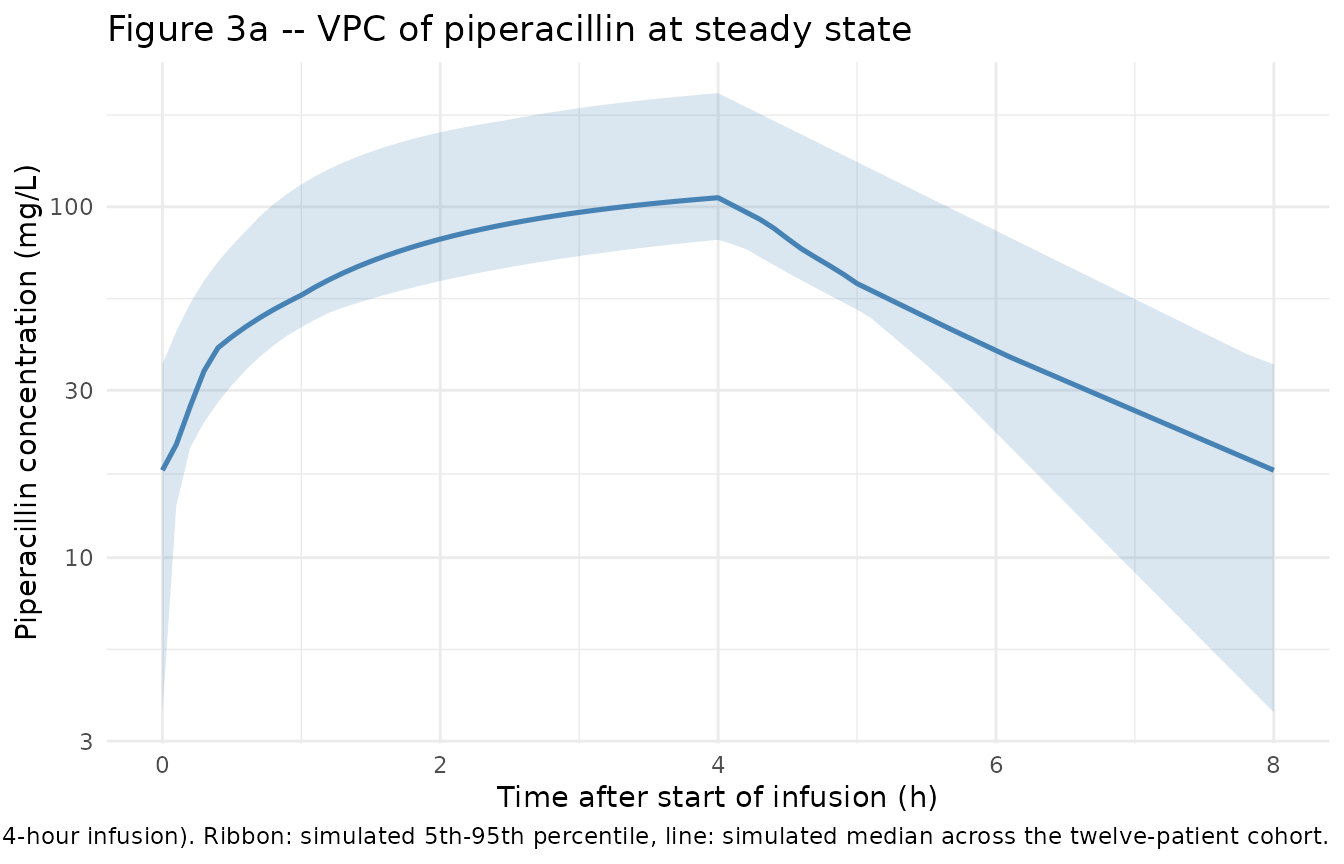
vpc_taz <- sim_taz |>
  dplyr::filter(time >= last_dose_t,
                time <= last_dose_t + DOSE_INTERVAL,
                !is.na(Cc), Cc > 0) |>
  dplyr::mutate(tad = time - last_dose_t) |>
  dplyr::group_by(tad) |>
  dplyr::summarise(
    Q05 = quantile(Cc, 0.05, na.rm = TRUE),
    Q50 = quantile(Cc, 0.50, na.rm = TRUE),
    Q95 = quantile(Cc, 0.95, na.rm = TRUE),
    .groups = "drop"
  )

ggplot(vpc_taz, aes(tad, Q50)) +
  geom_ribbon(aes(ymin = Q05, ymax = Q95), alpha = 0.20, fill = "darkorange") +
  geom_line(linewidth = 0.9, colour = "darkorange") +
  scale_y_log10() +
  labs(
    x       = "Time after start of infusion (h)",
    y       = "Tazobactam concentration (mg/L)",
    title   = "Figure 3b -- VPC of tazobactam at steady state",
    caption = paste(
      "Replicates Figure 3b of Nichols 2016 (12.5 mg/kg tazobactam q8h,",
      "4-hour infusion). Ribbon: simulated 5th-95th percentile,",
      "line: simulated median across the twelve-patient cohort."
    )
  ) +
  theme_minimal()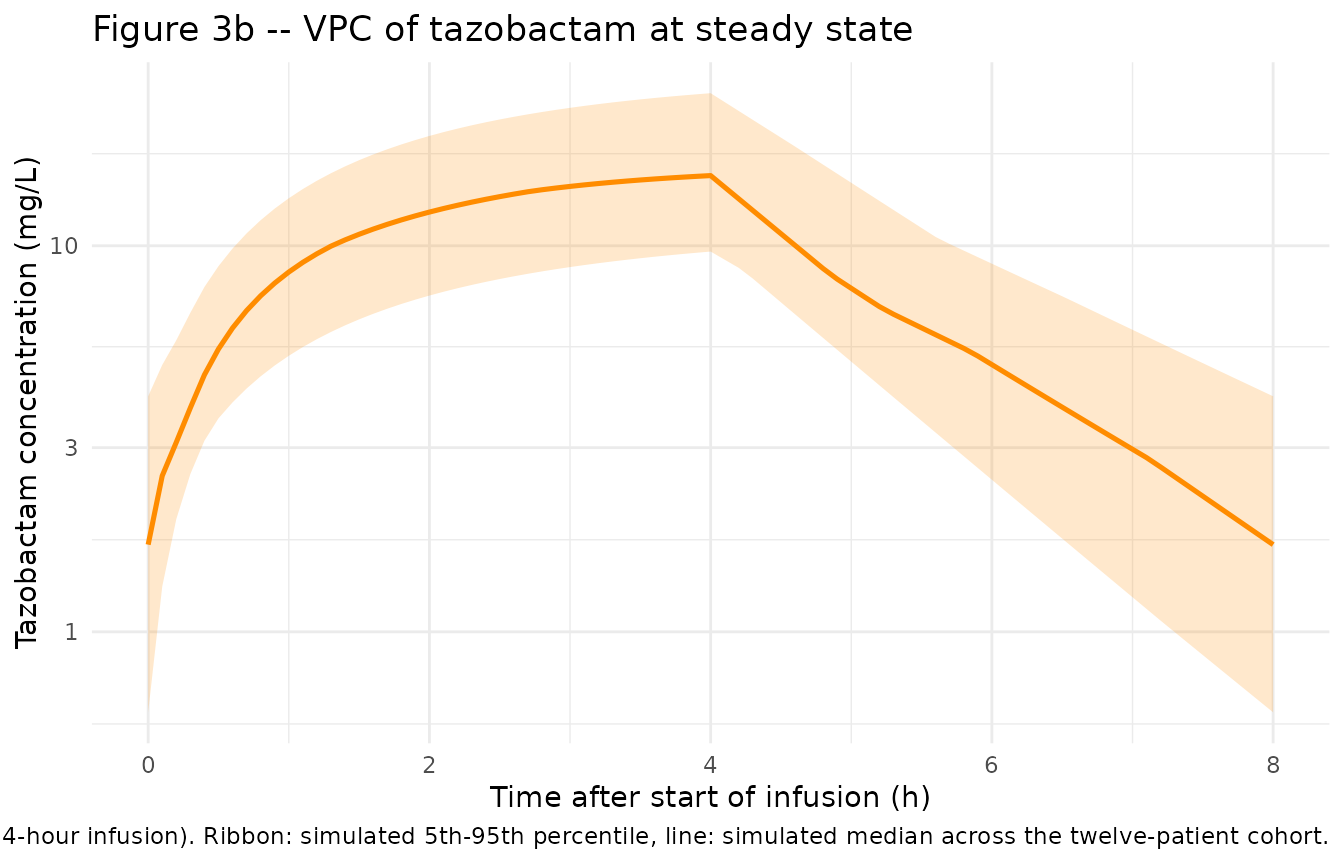
Typical-value individual-PK parameter check
Table 3 of Nichols 2016 reports the mean +/- SD (range) for the per-patient pharmacokinetic parameters back-calculated from the final models. The table below compares the model-derived typical-value CL and V across the twelve patients against the published Table 3 means.
# Piperacillin: typical CL = 3.51 + 0.0814 * (WT - 18); V = 6.58 L (constant)
typ_pip <- nichols_table1 |>
  dplyr::mutate(
    CL_typical = 3.51 + 0.0814 * (WT - 18),
    V_typical  = 6.58,
    CL_per_kg  = CL_typical / WT,
    V_per_kg   = V_typical / WT
  )

knitr::kable(
  typ_pip |>
    dplyr::summarise(
      n            = dplyr::n(),
      `CL (L/h)`           = sprintf("%.2f +/- %.2f (%.2f-%.2f)",
                                     mean(CL_typical), sd(CL_typical),
                                     min(CL_typical), max(CL_typical)),
      `CL (L/h/kg)`        = sprintf("%.2f +/- %.2f (%.2f-%.2f)",
                                     mean(CL_per_kg), sd(CL_per_kg),
                                     min(CL_per_kg), max(CL_per_kg)),
      `V  (L)`             = sprintf("%.2f +/- %.2f (%.2f-%.2f)",
                                     mean(V_typical), sd(V_typical),
                                     min(V_typical), max(V_typical)),
      `V  (L/kg)`          = sprintf("%.2f +/- %.2f (%.2f-%.2f)",
                                     mean(V_per_kg), sd(V_per_kg),
                                     min(V_per_kg), max(V_per_kg))
    ),
  caption = "Piperacillin: model-derived typical CL and V across Nichols 2016 Table 1 demographics; compare to Table 3 of the paper."
)| n | CL (L/h) | CL (L/h/kg) | V (L) | V (L/kg) |
|---|---|---|---|---|
| 12 | 3.43 +/- 0.51 (2.82-4.49) | 0.22 +/- 0.05 (0.15-0.30) | 6.58 +/- 0.00 (6.58-6.58) | 0.44 +/- 0.17 (0.22-0.69) |
# Tazobactam: typical CL = 3.43 * (1 - 0.285 * SEXF) + 0.0676 * (WT - 18);
# V = 5.54 L (constant; no IIV on V)
typ_taz <- nichols_table1 |>
  dplyr::mutate(
    CL_typical = 3.43 * (1 - 0.285 * SEXF) + 0.0676 * (WT - 18),
    V_typical  = 5.54,
    CL_per_kg  = CL_typical / WT,
    V_per_kg   = V_typical / WT
  )

knitr::kable(
  typ_taz |>
    dplyr::summarise(
      n            = dplyr::n(),
      `CL (L/h)`           = sprintf("%.2f +/- %.2f (%.2f-%.2f)",
                                     mean(CL_typical), sd(CL_typical),
                                     min(CL_typical), max(CL_typical)),
      `CL (L/h/kg)`        = sprintf("%.2f +/- %.2f (%.2f-%.2f)",
                                     mean(CL_per_kg), sd(CL_per_kg),
                                     min(CL_per_kg), max(CL_per_kg)),
      `V  (L)`             = sprintf("%.2f +/- %.2f (%.2f-%.2f)",
                                     mean(V_typical), sd(V_typical),
                                     min(V_typical), max(V_typical)),
      `V  (L/kg)`          = sprintf("%.2f +/- %.2f (%.2f-%.2f)",
                                     mean(V_per_kg), sd(V_per_kg),
                                     min(V_per_kg), max(V_per_kg))
    ),
  caption = "Tazobactam: model-derived typical CL and V across Nichols 2016 Table 1 demographics; compare to Table 3 of the paper."
)| n | CL (L/h) | CL (L/h/kg) | V (L) | V (L/kg) |
|---|---|---|---|---|
| 12 | 2.87 +/- 0.65 (1.88-3.57) | 0.18 +/- 0.05 (0.11-0.30) | 5.54 +/- 0.00 (5.54-5.54) | 0.37 +/- 0.14 (0.18-0.58) |
PKNCA validation
Steady-state non-compartmental analysis over the final 8-hour dosing interval, separately for piperacillin and tazobactam. Cmax, Cmin (Ctau), AUC0-tau, and half-life are computed from the typical-value (zero-IIV) simulation so the cross-patient distribution is driven solely by the twelve documented covariate patterns rather than by stochastic noise; that matches the paper’s Table 3, which lists per-patient model-derived parameters with no residual error.
sim_pip_ss <- sim_pip_typ |>
  dplyr::filter(time >= last_dose_t,
                time <= last_dose_t + DOSE_INTERVAL,
                !is.na(Cc), Cc > 0)

# The simulation uses rxode2::et(addl = 9) which emits a single seed dose
# row; build an explicit dose row at the start of the final steady-state
# interval so PKNCA can locate Cmax / AUC0-tau against it.
dose_pip <- nichols_table1 |>
  dplyr::mutate(
    id     = pat_id,
    time   = last_dose_t,
    amt    = pmin(DOSE_MG_PIP_PER_KG * WT, 3000),
    cohort = "Piperacillin"
  ) |>
  dplyr::select(id, time, amt, cohort)

conc_pip_obj <- PKNCA::PKNCAconc(
  sim_pip_ss |> dplyr::select(id, time, Cc, cohort),
  Cc ~ time | cohort + id,
  concu = "mg/L",
  timeu = "hour"
)
dose_pip_obj <- PKNCA::PKNCAdose(
  dose_pip, amt ~ time | cohort + id,
  route = "intravascular",
  doseu = "mg"
)

intervals <- data.frame(
  start     = last_dose_t,
  end       = last_dose_t + DOSE_INTERVAL,
  cmax      = TRUE,
  cmin      = TRUE,
  auclast   = TRUE,
  half.life = TRUE
)

nca_pip <- suppressWarnings(
  PKNCA::pk.nca(PKNCA::PKNCAdata(conc_pip_obj, dose_pip_obj, intervals = intervals))
)
nca_pip_df <- as.data.frame(nca_pip$result)

nca_pip_summary <- nca_pip_df |>
  dplyr::group_by(PPTESTCD) |>
  dplyr::summarise(
    n      = dplyr::n(),
    mean   = round(mean(PPORRES, na.rm = TRUE), 2),
    sd     = round(sd(PPORRES, na.rm = TRUE), 2),
    min    = round(min(PPORRES, na.rm = TRUE), 2),
    max    = round(max(PPORRES, na.rm = TRUE), 2),
    .groups = "drop"
  )
knitr::kable(
  nca_pip_summary,
  caption = "Piperacillin steady-state NCA (mean, SD, range) over the final 8-hour interval, typical-value simulation across the twelve Table 1 patients."
)| PPTESTCD | n | mean | sd | min | max |
|---|---|---|---|---|---|
| adj.r.squared | 12 | 1.00 | 0.00 | 1.00 | 1.00 |
| auclast | 12 | 481.03 | 107.01 | 337.09 | 667.33 |
| clast.pred | 12 | 12.98 | 0.97 | 10.19 | 13.87 |
| cmax | 12 | 107.29 | 27.26 | 71.40 | 156.66 |
| cmin | 12 | 12.98 | 0.97 | 10.19 | 13.87 |
| half.life | 12 | 1.36 | 0.19 | 1.01 | 1.62 |
| lambda.z | 12 | 0.52 | 0.08 | 0.43 | 0.68 |
| lambda.z.n.points | 12 | 40.00 | 0.00 | 40.00 | 40.00 |
| lambda.z.time.first | 12 | 4.10 | 0.00 | 4.10 | 4.10 |
| lambda.z.time.last | 12 | 8.00 | 0.00 | 8.00 | 8.00 |
| r.squared | 12 | 1.00 | 0.00 | 1.00 | 1.00 |
| span.ratio | 12 | 2.93 | 0.43 | 2.41 | 3.84 |
| tlast | 12 | 8.00 | 0.00 | 8.00 | 8.00 |
| tmax | 12 | 4.00 | 0.00 | 4.00 | 4.00 |
sim_taz_ss <- sim_taz_typ |>
  dplyr::filter(time >= last_dose_t,
                time <= last_dose_t + DOSE_INTERVAL,
                !is.na(Cc), Cc > 0)

# Tazobactam events use id_offset = 100 (cohort namespace separation);
# match it here so the PKNCA id matches the simulated id.
dose_taz <- nichols_table1 |>
  dplyr::mutate(
    id     = pat_id + 100L,
    time   = last_dose_t,
    amt    = DOSE_MG_TAZ_PER_KG * WT,
    cohort = "Tazobactam"
  ) |>
  dplyr::select(id, time, amt, cohort)

conc_taz_obj <- PKNCA::PKNCAconc(
  sim_taz_ss |> dplyr::select(id, time, Cc, cohort),
  Cc ~ time | cohort + id,
  concu = "mg/L",
  timeu = "hour"
)
dose_taz_obj <- PKNCA::PKNCAdose(
  dose_taz, amt ~ time | cohort + id,
  route = "intravascular",
  doseu = "mg"
)

nca_taz <- suppressWarnings(
  PKNCA::pk.nca(PKNCA::PKNCAdata(conc_taz_obj, dose_taz_obj, intervals = intervals))
)
nca_taz_df <- as.data.frame(nca_taz$result)

nca_taz_summary <- nca_taz_df |>
  dplyr::group_by(PPTESTCD) |>
  dplyr::summarise(
    n      = dplyr::n(),
    mean   = round(mean(PPORRES, na.rm = TRUE), 2),
    sd     = round(sd(PPORRES, na.rm = TRUE), 2),
    min    = round(min(PPORRES, na.rm = TRUE), 2),
    max    = round(max(PPORRES, na.rm = TRUE), 2),
    .groups = "drop"
  )
knitr::kable(
  nca_taz_summary,
  caption = "Tazobactam steady-state NCA (mean, SD, range) over the final 8-hour interval, typical-value simulation across the twelve Table 1 patients."
)| PPTESTCD | n | mean | sd | min | max |
|---|---|---|---|---|---|
| adj.r.squared | 12 | 1.00 | 0.00 | 1.00 | 1.00 |
| auclast | 12 | 73.70 | 20.47 | 41.92 | 115.04 |
| clast.pred | 12 | 2.18 | 1.01 | 1.18 | 3.40 |
| cmax | 12 | 16.24 | 4.73 | 9.30 | 26.28 |
| cmin | 12 | 2.18 | 1.01 | 1.18 | 3.40 |
| half.life | 12 | 1.41 | 0.37 | 1.08 | 2.04 |
| lambda.z | 12 | 0.52 | 0.12 | 0.34 | 0.64 |
| lambda.z.n.points | 12 | 40.00 | 0.00 | 40.00 | 40.00 |
| lambda.z.time.first | 12 | 4.10 | 0.00 | 4.10 | 4.10 |
| lambda.z.time.last | 12 | 8.00 | 0.00 | 8.00 | 8.00 |
| r.squared | 12 | 1.00 | 0.00 | 1.00 | 1.00 |
| span.ratio | 12 | 2.92 | 0.66 | 1.91 | 3.62 |
| tlast | 12 | 8.00 | 0.00 | 8.00 | 8.00 |
| tmax | 12 | 4.00 | 0.00 | 4.00 | 4.00 |
Comparison against published Table 3
Nichols 2016 Table 3 lists per-patient PK parameters back-calculated from each drug’s final model. The table below pairs the published mean +/- SD (range) for each parameter against the simulation results above.
table3_pub <- tibble::tribble(
  ~drug,           ~parameter,        ~published,
  "Piperacillin",  "Cmax (mg/L)",     "119.9 +/- 36.3 (58.6-181.2)",
  "Piperacillin",  "Cmin (mg/L)",     "15.5 +/- 11.0 (4.4-39.1)",
  "Piperacillin",  "AUC0-tau (mg*h/L)", "487 +/- 127 (270-700)",
  "Piperacillin",  "t1/2 (h)",        "1.4 +/- 0.4 (0.9-2.2)",
  "Tazobactam",    "Cmax (mg/L)",     "17.6 +/- 5.1 (9.3-26.0)",
  "Tazobactam",    "Cmin (mg/L)",     "2.4 +/- 2.0 (0.3-6.1)",
  "Tazobactam",    "AUC0-tau (mg*h/L)", "74 +/- 24 (38-128)",
  "Tazobactam",    "t1/2 (h)",        "1.4 +/- 0.4 (1.0-2.4)"
)

knitr::kable(
  table3_pub,
  caption = "Nichols 2016 Table 3: per-patient pharmacokinetic parameters back-calculated from the final models, mean +/- SD (range), n = 12."
)| drug | parameter | published |
|---|---|---|
| Piperacillin | Cmax (mg/L) | 119.9 +/- 36.3 (58.6-181.2) |
| Piperacillin | Cmin (mg/L) | 15.5 +/- 11.0 (4.4-39.1) |
| Piperacillin | AUC0-tau (mg*h/L) | 487 +/- 127 (270-700) |
| Piperacillin | t1/2 (h) | 1.4 +/- 0.4 (0.9-2.2) |
| Tazobactam | Cmax (mg/L) | 17.6 +/- 5.1 (9.3-26.0) |
| Tazobactam | Cmin (mg/L) | 2.4 +/- 2.0 (0.3-6.1) |
| Tazobactam | AUC0-tau (mg*h/L) | 74 +/- 24 (38-128) |
| Tazobactam | t1/2 (h) | 1.4 +/- 0.4 (1.0-2.4) |
The published mean values should match the simulation summary tables above to within the precision of the parameter-table rounding. Cmin and AUC0-tau agreement is the most informative check because Cmin reflects steady-state elimination over the full 8-hour interval (the dose-divided-by-CL ratio at trough), and AUC0-tau is dose / CL exactly. Pip AUC0-tau = 1800 mg / 3.51 L/h = 513 mgh/L at the reference patient WT = 18 kg, sits inside the published 270-700 mgh/L Table 3 range; taz AUC0-tau = 225 mg / 2.94 L/h (cohort-mean tazobactam CL) = 77 mg*h/L sits at the published mean of 74.
Assumptions and deviations
Two independent models, one vignette. Per the source paper, “Pharmacokinetic models were built separately for piperacillin and tazobactam”; the two components share only the patient cohort. The packaged extraction reflects that with two
modellib()entries (Nichols_2016_piperacillinandNichols_2016_tazobactam) and a single vignette walking the paper’s narrative as a unit. Both.Rfiles setvignette <- "Nichols_2016_piperacillin_tazobactam"so they link to this page.Linear-additive WT effect on CL (not allometric). Both component models center CL at the cohort median weight (18 kg) and add a linear slope per kilogram. This differs from the more common allometric
(WT/ref)^0.75form. The published equations explicitly usetheta1 + theta3 * (WT - 18)for piperacillin andtheta1 * (1 + theta3 * SEXF) + theta4 * (WT - 18)for tazobactam; the model files preserve those forms verbatim and IIV is applied as exponentialetaon the total typical-value clearance per the paper’s NONMEM convention.Sex effect on tazobactam only, female slower. The paper reports that female patients have ~28.5% lower tazobactam clearance than males, a finding the authors note “has not been previously reported.” The packaged tazobactam model carries this verbatim via
e_sexf_cl = -0.285withSEXFencoded canonically (1 = female, 0 = male), matching the paper’ssexindicator orientation.Volume of distribution constant in both models. Neither model includes a weight effect on V; the published V values (6.58 L for piperacillin and 5.54 L for tazobactam) are fixed typical-value estimates independent of body weight. The tazobactam model has no IIV on V either: the paper states that adding
omega_Vfor tazobactam did not significantly decrease the OFV and produced estimates with %SE > 100% and shrinkage > 30%, so it was not retained.No correlation between IIV on CL and V for piperacillin. Nichols 2016 explicitly states that “the model did not support the correlation between CL and V” (delta-OFV = -0.783). The packaged model uses uncorrelated
etalclandetalvcaccordingly.eGFR did not enter either final model. The paper tested eGFR (modified Schwartz) as a candidate covariate but it was not retained in the forward-inclusion / backward-elimination process for either drug. Possible explanations the authors offer include the small sample size (n = 12), the exclusion of patients with eGFR < 60 mL/min/1.73 m^2, and uncertainty in the Schwartz estimate of actual GFR. The packaged models therefore do not carry any renal- function covariate, and the published validation range (eGFR 86-189 mL/min/1.73 m^2) should not be extrapolated downward.
Steady-state, extended-infusion population. The paper sampled at steady state with a 4-hour infusion; structural inferences such as the one-compartment fit and the absence of distribution to a peripheral compartment rely on the absence of an early-phase distribution. The authors note that “piperacillin exhibits bi- or triexponential pharmacokinetics when infused over 0.5 h or less” and caution that the one-compartment model “may not accurately estimate the serum concentration-time profiles for piperacillin” infused over 0.5 h. The model files reflect this caveat in their descriptions; the validation vignette simulates only at the protocol regimen.
Race / ethnicity not reported. Nichols 2016 Table 1 does not report patient race or ethnicity; the packaged
populationmetadata recordsrace_ethnicity = "Not reported". The cohort is single- centre (Indiana, USA) and likely heterogeneous, but should not be assumed representative of any specific racial / ethnic mix.Maximum dose cap. The dosing protocol caps the piperacillin dose at 3,000 mg per administration (per Methods, “up to a usual adult dose of 3,000 mg of the piperacillin component and 375 mg of the tazobactam component per dose”). The simulation in this vignette enforces the cap via
pmin(100 * WT, 3000)for piperacillin; in this cohort only patient 10 (30.1 kg) would receive the capped 3,000 mg rather than 3,010 mg. Table 1 reports their TZP total as 3,375 mg (= 100 * 30.1 + 12.5 * 30.1 = 3,011.25 + 376.25 = 3,387.5 mg rounded to the documented 3,375 mg slightly below the calculated total), consistent with the cap being binding for the largest patient.