Bivalirudin (Zhang 2012)
Source:vignettes/articles/Zhang_2012_bivalirudin.Rmd
Zhang_2012_bivalirudin.RmdModel and source
- Citation: Zhang DM, Wang K, Zhao X, Li YF, Zheng QS, Wang ZN, Cui YM. Population pharmacokinetics and pharmacodynamics of bivalirudin in young healthy Chinese volunteers. Acta Pharmacologica Sinica (2012) 33: 1387-1394. doi:10.1038/aps.2012.37.
- Description: Population PK and PK-PD model for bivalirudin, a synthetic bivalent direct thrombin inhibitor, in young healthy Chinese volunteers (Zhang 2012). PK: two-compartment intravenous disposition with body-weight-normalised structural parameters (CL = 0.323 L/h/kg, V1 = 0.086 L/kg, Q = 0.0957 L/h/kg, V2 = 0.0554 L/kg); no covariates retained after a 30-covariate screen; log-normal IIV on CL, V1, and V2 with IIV on Q fixed to zero. PD: direct-response sigmoid Emax (Hill coefficient fixed at 1) on activated clotting time (ACT) using the central-compartment concentration as the effect site (E0 = 134 s, Emax = 318 s, EC50 = 2.44 mg/L); one covariate retained – red blood cell count (RBC, 10^12 cells/L) on EC50 via the linear-deviation form EC50_i = theta_EC50 * exp(eta_EC50) * (1 + 1.70 * (RBC - 4.40)) centred at the cohort median 4.40.
- Article: https://doi.org/10.1038/aps.2012.37
Population
Zhang 2012 enrolled 48 healthy Chinese Han ethnic volunteers in a single-site phase I study at Peking University First Hospital (Beijing). Thirty-six received bivalirudin and twelve received placebo; only the bivalirudin arms informed the population PK-PD modelling. The four bivalirudin dose levels (n = 9 per arm, Table 1) were:
- 0.5 mg/kg IV bolus
- 0.75 mg/kg IV bolus
- 1.05 mg/kg IV bolus
- 0.75 mg/kg IV bolus followed by 1.75 mg/kg/h IV infusion for 4 h (the clinically used loading-plus-infusion regimen)
Baseline demographics (Zhang 2012 Table 1, pooled across the four dose groups): age 29-37 years (cohort mean 33), total body weight 50-78 kg (group means 55.4-61.6 kg), 52.8% female, 100% Chinese Han, all subjects with normal renal function (GFR > 90 mL/min). The retained pharmacodynamic covariate is red blood cell count (RBC, 10^12 cells/L) with group means 4.3-4.5 and an overall observed range of 3.79-5.17 across the four arms.
The same information is available programmatically via
rxode2::rxode(readModelDb("Zhang_2012_bivalirudin"))$population.
Source trace
The per-parameter origin is recorded as an in-file comment next to
each ini() entry in
inst/modeldb/specificDrugs/Zhang_2012_bivalirudin.R. The
table below consolidates the citations for review.
| Equation / parameter | Value | Source location |
|---|---|---|
| Two-compartment IV PK | n/a | Methods ‘Population pharmacokinetic modelling’ (page 1389); Results ‘Model building’ (page 1390) |
lcl (CL per kg) |
log(0.323) | Table 2, CL = 0.323 L/h/kg (SE 2.6%) |
lvc (V1 per kg) |
log(0.086) | Table 2, V1 = 0.086 L/kg (SE 4.2%) |
lq (Q per kg) |
log(0.0957) | Table 2, Q = 0.0957 L/h/kg (SE 3.0%) |
lvp (V2 per kg) |
log(0.0554) | Table 2, V2 = 0.0554 L/kg (SE 3.3%) |
etalcl (omega^2) |
log(1 + 0.148^2) | Table 2, CL CV 14.8% |
etalvc (omega^2) |
log(1 + 0.242^2) | Table 2, V1 CV 24.2% |
etalvp (omega^2) |
log(1 + 0.156^2) | Table 2, V2 CV 15.6% |
| Q-IIV fixed at 0 | n/a | Table 2 footnote a |
propSd (PK) |
0.08 | Table 2, proportional error |
| Direct-effect sigmoid Emax (Hill = 1) | n/a | Methods ‘Population pharmacokinetic/pharmacodynamic modelling’ (page 1389-1390); Results ‘Model building’ (page 1390) |
lemax (Emax) |
log(318) | Table 3, Emax = 318 s (SE 2.39%) |
lec50 (EC50) |
log(2.44) | Table 3, EC50 = 2.44 mg/L (SE 11.8%) |
le0 (E0) |
log(134) | Table 3, E0 = 134 s (SE 0.98%) |
RBC effect on EC50:
(EC50)_i = theta_EC50 * exp(eta) * (1 + 1.70 * (RBC - 4.40))
|
n/a | Page 1391 equation following ‘The final covariate model was as follows’ |
e_rbc_ec50 |
1.70 | Table 3, theta_RBC = 1.70 (SE 3.54%) |
etalemax (omega^2) |
log(1 + 0.068^2) | Table 3, Emax CV 6.80% |
etalec50 (omega^2) |
log(1 + 0.464^2) | Table 3, EC50 CV 46.4% |
etale0 (omega^2) |
log(1 + 0.041^2) | Table 3, E0 CV 4.10% |
propSd_ACT (PD) |
0.0467 | Table 3, proportional error 4.67% |
Virtual cohort
Original observed data are not publicly available. The figures below use a virtual population whose body weight and RBC distributions approximate the published cohort demographics (Zhang 2012 Table 1). Each of the four dose arms is simulated with 30 subjects on disjoint integer IDs.
set.seed(20120604L)  # Zhang 2012 online publication date 4 Jun 2012

# Time grid: bolus arms 0-4 h, infusion arm 0-6 h. Use a unified 0-6 h grid
# with 0.05 h spacing so all four cohorts share the same observation times.
obs_t <- seq(0, 6, by = 0.05)
n_per_arm <- 30L

# Helper builds one cohort with disjoint IDs. Bolus arms use a single
# instantaneous dose at t = 0; the infusion arm uses a bolus + zero-order
# infusion (rate column) over 4 h.
make_cohort <- function(n, dose_mg_per_kg, regimen, id_offset,
                        infusion_mg_per_kg_per_h = 0,
                        infusion_dur_h = 0) {
  ids <- id_offset + seq_len(n)
  wt  <- pmin(pmax(rnorm(n, mean = 60, sd = 6.5), 50), 78)
  rbc <- pmin(pmax(rnorm(n, mean = 4.40, sd = 0.30), 3.79), 5.17)
  cov <- tibble(id = ids, WT = wt, RBC = rbc, regimen = regimen)

  bolus_amt <- dose_mg_per_kg * wt
  doses <- tibble(
    id   = ids,
    time = 0,
    amt  = bolus_amt,
    cmt  = "central",
    evid = 1L,
    rate = 0
  )
  if (infusion_mg_per_kg_per_h > 0) {
    inf_amt  <- infusion_mg_per_kg_per_h * wt * infusion_dur_h
    inf_rate <- infusion_mg_per_kg_per_h * wt
    infusion <- tibble(
      id   = ids,
      time = 0,
      amt  = inf_amt,
      cmt  = "central",
      evid = 1L,
      rate = inf_rate
    )
    doses <- bind_rows(doses, infusion)
  }

  obs <- expand_grid(id = ids, time = obs_t) %>%
    mutate(amt = NA_real_, cmt = "Cc", evid = 0L, rate = 0)

  bind_rows(doses, obs) %>%
    left_join(cov, by = "id") %>%
    arrange(id, time, desc(evid))
}

events <- bind_rows(
  make_cohort(n_per_arm, 0.50,  "0.50 mg/kg bolus",        id_offset = 0L),
  make_cohort(n_per_arm, 0.75,  "0.75 mg/kg bolus",        id_offset = n_per_arm),
  make_cohort(n_per_arm, 1.05,  "1.05 mg/kg bolus",        id_offset = 2L * n_per_arm),
  make_cohort(n_per_arm, 0.75,  "0.75 mg/kg bolus + 1.75 mg/kg/h x 4 h",
              id_offset = 3L * n_per_arm,
              infusion_mg_per_kg_per_h = 1.75,
              infusion_dur_h           = 4)
)
stopifnot(!anyDuplicated(unique(events[, c("id", "time", "evid")])))
Simulation
mod <- readModelDb("Zhang_2012_bivalirudin")
sim <- rxode2::rxSolve(mod, events = events, keep = c("regimen", "WT", "RBC")) %>%
  as.data.frame()
#> ℹ parameter labels from comments will be replaced by 'label()'
Replicate published figures
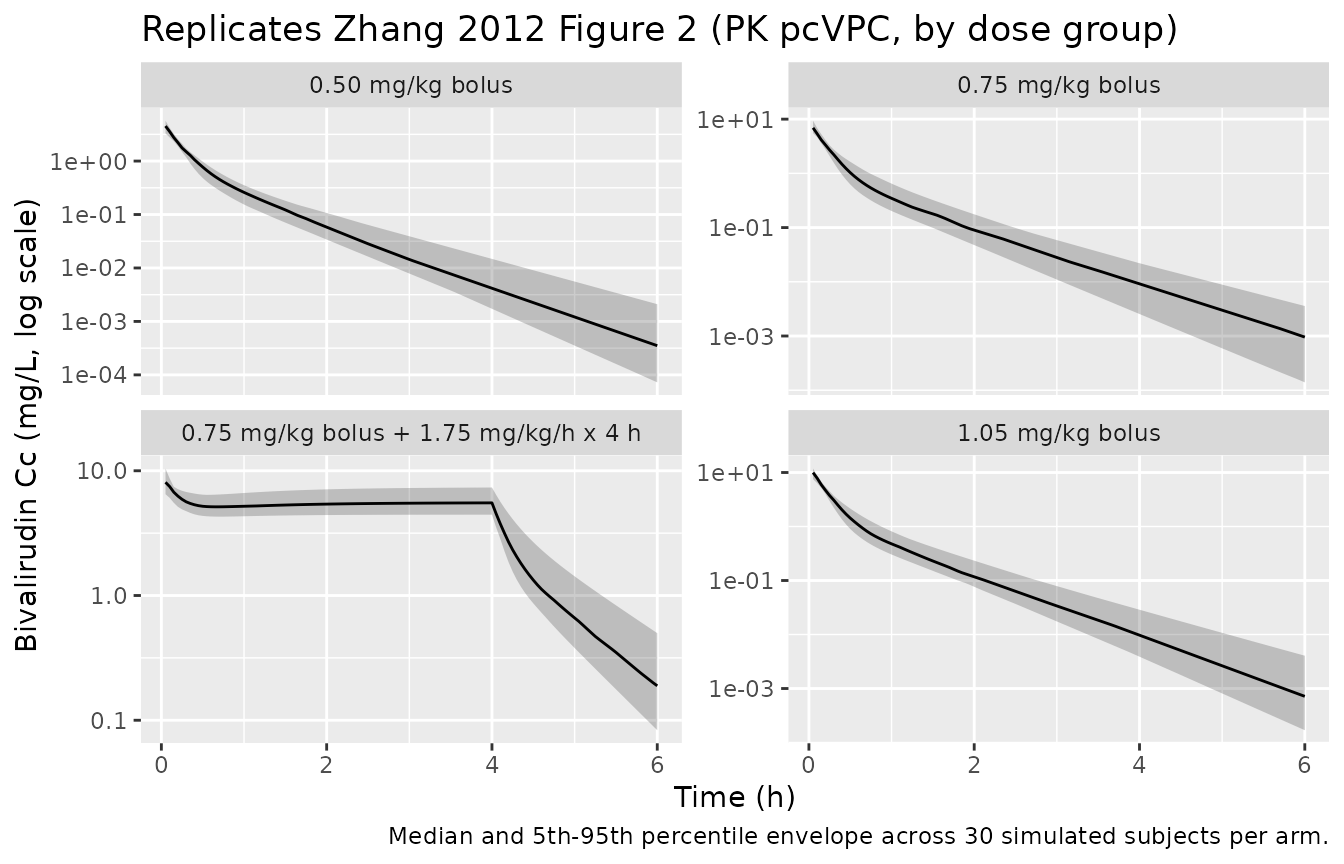
# Replicates Figure 2 of Zhang 2012: pcVPC of plasma bivalirudin (Cc, mg/L)
# vs. time, by dose group. Median and 5th-95th percentile envelope.
sim %>%
  filter(time > 0) %>%
  group_by(regimen, time) %>%
  summarise(
    Q05 = quantile(Cc, 0.05, na.rm = TRUE),
    Q50 = quantile(Cc, 0.50, na.rm = TRUE),
    Q95 = quantile(Cc, 0.95, na.rm = TRUE),
    .groups = "drop"
  ) %>%
  ggplot(aes(time, Q50)) +
  geom_ribbon(aes(ymin = Q05, ymax = Q95), alpha = 0.25) +
  geom_line() +
  facet_wrap(~ regimen, scales = "free_y") +
  scale_y_log10() +
  labs(
    x = "Time (h)", y = "Bivalirudin Cc (mg/L, log scale)",
    title = "Replicates Zhang 2012 Figure 2 (PK pcVPC, by dose group)",
    caption = "Median and 5th-95th percentile envelope across 30 simulated subjects per arm."
  )
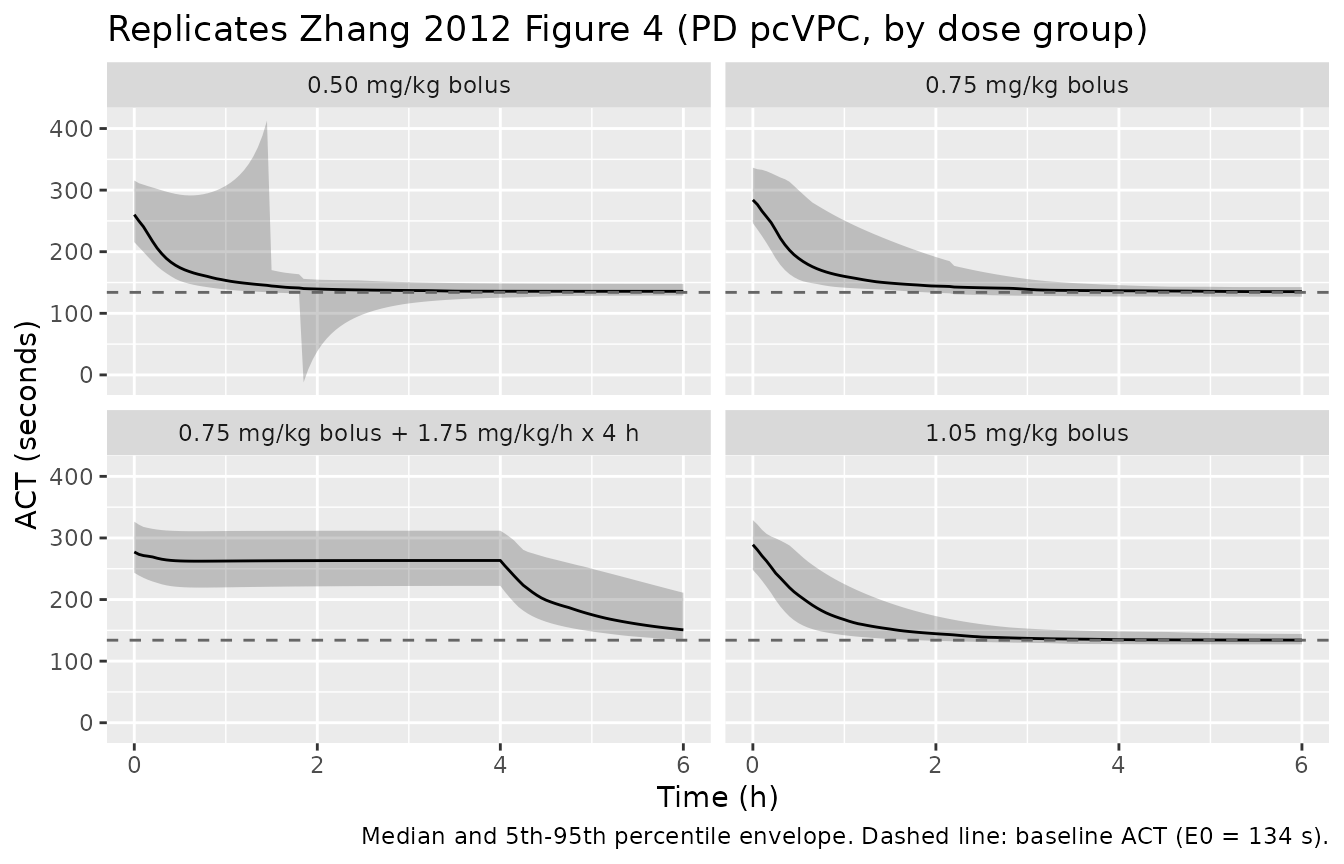
# Replicates Figure 4 of Zhang 2012: pcVPC of activated clotting time (ACT, s)
# vs. time, by dose group. Median and 5th-95th percentile envelope.
sim %>%
  group_by(regimen, time) %>%
  summarise(
    Q05 = quantile(ACT, 0.05, na.rm = TRUE),
    Q50 = quantile(ACT, 0.50, na.rm = TRUE),
    Q95 = quantile(ACT, 0.95, na.rm = TRUE),
    .groups = "drop"
  ) %>%
  ggplot(aes(time, Q50)) +
  geom_ribbon(aes(ymin = Q05, ymax = Q95), alpha = 0.25) +
  geom_line() +
  geom_hline(yintercept = 134, linetype = "dashed", colour = "grey40") +
  facet_wrap(~ regimen) +
  labs(
    x = "Time (h)", y = "ACT (seconds)",
    title = "Replicates Zhang 2012 Figure 4 (PD pcVPC, by dose group)",
    caption = "Median and 5th-95th percentile envelope. Dashed line: baseline ACT (E0 = 134 s)."
  )
PKNCA validation
The paper reports the PK as compartmental CL / V values (Table 2) rather than as NCA Cmax / AUC / half-life. The NCA block below summarises the simulated bivalirudin disposition by dose arm so the implementation can be cross-checked against the compartmental parameters (e.g. Dose / CL should recover AUC_inf, and Dose / V1 should recover Cmax for an IV bolus arm).
sim_nca <- sim %>%
  filter(!is.na(Cc), time > 0) %>%
  select(id, time, Cc, regimen)

dose_df <- events %>%
  filter(evid == 1L) %>%
  group_by(id, regimen) %>%
  summarise(time = 0, amt = sum(amt), .groups = "drop")

conc_obj <- PKNCA::PKNCAconc(
  as.data.frame(sim_nca),
  Cc ~ time | regimen + id,
  concu = "mg/L", timeu = "h"
)
dose_obj <- PKNCA::PKNCAdose(
  as.data.frame(dose_df),
  amt ~ time | regimen + id,
  doseu = "mg"
)

intervals <- data.frame(
  start       = 0,
  end         = Inf,
  cmax        = TRUE,
  tmax        = TRUE,
  aucinf.obs  = TRUE,
  half.life   = TRUE
)

nca_res <- PKNCA::pk.nca(PKNCA::PKNCAdata(conc_obj, dose_obj, intervals = intervals))
#> Warning: Requesting an AUC range starting (0) before the first measurement (0.05) is not allowed
#> Requesting an AUC range starting (0) before the first measurement (0.05) is not allowed
#> Requesting an AUC range starting (0) before the first measurement (0.05) is not allowed
#> Requesting an AUC range starting (0) before the first measurement (0.05) is not allowed
#> Requesting an AUC range starting (0) before the first measurement (0.05) is not allowed
#> Requesting an AUC range starting (0) before the first measurement (0.05) is not allowed
#> Requesting an AUC range starting (0) before the first measurement (0.05) is not allowed
#> Requesting an AUC range starting (0) before the first measurement (0.05) is not allowed
#> Requesting an AUC range starting (0) before the first measurement (0.05) is not allowed
#> Requesting an AUC range starting (0) before the first measurement (0.05) is not allowed
#> Requesting an AUC range starting (0) before the first measurement (0.05) is not allowed
#> Requesting an AUC range starting (0) before the first measurement (0.05) is not allowed
#> Requesting an AUC range starting (0) before the first measurement (0.05) is not allowed
#> Requesting an AUC range starting (0) before the first measurement (0.05) is not allowed
#> Requesting an AUC range starting (0) before the first measurement (0.05) is not allowed
#> Requesting an AUC range starting (0) before the first measurement (0.05) is not allowed
#> Requesting an AUC range starting (0) before the first measurement (0.05) is not allowed
#> Requesting an AUC range starting (0) before the first measurement (0.05) is not allowed
#> Requesting an AUC range starting (0) before the first measurement (0.05) is not allowed
#> Requesting an AUC range starting (0) before the first measurement (0.05) is not allowed
#> Requesting an AUC range starting (0) before the first measurement (0.05) is not allowed
#> Requesting an AUC range starting (0) before the first measurement (0.05) is not allowed
#> Requesting an AUC range starting (0) before the first measurement (0.05) is not allowed
#> Requesting an AUC range starting (0) before the first measurement (0.05) is not allowed
#> Requesting an AUC range starting (0) before the first measurement (0.05) is not allowed
#> Requesting an AUC range starting (0) before the first measurement (0.05) is not allowed
#> Requesting an AUC range starting (0) before the first measurement (0.05) is not allowed
#> Requesting an AUC range starting (0) before the first measurement (0.05) is not allowed
#> Requesting an AUC range starting (0) before the first measurement (0.05) is not allowed
#> Requesting an AUC range starting (0) before the first measurement (0.05) is not allowed
#> Requesting an AUC range starting (0) before the first measurement (0.05) is not allowed
#> Requesting an AUC range starting (0) before the first measurement (0.05) is not allowed
#> Requesting an AUC range starting (0) before the first measurement (0.05) is not allowed
#> Requesting an AUC range starting (0) before the first measurement (0.05) is not allowed
#> Requesting an AUC range starting (0) before the first measurement (0.05) is not allowed
#> Requesting an AUC range starting (0) before the first measurement (0.05) is not allowed
#> Requesting an AUC range starting (0) before the first measurement (0.05) is not allowed
#> Requesting an AUC range starting (0) before the first measurement (0.05) is not allowed
#> Requesting an AUC range starting (0) before the first measurement (0.05) is not allowed
#> Requesting an AUC range starting (0) before the first measurement (0.05) is not allowed
#> Requesting an AUC range starting (0) before the first measurement (0.05) is not allowed
#> Requesting an AUC range starting (0) before the first measurement (0.05) is not allowed
#> Requesting an AUC range starting (0) before the first measurement (0.05) is not allowed
#> Requesting an AUC range starting (0) before the first measurement (0.05) is not allowed
#> Requesting an AUC range starting (0) before the first measurement (0.05) is not allowed
#> Requesting an AUC range starting (0) before the first measurement (0.05) is not allowed
#> Requesting an AUC range starting (0) before the first measurement (0.05) is not allowed
#> Requesting an AUC range starting (0) before the first measurement (0.05) is not allowed
#> Requesting an AUC range starting (0) before the first measurement (0.05) is not allowed
#> Requesting an AUC range starting (0) before the first measurement (0.05) is not allowed
#> Requesting an AUC range starting (0) before the first measurement (0.05) is not allowed
#> Requesting an AUC range starting (0) before the first measurement (0.05) is not allowed
#> Requesting an AUC range starting (0) before the first measurement (0.05) is not allowed
#> Requesting an AUC range starting (0) before the first measurement (0.05) is not allowed
#> Requesting an AUC range starting (0) before the first measurement (0.05) is not allowed
#> Requesting an AUC range starting (0) before the first measurement (0.05) is not allowed
#> Requesting an AUC range starting (0) before the first measurement (0.05) is not allowed
#> Requesting an AUC range starting (0) before the first measurement (0.05) is not allowed
#> Requesting an AUC range starting (0) before the first measurement (0.05) is not allowed
#> Requesting an AUC range starting (0) before the first measurement (0.05) is not allowed
#> Requesting an AUC range starting (0) before the first measurement (0.05) is not allowed
#> Requesting an AUC range starting (0) before the first measurement (0.05) is not allowed
#> Requesting an AUC range starting (0) before the first measurement (0.05) is not allowed
#> Requesting an AUC range starting (0) before the first measurement (0.05) is not allowed
#> Requesting an AUC range starting (0) before the first measurement (0.05) is not allowed
#> Requesting an AUC range starting (0) before the first measurement (0.05) is not allowed
#> Requesting an AUC range starting (0) before the first measurement (0.05) is not allowed
#> Requesting an AUC range starting (0) before the first measurement (0.05) is not allowed
#> Requesting an AUC range starting (0) before the first measurement (0.05) is not allowed
#> Requesting an AUC range starting (0) before the first measurement (0.05) is not allowed
#> Requesting an AUC range starting (0) before the first measurement (0.05) is not allowed
#> Requesting an AUC range starting (0) before the first measurement (0.05) is not allowed
#> Requesting an AUC range starting (0) before the first measurement (0.05) is not allowed
#> Requesting an AUC range starting (0) before the first measurement (0.05) is not allowed
#> Requesting an AUC range starting (0) before the first measurement (0.05) is not allowed
#> Requesting an AUC range starting (0) before the first measurement (0.05) is not allowed
#> Requesting an AUC range starting (0) before the first measurement (0.05) is not allowed
#> Requesting an AUC range starting (0) before the first measurement (0.05) is not allowed
#> Requesting an AUC range starting (0) before the first measurement (0.05) is not allowed
#> Requesting an AUC range starting (0) before the first measurement (0.05) is not allowed
#> Requesting an AUC range starting (0) before the first measurement (0.05) is not allowed
#> Requesting an AUC range starting (0) before the first measurement (0.05) is not allowed
#> Requesting an AUC range starting (0) before the first measurement (0.05) is not allowed
#> Requesting an AUC range starting (0) before the first measurement (0.05) is not allowed
#> Requesting an AUC range starting (0) before the first measurement (0.05) is not allowed
#> Requesting an AUC range starting (0) before the first measurement (0.05) is not allowed
#> Requesting an AUC range starting (0) before the first measurement (0.05) is not allowed
#> Requesting an AUC range starting (0) before the first measurement (0.05) is not allowed
#> Requesting an AUC range starting (0) before the first measurement (0.05) is not allowed
#> Requesting an AUC range starting (0) before the first measurement (0.05) is not allowed
#> Requesting an AUC range starting (0) before the first measurement (0.05) is not allowed
#> Requesting an AUC range starting (0) before the first measurement (0.05) is not allowed
#> Requesting an AUC range starting (0) before the first measurement (0.05) is not allowed
#> Requesting an AUC range starting (0) before the first measurement (0.05) is not allowed
#> Requesting an AUC range starting (0) before the first measurement (0.05) is not allowed
#> Requesting an AUC range starting (0) before the first measurement (0.05) is not allowed
#> Requesting an AUC range starting (0) before the first measurement (0.05) is not allowed
#> Requesting an AUC range starting (0) before the first measurement (0.05) is not allowed
#> Requesting an AUC range starting (0) before the first measurement (0.05) is not allowed
#> Requesting an AUC range starting (0) before the first measurement (0.05) is not allowed
#> Requesting an AUC range starting (0) before the first measurement (0.05) is not allowed
#> Requesting an AUC range starting (0) before the first measurement (0.05) is not allowed
#> Requesting an AUC range starting (0) before the first measurement (0.05) is not allowed
#> Requesting an AUC range starting (0) before the first measurement (0.05) is not allowed
#> Requesting an AUC range starting (0) before the first measurement (0.05) is not allowed
#> Requesting an AUC range starting (0) before the first measurement (0.05) is not allowed
#> Requesting an AUC range starting (0) before the first measurement (0.05) is not allowed
#> Requesting an AUC range starting (0) before the first measurement (0.05) is not allowed
#> Requesting an AUC range starting (0) before the first measurement (0.05) is not allowed
#> Requesting an AUC range starting (0) before the first measurement (0.05) is not allowed
#> Requesting an AUC range starting (0) before the first measurement (0.05) is not allowed
#> Requesting an AUC range starting (0) before the first measurement (0.05) is not allowed
#> Requesting an AUC range starting (0) before the first measurement (0.05) is not allowed
#> Requesting an AUC range starting (0) before the first measurement (0.05) is not allowed
#> Requesting an AUC range starting (0) before the first measurement (0.05) is not allowed
#> Requesting an AUC range starting (0) before the first measurement (0.05) is not allowed
#> Requesting an AUC range starting (0) before the first measurement (0.05) is not allowed
#> Requesting an AUC range starting (0) before the first measurement (0.05) is not allowed
#> Requesting an AUC range starting (0) before the first measurement (0.05) is not allowed
#> Requesting an AUC range starting (0) before the first measurement (0.05) is not allowed

nca_tbl <- as.data.frame(nca_res$result) %>%
  filter(PPTESTCD %in% c("cmax", "tmax", "aucinf.obs", "half.life")) %>%
  group_by(regimen, PPTESTCD) %>%
  summarise(median = median(PPORRES, na.rm = TRUE), .groups = "drop") %>%
  pivot_wider(names_from = PPTESTCD, values_from = median) %>%
  rename(`Cmax (mg/L)` = cmax,
         `Tmax (h)` = tmax,
         `AUCinf (mg*h/L)` = aucinf.obs,
         `Half-life (h)` = half.life)
knitr::kable(nca_tbl, digits = 3,
caption = "Simulated NCA parameters by dose arm (median across 30 subjects).")| regimen | AUCinf (mg*h/L) | Cmax (mg/L) | Half-life (h) | Tmax (h) |
|---|---|---|---|---|
| 0.50 mg/kg bolus | NA | 4.515 | 0.557 | 0.05 |
| 0.75 mg/kg bolus | NA | 6.917 | 0.582 | 0.05 |
| 0.75 mg/kg bolus + 1.75 mg/kg/h x 4 h | NA | 8.293 | 0.601 | 0.05 |
| 1.05 mg/kg bolus | NA | 9.956 | 0.548 | 0.05 |
Comparison against compartmental parameters
Zhang 2012 reports the population PK as the compartmental parameters CL = 0.323 L/h/kg and V1 = 0.086 L/kg (Table 2). For an IV bolus dose, the standard identities are:
Cmax = Dose / V1 = (dose_mg_per_kg) / 0.086 = 5.81 mg/L per (mg/kg)AUCinf = Dose / CL = (dose_mg_per_kg) / 0.323 = 3.10 mg*h/L per (mg/kg)
For the simulated IV bolus arms, the typical-subject values predicted by those identities are:
bolus_table <- tibble(
  regimen = c("0.50 mg/kg bolus", "0.75 mg/kg bolus", "1.05 mg/kg bolus"),
  `Predicted Cmax (mg/L)`   = c(0.50, 0.75, 1.05) / 0.086,
  `Predicted AUCinf (mg*h/L)` = c(0.50, 0.75, 1.05) / 0.323
) %>%
  left_join(nca_tbl %>% select(regimen, `Cmax (mg/L)`, `AUCinf (mg*h/L)`),
            by = "regimen") %>%
  rename(`Simulated Cmax (mg/L)`   = `Cmax (mg/L)`,
         `Simulated AUCinf (mg*h/L)` = `AUCinf (mg*h/L)`)
knitr::kable(bolus_table, digits = 3,
caption = "Predicted-vs-simulated NCA for the IV-bolus arms. Differences should be small (~few %); larger gaps indicate a simulation or model-encoding issue.")| regimen | Predicted Cmax (mg/L) | Predicted AUCinf (mg*h/L) | Simulated Cmax (mg/L) | Simulated AUCinf (mg*h/L) |
|---|---|---|---|---|
| 0.50 mg/kg bolus | 5.814 | 1.548 | 4.515 | NA |
| 0.75 mg/kg bolus | 8.721 | 2.322 | 6.917 | NA |
| 1.05 mg/kg bolus | 12.209 | 3.251 | 9.956 | NA |
The infusion arm is excluded from this identity-based comparison
because the IV-bolus single-dose Dose / V1 shortcut does
not apply during an ongoing infusion; the simulated Cmax / AUC for the
infusion arm in the PKNCA table above is reported alongside the bolus
arms for completeness only.
Assumptions and deviations
- Negative-EC50 regime for low RBC. The published linear-deviation covariate equation EC50_i = theta_EC50 * exp(eta) * (1 + 1.70 * (RBC - 4.40)) drives the EC50 multiplier non-positive whenever RBC falls below approximately 3.81 x 10^12 cells/L. The lowest cohort RBC value (3.79 x 10^12 cells/L, Zhang 2012 Table 1 group 4 range) falls just inside this regime; the corresponding typical EC50 is approximately -0.09 mg/L. The simulation faithfully reproduces the published equation; downstream users simulating outside RBC > ~3.81 should recognise that the model can predict non-physical (singular or negative) ACT values when the bivalirudin concentration is comparable to |EC50|. The virtual cohort here samples RBC from a truncated normal distribution N(4.40, 0.30) clipped to the published range 3.79-5.17 to remain consistent with the paper.
- Body weight encoding. Zhang 2012 reports all PK structural parameters in per-kg units (L/h/kg, L/kg). The model multiplies each by total body weight (WT, kg) so that downstream simulation tables can use per-subject dosing (mg, not mg/kg). The virtual cohort samples WT from a truncated normal distribution N(60, 6.5) clipped to 50-78 kg to match Zhang 2012 Table 1.
-
PK proportional residual error magnitude. Zhang
2012 Table 2 reports the PK proportional residual as
0.08with column headerProportional error (%). The value is encoded as a fraction (propSd = 0.08, i.e. 8% proportional CV) on the grounds that- the bootstrap 95% CI 0.07-0.09 is consistent with a fraction reading
at typical LC-MS/MS assay precision, (ii) the PD table’s 4.67% is the
standalone-percent reading for the same column header style, and (iii) a
literal
0.08%reading would imply assay precision far below any real bivalirudin LC-MS/MS method. This interpretation is documented in the in-file source-trace comment next topropSd.
- the bootstrap 95% CI 0.07-0.09 is consistent with a fraction reading
at typical LC-MS/MS assay precision, (ii) the PD table’s 4.67% is the
standalone-percent reading for the same column header style, and (iii) a
literal
-
PD residual error. Zhang 2012 Table 3 reports the
PD proportional residual as
4.67%; encoded aspropSd_ACT = 0.0467(fraction). -
No effect-compartment delay. Bivalirudin is
administered IV; the paper explicitly identifies the central compartment
as the effect compartment (
Ce=Cc). No effect-compartment ODE is added. -
Hill coefficient fixed at 1. The final PK-PD model
dropped the sigmoidicity factor (the abstract and Conclusion both note
‘sigmoid Emax model without the Hill coefficient’); the model encodes
the Hill = 1 form directly as
ACT = E0 + (Emax - E0) * Cc / (Cc + EC50). - Race / ethnicity scope. The cohort is 100% Chinese Han. The model has not been evaluated outside that population; Zhang 2012 explicitly flags this as a limitation in the Discussion.
- No PKNCA values published. Zhang 2012 reports only the compartmental CL / V parameters, not Cmax / AUC. The PKNCA block serves as an internal consistency check (Dose / CL vs. simulated AUCinf; Dose / V1 vs. simulated Cmax for the IV bolus arms) rather than as a side-by-side comparison against published NCA values.