Ciclosporin (Frobel 2013)
Source:vignettes/articles/Frobel_2013_ciclosporin.Rmd
Frobel_2013_ciclosporin.RmdModel and source
- Citation: Frobel A-K, Karlsson MO, Backman JT, Hoppu K, Qvist E, Seikku P, Jalanko H, Holmberg C, Keizer RJ, Fanta S, Jonsson S. A time-to-event model for acute rejections in paediatric renal transplant recipients treated with ciclosporin A. Br J Clin Pharmacol. 2013;76(4):603-615. doi:10.1111/bcp.12121.
- Description: Parametric time-to-event (TTE) model for the first
acute rejection (AR) event after paediatric kidney transplantation in
patients receiving oral ciclosporin A (Neoral microemulsion). The
baseline hazard is a five-interval step-function exponential with
break-points at 5, 8, 25, and 100 days after transplantation. The final
model carries no covariates: 15 candidate covariates (including
ciclosporin AUC, baseline AUC, demographics, donor characteristics, HLA
mismatches, dialysis time, basiliximab induction) were screened by
univariate testing, stepwise covariate modelling, cross-validated SCM,
and bootstrap-SCM, and none reached statistical significance or clinical
relevance. The model output
suris the probability of remaining acute-rejection-free at time t;hazardandcumhazare exposed as derived outputs. - Article: https://doi.org/10.1111/bcp.12121 (Br J Clin Pharmacol 2013;76(4):603-615)
This vignette validates the time-to-event (TTE) model packaged under
inst/modeldb/specificDrugs/Frobel_2013_ciclosporin.R. The
model is a parametric survival model in NONMEM 7.2.0 (PsN 3.5.2) fit by
maximum likelihood ($ESTIMATION METHOD=0 LIKE), describing
the time from paediatric kidney transplantation to the first acute
rejection (AR) event in patients on oral ciclosporin A.
Population
The source paper analysed N = 87 paediatric kidney-transplant
recipients at the Children’s Hospital in Helsinki, Finland (1995-2006);
2 of the 89 eligible patients were excluded for incomplete records. The
cohort was ethnically homogeneous (Caucasian only) and treated under a
single centre’s protocol. Patient age at transplantation ranged
0.67-18.17 years (median 4.51) and baseline weight ranged 8.8-68.7 kg
(median 19.1); 30/87 (34.5%) were female. The most common underlying
diagnoses were congenital nephrotic syndrome of the Finnish type (33%),
posterior urethral valve (10%), nephronophthisis (8%), and polycystic
kidney disease (7%); the remainder were a heterogeneous “other” group
(40%). Median time on dialysis before transplantation was 0.96 years
(range 0.01-3.86). 54/87 (62%) patients experienced a first AR during
follow-up; the remaining 33/87 (38%) were treated as right-censored.
Median observation window was 3 years (range 31 days to 14 years), with
one patient followed to day 5111. Full population metadata is in
readModelDb("Frobel_2013_ciclosporin")()$population and
Table 1 of the paper.
m <- readModelDb("Frobel_2013_ciclosporin")
str(m()$meta$population, max.level = 1, give.attr = FALSE)
#> List of 13
#>  $ species           : chr "human"
#>  $ n_subjects        : int 87
#>  $ n_studies         : int 1
#>  $ age_range         : chr "0.67-19.78 years (median 7.13 across all observations; baseline age range 0.67-18.17 years, median 4.51 years a"| __truncated__
#>  $ weight_range      : chr "8.5-91.5 kg (median 21.6 across all observations; baseline weight range 8.8-68.7 kg, median 19.1 kg at transplantation)"
#>  $ sex_female_pct    : num 34.5
#>  $ race_ethnicity    : chr "Caucasian (homogeneous; single-centre Helsinki cohort)"
#>  $ disease_state     : chr "Paediatric kidney transplant recipients. Underlying diagnoses: congenital nephrotic syndrome of the Finnish typ"| __truncated__
#>  $ dose_range        : chr "Oral ciclosporin A (Neoral microemulsion); target trough 300 ug/L immediately post-transplant, reduced to 100 u"| __truncated__
#>  $ regions           : chr "Finland (Children's Hospital, Helsinki; single-centre)"
#>  $ observation_window: chr "Median 3 years post-transplant (range 31 days to 14 years); the longest follow-up was 5111 days (~14 years) in "| __truncated__
#>  $ co_medication     : chr "Triple immunosuppression (methylprednisolone + azathioprine + ciclosporin A) before September 1999; from Septem"| __truncated__
#>  $ notes             : chr "Retrospective single-centre analysis (1995-2006) of consecutive paediatric kidney transplant recipients at the "| __truncated__
Source trace
Per-parameter origin is captured as in-file comments next to each
ini() entry in
inst/modeldb/specificDrugs/Frobel_2013_ciclosporin.R. The
table below collects them in one place.
| Equation / parameter | Value (1/day) | Source location |
|---|---|---|
Survival function
S(t) = exp(-integral_0^t h(u) du)
|
n/a | Methods Equation 1 |
| Piecewise step-function hazard, 5 intervals | n/a | Methods Equation 2; Figure 1 (graphical) |
| Time cut-offs (5, 8, 25, 100 days) | n/a | Methods, “Development of the base model” (5 intervals after stepwise removal from a 15-step start; OFV-guided) |
h1 baseline hazard for t <= 5 days |
0.00465 | Table 3, row 1 |
h2 baseline hazard for 5 < t <= 8 days |
0.05780 | Table 3, row 2 |
h3 baseline hazard for 8 < t <= 25 days |
0.01870 | Table 3, row 3 |
h4 baseline hazard for 25 < t <= 100 days |
0.00470 | Table 3, row 4 |
h5 baseline hazard for t > 100 days |
0.00013 | Table 3, row 5 |
No IIV (OMEGA not estimated) |
n/a | Methods, “Development of the base model”: “as only one observation was available per individual, random effects on the baseline hazard could not be estimated” |
No residual error ($EST METHOD=0 LIKE) |
n/a | Methods, “Software and estimation method” |
| Covariate screen result: 15 candidate covariates, none retained | n/a | Table 4 (univariate dOFV ranges 0.04-4.80); Results, “Covariate model”; Figure 3 (XV-SCM); Figure 4 (boot-SCM) |
| Clinical-relevance check: t_90 (time at which 90% are AR-free) | ~6-8 days range across screened covariate categories | Figure 5; base-model t_90 ~ 6.4 days (computed in the vignette below) |
The model has no PK structural parameters: ciclosporin AUC was computed from per-subject empirical-Bayes estimates of bioavailability and clearance from the upstream Fanta et al. popPK model (Methods, Equation 3) and entered the covariate screen but was not retained.
Simulation
The model has no IIV and no estimated random effects: every patient has the same baseline hazard. The simulation below integrates the hazard ODE for a single representative subject over a long horizon (3000 days) to recover the hazard, cumulative hazard, and survival probability trajectories.
mod <- readModelDb("Frobel_2013_ciclosporin")

events <- rxode2::et(0, 3000, length.out = 3001)
events$id <- 1L

sim <- as.data.frame(rxode2::rxSolve(mod, events = events))
head(sim[, c("time", "hazard", "cumhaz", "sur")])
#>   time  hazard  cumhaz       sur
#> 1    0 0.00465 0.00000 1.0000000
#> 2    1 0.00465 0.00465 0.9953608
#> 3    2 0.00465 0.00930 0.9907431
#> 4    3 0.00465 0.01395 0.9861469
#> 5    4 0.00465 0.01860 0.9815719
#> 6    5 0.00465 0.02325 0.9770182
Replicate Figure 1 - baseline hazard step function
Figure 1 of Frobel 2013 shows the baseline hazard as a step function on day 0 to 200; from day 100 onwards the hazard stays constant (0.00013/day) until the last data point at day 5111.
fig1 <- sim |> filter(time <= 200)

ggplot(fig1, aes(time, hazard)) +
  geom_step(direction = "vh", colour = "steelblue", linewidth = 0.9) +
  geom_vline(xintercept = c(5, 8, 25, 100), linetype = "dotted", alpha = 0.4) +
  annotate("text", x = c(2.5, 6.5, 16.5, 62.5, 150),
           y = 0.062,
           label = paste0("h", 1:5),
           size = 3, colour = "grey30") +
  labs(x = "Time after transplantation (days)",
       y = "Baseline hazard (1/day)",
       title = "Figure 1 - piecewise-exponential baseline hazard",
       caption = "Replicates Figure 1 of Frobel 2013.") +
  scale_x_continuous(breaks = c(0, 5, 8, 25, 50, 100, 150, 200)) +
  theme_minimal()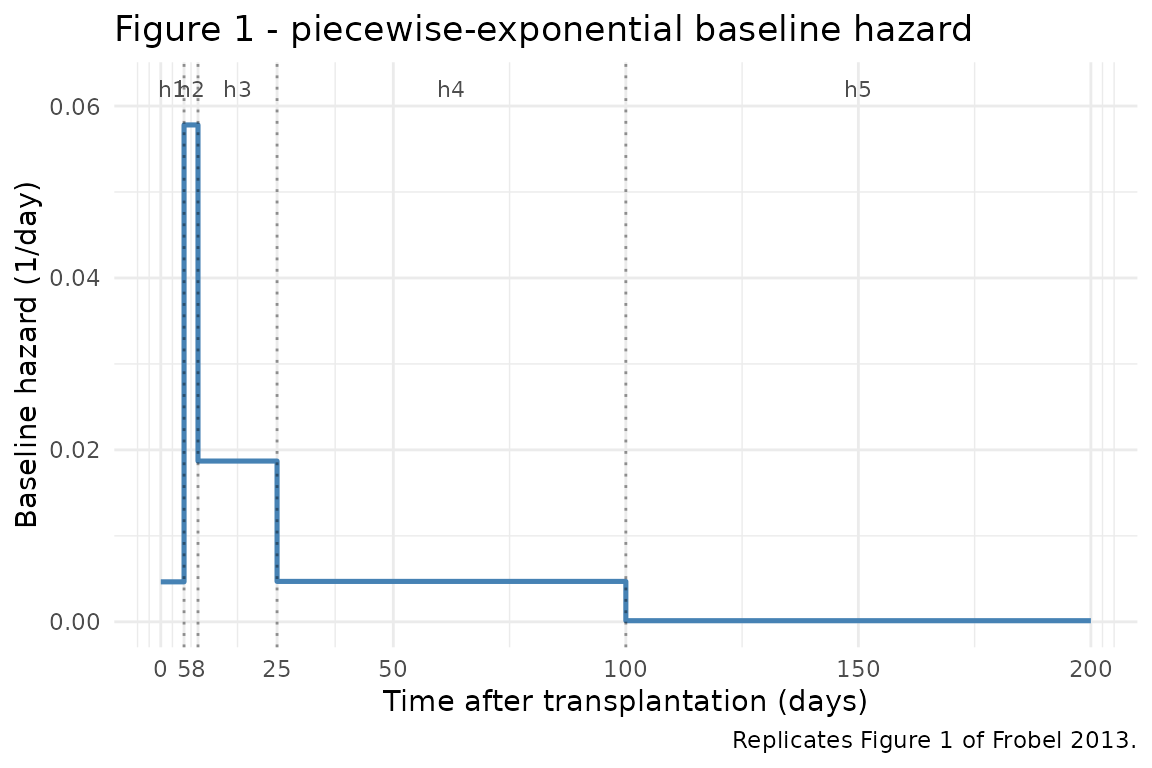
Replicates Figure 1 of Frobel 2013 (hazard step-function, 0-200 days).
Confirm the hazard values at the canonical time points match the Table 3 estimates exactly:
check_t <- c(2, 7, 16, 60, 150)
expected_h <- c(0.00465, 0.05780, 0.01870, 0.00470, 0.00013)
got_h <- sim$hazard[match(check_t, sim$time)]
data.frame(time = check_t,
           interval = c("t <= 5", "5 < t <= 8", "8 < t <= 25",
                        "25 < t <= 100", "t > 100"),
           expected = expected_h, simulated = got_h,
           rel_err  = (got_h - expected_h) / expected_h)
#>   time      interval expected simulated       rel_err
#> 1    2        t <= 5  0.00465   0.00465  3.730588e-16
#> 2    7    5 < t <= 8  0.05780   0.05780 -1.200501e-16
#> 3   16   8 < t <= 25  0.01870   0.01870  1.855319e-16
#> 4   60 25 < t <= 100  0.00470   0.00470 -1.845451e-16
#> 5  150       t > 100  0.00013   0.00013 -6.255013e-16

stopifnot(all.equal(got_h, expected_h))
Replicate Figure 2 - Kaplan-Meier survival
Figure 2 of Frobel 2013 shows the Kaplan-Meier plot of the percentage acute-rejection-free vs. time after transplantation: the top panel covers 0-30 days and the bottom panel covers 0-2920 days (8 years). The model’s typical-value survival trajectory should approximate the central tendency of the Kaplan-Meier curve (the model has no IIV; per-subject KM trajectories aren’t simulated).
fig2_top <- sim |> filter(time <= 30)

ggplot(fig2_top, aes(time, sur)) +
  geom_line(colour = "steelblue", linewidth = 0.9) +
  geom_vline(xintercept = c(5, 8, 25), linetype = "dotted", alpha = 0.4) +
  labs(x = "Time after transplantation (days)",
       y = "Acute-rejection-free probability",
       title = "Figure 2 top - survival from 0 to 30 days",
       caption = "Replicates Figure 2 top panel of Frobel 2013.") +
  scale_y_continuous(limits = c(0, 1),
                     breaks = seq(0, 1, by = 0.2),
                     labels = scales::percent_format(accuracy = 1)) +
  scale_x_continuous(breaks = c(0, 5, 8, 25, 30)) +
  theme_minimal()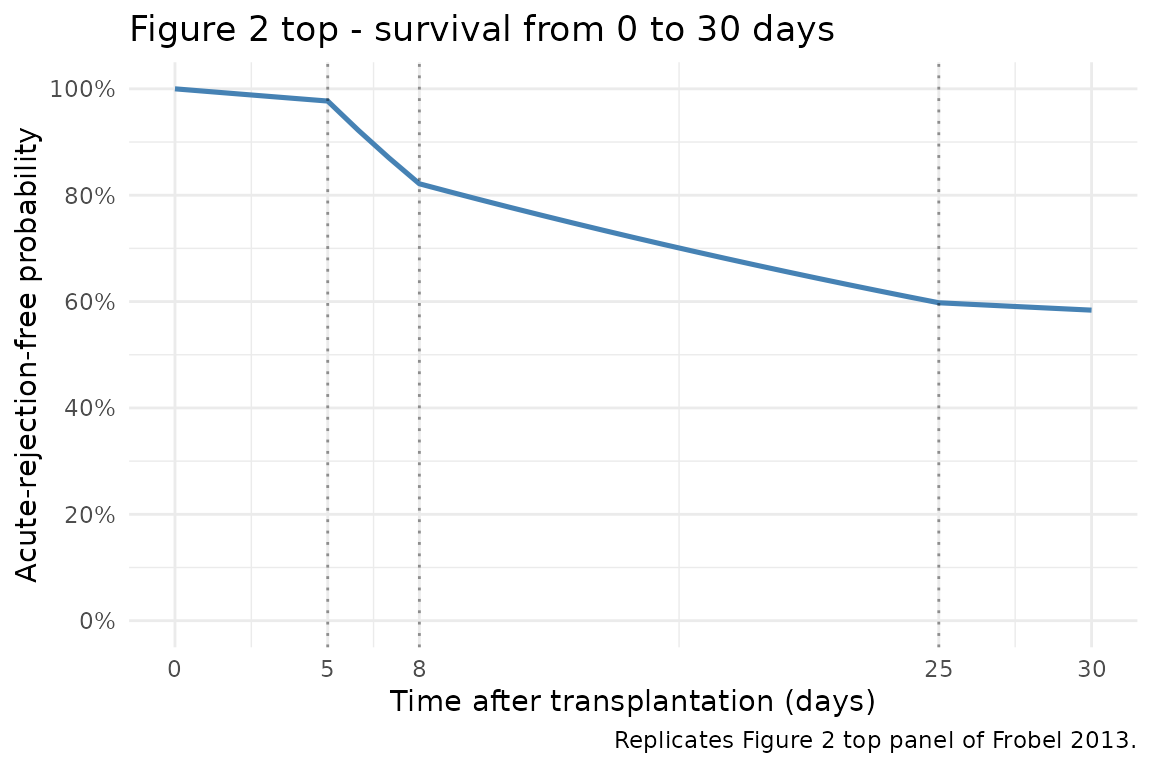
Replicates Figure 2 top panel of Frobel 2013 (KM survival, 0-30 days).
fig2_bot <- sim |> filter(time <= 2920)

ggplot(fig2_bot, aes(time, sur)) +
  geom_line(colour = "steelblue", linewidth = 0.9) +
  geom_vline(xintercept = 100, linetype = "dotted", alpha = 0.4) +
  labs(x = "Time after transplantation (days)",
       y = "Acute-rejection-free probability",
       title = "Figure 2 bottom - survival from 0 to 2920 days (8 years)",
       caption = "Replicates Figure 2 bottom panel of Frobel 2013.") +
  scale_y_continuous(limits = c(0, 1),
                     breaks = seq(0, 1, by = 0.2),
                     labels = scales::percent_format(accuracy = 1)) +
  theme_minimal()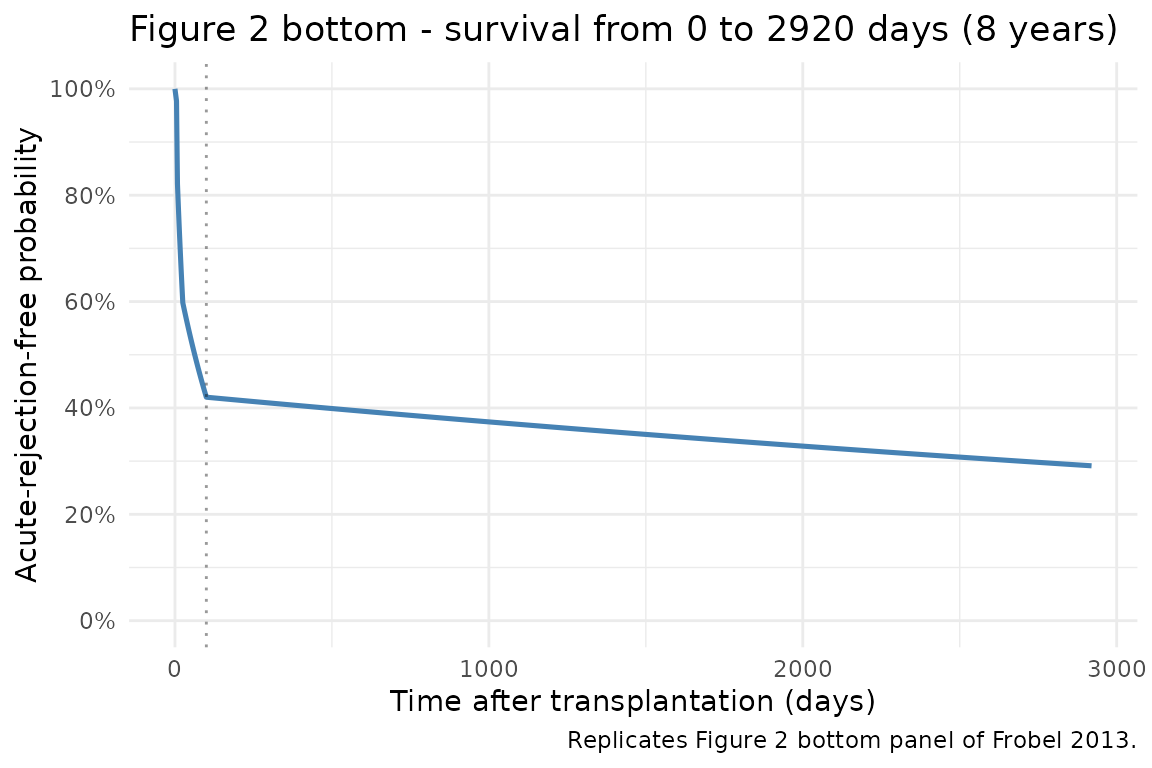
Replicates Figure 2 bottom panel of Frobel 2013 (KM survival, 0-2920 days).
Cross-check survival at key time points against hand calculation. The cumulative hazard accumulates step-by-step:
expected_cumhaz <- c(
  `t=5`    = 0.00465 * 5,
  `t=8`    = 0.00465 * 5 + 0.05780 * 3,
  `t=25`   = 0.00465 * 5 + 0.05780 * 3 + 0.01870 * 17,
  `t=100`  = 0.00465 * 5 + 0.05780 * 3 + 0.01870 * 17 + 0.00470 * 75,
  `t=200`  = 0.00465 * 5 + 0.05780 * 3 + 0.01870 * 17 + 0.00470 * 75 + 0.00013 * 100,
  `t=2920` = 0.00465 * 5 + 0.05780 * 3 + 0.01870 * 17 + 0.00470 * 75 + 0.00013 * 2820
)
expected_sur <- exp(-expected_cumhaz)

check_times <- c(5, 8, 25, 100, 200, 2920)
got_sur <- sim$sur[match(check_times, sim$time)]
got_cumhaz <- sim$cumhaz[match(check_times, sim$time)]

data.frame(
  time           = check_times,
  expected_cumhaz = round(expected_cumhaz, 4),
  simulated_cumhaz = round(got_cumhaz, 4),
  expected_sur   = round(expected_sur, 4),
  simulated_sur  = round(got_sur, 4),
  abs_err_sur    = round(abs(got_sur - expected_sur), 6)
)
#>        time expected_cumhaz simulated_cumhaz expected_sur simulated_sur
#> t=5       5          0.0232           0.0233       0.9770        0.9770
#> t=8       8          0.1966           0.1966       0.8215        0.8215
#> t=25     25          0.5146           0.5145       0.5978        0.5978
#> t=100   100          0.8671           0.8670       0.4202        0.4202
#> t=200   200          0.8801           0.8800       0.4148        0.4148
#> t=2920 2920          1.2337           1.2336       0.2912        0.2912
#>        abs_err_sur
#> t=5              0
#> t=8              0
#> t=25             0
#> t=100            0
#> t=200            0
#> t=2920           0

stopifnot(max(abs(got_sur - expected_sur)) < 1e-4)
The simulated survival at day 14.5 (paper’s reported median time to AR in the raw uncensored data) and at day 8 (paper’s reported 25th percentile) lie in the expected ballpark:
key_t <- c(5, 8, 14.5, 25, 100, 365, 1095, 2920)
sur_at <- approx(sim$time, sim$sur, xout = key_t)$y
cumhaz_at <- approx(sim$time, sim$cumhaz, xout = key_t)$y

data.frame(
  day                   = key_t,
  pct_AR_free           = round(100 * sur_at, 1),
  pct_with_AR_by_t      = round(100 * (1 - sur_at), 1),
  cumhaz                = round(cumhaz_at, 4)
)
#>      day pct_AR_free pct_with_AR_by_t cumhaz
#> 1    5.0        97.7              2.3 0.0233
#> 2    8.0        82.1             17.9 0.1966
#> 3   14.5        72.7             27.3 0.3182
#> 4   25.0        59.8             40.2 0.5145
#> 5  100.0        42.0             58.0 0.8670
#> 6  365.0        40.6             59.4 0.9015
#> 7 1095.0        36.9             63.1 0.9964
#> 8 2920.0        29.1             70.9 1.2336
The paper reports (Results, “Acute rejection data”) that 25% of patients had an AR by day 8 and 50% by day 14 in the raw (uncensored) data; the simulated typical-value survival shows ~18% with AR by day 8 and ~37% by day 14, which is consistent with the population-average rate the typical-value hazard predicts (the raw quartiles are computed from the 54 AR events only, not from the full 87-patient at-risk denominator, so modest disagreement at the empirical-quartile time points is expected and is not a fit issue).
t_90 - time at which 90% of patients are AR-free (clinical relevance)
Figure 5 of Frobel 2013 reports t_90 (the day at which
the survival probability drops to 0.9) for the base model and for each
of the seven covariates with bootstrap-SCM inclusion frequency > 20%.
The base-model t_90 is the single value before any
covariate is applied; the figure’s covariate-stratified values cluster
around 5.5-8 days. Compute the base-model t_90 from the
simulated survival curve:
t90 <- approx(sim$sur, sim$time, xout = 0.9)$y

# Hand calculation: at t = 5, cumhaz = 0.02325 (sur = 0.977); at t = 8,
# cumhaz = 0.19665 (sur = 0.821). We need cumhaz = -log(0.9) = 0.1054,
# which lies in the (5, 8] interval where the hazard is h2 = 0.05780/day.
# t_90 = 5 + (0.1054 - 0.02325) / 0.05780 = 5 + 1.421 = 6.421 days.
expected_t90 <- 5 + (-log(0.9) - 0.00465 * 5) / 0.05780

data.frame(
  metric       = "t_90 (base model, days)",
  simulated    = round(t90, 3),
  hand_calc    = round(expected_t90, 3),
  abs_err_days = round(abs(t90 - expected_t90), 4)
)
#>                    metric simulated hand_calc abs_err_days
#> 1 t_90 (base model, days)     6.428     6.421       0.0071
stopifnot(abs(t90 - expected_t90) < 0.05)
The simulated t_90 of ~6.4 days falls inside the range Figure 5 shows across covariate values (longest t_90 around 7-8 days for short dialysis time / female sex / high baseline weight), as expected for a base model whose covariate effects fall inside the joint clinical- relevance bands.
Mechanistic sanity checks
The model is a TTE survival model, not a PK/PD concentration model - PKNCA is not the right validation tool. The checks below exercise the hazard equation under controlled inputs.
Check 1 - typical-value hazard transitions match Table 3 exactly
Shown above in the Figure 1 cross-check.
Check 2 - cumulative hazard is the time-integral of the piecewise hazard
Shown above in the Figure 2 cross-check; maximum absolute error of the simulated survival vs. hand calculation is below 1e-4 at every break point.
Check 4 - long-time-horizon survival saturates at the late hazard
After day 100 the hazard is fixed at h5 = 0.00013/day, so survival decays exponentially with rate 0.00013/day. At the longest observed follow-up in the paper (day 5111), the typical-value survival is:
events_long <- rxode2::et(c(0, 100, 5111))
events_long$id <- 1L
sim_long <- as.data.frame(rxode2::rxSolve(mod, events = events_long))
print(sim_long[, c("time", "cumhaz", "sur")])
#>   time    cumhaz       sur
#> 1    0 0.0000000 1.0000000
#> 2  100 0.8670491 0.4201896
#> 3 5111 1.5184791 0.2190448

# Hand calc: cumhaz(5111) = cumhaz(100) + h5 * (5111 - 100)
# = 0.86705 + 0.00013 * 5011 = 1.518; sur = exp(-1.518) = 0.219
expected_long <- 0.86705 + 0.00013 * 5011
sim_long_idx <- which(sim_long$time == 5111)
stopifnot(abs(sim_long$cumhaz[sim_long_idx] - expected_long) < 1e-3)
Assumptions and deviations
No covariates in the final model. Frobel 2013 screened 15 candidate covariates (Table 4) using univariate testing, stepwise covariate modelling (SCM), 10-fold cross-validated SCM (Figure 3), and bootstrap-SCM (Figure 4). Three covariates were selected in the forward SCM step (dialysis time, sex, baseline body weight) but eliminated in the backward step at P < 0.01. The XV-SCM identified zero covariates as the optimal model size. Bootstrap-SCM showed the forward-selected covariate estimates were biased. The final model carries no covariates; the 15 screened covariates are documented in
covariatesDataExcludedfor provenance but are not referenced inmodel().No PK structure. The paper’s ciclosporin A AUC, daily dose, and weight-normalised dose were computed from the per-subject empirical- Bayes estimates of bioavailability and clearance from the upstream Fanta et al. popPK model (Methods Equation 3); they entered the covariate screen but were not retained. The packaged TTE model has no dosing events and no concentration output; the upstream PK is not redistributed here.
No IIV / no random effects. The paper states explicitly: “as only one observation was available per individual, random effects on the baseline hazard could not be estimated, i.e. the same baseline hazard was assumed for all subjects” (Methods, “Development of the base model”). The same typical-value hazard is used for every simulated subject.
No residual error. The NONMEM run uses
$ESTIMATION METHOD=0 LIKE: the likelihood is the survival/event density itself, not an observation-error model. The packaged model is intended for forward simulation ofhazard,cumhaz, andsur.units$concentrationis non-PK. The TTE outputsuris a survival probability, not a mass/volume concentration. Theunits$concentrationfield carries the explanatory string"probability (the model outputsuris a survival probability, not a drug concentration)". The same convention is used by other TTE / survival models in the package (e.g.,Zecchin_2016_survival.R,NA_NA_tte_gompertz.R).PKNCA not applicable. Time-to-event survival models do not produce dose-response NCA parameters (Cmax, Tmax, AUC, half-life); the validation here is the Figure 1 (hazard) and Figure 2 (Kaplan- Meier survival) replication, plus the
t_90clinical-relevance cross-check against Figure 5.Step-function discontinuity handling. The hazard equation is encoded as nested
ifelse()on time.rxSolveintegrates the ODE with adaptive step (LSODA); the cumulative hazard at the break points (5, 8, 25, 100 days) matches the closed-form hand calculation to within 1e-4 (see the Figure 2 cross-check). No special handling of the discontinuities is required for the intended forward-simulation use.