Meropenem-vaborbactam with CRRT (Reed 2025)
Source:vignettes/articles/Reed_2025_meropenem_vaborbactam.Rmd
Reed_2025_meropenem_vaborbactam.RmdModel and source
- Citation: Reed G, Valadez A, Smith BJ, McCreary EK, Kline EG, Neely MN, Squires KM, Shields RK, Rhodes NJ. Population pharmacokinetics of meropenem-vaborbactam in acutely ill hospitalized patients with various degrees of renal dysfunction including continuous renal replacement therapy. Antimicrob Agents Chemother. 2025;69(7):e00108-25. doi:10.1128/aac.00108-25
- Description: Joint population PK model for intravenous meropenem and vaborbactam (1:1 fixed-ratio combination) in 18 acutely ill hospitalised adults with varying renal function, three of them on continuous renal replacement therapy (CRRT) (Reed 2025). Pmetrics NPAG non-parametric fit. Each drug runs through its own copy of a three-state system: the patient’s pre-filter blood (central, the sampled matrix), the CRRT hemofilter (circuit_plasma) and the post-filter return limb (circuit_return). Off CRRT the circuit states are disconnected and each drug is one-compartment with clearance proportional to BSA-normalised Cockcroft-Gault creatinine clearance (reference 120 mL/min/1.73 m^2); on CRRT the body clearance is a separate residual clearance and the filter removes drug at a rate proportional to the effluent flow standardised to 2000 mL/h. Volume scales linearly with body weight (reference 80 kg). Meropenem uses the unsuffixed canonical names; vaborbactam carries the sibling-drug suffix _vab.
- Article: https://doi.org/10.1128/aac.00108-25 (open access, PMC12217465)
- Supplement (Table S1 model build, Figures S1-S4): AAC00108-25-s0001.pdf on the article page.
Reed 2025 is the first population PK analysis of meropenem (MEM) and
vaborbactam (VAB) that carries the continuous renal replacement therapy
(CRRT) circuit as model structure. Each drug runs through its own copy
of a three-state system: the patient’s pre-filter blood
(central, the sampled matrix), the CRRT hemofilter
(circuit_plasma) and the post-filter return limb
(circuit_return). While CRRT runs, drug moves central ->
filter -> return limb -> central, and the filter loses drug to the
effluent at a rate proportional to the effluent flow. Off CRRT the
circuit is disconnected and each drug is one-compartment, which is why
the paper calls the final model “two-input, two-output,
one-compartment”.
Population
Eighteen acutely ill hospitalised adults treated with meropenem-vaborbactam for suspected or confirmed carbapenem-resistant Enterobacterales infection at the University of Pittsburgh Medical Center (December 2017 - July 2022) contributed 83 plasma samples, each assayed for both analytes by LC-MS/MS (Reed 2025 Table 1). Mean (SD) age 54.7 (14.4) years, total body weight 90.7 (32.6) kg, BSA 2.02 (0.36) m^2, serum creatinine 0.99 (0.74) mg/dL and baseline Cockcroft-Gault creatinine clearance 123.3 (103.7) mL/min/1.73 m^2; 56% female. Two patients had acute kidney injury without CRRT and three (16.7%) required CRRT, with median effluent flow 2,000 mL/h, blood flow 250 mL/min and dialysate flow 1,500 mL/h. Patients on intermittent hemodialysis, peritoneal or low-efficiency dialysis were excluded. Race and ethnicity are not reported.
The same information is available programmatically via
readModelDb("Reed_2025_meropenem_vaborbactam")()$population.
Source trace
The equations are Methods, ‘Model development’, equations 1-3 (the ODE system) and Results Equations 1-2 (the covariate model); the typeset equations in the article are images, and the values below were read from them. Parameter values are the weighted medians of the Pmetrics NPAG non-parametric population distribution in Table 2.
| Equation / parameter | Value (MEM / VAB) | Source location |
|---|---|---|
lcl / lcl_vab (CL non-CRRT, L/h at CrCL
120) |
10.6 / 6.64 | Table 2 |
lcl_residual / lcl_residual_vab (CL
residual on CRRT, L/h) |
2.1 / 1.15 | Table 2 |
lvc / lvc_vab (Vd, L at 80 kg) |
27.4 / 24.3 | Table 2 |
lk_central_circuit / _vab (K12, 1/h) |
0.77 / 1.45 | Table 2 |
lk_circuit_effluent / _vab (K20, 1/h) |
4.44 / 0.59 | Table 2 |
lk_circuit_return / _vab (K23, 1/h) |
29.3 / 22.2 | Table 2 |
lk_return_central / _vab (K31, 1/h) |
1.67 / 4.31 | Table 2 |
cl = CL_nonCRRT * (CRCL/120) * (1 - CRRT) + CL_CRRT * CRRT |
n/a | Results Equation 1 |
vc = V1 * (WT/80) |
n/a | Results Equation 2 |
d/dt(central) = -(K12 + K10) * central + K31 * circuit_return |
n/a | Methods equation 1 |
d/dt(circuit_plasma) = K12 * central - (K23 + FLOW * K20) * circuit_plasma |
n/a | Methods equation 2 |
d/dt(circuit_return) = K23 * circuit_plasma - K31 * circuit_return |
n/a | Methods equation 3 |
FLOW = RRT_CRRT_EFFLUENT_FLOW / 2000 |
2,000 mL/h | Methods (‘standardized to the median flow rate’); Results, ‘Patient characteristics’ (median 2,000 mL/h) |
K12, K23, K31 gated by RRT_CRRT_ACTIVE
|
n/a | Methods (‘when CRRT was active’) |
| IIV, residual error | fixed(0) |
Not reported (see Assumptions and deviations) |
Simulation design
The paper’s own Monte Carlo simulations (Methods, ‘Monte Carlo simulations’) gave 2 g (1 g MEM / 1 g VAB) or 4 g (2 g / 2 g) every 8 h as 3-hour infusions, predicted the first 24 h of dosing, held body weight constant, and studied CrCL 120 and 50 mL/min/1.73 m^2 off CRRT and an effluent flow of 1,750 mL/h (“25 mL/kg/h for a 70 kg patient”) on CRRT. The same arms are used below, at 70 kg. The CrCL value is not read on CRRT; 120 is supplied to keep the column finite.
The paper reports no between-subject or residual variance that can be carried into a parametric model (see Assumptions and deviations), so every simulation here is a typical-value solve; a stochastic VPC is not possible.
mod <- readModelDb("Reed_2025_meropenem_vaborbactam")
mod_typ <- rxode2::zeroRe(rxode2::rxode2(mod))

arms <- tibble::tribble(
  ~arm,                 ~CRCL, ~RRT_CRRT_ACTIVE, ~RRT_CRRT_EFFLUENT_FLOW,
  "CrCL 120",           120,   0L,               0,
  "CrCL 50",            50,    0L,               0,
  "CRRT 1750 mL/h",     120,   1L,               1750
)
WT_SIM <- 70

# Dose rows address the two real ODE states; observation rows use dvid
# alone, which is the form that works for a two-endpoint rxUi.
make_events <- function(arms, dose_mg, dose_times, obs_times, wt = WT_SIM) {
  bind_rows(lapply(seq_len(nrow(arms)), function(i) {
    doses <- data.frame(
      time = rep(dose_times, each = 2), amt = dose_mg, rate = dose_mg / 3,
      evid = 1L, cmt = rep(c("central", "central_vab"), length(dose_times)),
      dvid = NA_integer_
    )
    obs <- data.frame(
      time = obs_times, amt = NA_real_, rate = NA_real_, evid = 0L,
      cmt = NA_character_, dvid = 1L
    )
    bind_rows(doses, obs) |>
      arrange(time, desc(evid)) |>
      mutate(
        id = i, arm = arms$arm[i], CRCL = arms$CRCL[i], WT = wt,
        RRT_CRRT_ACTIVE = arms$RRT_CRRT_ACTIVE[i],
        RRT_CRRT_EFFLUENT_FLOW = arms$RRT_CRRT_EFFLUENT_FLOW[i]
      )
  }))
}

solve_typ <- function(events) {
  as.data.frame(rxode2::rxSolve(mod_typ, events, keep = "arm", returnType = "data.frame"))
}
Typical first-24-hour profiles
prof <- bind_rows(
  solve_typ(make_events(arms, 1000, c(0, 8, 16), seq(0, 24, by = 0.05))) |>
    mutate(regimen = "MVB 2 g q8h (1 g / 1 g)"),
  solve_typ(make_events(arms, 2000, c(0, 8, 16), seq(0, 24, by = 0.05))) |>
    mutate(regimen = "MVB 4 g q8h (2 g / 2 g)")
)
#> ℹ omega/sigma items treated as zero: 'etalcl', 'etalcl_residual', 'etalvc', 'etalk_central_circuit', 'etalk_circuit_effluent', 'etalk_circuit_return', 'etalk_return_central', 'etalcl_vab', 'etalcl_residual_vab', 'etalvc_vab', 'etalk_central_circuit_vab', 'etalk_circuit_effluent_vab', 'etalk_circuit_return_vab', 'etalk_return_central_vab'
#> Warning: multi-subject simulation without without 'omega'

prof |>
  select(time, arm, regimen, Meropenem = Cc, Vaborbactam = Cc_vab) |>
  pivot_longer(c(Meropenem, Vaborbactam), names_to = "analyte", values_to = "conc") |>
  ggplot(aes(time, conc, colour = arm)) +
  geom_line() +
  facet_grid(analyte ~ regimen) +
  scale_x_continuous(breaks = seq(0, 24, by = 8)) +
  labs(x = "Time (h)", y = "Total plasma concentration (mg/L)", colour = NULL,
       title = "Typical-value profiles for the simulated regimens of Reed 2025") +
  theme_bw() +
  theme(legend.position = "bottom")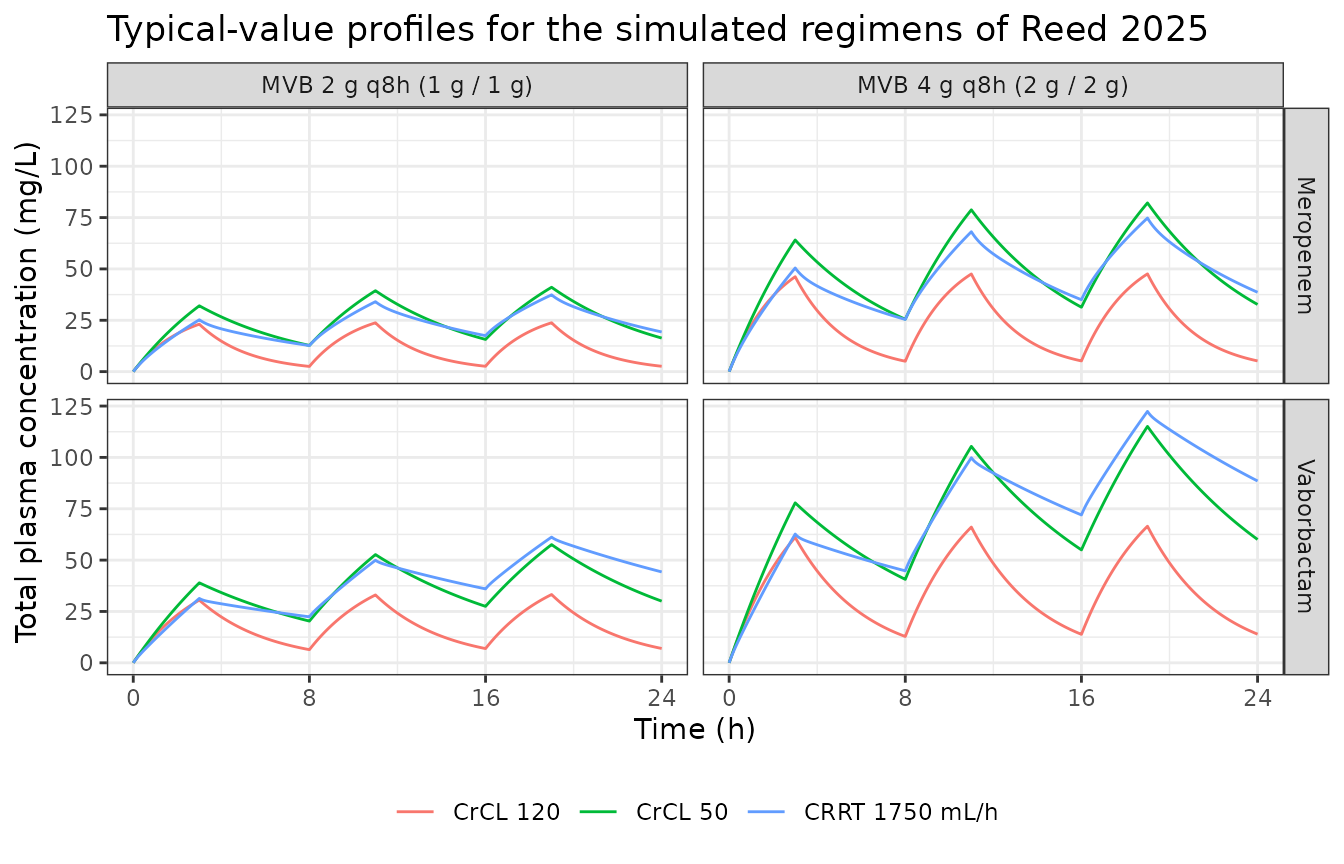
The circuit states carry drug only while CRRT runs. Off CRRT the transfer constants are gated to zero, so both circuit states stay empty:
circ <- prof |>
  group_by(arm) |>
  summarise(
    max_circuit = max(c(circuit_plasma, circuit_return, circuit_plasma_vab, circuit_return_vab)),
    .groups = "drop"
  )
knitr::kable(circ |> rename("Arm" = arm, "Largest circuit amount (mg)" = max_circuit), digits = 3)| Arm | Largest circuit amount (mg) |
|---|---|
| CRRT 1750 mL/h | 838.667 |
| CrCL 120 | 0.000 |
| CrCL 50 | 0.000 |
Validation against the paper’s statements
The paper publishes no NCA table and no typical-value profile, so the model is checked against the quantitative statements it does make.
CRRT reduces meropenem clearance by 54%
The Discussion states that “CRRT was associated with a 54% reduction in clearance” compared with patients with normal renal function. At steady state the circuit removes a fixed fraction of the drug that enters the filter, so the on-CRRT clearance has the closed form
CL_eff = CL_residual + K12 * Vd * FLOW * K20 / (K23 + FLOW * K20).
At the reference effluent flow (FLOW = 1, 2,000 mL/h) and weight (80 kg) the meropenem value reproduces the paper’s figure to three significant digits. The statement pins the structure (circuit gated, FLOW normalised to 2,000 mL/h, residual and filter routes additive) and the Table 2 values together.
p <- function(nm) exp(rxode2::rxode2(mod)$theta[[nm]])
cl_eff <- function(sfx, flow, wt) {
  vc <- p(paste0("lvc", sfx)) * wt / 80
  k20 <- p(paste0("lk_circuit_effluent", sfx)) * flow / 2000
  p(paste0("lcl_residual", sfx)) +
    p(paste0("lk_central_circuit", sfx)) * vc * k20 / (p(paste0("lk_circuit_return", sfx)) + k20)
}
reduction <- tibble(
  Analyte = c("Meropenem", "Vaborbactam"),
  `CL at CrCL 120 (L/h)` = c(p("lcl"), p("lcl_vab")),
  `CL on CRRT, 2,000 mL/h, 80 kg (L/h)` = c(cl_eff("", 2000, 80), cl_eff("_vab", 2000, 80))
) |>
  mutate(`Reduction (%)` = 100 * (1 - `CL on CRRT, 2,000 mL/h, 80 kg (L/h)` / `CL at CrCL 120 (L/h)`))
knitr::kable(reduction, digits = 2)| Analyte | CL at CrCL 120 (L/h) | CL on CRRT, 2,000 mL/h, 80 kg (L/h) | Reduction (%) |
|---|---|---|---|
| Meropenem | 10.60 | 4.88 | 54.00 |
| Vaborbactam | 6.64 | 2.06 | 68.94 |
The vaborbactam reduction (69%) is larger than meropenem’s, which is the paper’s “greater accumulation of vaborbactam relative to meropenem” on CRRT; its filter elimination constant K20 is 4.44 / 0.59 = 7.5-fold lower than meropenem’s (Discussion: “roughly 8-fold lower”).
stopifnot(
  reduction$`Reduction (%)`[2] > reduction$`Reduction (%)`[1],
  p("lk_circuit_effluent") / p("lk_circuit_effluent_vab") > 7
)
Vaborbactam exposure against the PTA and safety statements
Reed 2025 evaluated vaborbactam against fAUC/MIC > 38 with a free fraction of 0.67, over the first 24 h of dosing, and against an upper safety bound of fAUC0-24 = 1373.5 mg*h/L. Its Results state that:
- PTA was > 90% for VAB 1 or 2 g doses at MICs up to 8 mg/L except the 1 g regimen at CrCL 120, so every other arm needs a 10th-percentile fAUC0-24 of at least 38 x 8 = 304 mg*h/L, and therefore a typical value above it;
- 30.5% (CrCL 50) and 14.2% (CRRT) of simulated patients on the 2 g VAB regimen exceeded 1373.5 mg*h/L, and none on the 1 g regimen did, so every typical value lies below the bound.
The typical-value solve is consistent with both, and the one excepted arm is also the one arm whose typical exposure falls below 304 mg*h/L.
fauc <- prof |>
  group_by(regimen, arm) |>
  summarise(
    fauc_vab = 0.67 * sum(diff(time) * (head(Cc_vab, -1) + tail(Cc_vab, -1)) / 2),
    .groups = "drop"
  ) |>
  mutate(fauc_mic8 = fauc_vab / 8)

knitr::kable(
  fauc |>
    rename("Regimen" = regimen, "Arm" = arm,
           "Typical VAB fAUC0-24 (mg*h/L)" = fauc_vab, "fAUC0-24 / MIC at MIC 8" = fauc_mic8),
  digits = 1
)| Regimen | Arm | Typical VAB fAUC0-24 (mg*h/L) | fAUC0-24 / MIC at MIC 8 |
|---|---|---|---|
| MVB 2 g q8h (1 g / 1 g) | CRRT 1750 mL/h | 610.2 | 76.3 |
| MVB 2 g q8h (1 g / 1 g) | CrCL 120 | 287.7 | 36.0 |
| MVB 2 g q8h (1 g / 1 g) | CrCL 50 | 571.9 | 71.5 |
| MVB 4 g q8h (2 g / 2 g) | CRRT 1750 mL/h | 1220.3 | 152.5 |
| MVB 4 g q8h (2 g / 2 g) | CrCL 120 | 575.5 | 71.9 |
| MVB 4 g q8h (2 g / 2 g) | CrCL 50 | 1143.8 | 143.0 |
PKNCA validation
PKNCA is run on a steady-state dosing interval (2 g MVB q8h, interval
112-120 h) and on a single dose followed to 72 h, for each arm and
analyte. With no published NCA to compare against, the reference values
are the model’s own closed forms: at steady state
AUC_tau = Dose / CL_eff, and the terminal half-life is
log(2) / lambda, where lambda is the smallest
eigenvalue of the drug’s 3 x 3 rate matrix (for an off-CRRT arm, simply
CL / Vd). This checks that the integrated ODE system
honours the clearance the circuit implies, which the 54% statement
relies on.
ss <- solve_typ(make_events(arms, 1000, seq(0, 112, by = 8), sort(unique(c(seq(0, 120, by = 0.1), 120)))))
#> ℹ omega/sigma items treated as zero: 'etalcl', 'etalcl_residual', 'etalvc', 'etalk_central_circuit', 'etalk_circuit_effluent', 'etalk_circuit_return', 'etalk_return_central', 'etalcl_vab', 'etalcl_residual_vab', 'etalvc_vab', 'etalk_central_circuit_vab', 'etalk_circuit_effluent_vab', 'etalk_circuit_return_vab', 'etalk_return_central_vab'
#> Warning: multi-subject simulation without without 'omega'
sd <- solve_typ(make_events(arms, 1000, 0, c(seq(0, 12, by = 0.05), seq(12.5, 72, by = 0.5))))
#> ℹ omega/sigma items treated as zero: 'etalcl', 'etalcl_residual', 'etalvc', 'etalk_central_circuit', 'etalk_circuit_effluent', 'etalk_circuit_return', 'etalk_return_central', 'etalcl_vab', 'etalcl_residual_vab', 'etalvc_vab', 'etalk_central_circuit_vab', 'etalk_circuit_effluent_vab', 'etalk_circuit_return_vab', 'etalk_return_central_vab'
#> Warning: multi-subject simulation without without 'omega'

to_long <- function(sim) {
  sim |>
    select(id, time, arm, Meropenem = Cc, Vaborbactam = Cc_vab) |>
    pivot_longer(c(Meropenem, Vaborbactam), names_to = "analyte", values_to = "Cc") |>
    filter(!is.na(Cc))
}
dose_rows <- function(times) {
  tidyr::expand_grid(arm = arms$arm, analyte = c("Meropenem", "Vaborbactam"), time = times) |>
    left_join(tibble(arm = arms$arm, id = seq_len(nrow(arms))), by = "arm") |>
    mutate(amt = 1000)
}

run_nca <- function(conc, doses, intervals) {
  o_conc <- PKNCA::PKNCAconc(conc, Cc ~ time | arm + analyte + id)
  o_dose <- PKNCA::PKNCAdose(doses, amt ~ time | arm + analyte + id, duration = 3)
  as.data.frame(PKNCA::pk.nca(PKNCA::PKNCAdata(o_conc, o_dose, intervals = intervals)))
}

nca_ss <- run_nca(to_long(ss), dose_rows(seq(0, 112, by = 8)),
                  data.frame(start = 112, end = 120, auclast = TRUE, cmax = TRUE))
nca_sd <- run_nca(to_long(sd), dose_rows(0),
                  data.frame(start = 0, end = Inf, half.life = TRUE))
# Analytic references at WT_SIM.
rate_matrix <- function(sfx, arm_row) {
  act <- arm_row$RRT_CRRT_ACTIVE
  vc <- p(paste0("lvc", sfx)) * WT_SIM / 80
  cl <- p(paste0("lcl", sfx)) * arm_row$CRCL / 120 * (1 - act) + p(paste0("lcl_residual", sfx)) * act
  k12 <- p(paste0("lk_central_circuit", sfx)) * act
  k23 <- p(paste0("lk_circuit_return", sfx)) * act
  k31 <- p(paste0("lk_return_central", sfx)) * act
  k20 <- p(paste0("lk_circuit_effluent", sfx)) * arm_row$RRT_CRRT_EFFLUENT_FLOW / 2000
  list(
    cl_eff = cl + k12 * vc * k20 / (k23 + k20 + (k23 + k20 == 0)),
    A = matrix(c(-(k12 + cl / vc), 0, k31,
                 k12, -(k23 + k20), 0,
                 0, k23, -k31), nrow = 3, byrow = TRUE)
  )
}
ref <- tidyr::expand_grid(arm = arms$arm, analyte = c("Meropenem", "Vaborbactam")) |>
  rowwise() |>
  mutate(
    rm = list(rate_matrix(if (analyte == "Vaborbactam") "_vab" else "", arms[arms$arm == arm, ])),
    auc_ref = 1000 / rm$cl_eff,
    # The off-CRRT circuit rows are all-zero, contributing eigenvalues of 0
    # that do not belong to the central disposition; keep the negative ones.
    hl_ref = log(2) / min(abs(Re(eigen(rm$A)$values[Re(eigen(rm$A)$values) < -1e-12])))
  ) |>
  ungroup() |>
  select(-rm)

cmp <- bind_rows(nca_ss, nca_sd) |>
  filter(PPTESTCD %in% c("auclast", "half.life")) |>
  select(arm, analyte, PPTESTCD, PPORRES) |>
  pivot_wider(names_from = PPTESTCD, values_from = PPORRES) |>
  left_join(ref, by = c("arm", "analyte")) |>
  mutate(auc_err_pct = 100 * (auclast / auc_ref - 1), hl_err_pct = 100 * (half.life / hl_ref - 1))

knitr::kable(
  cmp |>
    select(arm, analyte, auclast, auc_ref, auc_err_pct, half.life, hl_ref, hl_err_pct) |>
    rename(
      "Arm" = arm, "Analyte" = analyte,
      "AUC0-8,ss PKNCA (mg*h/L)" = auclast, "Dose / CL_eff (mg*h/L)" = auc_ref,
      "AUC diff (%)" = auc_err_pct,
      "t1/2 PKNCA (h)" = half.life, "t1/2 analytic (h)" = hl_ref, "t1/2 diff (%)" = hl_err_pct
    ),
  digits = 2
)| Arm | Analyte | AUC0-8,ss PKNCA (mg*h/L) | Dose / CL_eff (mg*h/L) | AUC diff (%) | t1/2 PKNCA (h) | t1/2 analytic (h) | t1/2 diff (%) |
|---|---|---|---|---|---|---|---|
| CrCL 120 | Meropenem | 94.33 | 94.34 | -0.01 | 1.57 | 1.57 | 0.00 |
| CrCL 120 | Vaborbactam | 150.60 | 150.60 | 0.00 | 2.22 | 2.22 | 0.00 |
| CrCL 50 | Meropenem | 226.41 | 226.42 | 0.00 | 3.76 | 3.76 | 0.00 |
| CrCL 50 | Vaborbactam | 361.44 | 361.45 | 0.00 | 5.33 | 5.33 | 0.00 |
| CRRT 1750 mL/h | Meropenem | 234.67 | 234.67 | 0.00 | 5.69 | 5.70 | -0.08 |
| CRRT 1750 mL/h | Vaborbactam | 540.01 | 540.35 | -0.06 | 11.12 | 11.13 | -0.02 |
Assumptions and deviations
-
No between-subject or residual variability.
Pmetrics NPAG estimates a discrete non-parametric joint distribution.
Table 2 summarises it only by each parameter’s weighted median, a 95%
credible interval and a shrinkage; no SD, CV%, covariance, support-point
table or assay-error polynomial is reported in the paper or its
supplement. The intervals are strongly asymmetric (MEM K31 0.51-35.0
around 1.67) and too narrow on clearance (MEM CL non-CRRT 9.13-12.5) to
be read as the spread of an ICU population, so no omega was derived from
them. Every random effect and both residual components per analyte are
carried as
fixed(0). The paper’s PTA, CFR and safety percentages, which come from semi-parametric sampling of that distribution, therefore cannot be reproduced; they are checked here only for consistency of the typical value. -
Gate covariate. The paper’s
CRRTterm is encoded as the time-varyingRRT_CRRT_ACTIVEgate rather than the subject-levelRRT_CRRT_STATUSflag, because the switch connects and disconnects the circuit states. For the paper’s three CRRT patients, who were on CRRT throughout sampling, the two encodings are identical. -
Effluent flow off CRRT. The paper gates K12, K23
and K31 but not the
FLOW * K20term. SupplyRRT_CRRT_EFFLUENT_FLOW = 0(notNA) for subjects off CRRT; any value gives the same result whileRRT_CRRT_ACTIVE = 0and the filter is empty. -
Circuit compartment names. The paper’s filter state
(X[2]) is carried as
circuit_plasmaand the post-filter blood (X[3]) ascircuit_return. Reed 2025 lumps plasma and red cells in the filter and assigns the circuit states no volume, so they hold amounts only and are never observed. -
The return limb behaves as a distribution
reservoir. Because K31 is much slower than K23 (MEM 1.67 vs
29.3 1/h), the fitted
circuit_returnstate holds roughly 40% of the meropenem amount incentralat steady state, far more than the blood volume of a real return line could carry. This is the paper’s fit as published and is kept unchanged; it means that on CRRT the model is effectively multi-compartmental, and the volumevcalone is not the total apparent volume. - CrCL on CRRT. Equation 1 does not read CrCL while CRRT is running, but the column must still be finite; any value works.
- Simulation weight. The paper held body weight constant in its simulations without stating the value; 70 kg is used here, the weight its 1,750 mL/h effluent flow was derived from. The reference weight in the model is 80 kg. The typical-value conclusions above also hold at 80 kg.
-
Sampled matrix. In CRRT patients the paper sampled
pre-filter blood (plasma), which is the
centralstate; no post-filter or effluent samples were collected, so the circuit states are not separately validated by data.