Polymyxin B + minocycline against carbapenem-resistant Klebsiella pneumoniae (Olsson 2024)
Source:vignettes/articles/Olsson_2024_polymyxinB_minocycline.Rmd
Olsson_2024_polymyxinB_minocycline.RmdModel and source
- Article: https://doi.org/10.1093/jac/dkad394
- Citation: Olsson A, Malmberg C, Zhao C, Friberg LE, Nielsen EI, Lagerback P, Tangden T. Synergy of polymyxin B and minocycline against KPC-3- and OXA-48-producing Klebsiella pneumoniae in dynamic time-kill experiments: agreement with in silico predictions. J Antimicrob Chemother 2024;79(2):391-402. PMCID: PMC10832586.
This is not a population PK model. It is a semi-mechanistic pharmacokinetic/pharmacodynamic (PK/PD) model of bacterial killing by polymyxin B (PMB) and minocycline (MIN), alone and in combination, against carbapenem-resistant Klebsiella pneumoniae. The structural model is that of Zhao et al. 2020 (Int J Antimicrob Agents 55:105941), which Olsson 2024 reproduces in supplementary Table S1 (equations 1-10) with the parameter values in Table 3.
The model has two bacterial states: a growing drug-susceptible
population (bact_susceptible, S) that transfers to a
resting drug-insusceptible population (bact_resting, R) as
the total count approaches the system carrying capacity
Bmax. Each drug kills the susceptible bacteria through a
power function of its concentration, attenuated by a drug-specific,
irreversible adaptive-resistance system (an aroff
-> aron transition whose rate rises with concentration).
Polymyxin B enhances minocycline twice over: it raises the minocycline
kill rate through an Emax function of the PMB concentration (Eq 5), and
it raises the rate at which minocycline-induced adaptive resistance
develops through a power function of the PMB concentration (Eq 10). The
reverse (minocycline affecting PMB) was not supported.
Two clinical isolates were studied, and the paper is contributed to nlmixr2lib as two model files, one per isolate:
olsson_models <- c(
  "Olsson_2024_polymyxinB_minocycline_ARU705",
  "Olsson_2024_polymyxinB_minocycline_ARU613"
)
strain_label <- c(
  Olsson_2024_polymyxinB_minocycline_ARU705 = "ARU705 (KPC-3)",
  Olsson_2024_polymyxinB_minocycline_ARU613 = "ARU613 (OXA-48)"
)
uis <- lapply(olsson_models, function(n) rxode2::rxode(readModelDb(n)))
names(uis) <- olsson_models
lapply(uis, function(u) u$description)
#> $Olsson_2024_polymyxinB_minocycline_ARU705
#> [1] "In vitro (Klebsiella pneumoniae ARU705, KPC-3-producing clinical isolate; polymyxin B MIC 0.5 mg/L, minocycline MIC 1 mg/L). Semi-mechanistic PK/PD model of polymyxin B (PMB) and minocycline (MIN) alone and in combination, used for in silico predictions of 72 h dynamic time-kill experiments. Growing drug-susceptible bacteria (bact_susceptible) transfer to drug-insusceptible resting bacteria (bact_resting) as the total count approaches Bmax. Each drug kills the susceptible bacteria through a power function of its concentration, attenuated by a drug-specific irreversible adaptive-resistance system (aroff -> aron at a concentration-driven rate). PMB enhances MIN in two ways: it raises the MIN kill rate through an Emax function of the PMB concentration and it raises the rate at which MIN-induced adaptive resistance develops through a power function of the PMB concentration. Drug concentrations are user-dosed bath states (cpmb, cmino; mg/L). The drug-effect parameters re-estimated from ARU705 static time-kill data are carried as scaling factors on the ARU613 values; all other parameters are shared with ARU613. Companion model: Olsson_2024_polymyxinB_minocycline_ARU613 (OXA-48-producing isolate)."
#>
#> $Olsson_2024_polymyxinB_minocycline_ARU613
#> [1] "In vitro (Klebsiella pneumoniae ARU613, OXA-48-producing clinical isolate; polymyxin B MIC 8 mg/L, minocycline MIC 8 mg/L). Semi-mechanistic PK/PD model of polymyxin B (PMB) and minocycline (MIN) alone and in combination, used for in silico predictions of 72 h dynamic time-kill experiments. Growing drug-susceptible bacteria (bact_susceptible) transfer to drug-insusceptible resting bacteria (bact_resting) as the total count approaches Bmax. Each drug kills the susceptible bacteria through a power function of its concentration, attenuated by a drug-specific irreversible adaptive-resistance system (aroff -> aron at a concentration-driven rate). PMB enhances MIN in two ways: it raises the MIN kill rate through an Emax function of the PMB concentration and it raises the rate at which MIN-induced adaptive resistance develops through a power function of the PMB concentration. Drug concentrations are user-dosed bath states (cpmb, cmino; mg/L). Companion model: Olsson_2024_polymyxinB_minocycline_ARU705 (KPC-3-producing isolate)."
ARU705 (KPC-3-producing; PMB MIC 0.5 mg/L, MIN MIC 1 mg/L) was the
more susceptible strain. Olsson 2024 generated strain-specific
drug-effect parameters for ARU705 from fresh static time-kill
experiments, expressing them as scaling factors on the
ARU613 estimates (Table 3 footnote b: “the estimated Slope1 for ARU705
for MIN single drug is 0.339 x 1.55 = 0.525”). The ARU705 model file
carries those scaling factors explicitly and multiplies them by the
ARU613 values; parameters not re-estimated for ARU705 (the Hill-type
exponents, the adaptive-resistance slopes, and the interaction
Slope4, gamma4 and Emax) keep
their ARU613 values.
ARU613 (OXA-48-producing) was non-susceptible to both drugs (PMB MIC 8 mg/L, MIN MIC 8 mg/L) and carries the original Zhao 2020 model parameters.
Population (biological context)
pop705 <- uis[["Olsson_2024_polymyxinB_minocycline_ARU705"]]$population
tibble::tibble(
  Field = c("Species", "Organism", "Model system", "Dose range"),
  Value = c(pop705$species, pop705$organism, pop705$model_system, pop705$dose_range)
) |>
knitr::kable()| Field | Value |
|---|---|
| Species | in vitro (Klebsiella pneumoniae ARU705) |
| Organism | Klebsiella pneumoniae ARU705, a KPC-3-producing clinical isolate obtained from Erasmus MC, Rotterdam. Meropenem MIC >= 16 mg/L (R), minocycline 1 mg/L (S), polymyxin B 0.5 mg/L (I); ompK35 frameshift Q292fs. Table 1. |
| Model system | Drug-effect scaling factors were re-estimated from 28 h static time-kill experiments with ARU705 in cation-adjusted Mueller-Hinton broth at 37 C (starting inoculum 6 log10 CFU/mL; PMB 0.0625-64 mg/L and MIN 0.25-256 mg/L alone, nine PMB + MIN combinations within PMB 0.25-1 mg/L and MIN 0.5-16 mg/L; sampling at 0, 1, 2, 4, 8, 24 and 28 h; duplicates). Olsson 2024 used the model to predict 72 h dynamic time-kill experiments in a 100 mL in vitro PK/PD model mimicking free plasma concentrations in critically ill patients. |
| Dose range | Dynamic predictions: PMB 2.5 mg/kg loading dose then 1.5 mg/kg q12h (targeted Cmax 5.0 and 4.5 mg/L, Cmin 1.1 mg/L) and MIN 400 mg loading dose then 200 mg q12h (targeted Cmax 3.8 and 4.1 mg/L, Cmin 1.8 mg/L), alone and in combination. |
Both strains were resistant to meropenem and produced carbapenemases (ARU705 carried blaKPC-3, ARU613 carried blaOXA-48). The drug-effect parameters derive from static time-kill experiments at a 6 log10 CFU/mL inoculum; Olsson 2024 then used the model to predict 72 h dynamic time-kill experiments in a 100 mL in vitro PK/PD apparatus mimicking free plasma concentrations in critically ill patients.
Source trace
Every parameter in both files is traced in an in-file comment to Table 3 of Olsson 2024 (which, for ARU613, reproduces the Zhao 2020 static-model estimates). The model structure is supplementary Table S1.
| Element | Source location |
|---|---|
| ODE structure (S, R, adaptive resistance) | Table S1, Eqs 1-3, 7-8 |
| Power-function kill rates (Eq 4), PMB-on-MIN Emax (Eq 5) | Table S1 |
| Adaptive-resistance inhibition, beta = +1 PMB / -1 MIN (Eq 6) | Table S1 |
| Adaptive-resistance on-rates (Eq 9), PMB-on-MIN power term (Eq 10) | Table S1 |
kgrowth, kdeath, Bmax,
Tlag
|
Table 3, “Bacteria-related” block |
Slope1/Slope2/gamma1/Slope3
per drug |
Table 3, “Single drug-specific” block |
Emax/EC50/Slope4/gamma4
interaction |
Table 3, “Combination-specific interaction” block |
| ARU705 scaling factors on Slope1/Slope2/EC50 | Table 3, ARU705 columns + footnote b |
| Inoculum 6 log10 CFU/mL | Methods, “PD predictions” |
# Read the transcribed constants back out of the built ARU613 model and confirm
# the key Table 3 values are present exactly as published.
ini613 <- uis[["Olsson_2024_polymyxinB_minocycline_ARU613"]]$iniDf
val <- function(nm) ini613$est[ini613$name == nm]
stopifnot(
  val("kgrowth") == 1.37,
  val("kdeath") == 0.179,
  val("log10bmax") == 9.53,
  val("tlag") == 0.304,
  val("slope1_pmb") == 0.0690,
  val("gamma1_pmb") == 1.20,
  val("slope1_mino") == 0.339,
  val("gamma1_mino") == 0.546,
  val("emax_int") == 2.45,
  val("ec50_int") == 0.285
)

# ARU705: Slope1 scaling reproduces the footnote-b worked example (0.339 x 1.55).
ini705 <- uis[["Olsson_2024_polymyxinB_minocycline_ARU705"]]$iniDf
v705 <- function(nm) ini705$est[ini705$name == nm]
stopifnot(
  # Footnote b rounds 0.339 x 1.55 to 0.525; the product is 0.52545.
  abs(v705("slope1_mino") * v705("fslope1_mino") - 0.525) < 1e-3,
  v705("fslope1_pmb") == 57.1,
  v705("fslope2_pmb") == 50.4,
  v705("fec50_int") == 0.553
)
Helper: static time-kill simulation
A static time-kill experiment holds each drug at a constant bath
concentration. In these models the concentration lives in a state
(cpmb, cmino) whose derivative is zero, so a
single dose event at time 0 fixes it for the run.
simulate_static <- function(ui, pmb, mino, times = c(0, 2, 4, 8, 24)) {
  obs <- data.frame(time = times, amt = 0, evid = 0, cmt = "bact_susceptible")
  dose <- rbind(
    data.frame(time = 0, amt = pmb, evid = 1, cmt = "cpmb"),
    data.frame(time = 0, amt = mino, evid = 1, cmt = "cmino")
  )
  ev <- dplyr::arrange(dplyr::bind_rows(dose, obs), time, dplyr::desc(evid))
  # rxSolve() returns one row per observation record and carries no `evid`
  # column, so select the output columns directly rather than filtering on evid.
  out <- as.data.frame(rxode2::rxSolve(ui, ev, returnType = "data.frame"))
  out[, c("time", "log_cfu")]
}
Static time-kill behaviour (replicates Figure 1 for ARU705)
Figure 1 of Olsson 2024 shows the static time-kill VPC for ARU705. The model is deterministic here (typical values only), so we reproduce the structural trends: a susceptible strain cleared by low PMB, concentration-dependent regrowth at the higher single-drug PMB levels as adaptive resistance develops, minocycline holding the count down but not clearing it, and the combination driving the fastest and deepest kill.
ui705 <- uis[["Olsson_2024_polymyxinB_minocycline_ARU705"]]
scenarios <- tibble::tribble(
  ~label,                 ~pmb, ~mino,
  "GC",                      0,     0,
  "PMB 0.5",                0.5,    0,
  "PMB 2",                   2,     0,
  "MIN 8",                   0,     8,
  "MIN 64",                  0,    64,
  "PMB 0.5 + MIN 1",        0.5,    1,
  "PMB 0.5 + MIN 4",        0.5,    4
)
static705 <- scenarios |>
  dplyr::rowwise() |>
  dplyr::reframe(label = label, simulate_static(ui705, pmb, mino))

ggplot(static705, aes(time, log_cfu, colour = label)) +
  geom_line() +
  geom_point(size = 1) +
  geom_hline(yintercept = 1, linetype = "dashed") +
  labs(
    x = "Time (h)", y = expression(log[10] ~ "CFU/mL"),
    colour = NULL,
    title = "ARU705 static time-kill (typical-value predictions; cf. Figure 1)"
  )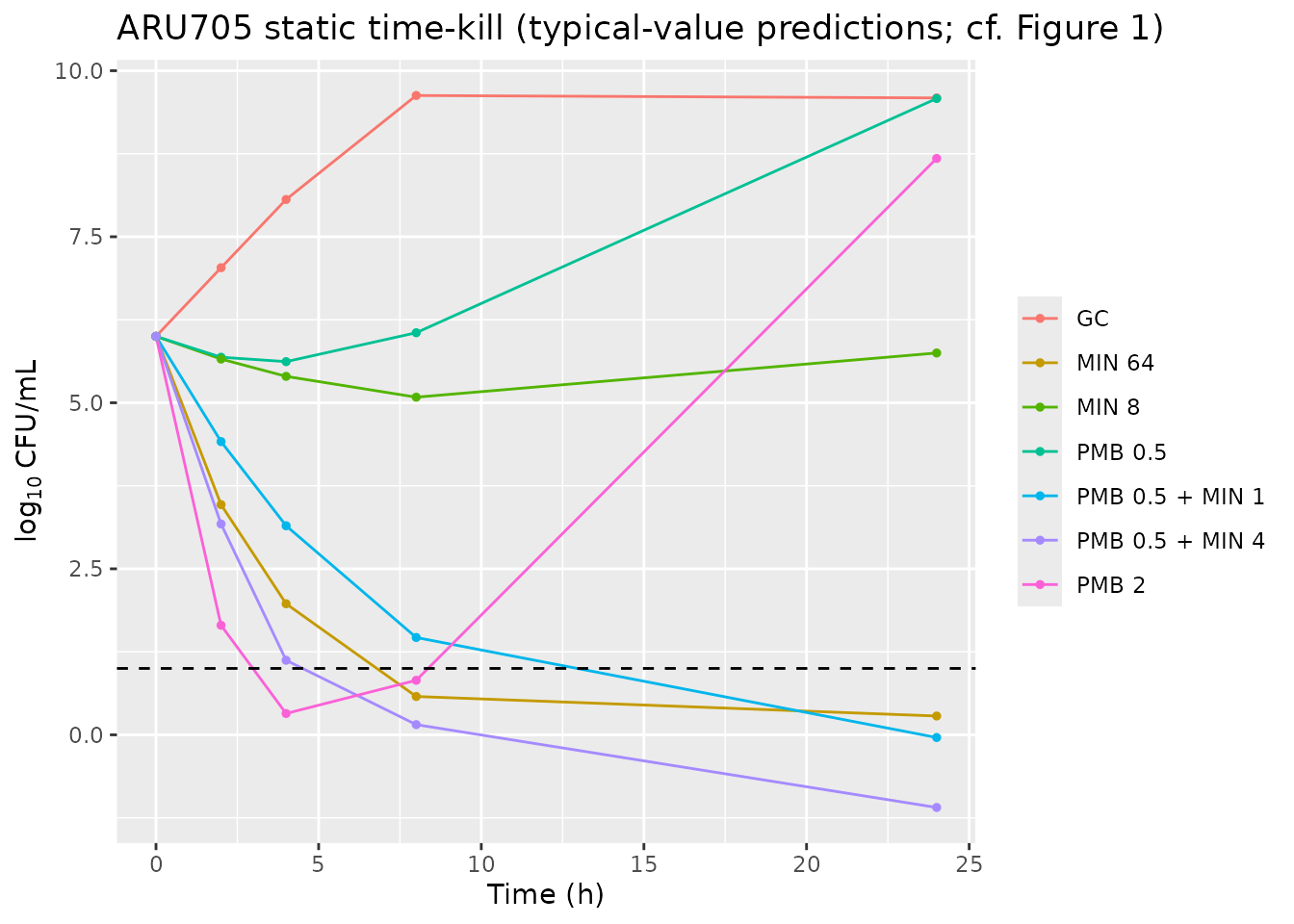
# Structural gates on the ARU705 static predictions (Figure 1 panels):
# the growth control saturates near Bmax, low PMB alone clears to the LOD,
# and the combination is the most bactericidal at 24 h.
gc24 <- static705$log_cfu[static705$label == "GC" & static705$time == 24]
pmb05_8 <- static705$log_cfu[static705$label == "PMB 0.5" & static705$time == 8]
comb24 <- static705$log_cfu[static705$label == "PMB 0.5 + MIN 4" & static705$time == 24]
min64_24 <- static705$log_cfu[static705$label == "MIN 64" & static705$time == 24]
stopifnot(
  gc24 > 9,                 # growth control reaches carrying capacity
  pmb05_8 < 7,              # 0.5 mg/L PMB (= MIC) kills early
  comb24 < min64_24,        # combination beats minocycline monotherapy
  comb24 < 2                # combination essentially clears the susceptible pool
)
Dynamic time-kill predictions (replicates Figure 2)
Figure 2 shows the model’s in silico predictions for the 72 h dynamic experiments that mimic patient plasma PK. We reconstruct the concentration drivers from the paper’s design (Methods, “Design of PK profiles”): targeted peaks of 5.0 mg/L (loading) and 4.5 mg/L (maintenance) for PMB and 3.8 / 4.1 mg/L for minocycline, q12h dosing, with a biphasic elimination whose half-lives are ~2 h for the first 3 h (first dose) / 2 h (subsequent doses) and ~10 h thereafter, and a constant 1.2 mg/L minocycline floor in the diluent.
# Per-cycle flow rate: fast phase (t<2 h into the cycle, 3 h for the first dose)
# then slow phase, as elimination half-lives of 2 and 10 h.
k_fast <- log(2) / 2
k_slow <- log(2) / 10

# Dose increments to hit the targeted peaks given the trough each cycle reaches.
pk_amts <- function(cmax_ld, cmax_md, floor) {
  tr_ld <- floor + (cmax_ld - floor) * exp(-3 * k_fast - 9 * k_slow)
  tr_md <- floor + (cmax_md - floor) * exp(-2 * k_fast - 10 * k_slow)
  c(cmax_ld, cmax_md - tr_ld, rep(cmax_md - tr_md, 4))
}
amt_pmb <- pk_amts(5.0, 4.5, 0)
amt_min <- pk_amts(3.8, 4.1, 1.2)

# Replace the zero `cpmb` / `cmino` derivatives with the biphasic washout. The
# numeric constants are inlined with sprintf so they do not become model
# parameters (rxode2::model() would otherwise treat k_slow etc. as thetas).
add_dynamic_pk <- function(ui, cmino_floor) {
  kflow <- sprintf(
    "(%.7f + %.7f * ((t < 3) + (t >= 12) * ((t - 12 * floor(t / 12)) < 2)))",
    k_slow, k_fast - k_slow
  )
  # Assign the parsed expressions to variables: rxode2::model() captures its
  # `...` by non-standard evaluation, so an inline str2lang(...) call would be
  # taken literally; a variable holding a language object is evaluated.
  pmb_ode <- str2lang(sprintf("d/dt(cpmb) <- -%s * cpmb", kflow))
  mino_ode <- str2lang(sprintf("d/dt(cmino) <- -%s * (cmino - %.4f)", kflow, cmino_floor))
  ui <- rxode2::model(ui, pmb_ode)
  rxode2::model(ui, mino_ode)
}

simulate_dynamic <- function(ui, pmb_on, min_on) {
  floor <- if (min_on) 1.2 else 0
  m <- add_dynamic_pk(ui, floor)
  ev <- data.frame(id = 1, time = seq(0, 72, by = 0.25), amt = 0, evid = 0,
                   cmt = "bact_susceptible")
  if (pmb_on) {
    ev <- rbind(ev, data.frame(id = 1, time = seq(0, 60, 12), amt = amt_pmb,
                               evid = 1, cmt = "cpmb"))
  }
  if (min_on) {
    ev <- rbind(ev, data.frame(id = 1, time = seq(0, 60, 12), amt = amt_min,
                               evid = 1, cmt = "cmino"))
  }
  ev <- ev[order(ev$time, -ev$evid), ]
  out <- as.data.frame(rxode2::rxSolve(m, ev, returnType = "data.frame",
                                       maxsteps = 1e6))
  out[, c("time", "log_cfu")]
}
arms <- tibble::tribble(
  ~arm,         ~pmb_on, ~min_on,
  "GC",           FALSE,   FALSE,
  "MIN",          FALSE,    TRUE,
  "PMB",           TRUE,   FALSE,
  "PMB + MIN",     TRUE,    TRUE
)

dynamic_all <- lapply(names(uis), function(nm) {
  ui <- uis[[nm]]
  res <- arms |>
    dplyr::rowwise() |>
    dplyr::reframe(arm = arm, simulate_dynamic(ui, pmb_on, min_on))
  res$strain <- strain_label[[nm]]
  res
}) |>
  dplyr::bind_rows()

ggplot(dynamic_all, aes(time, log_cfu, colour = arm)) +
  geom_line() +
  facet_wrap(~strain) +
  geom_hline(yintercept = c(1, 8), linetype = "dashed") +
  coord_cartesian(ylim = c(-1, 10)) +
  labs(
    x = "Time (h)", y = expression(log[10] ~ "CFU/mL"), colour = NULL,
    title = "Dynamic time-kill in silico predictions (cf. Figure 2)"
  )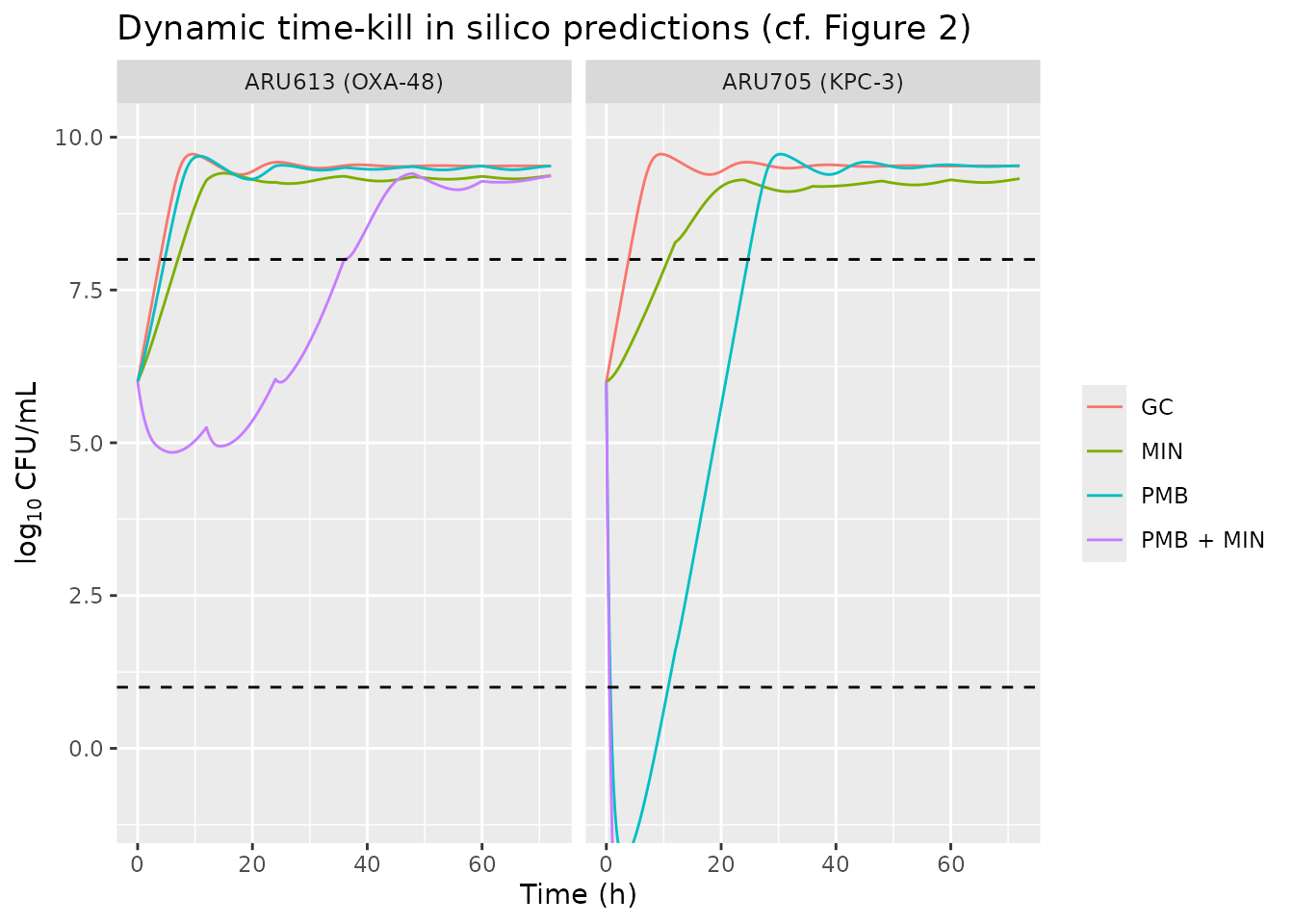
The predicted curves reproduce the paper’s headline findings. Read off Figure 2, the in silico lines pass through (log10 CFU/mL, +/- the line width):
- ARU705 (Figure 2a): minocycline ~8.3 at 12 h and ~9.3 at 24 h; polymyxin B ~1.0 to 12 h then regrowth to ~9.6 by ~30 h; the combination held at the LOD throughout.
- ARU613 (Figure 2b): the combination dips to ~5 at 8-12 h, then regrows, crossing ~8 at ~36 h and reaching ~9.3 by 48 h; single drugs track the growth control.
pick <- function(strain, arm, t) {
  d <- dynamic_all[dynamic_all$strain == strain & dynamic_all$arm == arm, ]
  d$log_cfu[which.min(abs(d$time - t))]
}

# ARU705: combination suppresses to the LOD and stays there; PMB alone regrows.
stopifnot(
  pick("ARU705 (KPC-3)", "PMB + MIN", 24) < 1,
  pick("ARU705 (KPC-3)", "PMB + MIN", 72) < 1,
  pick("ARU705 (KPC-3)", "PMB", 12) < 2,        # PMB nadir before regrowth
  pick("ARU705 (KPC-3)", "PMB", 48) > 8,        # PMB regrowth
  pick("ARU705 (KPC-3)", "MIN", 24) > 8         # minocycline does not clear
)

# ARU613: combination dips then regrows (synergy only transient); the 12 h and
# 48 h values bracket the Figure 2b trajectory.
comb613_12 <- pick("ARU613 (OXA-48)", "PMB + MIN", 12)
comb613_48 <- pick("ARU613 (OXA-48)", "PMB + MIN", 48)
stopifnot(
  comb613_12 > 4, comb613_12 < 7,               # transient suppression ~5-6.5
  comb613_48 > 8,                               # full regrowth by 48 h
  comb613_48 > comb613_12                        # regrowth, not sustained kill
)
Adaptive resistance drives the ARU705 polymyxin B regrowth
The sharp PMB-alone regrowth against ARU705 is the model’s
irreversible adaptive resistance: aron_pmb climbs toward 1
under PMB exposure, and the inhibition factor
1 - Slope3 * aron_pmb (Slope3 = 1 for PMB) drives the PMB
kill rate toward zero. We confirm the mechanism by reading the state
back.
m705 <- add_dynamic_pk(ui705, 0)
ev <- rbind(
  data.frame(id = 1, time = seq(0, 72, by = 0.5), amt = 0, evid = 0, cmt = "bact_susceptible"),
  data.frame(id = 1, time = seq(0, 60, 12), amt = amt_pmb, evid = 1, cmt = "cpmb")
)
ev <- ev[order(ev$time, -ev$evid), ]
ar <- as.data.frame(rxode2::rxSolve(m705, ev, returnType = "data.frame"))
ar_on_24 <- ar$aron_pmb[which.min(abs(ar$time - 24))]
# By 24 h adaptive resistance has developed substantially, abolishing PMB kill.
stopifnot(ar_on_24 > 0.9, all(ar$aron_pmb >= -1e-9), all(ar$aron_pmb <= 1 + 1e-9))
ar_on_24
#> [1] 0.9998624
Assumptions and deviations
-
No residual error or between-experiment
variability. Olsson 2024 reports typical-value parameters only
(Table 3); the original Zhao 2020 fit, which would carry the residual
model and any between-experiment variability, is not open access.
addSdis thereforefixed(0)and the models are deterministic. The static VPC of Figure 1 (grey shaded 95% interval) cannot be reproduced without that variance model; this vignette compares against the Figure 1 medians and the Figure 2 prediction lines. - ARU705 static predictions are more bactericidal than the Figure 1 VPC at low drug concentrations. The typical-value model clears 0.5-2 mg/L PMB to well below the LOD within hours, whereas the Figure 1 VPC medians regrow at those levels. This reflects a known limitation the authors discuss (static 24 h data under-predict the late regrowth and resistance seen over longer experiments). The structural gates above are written on the robust features (growth-control saturation, combination being the most bactericidal), not on the extreme low-concentration kill depth.
-
Dynamic concentration drivers are reconstructed, not
transcribed. The paper gives targeted peaks/troughs, phase
half-lives, the phase-switch times, and the minocycline diluent floor
(Methods, “Design of PK profiles”; Figure S2), but not a closed-form
concentration equation. The biphasic exponential-washout driver here
reproduces the targeted Figure S2 profiles (PMB peaks ~4.5-5, troughs
~1.1; minocycline peaks ~3.8-4.1, troughs ~1.8 with a 1.2 mg/L floor).
Simulations that need the exact measured concentrations should supply
them as a time-course into
cpmb/cmino. -
Irreversible adaptive resistance. Table S1 gives no
return (
koff) term for eitheraronstate, soaroff -> aronis one-way; thearonstates therefore accumulate monotonically toward 1 over an experiment. -
S -> R transfer switches on at
Tlag. Eq 3 sets the transfer rate to 0 forTime < Tlag; hereTlag= 0.304 h is small, so the switch is near the start of the run. ```