Tacrolimus (Abdel Jalil 2013)
Source:vignettes/articles/AbdelJalil_2013_tacrolimus.Rmd
AbdelJalil_2013_tacrolimus.RmdModel and source
- Citation: Abdel Jalil MH, Hawwa AF, McKiernan PJ, Shields MD, McElnay JC. Population pharmacokinetic and pharmacogenetic analysis of tacrolimus in paediatric liver transplant patients. Br J Clin Pharmacol. 2014;77(1):130-140. doi:10.1111/bcp.12174
- Description: One-compartment population PK model for oral tacrolimus in paediatric liver transplant recipients (Abdel Jalil 2013), with first-order absorption (ka fixed at the literature value 4.5 1/h), an apparent volume of distribution fixed at the literature value 30 L/kg, allometric (WT/13.2 kg)^0.75 scaling on apparent clearance with the theory-based exponent fixed, multiplicative exponential effects of time post-transplantation (days) and CYP3A5*1 carrier status on CL/F, exponential (log-normal) inter-individual variability on CL/F, and proportional residual error.
- Article: https://doi.org/10.1111/bcp.12174
Population
The model was developed from 628 tacrolimus pre-dose whole-blood trough concentrations collected retrospectively from therapeutic drug monitoring records of 43 paediatric patients during their first year after liver transplantation at Birmingham Children’s Hospital, UK (Abdel Jalil 2013 Table 2). Mean (range) age was 5 (0.65-17.56) years and mean (range) body weight 21.6 (6.06-69.95) kg; 44.2% (19/43) of subjects were female. The race distribution was 31 Caucasian (72.1%), 9 Asian (20.9%), and 3 African Caribbean (7.0%). Tacrolimus was administered orally as capsules or oral suspension, predominantly twice daily, in combination with low-dose steroids; the dose range was 0.4-30 mg/day (0.03-1.23 mg/kg/day) and the median time since transplantation 153 days (range 15-364). Trough concentrations were measured by enzyme immunoassay (Abbott IMx; LLQ 2 ng/mL, linear to 30 ng/mL). The cohort was genotyped for CYP3A53 and three ABCB1 SNPs; the CYP3A5 genotype distribution was 1/1 n = 2 (4.7%), 1/3 n = 9 (20.9%), 3/*3 n = 32 (74.4%), in Hardy-Weinberg equilibrium.
The same information is available programmatically via
readModelDb("AbdelJalil_2013_tacrolimus")$population.
Source trace
Every parameter in the model file carries an inline source-location comment. The table below collects the entries in one place.
| Equation / parameter | Value | Source location |
|---|---|---|
lka (ka, fixed) |
4.5 1/h | Methods ‘Selecting the base model’ (literature reference 9) |
lvc (V/F per kg, fixed) |
30 L/kg | Methods ‘Selecting the base model’ (literature references 7, 8) |
lcl (CL/F at WT 13.2 kg, 3/3, POD 0) |
12.92 L/h | Table 5, theta_1 row (RSE 4.8%) |
e_wt_cl (allometric exponent, fixed) |
0.75 | Methods ‘Selecting the base model’ (theory-based allometric exponent) |
e_pod_cl (theta_2) |
-0.00158 /d | Table 5, theta_2 row (RSE 13.8%) |
e_cyp3a5_expr_cl (theta_3) |
0.4282 | Table 5, theta_3 row (RSE 25.5%) |
| IIV CL/F (omega^2) | 0.16 | Table 5, omega^2 row (RSE 19.8%; ~40% CV) |
| Proportional residual error (sigma^2) | 0.125 | Table 5, sigma^2 row (RSE 11.9%; ~35.4% CV) |
| Compartment structure (1-cmt oral, first-order absorption + elimination) | – | Results ‘Population pharmacokinetic analysis’ paragraph |
| Final CL/F covariate equation | 12.92 * (WT/13.2)^0.75 * exp(-0.00158 * TPT) * exp(0.4282 * CYP3A5) |
Results ‘Covariate selection and final pharmacokinetic model’ equation; Abstract Results equation |
| Reference weight (study median) | 13.2 kg | Methods ‘Selecting the base model’ allometric paragraph |
Virtual cohort
The published dataset is not openly available, so the virtual cohort below mirrors the demographics in Abdel Jalil 2013 Table 2 and the CYP3A5 genotype distribution stated in Results. Two genotype strata are built so the time-related clearance simulation reproduces Figure 3 of the paper.
set.seed(20130506)

n_per_geno <- 100L

make_cohort <- function(n, cyp3a5_expr, label, id_offset = 0L) {
  tibble(
    id          = id_offset + seq_len(n),
    # Weight distribution centred on the study median 13.2 kg; the geometric
    # spread is chosen so the 5th-95th percentile spans roughly the observed
    # 6-70 kg range. A log-normal draw keeps weights strictly positive.
    WT          = pmin(pmax(exp(rnorm(n, mean = log(13.2), sd = 0.55)),
                            5.0), 75.0),
    POD         = 100,   # POD set per-scenario; placeholder for cohort construction
    CYP3A5_EXPR = cyp3a5_expr,
    cohort      = label
  )
}

demo <- bind_rows(
  make_cohort(n_per_geno, cyp3a5_expr = 0L,
              label = "*3/*3 (nonexpresser)",
              id_offset = 0L),
  make_cohort(n_per_geno, cyp3a5_expr = 1L,
              label = "*1 carrier",
              id_offset = n_per_geno)
)
stopifnot(!anyDuplicated(demo$id))
Simulation
Two scenarios are simulated:
- A typical-value clearance sweep across post-transplant day for two genotype groups (Figure 3 of the paper).
- A stochastic steady-state simulation of twice-daily oral tacrolimus over five days, used for the trough comparison and the PKNCA tables.
mod <- rxode2::rxode2(readModelDb("AbdelJalil_2013_tacrolimus"))
#> ℹ parameter labels from comments will be replaced by 'label()'
mod_typical <- mod |> rxode2::zeroRe()
Figure 3 – time-related changes in apparent clearance
Figure 3 shows the time-related changes in tacrolimus apparent clearance for two typical individuals (one CYP3A53/3, one CYP3A5*1 carrier) over the first post-transplant year, at a fixed dose of 2.3 mg/day (0.17 mg/kg every 12 h, paper’s caption). Apparent clearance is a deterministic function of weight, POD, and CYP3A5 genotype in this model, so a single typical individual per genotype recovers the figure.
pod_grid <- seq(0, 365, by = 5)

clearance_by_pod <- function(WT, CYP3A5_EXPR, pod_grid,
                              theta_cl = 12.92, theta_pod = -0.00158,
                              theta_cyp = 0.4282, ref_wt = 13.2,
                              allo = 0.75, omega_sq = 0.16) {
  tv <- theta_cl * (WT / ref_wt)^allo *
        exp(theta_pod * pod_grid) *
        exp(theta_cyp * CYP3A5_EXPR)
  # 95% IIV interval from a log-normal eta with variance omega_sq
  sd_log <- sqrt(omega_sq)
  data.frame(
    POD     = pod_grid,
    CL_typ  = tv,
    CL_low  = tv * exp(qnorm(0.025) * sd_log),
    CL_high = tv * exp(qnorm(0.975) * sd_log)
  )
}

fig3 <- bind_rows(
  clearance_by_pod(WT = 13.2, CYP3A5_EXPR = 0, pod_grid = pod_grid) |>
    mutate(cohort = "*3/*3 (nonexpresser)"),
  clearance_by_pod(WT = 13.2, CYP3A5_EXPR = 1, pod_grid = pod_grid) |>
    mutate(cohort = "*1 carrier")
)

ggplot(fig3, aes(POD, CL_typ, color = cohort, fill = cohort)) +
  geom_ribbon(aes(ymin = CL_low, ymax = CL_high), alpha = 0.2, color = NA) +
  geom_line(linewidth = 0.9) +
  scale_x_continuous(breaks = c(0, 90, 180, 270, 365)) +
  labs(x = "Time post-transplantation (days)",
       y = "Apparent oral clearance CL/F (L/h)",
       color = "CYP3A5 genotype", fill = "CYP3A5 genotype",
       title = "Time-related changes in tacrolimus apparent clearance",
       caption = "Replicates Figure 3 of Abdel Jalil 2013 (typical paediatric subject at WT = 13.2 kg).")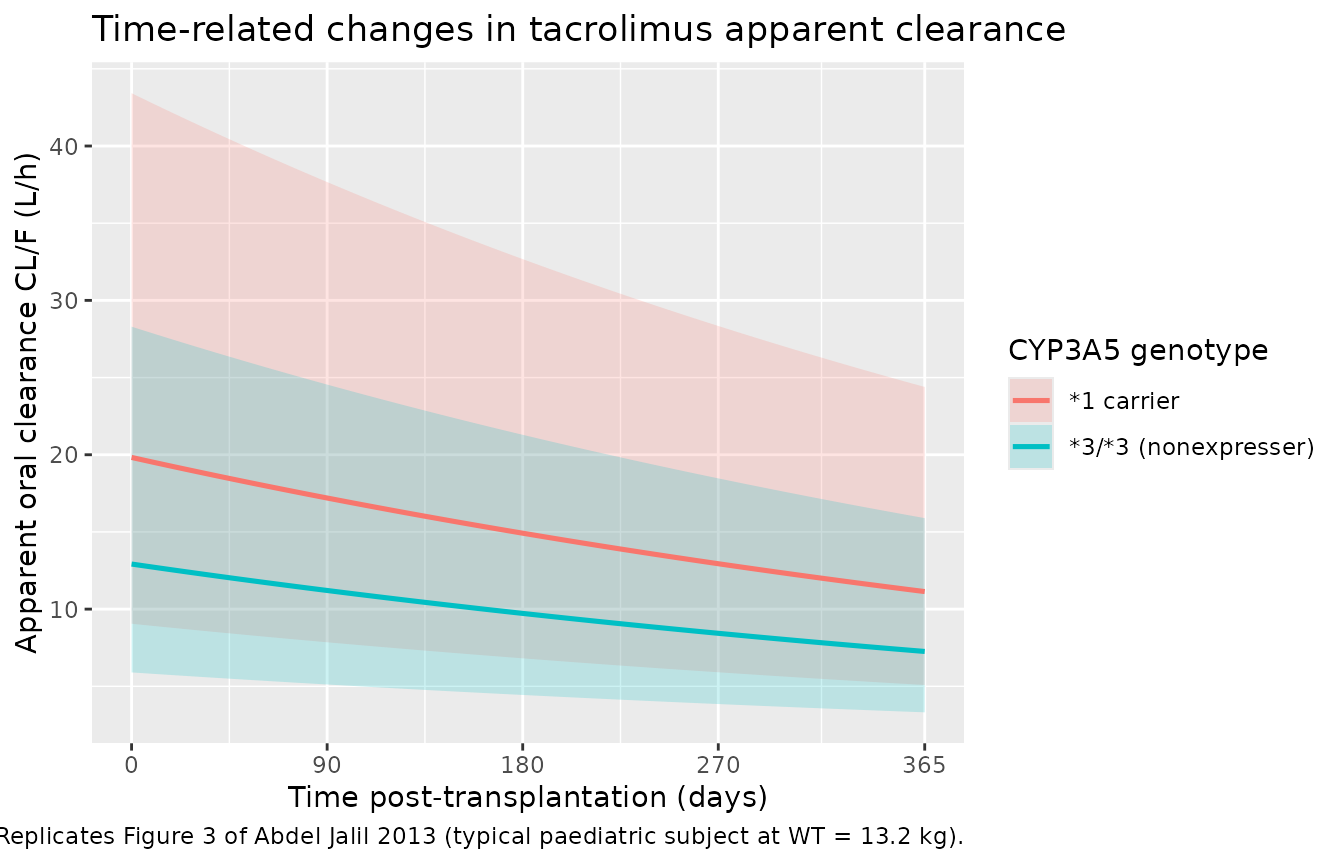
Replicates Figure 3 of Abdel Jalil 2013: time-related changes in tacrolimus apparent clearance for a typical paediatric patient by CYP3A5 genotype. Solid lines are typical-value clearance; the shaded ribbon is the 95% confidence range derived from the model IIV (omega^2 = 0.16).
Worked-example dose calculations from the paper
The paper closes its Results section with worked dose calculations for a 13.2 kg CYP3A5 nonexpresser at 14 and 40 weeks post-transplant, targeting a 5 ng/mL trough. The table below replicates those calculations using the model file’s parameter values to confirm the model reproduces the paper-quoted clearances exactly.
worked_cl <- function(POD_days, CYP3A5_EXPR, WT = 13.2,
                      theta_cl = 12.92, theta_pod = -0.00158,
                      theta_cyp = 0.4282, ref_wt = 13.2, allo = 0.75) {
  theta_cl * (WT / ref_wt)^allo *
    exp(theta_pod * POD_days) *
    exp(theta_cyp * CYP3A5_EXPR)
}

scenarios <- tibble::tibble(
  scenario = c("13.2 kg, *3/*3, 14 weeks post-transplant",
               "13.2 kg, *3/*3, 40 weeks post-transplant",
               "13.2 kg, *1 carrier, 14 weeks post-transplant",
               "13.2 kg, *1 carrier, 40 weeks post-transplant"),
  POD      = c(98, 280, 98, 280),
  CYP3A5_EXPR = c(0, 0, 1, 1)
) |>
  rowwise() |>
  mutate(
    CL_predicted_Lph = round(worked_cl(POD, CYP3A5_EXPR), 2),
    Dose_mg_per_day  = round(CL_predicted_Lph * 5 / 1000 * 24, 2)
  ) |>
  ungroup()

paper_quoted <- tibble::tibble(
  scenario = c("13.2 kg, *3/*3, 14 weeks post-transplant",
               "13.2 kg, *3/*3, 40 weeks post-transplant",
               "13.2 kg, *1 carrier, 14 weeks post-transplant",
               "13.2 kg, *1 carrier, 40 weeks post-transplant"),
  CL_paper_Lph = c(11.05, 8.29, NA_real_, NA_real_),
  Dose_paper_mg_per_day = c(1.3, 1.0, 2.0, 1.5)
)

knitr::kable(
  dplyr::left_join(scenarios, paper_quoted, by = "scenario"),
  caption = "Worked-example apparent clearance and daily dose to maintain a 5 ng/mL trough. Paper-quoted values are from Abdel Jalil 2013 Results, paragraph after Table 4."
)| scenario | POD | CYP3A5_EXPR | CL_predicted_Lph | Dose_mg_per_day | CL_paper_Lph | Dose_paper_mg_per_day |
|---|---|---|---|---|---|---|
| 13.2 kg, 3/3, 14 weeks post-transplant | 98 | 0 | 11.07 | 1.33 | 11.05 | 1.3 |
| 13.2 kg, 3/3, 40 weeks post-transplant | 280 | 0 | 8.30 | 1.00 | 8.29 | 1.0 |
| 13.2 kg, *1 carrier, 14 weeks post-transplant | 98 | 1 | 16.98 | 2.04 | NA | 2.0 |
| 13.2 kg, *1 carrier, 40 weeks post-transplant | 280 | 1 | 12.74 | 1.53 | NA | 1.5 |
Stochastic steady-state simulation
A second simulation gives a 12-hour steady-state dosing interval for each genotype stratum at POD = 100 days with twice-daily dosing of 0.1 mg/kg. This is used for the PKNCA tables and the trough comparison.
build_events <- function(demo, dose_mg_per_kg = 0.1, sim_hours = 120,
                          POD_value = 100) {
  demo_pod <- demo |> mutate(POD = POD_value,
                              amt_dose = dose_mg_per_kg * WT)
  doses <- demo_pod |>
    mutate(amt = amt_dose, evid = 1L, cmt = "depot",
           ii = 12, addl = 9L, time = 0) |>
    select(id, time, amt, evid, cmt, ii, addl, cohort,
           WT, POD, CYP3A5_EXPR)
  # Observation grid: dense over the last (steady-state) interval, 96-108 h.
  obs_times <- sort(unique(c(0,
                              seq(96, 96 + 12, by = 0.5))))
  obs <- demo_pod |>
    select(id, cohort, WT, POD, CYP3A5_EXPR) |>
    tidyr::crossing(time = obs_times) |>
    mutate(amt = NA_real_, evid = 0L, cmt = NA_character_,
           ii = NA_real_, addl = NA_integer_)
  bind_rows(doses, obs) |>
    arrange(id, time, desc(evid))
}

events_ss <- build_events(demo, dose_mg_per_kg = 0.1, POD_value = 100)
sim_iiv <- rxode2::rxSolve(
  mod, events = events_ss,
  keep   = c("cohort"),
  nStud  = 1
) |> as.data.frame()

sim_typ <- rxode2::rxSolve(
  mod_typical, events = events_ss,
  keep = c("cohort")
) |> as.data.frame()
#> ℹ omega/sigma items treated as zero: 'etalcl'
#> Warning: multi-subject simulation without without 'omega'
PKNCA validation
A steady-state NCA over the last (10th) dosing interval gives Cmax, Tmax, Cmin, AUC0-12, and Cavg by CYP3A5 genotype. Abdel Jalil 2013 only reports pre-dose trough concentrations (no full profile), so the NCA outputs here are reference values for downstream users who want a single-snapshot characterisation of the simulated steady-state interval. Cmin is the value that maps to the paper’s reported trough measurements.
last_dose_time <- 96  # 10th dose at t=96h; steady-state window 96-108 h

nca_window <- sim_iiv |>
  filter(time >= last_dose_time, time <= last_dose_time + 12) |>
  mutate(time_after_dose = time - last_dose_time) |>
  filter(!is.na(Cc)) |>
  select(id, time = time_after_dose, Cc, cohort)

dose_df <- demo |>
  mutate(time = 0, amt = 0.1 * WT) |>
  select(id, time, amt, cohort)

conc_obj <- PKNCA::PKNCAconc(nca_window, Cc ~ time | cohort + id,
                             concu = "ng/mL", timeu = "h")
dose_obj <- PKNCA::PKNCAdose(dose_df,    amt ~ time | cohort + id,
                             doseu = "mg")

intervals <- data.frame(start = 0, end = 12,
                        cmax = TRUE, tmax = TRUE, cmin = TRUE,
                        auclast = TRUE, cav = TRUE, ctrough = TRUE)

nca_data <- PKNCA::PKNCAdata(conc_obj, dose_obj, intervals = intervals)
nca_res  <- suppressMessages(suppressWarnings(PKNCA::pk.nca(nca_data)))

nca_summary <- summary(nca_res)
knitr::kable(
  nca_summary,
  caption = "Steady-state NCA on the simulated cohort (12 h dosing interval at POD = 100 days, 0.1 mg/kg twice daily, last interval after 10 doses), stratified by CYP3A5 genotype."
)| Interval Start | Interval End | cohort | N | AUClast (h*ng/mL) | Cmax (ng/mL) | Cmin (ng/mL) | Tmax (h) | Cav (ng/mL) | Ctrough (ng/mL) |
|---|---|---|---|---|---|---|---|---|---|
| 0 | 12 | *1 carrier | 100 | 76.1 [40.3] | 7.95 [30.8] | 4.75 [53.2] | 1.00 [1.00, 1.00] | 6.34 [40.3] | 4.80 [54.3] |
| 0 | 12 | 3/3 (nonexpresser) | 100 | 107 [37.9] | 10.5 [30.7] | 7.27 [46.0] | 1.00 [1.00, 1.00] | 8.96 [37.9] | 7.44 [47.8] |
Comparison against published trough
Abdel Jalil 2013 Table 2 reports a study-population mean tacrolimus trough concentration of 8.93 ng/mL (range 1.2-26.4 ng/mL) collected approximately 12 hours after a dose, pooled across all post-transplant days and genotypes. The table below compares that observed mean and range with the simulated steady-state Cmin (the model output that matches the paper’s trough definition), stratified by CYP3A5 genotype. Because the published distribution is pooled across all genotypes and POD values, the comparison is qualitative; the typical dose chosen for the simulation (0.1 mg/kg twice daily) is in the middle of the paper’s observed dose range (0.03-1.23 mg/kg/day).
trough_sim <- sim_iiv |>
  filter(time == last_dose_time) |>
  group_by(cohort) |>
  summarise(Q10 = quantile(Cc, 0.10),
            median = quantile(Cc, 0.50),
            Q90 = quantile(Cc, 0.90),
            .groups = "drop")

trough_typ <- sim_typ |>
  filter(time == last_dose_time) |>
  group_by(cohort) |>
  summarise(typical = mean(Cc), .groups = "drop")

tbl <- tibble::tibble(
  metric = c("Abdel Jalil 2013 Table 2 observed trough (mean, range)",
             "Simulated typical-value trough, *3/*3 (ng/mL)",
             "Simulated typical-value trough, *1 carrier (ng/mL)",
             "Simulated cohort median, *3/*3 (10-90 pct)",
             "Simulated cohort median, *1 carrier (10-90 pct)"),
  value  = c(sprintf("%.2f (range %.1f-%.1f) ng/mL", 8.93, 1.2, 26.4),
             sprintf("%.2f",
                     trough_typ$typical[trough_typ$cohort == "*3/*3 (nonexpresser)"]),
             sprintf("%.2f",
                     trough_typ$typical[trough_typ$cohort == "*1 carrier"]),
             sprintf("%.2f (%.2f-%.2f)",
                     trough_sim$median[trough_sim$cohort == "*3/*3 (nonexpresser)"],
                     trough_sim$Q10[trough_sim$cohort    == "*3/*3 (nonexpresser)"],
                     trough_sim$Q90[trough_sim$cohort    == "*3/*3 (nonexpresser)"]),
             sprintf("%.2f (%.2f-%.2f)",
                     trough_sim$median[trough_sim$cohort == "*1 carrier"],
                     trough_sim$Q10[trough_sim$cohort    == "*1 carrier"],
                     trough_sim$Q90[trough_sim$cohort    == "*1 carrier"]))
)
knitr::kable(tbl, caption = "Simulated steady-state trough vs Abdel Jalil 2013 Table 2 observed trough range.")| metric | value |
|---|---|
| Abdel Jalil 2013 Table 2 observed trough (mean, range) | 8.93 (range 1.2-26.4) ng/mL |
| Simulated typical-value trough, 3/3 (ng/mL) | 7.64 |
| Simulated typical-value trough, *1 carrier (ng/mL) | 4.95 |
| Simulated cohort median, 3/3 (10-90 pct) | 7.51 (4.05-12.16) |
| Simulated cohort median, *1 carrier (10-90 pct) | 4.94 (2.60-8.86) |
The simulated cohort medians sit well within the paper’s reported range (1.2-26.4 ng/mL), and the 1-carrier cohort median is approximately exp(-0.4282) ~ 65% of the 3/3 cohort median, matching the paper’s CYP3A51-carrier multiplier on CL/F.
Assumptions and deviations
-
Volume of distribution and absorption rate are fixed to
literature values, not estimated. Per Abdel Jalil 2013 Methods,
V/F was fixed at 30 L/kg (literature references 7 and 8 in the paper)
and ka at 4.5 1/h (literature reference 9). The paper attributes this to
the data consisting only of pre-dose troughs, which do not contain
information about the distribution phase or the absorption rate. The
model file uses
fixed()on bothlvcandlkaso the provenance is explicit. -
Allometric exponent fixed at the theory-based 0.75.
The paper attempted to estimate the exponent as an additional theta but
found it did not improve the fit (Abdel Jalil 2013 Results “Population
pharmacokinetic analysis” paragraph), so the theory-based value was
retained. The model file uses
fixed(0.75)one_wt_cl. - Reference weight is the study median 13.2 kg, NOT 70 kg. Abdel Jalil 2013 standardised allometric clearance on the median weight of the paediatric study population. Users porting this model into pooled adult+paediatric simulations should keep the 13.2 kg reference unless they also re-fit the typical-value clearance to a 70 kg adult.
-
CYP3A5 expresser status pools 1/1 and
1/3. The paper coded a single CYP3A5 indicator (= 1 if
at least one 1 allele, 0 if 3/3), consistent with the
canonical
CYP3A5_EXPRcovariate. The cohort had only 2 1/*1 homozygotes (4.7%), so the homozygote vs heterozygote distinction was not separately estimable. - Inter-occasion variability (IOV) is omitted from the model. Abdel Jalil 2013 Results state that IOV on clearance was below 15% and did not result in any significant change in the parameter estimates, so it was dropped from the final model. The model file therefore has no IOV slots.
-
No ABCB1 covariate effect on PK. The paper screened
C1236T, G2677T, and C3435T (and the T-T-T haplotype) as potential
covariates on CL/F but none was retained in the final model. They are
documented in the model file’s
covariatesDataExcludedlist for provenance. - Time post-transplantation effect is monotonic. The paper’s data ranged from 15-364 days post-transplant; the model’s exponential decay on CL/F is identifiable only within that window. Users simulating POD = 0 (day of transplant) should be aware the model has no support for the early-period transient changes that Fukudo et al. (the paper’s reference 11) reported within the first 50 days post-transplant.
- Concentrations measured by enzyme immunoassay, not LC-MS/MS. Tacrolimus immunoassays cross-react with metabolites (estimated < minimum detectable sensitivity in adult kidney transplant patients, per Abdel Jalil 2013 reference 33). Users predicting concentrations to compare against an LC-MS/MS-measured dataset should expect a small positive bias from the immunoassay-trained typical-value estimate.
- Vignette uses 100 subjects per CYP3A5 stratum. This is small enough to render the vignette well under 5 minutes but large enough to give stable percentiles for the steady-state trough comparison.