Bevacizumab (Panoilia 2015)
Source:vignettes/articles/Panoilia_2015_bevacizumab.Rmd
Panoilia_2015_bevacizumab.RmdModel and source
- Citation: Panoilia E, Schindler E, Samantas E, Aravantinos G, Kalofonos HP, Christodoulou C, Patrinos GP, Friberg LE, Sivolapenko G. A pharmacokinetic binding model for bevacizumab and VEGF165 in colorectal cancer patients. Cancer Chemother Pharmacol. 2015;75(4):791-803. doi:[10.1007/s00280-015-2701-3](https://doi.org/10.1007/s00280-015-2701-3).
- Description: Two-compartment quasi-steady-state target-mediated drug-disposition (TMDD QSS) model for IV bevacizumab and free VEGF165 in adults with stage IV metastatic colorectal cancer (mCRC), with body weight as the only covariate (allometric power scaling with fixed exponents 0.75 on CL and Q, 1 on V1 and V2). Final-model values come from Table 3 (TMDD model column) of Panoilia 2015.
- Modality: Therapeutic anti-VEGF-A monoclonal antibody (humanized IgG1, MW about 149 kDa) bound to a soluble target (free VEGF165, MW about 40 kDa back-calculated from the paper’s BM0 dual-unit reporting).
This vignette validates the binding TMDD-QSS model. Panoilia 2015 also fits a stand-alone descriptive PK model for bevacizumab (Table 3, PK model column) used internally as a base before linking the binding component; only the final TMDD model is packaged here.
Population
The Panoilia 2015 cohort comprised 19 adult patients with histologically confirmed stage IV colorectal cancer (ECOG 0-2) treated at three Greek clinics. Baseline demographics (paper “Patients and samples”, page 797):
- Sex: 58% male, 42% female (11 M / 8 F).
- Median age 60 years (range 37-73).
- Median body weight 70 kg (range 50-94).
- Race / ethnicity: not formally tabulated; single-country (Greek) observational study.
- Dosing regimens: 5 mg/kg IV every 2 weeks (BEV-FOLFIRI or BEV-FOLFOX, n = 10), 7.5 mg/kg IV every 3 weeks (BEV-CAPIRI, n = 9), or 10 mg/kg every 2 weeks (1 patient, BEV-FOLFIRI).
- Sample sizes: 86 total bevacizumab + 93 free VEGF165 serum concentrations, median 4 samples per patient (range 2-10).
VEGF-A polymorphisms rs699947 (-2578 C/A), rs1570360 (-1154 G/A), and rs2010963 (-634 G/C) were tested as covariates but none was retained in the final TMDD model after randomization-test correction (Discussion, page 800). Body weight is therefore the only covariate in the packaged model.
The same metadata is available programmatically via
readModelDb("Panoilia_2015_bevacizumab")$population.
Source trace
| Parameter (model name) | Value | Source |
|---|---|---|
lcl (CL, L/day) |
log(0.18) | Panoilia 2015 Table 3, TMDD column row CL |
lvc (V1, L) |
log(3.23) | Panoilia 2015 Table 3, TMDD column row V1 |
lq (Q, L/day) |
log(1.38) | Panoilia 2015 Table 3, TMDD column row Q |
lvp (V2, L) |
log(3.1) | Panoilia 2015 Table 3, TMDD column row V2 |
lkout (kout, 1/day) |
log(0.401) | Panoilia 2015 Table 3, row kout |
lbm0 (BM0, nM) |
log(0.0053) | Panoilia 2015 Table 3, row BM0 (= 212 ng/L per Results) |
lkss (Kss, nM) |
log(267) | Panoilia 2015 Table 3, row Kss |
e_wt_cl_q (allometric exponent) |
0.75 (fixed) | Panoilia 2015 Methods Eq 3 (“0.75 for clearance … fixed”) |
e_wt_vc_vp (allometric exponent) |
1 (fixed) | Panoilia 2015 Methods Eq 3 (“1 for volume parameters … fixed”) |
etalcl variance (CV 20%) |
0.03922 | Panoilia 2015 Table 3, IIV CL CV% |
etalvc variance (CV 22%) |
0.04727 | Panoilia 2015 Table 3, IIV V1 CV% |
etalbm0 variance (CV 24%) |
0.05599 | Panoilia 2015 Table 3, IIV BM0 CV% |
propSd (bevacizumab) |
0.28 | Panoilia 2015 Table 3, row Prop. error_bev |
propSd_freeVegf (VEGF165) |
0.32 | Panoilia 2015 Table 3, row Prop. error_VEGF165 |
Equations (paper section “TMDD (binding) model”, Eqs 5-9 plus Gibiansky et al. 2008 QSS algebra in numerically stable form):
with the QSS algebraic relation
, , , , (paper Eq 6 with ; Results page 798).
The bevacizumab observation is total (free + complex) drug in mg/L; the free-VEGF165 observation is in ng/L. Both residual error models are proportional, derived from the paper’s “additive error model on log-transformed data” (NONMEM additive on log scale equals proportional in linear space).
Errata note
A literature search (May 2026) found no published corrigendum or erratum for Panoilia 2015. The paper is open-access under a Creative Commons Attribution license (Open Access notice, page 801).
Virtual cohort
A 100-subject virtual cohort, with body weights drawn around the study median of 70 kg.
set.seed(2015)
n_subj <- 100

cohort <- tibble(
  ID = seq_len(n_subj),
  WT = pmin(pmax(rlnorm(n_subj, log(70), 0.18), 45), 110)
)
inf_dur     <- 1.5 / 24            # 90-min infusion (days)
n_doses_q2w <- 6
sim_horizon <- 84                  # 12 weeks total follow-up
dose_times  <- seq(0, by = 14, length.out = n_doses_q2w)
obs_times   <- sort(unique(c(0, seq(0.05, sim_horizon, by = 0.5))))

build_events <- function(pop, mgkg, dose_times, regimen_label) {
  amt_per_subject <- pop$WT * mgkg
  d_dose <- pop |>
    dplyr::mutate(amt = amt_per_subject) |>
    tidyr::crossing(time = dose_times) |>
    dplyr::mutate(evid = 1L, cmt = "central", dur = inf_dur,
                  treatment = regimen_label)
  d_obs_cc <- pop |>
    tidyr::crossing(time = obs_times) |>
    dplyr::mutate(amt = 0, evid = 0L, cmt = "Cc", dur = NA_real_,
                  treatment = regimen_label)
  d_obs_cv <- pop |>
    tidyr::crossing(time = obs_times) |>
    dplyr::mutate(amt = 0, evid = 0L, cmt = "freeVegf", dur = NA_real_,
                  treatment = regimen_label)
  dplyr::bind_rows(d_dose, d_obs_cc, d_obs_cv) |>
    dplyr::rename(id = ID) |>
    dplyr::arrange(id, time, dplyr::desc(evid)) |>
    as.data.frame()
}

events <- build_events(cohort, mgkg = 5, dose_times = dose_times,
                       regimen_label = "5 mg/kg Q2W")
Simulation
mod <- rxode2::rxode2(readModelDb("Panoilia_2015_bevacizumab"))
sim <- rxode2::rxSolve(mod, events = events,
                       keep = c("treatment"),
                       returnType = "data.frame")

# Endpoint compartments: Cc -> CMT 4, freeVegf -> CMT 5 (after the 3 ODE states)
sim_cc <- sim |> dplyr::filter(CMT == 4)
sim_cv <- sim |> dplyr::filter(CMT == 5)
Replicate published figures
Bevacizumab concentration-time profile (mirrors Panoilia 2015 Figure 3a)
Panoilia 2015 Figure 3a shows the typical-patient (70 kg) total bevacizumab profile at 5 mg/kg Q2W. The simulation below extends the typical-value profile with a 90% prediction band drawn from the 100-subject cohort.
sim_cc_summary <- sim_cc |>
  dplyr::filter(time > 0) |>
  dplyr::group_by(time) |>
  dplyr::summarise(
    median = stats::median(Cc, na.rm = TRUE),
    lo     = stats::quantile(Cc, 0.05, na.rm = TRUE),
    hi     = stats::quantile(Cc, 0.95, na.rm = TRUE),
    .groups = "drop"
  )

ggplot(sim_cc_summary, aes(time, median)) +
  geom_ribbon(aes(ymin = lo, ymax = hi), alpha = 0.2, fill = "steelblue") +
  geom_line(linewidth = 1, colour = "steelblue") +
  scale_y_log10() +
  labs(
    x = "Time since first dose (days)",
    y = "Total bevacizumab (mg/L, log scale)",
    title = "Simulated bevacizumab PK from binding QSS model (5 mg/kg Q2W)",
    subtitle = paste0("Median and 90% prediction interval, N = ", n_subj),
    caption = "Mirrors Panoilia 2015 Figure 3a (total bevacizumab profile)."
  ) +
  theme_bw()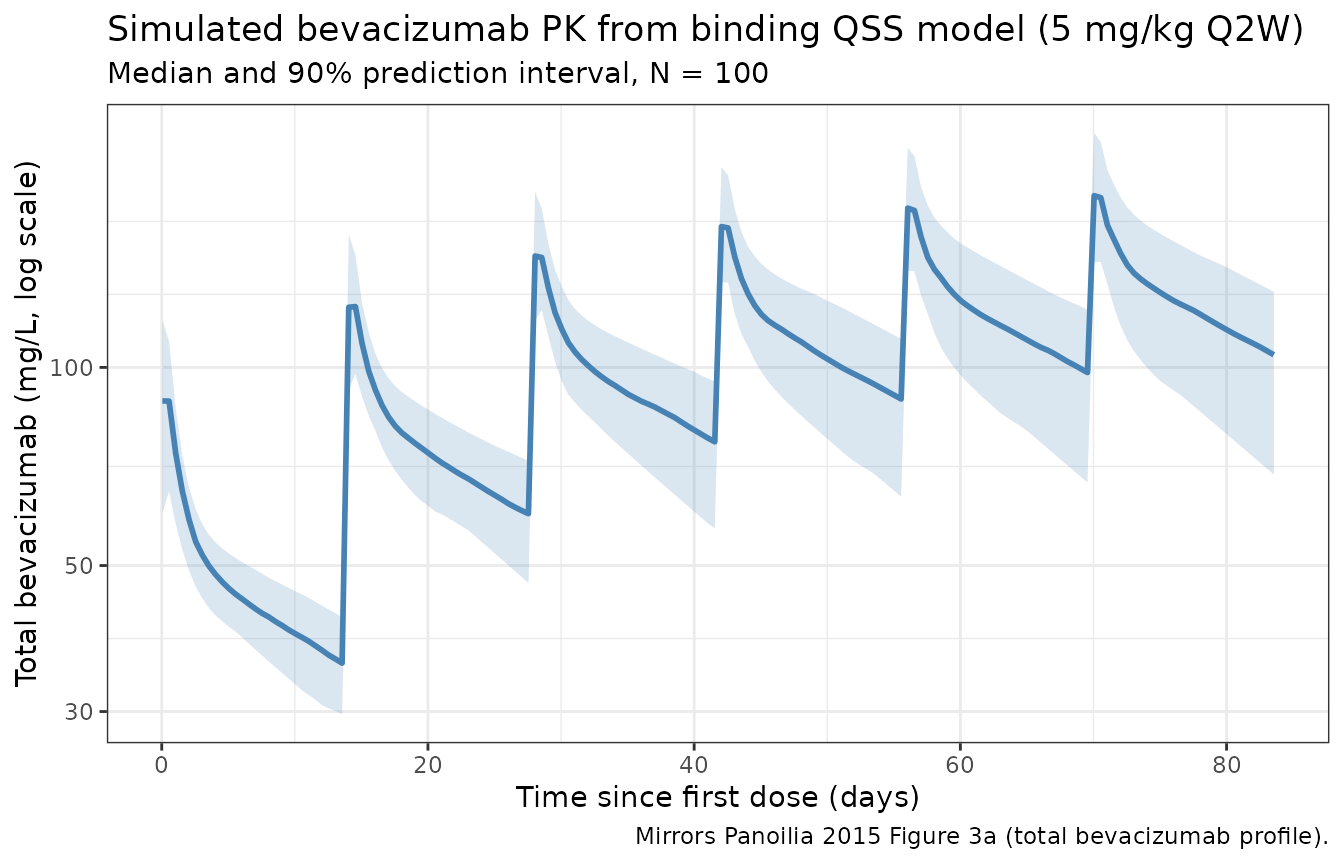
Free VEGF165 first-dose drop and pseudo-steady-state (mirrors Figure 3a)
The paper reports a 73% drop in free VEGF165 after the first 5 mg/kg dose, with subsequent doses producing successively smaller drops as the bevacizumab-VEGF165 complex accumulates and the system approaches pseudo-steady-state (Results, page 800). The typical-value simulation below quantifies that prediction.
sim_cv_summary <- sim_cv |>
  dplyr::group_by(time) |>
  dplyr::summarise(
    median = stats::median(freeVegf, na.rm = TRUE),
    lo     = stats::quantile(freeVegf, 0.05, na.rm = TRUE),
    hi     = stats::quantile(freeVegf, 0.95, na.rm = TRUE),
    .groups = "drop"
  )

ggplot(sim_cv_summary, aes(time, median)) +
  geom_ribbon(aes(ymin = lo, ymax = hi), alpha = 0.2, fill = "darkorange") +
  geom_line(linewidth = 1, colour = "darkorange") +
  geom_hline(yintercept = 212, linetype = "dashed", colour = "grey40") +
  labs(
    x = "Time since first dose (days)",
    y = "Free VEGF165 (ng/L)",
    title = "Simulated free VEGF165 from binding QSS model (5 mg/kg Q2W)",
    subtitle = "Median and 90% prediction interval. Dashed line = baseline BM0 (212 ng/L).",
    caption = "Mirrors Panoilia 2015 Figure 3a (free VEGF165 panel)."
  ) +
  theme_bw()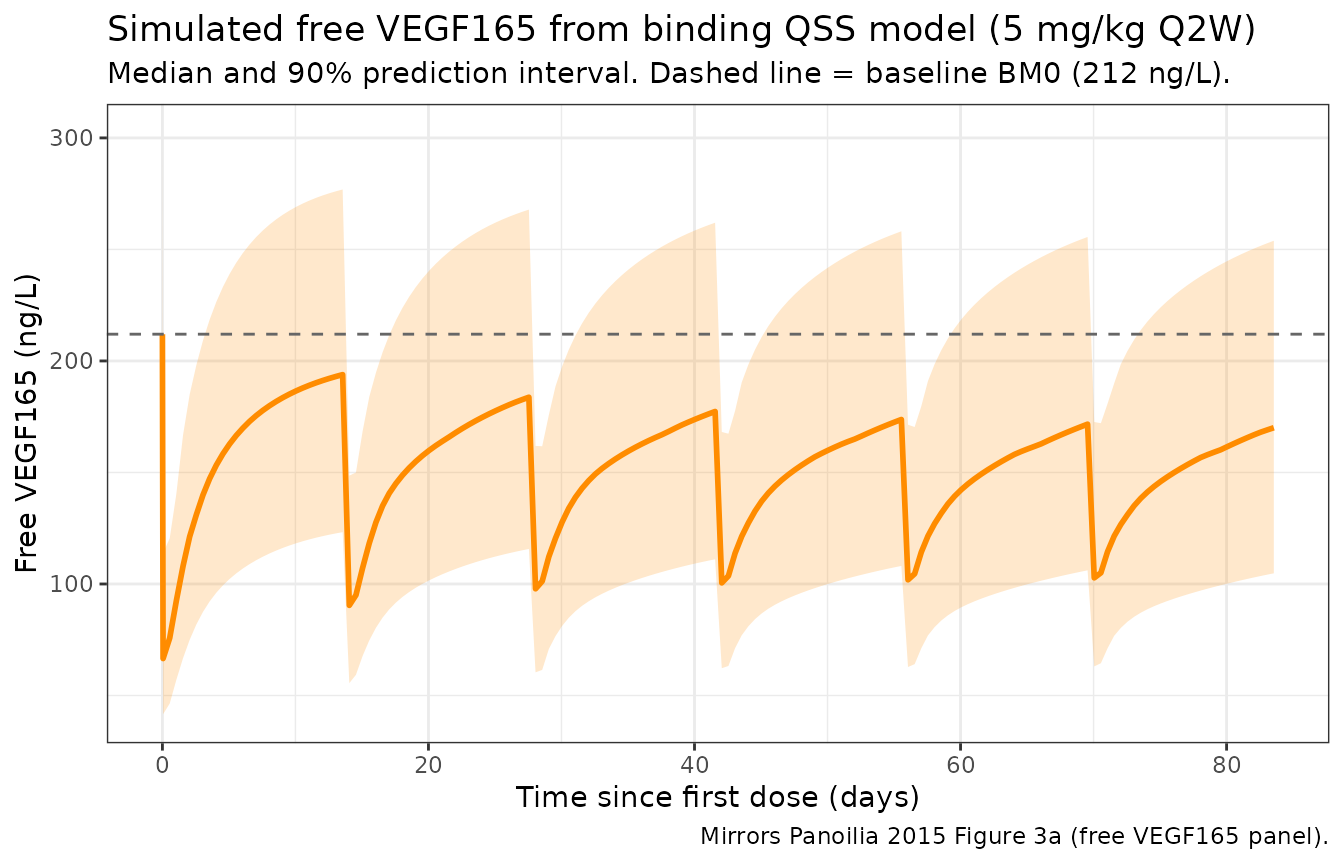
First-dose nadir of free VEGF165 (paper-reported 73% drop)
mod_typical <- rxode2::rxode2(readModelDb("Panoilia_2015_bevacizumab")) |>
  rxode2::zeroRe()

typ_grid <- tibble(id = 1L, WT = 70)
typ_dose_times <- 0
typ_obs_times <- sort(unique(c(0, seq(0.05, 14, by = 0.05))))

build_typ_events <- function(grid, mgkg, dose_times, obs_times) {
  d_dose <- grid |>
    dplyr::mutate(amt = WT * mgkg) |>
    tidyr::crossing(time = dose_times) |>
    dplyr::mutate(evid = 1L, cmt = "central", dur = inf_dur)
  d_obs_cc <- grid |>
    tidyr::crossing(time = obs_times) |>
    dplyr::mutate(amt = 0, evid = 0L, cmt = "Cc", dur = NA_real_)
  d_obs_cv <- grid |>
    tidyr::crossing(time = obs_times) |>
    dplyr::mutate(amt = 0, evid = 0L, cmt = "freeVegf", dur = NA_real_)
  dplyr::bind_rows(d_dose, d_obs_cc, d_obs_cv) |>
    dplyr::arrange(id, time, dplyr::desc(evid)) |>
    as.data.frame()
}

typ_events <- build_typ_events(typ_grid, 5, typ_dose_times, typ_obs_times)
sim_typ_first <- rxode2::rxSolve(mod_typical, events = typ_events,
                                 returnType = "data.frame") |>
  dplyr::filter(CMT == 5)
#> ℹ omega/sigma items treated as zero: 'etalcl', 'etalvc', 'etalbm0'

bm0_typ      <- 212  # ng/L (paper Table 3 / Results)
nadir_5mgkg  <- min(sim_typ_first$freeVegf, na.rm = TRUE)
nadir_drop   <- round(100 * (1 - nadir_5mgkg / bm0_typ), 1)

knitr::kable(
  tibble(
    quantity         = c("Pre-dose BM0 (ng/L)",
                         "First-dose nadir of free VEGF165 (ng/L)",
                         "Percent drop after first 5 mg/kg dose"),
    typical_70kg     = c(bm0_typ, round(nadir_5mgkg, 2), nadir_drop),
    paper_value      = c(212, NA, 73)
  ),
  caption = "First-dose perturbation of free VEGF165 in a typical 70 kg patient. Paper-reported drop is 73% after the first 5 mg/kg Q2W dose (Panoilia 2015 Results, page 800)."
)| quantity | typical_70kg | paper_value |
|---|---|---|
| Pre-dose BM0 (ng/L) | 212.00 | 212 |
| First-dose nadir of free VEGF165 (ng/L) | 59.49 | NA |
| Percent drop after first 5 mg/kg dose | 71.90 | 73 |
Steady-state and mass-balance checks
This is a binding-target / turnover model – PKNCA on free VEGF165 is not appropriate (VEGF165 is endogenous, not dosed). The two checks below verify model correctness:
- Pre-dose baseline of free VEGF165 matches BM0. With no drug on board, T_free should equal BM0 = 212 ng/L (= 0.0053 nM x 40 kDa).
predose <- sim_typ_first |>
  dplyr::filter(time == 0) |>
  dplyr::summarise(observed_predose = freeVegf[1])
predose$expected_bm0 <- 212
knitr::kable(predose,
caption = "Pre-dose free VEGF165: simulated vs algebraic expectation (ng/L). Both should be 212.")| observed_predose | expected_bm0 |
|---|---|
| 212 | 212 |
- Long-term recovery to baseline after dosing stops. With no further infusion, free VEGF165 should rebound to BM0 over a few half-lives of the target turnover (1/k_out ~= 2.5 days).
recovery_grid     <- tibble(id = 1L, WT = 70)
recovery_doses    <- 0
recovery_obs      <- sort(unique(c(0, seq(0.05, 60, by = 0.5))))
recovery_events   <- build_typ_events(recovery_grid, 5,
                                      recovery_doses, recovery_obs)
sim_recovery      <- rxode2::rxSolve(mod_typical,
                                     events = recovery_events,
                                     returnType = "data.frame") |>
  dplyr::filter(CMT == 5)
#> ℹ omega/sigma items treated as zero: 'etalcl', 'etalvc', 'etalbm0'

recovered <- sim_recovery |>
  dplyr::filter(time >= 30) |>
  dplyr::summarise(final_freeVegf = dplyr::last(freeVegf),
                   pct_recovered  = round(100 * final_freeVegf / 212, 1))
knitr::kable(recovered,
caption = "End-of-window free VEGF165 vs BM0 (ng/L). Single 5 mg/kg dose at t = 0; observed at day 60 (~24 x 1/k_out post-dose) -- expect full recovery.")| final_freeVegf | pct_recovered |
|---|---|
| 207.9569 | 98.1 |
Bevacizumab PKNCA validation
For completeness, a steady-state NCA on the simulated bevacizumab output uses the last simulated dosing interval. Total drug includes the bevacizumab-VEGF165 complex, but at clinical doses the complex is a small fraction of total drug (Kss = 267 nM, Cmin >> Kss).
suppressPackageStartupMessages(library(PKNCA))

start_ss <- max(dose_times)
end_ss   <- start_ss + 14

conc_df <- sim_cc |>
  dplyr::filter(time >= start_ss, time <= end_ss, !is.na(Cc)) |>
  dplyr::mutate(time_rel = time - start_ss) |>
  dplyr::select(id, treatment, time_rel, Cc)

dose_df <- events |>
  dplyr::filter(treatment == "5 mg/kg Q2W", evid == 1, time == start_ss) |>
  dplyr::mutate(time_rel = 0) |>
  dplyr::select(id, treatment, time_rel, amt)

conc_obj <- PKNCA::PKNCAconc(conc_df, Cc ~ time_rel | treatment + id,
                             concu = "mg/L", timeu = "day")
dose_obj <- PKNCA::PKNCAdose(dose_df, amt ~ time_rel | treatment + id,
                             doseu = "mg")

intervals <- data.frame(
  start    = 0,
  end      = 14,
  cmax     = TRUE,
  tmax     = TRUE,
  cmin     = TRUE,
  auclast  = TRUE,
  cav      = TRUE
)

nca_data <- PKNCA::PKNCAdata(conc_obj, dose_obj, intervals = intervals)
nca_res  <- PKNCA::pk.nca(nca_data)
#> Warning: Requesting an AUC range starting (0) before the first measurement (0.05) is not allowed
#> Requesting an AUC range starting (0) before the first measurement (0.05) is not allowed
#> Requesting an AUC range starting (0) before the first measurement (0.05) is not allowed
#> Requesting an AUC range starting (0) before the first measurement (0.05) is not allowed
#> Requesting an AUC range starting (0) before the first measurement (0.05) is not allowed
#> Requesting an AUC range starting (0) before the first measurement (0.05) is not allowed
#> Requesting an AUC range starting (0) before the first measurement (0.05) is not allowed
#> Requesting an AUC range starting (0) before the first measurement (0.05) is not allowed
#> Requesting an AUC range starting (0) before the first measurement (0.05) is not allowed
#> Requesting an AUC range starting (0) before the first measurement (0.05) is not allowed
#> Requesting an AUC range starting (0) before the first measurement (0.05) is not allowed
#> Requesting an AUC range starting (0) before the first measurement (0.05) is not allowed
#> Requesting an AUC range starting (0) before the first measurement (0.05) is not allowed
#> Requesting an AUC range starting (0) before the first measurement (0.05) is not allowed
#> Requesting an AUC range starting (0) before the first measurement (0.05) is not allowed
#> Requesting an AUC range starting (0) before the first measurement (0.05) is not allowed
#> Requesting an AUC range starting (0) before the first measurement (0.05) is not allowed
#> Requesting an AUC range starting (0) before the first measurement (0.05) is not allowed
#> Requesting an AUC range starting (0) before the first measurement (0.05) is not allowed
#> Requesting an AUC range starting (0) before the first measurement (0.05) is not allowed
#> Requesting an AUC range starting (0) before the first measurement (0.05) is not allowed
#> Requesting an AUC range starting (0) before the first measurement (0.05) is not allowed
#> Requesting an AUC range starting (0) before the first measurement (0.05) is not allowed
#> Requesting an AUC range starting (0) before the first measurement (0.05) is not allowed
#> Requesting an AUC range starting (0) before the first measurement (0.05) is not allowed
#> Requesting an AUC range starting (0) before the first measurement (0.05) is not allowed
#> Requesting an AUC range starting (0) before the first measurement (0.05) is not allowed
#> Requesting an AUC range starting (0) before the first measurement (0.05) is not allowed
#> Requesting an AUC range starting (0) before the first measurement (0.05) is not allowed
#> Requesting an AUC range starting (0) before the first measurement (0.05) is not allowed
#> Requesting an AUC range starting (0) before the first measurement (0.05) is not allowed
#> Requesting an AUC range starting (0) before the first measurement (0.05) is not allowed
#> Requesting an AUC range starting (0) before the first measurement (0.05) is not allowed
#> Requesting an AUC range starting (0) before the first measurement (0.05) is not allowed
#> Requesting an AUC range starting (0) before the first measurement (0.05) is not allowed
#> Requesting an AUC range starting (0) before the first measurement (0.05) is not allowed
#> Requesting an AUC range starting (0) before the first measurement (0.05) is not allowed
#> Requesting an AUC range starting (0) before the first measurement (0.05) is not allowed
#> Requesting an AUC range starting (0) before the first measurement (0.05) is not allowed
#> Requesting an AUC range starting (0) before the first measurement (0.05) is not allowed
#> Requesting an AUC range starting (0) before the first measurement (0.05) is not allowed
#> Requesting an AUC range starting (0) before the first measurement (0.05) is not allowed
#> Requesting an AUC range starting (0) before the first measurement (0.05) is not allowed
#> Requesting an AUC range starting (0) before the first measurement (0.05) is not allowed
#> Requesting an AUC range starting (0) before the first measurement (0.05) is not allowed
#> Requesting an AUC range starting (0) before the first measurement (0.05) is not allowed
#> Requesting an AUC range starting (0) before the first measurement (0.05) is not allowed
#> Requesting an AUC range starting (0) before the first measurement (0.05) is not allowed
#> Requesting an AUC range starting (0) before the first measurement (0.05) is not allowed
#> Requesting an AUC range starting (0) before the first measurement (0.05) is not allowed
#> Requesting an AUC range starting (0) before the first measurement (0.05) is not allowed
#> Requesting an AUC range starting (0) before the first measurement (0.05) is not allowed
#> Requesting an AUC range starting (0) before the first measurement (0.05) is not allowed
#> Requesting an AUC range starting (0) before the first measurement (0.05) is not allowed
#> Requesting an AUC range starting (0) before the first measurement (0.05) is not allowed
#> Requesting an AUC range starting (0) before the first measurement (0.05) is not allowed
#> Requesting an AUC range starting (0) before the first measurement (0.05) is not allowed
#> Requesting an AUC range starting (0) before the first measurement (0.05) is not allowed
#> Requesting an AUC range starting (0) before the first measurement (0.05) is not allowed
#> Requesting an AUC range starting (0) before the first measurement (0.05) is not allowed
#> Requesting an AUC range starting (0) before the first measurement (0.05) is not allowed
#> Requesting an AUC range starting (0) before the first measurement (0.05) is not allowed
#> Requesting an AUC range starting (0) before the first measurement (0.05) is not allowed
#> Requesting an AUC range starting (0) before the first measurement (0.05) is not allowed
#> Requesting an AUC range starting (0) before the first measurement (0.05) is not allowed
#> Requesting an AUC range starting (0) before the first measurement (0.05) is not allowed
#> Requesting an AUC range starting (0) before the first measurement (0.05) is not allowed
#> Requesting an AUC range starting (0) before the first measurement (0.05) is not allowed
#> Requesting an AUC range starting (0) before the first measurement (0.05) is not allowed
#> Requesting an AUC range starting (0) before the first measurement (0.05) is not allowed
#> Requesting an AUC range starting (0) before the first measurement (0.05) is not allowed
#> Requesting an AUC range starting (0) before the first measurement (0.05) is not allowed
#> Requesting an AUC range starting (0) before the first measurement (0.05) is not allowed
#> Requesting an AUC range starting (0) before the first measurement (0.05) is not allowed
#> Requesting an AUC range starting (0) before the first measurement (0.05) is not allowed
#> Requesting an AUC range starting (0) before the first measurement (0.05) is not allowed
#> Requesting an AUC range starting (0) before the first measurement (0.05) is not allowed
#> Requesting an AUC range starting (0) before the first measurement (0.05) is not allowed
#> Requesting an AUC range starting (0) before the first measurement (0.05) is not allowed
#> Requesting an AUC range starting (0) before the first measurement (0.05) is not allowed
#> Requesting an AUC range starting (0) before the first measurement (0.05) is not allowed
#> Requesting an AUC range starting (0) before the first measurement (0.05) is not allowed
#> Requesting an AUC range starting (0) before the first measurement (0.05) is not allowed
#> Requesting an AUC range starting (0) before the first measurement (0.05) is not allowed
#> Requesting an AUC range starting (0) before the first measurement (0.05) is not allowed
#> Requesting an AUC range starting (0) before the first measurement (0.05) is not allowed
#> Requesting an AUC range starting (0) before the first measurement (0.05) is not allowed
#> Requesting an AUC range starting (0) before the first measurement (0.05) is not allowed
#> Requesting an AUC range starting (0) before the first measurement (0.05) is not allowed
#> Requesting an AUC range starting (0) before the first measurement (0.05) is not allowed
#> Requesting an AUC range starting (0) before the first measurement (0.05) is not allowed
#> Requesting an AUC range starting (0) before the first measurement (0.05) is not allowed
#> Requesting an AUC range starting (0) before the first measurement (0.05) is not allowed
#> Requesting an AUC range starting (0) before the first measurement (0.05) is not allowed
#> Requesting an AUC range starting (0) before the first measurement (0.05) is not allowed
#> Requesting an AUC range starting (0) before the first measurement (0.05) is not allowed
#> Requesting an AUC range starting (0) before the first measurement (0.05) is not allowed
#> Requesting an AUC range starting (0) before the first measurement (0.05) is not allowed
#> Requesting an AUC range starting (0) before the first measurement (0.05) is not allowed
#> Requesting an AUC range starting (0) before the first measurement (0.05) is not allowed
knitr::kable(summary(nca_res),
caption = "Steady-state NCA for total bevacizumab (5 mg/kg Q2W, last simulated interval).")| Interval Start | Interval End | treatment | N | AUClast (day*mg/L) | Cmax (mg/L) | Cmin (mg/L) | Tmax (day) | Cav (mg/L) |
|---|---|---|---|---|---|---|---|---|
| 0 | 14 | 5 mg/kg Q2W | 100 | NC | 181 [14.4] | 98.3 [21.0] | 0.0500 [0.0500, 0.550] | NC |
Assumptions and deviations
-
Bevacizumab molecular weight (MW_BEV = 149,000
g/mol). Required to convert mg input doses to molar units (nM)
for the binding equations; not reported numerically in Panoilia 2015.
The 149 kDa value is the standard reference for the marketed antibody
and is documented as a model assumption in the model file’s
model()block. - VEGF165 effective molecular weight (MW_VEGF165 ~= 40,000 g/mol). Back-calculated from the paper’s BM0 dual-unit reporting (0.0053 nM == 212 ng/L; MW = 212 / 0.0053 / 1 = 40 kDa under the paper’s stated 1:1 binding assumption). Documented as a model assumption.
- 1:1 stoichiometric drug-target binding. Paper Results page 798: “assuming a 1:1 molecular interaction”. The packaged QSS model uses 1:1 binding consistent with the paper.
- Bevacizumab observation = total drug (free + complex). Paper Methods explicitly reports “total (free and bound to one molecule of VEGF165) bevacizumab” via ELISA (page 793). Implemented as Cc = (free + complex) drug.
- k_int = CL / V1. Per Results page 798: “the elimination clearance of the bevacizumab-VEGF165 complex… was therefore set equal to the CL of the free bevacizumab (CL_RC = CL).” Implemented as kint = CL / V1 in the concentration-rate form of Eq 6.
- Allometric exponents fixed. Paper Methods Eq 3: “in case of body weight, [the exponent] was either estimated or fixed to a certain value (0.75 for clearance and 1 for volume parameters)”. Table 3 reports no exponent estimates with uncertainty; the final TMDD model uses the canonical fixed exponents (Discussion page 800 confirms WT was the only retained covariate).
- No SNP covariates retained. Three VEGF-A polymorphisms (rs699947, rs1570360, rs2010963) were tested. Forward-inclusion drops in OFV did not survive randomization-test correction (Results page 798 and Discussion page 800-801). The packaged model omits SNP terms.
- Race / ethnicity not reported. The cohort was Greek; population metadata records race as not formally tabulated.
- Residual error: log-additive == proportional. Paper Methods page 796: “Modeling was performed on log-transformed data … an additive error model on log-transformed data”. Translated to proportional residual on linear-scale concentrations per the standard nlmixr2lib convention.
- No errata identified (literature search May 2026).