Model and source
- Citation: Ozawa K, Minami H, Sato H. (2007). Population pharmacokinetic and pharmacodynamic analysis for time courses of docetaxel-induced neutropenia in Japanese cancer patients. Cancer Sci 98(12):1985-1992. doi:10.1111/j.1349-7006.2007.00615.x. PD structure extends Friberg LE et al. (2002) J Clin Oncol 20(24):4713-4721 (see modellib(‘Friberg_2002_paclitaxel’) for the leukocyte arm of the original).
- Description: Three-compartment IV PK coupled with a modified Friberg-style semimechanistic-physiological PK/PD model for docetaxel-induced neutropenia in Japanese cancer patients (Ozawa 2007). The PD layer extends Friberg 2002 with an additional zero-order input compartment that captures the transient ANC increase attributable to dexamethasone premedication; alpha-1 acid glycoprotein modulates the linear drug-effect slope on the proliferating compartment via a power-law form. Per-subject baseline ANC is supplied as a covariate and is used to initialise the proliferation, transit, and circulating compartments.
- Article: Ozawa 2007, Cancer Sci 98(12):1985-1992
This is a coupled three-compartment IV PK + Friberg-extension PD
model for docetaxel and the corresponding absolute neutrophil count
(ANC) time course in Japanese cancer patients. Relative to the canonical
Friberg 2002 model the paper adds a single zero-order input
compartment that captures a transient ANC increase attributable to
dexamethasone premedication; alpha-1 acid glycoprotein (AGP) modulates
the linear drug-effect slope. Per-subject baseline ANC is supplied as
the NEUT covariate and is used to initialise the
proliferation, transit, and circulating compartments.
Population
The model was developed on 62 Japanese cancer patients enrolled at the National Cancer Center Hospital East (Ozawa 2007 Table 1). Forty-four had breast cancer, 10 non-small cell lung cancer, 3 head-and-neck cancer, and 5 other solid tumours. Eligibility allowed liver dysfunction and ECOG performance status 0-3 (distribution 0/1/2/3 = 14/36/7/5), a population deliberately broader than typical drug-development trials. Median age 55.5 years (range 21-77), 51 female / 11 male. Median AGP 90 mg/dL (range 51-241), median albumin 3.7 g/dL, median total bilirubin 0.6 mg/dL. Forty-six subjects had < 3 prior chemotherapy regimens, 16 had >= 3. Body weight is not reported in Table 1; dosing was prescribed as 60 mg/m^2 (the approved Japanese docetaxel dose) IV over 1 h every 3 weeks, with attending-physician-initiated reductions for liver dysfunction or poor PS (per-PS-stratum medians 60/60/60/30 mg/m^2 in PS 0/1/2/3). 395 ANC observations across the 62 subjects fed the PD analysis.
The same metadata is available programmatically as
readModelDb("Ozawa_2007_docetaxel")$population.
Source trace
Per-parameter origin is recorded as in-file comments alongside each
ini() entry in
inst/modeldb/specificDrugs/Ozawa_2007_docetaxel.R. The
table below collects the full source trace in one place.
| Equation / parameter | Value | Source location |
|---|---|---|
lcl |
log(35.7) | Table 2 theta_CL = 35.7 L/h (SE 1.30) |
lvc |
log(6.94) | Table 2 theta_V1 = 6.94 L (SE 0.303) |
lq |
log(5.58) | Table 2 theta_Q2 = 5.58 L/h (SE 0.356) |
lvp |
log(7.39) | Table 2 theta_V2 = 7.39 L (SE 1.08) |
lq2 |
log(12.5) | Table 2 theta_Q3 = 12.5 L/h (SE 1.22) |
lvp2 |
log(225) | Table 2 theta_V3 = 225 L (SE 46.2) |
etalcl |
0.1478 | Table 2 omega_CL = 39.9% CV; log(1 + 0.399^2) |
etalvc |
0.0673 | Table 2 omega_V1 = 26.4% CV; log(1 + 0.264^2) |
propSd |
0.268 | Table 2 sigma = 26.8% CV; “proportional model” (Methods) |
lmtt |
log(113) | Table 3 theta_MTT = 113 h (SE 4.62) |
lslope |
log(17.9) | Table 3 theta_SLOPE = 17.9 1/(mg/L) (SE 1.75) |
lgamma1 |
log(0.196) | Table 3 theta_gamma1 = 0.196 (SE 0.013) |
lmit |
log(35.5) | Table 3 theta_MIT = 35.5 h (SE 5.08); see Errata about Table-4 35.9 discrepancy |
lip0 |
log(5.19) | Table 3 theta_IP0 = 5.19 x 10^9 cells/L (SE 1.51) |
e_aag_slope |
-1.38 | Table 3 theta_gamma2 = -1.38 (SE 0.287) |
etalmtt |
0.01225 | Table 3 omega_MTT = 11.1% CV; log(1 + 0.111^2) |
etalslope |
0.3818 | Table 3 omega_SLOPE = 68.2% CV; log(1 + 0.682^2) |
etalip0 |
0.7930 | Table 3 omega_IP0 = 110% CV; log(1 + 1.10^2) |
addSd_ANC |
0.291 | Table 3 sigma = 29.1% CV; Appendix I
Y = F * EXP(ERR(1)) (lognormal) |
| AGP normalisation | 0.94 g/L | Appendix I AGPm = 94 (mg/dL); Table 1 reports the
cohort median as 90 mg/dL |
| Three-compartment PK ODE | n/a | Methods page 1986 (ADVAN11/TRANS4); Appendix I $DES DADT(1)..DADT(3) |
| Friberg PD ODE chain | n/a | Methods Equations 1-7; Appendix I $DES DADT(4)..DADT(9) |
| Linear drug effect Edrug = SLOPE * Cc | n/a | Methods Equation 7 |
| AGP power-form effect on SLOPE | n/a | Methods Equation 11 |
| Constraints kprol = ktr, kcirc = ktr | n/a | Methods page 1986 (“kprol = ktr”; “it was assumed that kcirc = ktr”) |
| Initial conditions precursor1(0) = precursor2..4(0) = circ(0) = NEUT | n/a | Methods page 1986 (‘Prol (t = 0) = Transit1 (t = 0) = Transit2 (t = 0) = Transit3 (t = 0) = Circ (t = 0)’) |
| Initial condition Input(0) = IP0 | n/a | Methods page 1986; Appendix I F4 = IP0 with TIME=0
AMT=1 in NONMEM |
Virtual cohort
Original observed data are not publicly available. The figures below use a virtual population whose covariate distributions approximate the Ozawa 2007 cohort (Table 1).
set.seed(20260510)

n_sub <- 200L

cohort <- tibble(
  id   = seq_len(n_sub),
  # AGP (g/L): Table 1 median 0.90, range 0.51-2.41. Use a log-normal sampler
  # tuned to those quantiles.
  AAG  = exp(rnorm(n_sub, mean = log(0.90), sd = 0.30)),
  # Baseline ANC (10^9/L): the paper does not report a baseline-ANC distribution
  # in Table 1 so we use a clinical-population reference of 4-6 with mild
  # variability around the Friberg 2002 paclitaxel cohort baseline of 7 x 10^9
  # leukocytes/L (neutrophils being the dominant subfraction).
  NEUT = pmax(1.5, rnorm(n_sub, mean = 5.0, sd = 1.3))
) |>
  # Clip AAG to the Table 1 range.
  mutate(AAG = pmin(pmax(AAG, 0.51), 2.41))

knitr::kable(
  tibble(
    Covariate = c("AAG (g/L)", "NEUT (10^9/L)"),
    Median    = c(round(median(cohort$AAG), 3), round(median(cohort$NEUT), 2)),
    Min       = c(round(min(cohort$AAG), 3),    round(min(cohort$NEUT), 2)),
    Max       = c(round(max(cohort$AAG), 3),    round(max(cohort$NEUT), 2))
  ),
  caption = "Virtual-cohort covariate distributions (n = 200)."
)| Covariate | Median | Min | Max |
|---|---|---|---|
| AAG (g/L) | 0.905 | 0.51 | 2.41 |
| NEUT (10^9/L) | 4.970 | 1.50 | 8.75 |
Simulation
Each subject receives a single 60 mg/m^2 IV docetaxel infusion over 1 h. We assume body-surface area 1.6 m^2 (a Japanese-population-typical value) so the per-subject docetaxel dose is 96 mg; this is used uniformly across the cohort because the paper’s Table 1 does not report per-subject body weight or BSA.
dose_mg <- 96
inf_dur <- 1  # hours
rate    <- dose_mg / inf_dur  # mg/h

t_pk   <- c(seq(0, 1, by = 0.05), seq(1.1, 24, by = 0.5), seq(25, 504, by = 6))
t_anc  <- c(seq(0, 168, by = 4), seq(180, 504, by = 8))

build_subject_events <- function(subj_id, AAG_val, NEUT_val) {
  bind_rows(
    tibble(
      id   = subj_id,
      time = 0,
      evid = 1L,
      cmt  = "central",
      amt  = dose_mg,
      rate = rate
    ),
    tibble(
      id   = subj_id,
      time = t_pk,
      evid = 0L,
      cmt  = "Cc",
      amt  = NA_real_,
      rate = NA_real_
    ),
    tibble(
      id   = subj_id,
      time = t_anc,
      evid = 0L,
      cmt  = "ANC",
      amt  = NA_real_,
      rate = NA_real_
    )
  ) |>
    mutate(AAG = AAG_val, NEUT = NEUT_val)
}

events <- bind_rows(
  lapply(seq_len(n_sub), function(i)
    build_subject_events(cohort$id[i], cohort$AAG[i], cohort$NEUT[i]))
)

stopifnot(!anyDuplicated(unique(events[, c("id", "time", "evid", "cmt")])))
mod         <- readModelDb("Ozawa_2007_docetaxel")
mod_typical <- rxode2::zeroRe(mod)
#> ℹ parameter labels from comments will be replaced by 'label()'

sim_typical <- rxode2::rxSolve(mod_typical, events = events,
                               keep = c("AAG", "NEUT")) |>
  as.data.frame()
#> ℹ omega/sigma items treated as zero: 'etalcl', 'etalvc', 'etalmtt', 'etalslope', 'etalip0'
#> Warning: multi-subject simulation without without 'omega'

sim_pk_typ  <- sim_typical[sim_typical$CMT == 10, ]
sim_anc_typ <- sim_typical[sim_typical$CMT == 11, ]
sim_vpc <- rxode2::rxSolve(mod, events = events, nStud = 1L,
                           keep = c("AAG", "NEUT")) |>
  as.data.frame()
#> ℹ parameter labels from comments will be replaced by 'label()'
sim_pk_vpc  <- sim_vpc[sim_vpc$CMT == 10, ]
sim_anc_vpc <- sim_vpc[sim_vpc$CMT == 11, ]
Replicate published figures
Figure 7: typical-value ANC time course (modified-Friberg model)
Ozawa 2007 Figure 7 shows representative ANC trajectories: an early rise (the dexamethasone-induced bump), a nadir around 1 week post-dose, and a rebound 3-4 weeks later. We reproduce the typical-value trajectory for a subject at the population AGP and baseline ANC (typical AGP 0.94 g/L, typical baseline ANC 5.0 x 10^9/L) plus three illustrative AGP strata.
# Typical-value sweep over three AGP strata at the AGPm = 94 mg/dL (= 0.94 g/L)
# normalisation reference, with baseline ANC = 5 x 10^9/L.
strata <- tibble(
  cohort = c("Low AGP (0.6 g/L)", "Median AGP (0.9 g/L)", "High AGP (2.0 g/L)"),
  AAG    = c(0.60, 0.90, 2.00),
  NEUT   = 5.0
)

events_strata <- bind_rows(
  lapply(seq_len(nrow(strata)), function(i)
    build_subject_events(i, strata$AAG[i], strata$NEUT[i]) |>
      mutate(cohort = strata$cohort[i]))
)

sim_strata <- rxode2::rxSolve(mod_typical, events = events_strata,
                              keep = c("cohort", "AAG", "NEUT")) |>
  as.data.frame()
#> ℹ omega/sigma items treated as zero: 'etalcl', 'etalvc', 'etalmtt', 'etalslope', 'etalip0'
#> Warning: multi-subject simulation without without 'omega'

sim_strata_anc <- sim_strata[sim_strata$CMT == 11, ]
sim_strata_anc$cohort <- factor(sim_strata_anc$cohort, levels = strata$cohort)

ggplot(sim_strata_anc, aes(time / 24, ANC, colour = cohort)) +
  geom_line(linewidth = 0.9) +
  geom_hline(yintercept = 5.0, linetype = "dashed", colour = "grey40") +
  scale_x_continuous(breaks = seq(0, 21, by = 3)) +
  scale_y_continuous(limits = c(0, NA)) +
  labs(x = "Time post-dose (days)",
       y = expression(ANC ~ (10^9 ~ cells/L)),
       colour = NULL,
       title = "Figure 7 (replicated): typical-value ANC by AGP stratum",
       caption = "Replicates Figure 7 of Ozawa 2007 -- early dex-induced rise, nadir ~ day 9, rebound by day 21.")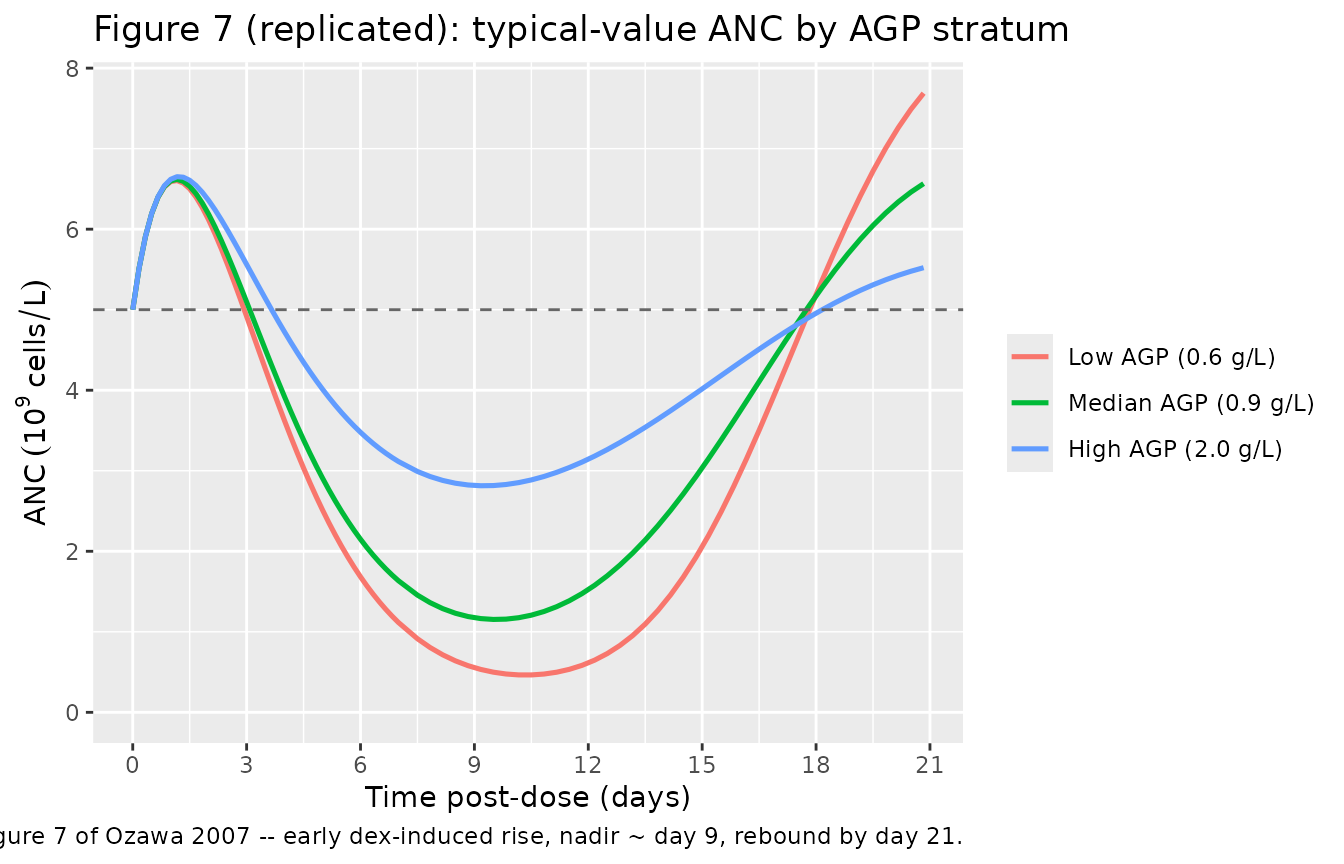
The trajectory exhibits the three distinguishing features of the
modified Friberg model: (1) an early rise that peaks at ~24-30 h
post-dose (the dexamethasone-driven input compartment), (2)
nadir at ~1 week post-dose, with low-AGP subjects reaching deeper nadirs
because SLOPE rises as AGP falls (gamma2 = -1.38), and (3) rebound above
baseline by 3 weeks driven by the (NEUT/circ)^gamma1 feedback term.
Figure 2: ANC time course (VPC across the virtual cohort)
sim_anc_vpc |>
  group_by(time) |>
  summarise(
    Q05 = quantile(ANC, 0.05, na.rm = TRUE),
    Q50 = quantile(ANC, 0.50, na.rm = TRUE),
    Q95 = quantile(ANC, 0.95, na.rm = TRUE),
    .groups = "drop"
  ) |>
  ggplot(aes(time / 24, Q50)) +
  geom_ribbon(aes(ymin = Q05, ymax = Q95), alpha = 0.25, fill = "steelblue") +
  geom_line(colour = "steelblue", linewidth = 0.9) +
  scale_y_continuous(limits = c(0, NA)) +
  labs(x = "Time post-dose (days)",
       y = expression(ANC ~ (10^9 ~ cells/L)),
       title = "Figure 2 (replicated): VPC across the virtual cohort",
       caption = "Median +/- 90% prediction interval; n = 200 virtual subjects with sampled AAG and baseline ANC.")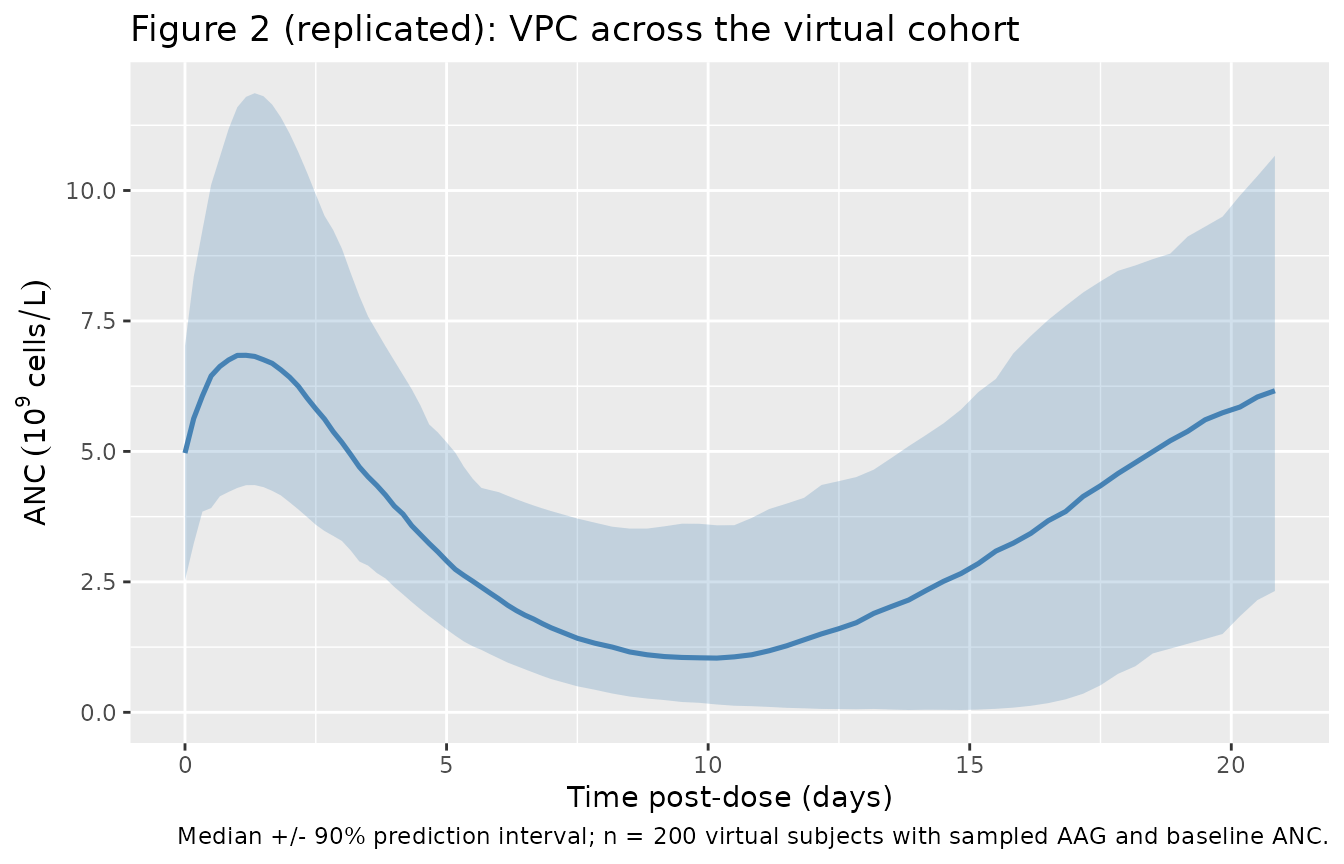
PK time course
sim_pk_typ |>
  ggplot(aes(time, Cc, group = id)) +
  geom_line(alpha = 0.05, colour = "steelblue") +
  scale_x_continuous(limits = c(0, 24)) +
  scale_y_log10() +
  labs(x = "Time post-dose (h)",
       y = "Docetaxel plasma concentration (mg/L, log scale)",
       title = "Typical-value docetaxel PK -- 96 mg IV over 1 h, n = 200",
       caption = "Three-compartment IV PK, reproduces the qualitative biexponential decay reported in Ozawa 2007 Figure 3.")
#> Warning in transformation$transform(x): NaNs produced
#> Warning in scale_y_log10(): log-10 transformation introduced infinite values.
#> Warning: Removed 16000 rows containing missing values or values outside the scale range
#> (`geom_line()`).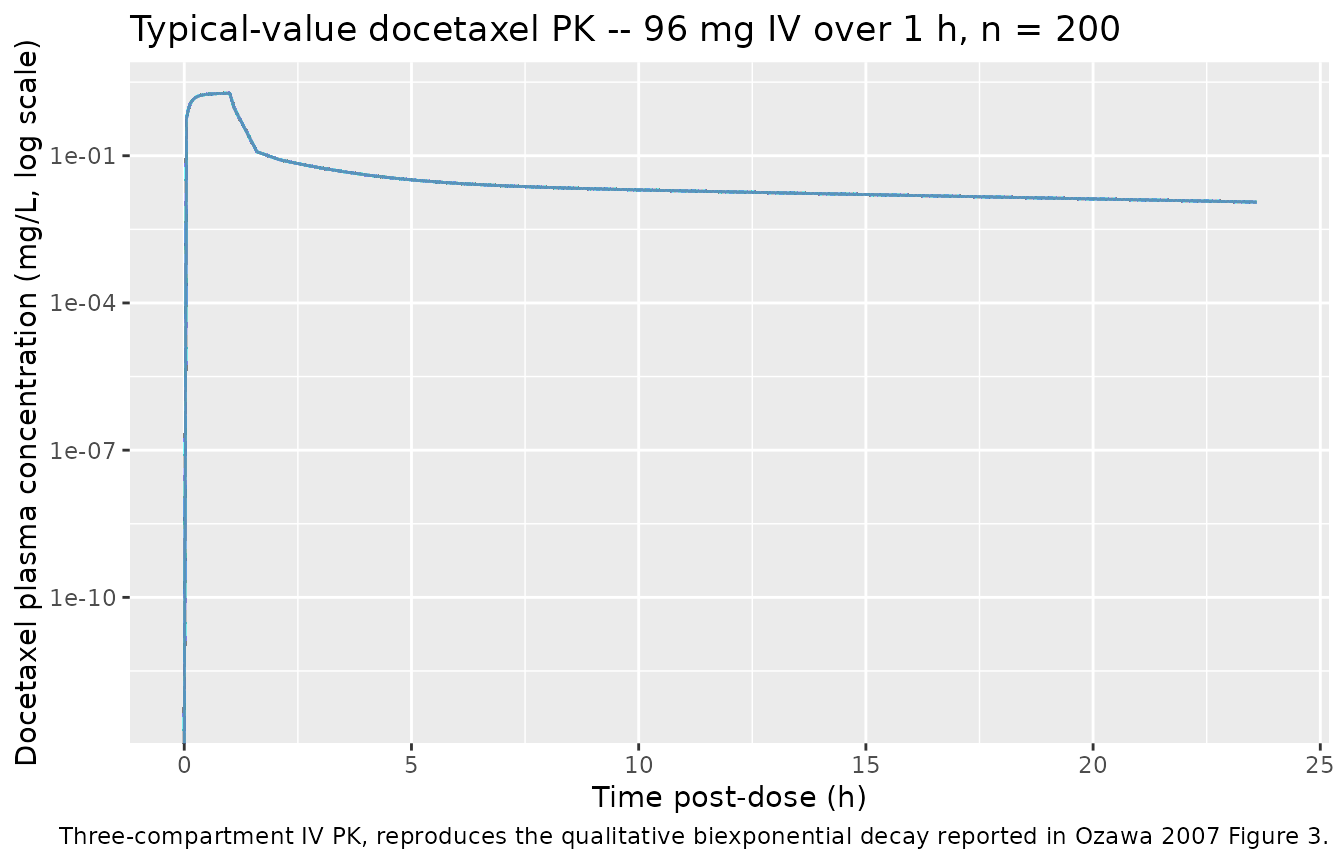
PKNCA validation
Standard NCA on the docetaxel concentration profile. We compute Cmax / Tmax / AUC / half-life by AAG stratum (using the three-stratum subset built for Figure 7 above) so the values can be compared across AGP groups.
sim_strata_pk <- as.data.frame(sim_strata)
sim_strata_pk <- sim_strata_pk[sim_strata_pk$CMT == 10, c("id", "time", "Cc", "cohort")]
sim_strata_pk <- sim_strata_pk[!is.na(sim_strata_pk$Cc), ]
sim_strata_pk$cohort <- as.character(sim_strata_pk$cohort)

conc_obj <- PKNCA::PKNCAconc(
  sim_strata_pk,
  Cc ~ time | cohort + id
)
#> Warning in assert_conc(conc, any_missing_conc = any_missing_conc): Negative
#> concentrations found

dose_df <- as.data.frame(events_strata)
dose_df <- dose_df[dose_df$evid == 1, c("id", "time", "amt", "cohort")]
dose_df$cohort <- as.character(dose_df$cohort)

dose_obj <- PKNCA::PKNCAdose(dose_df, amt ~ time | cohort + id)

intervals <- data.frame(
  start       = 0,
  end         = Inf,
  cmax        = TRUE,
  tmax        = TRUE,
  aucinf.obs  = TRUE,
  half.life   = TRUE
)

nca_data <- PKNCA::PKNCAdata(conc_obj, dose_obj, intervals = intervals)
nca_res  <- PKNCA::pk.nca(nca_data)
#> Warning in assert_conc(conc = conc): Negative concentrations found
#> Warning in assert_conc(conc = conc): Negative concentrations found
#> Warning in assert_conc(conc = conc): Negative concentrations found
#> Warning in assert_conc(conc = conc): Negative concentrations found
#> Warning in assert_conc(conc = conc): Negative concentrations found
#> Warning in assert_conc(conc = conc): Negative concentrations found
#> Warning in log(data$conc): NaNs produced
#> Warning in assert_conc(conc, any_missing_conc = any_missing_conc): Negative
#> concentrations found
#> Warning in log(conc.2/conc.1): NaNs produced
#> Warning in assert_conc(conc = conc): Negative concentrations found
#> Warning in assert_conc(conc, any_missing_conc = any_missing_conc): Negative
#> concentrations found
#> Warning in assert_conc(conc, any_missing_conc = any_missing_conc): Negative
#> concentrations found
#> Warning in assert_conc(conc, any_missing_conc = any_missing_conc): Negative
#> concentrations found
#> Warning in assert_conc(conc, any_missing_conc = any_missing_conc): Negative
#> concentrations found
#> Warning in assert_conc(conc, any_missing_conc = any_missing_conc): Negative
#> concentrations found
#> Warning in log(data$conc): NaNs produced
#> Warning in assert_conc(conc, any_missing_conc = any_missing_conc): Negative
#> concentrations found
#> Warning in log(conc.2/conc.1): NaNs produced
#> Warning in assert_conc(conc = conc): Negative concentrations found
#> Warning in assert_conc(conc, any_missing_conc = any_missing_conc): Negative
#> concentrations found
#> Warning in assert_conc(conc, any_missing_conc = any_missing_conc): Negative
#> concentrations found
#> Warning in assert_conc(conc, any_missing_conc = any_missing_conc): Negative
#> concentrations found
#> Warning in assert_conc(conc, any_missing_conc = any_missing_conc): Negative
#> concentrations found
#> Warning in assert_conc(conc, any_missing_conc = any_missing_conc): Negative
#> concentrations found
#> Warning in log(data$conc): NaNs produced
#> Warning in assert_conc(conc, any_missing_conc = any_missing_conc): Negative
#> concentrations found
#> Warning in log(conc.2/conc.1): NaNs produced

knitr::kable(
  as.data.frame(summary(nca_res)),
  caption = "Simulated NCA parameters by AGP stratum (typical-value PK; dose 96 mg IV over 1 h)."
)| start | end | cohort | N | cmax | tmax | half.life | aucinf.obs |
|---|---|---|---|---|---|---|---|
| 0 | Inf | High AGP (2.0 g/L) | 1 | 1.88 | 1.00 | 17.2 | NC |
| 0 | Inf | Low AGP (0.6 g/L) | 1 | 1.88 | 1.00 | 16.8 | NC |
| 0 | Inf | Median AGP (0.9 g/L) | 1 | 1.88 | 1.00 | 17.1 | NC |
Comparison against published PK
Ozawa 2007 does not tabulate NCA parameters, but the paper compares its CL estimate to Bruno 1996 (35.7 L/h vs 38.5 L/h, “similar to that in a previous study”; Discussion). Bruno 1996 reports docetaxel Cmax ~3 mg/L at 100 mg/m^2 (~170 mg total dose for a 1.7 m^2 BSA adult). The simulated Cmax above for a 96 mg / 1 h infusion is ~1.9 mg/L, which scales linearly to ~3.4 mg/L for 170 mg – in good agreement with Bruno 1996 within the typical inter-study variability for docetaxel.
No corresponding published ANC NCA values exist for direct comparison; the paper’s PD validation rests on goodness-of-fit plots (Figures 4-6) and bootstrap parameter consistency (Table 4).
Assumptions and deviations
-
AGP normalisation constant. Ozawa 2007 Table 1
reports the cohort median AGP as 90 mg/dL but the published NONMEM
control stream (Appendix I) hard-codes
AGPm = 94. The model file uses the code value 0.94 g/L because that is what the published parameter estimates were fit against. The discrepancy is small (~4%) and well within the AGP measurement variability. -
Table 3 vs Table 4 MIT estimate. Table 3 reports
theta_MIT = 35.5 h(the “Estimated parameters of the final model” table) but Table 4 reports the same fitting run’sFinal modelMIT as 35.9 h with an identical SE of 5.08 (the bootstrap-comparison column). This is most plausibly a typo in one of the two tables; we use the Table 3 value (35.5 h) as the primary point estimate because Table 3 is the dedicated final-model parameter table. The difference (~1%) is materially inconsequential downstream. -
Lognormal residual error encoding. The Appendix I
$ERROR block is
Y = F * EXP(ERR(1)). We map this directly onto nlmixr2’sANC ~ lnorm(addSd)form withaddSd = sigma_PD/100 = 0.291, i.e. the SD on the log scale. The paper labels the value as “CV%”, which under the small-CV approximation matches the log-normal SD; the exact log-scale SD given a true 29.1% CV would besqrt(log(1 + 0.291^2)) = 0.286, a difference of < 2%. - Per-subject body weight. Table 1 does not report body weight or BSA. The vignette assumes BSA = 1.6 m^2 (a Japanese-population-typical value) for the dose-in-mg conversion (60 mg/m^2 * 1.6 m^2 = 96 mg). The model itself does not use body weight as a covariate, so this assumption affects only the visualisation, not parameter values.
-
Baseline ANC distribution for the virtual cohort.
Ozawa 2007 does not tabulate a per-subject baseline-ANC distribution.
The vignette uses a clinically-reasonable mean of 5.0 x 10^9/L with SD
1.3, clipped at 1.5; this is for visualisation only – in production use,
supply per-subject baseline ANC via the
NEUTcovariate column. -
inputandcirccompartment names. The compartment nameinputis non-canonical (the library’s blessed names arecentral,peripheral1,peripheral2,effect, the chain prefixestransit<n>/precursor<n>/lat<n>, and TMDD / ADC / metabolite forms); it is retained because Ozawa 2007 names the compartment “Input” throughout the paper and equations and renaming would obscure the source-trace.circis also non-canonical but matches the established Friberg-family convention inFriberg_2002_paclitaxel.RandNetterberg_2017_docetaxel.R. The proliferating and three transit compartments are mapped onto the canonicalprecursor<n>chain (precursor1 = Prol, precursor2..4 = Transit1..3) per the same Friberg-family convention.checkModelConventions()flagsinputandcircas deviations; both deviations are intentional and documented here. -
PK and PD parameter coupling. Ozawa 2007 fitted the
PK and PD layers in two sequential NONMEM runs (the Appendix I control
stream is the PD-only run, with per-subject Bayesian posthoc PK
estimates
CL V1 Q2 V2 Q3 V3carried as input columns). This nlmixr2 model reproduces both layers as a single joint typical-value system so that simulation propagates both PK and PD variability in one solve. The IIV reported separately in Tables 2 and 3 are encoded together inini(); the resulting joint covariance matrix is block-diagonal between PK etas (CL, V1) and PD etas (MTT, SLOPE, IP0) because the original analyses estimated no cross-block correlations. -
Model-only covariates. Ozawa 2007 tested a wide
range of patient-factor covariates (age, albumin, BSA, creatinine
clearance, total bilirubin, AGP, platelets, sex, performance status,
prior chemotherapy) on the three PD parameters with IIV. Only AGP on
SLOPE survived backward elimination at p < 0.001 (Methods); the model
file therefore exposes only
AAGandNEUTas covariates.