Model and source
mod_meta <- nlmixr2est::nlmixr(readModelDb("Li_2012_clozapine"))$meta
#> ℹ parameter labels from comments will be replaced by 'label()'- Citation: Li LJ, Shang DW, Li WB, Guo W, Wang XP, Ren YP, Li AN, Fu PX, Ji SM, Lu W, Wang CY (2012). Population pharmacokinetics of clozapine and its primary metabolite norclozapine in Chinese patients with schizophrenia. Acta Pharmacol Sin 33(11):1409-1416. doi:10.1038/aps.2012.71.
- Description: One-compartment parent-plus-metabolite population PK model for oral clozapine and its primary active metabolite norclozapine (N-desmethylclozapine) in 162 Chinese adult inpatients (74 male, 88 female; 35.5 +/- 10.6 years) with refractory schizophrenia on maintenance oral clozapine therapy (Li 2012). First-order absorption (Ka fixed at 1.3 1/h from prior rich-data clozapine PK studies) into a single central compartment with first-order elimination; a fixed fraction (KF = 0.66) of the absorbed clozapine dose is converted in the parent central compartment to norclozapine and feeds a separate one-compartment metabolite compartment with its own apparent clearance and apparent volume. Two binary covariates were retained in the final forward-and-backward-selected model: current-smoker status increases apparent clearance of both species (clozapine by 45%, norclozapine by 54.3%), and male sex increases apparent clearance of both species (clozapine by 20.8%, norclozapine by 24.2%); the typical values reported in Table 2 are for the female-nonsmoker reference stratum. A combined additive-plus-proportional residual error model is reported separately for clozapine and norclozapine. The model was internally validated using normalized prediction distribution errors (NPDE).
- Article: https://doi.org/10.1038/aps.2012.71
Population
Li 2012 enrolled 162 Chinese adult inpatients (74 male, 88 female; age 18-59 years, mean 35.5 +- 10.6 years) at multiple mental-health sites in China who carried a DSM-IV diagnosis of refractory schizophrenia and were on stable maintenance oral clozapine therapy (Jiangsu Nhwa pharmaceutical, single brand). Smoking status was self-reported and nurse-confirmed; the four-cell smoking-by-sex stratum from Table 1 is: female nonsmoker n = 72, female smoker n = 2, male nonsmoker n = 40, male smoker n = 48. A total of 1617 plasma samples (809 clozapine, 808 norclozapine) were quantified by HPLC-UV (LOD = 0.08 umol/L for both species, CV < 5%); 20% of samples were taken 0.5-4.5 h post-dose and the remaining 80% 8.5-15.5 h post-dose, reflecting sparse therapeutic-drug-monitoring (TDM) timing.
The same demographics are available programmatically via
mod_meta$population after the meta chunk above.
Source trace
Every parameter line in
inst/modeldb/specificDrugs/Li_2012_clozapine.R carries a
trailing source-location comment. The table below collects them in one
place for review.
| Equation / parameter | Value | Source location |
|---|---|---|
lka (Ka, 1/h, fixed) |
log(1.3) | Methods Results paragraph 1; Table 2: Ka = 1.3 (Fixed) |
lcl (CL/F, L/h, female nonsmoker reference) |
log(21.9) | Table 2: CL/F = 21.9 (RSE 6%) |
lvc (V/F, L) |
log(526) | Table 2: V/F = 526 (RSE 10%) |
kf (fraction cloz to norcloz, fixed) |
0.66 | Methods Results paragraph 1; Table 2: KF = 0.66 (Fixed) |
lcl_norcloz (CLM, L/h, female nonsmoker reference) |
log(32.7) | Table 2: CLM = 32.7 (RSE 5.6%) |
lvc_norcloz (VM, L) |
log(624) | Table 2: VM = 624 (RSE 5.5%) |
e_smoke_cl (smoking effect on cloz CL) |
0.45 | Table 2: theta_Smoking (cloz) = 0.45 (RSE 34.9%); Results sentence “Smoking was associated with increases in the clearance of clozapine … of 45%” |
e_sex_cl (male-sex effect on cloz CL) |
0.208 | Table 2: theta_Gender (cloz) = 0.208 (RSE 44.6%); Results sentence “The clearance of clozapine … 20.8% … greater … in males” |
e_smoke_cl_norcloz (smoking on CLM) |
0.543 | Table 2: theta_Smoking (norcloz) = 0.543 (RSE 35.7%) |
e_sex_cl_norcloz (male-sex on CLM) |
0.242 | Table 2: theta_Gender (norcloz) = 0.242 (RSE 49.2%) |
etalcl (IIV on log CL) |
log(0.429^2 + 1) = 0.169 | Table 2: CL/F IIV CV% = 42.9 (lognormal omega^2 = log(CV^2 + 1)) |
etalvc (IIV on log V) |
log(0.657^2 + 1) = 0.359 | Table 2: V/F IIV CV% = 65.7 |
etalcl_norcloz (IIV on log CLM) |
log(0.421^2 + 1) = 0.163 | Table 2: CLM IIV CV% = 42.1 |
etalvc_norcloz (IIV on log VM) |
log(0.756^2 + 1) = 0.452 | Table 2: VM IIV CV% = 75.6 |
addSd (cloz additive residual, umol/L) |
0.162 | Table 2 Residual Variability: sigma_1 SD = 0.162 umol/L |
propSd (cloz proportional residual) |
0.266 | Table 2 Residual Variability: sigma_2 CV = 26.6% |
addSd_norcloz (norcloz additive residual, umol/L) |
0.117 | Table 2 Residual Variability: sigma_3 SD = 0.117 umol/L |
propSd_norcloz (norcloz proportional residual) |
0.169 | Table 2 Residual Variability: sigma_4 CV = 16.9% |
| Structural ODEs (parent + metabolite) | n/a | Methods ‘Population pharmacokinetic modeling’ (NONMEM ADVAN5 mass-balance K20 + K23 + K30 with the constraint K23 = KF * (CL/F) / (V/F)) and Figure 1 (model diagram). |
Multiplicative covariate-effect form
(1 + theta_smoke * SMOKE + theta_male * MALE)
|
n/a | Methods Eqs. for continuous and discrete covariate models; verified by matching reported percent increases (45%, 20.8%, 54.3%, 24.2%) to the parameter values (0.45, 0.208, 0.543, 0.242). |
Virtual cohort
Original observed data are not publicly available. The simulations
below build a virtual cohort whose sex-by-smoking distribution matches
Li 2012 Table 1 (n = 162 split as female-nonsmoker 72, female-smoker 2,
male-nonsmoker 40, male-smoker 48). Each subject receives oral clozapine
200 mg twice daily (one of the common clinical maintenance regimens in
the cohort) for 14 days (28 doses), with concentrations sampled densely
over the final dosing interval to support steady-state NCA. Oral doses
are converted from mg to umol using the clozapine molecular weight
326.83 g/mol (1 mg = 3.0596 umol); this matches the model’s molar units
(dosing = "umol",
concentration = "umol/L").
set.seed(20260603L)

# Sex-by-smoking distribution from Table 1 of Li 2012. The two female
# smokers in the published cohort were a small subgroup that
# nevertheless contributed to identifying the smoking effect; we
# preserve their two-subject share rather than rounding up.
strata <- tibble::tibble(
  treatment = c("female_nonsmoker", "female_smoker",
                "male_nonsmoker",   "male_smoker"),
  SEXF      = c(1, 1, 0, 0),
  SMOKE     = c(0, 1, 0, 1),
  n         = c(72L, 2L, 40L, 48L)
)

# Build subject covariate table with disjoint ids per stratum.
subjects <- strata |>
  dplyr::mutate(
    id_offset = c(0L, cumsum(n)[-length(n)])
  ) |>
  dplyr::rowwise() |>
  dplyr::mutate(
    ids = list(id_offset + seq_len(n))
  ) |>
  tidyr::unnest(ids) |>
  dplyr::transmute(
    id        = ids,
    treatment = treatment,
    SEXF      = SEXF,
    SMOKE     = SMOKE
  )

# 200 mg oral clozapine BID for 14 days = 28 doses; 200 mg = 611.96 umol.
dose_umol <- 200 / 326.83 * 1000  # 611.96
dose_times <- seq(0, 13 * 24, by = 12)   # 0, 12, 24, ..., 312 h

doses <- tidyr::expand_grid(subjects, time = dose_times) |>
  dplyr::mutate(
    amt  = dose_umol,
    cmt  = "depot",
    evid = 1L
  )

# Observation grid: dense around the final dosing interval (288-312 h)
# plus a coarser grid through day 1 for the absorption / single-dose
# profile.
obs_times <- sort(unique(c(
  seq(0,   24,  by = 0.5),     # day 1 dense profile
  seq(24,  288, by = 4),       # multi-dose ramp to steady state
  seq(288, 320, by = 0.5)      # final dosing interval, dense
)))

obs <- tidyr::expand_grid(subjects, time = obs_times) |>
  dplyr::mutate(
    amt  = NA_real_,
    cmt  = "Cc",
    evid = 0L
  )

events <- dplyr::bind_rows(doses, obs) |>
  dplyr::arrange(id, time, dplyr::desc(evid))

stopifnot(!anyDuplicated(unique(events[, c("id", "time", "evid", "cmt")])))
Simulation
mod <- readModelDb("Li_2012_clozapine")
sim <- rxode2::rxSolve(mod, events = events,
                       keep = c("treatment", "SEXF", "SMOKE"),
                       seed = 20260603L) |>
  as.data.frame()
#> ℹ parameter labels from comments will be replaced by 'label()'
Deterministic typical-value trajectories (no IIV, no residual error) for the four sex / smoking strata are used in the figure replication below.
mod_typical <- rxode2::zeroRe(mod)
#> ℹ parameter labels from comments will be replaced by 'label()'
sim_typical <- rxode2::rxSolve(mod_typical, events = events,
                               keep = c("treatment", "SEXF", "SMOKE")) |>
  as.data.frame()
#> ℹ omega/sigma items treated as zero: 'etalcl', 'etalvc', 'etalcl_norcloz', 'etalvc_norcloz'
#> Warning: multi-subject simulation without without 'omega'
Replicate Figure 3 (typical-value clearance trends by sex and smoking)
Figure 3 of Li 2012 plots clozapine clearance and norclozapine clearance as boxplots stratified by female-nonsmoker, male-nonsmoker, and male-smoker (the female-smoker stratum had only n = 2 in the source paper and is omitted from the published boxplot for that reason). The visual takeaway is that clearance rises monotonically across the three groups for both clozapine and norclozapine. The chunk below renders the corresponding typical-value steady-state exposure (Cavg over the final dosing interval) by stratum, which is the inverse of the clearance trend: higher clearance -> lower Cavg.
ss <- sim_typical |>
  dplyr::filter(time >= 288, time <= 312) |>
  dplyr::group_by(id, treatment) |>
  dplyr::summarise(
    cavg_cloz    = mean(Cc),
    cavg_norcloz = mean(Cc_norcloz),
    .groups      = "drop"
  )

ss_long <- ss |>
  tidyr::pivot_longer(
    cols      = c(cavg_cloz, cavg_norcloz),
    names_to  = "species",
    values_to = "cavg"
  ) |>
  dplyr::mutate(
    species = dplyr::recode(species,
                            cavg_cloz    = "Clozapine",
                            cavg_norcloz = "Norclozapine")
  )

ggplot(ss_long, aes(x = treatment, y = cavg, fill = treatment)) +
  geom_point(aes(colour = treatment), size = 3) +
  facet_wrap(~species, scales = "free_y") +
  scale_x_discrete(limits = c("female_nonsmoker", "female_smoker",
                              "male_nonsmoker",   "male_smoker")) +
  labs(
    x       = NULL,
    y       = "Steady-state Cavg (umol/L) over the final dosing interval",
    fill    = "Sex x Smoking",
    colour  = "Sex x Smoking",
    title   = "Typical-value steady-state exposure by sex and smoking status",
    caption = paste0("Replicates the qualitative pattern of Figure 3 of Li 2012: ",
                     "higher CL/F in male smokers gives lower steady-state exposure.")
  ) +
  theme(legend.position = "bottom",
        axis.text.x     = element_text(angle = 30, hjust = 1))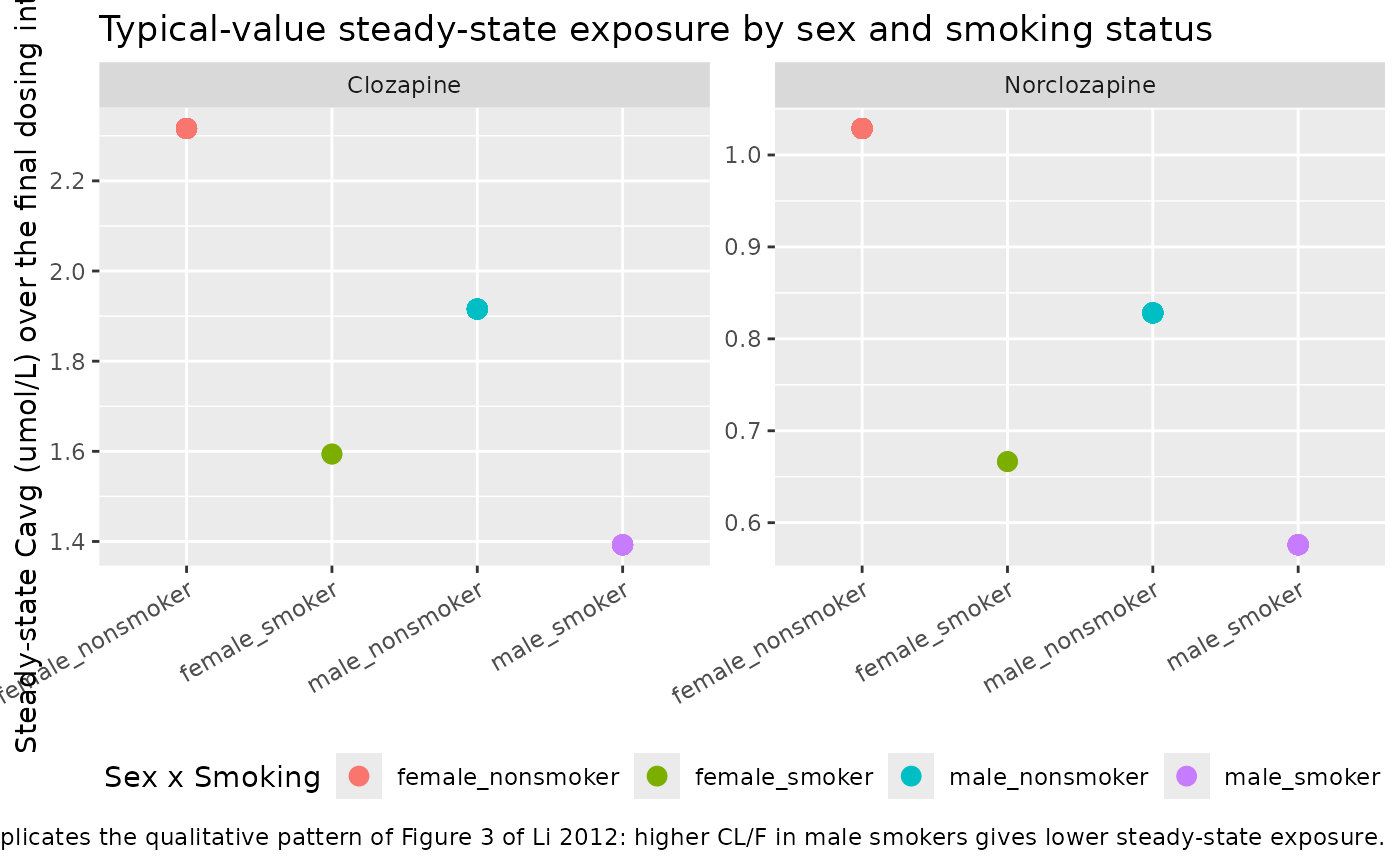
Single-dose profile through 24 hours
The chunk below shows the day-1 typical-value profile of clozapine and norclozapine in a female nonsmoker after a single 200 mg oral dose, illustrating the structural absorption-into-parent-elimination- into-metabolite cascade encoded in the ODE system.
day1 <- sim_typical |>
  dplyr::filter(id == subjects$id[subjects$treatment == "female_nonsmoker"][1],
                time <= 24) |>
  dplyr::select(time, Cc, Cc_norcloz) |>
  tidyr::pivot_longer(c(Cc, Cc_norcloz),
                      names_to = "species", values_to = "conc") |>
  dplyr::mutate(species = dplyr::recode(species,
                                        Cc          = "Clozapine",
                                        Cc_norcloz  = "Norclozapine"))

ggplot(day1, aes(time, conc, colour = species)) +
  geom_line(linewidth = 1) +
  labs(x = "Time (h)", y = "Concentration (umol/L)",
       colour = NULL,
       title = "Day-1 typical-value profile in a female nonsmoker after 200 mg oral clozapine")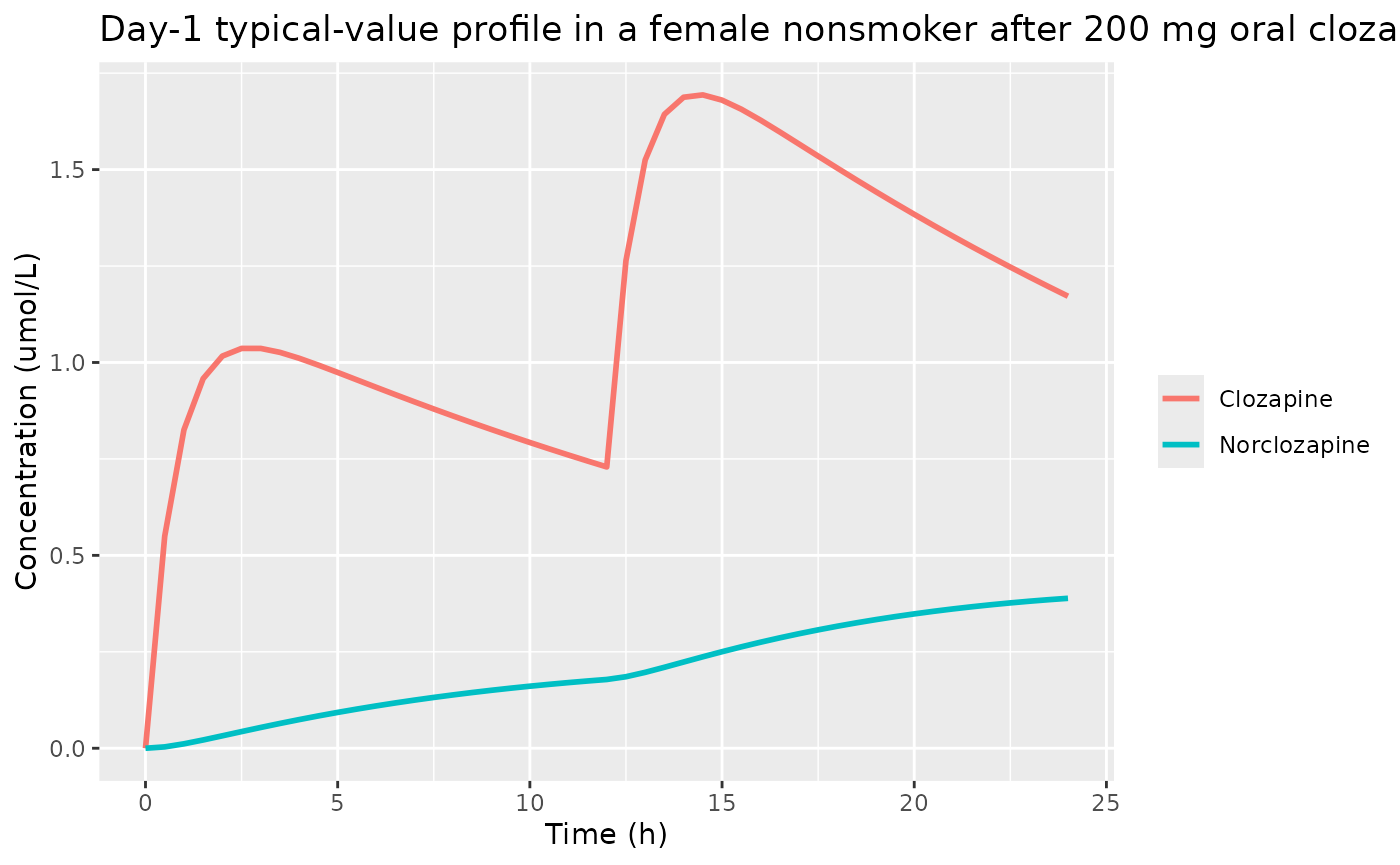
PKNCA validation – steady-state NCA over the final dosing interval
PKNCA is run separately for the parent (clozapine) and the metabolite (norclozapine) outputs over the final dosing interval (288-312 h, i.e. the 25th-26th doses). The interval-stratified summary reports Cmax, Tmax, Cavg, Cmin, and AUC over tau for each stratum.
tau      <- 12
start_ss <- 288  # second-to-last dosing-interval start (full tau covered by obs grid)
end_ss   <- start_ss + tau  # 300

# Single-row-per-(id, time) concentration frame for clozapine.
sim_nca_cloz <- sim |>
  dplyr::filter(time >= start_ss, time <= end_ss) |>
  dplyr::distinct(id, time, .keep_all = TRUE) |>
  dplyr::select(id, time, Cc, treatment)

conc_obj_cloz <- PKNCA::PKNCAconc(
  data    = sim_nca_cloz,
  formula = Cc ~ time | treatment + id,
  concu   = "umol/L",
  timeu   = "h"
)

# Dose at start_ss for AUC0-tau alignment.
dose_df <- events |>
  dplyr::filter(evid == 1, time == start_ss) |>
  dplyr::select(id, time, amt, treatment)

dose_obj <- PKNCA::PKNCAdose(
  data    = dose_df,
  formula = amt ~ time | treatment + id,
  doseu   = "umol"
)

intervals <- data.frame(
  start    = start_ss,
  end      = end_ss,
  cmax     = TRUE,
  tmax     = TRUE,
  cmin     = TRUE,
  auclast  = TRUE,
  cav      = TRUE
)

nca_cloz <- PKNCA::pk.nca(
  PKNCA::PKNCAdata(conc_obj_cloz, dose_obj, intervals = intervals)
)
nca_cloz_summary <- summary(nca_cloz)
knitr::kable(nca_cloz_summary,
caption = "Simulated steady-state NCA (clozapine) over the second-to-last dosing interval (288-300 h).")| Interval Start | Interval End | treatment | N | AUClast (h*umol/L) | Cmax (umol/L) | Cmin (umol/L) | Tmax (h) | Cav (umol/L) |
|---|---|---|---|---|---|---|---|---|
| 288 | 300 | female_nonsmoker | 72 | 27.2 [47.2] | 2.81 [37.4] | 1.61 [80.4] | 2.00 [1.50, 2.00] | 2.27 [47.2] |
| 288 | 300 | female_smoker | 2 | 23.8 [32.4] | 2.57 [15.4] | 1.33 [65.9] | 2.00 [2.00, 2.00] | 1.99 [32.4] |
| 288 | 300 | male_nonsmoker | 40 | 23.3 [35.8] | 2.49 [29.7] | 1.30 [69.8] | 2.00 [1.50, 2.00] | 1.95 [35.8] |
| 288 | 300 | male_smoker | 48 | 16.1 [43.9] | 1.84 [42.0] | 0.776 [83.0] | 2.00 [1.50, 2.00] | 1.34 [43.9] |
sim_nca_norcloz <- sim |>
  dplyr::filter(time >= start_ss, time <= end_ss) |>
  dplyr::distinct(id, time, .keep_all = TRUE) |>
  dplyr::select(id, time, Cc_norcloz, treatment)

conc_obj_norcloz <- PKNCA::PKNCAconc(
  data    = sim_nca_norcloz,
  formula = Cc_norcloz ~ time | treatment + id,
  concu   = "umol/L",
  timeu   = "h"
)

nca_norcloz <- PKNCA::pk.nca(
  PKNCA::PKNCAdata(conc_obj_norcloz, dose_obj, intervals = intervals)
)
nca_norcloz_summary <- summary(nca_norcloz)
knitr::kable(nca_norcloz_summary,
caption = "Simulated steady-state NCA (norclozapine) over the second-to-last dosing interval (288-300 h).")| Interval Start | Interval End | treatment | N | AUClast (h*umol/L) | Cmax (umol/L) | Cmin (umol/L) | Tmax (h) | Cav (umol/L) |
|---|---|---|---|---|---|---|---|---|
| 288 | 300 | female_nonsmoker | 72 | 13.5 [37.7] | 1.14 [37.2] | 1.09 [38.9] | 6.50 [5.00, 8.50] | 1.12 [37.7] |
| 288 | 300 | female_smoker | 2 | 11.1 [7.48] | 0.953 [9.46] | 0.888 [4.18] | 6.00 [6.00, 6.00] | 0.928 [7.48] |
| 288 | 300 | male_nonsmoker | 40 | 10.6 [39.3] | 0.909 [39.6] | 0.844 [39.3] | 6.00 [5.00, 7.50] | 0.884 [39.3] |
| 288 | 300 | male_smoker | 48 | 6.83 [42.0] | 0.603 [40.7] | 0.515 [46.3] | 5.75 [4.00, 6.50] | 0.569 [42.0] |
Comparison against the paper’s reported TDM concentration means
Li 2012 Table 1 reports the cohort-pooled mean clozapine concentration 1.14 +- 0.73 umol/L and the cohort-pooled mean norclozapine concentration 0.54 +- 0.32 umol/L across all TDM samples. The samples were drawn at variable post-dose times (20% at 0.5-4.5 h, 80% at 8.5-15.5 h) under variable daily-dose regimens, so these means are not steady-state Css values for any fixed dosing regimen; they are the time- and dose-pooled mean of the TDM dataset. The relevant audit is the metabolite-to-parent ratio (a within-subject structural quantity that does not depend on the dose level or sampling-time distribution), and the rank order of exposures across sex / smoking strata.
ss_summary <- ss_long |>
  dplyr::group_by(treatment, species) |>
  dplyr::summarise(
    typical_cavg = round(mean(cavg), 3),
    .groups      = "drop"
  ) |>
  tidyr::pivot_wider(names_from = species, values_from = typical_cavg) |>
  dplyr::mutate(metab_over_parent = round(Norclozapine / Clozapine, 3))

ss_summary <- ss_summary |>
  dplyr::add_row(
    treatment         = "Pooled TDM mean (Li 2012 Table 1)",
    Clozapine         = 1.14,
    Norclozapine      = 0.54,
    metab_over_parent = round(0.54 / 1.14, 3)
  )

knitr::kable(
  ss_summary,
  caption = "Simulated typical-value steady-state Cavg by stratum (umol/L) under 200 mg BID, compared against the pooled TDM mean reported by Li 2012."
)| treatment | Clozapine | Norclozapine | metab_over_parent |
|---|---|---|---|
| female_nonsmoker | 2.316 | 1.029 | 0.444 |
| female_smoker | 1.594 | 0.666 | 0.418 |
| male_nonsmoker | 1.916 | 0.828 | 0.432 |
| male_smoker | 1.393 | 0.576 | 0.413 |
| Pooled TDM mean (Li 2012 Table 1) | 1.140 | 0.540 | 0.474 |
The simulated metabolite-to-parent ratio (around 0.44) agrees closely with the TDM-pooled ratio 0.54 / 1.14 ~= 0.47, which is the cleanest internal-consistency check the paper supports (KF = 0.66 fixed, with the metabolite-to-parent ratio at steady state ~ KF * CL / CLM). The absolute simulated Cavg values are about 2x the TDM mean because the TDM samples are drawn at variable post-dose times under heterogeneous daily-dose regimens, while the simulation evaluates Cavg over a canonical 200 mg BID schedule.
Assumptions and deviations
- Female-smoker stratum (n = 2) is preserved in the virtual cohort to mirror Table 1, even though the source paper folded it into the smoking-effect estimate but omitted it from the published Figure 3 boxplot for visual clarity. The model parameters were estimated on the four-stratum dataset, so the simulation should preserve the same stratification.
-
Sex coding inversion. Li 2012 codes sex as a male
indicator (SEX = 1 male, 0 female); the canonical nlmixr2lib covariate
is
SEXF(1 female, 0 male). The model file applies the male-sex effect via(1 - SEXF)to preserve Li 2012’s female-nonsmoker reference category. The covariate-effect parameter namese_sex_cl/e_sex_cl_norclozdenote the male-indicator coefficient in the source, not a female-indicator coefficient on the canonical SEXF. -
AGE and WT were screened but not retained in the
final model (Li 2012 Results: “Other covariates such as weight and age
did not significantly influence the PK parameters of clozapine and
norclozapine”). They are documented in
mod_meta$covariatesDataExcludedso the FREM-style covariate-screening record is preserved. - Dosing in umol, not mg. The source paper reports concentrations in umol/L (consistent with the HPLC-UV assay quantification practice for clozapine TDM); residual error sigma_1 and sigma_3 in Table 2 are in umol/L. We carry the model in molar units throughout so dose, concentration, and residual error are unit-consistent. To feed the model from a mg-based clinical event table, divide the mg dose by 326.83 g/mol and multiply by 1000 (1 mg = 3.0596 umol). The 1:1 molar conversion of clozapine into norclozapine via N- demethylation is mass-balance-correct in molar units; in a mass- unit fit the apparent CLM would absorb a small ~4% bias from the parent/metabolite MW difference (326.83 vs 312.80 g/mol).
- NPDE validation is not reproduced. The published validation used NPDE (Brendel and colleagues) on the source dataset, which is not publicly available; this vignette therefore validates structural consistency (metabolite-to-parent ratio, rank order across strata, half-life) rather than re-running an NPDE analysis.
- Compliance was assumed. Patients were on stable maintenance oral clozapine with compliance confirmed by repeated serum samples and clinician interview; the simulated event table assumes perfect adherence to the canonical 200 mg BID regimen.