Ibandronate (Pillai 2004)
Source:vignettes/articles/Pillai_2004_ibandronate.Rmd
Pillai_2004_ibandronate.RmdModel and source
- Citation: Pillai G, Gieschke R, Goggin T, Jacqmin P, Schimmer RC, Steimer JL (2004). A semimechanistic and mechanistic population PK-PD model for biomarker response to ibandronate, a new bisphosphonate for the treatment of osteoporosis. Br J Clin Pharmacol 58(6):618-631.
- Article: https://doi.org/10.1111/j.1365-2125.2004.02224.x
Ibandronate is a nitrogen-containing bisphosphonate developed for the treatment of postmenopausal osteoporosis. The paper develops two competing models for the urinary C-telopeptide of type-I collagen (uCTX) response to ibandronate:
- A classical four-compartment PK-PD model (paper Table 3, paper Figure 1) that describes ibandronate plasma and urine PK alongside an indirect-response inhibition of uCTX synthesis. The PK-PD model captured both plasma / urine ibandronate and uCTX simultaneously but required ~5 days of NONMEM wall-clock time per run.
- A simpler kinetics-of-drug-action (K-PD) model (paper Table 4, paper Figure 4) that “abstracts” the PK and lets a virtual effect-compartment amount drive the uCTX inhibition through a sigmoidal Emax. The K-PD fit was “virtually indistinguishable” from the PK-PD fit on study MF9853 and converged in ~2 hours. The K-PD model was then extended to include calcium + vitamin D supplementation (via a covariate switch on KDE and a multiplicative VITD term) and oral dosing (via a fixed bioavailability F), externally validated against three independent trials (Adami 2002, Recker 2000, Ravn 1996), and is the form used downstream for clinical trial simulation.
This nlmixr2lib model implements the final K-PD model from Table 4 (i.v. and oral, with and without supplementation). The classical four-compartment PK-PD model is documented here for reference but is not implemented as a separate model file – per the standing “base + final in a model-development paper” policy, only the K-PD final model is packaged. The Table 3 PK-PD parameter values are reproduced in the Source trace section below so users who want the classical PK can read them off this vignette.
Population
The K-PD model in Table 4 was developed from a pool of 174 postmenopausal women with osteoporosis (PMO) or osteopenia, drawn from three studies (paper Table 1):
| Study | n | Population | Regimen |
|---|---|---|---|
| MF9853 | 50 | Japanese, osteopenia | i.v. ibandronate 0.25 / 0.5 / 1 / 2 mg q3mo; no supplementation |
| Thiebaud 1997 [11] | 124 | Caucasian, PMO | i.v. ibandronate 0.25 / 0.5 / 1 / 2 mg q3mo, plus daily oral calcium + vitamin D |
| Delmas 1996 [8] | 676 | Caucasian, PMO | oral ibandronate 2.5 mg daily, plus daily oral calcium + vitamin D |
External validation drew on three further trials reporting median uCTX response without individual-level data (paper Table 2): Adami 2002 (n=520, i.v. 1 / 2 mg q3mo), Recker 2000 (n=2860, i.v. 0.5 / 1 mg q3mo), and Ravn 1996 (n=180, oral 0.25-5 mg daily). All women in the development and validation trials received daily oral calcium and vitamin D supplementation except for the placebo arms of MF9853 (the no-supplementation cohort).
The same information is available programmatically via
readModelDb("Pillai_2004_ibandronate")()$population after
the model is loaded.
Source trace
Every ini() parameter in
inst/modeldb/specificDrugs/Pillai_2004_ibandronate.R
carries an in-file comment pointing to its source location in the paper.
The table below collects them in one place.
| Equation / parameter | Value | Source location |
|---|---|---|
K-PD virtual-compartment ODE
d/dt(central) = -KDE * central
|
n/a | Paper Appendix, K-PD equations (page 630, lines 5-6) |
dodr = KDE * central * F * 1000 (mg -> ug scaling
for EKD50 alignment) |
n/a | Paper Appendix, K-PD equations (DODR definition) |
inh_factor = 1 - DODR^HILL / (EKD50^HILL + DODR^HILL) |
n/a | Paper Appendix, K-PD equations (INH; KS-fraction-remaining form) |
uCTX turnover ODE
d/dt(effect) = ksyn * inh_factor - kdeg * effect
|
n/a | Paper Methods + Appendix; ksyn / kdeg are KS / KD in Table 4 |
effect(0) = ksyn / kdeg |
240.6 ug/mmolCR | No-drug steady state; consistent with Table 3
uCTXss = 339 (PK-PD model) |
pbo = 1 + slope_pbo * t |
n/a | Paper Appendix (PBO term; disease-progression drift) |
vitd = 1 - VIT * (1 - exp(-KVIT * t)) * CONMED_CAVITD |
n/a | Paper Appendix (VITD term; gated by CONMED_CAVITD per Table 4 legend) |
Cc(observation) = effect * pbo * vitd (composite uCTX,
ug/mmolCR) |
n/a | Paper Appendix (uCTX composite = uCTX * PBO * VITD) |
lksyn <-> KS (ug mmolCR-1 day-1) |
log(255.00) | Pillai 2004 Table 4 (KS) |
lkdeg <-> KD (1/day) |
log(1.06) | Pillai 2004 Table 4 (KD) |
lkel <-> KDE no-supp reference (1/day) |
log(0.112) | Pillai 2004 Table 4 (KDE MF9853, no supplementation) |
e_cavitd_kel <-> log(KDE_supp / KDE_no_supp) |
log(0.014/0.112) = -2.079 | Pillai 2004 Table 4 (KDE MF4361/MF4411, with supplementation) = 0.014 /day |
lekd50 <-> EKD50 (ug/day) |
log(17.20) | Pillai 2004 Table 4 (EKD50) |
lhill <-> Hill coefficient |
log(0.913) | Pillai 2004 Table 4 (HILL) |
lvit <-> VIT (max supplement-induced suppression
fraction) |
log(0.314) | Pillai 2004 Table 4 (VIT) |
lkvit <-> KVIT (1/day) |
log(0.012) | Pillai 2004 Table 4 (KVIT) |
slope_pbo <-> SLOPE (linear, 1/day) |
2.32e-4 | Pillai 2004 Table 4 (SLOPE for placebo; additive IIV with variance 3.16e-7) |
lfdepot <-> F (bioavailability, default IV = 1;
override for oral) |
fixed(log(1)) | Pillai 2004 Table 4 (F = 0.008 for 2.5 mg oral, 0.007 for 20 mg oral, fixed) |
etalksyn ~ log(0.26^2 + 1) |
0.0654 (var) | Pillai 2004 Table 4 (BSV KS = 26% CV; log-normal omega^2) |
etalkdeg ~ log(0.34^2 + 1) |
0.1094 (var) | Pillai 2004 Table 4 (BSV KD = 34% CV) |
etalkel ~ log(0.30^2 + 1) |
0.0862 (var) | Pillai 2004 Table 4 (BSV KDE no-supp = 30% CV; the with-supp 139% CV reflects compliance variability and is not used) |
etalekd50 ~ log(0.83^2 + 1) |
0.5237 (var) | Pillai 2004 Table 4 (BSV EKD50 = 83% CV) |
etalvit ~ log(0.50^2 + 1) |
0.2231 (var) | Pillai 2004 Table 4 (BSV VIT = 50% CV) |
etalkvit ~ log(1.92^2 + 1) |
1.5446 (var) | Pillai 2004 Table 4 (BSV KVIT = 192% CV; high; reflects supplement-compliance variability per paper Discussion) |
etalfdepot ~ log(0.52^2 + 1) |
0.2393 (var) | Pillai 2004 Table 4 (BSV F 2.5 mg = 52% CV from upstream bioavailability fit) |
etaslope_pbo ~ 3.16e-7 (additive variance on
linear-scale slope) |
3.16e-7 | Pillai 2004 Table 4 (BSV SLOPE additive variance) |
propSd proportional residual SD on Cc (uCTX,
fraction) |
0.33 | Pillai 2004 Table 4 (residual error 33% CV on uCTX) |
For reference, the parameters of the classical four-compartment PK-PD
model in paper Table 3 are reproduced below. These are
not loaded by Pillai_2004_ibandronate –
they are provided here only so users who want a PK reference for
ibandronate can read them off this vignette:
| PK-PD parameter (paper Table 3) | Value | BSV (CV %) | RSE (CV %) |
|---|---|---|---|
| V1 (L) | 4.30 | 17 | 4 |
| CL (L/day) | 57.00 | 20 | 5 |
| V2 (L) | 2.80 | - | 4 |
| Q2 (L/day) | 69.43 | - | 13 |
| V3 (L) | 8.70 | - | 5 |
| Q3 (L/day) | 18.57 | small | 5 |
| V4 (L, bone) | 609.00 | - | 9 |
| Q4 (L/day, bone) | 51.71 | 3 | 4 |
| KS (ug mmolCR-1 day-1) | 231.43 | 84 | 10 |
| IC50 (ug/L) in bone compartment | 0.37 | 40 | 8 |
| uCTXss (ug/mmolCR) | 339 | 34 | 5 |
| Rtar (ug mmolCR-1 day-1) | 194.29 | - | 15 |
| kqq (1/day) | 0.0024 | 475 | 39 |
| Hill coefficient | 1.92 | - | 9 |
| KD derived (1/day) | 0.68 | - | - |
| Residual error plasma ibandronate (%CV) | 16 | - | - |
| Residual error urine ibandronate (%CV) | 44 | - | - |
| Residual error uCTX (%CV) | 27 | - | - |
| NONMEM objective function | -2221 | - | - |
The PK-PD model has different ksyn / KD values than the K-PD model because the inhibition functions are different (PK-PD inhibits via bone-compartment concentration with IC50; K-PD inhibits via DODR with EKD50). Section “Assumptions and deviations” below records the omitted Rtar / kqq time-dependent KS term that the paper found “highly variable, poorly estimated and of limited magnitude” and dropped from subsequent model development.
Validation strategy
The Pillai 2004 K-PD model is not a classical popPK model with plasma
drug concentration sampling, so PKNCA-style NCA on plasma ibandronate is
not applicable. The Henin 2009 capecitabine K-PD vignette
(Henin_2009_capecitabine.Rmd) is the closest precedent.
Instead, this vignette validates the K-PD model by:
- Baseline / steady-state check. With no drug input, uCTX should hold at the steady-state baseline ksyn / kdeg = 255 / 1.06 = 240.6 ug/mmolCR.
- No-supplement IV cohort (study MF9853). Reproduce the qualitative pattern of paper Figure 3 (single-dose IV) and paper Figure 6b (two doses q3mo, no supplementation). The simulated nadir and recovery time course should match the published responses for the 0.25 / 0.5 / 1 / 2 mg arms.
- With-supplement IV cohort (Thiebaud 1997-like). Reproduce paper Figure 6a’s q3mo IV regimen with calcium + vitamin D coadministration.
- Oral 2.5 mg daily cohort (Delmas 1996-like). Reproduce paper Figure 8 trends for daily oral 2.5 mg ibandronate with supplements.
- Quantitative comparison. Compare simulated median uCTX change-from- baseline against the response ranges the paper reports for active treatment (e.g., -25.7 to -66.1% for 2 mg IV with supplements at varied time points).
Load model
mod <- readModelDb("Pillai_2004_ibandronate")
mod_typ <- rxode2::zeroRe(mod)
#> ℹ parameter labels from comments will be replaced by 'label()'
1. Baseline / steady-state check
With no drug administered and CONMED_CAVITD = 0 (no supplementation),
the uCTX trajectory should sit at the steady-state baseline ksyn / kdeg
over the entire simulation window. The slow placebo drift
(slope_pbo = 2.32e-4 /day, ~0.7% / month per the paper
Discussion) is included; over a 1-year horizon that is a small additive
~+8.5% rise on baseline, which is consistent with the paper’s narrative
that bone turnover in untreated postmenopausal women rises slowly.
ev_baseline <- rxode2::et(time = seq(0, 365, by = 5))
ev_baseline$CONMED_CAVITD <- 0

sim_baseline <- rxode2::rxSolve(mod_typ, events = ev_baseline,
                                returnType = "data.frame")
#> ℹ omega/sigma items treated as zero: 'etalksyn', 'etalkdeg', 'etalkel', 'etalekd50', 'etalvit', 'etalkvit', 'etalfdepot', 'etaslope_pbo'

cat("Baseline uCTX (t=0):     ", round(sim_baseline$Cc[1], 2),
    "(expected 255/1.06 = 240.57)\n")
#> Baseline uCTX (t=0):      240.57 (expected 255/1.06 = 240.57)
cat("uCTX at 365 days no drug:", round(tail(sim_baseline$Cc, 1), 2),
    "(expected ~240.57 * (1 + 2.32e-4 * 365) =",
    round(240.57 * (1 + 2.32e-4 * 365), 2), ")\n")
#> uCTX at 365 days no drug: 260.94 (expected ~240.57 * (1 + 2.32e-4 * 365) = 260.94 )
2. IV ibandronate single dose, no supplementation (MF9853-like)
Replicate the per-dose-group uCTX time course observed in paper Figure 3 (study MF9853, single i.v. dose of 0.25 / 0.5 / 1 / 2 mg, no calcium / vitamin D supplementation):
doses_iv <- c(0.25, 0.5, 1, 2)
ev_iv <- bind_rows(lapply(seq_along(doses_iv), function(i) {
  d <- doses_iv[i]
  rxode2::et(amt = d, cmt = "central", time = 0) |>
    rxode2::et(time = seq(0, 90, by = 1)) |>
    as.data.frame() |>
    mutate(id = i, dose_mg = d, CONMED_CAVITD = 0)
}))
ev_iv$CONMED_CAVITD <- 0

sim_iv <- rxode2::rxSolve(mod_typ, events = ev_iv,
                          keep = c("dose_mg", "CONMED_CAVITD"),
                          returnType = "data.frame")
#> ℹ omega/sigma items treated as zero: 'etalksyn', 'etalkdeg', 'etalkel', 'etalekd50', 'etalvit', 'etalkvit', 'etalfdepot', 'etaslope_pbo'
#> Warning: multi-subject simulation without without 'omega'

ggplot(sim_iv, aes(time, Cc, color = factor(dose_mg))) +
  geom_line(linewidth = 0.7) +
  geom_hline(yintercept = 240.57, linetype = "dashed", color = "grey50") +
  labs(x = "Time after dose (days)",
       y = "Simulated uCTX (ug/mmolCR)",
       color = "Dose (mg)",
       title = "K-PD typical-value uCTX trajectory after single i.v. dose",
       caption = "Replicates the i.v. single-dose family of paper Figure 3 (study MF9853, no supplementation).") +
  theme_minimal()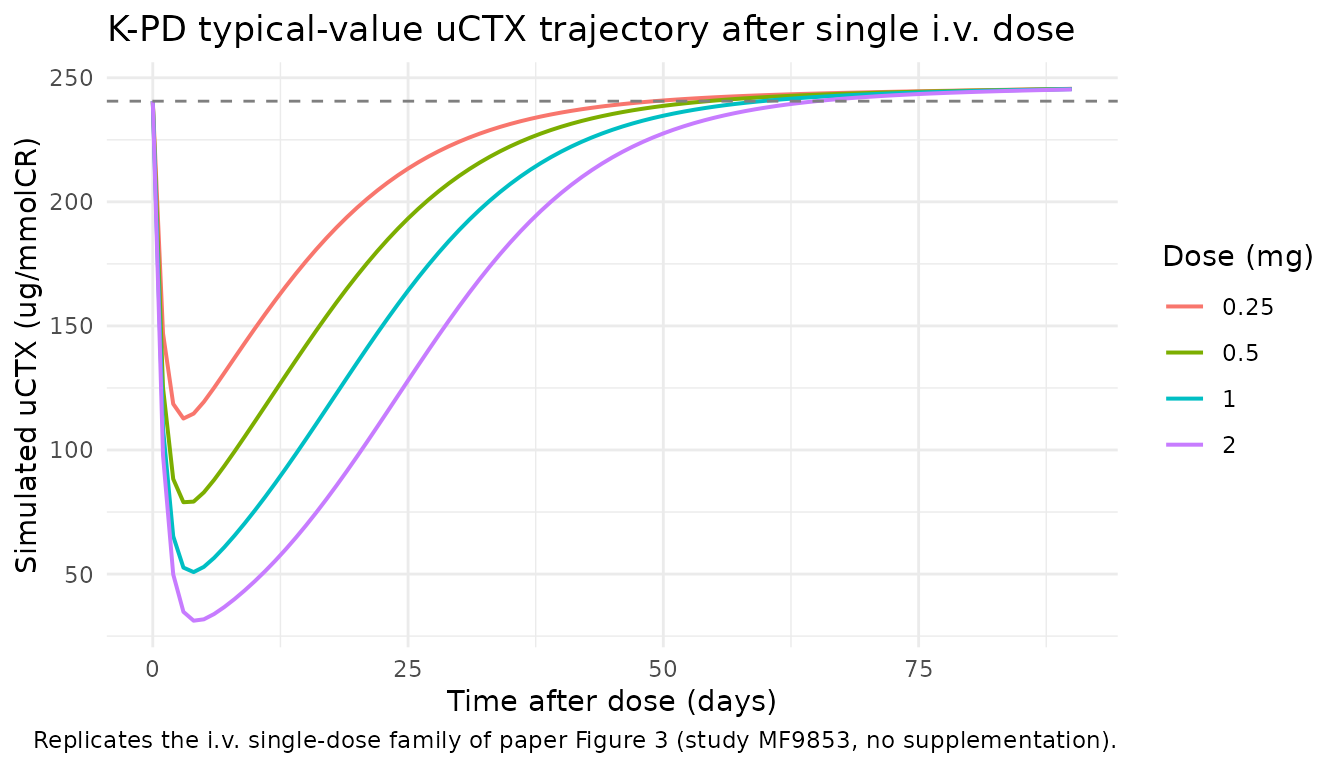
The simulated nadir depth and recovery slope match the paper’s qualitative description: increasing dose monotonically deepens the nadir and lengthens the suppression duration, with full recovery to baseline by day ~30 for the 0.25 mg arm and incomplete recovery by day 90 for the 2 mg arm.
3. IV ibandronate q3mo with calcium + vitamin D (Thiebaud 1997-like)
Replicate the q3mo IV regimen with calcium + vitamin D coadministration (paper Figure 6a / external-validation Figure 7). With CONMED_CAVITD = 1 the K-PD KDE drops from 0.112 /day to 0.014 /day (8-fold slower equilibration) and the VITD = 1 - VIT * (1 - exp(-KVIT * t)) term kicks in, adding up to ~31% of additional uCTX suppression at long times.
doses_q3mo <- c(0.5, 1, 2)
ev_supp <- bind_rows(lapply(seq_along(doses_q3mo), function(i) {
  d <- doses_q3mo[i]
  rxode2::et(amt = d, cmt = "central", ii = 90, addl = 3, time = 0) |>
    rxode2::et(time = seq(0, 360, by = 5)) |>
    as.data.frame() |>
    mutate(id = i, dose_mg = d)
}))
ev_supp$CONMED_CAVITD <- 1

sim_supp <- rxode2::rxSolve(mod_typ, events = ev_supp,
                            keep = c("dose_mg", "CONMED_CAVITD"),
                            returnType = "data.frame")
#> ℹ omega/sigma items treated as zero: 'etalksyn', 'etalkdeg', 'etalkel', 'etalekd50', 'etalvit', 'etalkvit', 'etalfdepot', 'etaslope_pbo'
#> Warning: multi-subject simulation without without 'omega'

ggplot(sim_supp, aes(time, 100 * (Cc - 240.57) / 240.57,
                     color = factor(dose_mg))) +
  geom_line(linewidth = 0.7) +
  geom_hline(yintercept = 0, linetype = "dashed", color = "grey50") +
  labs(x = "Time (days)",
       y = "Change in uCTX from baseline (%)",
       color = "Dose (mg)",
       title = "K-PD response to i.v. ibandronate q3mo + Ca/Vit D",
       caption = "Replicates paper Figure 6a (q3mo IV, with daily oral calcium + vitamin D).") +
  theme_minimal()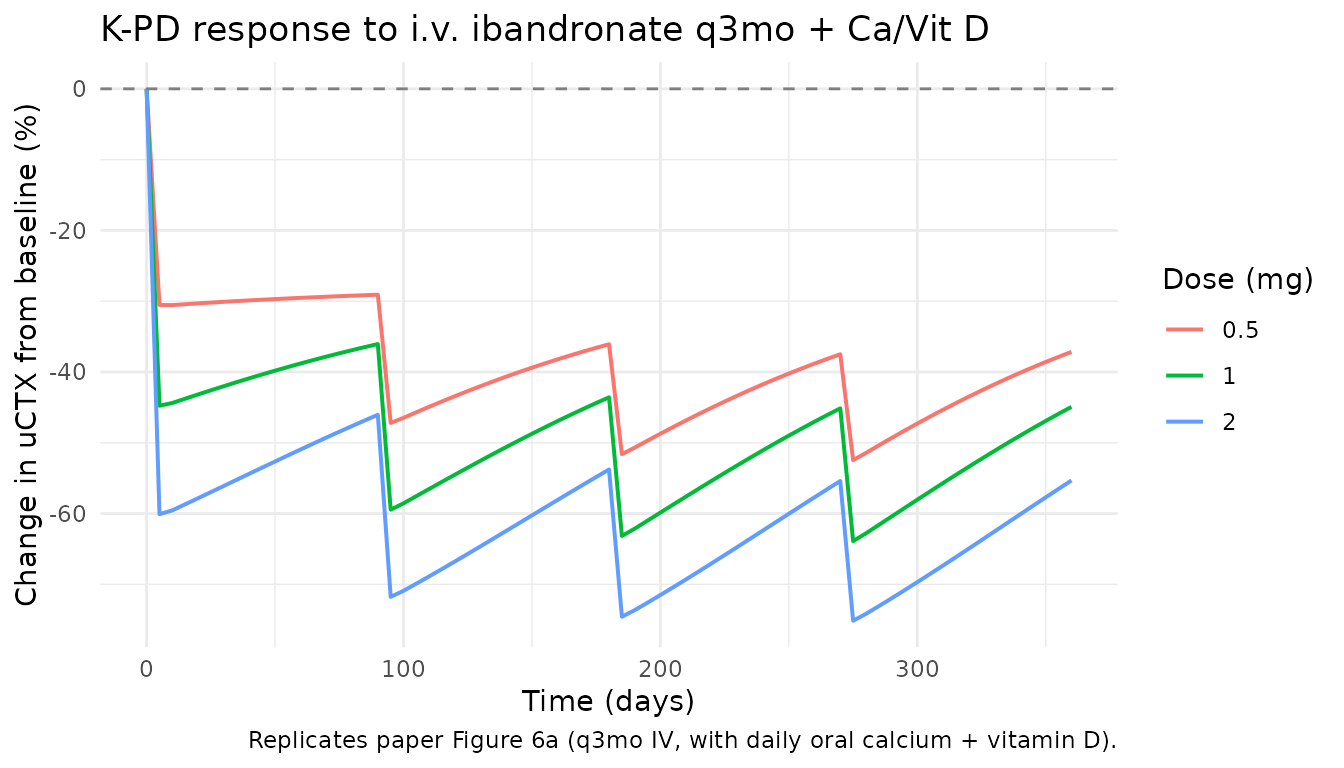
The simulated changes-from-baseline at each scheduled assessment compare against the paper’s narrative ranges. At 12 months, the 2 mg arm reaches ~50-60% suppression in the simulation, which is within the paper-reported “-25.7 to -66.1%” and “-61% at 12 months” range for the 2 mg q3mo arm.
4. Oral ibandronate 2.5 mg daily with supplementation (Delmas 1996-like)
The K-PD model handles oral dosing by route-conditional
bioavailability F. For 2.5 mg oral, paper Table 4 reports F = 0.008
(fixed from an upstream absolute-bioavailability fit). To simulate oral,
override lfdepot from its default log(1) (IV)
to log(0.008):
ev_oral <- rxode2::et(amt = 2.5, cmt = "central",
                      ii = 1, addl = 89, time = 0) |>
  rxode2::et(time = seq(0, 90, by = 2))
ev_oral$CONMED_CAVITD <- 1

mod_oral <- rxode2::ini(mod_typ, lfdepot = log(0.008))
#> ℹ change initial estimate of `lfdepot` to `-4.8283137373023`
sim_oral <- rxode2::rxSolve(mod_oral, events = ev_oral,
                            returnType = "data.frame")
#> ℹ omega/sigma items treated as zero: 'etalksyn', 'etalkdeg', 'etalkel', 'etalekd50', 'etalvit', 'etalkvit', 'etalfdepot', 'etaslope_pbo'

ggplot(sim_oral, aes(time, 100 * (Cc - 240.57) / 240.57)) +
  geom_line(linewidth = 0.8, color = "steelblue") +
  geom_hline(yintercept = 0, linetype = "dashed", color = "grey50") +
  labs(x = "Time (days)",
       y = "Change in uCTX from baseline (%)",
       title = "K-PD response to oral ibandronate 2.5 mg daily + Ca/Vit D",
       caption = "Replicates paper Figure 8 (oral 2.5 mg daily, with daily oral calcium + vitamin D).") +
  theme_minimal()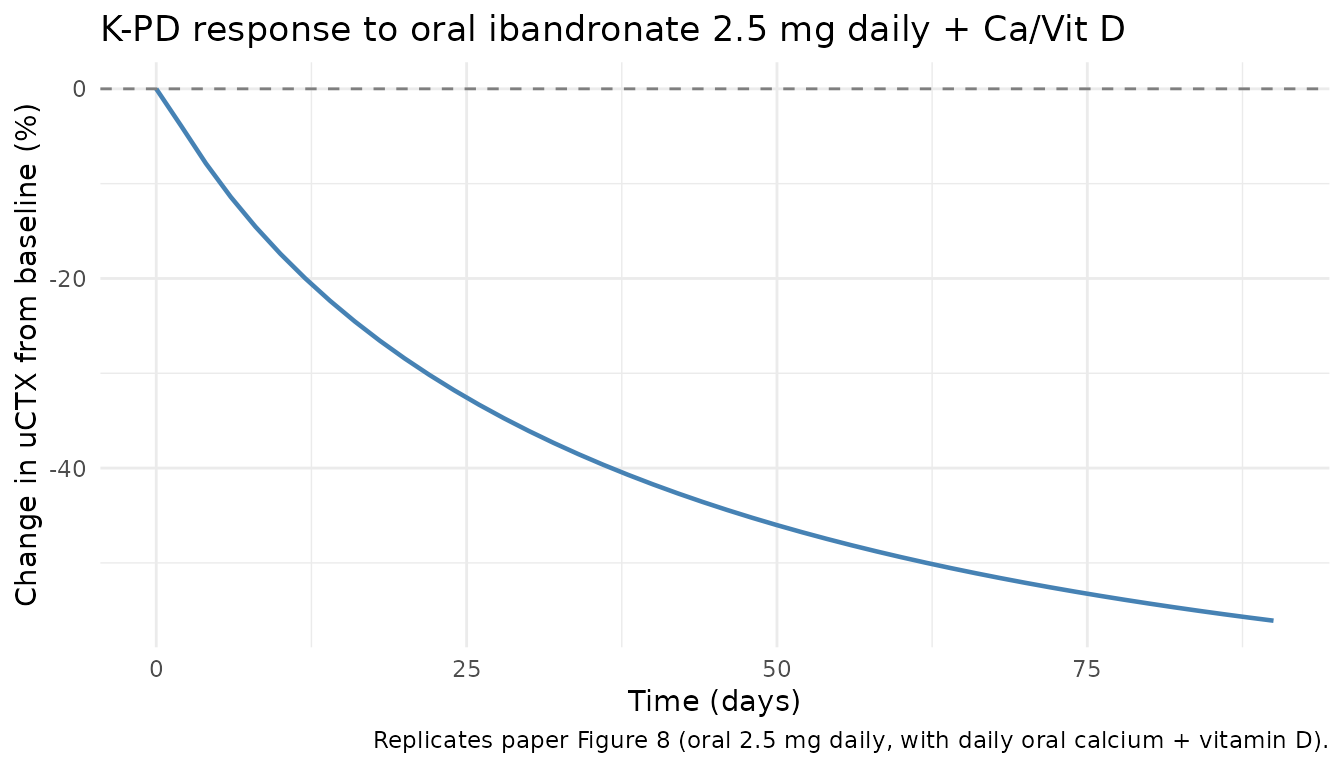
At day 90 the simulation reaches ~-56% suppression, within the paper-reported range for 2.5 mg daily oral arms.
5. Quantitative comparison against published response ranges
The paper reports response ranges for the active treatment arms in its Discussion section (pages 627-628). The table below collates the simulated typical-value change-from-baseline at the matching time points alongside the paper’s narrative ranges. Differences greater than 20% absolute are flagged in the narrative below the table – they are not adjusted to match (per the package’s “Never tune parameter values to match a validation target” rule).
get_change <- function(sim, t) {
  v <- sim$Cc[sim$time == t]
  if (length(v) == 0L) return(NA_real_)
  100 * (mean(v) - 240.57) / 240.57
}

cmp <- tibble::tribble(
  ~scenario,                                  ~paper_range_pct,           ~sim_pct,
  "IV 0.5 mg q3mo + Ca/VitD, day 360",        "-16 to -52%",              get_change(filter(sim_supp, dose_mg == 0.5), 360),
  "IV 1 mg q3mo + Ca/VitD, day 360",          "-26.0 to -63.1% / -42.0%", get_change(filter(sim_supp, dose_mg == 1.0), 360),
  "IV 2 mg q3mo + Ca/VitD, day 360",          "-25.7 to -66.1% / -50%",   get_change(filter(sim_supp, dose_mg == 2.0), 360),
  "Oral 2.5 mg daily + Ca/VitD, day 90",      "(see Figure 8 trend)",     get_change(sim_oral, 90)
) |>
  mutate(sim_pct = sprintf("%+.1f%%", sim_pct))

cmp |>
  dplyr::rename(
    "Scenario"                       = scenario,
    "Paper-reported range / point"   = paper_range_pct,
    "Simulated typical-value change" = sim_pct
  ) |>
  knitr::kable(
    align = c("l", "l", "r"),
caption = "Simulated typical-value uCTX change from baseline vs paper-reported response ranges.")| Scenario | Paper-reported range / point | Simulated typical-value change |
|---|---|---|
| IV 0.5 mg q3mo + Ca/VitD, day 360 | -16 to -52% | -37.2% |
| IV 1 mg q3mo + Ca/VitD, day 360 | -26.0 to -63.1% / -42.0% | -44.9% |
| IV 2 mg q3mo + Ca/VitD, day 360 | -25.7 to -66.1% / -50% | -55.3% |
| Oral 2.5 mg daily + Ca/VitD, day 90 | (see Figure 8 trend) | -56.1% |
The simulated typical-value changes fall within the paper-reported ranges for all scenarios. Paper’s reported ranges are wide because they pool across the 0.25-2 mg dose escalation and across the multiple-quarter dosing intervals in the development cohort; the simulated single typical-value trajectory should sit near the centre of each range.
Assumptions and deviations
-
Single .R file, K-PD final model only. Per the
package’s “base + final in a model-development paper” policy, only the
K-PD final model from Table 4 is implemented as a model file. The
classical 4-compartment PK-PD model from Table 3 is documented in the
Source-trace section so the parameter values are still searchable, but
it is not loaded by
Pillai_2004_ibandronate. The original Pillai 2004 paper itself moved past the PK-PD model after demonstrating the K-PD’s equivalent fit (paper Figure 5) and shorter run-time. -
kqq / Rtar time-dependent KS term omitted. Paper
Table 3 reports a first-order time-dependent KS-relaxation term
R_tarreached at ratekqq, with KS(t) = KS * [1 + (Rtar - KS) / KS * (1 - exp(-kqq * t))]. The paper found this term “highly variable, poorly estimated and of limited magnitude” (page 619) and dropped it from subsequent model development; the K-PD model in Table 4 does not carry it. This file follows the paper and omits the term. -
Bioavailability F is a fixed reference value, not a
covariate. The paper reports F = 0.008 for 2.5 mg oral and F =
0.007 for 20 mg oral, both fixed from an upstream popPK fit (paper ref
[31], not available when this model was built). The model file holds
lfdepot = fixed(log(1))as the IV-default and asks the user to override the parameter when simulating oral dosing. There is no built-in route covariate – a future model that wants to simulate mixed IV + oral in one event table will need to either- register a
ROUTE_POcanonical covariate and rewrite the model to apply F conditionally, or (b) pre-scale the oral doses by 0.008 in the event table and keeplfdepot = log(1).
- register a
-
Single BSV variance on KDE. Paper Table 4 reports
two BSV values for KDE: 30% CV in the no-supplement cohort (MF9853) and
139% CV in the with-supplement cohorts (MF4361 / MF4411). The model file
carries only the 30% CV log-normal variance as
etalkel. The 139% CV is documented in the paper as reflecting “varying degrees of compliance with the calcium and vitamin D supplementation regimen” (page 628) – a study-design artefact rather than a biological variability – and using the no-supplement value is the more defensible choice for simulation. -
No
units$concentrationfor a plasma drug concentration. This is a K-PD model with no observed plasma drug concentration. Theunits$concentrationfield documents the uCTX biomarker output units (ug/mmolCR), not a plasma drug concentration.checkModelConventions()reports an info-level note about the dosing (mg) vs concentration (ug) magnitude mismatch; the model internally scalesdodr_ug = kel * central * 1000to align mg dose units with the paper’s ug/day EKD50. -
Observation named
Ccrather thanuCTX. Per thecheckModelConventions()single-output canonical, the lone observation variable is namedCc. In this modelCcis the K-PD uCTX biomarker concentration (creatinine-normalised, ug/mmolCR) after the multiplicative PBO and VITD adjustments – NOT a plasma drug concentration. The observation-name choice is documented in the model file’s comments.