Octamethylcyclotetrasiloxane D4 siloxane PBPK (Luu 2001)
Source:vignettes/articles/Luu_2001_d4_siloxane.Rmd
Luu_2001_d4_siloxane.RmdModel and source
Luu and Hutter (2001, Environ Health Perspect 109:1095-1101, doi:10.1289/ehp.109-1240468) developed a whole-body physiologically based pharmacokinetic (PBPK) model for octamethylcyclotetrasiloxane (D4), a low-molecular-weight cyclic siloxane (CAS 556-67-2). D4 is a major component of silicone personal-care products and a precursor of the polydimethylsiloxane used in silicone breast implants, from which low-molecular-weight siloxanes slowly leach. D4 is highly lipophilic (log Poct/water = 5.1) and accumulates in fat, which motivated a toxicokinetic model to relate external exposure to internal (target-organ) dose, especially in women.
This is a toxicokinetic PBPK for an environmental / industrial chemical, not a therapeutic drug.
The paper contributes two model files, sharing one material-balance structure but parameterised for the two species the authors calibrated and validated:
| Model file | Role |
|---|---|
Luu_2001_d4_rat |
Female Sprague-Dawley rat, intravenous calibration (Kirkpatrick 1995) |
Luu_2001_d4_human |
Human, physiology scaled by power law; inhalation / implant exposure |
The structure (Figure 2 and the Appendix) is a flow-limited lung,
richly-perfused tissue, a two-subcompartment fat depot (a weakly-bound
compartment Cf1 exchanging with a deep strongly-bound
compartment Cf2), liver with first-order metabolism, GI
tract and kidney, together with a blood model in which D4 is dissolved
in plasma (Cai), weakly protein-bound (Cwk)
and - in the rat only - strongly protein-bound (Cstr). The
arterial concentration leaving the lung is Hair x Clung;
each tissue receives Q x Hair x Clung by arterial perfusion
and returns Q x C / D venous blood, where D is
the tissue:blood distribution coefficient. The states are concentrations
(ug/mL); the measured blood/tissue radioactivity is
total D4 (dissolved plus protein-bound), which the
model reports as Cc.
rat <- rxode2::rxode2(readModelDb("Luu_2001_d4_rat"))
hum <- rxode2::rxode2(readModelDb("Luu_2001_d4_human"))- Rat citation: Luu HMD, Hutter JC. Bioavailability of octamethylcyclotetrasiloxane (D4) after exposure to silicones by inhalation and implantation. Environ Health Perspect. 2001;109(11):1095-1101. doi:10.1289/ehp.109-1240468. Calibrated parameters from Table 3 (rat / Sprague-Dawley column); physiologic volumes and flows from Table 2 (rat); material-balance ODEs from the Appendix.
Population
The rat model was calibrated against the single and repeated
intravenous 14C-D4 disposition study of Kirkpatrick (1995):
three groups of 20 Sprague-Dawley rats (10 male, 10 female) dosed at 7
and 70 mg/kg single and 7 mg/kg daily for 14 days, with blood, liver,
kidney, lung and fat sampled to 48 h. Only the female data were used,
because females retain more D4 than males and the risk-assessment goal
concerned women. The human model was scaled from the rat by power law
(Y = a M^0.75) and validated against an independent
inhalation study (Utell 1998) in which 12 volunteers were exposed to 10
ppm D4 vapour for 1 h. The programmatic metadata are in each model’s
population list
(e.g. readModelDb("Luu_2001_d4_rat")()$population).
Source trace
Each ini() entry carries an in-file comment pointing to
its source location. The table collects the calibrated (Table 3)
parameters; the physiologic volumes and flows (Table 2) are fixed
numeric constants in model(), each likewise commented.
| Parameter | Rat | Human | Source |
|---|---|---|---|
Dr richly-perfused:blood |
10 | 10 | Table 3 |
Df1 weak-fat:blood |
700 | 700 | Table 3 |
Df2 deep-fat:blood |
2,000 | 2,000 | Table 3 (estimated from log P = 5.1) |
Dl liver:blood |
7.4 | 7.4 | Table 3 |
Dgi GI:blood |
0.41 | 0.41 | Table 3 |
Dk kidney:blood |
40 | 40 | Table 3 |
Hair blood:air |
20.0 | 20.0 | Table 3 |
kel metabolism (1/h) |
9 | 728 | Table 3 (human = 9 x (70/0.20)^0.75) |
ksi / kso strong binding (1/h) |
0.4 / 0.07 | - | Table 3 (human Vstrong = 0) |
kwi / kwo weak binding (1/h) |
0.2 / 1.0 | 0.2 / 1.0 | Table 3 |
Vweak / Vstrong (mL) |
1.0 / 1.0 | 10.4 / 0 | Table 3 |
Qf2/Qf1, Vf2/Vf1
|
0.059, 0.73 | 0.059, 0.73 | Table 3 |
preload fraction to Cwk
|
0.05 | 0.008 | Appendix |
d/dt material balances |
n/a | n/a | Appendix equations |
Mass-balance gate
The implemented ODEs lose parent D4 only to hepatic metabolism (into
the Mmet accumulator); there is no exhalation or
renal/faecal excretion of parent in the core equations (see Errata). The
system is therefore closed: parent D4 in all tissues plus accumulated
metabolites must equal the total input (the forcing-function dose plus
the preloaded weakly-bound fraction) at all times. For the rat single 7
mg/kg IV (DOSE = 1400 ug, 5% preloaded) the expected
conserved total is 1.05 x 1400 = 1470 ug.
V <- c(Vlung = 14, Vr = 146, Vf1 = 14.2, Vf2 = 0.73 * 14.2, Vl = 8,
       Vgi = 6, Vk = 1.9, Vblood = 8.5, Vweak = 1, Vstrong = 1)
s_mb <- rxode2::rxSolve(rat, rxode2::et(seq(0, 72, by = 0.5)),
                        c(DOSE = 1400, tinj = 0.1)) |> as.data.frame()
parent <- with(s_mb, Clung * V["Vlung"] + Cr * V["Vr"] + Cf1 * V["Vf1"] +
  Cf2 * V["Vf2"] + Cl * V["Vl"] + Cgi * V["Vgi"] + Ck * V["Vk"] +
  Cai * V["Vblood"] + Cwk * V["Vweak"] + Cstr * V["Vstrong"])
total <- parent + s_mb$Mmet
rel_err <- max(abs(total[s_mb$time > 0.2] - 1470) / 1470)
cat(sprintf("max relative mass-balance error (t > tinj): %.2e\n", rel_err))
#> max relative mass-balance error (t > tinj): 6.26e-09
stopifnot(rel_err < 1e-6)
Rat intravenous disposition
A single 7 mg/kg IV dose in a 0.20 kg rat is DOSE = 1400
ug delivered over a near-instantaneous tinj = 0.1 h forcing
window (the paper reports tmax = 0). The plasma (total
blood D4) profile is biphasic, driven by rapid tissue distribution and
slow redistribution out of the high-affinity fat depot.
tgrid <- sort(unique(c(seq(0, 2, by = 0.02), seq(2, 72, by = 0.25))))
rat_sim <- rxode2::rxSolve(rat, rxode2::et(tgrid), c(DOSE = 1400, tinj = 0.1)) |>
  as.data.frame()
rat_long <- rat_sim |>
  transmute(time, Plasma = Cc, Fat = Cfat) |>
  pivot_longer(c(Plasma, Fat), names_to = "Compartment", values_to = "conc")
ggplot(rat_long, aes(time, conc, colour = Compartment)) +
  geom_line(linewidth = 0.8) +
  scale_y_log10() +
  labs(x = "Time (h)", y = "D4 concentration (ug/mL)",
       title = "Rat 7 mg/kg single IV") +
  theme_bw()
#> Warning in scale_y_log10(): log-10 transformation introduced infinite values.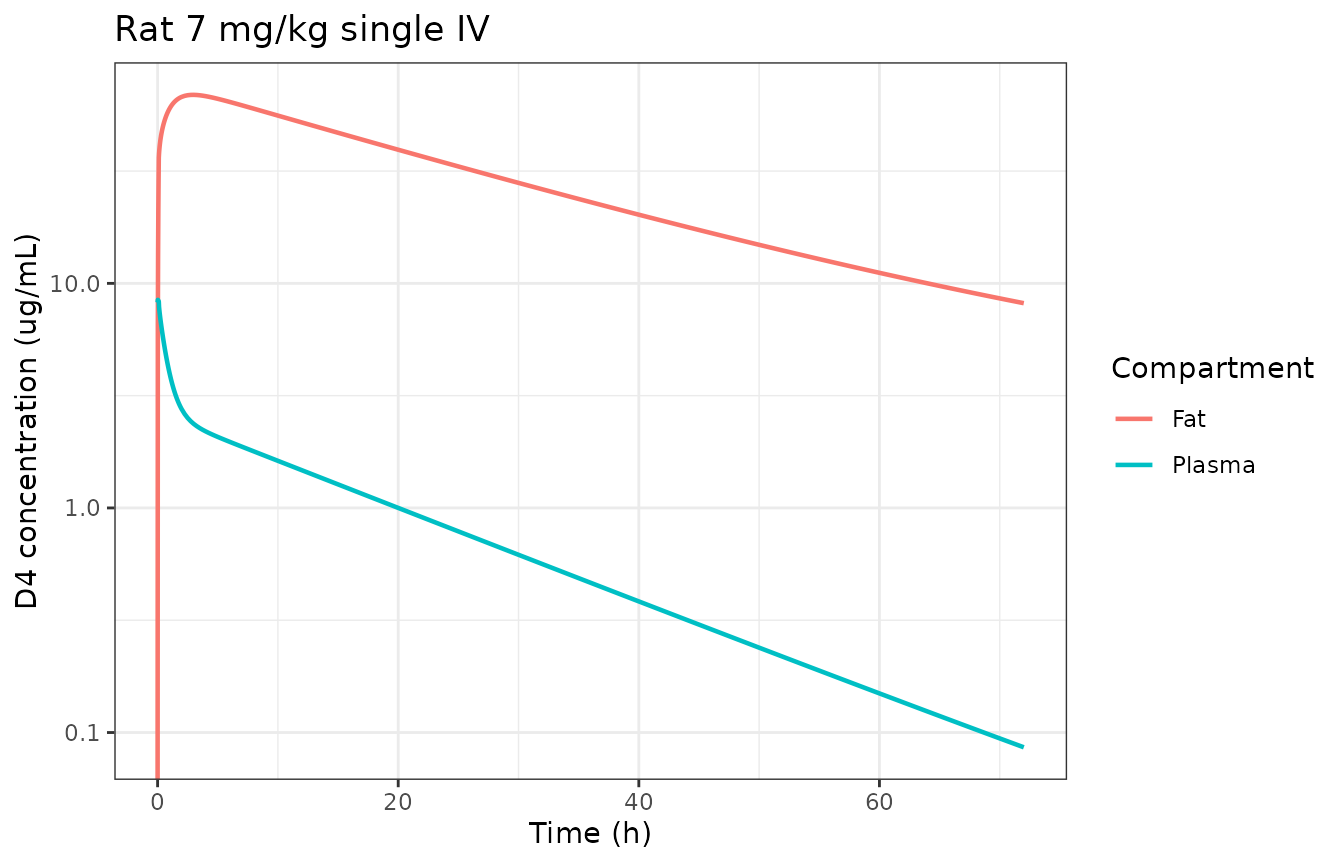
Replicates Figure 3 (plasma) and Figure 4 (fat) of Luu 2001: predicted D4 after a single 7 mg/kg IV dose in the female SD rat.
NCA on the simulated plasma profile, compared against the paper’s reported PK (Table 5, 7 mg/kg single IV). The paper’s model terminal half-life is 14.0 h.
conc_rat <- rat_sim |> dplyr::filter(!is.na(Cc)) |> transmute(id = 1L, time, conc = Cc)
dose_rat <- data.frame(id = 1L, time = 0, dose = 1400)
o_conc <- PKNCAconc(conc_rat, conc ~ time | id)
o_dose <- PKNCAdose(dose_rat, dose ~ time | id)
intervals <- data.frame(start = 0, end = Inf,
                        cmax = TRUE, tmax = TRUE, auclast = TRUE,
                        aucinf.obs = TRUE, half.life = TRUE)
res_rat <- pk.nca(PKNCAdata(o_conc, o_dose, intervals = intervals))
nca_rat <- as.data.frame(res_rat$result)

rat_cmp <- tibble::tibble(
  Parameter = c("Cmax (ug/mL)", "tmax (h)", "AUClast (ug*h/mL)",
                "AUCinf (ug*h/mL)", "terminal t1/2 (h)"),
  Simulated = c(
    nca_rat$PPORRES[nca_rat$PPTESTCD == "cmax"],
    nca_rat$PPORRES[nca_rat$PPTESTCD == "tmax"],
    nca_rat$PPORRES[nca_rat$PPTESTCD == "auclast"],
    nca_rat$PPORRES[nca_rat$PPTESTCD == "aucinf.obs"],
    nca_rat$PPORRES[nca_rat$PPTESTCD == "half.life"]),
  Published = c(6.7, 0, 43.4, NA, 14.0))
knitr::kable(rat_cmp, digits = 2,
caption = "Rat 7 mg/kg single IV: simulated NCA vs Luu 2001 Table 5.")| Parameter | Simulated | Published |
|---|---|---|
| Cmax (ug/mL) | 8.45 | 6.7 |
| tmax (h) | 0.02 | 0.0 |
| AUClast (ug*h/mL) | 57.19 | 43.4 |
| AUCinf (ug*h/mL) | 59.00 | NA |
| terminal t1/2 (h) | 14.55 | 14.0 |
Human inhalation disposition
The human validation scenario is the Utell (1998) 1-h inhalation
exposure, which the authors reduce to a net absorbed dose of 11.1 mg
delivered to the lung (DOSE = 11100 ug,
tinj = 1 h), with 0.8% preloaded to the weakly-bound blood
pool. Concentrations are reported in ng/mL.
hgrid <- sort(unique(c(seq(0, 2, by = 0.02), seq(2, 48, by = 0.1))))
hum_sim <- rxode2::rxSolve(hum, rxode2::et(hgrid), c(DOSE = 11100, tinj = 1.0)) |>
  as.data.frame()
hum_long <- hum_sim |>
  transmute(time, Plasma = Cc, Fat = Cfat) |>
  pivot_longer(c(Plasma, Fat), names_to = "Compartment", values_to = "conc")
ggplot(hum_long, aes(time, conc, colour = Compartment)) +
  geom_line(linewidth = 0.8) +
  scale_y_log10() +
  labs(x = "Time (h)", y = "D4 concentration (ng/mL)",
       title = "Human 11.1 mg single 1-h inhalation") +
  theme_bw()
#> Warning in scale_y_log10(): log-10 transformation introduced infinite values.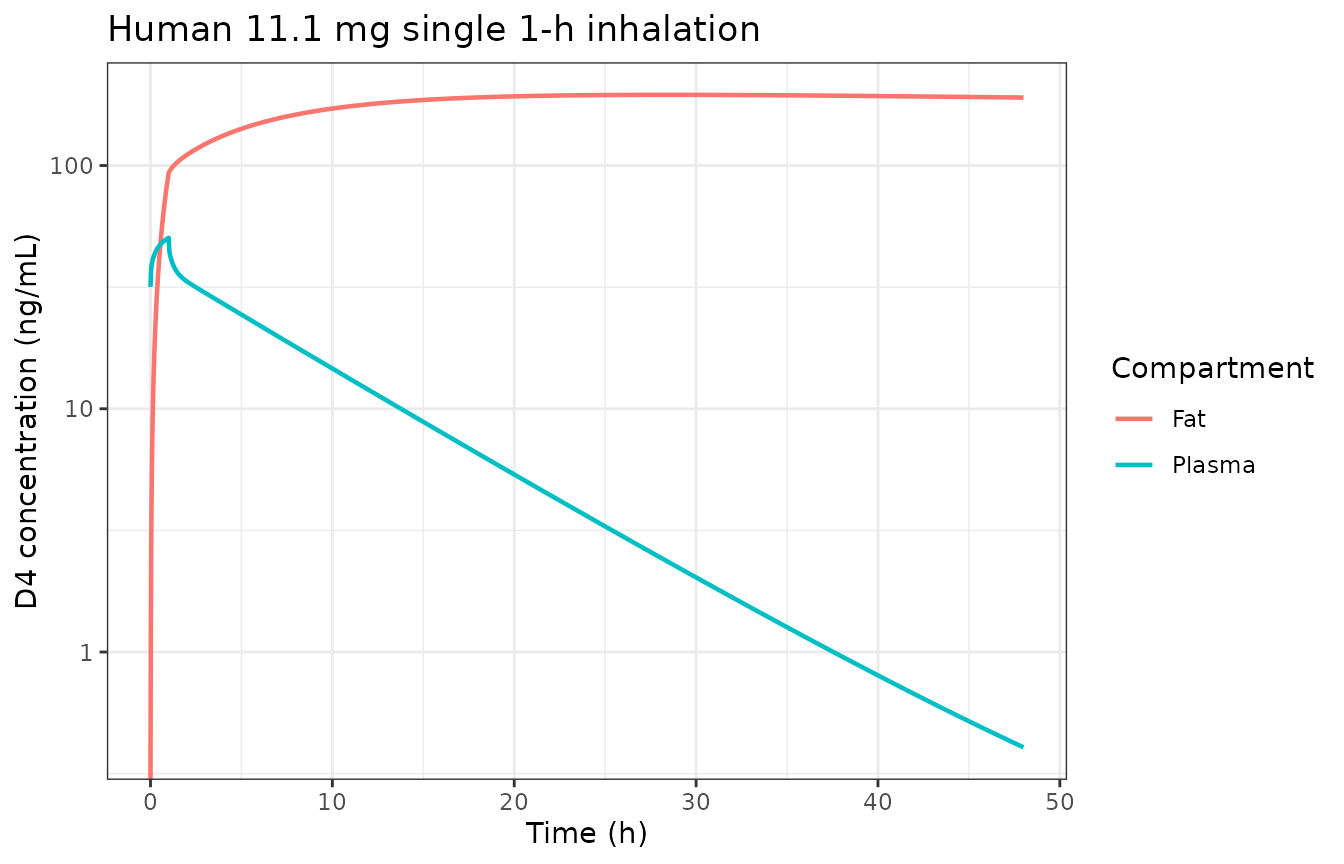
Replicates Figure 6 of Luu 2001: predicted D4 plasma and fat after a single 11.1 mg 1-h inhalation exposure in humans.
conc_hum <- hum_sim |> dplyr::filter(!is.na(Cc)) |> transmute(id = 1L, time, conc = Cc)
dose_hum <- data.frame(id = 1L, time = 0, dose = 11100)
h_conc <- PKNCAconc(conc_hum, conc ~ time | id)
h_dose <- PKNCAdose(dose_hum, dose ~ time | id)
res_hum <- pk.nca(PKNCAdata(h_conc, h_dose, intervals = intervals))
nca_hum <- as.data.frame(res_hum$result)

hum_cmp <- tibble::tibble(
  Parameter = c("Cmax (ng/mL)", "tmax (h)", "AUClast (ng*h/mL)",
                "AUCinf (ng*h/mL)", "terminal t1/2 (h)"),
  Simulated = c(
    nca_hum$PPORRES[nca_hum$PPTESTCD == "cmax"],
    nca_hum$PPORRES[nca_hum$PPTESTCD == "tmax"],
    nca_hum$PPORRES[nca_hum$PPTESTCD == "auclast"],
    nca_hum$PPORRES[nca_hum$PPTESTCD == "aucinf.obs"],
    nca_hum$PPORRES[nca_hum$PPTESTCD == "half.life"]),
  Published = c(69.4, 1, 453.4, NA, 7.4))
knitr::kable(hum_cmp, digits = 2,
caption = "Human 11.1 mg inhalation: simulated NCA vs Luu 2001 Table 7.")| Parameter | Simulated | Published |
|---|---|---|
| Cmax (ng/mL) | 50.45 | 69.4 |
| tmax (h) | 1.00 | 1.0 |
| AUClast (ng*h/mL) | 408.54 | 453.4 |
| AUCinf (ng*h/mL) | 413.40 | NA |
| terminal t1/2 (h) | 8.30 | 7.4 |
Assumptions and deviations / Errata
-
Observation = total blood D4. The experimental
readout is
14C radioactivity, i.e. total D4 in blood. The model reportsCc = (Cai*Vblood + Cwk*Vweak + Cstr*Vstrong) / Vblood, the sum of the dissolved and protein-bound pools. Reporting only the dissolvedCaistate underpredicts the measured concentration several-fold. -
Flow units. Table 2 lists blood flows in mL/min,
whereas the Appendix rate constants are per hour; the flows are
converted to mL/h (x 60) in
model(). The internal checkQr + Qf + Ql + Qgi + Qk = Qtholds exactly (rat 116.7, human 5200 mL/min), which fixes the tabulated fat flow / volume as the weakly-bound-fatQf1/Vf1, with the deep compartment defined by the Table 3 ratios (Qf2 = 0.059 Qf1,Vf2 = 0.73 Vf1). -
Three printed-equation typographical corrections
(each commented in the model file): the Appendix deep-fat equation is
printed as a self-cancelling
Qf2*Cf2/Df2 - Qf2*Cf2/Df2; mass balance with theCf1equation requires the inflowQf2*Cf1/Df1. The liver venous term is printedQl*Cl/Dr; the liver:blood coefficient isDl. The GI arterial term is printedQl*Clung*Hair; the GI flow isQgi. -
IV duration
tinj. The injection duration is not stated. The reportedtmax = 0implies a near-bolus;tinj = 0.1h is used and affects only the first few minutes. -
Human inhalation input. The paper reduces the 1-h,
rest/exercise, capture-efficiency exposure to a stated net absorbed dose
of 11.1 mg. The human model delivers this amount to the lung over
tinjrather than re-deriving the alveolar gas-exchange kinetics; the five period-specific ventilation forcing functions of the Appendix are not reproduced. -
Excretion mass balance not reproduced. The core
ODEs eliminate parent D4 only by hepatic metabolism (into
Mmet); they contain no exhalation or renal/faecal excretion of parent. The percentage-of-dose excretion splits of Table 4 (rat) and Table 6 (human) - exhaled 42-59%, urine, faeces - come from the paper’s separate metabolite / exhalation accounting and are not a validation target here. The model reproduces the plasma and fat concentration kinetics and the plasma NCA of Tables 5 and 7. -
Repeated-dose and breast-implant scenarios. The
single injection / inhalation window is implemented. The 14-day repeated
IV (rat), 7-day repeated inhalation (human) and first-order
breast-implant desorption (
kba D0 exp(-kba t)) scenarios are not wired into the event handling here; thekbadesorption constant is not tabulated. -
Deterministic model. No IIV or residual-error model
is reported. The
propSdentry is a fixed placeholder and carries no information from the paper. -
Species. The rat model carries full weak + strong
plasma protein binding; the human model has no strong-binding pool
(Table 3
Vstrong = 0), so theCstrstate is dropped - a genuine structural difference, hence the two separate files.