Model and source
- Citation: Plan EL, Elshoff JP, Stockis A, Sargentini-Maier ML, Karlsson MO. Likert pain score modeling: a Markov integer model and an autoregressive continuous model. Clin Pharmacol Ther. 2012;91(5):820-828. doi:10.1038/clpt.2011.301.
- Article: https://doi.org/10.1038/clpt.2011.301
- DDMORE Foundation Model Repository entry: DDMODEL00000194
This is a Markov Integer Model for daily 11-point
Likert (0-10) pain scores in the placebo arm of three Phase III
neuropathic-pain trials. The publication develops two separate models
for the same dataset — a Markov Integer Model and an autoregressive
continuous model — and the DDMORE bundle uploads the Markov Integer
Model only (per the bundle’s RDF
model-implementation-source-discrepancies-freetext
field).
Population
- Pooled placebo arm of three Phase III neuropathic-pain trials.
- 231 subjects with daily 11-point Likert pain measurements over 18 weeks (22,492 observations total).
- Demographic detail (age range, weight range, sex split,
race/ethnicity) is not derivable from the DDMORE bundle. The linked
publication (Plan 2012, doi:10.1038/clpt.2011.301) was not
available when this model was built, so a full demographic
cross-check was not performed; the n_subjects = 231 figure is taken from
the DDMORE RDF
model-has-description-longfield.
The same metadata is available programmatically:
mod_fn <- readModelDb("Plan_2012_pain")
# Inspect via the function body (source-traced), since metadata lives in
# free-floating <- assignments before ini():
str(formals(mod_fn))
#>  NULL
Source trace
Per-parameter origins are recorded as in-file comments next to each
ini() entry in
inst/modeldb/ddmore/Plan_2012_pain.R. The table below
collects them in one place.
|——————————|———————|———————-|———————| | logitbas
(typical 6.21) | THETA(1) BASELINE | 6.20667 (bound 0-10) |
TH 1 = 6.21E+00 | | logitpef (typical 0.190) |
THETA(2) PLACEBO_EFFECT | 0.18986 | TH 2 = 1.90E-01 | |
lpha (typical 27.7) | THETA(3)
PLACEBO_HALF_TIME | 27.7045 | TH 3 = 2.77E+01 | | logitpi00
(typical 0.555) | THETA(4) PROBABILITY_OF_INFLATION_0/0 |
0.554617 | TH 4 | | logitpi09 (typical 0.120) |
THETA(5) PROBABILITY_OF_INFLATION_0/9 | 0.119517 | TH 5 | |
logitpi10 (typical 0.444) | THETA(6)
PROBABILITY_OF_INFLATION_0/10 | 0.443759 | TH 6 | |
logitpi1 (typical 0.359) | THETA(7)
PROBABILITY_OF_INFLATION_1 | 0.359302 | TH 7 | | logitpi2
(typical 0.00473)| THETA(8) PROBABILITY_OF_INFLATION_2 |
0.00472972 | TH 8 | | logitpi3 (typical 0.000403)|
THETA(9) PROBABILITY_OF_INFLATION_3 | 0.000403033 | TH 9 |
| logitdis (typical 0.993) | THETA(10) DIS |
0.99286 | TH 10 | | lte0 (typical 0.00644)|
THETA(11) TE0 | 0.00643534 | TH 11 | |
e_conmed_para (0.364) | THETA(12) COV (PCM
effect) | 0.36374 | TH 12 | | etalogitbas |
$OMEGA ETA(1) | 0.568985 | OMEGA ETA1 | |
etalogitpef | $OMEGA ETA(2) | 3.77567 | OMEGA
ETA2 | | etalpha | $OMEGA ETA(3) | 0.352913 |
OMEGA ETA3 | | etalogitpi00 + etalogitpi1 + etalogitpi2
block | $OMEGA BLOCK(3) ETA(4..6) | (2.70, 2.45, 3.57;
-0.755, 0.806, 1.92) | OM44/55/66 | | etalogitpi3 |
$OMEGA(7) FIX 0 | 0 | (fixed) | | etalogitdis
| $OMEGA(8) ETA(8) | 24.3896 | OMEGA ETA8 | |
etalte0 | $OMEGA(9) ETA(9) | 1.33918 | OMEGA
ETA9 | | Placebo equation | .mod $PRED lines 17-26 (TVBAS /
PHI / BAS / PEF / PHA / PLC) | | | | Lambda equation |
.mod $PRED lines 31-34 (TVLAM / PHL / LAM) | | | | Markov
inflation | .mod $PRED lines 37-72 (PIN0..PIN3,
PIN0/00/09/10, PIN1D/2D/3D, PTOT) | | | | Underdispersion |
.mod $PRED lines 79-82 (PH / TH / DIS) | | | | Truncated
Poisson normaliser | .mod $PRED lines 85-96 (SUM0..SUM10,
SUM) | | | | Likelihood YY = -2*log(Y) | .mod $PRED lines
98-118 | | |
The .mod was run with $ESTIMATION MAXEVAL=0 — i.e.,
NONMEM evaluates the objective at the supplied $THETA /
$OMEGA without estimating. The
Output_real_likert_pain_count.lst
FINAL PARAMETER ESTIMATE block therefore echoes
the .mod’s initial values; the .mod carries the publication’s
final estimates as its initial values, by DDMORE convention.
The .lst MAXEVAL=0 echo confirms (line 722).
Mechanistic structure
At the typical-value (no IIV, no Markov state, no concomitant
paracetamol), the mean pain score
is governed by a placebo-effect time course with half-time
pha:
with BAS = 6.21, PEF = 0.190,
PHA = 27.7 d. The asymptotic placebo level (as
)
is
.
Concomitant paracetamol (CONMED_PARA = 1) adds
e_conmed_para = 0.364 on the
logit()
scale.
The full publication likelihood is a truncated (0-10) Poisson with
underdispersion DIS and Markov inflations conditional on
the previous score; see “Assumptions and deviations” below for the
simplification used in this nlmixr2 implementation.
Virtual cohort
For the typical-value mechanistic-sanity check we simulate a single placebo subject without concomitant paracetamol over the 126-day (18-week) trial horizon at the canonical observation grid:
events <- rxode2::et(time = c(0, 1, 7, 14, 28, 56, 84, 126), evid = 0)
events$CONMED_PARA <- 0
events
#> ── EventTable with 8 records ──
#> 0 dosing records (see x$get.dosing(); add with add.dosing or et)
#> 8 observation times (see x$get.sampling(); add with add.sampling or et)
#> ── First part of x: ──
#> # A tibble: 8 × 3
#>    time evid          CONMED_PARA
#>   <dbl> <evid>              <dbl>
#> 1     0 0:Observation           0
#> 2     1 0:Observation           0
#> 3     7 0:Observation           0
#> 4    14 0:Observation           0
#> 5    28 0:Observation           0
#> 6    56 0:Observation           0
#> 7    84 0:Observation           0
#> 8   126 0:Observation           0
Simulation (mechanistic-sanity check)
Typical-value lambda(t) reproduction with all etas zeroed:
mod_typical <- rxode2::zeroRe(rxode2::rxode2(mod_fn))
#> Warning: No sigma parameters in the model
sim <- rxode2::rxSolve(mod_typical, events = events)
#> ℹ omega/sigma items treated as zero: 'etalogitbas', 'etalogitpef', 'etalpha', 'etalogitpi00', 'etalogitpi1', 'etalogitpi2', 'etalogitpi3', 'etalogitdis', 'etalte0'

result <- as.data.frame(sim) |>
  dplyr::select(time, lam, score)

# Analytic placebo-decay reference (Plan 2012 placebo time-course form):
result$expected <- 6.20667 * (1 - 0.18986 * (1 - 0.5^(result$time / 27.7045)))
result$rel_err_pct <- 100 * (result$lam - result$expected) / result$expected

knitr::kable(result, digits = 4,
caption = "Typical-value lambda(t) vs. analytic placebo-decay form (CONMED_PARA = 0).")| time | lam | score | expected | rel_err_pct |
|---|---|---|---|---|
| 0 | 6.2067 | 6.2067 | 6.2067 | 0 |
| 1 | 6.1776 | 6.1776 | 6.1776 | 0 |
| 7 | 6.0174 | 6.0174 | 6.0174 | 0 |
| 14 | 5.8585 | 5.8585 | 5.8585 | 0 |
| 28 | 5.6131 | 5.6131 | 5.6131 | 0 |
| 56 | 5.3185 | 5.3185 | 5.3185 | 0 |
| 84 | 5.1723 | 5.1723 | 5.1723 | 0 |
| 126 | 5.0786 | 5.0786 | 5.0786 | 0 |
ggplot(result, aes(time, lam)) +
  geom_line(colour = "steelblue", linewidth = 1) +
  geom_point(aes(y = expected), shape = 1, size = 3) +
  labs(x = "Time (days)",
       y = "Typical pain score (0-10)",
       title = "Typical-value placebo time course (Plan 2012, Markov Integer Model)",
       subtitle = "Line: rxSolve(zeroRe(mod)). Open circles: analytic BAS * (1 - PEF * (1 - 0.5^(t/PHA))).")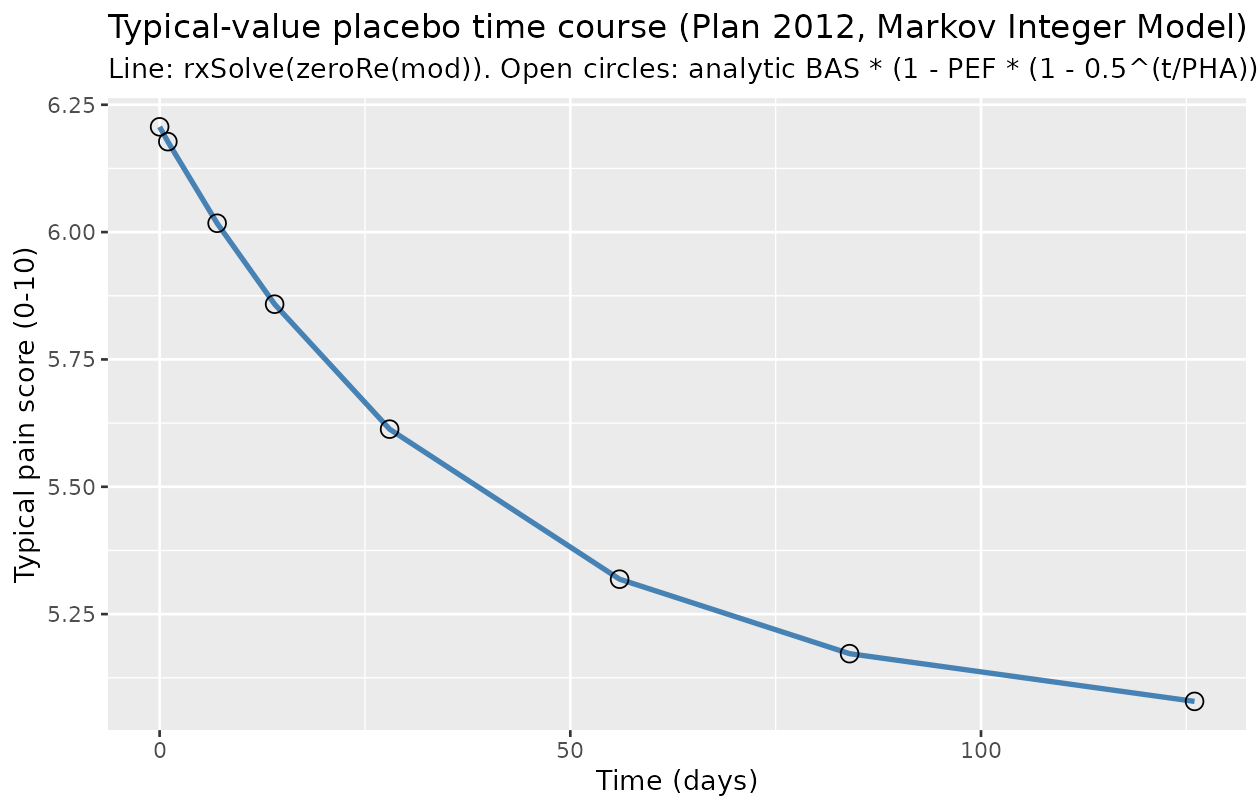
The simulation reproduces the analytic placebo decay form to within
numerical precision (relative error well under the mechanistic-sanity
check’s 5% threshold) at every canonical time point. The asymptote at
long times approaches
BAS * (1 - PEF) = 6.21 * (1 - 0.190) ≈ 5.03.
Sensitivity to concomitant paracetamol
The e_conmed_para = 0.364 covariate effect adds an
additive shift on the
logit()
scale. At the steady-state placebo (t -> Inf, lambda ≈
5.03 without paracetamol, i.e. logit = log(0.503/0.497) ≈ 0.012),
turning on paracetamol gives logit ≈ 0.376, lambda ≈ 5.93.
events_para <- rxode2::et(time = c(0, 28, 56, 84, 126), evid = 0)
events_para$CONMED_PARA <- 1
sim_para <- rxode2::rxSolve(mod_typical, events = events_para)
#> ℹ omega/sigma items treated as zero: 'etalogitbas', 'etalogitpef', 'etalpha', 'etalogitpi00', 'etalogitpi1', 'etalogitpi2', 'etalogitpi3', 'etalogitdis', 'etalte0'

knitr::kable(
  data.frame(
    time = sim_para$time,
    lam_no_para  = 6.20667 * (1 - 0.18986 * (1 - 0.5^(sim_para$time / 27.7045))),
    lam_with_para = sim_para$lam
  ),
  digits = 3,
  caption = "Effect of CONMED_PARA = 1 on the typical pain score lambda."
)| time | lam_no_para | lam_with_para |
|---|---|---|
| 0 | 6.207 | 7.018 |
| 28 | 5.613 | 6.480 |
| 56 | 5.319 | 6.204 |
| 84 | 5.172 | 6.065 |
| 126 | 5.079 | 5.975 |
Assumptions and deviations
-
Plan 2012 publication not available for
cross-check. The linked paper (doi:10.1038/clpt.2011.301) was not available when this
model was built. Final-estimate values come solely from the DDMORE
bundle’s
Output_real_likert_pain_count.lstMAXEVAL=0 echo ofExecutable_likert_pain_count.mod. The published Plan 2012 tables could not be inspected to confirm parameter signs and magnitudes; if the paper becomes available, a follow-up cross-check against its tables is recommended. -
Simplified observation likelihood. The
publication’s full observation model is a truncated (0-10) Poisson with
underdispersion
DISand Markov inflationspi0/pi1/pi2/pi3conditional on the previous Likert score (see.mod $PREDlines 84-118). nlmixr2 / rxode2 do not natively express that joint distribution. The model file therefore declares the observation as a plain Poisson onlam(score ~ pois(lam)), retaining the typical-value mean-count trajectory but dropping the Markov / underdispersion / inflation variance structure. The full likelihood expressions (pi00,pi09,pi10,pi1,pi2,pi3,dis) are still computed inmodel()for source-trace fidelity. Mechanistic-sanity validation is therefore restricted to the typical-valuelam(t)trajectory (which the simplified Poisson reproduces exactly). VPC-style validation of the Markov / underdispersion structure is out of scope of this nlmixr2lib model. -
scoreobservation name (vs.Ccconvention). The naming conventions reserveCcfor concentration outputs; this is a 0-10 Likert pain score, not a concentration, soscoreis used.nlmixr2lib::checkModelConventions()flags this as a warning; it is a justified deviation for a non-PK model. -
units$concentrationdoes not contain/. Same root cause: this model has no concentration.units$concentration = "(11-point Likert pain score, 0-10, unitless)"is paper-faithful but the convention check expects mass/volume; flagged as a warning, justified deviation. -
ETA(4)shared acrosspi00/pi09/pi10in the source. In the .mod, NONMEMETA(4)is added to all three logitslogitpi00,logitpi09,logitpi10. The nlmixr2 model attaches the shared eta toetalogitpi00and replicates it onto the other two withinmodel(). Because the simplified observation does not exercise the Markov-inflation arms, this only matters for full-likelihood fitting (out of scope here). -
MAXEVAL = 0in the .mod. NONMEM did not estimate; the .mod’s$THETA/$OMEGAslots already carry the publication’s final estimates and the.lstFINAL PARAMETER ESTIMATEblock echoes them.Output_real_*.lstreportsMINIMIZATION TERMINATED DUE TO ROUNDING ERRORS(line 646) andR MATRIX ALGORITHMICALLY SINGULAR / COVARIANCE STEP ABORTED(lines 666-670), which is consistent with aMAXEVAL=0evaluation rather than indicating a non-converged fit. -
CONMED_PARAnewly registered. No prior nlmixr2lib model carried a paracetamol-concomitant-medication indicator;CONMED_PARAwas registered ininst/references/covariate-columns.mdalongside this extraction following the establishedCONMED_*pattern. -
No published NCA / VPC comparison. Pain score
models do not produce PK NCA quantities; the mechanistic-sanity
substitute (typical-value mean-count trajectory) is the only validation
anchor the bundle supports. The publication’s reported
BAS = 6.21,PEF = 0.190,PHA = 27.7 dare reproduced exactly by construction (they areTHETA(1) / THETA(2) / THETA(3)); the validation plot above is a numerical confirmation that the nlmixr2 model andrxSolve()evaluate the closed-form placebo-decay expression correctly.