Isoniazid, linezolid and levofloxacin with clofazimine (Kengo 2024)
Source:vignettes/articles/Kengo_2024_clofazimine_ddi.Rmd
Kengo_2024_clofazimine_ddi.RmdModel and source
Kengo 2024 asked whether adding clofazimine to a drug-resistant tuberculosis regimen changes the pharmacokinetics of four co-administered drugs. Clofazimine was withheld for the first two weeks of treatment, and pharmacokinetic sampling was done on day 14 (visit 1, no clofazimine) and again 21 days after clofazimine was started (visit 2). The paper developed three new population PK models, each packaged here as its own model file:
-
Kengo_2024_isoniazid– two-compartment model with well-stirred hepatic first-pass extraction and NAT2-phenotype-dependent intrinsic clearance; no clofazimine effect. -
Kengo_2024_linezolid– one-compartment model with transit absorption; no clofazimine effect. -
Kengo_2024_levofloxacin– one-compartment model with transit absorption, a creatinine-clearance effect on clearance and a 14.8% lower clearance with clofazimine.
The other two drugs were described with previously published models and are not packaged from this paper. Clofazimine concentrations were predicted by the three-compartment model of Abdelwahab et al. 2020 (doi:10.1093/jac/dkaa310) without re-estimating any parameter. Cycloserine (dosed as terizidone, six participants) used the model of Chirehwa et al. 2020 (doi:10.1128/AAC.01381-20); the paper re-estimated its total clearance, but the change was not significant (dOFV -2.16) and the re-estimated value is not reported, so the cycloserine model is Chirehwa’s unchanged.
mod_inh <- readModelDb("Kengo_2024_isoniazid")
mod_lzd <- readModelDb("Kengo_2024_linezolid")
mod_lfx <- readModelDb("Kengo_2024_levofloxacin")
ui_inh <- rxode2::rxode2(mod_inh)
#> ℹ parameter labels from comments will be replaced by 'label()'
#> Warning: some etas defaulted to non-mu referenced, possible parsing error: etabvv_clint_1, etabvv_clint_2, etaiov_ka_1, etaiov_ka_2, etaiov_ka_3, etaiov_ka_4, etaiov_mtt_1, etaiov_mtt_2, etaiov_mtt_3, etaiov_mtt_4, etaiov_fdepot_1, etaiov_fdepot_2, etaiov_fdepot_3, etaiov_fdepot_4
#> as a work-around try putting the mu-referenced expression on a simple line
ui_lzd <- rxode2::rxode2(mod_lzd)
#> ℹ parameter labels from comments will be replaced by 'label()'
#> Warning: some etas defaulted to non-mu referenced, possible parsing error: etabvv_cl_1, etabvv_cl_2, etaiov_ka_1, etaiov_ka_2, etaiov_ka_3, etaiov_ka_4, etaiov_mtt_1, etaiov_mtt_2, etaiov_mtt_3, etaiov_mtt_4, etaiov_fdepot_1, etaiov_fdepot_2, etaiov_fdepot_3, etaiov_fdepot_4
#> as a work-around try putting the mu-referenced expression on a simple line
ui_lfx <- rxode2::rxode2(mod_lfx)
#> ℹ parameter labels from comments will be replaced by 'label()'
#> Warning: some etas defaulted to non-mu referenced, possible parsing error: etabvv_cl_1, etabvv_cl_2, etaiov_ka_1, etaiov_ka_2, etaiov_ka_3, etaiov_ka_4, etaiov_mtt_1, etaiov_mtt_2, etaiov_mtt_3, etaiov_mtt_4, etaiov_fdepot_1, etaiov_fdepot_2, etaiov_fdepot_3, etaiov_fdepot_4
#> as a work-around try putting the mu-referenced expression on a simple line- Citation: Kengo A, Nabeemeeah F, Denti P, Sabet R, Okyere-Manu G, Abraham P, Weisner L, Mosala MH, Tshabalala S, Scholefield J, Resendiz-Galvan JE, Martinson NA, Variava E, Leggett JE. Assessing potential drug-drug interactions between clofazimine and other frequently used agents to treat drug-resistant tuberculosis. Antimicrob Agents Chemother. 2024;68(5):e01583-23. doi:10.1128/aac.01583-23
- Article: https://doi.org/10.1128/aac.01583-23
- Description (isoniazid): Two-compartment population PK model for oral high-dose isoniazid in South African adults with drug-resistant tuberculosis, with first-pass extraction through a well-stirred liver (Kengo 2024; n = 27, PK sampled before and 3 weeks after clofazimine was added to the regimen). Absorption is a Savic transit chain (MTT 0.122 h, 2.32 transit compartments) feeding a first-order depot (ka 3.28 1/h), all three fixed to literature values. Intrinsic clearance depends on the NAT2 acetylator phenotype (12.2, 24.9 and 46.7 L/h for slow, intermediate and rapid acetylators); hepatic plasma flow (72.4 L/h) and the unbound fraction (0.95) are fixed. All clearance and volume parameters are scaled allometrically by fat-free mass (reference 42 kg, exponents 0.75 and 1). Clofazimine co-administration had no effect on isoniazid PK. Random effects are between-subject and between-visit variability on intrinsic clearance and between-occasion variability on ka, MTT and pre-hepatic bioavailability.
- Description (linezolid): One-compartment population PK model for oral linezolid in South African adults with drug-resistant tuberculosis (Kengo 2024; n = 21, PK sampled before and 3 weeks after clofazimine was added to the regimen). Absorption is a Savic transit chain (MTT 0.928 h, 12.6 transit compartments) feeding a first-order depot (ka 1.14 1/h); elimination is first order (CL 3.04 L/h, V 38.7 L). Clearance and volume are scaled allometrically by fat-free mass (reference 42 kg, exponents 0.75 and 1). Clofazimine co-administration had no effect on linezolid PK. Random effects are between-subject and between-visit variability on CL and between-occasion variability on ka, MTT and F, the latter inflated 1.60-fold for occasions whose dose was not observed.
- Description (levofloxacin): One-compartment population PK model for oral levofloxacin in South African adults with drug-resistant tuberculosis, with a clofazimine drug-drug interaction on clearance (Kengo 2024; n = 21, PK sampled before and 3 weeks after clofazimine was added to the regimen). Absorption is a Savic transit chain (MTT 1.32 h, 15.7 transit compartments) feeding a first-order depot (ka 2.05 1/h); elimination is first order (CL 6.81 L/h, V 98.5 L). Clearance and volume are scaled allometrically by fat-free mass (reference 42 kg, exponents 0.75 and 1). Clearance rises 4.70% per 10 mL/min of Cockcroft-Gault creatinine clearance above the 81.8 mL/min median and is 14.8% lower when clofazimine is co-administered. Random effects are between-subject and between-visit variability on CL and between-occasion variability on ka, MTT and F, the latter inflated 1.99-fold for occasions whose dose was not observed.
Population
The cohort was 27 newly diagnosed adults with pulmonary drug-resistant tuberculosis at Klerksdorp/Tshepong Hospital, North-West Province, South Africa (Kengo 2024 Table 1). 19 (70%) were men and 23 (85%) were living with HIV; median age was 39 years and median weight 52 kg. All 27 contributed isoniazid data (high-dose isoniazid 450 or 600 mg daily, median 10.0 mg/kg; 5 slow, 13 intermediate and 9 rapid NAT2 acetylators), and 21 contributed linezolid (600 mg daily) and levofloxacin (750 or 1000 mg daily) data. In the linezolid / levofloxacin subset, median fat-free mass was 41.5 kg (range 26.0-51.6) and median Cockcroft-Gault creatinine clearance 81.8 mL/min (range 50.5-136). Treatment was given under direct observation with a meal. Samples were drawn pre-dose and 2, 4, 6, 8 and 10 h after the observed dose at each visit.
The same information is available programmatically via each model’s
population metadata, for example
readModelDb("Kengo_2024_levofloxacin")()$population.
Source trace
Every ini() value carries an in-file comment pointing to
Kengo 2024 Table 2. The tables below collect them. All typical values
refer to a participant with fat-free mass (FFM) 42 kg (Table 2 footnote
a). Table 2 footnote g defines the reported variability as %CV =
sqrt(omega^2) * 100, so each variance is (%CV / 100)^2.
Isoniazid
| Parameter | Value | Source location |
|---|---|---|
lclint_slow, lclint_int,
lclint_rapid
|
log(12.2), log(24.9),
log(46.7) L/h |
Table 2 intrinsic clearance by acetylator status; Results paragraph 3 |
lvc |
log(57.0) L |
Table 2 central volume |
lq |
log(1.70) L/h |
Table 2 inter-compartmental clearance |
lvp |
log(42.4) L |
Table 2 peripheral volume |
lka, lmtt, lntr
|
fixed(log(3.28)) 1/h, fixed(log(0.122)) h,
fixed(log(2.32))
|
Table 2, fixed to literature values (footnote e) |
lfdepot |
fixed(log(1)) |
Table 2, pre-hepatic bioavailability fixed (footnotes b, d) |
lqh |
fixed(log(72.4)) L/h |
Table 2 hepatic flow at FFM 42 kg (footnote f) |
fu |
fixed(0.95) |
Table 2 unbound fraction 95% (footnote f) |
e_ffm_cl, e_ffm_vc
|
fixed(0.75), fixed(1)
|
Methods, “Pharmacokinetic modeling” |
etalclint |
0.026244 | Table 2 BSV in clearance 16.2% |
etabvv_clint_1/_2 |
0.033856 | Table 2 BVV in clearance 18.4% |
etaiov_ka_1.._4 |
0.889249 | Table 2 BOV in ka 94.3% |
etaiov_mtt_1.._4 |
1.6641 | Table 2 BOV in MTT 129% |
etaiov_fdepot_1.._4 |
0.225625 | Table 2 BOV in F 47.5% |
propSd |
0.244 | Table 2 proportional error 24.4% |
addSd |
fixed(0.021) mg/L |
Table 2, 20% of the 0.105 mg/L LLOQ (fixed) |
Well-stirred liver: eh = fu*clint/(fu*clint + qh),
fh = 1 - eh, systemic CL = qh*eh
|
– | Results paragraph 3; Methods (well-stirred liver model, Pang and Rowland 1977) |
Savic transit chain, ktr = (ntr + 1)/mtt
|
– | Methods (Savic 2007 transit model) |
Linezolid
| Parameter | Value | Source location |
|---|---|---|
lcl |
log(3.04) L/h |
Table 2 clearance; Results paragraph 4 |
lvc |
log(38.7) L |
Table 2 volume |
lka, lmtt, lntr
|
log(1.14) 1/h, log(0.928) h,
log(12.6)
|
Table 2 |
lfdepot |
fixed(log(1)) |
Table 2 (footnote b) |
etalcl |
0.099856 | Table 2 BSV in clearance 31.6% |
etabvv_cl_1/_2 |
0.110889 | Table 2 BVV in clearance 33.3% |
etaiov_ka_2/_4, etaiov_mtt_2/_4,
etaiov_fdepot_2/_4
|
1.0816, 0.544644, 0.015376 | Table 2 BOV in ka 104%, MTT 73.8%, F 12.4% |
etaiov_*_1/_3 |
the above times 1.60^2 | Table 2 scaling factor on BOV for unobserved dose 1.60 (footnote h) |
propSd, addSd
|
0.0731, 0.284 mg/L | Table 2 |
Levofloxacin
| Parameter | Value | Source location |
|---|---|---|
lcl |
log(6.81) L/h |
Table 2 clearance; Results paragraph 5 |
lvc |
log(98.5) L |
Table 2 volume |
lka, lmtt, lntr
|
log(2.05) 1/h, log(1.32) h,
log(15.7)
|
Table 2 |
lfdepot |
fixed(log(1)) |
Table 2 (footnote b) |
e_crcl_cl |
0.00470 per mL/min | Table 2 effect of CLCR, +4.70% per +10 mL/min; Results paragraph 5 (“from the median”) |
e_conmed_clofazimine_cl |
-0.148 | Table 2 effect of clofazimine on clearance, -14.8% |
etalcl |
0.033489 | Table 2 BSV in clearance 18.3% |
etabvv_cl_1/_2 |
0.0289 | Table 2 BVV in clearance 17.0% |
etaiov_ka_2/_4, etaiov_mtt_2/_4,
etaiov_fdepot_2/_4
|
1.3924, 0.197136, 0.046225 | Table 2 BOV in ka 118%, MTT 44.4%, F 21.5% |
etaiov_*_1/_3 |
the above times 1.99^2 | Table 2 scaling factor on BOV for unobserved dose 1.99 (footnote h) |
propSd, addSd
|
0.0497, 0.238 mg/L | Table 2 |
# Each estimated variance reproduces its Table 2 %CV as sqrt(omega^2) * 100.
omega_tab <- function(ui) {
  d <- ui$iniDf
  d <- d[!is.na(d$neta1) & d$neta1 == d$neta2 & !d$fix, ]
  setNames(sqrt(d$est) * 100, d$name)
}
printed <- list(
  inh = c(etalclint = 16.2, etabvv_clint_1 = 18.4, etaiov_ka_1 = 94.3, etaiov_mtt_1 = 129, etaiov_fdepot_1 = 47.5),
  lzd = c(etalcl = 31.6, etabvv_cl_1 = 33.3, etaiov_ka_2 = 104, etaiov_mtt_2 = 73.8, etaiov_fdepot_2 = 12.4),
  lfx = c(etalcl = 18.3, etabvv_cl_1 = 17.0, etaiov_ka_2 = 118, etaiov_mtt_2 = 44.4, etaiov_fdepot_2 = 21.5)
)
got <- list(inh = omega_tab(ui_inh), lzd = omega_tab(ui_lzd), lfx = omega_tab(ui_lfx))
for (d in names(printed)) {
  stopifnot(setequal(names(got[[d]]), names(printed[[d]])))
  stopifnot(all(abs(got[[d]][names(printed[[d]])] - printed[[d]]) < 1e-6))
}

# The inflated (unobserved-dose) slots are the estimated variance times the
# squared Table 2 scaling factor.
infl <- function(ui, factor) {
  d <- ui$iniDf
  v <- setNames(d$est, d$name)
  c(
    ka = v[["etaiov_ka_1"]] / v[["etaiov_ka_2"]],
    mtt = v[["etaiov_mtt_1"]] / v[["etaiov_mtt_2"]],
    f = v[["etaiov_fdepot_1"]] / v[["etaiov_fdepot_2"]]
  ) / factor^2
}
# Tolerance 1e-4: the inflated variances are stored to 6-7 significant figures.
stopifnot(all(abs(infl(ui_lzd, 1.60) - 1) < 1e-4), all(abs(infl(ui_lfx, 1.99) - 1) < 1e-4))
Structural checks
These checks use typical values only (omega = NA), so
they are deterministic and are asserted tightly.
# One dose on an observed occasion (OCC = 2) for a typical 42 kg-FFM
# participant, followed long enough for the terminal phase to vanish.
sd_events <- function(dose, tend, extra = list()) {
  tt <- sort(unique(c(seq(0, 24, by = 0.01), seq(24, tend, by = 0.5))))
  ev <- data.frame(
    id = 1L, time = c(0, tt), amt = c(dose, rep(0, length(tt))),
    evid = c(1L, rep(0L, length(tt))), cmt = "depot",
    FFM = 42, OCC = 2L
  )
  for (nm in names(extra)) ev[[nm]] <- extra[[nm]]
  ev
}
trap_auc <- function(t, y) sum(diff(t) * (head(y, -1) + tail(y, -1)) / 2)

solve_det <- function(mod, ev) {
  rxode2::rxSolve(mod, ev, omega = NA, returnType = "data.frame",
                  rtol = 1e-10, atol = 1e-12, maxsteps = 1e6)
}

sd_lzd <- solve_det(mod_lzd, sd_events(600, 400))
#> ℹ parameter labels from comments will be replaced by 'label()'
#> Warning: some etas defaulted to non-mu referenced, possible parsing error: etabvv_cl_1, etabvv_cl_2, etaiov_ka_1, etaiov_ka_2, etaiov_ka_3, etaiov_ka_4, etaiov_mtt_1, etaiov_mtt_2, etaiov_mtt_3, etaiov_mtt_4, etaiov_fdepot_1, etaiov_fdepot_2, etaiov_fdepot_3, etaiov_fdepot_4
#> as a work-around try putting the mu-referenced expression on a simple line
sd_lfx <- solve_det(mod_lfx, sd_events(1000, 600, list(CRCL = 81.8, CONMED_CLOFAZIMINE = 0)))
#> ℹ parameter labels from comments will be replaced by 'label()'
#> Warning: some etas defaulted to non-mu referenced, possible parsing error: etabvv_cl_1, etabvv_cl_2, etaiov_ka_1, etaiov_ka_2, etaiov_ka_3, etaiov_ka_4, etaiov_mtt_1, etaiov_mtt_2, etaiov_mtt_3, etaiov_mtt_4, etaiov_fdepot_1, etaiov_fdepot_2, etaiov_fdepot_3, etaiov_fdepot_4
#> as a work-around try putting the mu-referenced expression on a simple line
nat2 <- data.frame(phenotype = c("slow", "intermediate", "rapid"),
                   NAT2_SLOW = c(1, 0, 0), NAT2_RAPID = c(0, 0, 1),
                   clint = c(12.2, 24.9, 46.7))
sd_inh <- lapply(seq_len(nrow(nat2)), function(i) {
  solve_det(mod_inh, sd_events(600, 1200, list(NAT2_SLOW = nat2$NAT2_SLOW[i], NAT2_RAPID = nat2$NAT2_RAPID[i])))
})
#> ℹ parameter labels from comments will be replaced by 'label()'
#> Warning: some etas defaulted to non-mu referenced, possible parsing error: etabvv_clint_1, etabvv_clint_2, etaiov_ka_1, etaiov_ka_2, etaiov_ka_3, etaiov_ka_4, etaiov_mtt_1, etaiov_mtt_2, etaiov_mtt_3, etaiov_mtt_4, etaiov_fdepot_1, etaiov_fdepot_2, etaiov_fdepot_3, etaiov_fdepot_4
#> as a work-around try putting the mu-referenced expression on a simple line

# AUC(0-inf) * CL equals the bioavailable dose. For isoniazid the systemic
# clearance is qh * eh and the bioavailable dose is fh * dose; their ratio
# collapses to the oral-clearance identity AUC = dose / (fu * CLint).
mb <- data.frame(
  model = c("linezolid", "levofloxacin", paste("isoniazid,", nat2$phenotype)),
  auc = c(trap_auc(sd_lzd$time, sd_lzd$Cc), trap_auc(sd_lfx$time, sd_lfx$Cc),
          vapply(sd_inh, function(s) trap_auc(s$time, s$Cc), numeric(1))),
  expected = c(600 / 3.04, 1000 / 6.81, 600 / (0.95 * nat2$clint))
)
mb$pct_diff <- 100 * (mb$auc / mb$expected - 1)
knitr::kable(mb, digits = 3, caption = "Single-dose AUC(0-inf) against the closed-form value.")| model | auc | expected | pct_diff |
|---|---|---|---|
| linezolid | 197.373 | 197.368 | 0.002 |
| levofloxacin | 146.846 | 146.843 | 0.002 |
| isoniazid, slow | 51.769 | 51.769 | 0.001 |
| isoniazid, intermediate | 25.365 | 25.365 | 0.000 |
| isoniazid, rapid | 13.524 | 13.524 | 0.000 |
The isoniazid identity confirms that the liver extracts the oral dose
once on its way in (fraction fh survives) and clears
systemic drug at qh * eh. The apparent oral clearances
implied for a 42 kg-FFM participant are 11.6, 23.7, 44.4 L/h for slow,
intermediate and rapid acetylators, against a hepatic plasma flow of
72.4 L/h (first-pass extraction 14%, 25%, 38%).
# Levofloxacin covariate effects recovered from steady-state exposure. At
# steady state AUC(0-24) = F * dose / CL, so an AUC ratio is the inverse
# clearance ratio.
ss_events <- function(dose, extra) {
  doses <- data.frame(id = 1L, time = seq(0, 24 * 13, by = 24), amt = dose, evid = 1L, cmt = "depot")
  obs <- data.frame(id = 1L, time = 24 * 13 + seq(0, 24, by = 0.01), amt = 0, evid = 0L, cmt = "depot")
  ev <- rbind(doses, obs)
  ev$FFM <- 42
  ev$OCC <- 2L
  for (nm in names(extra)) ev[[nm]] <- extra[[nm]]
  ev[order(ev$time, -ev$evid), ]
}
auc_last_day <- function(extra) {
  s <- solve_det(mod_lfx, ss_events(1000, extra))
  trap_auc(s$time, s$Cc)
}
auc_ref <- auc_last_day(list(CRCL = 81.8, CONMED_CLOFAZIMINE = 0))
auc_cfz <- auc_last_day(list(CRCL = 81.8, CONMED_CLOFAZIMINE = 1))
auc_crcl <- auc_last_day(list(CRCL = 91.8, CONMED_CLOFAZIMINE = 0))
ratios <- data.frame(
  contrast = c("clofazimine vs none", "CLCR 91.8 vs 81.8 mL/min"),
  auc_ratio = c(auc_cfz / auc_ref, auc_crcl / auc_ref),
  expected = c(1 / (1 - 0.148), 1 / 1.047)
)
ratios$pct_diff <- 100 * (ratios$auc_ratio / ratios$expected - 1)
knitr::kable(ratios, digits = 4, caption = "Levofloxacin steady-state AUC ratios against the Table 2 effects.")| contrast | auc_ratio | expected | pct_diff |
|---|---|---|---|
| clofazimine vs none | 1.1737 | 1.1737 | 0 |
| CLCR 91.8 vs 81.8 mL/min | 0.9551 | 0.9551 | 0 |
A 14.8% lower clearance raises the steady-state AUC by 17.4%, the “19% increase” in levofloxacin AUC the paper reports (median 140 to 166 mg*h/L, a ratio of 1.186).
Virtual cohort
Covariates are drawn to match Table 1: sex (70% male in the isoniazid cohort, 62% in the linezolid / levofloxacin cohort), height, and weight log-normal around the cohort median and truncated to the observed range. Fat-free mass follows from sex, weight and height by the Janmahasatian equation. Creatinine clearance is log-normal around the 81.8 mL/min median, truncated to 50.5-136 mL/min. Doses follow the weight-band assumptions in the Assumptions section.
ffm_janmahasatian <- function(wt, ht, female) {
  ifelse(female == 1,
         37.99 * ht^2 * wt / (35.98 * ht^2 + wt),
         42.92 * ht^2 * wt / (30.93 * ht^2 + wt))
}
rtrunc_lnorm <- function(n, median, sdlog, lo, hi) {
  x <- rlnorm(n, log(median), sdlog)
  bad <- x < lo | x > hi
  while (any(bad)) {
    x[bad] <- rlnorm(sum(bad), log(median), sdlog)
    bad <- x < lo | x > hi
  }
  x
}
make_cohort <- function(n, male_frac, wt_median, wt_lo, wt_hi) {
  female <- rbinom(n, 1, 1 - male_frac)
  ht <- ifelse(female == 1, rnorm(n, 1.60, 0.06), rnorm(n, 1.70, 0.06))
  wt <- rtrunc_lnorm(n, wt_median, 0.15, wt_lo, wt_hi)
  data.frame(id = seq_len(n), female = female, HT = ht, WT = wt,
             FFM = ffm_janmahasatian(wt, ht, female))
}

set.seed(20240410)
n_per_arm <- 150
cohort_inh <- make_cohort(3 * n_per_arm, 0.70, 53, 37, 66)
cohort_inh$phenotype <- factor(rep(c("slow", "intermediate", "rapid"), each = n_per_arm),
                               levels = c("slow", "intermediate", "rapid"))
cohort_inh$NAT2_SLOW <- as.integer(cohort_inh$phenotype == "slow")
cohort_inh$NAT2_RAPID <- as.integer(cohort_inh$phenotype == "rapid")
cohort_inh$dose <- ifelse(cohort_inh$WT < 50, 450, 600)

cohort_lfx <- make_cohort(200, 0.62, 52, 37, 74)
cohort_lfx$CRCL <- rtrunc_lnorm(nrow(cohort_lfx), 81.8, 0.25, 50.5, 136)
cohort_lfx$dose <- ifelse(cohort_lfx$WT < 46, 750, 1000)
cohort_lzd <- cohort_lfx
cohort_lzd$dose <- 600

cohort_summary <- rbind(
  data.frame(cohort = "isoniazid", WT = median(cohort_inh$WT), FFM = median(cohort_inh$FFM),
             mg_per_kg = median(cohort_inh$dose / cohort_inh$WT)),
  data.frame(cohort = "linezolid", WT = median(cohort_lzd$WT), FFM = median(cohort_lzd$FFM),
             mg_per_kg = median(cohort_lzd$dose / cohort_lzd$WT)),
  data.frame(cohort = "levofloxacin", WT = median(cohort_lfx$WT), FFM = median(cohort_lfx$FFM),
             mg_per_kg = median(cohort_lfx$dose / cohort_lfx$WT))
)
knitr::kable(cohort_summary, digits = 1,
caption = "Simulated cohort medians (Table 1: FFM 44.2 / 41.5 / 41.5 kg; 10.0 / 11.5 / 19.1 mg/kg).")| cohort | WT | FFM | mg_per_kg |
|---|---|---|---|
| isoniazid | 52.1 | 42.8 | 10.3 |
| linezolid | 52.0 | 41.1 | 11.5 |
| levofloxacin | 52.0 | 41.1 | 18.3 |
Simulation
Each virtual participant takes the drug once daily for 14 days. Days 1-7 are visit 1 (no clofazimine) and days 8-14 visit 2 (clofazimine from day 8), so both visits reach steady state. As in the study, every dose before the sampling day is an unobserved occasion and the sampling-day dose is an observed occasion: OCC = 1 for days 1-6, 2 for day 7, 3 for days 8-13 and 4 for day 14. The pre-dose sample of each visit therefore belongs to the unobserved occasion and carries the inflated absorption BOV of linezolid and levofloxacin.
obs_grid <- c(seq(0.25, 2, by = 0.25), seq(2.5, 12, by = 0.5), seq(13, 24, by = 1))
dose_v1 <- 24 * 6
dose_v2 <- 24 * 13
occ_at <- function(t) ifelse(t < dose_v1, 1L, ifelse(t < 24 * 7, 2L, ifelse(t < dose_v2, 3L, 4L)))

build_events <- function(cohort) {
  per_id <- lapply(seq_len(nrow(cohort)), function(i) {
    doses <- data.frame(time = seq(0, dose_v2, by = 24), amt = cohort$dose[i], evid = 1L)
    obs <- data.frame(
      time = c(dose_v1 - 1e-3, dose_v1 + obs_grid, dose_v2 - 1e-3, dose_v2 + obs_grid),
      amt = 0, evid = 0L
    )
    ev <- rbind(doses, obs)
    ev$id <- cohort$id[i]
    ev
  })
  ev <- dplyr::bind_rows(per_id)
  ev$cmt <- "depot"
  ev$OCC <- occ_at(ev$time)
  ev$CONMED_CLOFAZIMINE <- as.integer(ev$time >= 24 * 7)
  covs <- intersect(c("FFM", "CRCL", "NAT2_SLOW", "NAT2_RAPID"), names(cohort))
  ev <- dplyr::left_join(ev, cohort[, c("id", covs)], by = "id")
  ev[order(ev$id, ev$time, -ev$evid), ]
}

# A small hmax keeps the solver from stepping over the narrow absorption pulse
# that a short mean transit time with a long transit chain produces.
sim_cohort <- function(mod, cohort, seed) {
  rxode2::rxSetSeed(seed)
  s <- rxode2::rxSolve(mod, build_events(cohort), returnType = "data.frame",
                       hmax = 0.05, maxsteps = 1e6)
  # Visit 1 runs to the end of its 24 h sampling interval at t = 168 h; the
  # visit-1 profile is followed to 24 h only for the NCA.
  in_v1 <- s$time <= dose_v1 + 24
  s$visit <- factor(ifelse(in_v1, "Visit 1: no clofazimine", "Visit 2: with clofazimine"),
                    levels = c("Visit 1: no clofazimine", "Visit 2: with clofazimine"))
  s$tad <- ifelse(in_v1, s$time - dose_v1, s$time - dose_v2)
  s$tad[s$tad < 0] <- 0
  s
}

sim_inh <- sim_cohort(mod_inh, cohort_inh, 20240411)
sim_lzd <- sim_cohort(mod_lzd, cohort_lzd, 20240412)
sim_lfx <- sim_cohort(mod_lfx, cohort_lfx, 20240413)
sim_inh <- dplyr::left_join(sim_inh, cohort_inh[, c("id", "phenotype")], by = "id")

stopifnot(
  !anyNA(sim_inh$Cc), !anyNA(sim_lzd$Cc), !anyNA(sim_lfx$Cc),
  all(sim_inh$Cc >= -1e-6 * max(sim_inh$Cc)),
  all(sim_lzd$Cc >= -1e-6 * max(sim_lzd$Cc)),
  all(sim_lfx$Cc >= -1e-6 * max(sim_lfx$Cc))
)
Replicating the published VPCs
The paper’s VPCs show 0-10 h after the observed dose, stratified by
visit. The ribbons below are the simulated 5th-95th percentiles and the
lines the simulated median, with the residual error included
(sim), as in a VPC.
vpc_summary <- function(sim, ...) {
  sim |>
    dplyr::filter(tad <= 10) |>
    dplyr::group_by(..., visit, tad) |>
    dplyr::summarise(
      p05 = quantile(sim, 0.05), p50 = median(sim), p95 = quantile(sim, 0.95),
      .groups = "drop"
    )
}
vpc_plot <- function(d, ylab) {
  ggplot(d, aes(tad)) +
    geom_ribbon(aes(ymin = p05, ymax = p95), alpha = 0.25, fill = "steelblue") +
    geom_line(aes(y = p50), colour = "firebrick") +
    labs(x = "Time after dose (h)", y = ylab) +
    theme_bw()
}
vpc_inh <- vpc_summary(sim_inh, phenotype)
vpc_plot(vpc_inh, "Isoniazid (mg/L)") + facet_grid(visit ~ phenotype)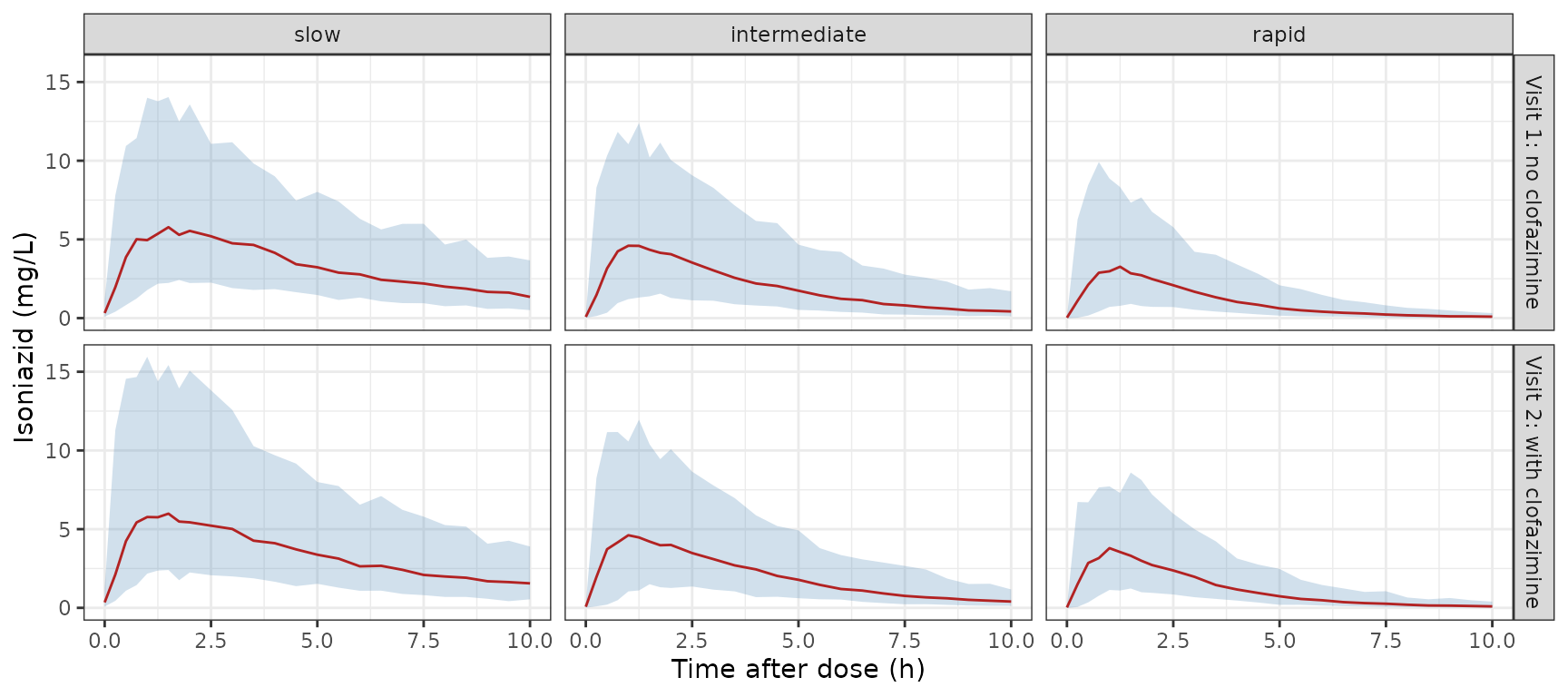
Replicates Figure 2 of Kengo 2024: isoniazid by NAT2 phenotype and study visit (simulated 5th, 50th and 95th percentiles).
vpc_both <- dplyr::bind_rows(
  dplyr::mutate(vpc_summary(sim_lzd), drug = "Linezolid"),
  dplyr::mutate(vpc_summary(sim_lfx), drug = "Levofloxacin")
)
vpc_both$drug <- factor(vpc_both$drug, levels = c("Linezolid", "Levofloxacin"))
vpc_plot(vpc_both, "Concentration (mg/L)") + facet_grid(drug ~ visit, scales = "free_y")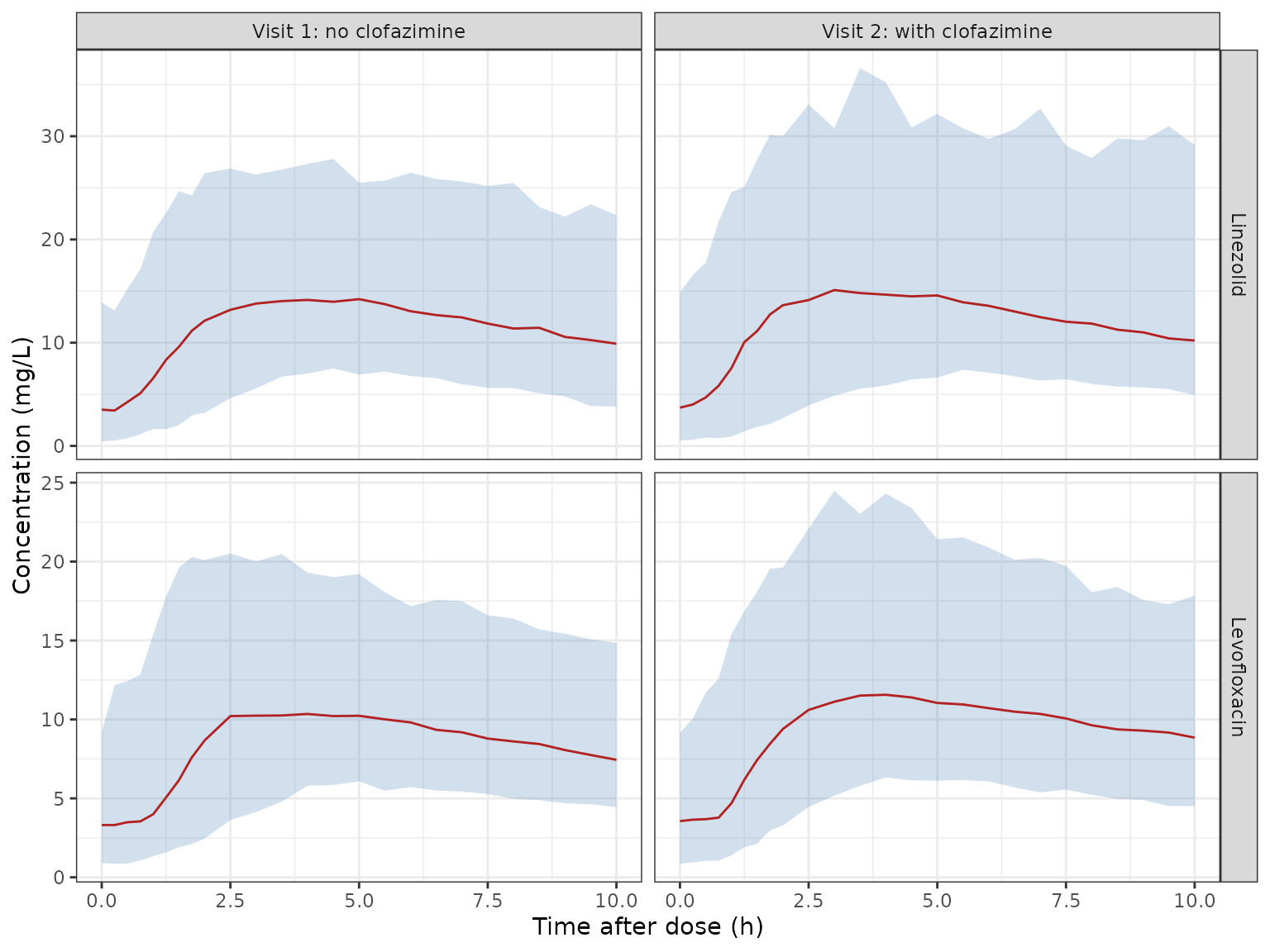
Replicates Figure 3 of Kengo 2024: linezolid (top) and levofloxacin (bottom) by study visit (simulated 5th, 50th and 95th percentiles).
Read off the published figures, the observed medians peak at about
13-15 mg/L for linezolid and 10-12 mg/L for levofloxacin, 2-4 h after
the dose, and the isoniazid medians peak at about 5, 3.5 and 2.5 mg/L at
2 h for slow, intermediate and rapid acetylators. The study drew no
sample before 2 h, so the isoniazid comparison is with the simulated
median at 2 h (median_2h); the simulated isoniazid peak
itself falls at about 1 h.
peaks <- dplyr::bind_rows(
  vpc_both |> dplyr::group_by(drug, visit) |> dplyr::summarise(peak_median = max(p50), t_peak = tad[which.max(p50)], median_2h = p50[tad == 2], .groups = "drop"),
  vpc_inh |> dplyr::group_by(drug = paste("Isoniazid,", phenotype), visit) |>
    dplyr::summarise(peak_median = max(p50), t_peak = tad[which.max(p50)], median_2h = p50[tad == 2], .groups = "drop")
)
knitr::kable(peaks, digits = 2, caption = "Peak of the simulated median profile.")| drug | visit | peak_median | t_peak | median_2h |
|---|---|---|---|---|
| Linezolid | Visit 1: no clofazimine | 14.22 | 5.00 | 12.13 |
| Linezolid | Visit 2: with clofazimine | 15.10 | 3.00 | 13.63 |
| Levofloxacin | Visit 1: no clofazimine | 10.35 | 4.00 | 8.67 |
| Levofloxacin | Visit 2: with clofazimine | 11.56 | 4.00 | 9.40 |
| Isoniazid, intermediate | Visit 1: no clofazimine | 4.60 | 1.00 | 4.06 |
| Isoniazid, intermediate | Visit 2: with clofazimine | 4.61 | 1.00 | 4.00 |
| Isoniazid, rapid | Visit 1: no clofazimine | 3.26 | 1.25 | 2.48 |
| Isoniazid, rapid | Visit 2: with clofazimine | 3.79 | 1.00 | 2.72 |
| Isoniazid, slow | Visit 1: no clofazimine | 5.78 | 1.50 | 5.54 |
| Isoniazid, slow | Visit 2: with clofazimine | 5.98 | 1.50 | 5.43 |
pk <- function(drug, visit) {
  v <- peaks$peak_median[peaks$drug == drug & grepl(visit, peaks$visit)]
  if (length(v) != 1L) stop("no unique peak for ", drug, " / ", visit)
  v
}
# Bounds are the figure read-offs widened for digitisation error; a wrong
# volume, dose or unit moves the peak by tens of percent.
stopifnot(
  pk("Linezolid", "Visit 1") > 10, pk("Linezolid", "Visit 1") < 18,
  pk("Levofloxacin", "Visit 1") > 8, pk("Levofloxacin", "Visit 1") < 14,
  pk("Isoniazid, slow", "Visit 1") > 3.5, pk("Isoniazid, slow", "Visit 1") < 7,
  pk("Isoniazid, rapid", "Visit 1") > 1.5, pk("Isoniazid, rapid", "Visit 1") < 4
)
PKNCA validation
NCA over the 24 h dosing interval after the observed dose at each visit. The pre-dose sample is the time-zero record.
run_nca <- function(sim, group_cols) {
  conc <- sim |>
    dplyr::filter(!is.na(Cc)) |>
    dplyr::mutate(Cc = pmax(Cc, 0)) |>
    dplyr::select(dplyr::all_of(c("id", group_cols, "tad", "Cc")))
  doses <- conc |>
    dplyr::filter(tad == 0) |>
    dplyr::distinct(dplyr::across(dplyr::all_of(c("id", group_cols)))) |>
    dplyr::mutate(tad = 0, amt = 1)
  f_conc <- stats::as.formula(paste("Cc ~ tad |", paste(c(group_cols, "id"), collapse = " + ")))
  f_dose <- stats::as.formula(paste("amt ~ tad |", paste(c(group_cols, "id"), collapse = " + ")))
  intervals <- data.frame(start = 0, end = 24, cmax = TRUE, tmax = TRUE, auclast = TRUE)
  res <- PKNCA::pk.nca(PKNCA::PKNCAdata(
    PKNCA::PKNCAconc(conc, f_conc),
    PKNCA::PKNCAdose(doses, f_dose),
    intervals = intervals
  ))
  as.data.frame(res$result)
}

nca_lfx <- run_nca(sim_lfx, "visit")
nca_lzd <- run_nca(sim_lzd, "visit")
nca_inh <- run_nca(sim_inh, c("phenotype", "visit"))

nca_summary <- function(nca, group_cols) {
  nca |>
    dplyr::filter(PPTESTCD %in% c("cmax", "tmax", "auclast")) |>
    dplyr::group_by(dplyr::across(dplyr::all_of(c(group_cols, "PPTESTCD")))) |>
    dplyr::summarise(median = median(PPORRES), .groups = "drop") |>
    tidyr::pivot_wider(names_from = PPTESTCD, values_from = median) |>
    dplyr::rename("Cmax (mg/L)" = cmax, "Tmax (h)" = tmax, "AUC0-24 (mg*h/L)" = auclast)
}
knitr::kable(nca_summary(nca_inh, c("phenotype", "visit")), digits = 2,
caption = "Isoniazid: simulated median NCA by NAT2 phenotype and visit.")| phenotype | visit | AUC0-24 (mg*h/L) | Cmax (mg/L) | Tmax (h) |
|---|---|---|---|---|
| slow | Visit 1: no clofazimine | 43.38 | 6.14 | 1.25 |
| slow | Visit 2: with clofazimine | 45.24 | 6.47 | 1.00 |
| intermediate | Visit 1: no clofazimine | 22.46 | 5.25 | 1.00 |
| intermediate | Visit 2: with clofazimine | 22.62 | 5.35 | 1.00 |
| rapid | Visit 1: no clofazimine | 11.40 | 3.52 | 1.00 |
| rapid | Visit 2: with clofazimine | 13.64 | 4.31 | 1.00 |
knitr::kable(nca_summary(nca_lzd, "visit"), digits = 2,
caption = "Linezolid: simulated median NCA by visit.")| visit | AUC0-24 (mg*h/L) | Cmax (mg/L) | Tmax (h) |
|---|---|---|---|
| Visit 1: no clofazimine | 198.31 | 15.95 | 3.5 |
| Visit 2: with clofazimine | 199.64 | 16.19 | 3.5 |
Comparison against the published levofloxacin AUC
The paper reports one exposure summary: the median levofloxacin AUC rose from 140 mgh/L at visit 1 to 166 mgh/L at visit 2 (Results paragraph 5, Figure S3).
reference <- data.frame(
  visit = c("Visit 1: no clofazimine", "Visit 2: with clofazimine"),
  auclast = c(140, 166)
)
cmp <- nlmixr2lib::ncaComparisonTable(
  simulated = nca_lfx |> dplyr::select(visit, PPTESTCD, PPORRES),
  reference = reference,
  by = "visit",
  params = "auclast",
  units = c(auclast = "mg*h/L")
)
knitr::kable(cmp, caption = "Levofloxacin AUC0-24: simulated median versus Kengo 2024.")| NCA parameter | visit | Reference | Simulated | % diff |
|---|---|---|---|---|
| AUClast (mg*h/L) | Visit 1: no clofazimine | 140 | 151 | +7.6% |
| AUClast (mg*h/L) | Visit 2: with clofazimine | 166 | 180 | +8.2% |
attr(cmp, "footnote")
#> NULL

auc_med <- nca_lfx |>
  dplyr::filter(PPTESTCD == "auclast") |>
  dplyr::group_by(visit) |>
  dplyr::summarise(auc = median(PPORRES), .groups = "drop")
ratio_med <- auc_med$auc[2] / auc_med$auc[1]
stopifnot(
  all(abs(auc_med$auc / reference$auclast - 1) < 0.2),
  # Typical-value ratio is 1 / 0.852 = 1.174; the per-subject between-visit
  # variability (17% CV) spreads the ratio of cohort medians by about 0.02.
  abs(ratio_med - 1 / 0.852) < 0.08
)
The simulated median visit-2 / visit-1 AUC ratio is 1.192, against the published 1.186.
Assumptions and deviations
-
Liver compartment without a volume. The paper
describes isoniazid first-pass “through a liver compartment” but reports
no liver volume (nor does the cited Gausi 2021 model). The model treats
the liver as instantly equilibrating: the absorbed dose is multiplied by
fh = 1 - ehand systemic drug is cleared atqh * eh, witheh = fu*CLint/(fu*CLint + QH). This is the form the same group’s isoniazid control streams use (seeCalderin_2025_isoniazid), and the single-dose check above confirms it gives the well-stirred oral-clearance identityAUC = dose / (fu * CLint). With a hepatic flow of 72 L/h a liver of about 1 L would equilibrate within about a minute, so the profile difference from an explicit compartment is negligible. - Hepatic flow parameterisation. Table 2 gives QH = 72.4 L/h for a 42 kg-FFM participant; it is encoded at that reference and scaled by (FFM/42)^0.75. This equals the conventional 90 L/h at 56.1 kg FFM used in the group’s other models, 90 * (42/56.1)^0.75 = 72.4 L/h.
- Isoniazid absorption values. Table 2 footnote e says the absorption parameters were fixed to those of Gausi et al. 2021, but the values Kengo 2024 prints (ka 3.28 1/h, MTT 0.122 h, NN 2.32) are not the isoniazid values in Gausi 2021 Table 2 (ka 2.69 1/h, MTT 0.342 h, NN 48.4). The values printed in Kengo 2024 are used, as the ones this model was fitted with.
- Allometric scaling of Q. Table 2 marks the isoniazid inter-compartmental clearance without footnote a, but the text says FFM scaling was applied to “all disposition parameters”, so Q is scaled with exponent 0.75.
- Occasion structure. The paper treats each dose as an occasion and inflates the absorption BOV for pre-dose samples after an unobserved dose. The model encodes this as four occasions (unobserved and observed dose at each of the two visits), with the visit for the between-visit variability derived from the occasion. The scaling factor is applied to the BOV of ka, MTT and F (the “absorption parameters” of footnote h) and multiplies the random deviate, so each inflated variance is the estimated variance times the squared factor.
-
Creatinine-clearance effect. The paper states a
4.70% increase in levofloxacin clearance per 10 mL/min above the median,
without printing the equation. It is encoded as linear,
1 + 0.0047 * (CRCL - 81.8), centred on the 81.8 mL/min median of the levofloxacin cohort (Table 1). CRCL is the raw Cockcroft-Gault value in mL/min, not BSA-normalised. -
Clofazimine effect. Encoded as a time-varying
indicator (
CONMED_CLOFAZIMINE), 0 at visit 1 and 1 at visit 2. The study was not a cross-over, so the paper cannot exclude that part of the visit-2 change in levofloxacin clearance reflects other factors such as clinical improvement. - Residual error. Additive errors are taken as printed. For isoniazid the additive error sat at its lower bound, 20% of the LLOQ, and was fixed there. The Beal M6 inflation of the additive error for imputed BLQ records applies to no simulated observation and is omitted.
- Virtual cohort. Weight and creatinine clearance distributions, the sex-specific height distributions, and the dose bands (isoniazid 450 mg below 50 kg and 600 mg otherwise; levofloxacin 750 mg below 46 kg and 1000 mg otherwise) are assumptions chosen to reproduce the Table 1 medians; the paper does not report its dose bands.
-
Convention-check warnings.
checkModelConventions()reports that the isoniazid between-visit etasetabvv_clint_1/etabvv_clint_2have nolclintparameter to pair with. They act on intrinsic clearance, whose typical value is split by NAT2 phenotype intolclint_slow,lclint_intandlclint_rapid; the between-subject etaetalclintpairs with the same split. - Not packaged. The clofazimine and cycloserine models used in the paper are earlier published models (see “Model and source”).