Model and source
#> ℹ parameter labels from comments will be replaced by 'label()'- Citation: Kim A, Lee J, Shin D, Jung YJ, Bahng MY, Cho JY, Jang IJ. Population pharmacokinetic analysis to recommend the optimal dose of udenafil in patients with mild and moderate hepatic impairment. Br J Clin Pharmacol. 2016;82(2):389-398. doi:10.1111/bcp.12977.
- Description: Parent-metabolite population PK model for oral udenafil and its active metabolite DA-8164 in healthy subjects and patients with mild (Child-Pugh A) and moderate (Child-Pugh B) hepatic impairment (Kim 2016). Two-compartment udenafil with first-order absorption and an absorption lag time, two parallel parent-side clearances (CLp/F = non-metabolic apparent clearance, CLpm/F = apparent formation clearance to DA-8164) feeding a two-compartment metabolite. Central and peripheral apparent volumes are assumed equal for parent and metabolite (the fraction metabolised f_m and the metabolite volume of distribution are not separately identifiable from this dataset). Mass-balance is preserved by multiplying the formation flux into the metabolite central compartment by the molecular-weight ratio Rpm = MW(DA-8164) / MW(udenafil) = 405.4 / 516.66. Prothrombin time expressed as INR (PT) acts on CLpm/F via a power covariate normalised to the cohort median 1.13: CLpm/F = theta1 * (PT/1.13)^theta10 with theta10 = -1.65 (decrease in CLpm/F with increasing PT).
- Article: https://doi.org/10.1111/bcp.12977
The packaged model implements the Kim 2016 final parent-metabolite
popPK model: two-compartment udenafil with first-order absorption and an
absorption lag time, two parallel parent-side apparent clearances
(clp = non-metabolic and clpm = formation to
DA-8164) feeding a two-compartment metabolite. Central and peripheral
apparent volumes are shared between parent and metabolite per the
paper’s structural assumption (the fraction metabolised fm
and the absolute metabolite distribution volumes are not separately
identifiable). The parent-to-metabolite formation flux is multiplied by
the molecular-weight ratio
Rpm = MW(DA-8164) / MW(udenafil) = 405.4 / 516.66 = 0.7847
so the simulated DA-8164 mass concentration is dimensionally consistent
with the parent mass concentration. Prothrombin time expressed as INR
(canonical covariate INR_BASE, source-paper label
PT) acts on clpm via a power covariate
normalised to the cohort median 1.13:
CLpm/F = theta1 * (PT/1.13)^theta10 with
theta10 = -1.65.
Population
Kim 2016 Table 1 summarises 18 Korean adults enrolled at four institutional review boards in South Korea between 2009 and 2010 (ClinicalTrials.gov NCT00956306): six healthy subjects, six patients with mild hepatic impairment (Child-Pugh class A), and six patients with moderate hepatic impairment (Child-Pugh class B). Healthy subjects were age- and weight-matched to the moderate-HI patients (within +/-10 years and +/-10 kg). Cohort means (+/- SD) for age were 50.7 +/- 7.63, 52.7 +/- 4.97, and 55.3 +/- 5.96 years in the healthy, mild-HI, and moderate-HI groups respectively; weights were 65.7 +/- 4.79, 68.0 +/- 7.90, and 67.0 +/- 6.43 kg. Baseline PT-as-INR (the only covariate retained in the final model) was 0.97 +/- 0.039 (healthy), 1.13 +/- 0.13 (mild HI), and 1.33 +/- 0.094 (moderate HI). Each subject received a single 100 mg oral dose of udenafil after at least 10 h of fasting, with serial plasma sampling for 72 h. Exclusion criteria included cardiovascular / cerebrovascular disease, creatinine clearance < 40 mL/min, and use of CYP3A4 or CYP2D6 inducers / inhibitors.
The same metadata is available programmatically via
readModelDb("Kim_2016_udenafil")$meta$population.
Source trace
The per-parameter origin is recorded as an in-file comment next to
each ini() entry in
inst/modeldb/specificDrugs/Kim_2016_udenafil.R. The table
below collects them in one place for review. All parameter values are
from Kim 2016 Table 2 “Estimate” column.
| Equation / parameter | Value | Source location |
|---|---|---|
lka (ka, udenafil) |
log(0.326) -> 0.326 1/h | Table 2, RSE 19.4% |
ltlag (ALAG) |
log(0.314) -> 0.314 h | Table 2, RSE 14.8% |
lclp (CLp/F) |
log(3.62) -> 3.62 L/h | Table 2, RSE 19.4% |
lclpm (CLpm/F at PT = 1.13) |
log(35.7) -> 35.7 L/h | Table 2, RSE 25.3% |
lcl_da8164 (CLm/(F*fm)) |
log(36.5) -> 36.5 L/h | Table 2, RSE 26.2% |
lq (Qp/F) |
log(61.7) -> 61.7 L/h | Table 2, RSE 15.7% |
lq_da8164 (Qm/(F*fm)) |
log(11.4) -> 11.4 L/h | Table 2, RSE 25.4% |
lvc (Vp/F, shared) |
log(44.1) -> 44.1 L | Table 2, RSE 29.0% |
lvp (Vp2/F, shared) |
log(588) -> 588 L | Table 2, RSE 7.21% |
e_inr_base_clpm (theta10) |
-1.65 | Table 2 + prose: “decrease in CLpm/F with increase in PT”; bootstrap -1.66 (-3.43, -0.729) |
etalclpm variance |
log(1 + 0.351^2) = 0.11622 | Table 2: omega CLpm/F 35.1% CV |
etalcl_da8164 variance |
log(1 + 0.544^2) = 0.25929 | Table 2: omega CLm/(F*fm) 54.4% CV |
etalka variance |
log(1 + 0.641^2) = 0.34416 | Table 2: omega ka 64.1% CV |
etalvc variance |
log(1 + 0.756^2) = 0.45227 | Table 2: omega Vp/F 75.6% CV |
etalvp variance |
log(1 + 0.238^2) = 0.05512 | Table 2: omega Vp2/F 23.8% CV |
etalq variance |
log(1 + 0.513^2) = 0.23354 | Table 2: omega Qp/F 51.3% CV |
etaltlag variance |
log(1 + 0.207^2) = 0.04195 | Table 2: omega ALAG 20.7% CV |
propSd (parent) |
0.216 (21.6%) | Table 2 sigma_prop,p |
propSd_da8164 (metabolite) |
0.231 (23.1%) | Table 2 sigma_prop,m |
rpm (MW(DA-8164)/MW(udenafil)) |
405.4 / 516.66 = 0.7847 | Methods, Population PK model development paragraph |
ODE: d/dt(depot)
|
-ka * depot |
Methods, Eq. for Depot |
ODE: d/dt(central)
|
parent 2-cmt with CLp + CLpm out | Methods, Eq. for Central (parent) |
ODE: d/dt(peripheral1)
|
Qp/Vc, Qp/Vp | Methods, Eq. for Peripheral (parent) |
ODE: d/dt(central_da8164)
|
Rpm * CLpm input; CLm out | Methods, Eq. for Central (metabolite) |
ODE: d/dt(peripheral1_da8164)
|
Qm/Vc, Qm/Vp | Methods, Eq. for Peripheral (metabolite) |
alag(depot) <- tlag |
0.314 h | Table 2 ALAG |
Virtual cohort
Kim 2016 does not publish per-subject concentration-time data. The vignette uses a stochastic simulated cohort of 100 subjects per Child-Pugh stratum (healthy, mild HI, moderate HI), matching the Kim 2016 Methods (“Simulation and statistical analysis for dose recommendation in patients with hepatic impairment” paragraph: “The plasma concentration-time data for 100 virtual subjects by each group were simulated from the final PK model”). PT-as-INR is sampled from per-stratum normal distributions with the published means and SDs (Table 1), truncated at 0.5 to avoid pathological non-positive values. Each subject receives a single 100 mg oral dose of udenafil at t = 0, followed by observations across 0-72 h on a dense early grid (capturing the absorption / Tmax phase) and a sparser late grid (capturing the elimination phase).
set.seed(20160428)

mod <- readModelDb("Kim_2016_udenafil")

n_per_arm <- 100L
sim_horizon_h <- 72

# Per-stratum PT-as-INR distributions (Kim 2016 Table 1 mean +/- SD).
inr_lookup <- tibble::tribble(
  ~treatment,           ~mean_inr, ~sd_inr,
  "Healthy",            0.97,      0.039,
  "Mild HI (CP-A)",     1.13,      0.13,
  "Moderate HI (CP-B)", 1.33,      0.094
)

# Dose 100 mg PO single. Convert to nmol of dose for the model's mg dosing
# units (the packaged model declares `dosing = "mg"` so amt is in mg).
dose_mg <- 100

make_cohort <- function(treatment_label, n, mean_inr, sd_inr, id_offset) {
  inr <- pmax(rnorm(n, mean = mean_inr, sd = sd_inr), 0.5)
  id  <- id_offset + seq_len(n)

  # Dose record at t = 0 into the depot.
  doses <- tibble::tibble(
    id        = id,
    time      = 0,
    evid      = 1L,
    amt       = dose_mg,
    cmt       = "depot",
    dvid      = NA_integer_,
    INR_BASE  = inr,
    treatment = treatment_label
  )

  # Observation grid: dense over the absorption / early-elimination window,
  # sparser at late times. cmt is set to the canonical ODE-state name
  # "central" and dvid = 1L tags each observation row as endpoint 1 (parent
  # Cc); rxSolve emits BOTH algebraic observables (`Cc` and `Cc_da8164`)
  # as columns in the output regardless of dvid, so a single obs row per
  # timepoint is sufficient. The dvid is required to satisfy the multi-
  # output model's auto-injected dvid->cmt mapping for the algebraic
  # observables.
  obs_times <- sort(unique(c(
    seq(0,  4,    by = 0.1),
    seq(4,  12,   by = 0.5),
    seq(12, 24,   by = 2),
    seq(24, sim_horizon_h, by = 4)
  )))
  obs <- tidyr::expand_grid(id = id, time = obs_times) |>
    dplyr::mutate(
      evid = 0L,
      amt  = NA_real_,
      cmt  = "central",
      dvid = 1L
    ) |>
    dplyr::left_join(
      doses |> dplyr::select(id, INR_BASE, treatment),
      by = "id"
    )

  dplyr::bind_rows(doses, obs) |>
    dplyr::arrange(id, time, dplyr::desc(evid))
}

events <- dplyr::bind_rows(
  make_cohort("Healthy",            n_per_arm,
              inr_lookup$mean_inr[1], inr_lookup$sd_inr[1], id_offset =  0L),
  make_cohort("Mild HI (CP-A)",     n_per_arm,
              inr_lookup$mean_inr[2], inr_lookup$sd_inr[2], id_offset =  1000L),
  make_cohort("Moderate HI (CP-B)", n_per_arm,
              inr_lookup$mean_inr[3], inr_lookup$sd_inr[3], id_offset =  2000L)
)
stopifnot(!anyDuplicated(unique(events[, c("id", "time", "evid")])))
Simulation
sim <- rxode2::rxSolve(
  mod,
  events = events,
  keep   = c("INR_BASE", "treatment")
) |>
  as.data.frame() |>
  dplyr::as_tibble()
#> ℹ parameter labels from comments will be replaced by 'label()'
Replicate published figures
Figure 3 / S2 – Visual predictive check style profile by hepatic-impairment group
Kim 2016 Figure 3 panels A-C show VPC-style plots of udenafil plasma concentration over 72 h for healthy, mild-HI, and moderate-HI subjects, with the prediction median and 90% prediction interval overlaid on observed data. Supplementary Figure S2 shows the same VPC for DA-8164. The chunks below reproduce the shape of those panels for the two analytes.
vpc_parent <- sim |>
  dplyr::filter(time > 0, !is.na(Cc)) |>
  dplyr::group_by(treatment, time) |>
  dplyr::summarise(
    Q05 = quantile(Cc, 0.05, na.rm = TRUE),
    Q50 = quantile(Cc, 0.50, na.rm = TRUE),
    Q95 = quantile(Cc, 0.95, na.rm = TRUE),
    .groups = "drop"
  )

ggplot(vpc_parent, aes(time, Q50)) +
  geom_ribbon(aes(ymin = Q05, ymax = Q95), alpha = 0.25, fill = "steelblue") +
  geom_line(colour = "steelblue", linewidth = 0.8) +
  facet_wrap(~ treatment) +
  scale_y_log10() +
  labs(x = "Time after dose (h)",
       y = "Udenafil plasma concentration (mg/L)",
       title  = "Udenafil VPC-style profiles by hepatic-impairment group",
       caption = "Replicates the shape of Kim 2016 Figure 3 panels.")
#> Warning in scale_y_log10(): log-10 transformation introduced infinite values.
#> log-10 transformation introduced infinite values.
#> log-10 transformation introduced infinite values.
#> log-10 transformation introduced infinite values.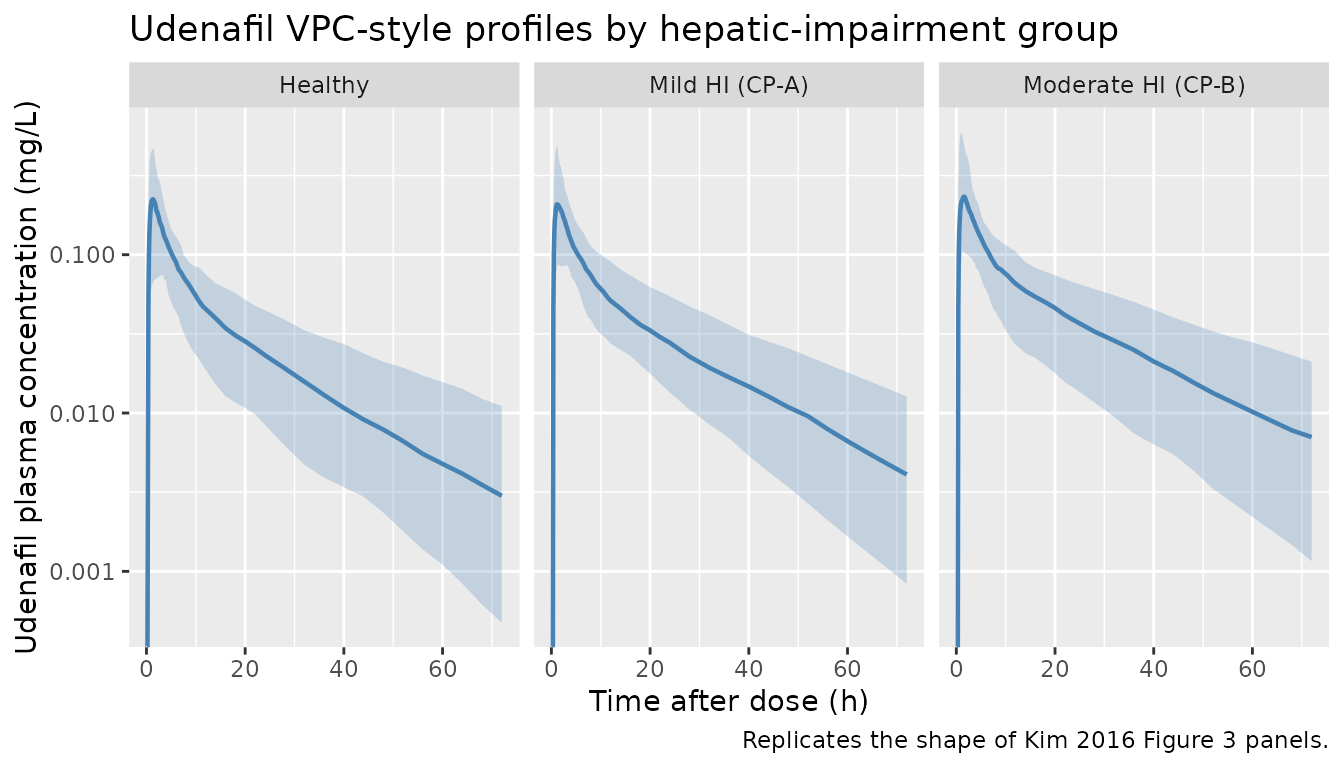
vpc_da8164 <- sim |>
  dplyr::filter(time > 0, !is.na(Cc_da8164)) |>
  dplyr::group_by(treatment, time) |>
  dplyr::summarise(
    Q05 = quantile(Cc_da8164, 0.05, na.rm = TRUE),
    Q50 = quantile(Cc_da8164, 0.50, na.rm = TRUE),
    Q95 = quantile(Cc_da8164, 0.95, na.rm = TRUE),
    .groups = "drop"
  )

ggplot(vpc_da8164, aes(time, Q50)) +
  geom_ribbon(aes(ymin = Q05, ymax = Q95), alpha = 0.25, fill = "darkorange") +
  geom_line(colour = "darkorange", linewidth = 0.8) +
  facet_wrap(~ treatment) +
  scale_y_log10() +
  labs(x = "Time after dose (h)",
       y = "DA-8164 plasma concentration (mg/L)",
       title  = "DA-8164 VPC-style profiles by hepatic-impairment group",
       caption = "Replicates the shape of Kim 2016 Figure S2.")
#> Warning in scale_y_log10(): log-10 transformation introduced infinite values.
#> log-10 transformation introduced infinite values.
#> log-10 transformation introduced infinite values.
#> log-10 transformation introduced infinite values.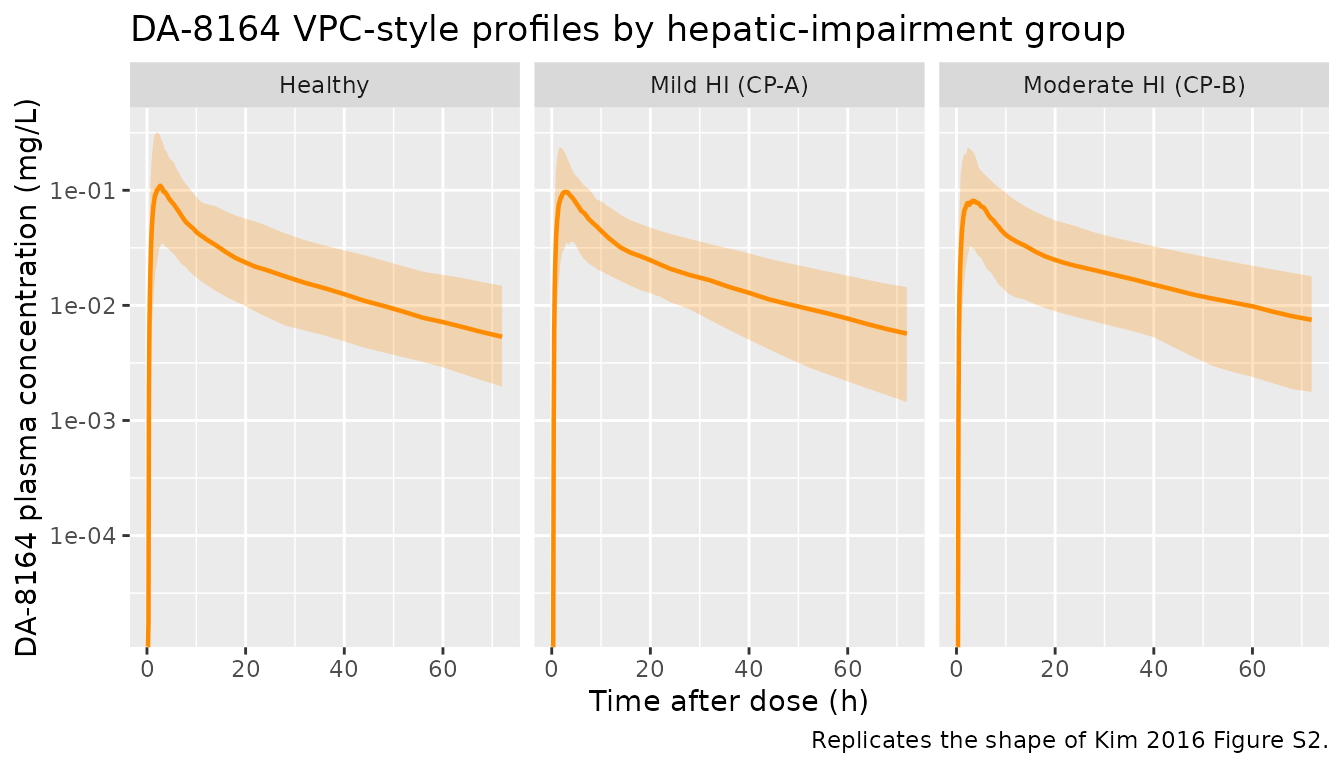
PKNCA validation
The Kim 2016 source paper reports geometric-mean ratios (GMRs) for AUC(0, tlast) and Cmax across patient groups versus the healthy reference at the same 100 mg dose (Table 3). The vignette computes per-subject NCA for udenafil on the simulated cohort using PKNCA, then forms the simulated GMRs and compares them to the published values. PKNCA is run separately for the parent (Cc) and metabolite (Cc_da8164) analytes.
sim_nca <- sim |>
  dplyr::filter(!is.na(Cc)) |>
  dplyr::select(id, time, Cc, treatment)

# Guarantee a time = 0 row per (id, treatment) so PKNCA's AUC0-tlast anchor
# is well-defined (extravascular: pre-dose Cc = 0).
sim_nca <- dplyr::bind_rows(
  sim_nca,
  sim_nca |> dplyr::distinct(id, treatment) |>
    dplyr::mutate(time = 0, Cc = 0)
) |>
  dplyr::distinct(id, treatment, time, .keep_all = TRUE) |>
  dplyr::arrange(id, treatment, time)

dose_df <- events |>
  dplyr::filter(evid == 1) |>
  dplyr::select(id, time, amt, treatment)

conc_obj <- PKNCA::PKNCAconc(
  sim_nca,
  Cc ~ time | treatment + id,
  concu = "mg/L",
  timeu = "hr"
)
dose_obj <- PKNCA::PKNCAdose(dose_df, amt ~ time | treatment + id,
                             doseu = "mg")

intervals_parent <- data.frame(
  start      = 0,
  end        = sim_horizon_h,
  cmax       = TRUE,
  tmax       = TRUE,
  auclast    = TRUE,
  aucinf.obs = TRUE,
  half.life  = TRUE
)

nca_parent <- PKNCA::pk.nca(
  PKNCA::PKNCAdata(conc_obj, dose_obj, intervals = intervals_parent)
)

# Extract per-subject parameters into a long tibble for GMR computation.
parent_tbl <- as.data.frame(nca_parent$result) |>
  dplyr::filter(PPTESTCD %in% c("cmax", "auclast", "aucinf.obs", "half.life")) |>
  dplyr::select(treatment, id, PPTESTCD, PPORRES)
Comparison against Kim 2016 Table 3 (udenafil 100 mg)
Kim 2016 Table 3 reports udenafil GMRs (and 95% CI) for AUC(0, tlast)
and Cmax in HI patients relative to healthy subjects at the same 100 mg
dose. Here we compute the simulated GMR (HI / Healthy) per analyte and
parameter and place the simulated and published GMRs side by side via
nlmixr2lib::ncaComparisonTable().
# Geometric mean per (treatment, PPTESTCD).
gmean <- function(x) exp(mean(log(x[x > 0]), na.rm = TRUE))

geo_means <- parent_tbl |>
  dplyr::filter(PPTESTCD %in% c("cmax", "auclast")) |>
  dplyr::group_by(treatment, PPTESTCD) |>
  dplyr::summarise(gm = gmean(PPORRES), .groups = "drop")

gm_ref <- geo_means |>
  dplyr::filter(treatment == "Healthy") |>
  dplyr::select(PPTESTCD, gm_ref = gm)

sim_gmr <- geo_means |>
  dplyr::inner_join(gm_ref, by = "PPTESTCD") |>
  dplyr::mutate(gmr_sim = gm / gm_ref) |>
  dplyr::filter(treatment != "Healthy") |>
  dplyr::select(treatment, PPTESTCD, gmr_sim) |>
  tidyr::pivot_wider(names_from = PPTESTCD, values_from = gmr_sim) |>
  dplyr::rename(auclast_sim = auclast, cmax_sim = cmax)

# Kim 2016 Table 3 reports the SIMULATED GMRs (from the paper's own
# simulation of 100 virtual subjects per group). We compare our independently
# simulated GMRs to those published numbers.
published_gmr <- tibble::tribble(
  ~treatment,           ~cmax,  ~auclast,
  "Mild HI (CP-A)",     1.13,   1.21,
  "Moderate HI (CP-B)", 1.21,   1.55
)

cmp <- nlmixr2lib::ncaComparisonTable(
  simulated = sim_gmr |>
    dplyr::rename(cmax = cmax_sim, auclast = auclast_sim),
  reference = published_gmr,
  by        = "treatment",
  units     = c(cmax = "GMR vs healthy 100 mg",
                auclast = "GMR vs healthy 100 mg"),
  tolerance_pct = 20
)

knitr::kable(
  cmp,
  caption = "Simulated vs Kim 2016 Table 3 (udenafil 100 mg) GMRs vs healthy. * differs from reference by >20%.",
  align   = c("l", "l", "r", "r", "r")
)| NCA parameter | treatment | Reference | Simulated | % diff |
|---|---|---|---|---|
| Cmax (GMR vs healthy 100 mg) | Mild HI (CP-A) | 1.13 | 0.992 | -12.2% |
| Cmax (GMR vs healthy 100 mg) | Moderate HI (CP-B) | 1.21 | 1.18 | -2.5% |
| AUClast (GMR vs healthy 100 mg) | Mild HI (CP-A) | 1.21 | 1.14 | -5.6% |
| AUClast (GMR vs healthy 100 mg) | Moderate HI (CP-B) | 1.55 | 1.42 | -8.3% |
sim_nca_da8164 <- sim |>
  dplyr::filter(!is.na(Cc_da8164)) |>
  dplyr::select(id, time, Cc_da8164, treatment)

sim_nca_da8164 <- dplyr::bind_rows(
  sim_nca_da8164,
  sim_nca_da8164 |> dplyr::distinct(id, treatment) |>
    dplyr::mutate(time = 0, Cc_da8164 = 0)
) |>
  dplyr::distinct(id, treatment, time, .keep_all = TRUE) |>
  dplyr::arrange(id, treatment, time)

conc_obj_da8164 <- PKNCA::PKNCAconc(
  sim_nca_da8164,
  Cc_da8164 ~ time | treatment + id,
  concu = "mg/L",
  timeu = "hr"
)

intervals_da8164 <- data.frame(
  start    = 0,
  end      = sim_horizon_h,
  cmax     = TRUE,
  tmax     = TRUE,
  auclast  = TRUE
)

nca_da8164 <- PKNCA::pk.nca(
  PKNCA::PKNCAdata(conc_obj_da8164, dose_obj, intervals = intervals_da8164)
)
nca_da8164_summary <- summary(nca_da8164)
knitr::kable(
  nca_da8164_summary,
  caption = "DA-8164 NCA by hepatic-impairment group, single 100 mg udenafil dose."
)| Interval Start | Interval End | treatment | N | AUClast (hr*mg/L) | Cmax (mg/L) | Tmax (hr) |
|---|---|---|---|---|---|---|
| 0 | 72 | Healthy | 100 | 1.66 [49.5] | 0.115 [67.9] | 2.60 [0.900, 14.0] |
| 0 | 72 | Mild HI (CP-A) | 100 | 1.65 [42.9] | 0.101 [61.6] | 2.70 [0.700, 9.00] |
| 0 | 72 | Moderate HI (CP-B) | 100 | 1.63 [52.6] | 0.0944 [62.9] | 2.60 [0.800, 12.0] |
Assumptions and deviations
-
Exponent of PT (theta10) sign convention. Kim 2016
Table 2 prints the exponent as “1.65” but the paper’s prose (“which
indicates a decrease in the CLpm/F with increase in PT”) and the
bootstrap 95% CI “(-3.43, -0.729)” both indicate a negative exponent.
The packaged model uses
theta10 = -1.65; this reproduces the paper’s worked typical values (CLpm/F = 27.3 L/h at PT = 1.33 / moderate HI, 45.9 L/h at PT = 0.97 / healthy; the packaged values are 26.3 and 46.3 respectively, within rounding of the printed numbers). Treat the leading minus sign as having been lost in typesetting of the Estimate column. -
Shared parent/metabolite distribution volumes. Kim
2016 fixes
Vp,udenafil = Vp,DA-8164andVp2,udenafil = Vp2,DA-8164becausefmand the absolute metabolite volume are not separately identifiable from oral-dose-only data. The absolute metabolite clearance and volume cannot be recovered from the model – only the lumped apparent quantitiesCLm/(F*fm),Qm/(F*fm)are estimable. -
Mass-balance scaling for the metabolite. The
molecular-weight ratio
Rpm = MW(DA-8164) / MW(udenafil) = 405.4 / 516.66is applied to the formation flux into the metabolite central compartment so the simulated DA-8164 mass concentration is dimensionally consistent with the parent mass concentration (Kim 2016 Methods, Population PK model development paragraph: “the molecular weight ratio of DA-8164 to udenafil (Rpm) was multiplied by the turnover rate of udenafil to DA-8164 in a differential equation”). -
Covariate canonical name. The paper’s “PT” column
is the prothrombin time expressed as INR; the packaged model
uses the canonical covariate name
INR_BASE(withsource_name = "PT") so the model integrates with the existing INR-handling tooling innlmixr2lib. The numerical value is identical to the paper’s column; only the column label differs. - **No IIV on CLp/F or Qm/(F*fm).** Kim 2016 Table 2 does not report
IIV for these two parameters; the packaged model encodes them without
etaterms. - Virtual-cohort PT distributions. PT (as INR) is sampled per-stratum from independent normal distributions with the published means and SDs (Table 1), truncated at 0.5 to prevent unphysiological zero / negative values. The Kim 2016 cohort has only 6 subjects per stratum so the SD estimates are themselves uncertain; the simulated cohort uses 100 subjects per stratum to match the Kim 2016 simulation (“Simulation and statistical analysis for dose recommendation” paragraph).
- Dose-proportionality correction. Kim 2016 also reports udenafil exhibits dose non-proportionality (Cmax and AUC increase supraproportionally between 25 and 100 mg) and uses a separately estimated linear correction to extrapolate the 75 mg dose. The packaged model encodes the popPK structure exactly as published for the 100 mg dose and does NOT include the dose-proportionality correction (which is a separate paper-specific post-hoc adjustment rather than a structural PK component). The 75 mg AUC / Cmax GMRs in Kim 2016 Table 3 therefore cannot be reproduced from this model alone without that additional correction step.
- No erratum / corrigendum identified. A search of the Br J Clin Pharmacol corrections feed for the paper’s DOI (10.1111/bcp.12977) on 2026-06-20 found no published correction.