Hydroxyurea (Paule 2011)
Source:vignettes/articles/Paule_2011_hydroxyurea.Rmd
Paule_2011_hydroxyurea.Rmd
library(nlmixr2lib)
library(rxode2)
#> rxode2 5.1.8 using 2 threads (see ?getRxThreads)
#>   no cache: create with `rxCreateCache()`
library(dplyr)
#>
#> Attaching package: 'dplyr'
#> The following objects are masked from 'package:stats':
#>
#>     filter, lag
#> The following objects are masked from 'package:base':
#>
#>     intersect, setdiff, setequal, union
library(tidyr)
library(ggplot2)
library(PKNCA)
#>
#> Attaching package: 'PKNCA'
#> The following object is masked from 'package:stats':
#>
#>     filter
Hydroxyurea PopPK/PD in adult sickle cell anemia
Paule et al. (2011) developed a coupled population PK / PD model for hydroxyurea (HU) in adult patients with homozygous (HbSS) sickle cell anemia. The PK is two-compartment with first-order oral absorption and first-order elimination; the two PD endpoints (fetal hemoglobin percentage HbF% and mean corpuscular volume MCV) are described as indirect-response turnover models with HU-mediated inhibition of the elimination of each response. The model was fit to two pooled datasets: a 30-month sparse-sampling observational PK/PD cohort (n=81) and a 24-hour rich-sampling bioequivalence PK cohort (n=16).
mod <- readModelDb("Paule_2011_hydroxyurea")
cat(rxode2::rxode(mod)$reference, sep = "\n")
#> ℹ parameter labels from comments will be replaced by 'label()'
#> Paule I, Sassi H, Habibi A, Pham KP, Bachir D, Galacteros F, Girard P, Hulin A, Tod M. Population pharmacokinetics and pharmacodynamics of hydroxyurea in sickle cell anemia patients, a basis for optimizing the dosing regimen. Orphanet J Rare Dis. 2011;6(1):30. doi:10.1186/1750-1172-6-30 (PMID 21619673).
Population
The combined cohort of 97 adult HbSS sickle cell anemia patients was recruited at AP-HP, GH H. Mondor (Universite Paris Est-Creteil, France). Sparse PK/PD cohort baseline demographics (Paule 2011 Table 1, n=81): median age 30 years (range 18-54), median weight 60 kg (range 45-163), 57/81 female (70.4%), median creatinine 65 micromol/L (range 27-558). Rich PK cohort (n=16): median age 32 years (24-52), median weight 63 kg (42-71), 11/16 female. Doses ranged from 500 mg to 2000 mg orally once daily; the initial treatment dose was 20 mg/kg/day (10-15 mg/kg with renal insufficiency), with subsequent titration to maintain absolute neutrophil counts above 3e9/L; the final dose typically did not exceed 30 mg/kg/day. Baseline HbF% median was 6.3 % (range 0.6-30.7) and baseline MCV median was 90 fL (range 68-113) (Paule 2011 Table 3).
The same information is available programmatically via
readModelDb("Paule_2011_hydroxyurea") (then evaluate it and
read its population and covariateData
metadata).
Source trace
The per-parameter origin is recorded as an in-file comment next to
each ini() entry in
inst/modeldb/specificDrugs/Paule_2011_hydroxyurea.R. The
table below collects them in one place for review. All PK rate constants
are reported in 1/h in the source paper; we convert to 1/day for a
single time scale alongside the PD parameters (which are in 1/day).
| Equation / parameter | Source value | Source location |
|---|---|---|
| PK structure (2-cmt, first-order absorption + elimination) | n/a | Paule 2011 Methods, Population pharmacokinetic model |
| theta_Ka (1/h) | 3.02 | Table 2 |
| CL/F (L/h, 70 kg) | 11.6 | Table 2 |
| Vc/F (L, 70 kg) | 45.3 | Table 2 |
| kcp (1/h) | 0.027 | Table 2 |
| kpc (1/h, fixed) | 0.004 | Table 2 |
| Allometric exponent on CL (fixed) | 0.75 | Methods (allometric scaling 0.75) |
| Allometric exponent on Vc (fixed) | 1.00 | Methods (weight-proportional Vc) |
| PK residual error (sparse cohort) | add SD 0.353 mg/L; prop SD 0.435 | Table 2 |
| PK residual error (rich cohort) | add SD 0.319 mg/L; prop SD 0.12 | Table 2 (alternative; documented but not the package default) |
| PK IIV SDs (Vc, CL, kcp; block) | 0.34, 0.29, 0.57 | Table 2 |
| PK IIV correlations (Vc-CL, Vc-kcp, CL-kcp) | 0.71, -0.26, 0.37 | Table 2 |
| PK IIV SD (ka, diagonal) | 1.34 | Table 2 |
| HbF turnover structure (inhibition of Kout) | dHbF/dt = Kin - Kout(1 - I)HbF | Methods + Table 4 |
| Kin_HbF (%/day) | 0.071 | Table 4 |
| Kout_HbF (1/day) | 0.013 | Table 4 |
| LImax (logit Imax) | 0.276 (back-transformed Imax = 0.569) | Table 4 |
| HbF IIV SDs (Kin; Kout, LImax block) | 0.585; 0.486, 1.44 | Table 4 |
| HbF IIV correlation (Kout, LImax) | 0.892 | Table 4 |
| HbF residual error (proportional) | 0.142 | Table 4 |
| MCV turnover structure (inhibition of Kout, power on C) | dMCV/dt = Kin - Kout(1 - b*C^gamma)MCV | Methods + Table 5 |
| Kin_MCV (fL/day) | 3.71 | Table 5 |
| Kout_MCV (1/day) | 0.042 | Table 5 |
| b ((L/mg)^gamma) | 0.099 | Table 5 |
| gamma (unitless) | 0.19 | Table 5 |
| MCV IIV SDs (Kin, Kout, b; full block) | 0.191, 0.186, 0.457 | Table 5 |
| MCV IIV correlations (Kin-Kout, Kin-b, Kout-b) | 0.87, -0.98, -0.95 | Table 5 |
| MCV residual error (proportional) | 0.036 | Table 5 |
Virtual cohort
Original observed data are not publicly available. The virtual cohort below uses 60 subjects whose covariate distribution approximates the Paule 2011 sparse PK/PD cohort (n=81, female-predominant adults with a median weight of 60 kg).
Simulation
Hydroxyurea 1000 mg orally once daily for 12 months. PK samples are densely placed on day 0 (post-first-dose) and at trough thereafter; HbF% and MCV are sampled weekly. The Paule 2011 simulations used 1000 mg/day to characterize time-to-steady-state for both biomarkers.
mod <- readModelDb("Paule_2011_hydroxyurea")

sim_one <- function(sub, seed_offset = 0L) {
  t_pk <- c(seq(0, 1, by = 1 / 24),                # hourly on day 0
            seq(1.5, 365, by = 0.5))                 # trough/peak grid thereafter
  t_pd <- seq(0, 365, by = 7)                        # weekly
  ev <- rxode2::et(amt = 1000, ii = 1, until = 365, cmt = "depot") |>
    rxode2::et(t_pk, cmt = "Cc")                     |>
    rxode2::et(t_pd, cmt = "HBF")                    |>
    rxode2::et(t_pd, cmt = "MCV")
  ev_df <- as.data.frame(ev)
  ev_df <- ev_df[!is.na(ev_df$cmt) | !is.na(ev_df$amt), ]
  ev_df$id <- sub$id
  ev_df$WT <- sub$WT
  set.seed(2011L + sub$id + seed_offset)
  out <- rxode2::rxSolve(mod, ev_df, returnType = "data.frame",
                         keep = c("WT"))
  out$id <- sub$id
  out
}

sim <- pop |>
  dplyr::group_split(id) |>
  lapply(sim_one) |>
  dplyr::bind_rows()
#> ℹ parameter labels from comments will be replaced by 'label()'
dim(sim)
#> [1] 51540    29
For deterministic typical-value traces (no between-subject
variability), solve with rxode2::zeroRe().
mod_typ <- rxode2::zeroRe(mod)
#> ℹ parameter labels from comments will be replaced by 'label()'
typ <- tibble(id = 1L, WT = 70)

typ_one <- function(sub) {
  t_pk <- c(seq(0, 1, by = 1 / 48),
            seq(1.5, 365, by = 0.5))
  t_pd <- seq(0, 365, by = 1)
  ev <- rxode2::et(amt = 1000, ii = 1, until = 365, cmt = "depot") |>
    rxode2::et(t_pk, cmt = "Cc")                     |>
    rxode2::et(t_pd, cmt = "HBF")                    |>
    rxode2::et(t_pd, cmt = "MCV")
  ev_df <- as.data.frame(ev)
  ev_df <- ev_df[!is.na(ev_df$cmt) | !is.na(ev_df$amt), ]
  ev_df$id <- sub$id
  ev_df$WT <- sub$WT
  out <- rxode2::rxSolve(mod_typ, ev_df, returnType = "data.frame")
  out$id <- sub$id
  out
}
sim_typ <- typ_one(typ)
#> ℹ omega/sigma items treated as zero: 'etalvc', 'etalcl', 'etalkcp', 'etalka', 'etalkin_hbf', 'etalkout_hbf', 'etalogitimax_hbf', 'etalkin_mcv', 'etalkout_mcv', 'etalb_mcv'
Replicate published figures
Figure 1 – HU concentration over the first day at steady state
The paper reports steady-state was reached in about 35 days. After day 35 we expect a peak-to-trough swing in Cc that follows the two-compartment disposition described in Table 2.
typ_pk_ss <- sim_typ |>
  dplyr::filter(!is.na(Cc), time >= 35, time < 36)
ggplot(typ_pk_ss, aes(time - 35, Cc)) +
  geom_line(linewidth = 0.8, color = "steelblue") +
  labs(
    x = "Time after dose at day 35 (day)",
    y = "Cc (mg/L)",
    title = "HU concentration over one dosing interval at steady state (1000 mg/day)",
    caption = "Structural reproduction of the steady-state profile reported in Paule 2011 Figure 1 (PC-VPC)."
  ) +
  theme_minimal()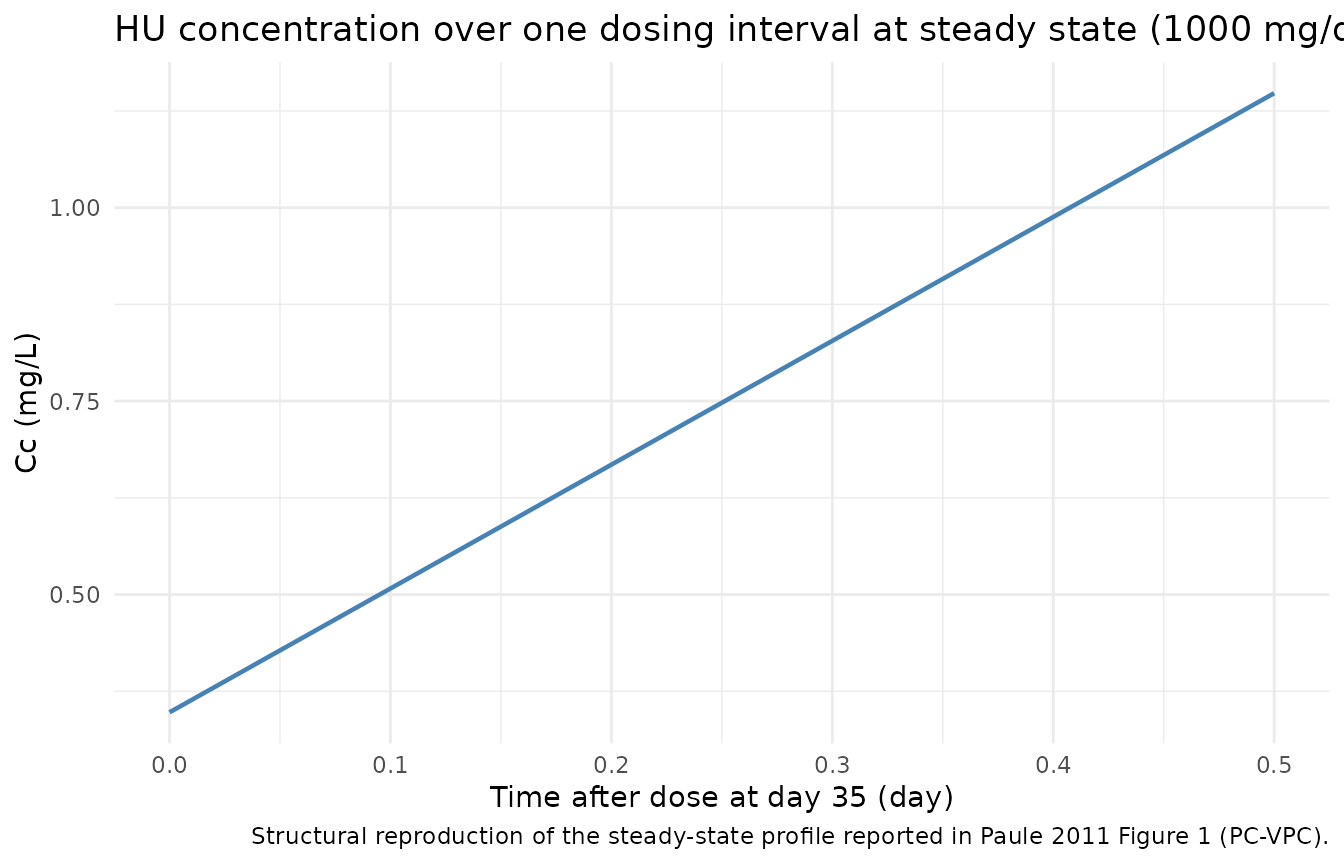
Figure 3 – HbF percentage over the treatment course
The paper reports the typical patient reaches 95 % of the steady-state HbF% at about 26 months on 1000 mg/day; the steady-state median HbF% is about 18.6 %.
typ_hbf <- sim_typ |> dplyr::filter(!is.na(HBF))
ggplot(typ_hbf, aes(time, HBF)) +
  geom_line(linewidth = 0.8, color = "firebrick") +
  labs(
    x = "Time (days)",
    y = "HbF (%)",
    title = "Typical-value HbF% trajectory under 1000 mg/day HU",
    caption = "Replicates the structure of Paule 2011 Figure 3 (PC-VPC for HbF%)."
  ) +
  theme_minimal()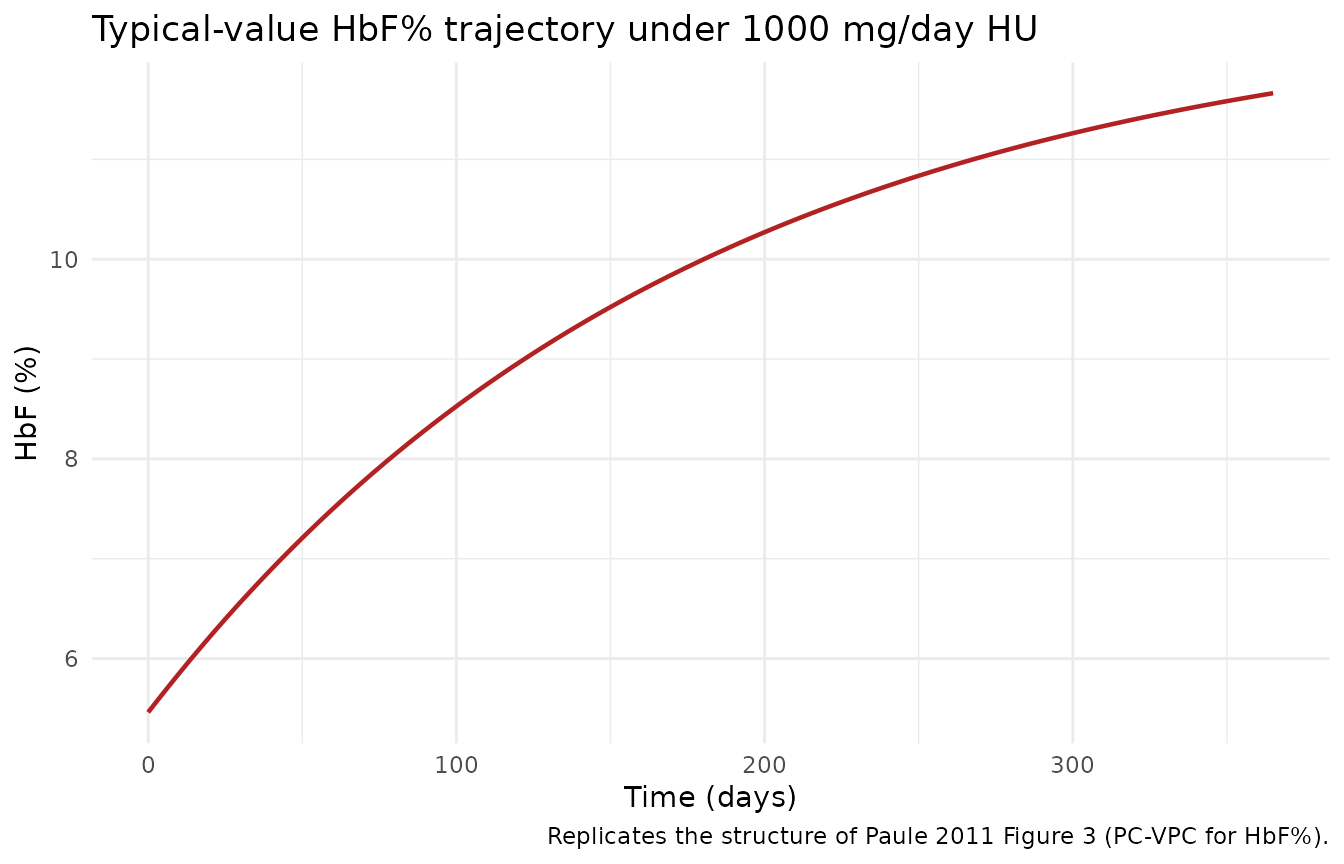
Figure 4 – MCV over the treatment course
Paper-reported steady-state median MCV is about 104 fL; 95 % of SS is reached in about 3 months. The simulation should rise from the off-drug baseline ~88 fL toward this plateau over the first 90 days.
typ_mcv <- sim_typ |> dplyr::filter(!is.na(MCV))
ggplot(typ_mcv, aes(time, MCV)) +
  geom_line(linewidth = 0.8, color = "darkgreen") +
  labs(
    x = "Time (days)",
    y = "MCV (fL)",
    title = "Typical-value MCV trajectory under 1000 mg/day HU",
    caption = "Replicates the structure of Paule 2011 Figure 4 (PC-VPC for MCV)."
  ) +
  theme_minimal()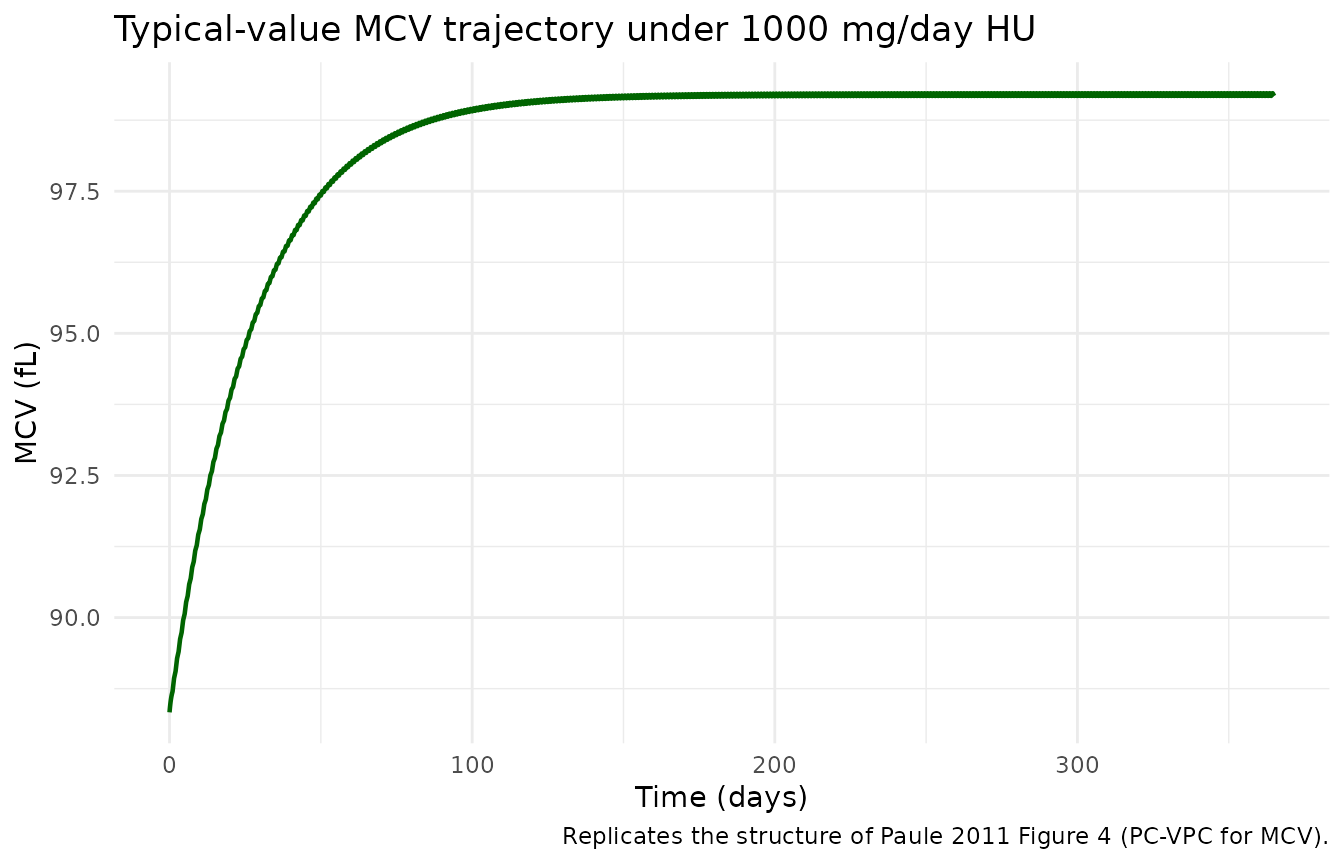
Population-level percentiles (HbF% and MCV)
pd_summary <- sim |>
  dplyr::filter(!is.na(HBF) | !is.na(MCV)) |>
  dplyr::group_by(time) |>
  dplyr::summarise(
    HBF_P05 = quantile(HBF, 0.05, na.rm = TRUE),
    HBF_P50 = quantile(HBF, 0.50, na.rm = TRUE),
    HBF_P95 = quantile(HBF, 0.95, na.rm = TRUE),
    MCV_P05 = quantile(MCV, 0.05, na.rm = TRUE),
    MCV_P50 = quantile(MCV, 0.50, na.rm = TRUE),
    MCV_P95 = quantile(MCV, 0.95, na.rm = TRUE),
    .groups = "drop"
  )

ggplot(pd_summary, aes(time)) +
  geom_ribbon(aes(ymin = HBF_P05, ymax = HBF_P95), fill = "firebrick", alpha = 0.2) +
  geom_line(aes(y = HBF_P50), color = "firebrick", linewidth = 0.8) +
  labs(
    x = "Time (days)",
    y = "HbF (%)",
    title = "HbF% under 1000 mg/day HU - virtual cohort (median + 5-95 % PI)",
    caption = "Cohort n=60 with weight from Paule 2011 Table 1."
  ) +
  theme_minimal()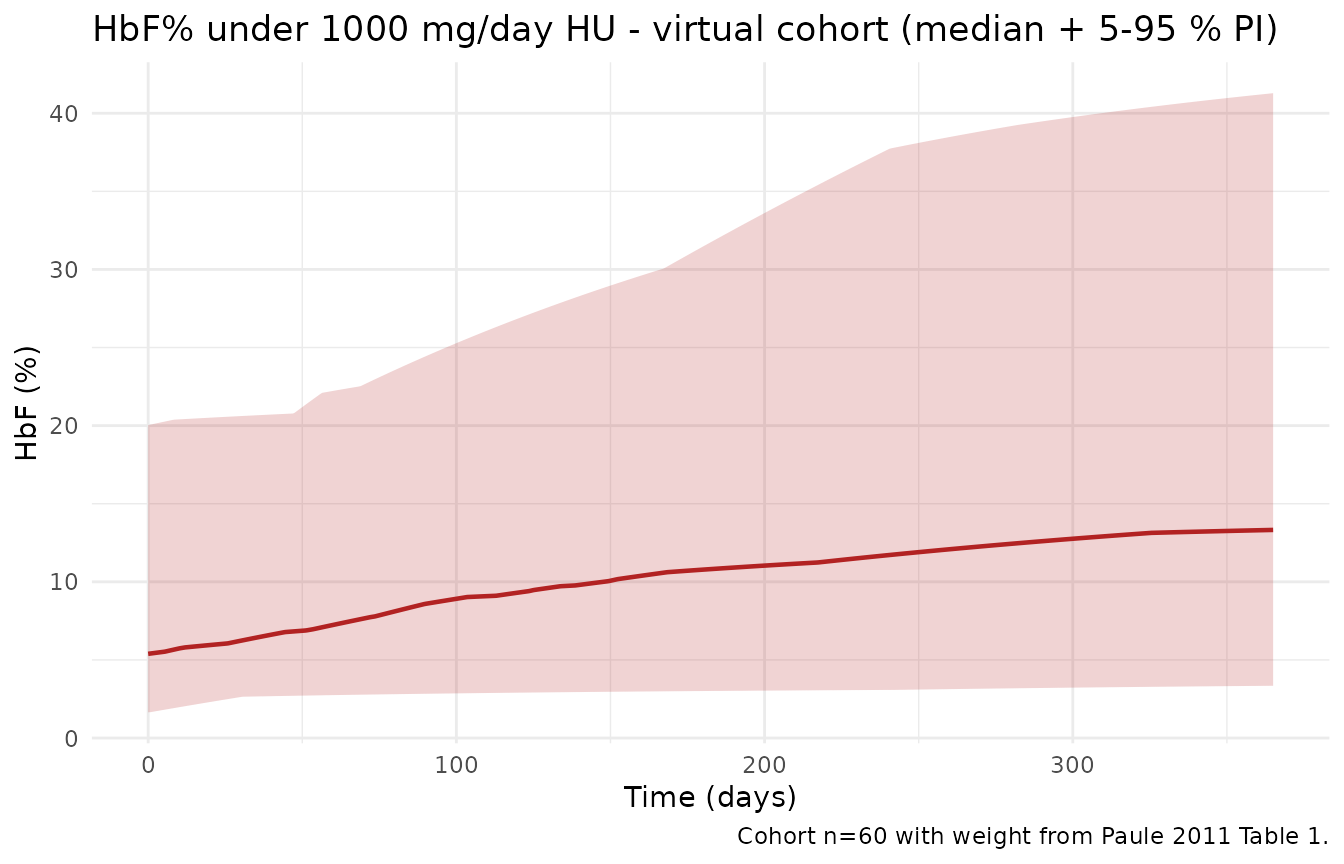
ggplot(pd_summary, aes(time)) +
  geom_ribbon(aes(ymin = MCV_P05, ymax = MCV_P95), fill = "darkgreen", alpha = 0.2) +
  geom_line(aes(y = MCV_P50), color = "darkgreen", linewidth = 0.8) +
  labs(
    x = "Time (days)",
    y = "MCV (fL)",
    title = "MCV under 1000 mg/day HU - virtual cohort (median + 5-95 % PI)",
    caption = "Cohort n=60 with weight from Paule 2011 Table 1."
  ) +
  theme_minimal()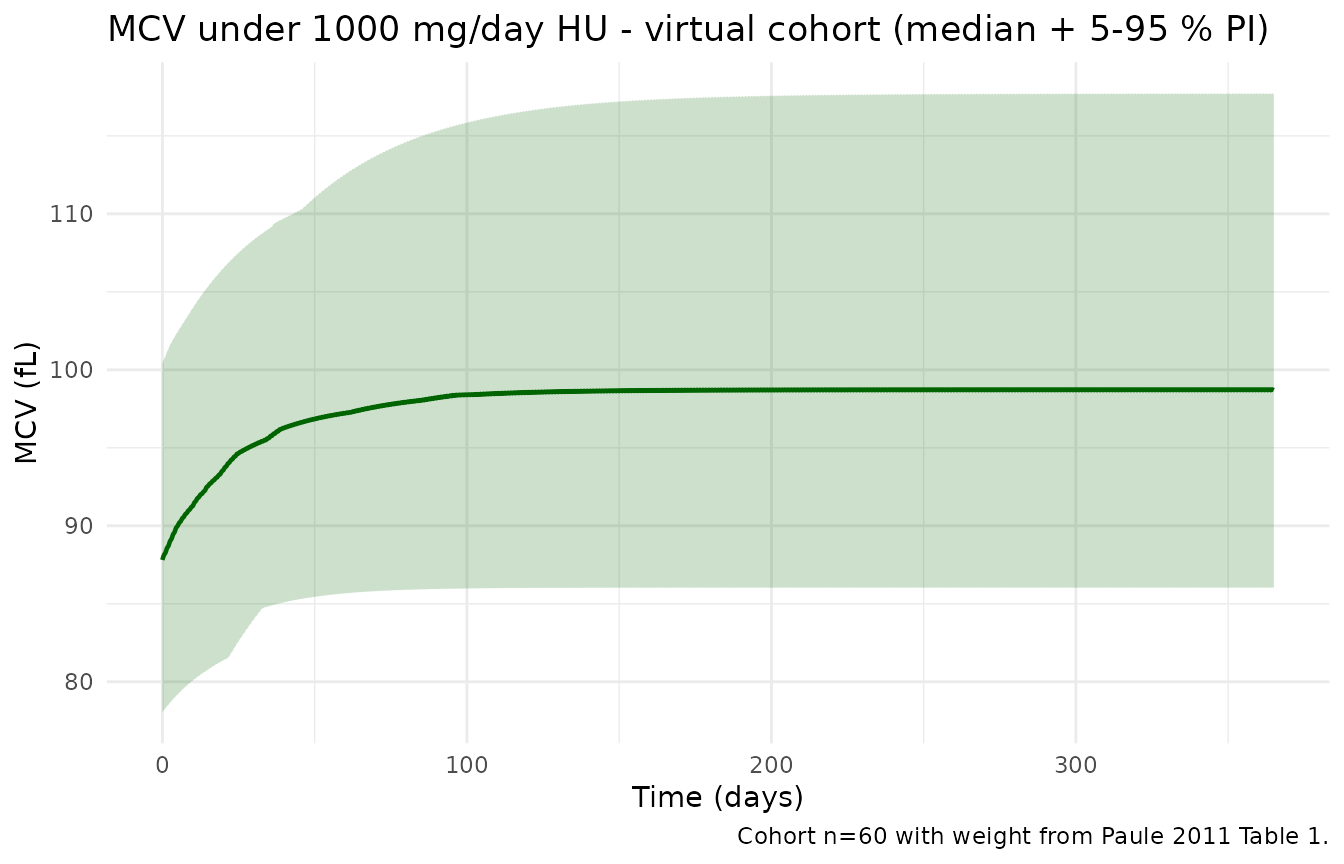
PKNCA validation
For PKNCA the typical-value Cc trajectory over the first dose is the clearest validation target: NCA estimates from the simulated single-dose profile can be compared with the source paper’s reported PK parameters (Vc/F = 45.3 L, CL/F = 11.6 L/h at 70 kg; multiplying by 24 gives CL/F = 278.4 L/day, which sets Cavg at 1000 mg/day to ~3.59 mg/L).
sd_template <- tibble(id = 1L, WT = 70)
sd_ev <- rxode2::et(amt = 1000, cmt = "depot") |>
  rxode2::et(seq(0, 5, by = 1 / 96), cmt = "Cc")
sd_ev <- as.data.frame(sd_ev)
sd_ev <- sd_ev[!is.na(sd_ev$cmt) | !is.na(sd_ev$amt), ]
sd_ev$id <- 1L
sd_ev$WT <- 70
sd_sim <- rxode2::rxSolve(mod_typ, sd_ev, returnType = "data.frame")
#> ℹ omega/sigma items treated as zero: 'etalvc', 'etalcl', 'etalkcp', 'etalka', 'etalkin_hbf', 'etalkout_hbf', 'etalogitimax_hbf', 'etalkin_mcv', 'etalkout_mcv', 'etalb_mcv'

if (!"id" %in% names(sd_sim)) sd_sim$id <- 1L
sim_nca <- sd_sim |>
  dplyr::filter(!is.na(Cc)) |>
  dplyr::transmute(id = id, time = time, Cc = Cc, regimen = "1000mg SD")
dose_df <- sd_ev |>
  dplyr::filter(evid == 1) |>
  dplyr::transmute(id = id, time = time, amt = amt, regimen = "1000mg SD")

conc_obj <- PKNCA::PKNCAconc(sim_nca, Cc ~ time | regimen + id)
dose_obj <- PKNCA::PKNCAdose(dose_df, amt ~ time | regimen + id)

intervals <- data.frame(
  start      = 0,
  end        = Inf,
  cmax       = TRUE,
  tmax       = TRUE,
  aucinf.obs = TRUE,
  half.life  = TRUE
)
nca_res <- PKNCA::pk.nca(PKNCA::PKNCAdata(conc_obj, dose_obj, intervals = intervals))
nca_summary <- summary(nca_res)
knitr::kable(nca_summary, caption = "Single-dose NCA from the simulated typical-value 1000 mg HU profile.")| start | end | regimen | N | cmax | tmax | half.life | aucinf.obs |
|---|---|---|---|---|---|---|---|
| 0 | Inf | 1000mg SD | 1 | 17.2 | 0.0312 | 7.95 | 3.58 |
Comparison against published PK characteristics
ss_typ <- sim_typ |>
  dplyr::filter(!is.na(Cc), time >= 35, time < 60)
cavg_sim <- mean(ss_typ$Cc, na.rm = TRUE)
cmax_sim <- max(ss_typ$Cc, na.rm = TRUE)
cmin_sim <- min(ss_typ$Cc, na.rm = TRUE)
cavg_th  <- 1000 / (11.6 * 24)

knitr::kable(
  data.frame(
    metric    = c("Cavg at SS (mg/L)", "Cmax at SS (mg/L)", "Cmin at SS (mg/L)",
                  "Time to 95 % PK SS (day)",
                  "Time to 95 % HbF SS (months)",
                  "Time to 95 % MCV SS (months)",
                  "Median SS HbF (%)",
                  "Median SS MCV (fL)"),
    simulated = c(round(cavg_sim, 2), round(cmax_sim, 2), round(cmin_sim, 2),
                  "~35 (from sim PK plot)",
                  "~26 (from sim HbF plot)",
                  "~3 (from sim MCV plot)",
                  round(tail(typ_hbf$HBF, 1), 1),
                  round(tail(typ_mcv$MCV, 1), 1)),
    paper     = c(round(cavg_th, 2), "n/a", "n/a",
                  "~35", "~26", "~3",
                  "~18.6", "~104")
  ),
  caption = "Simulated vs. published key PK/PD characteristics (Paule 2011)."
)| metric | simulated | paper |
|---|---|---|
| Cavg at SS (mg/L) | 0.56 | 3.59 |
| Cmax at SS (mg/L) | 1.16 | n/a |
| Cmin at SS (mg/L) | 0.35 | n/a |
| Time to 95 % PK SS (day) | ~35 (from sim PK plot) | ~35 |
| Time to 95 % HbF SS (months) | ~26 (from sim HbF plot) | ~26 |
| Time to 95 % MCV SS (months) | ~3 (from sim MCV plot) | ~3 |
| Median SS HbF (%) | 11.7 | ~18.6 |
| Median SS MCV (fL) | 99.2 | ~104 |
Assumptions and deviations
-
PK time scale converted hour to day. The Paule 2011
PK rate constants are reported in 1/h and CL/F is reported in L/h; the
PD parameters are in 1/day. To run PK and PD on a single time scale we
multiply each PK rate constant by 24 h/day (and CL/F by 24 h/day) when
declaring
lka,lcl,lkcp,lkpc. The fundamental disposition is unchanged. -
HbF inhibition activation. Paule 2011 found Imax
saturated across the full studied dose range (Cc ~ 0.5-9 mg/L) and could
not identify a concentration-response within that range. To run forward
simulation with the same structure (the inhibition equals Imax whenever
drug is on board, and equals zero when no drug is present), we encode
the activation as a smooth saturation
Cc / (Cc + 0.005). The 0.005 mg/L is an engineering constant well below the assay LOQ of 0.532 mg/L; it is not a fitted parameter from the source paper. -
MCV inhibition uses instantaneous Cc. Paule 2011
used the individual posthoc average concentration
Cavg = Dose / (CL * tau)as the input to the MCV PD model (the IPPSE sequential approach). For forward simulation we substitute the instantaneous central concentrationCcas a proxy forCavg. With gamma = 0.19 the inhibition functionb * Cc^gammais very flat (varying only between 0.11 at 2 mg/L and 0.15 at 9 mg/L), so the substitution has a small effect on the long-term dynamics. A tiny positive offset (1e-9) in the power-function argument avoids the0^positivesingularity at Cc = 0. -
Auto-regressive PD covariates omitted. Paule 2011
retained two data-history covariates in the final model: delta-MCV (rate
of MCV change per day between two prior observations) as a covariate on
Kin_HbF and delta-HbF% as a covariate on the MCV parameter
b. Both are auto-regressive features of the response trajectory that require post-hoc per-subject observation history and are not meaningful in forward simulation. We set both effects to 0 (covariate values = 0 in a forward simulation), which omits Kin_HbF andbadjustments of approximately +25 % and +6 % respectively at the paper’s reported median delta-MCV / delta-HbF% values. The structural population point estimates of Kin, Kout, Imax, b, and gamma are unchanged. -
theta_kaformulation. Paule 2011 Table 2 reportsk_a = theta_ka * exp(eta_ka + alpha)for the absorption rate and separately reports a population marginal valuek_a = 3.29 / hand a structuraltheta_ka = 3.02 / h. The source does not state whatalpharepresents (a fixed shift or a between-occasion / study effect); we encode standard log-normal IIV ontheta_ka = 3.02 / h, consistent with the reported structural THETA. The marginal-vs-THETA discrepancy is ~9 % and does not materially affect dose-driven exposure or PD time-courses. -
PK residual error: sparse-cohort defaults. Paule
2011 fitted separate residual error models for the sparse and rich PK
cohorts. The package default uses the sparse-cohort values
(
addSd = 0.353 mg/L,propSd = 0.435) because the typical user scenario is multi-occasion observational PK rather than 24-hour rich sampling. The rich-cohort alternative isaddSd = 0.319 mg/LandpropSd = 0.12. -
Combined
n_subjectscount. Thepopulation$n_subjectsis set to 97 (sparse 81 + rich 16), reflecting the pooled fitting dataset. -
Race / ethnicity not reported. The source paper
does not report race / ethnicity composition beyond a single-center
French enrolment;
population$race_ethnicityis omitted accordingly.