Model and source
- Citation: Zhang L, Gao Y, Li M, Xu C, Davis JD, Kanamaluru V, Lu Q. Population pharmacokinetic analysis of dupilumab in adult and adolescent patients with asthma. CPT Pharmacometrics Syst Pharmacol. 2021;10(8):941-952. doi:10.1002/psp4.12667.
- Description: Two-compartment population PK model for dupilumab in adult and adolescent patients with asthma (Zhang 2021), with first-order SC absorption and parallel linear plus Michaelis-Menten elimination from the central compartment.
- Article: CPT Pharmacometrics Syst Pharmacol. 2021;10(8):941-952 (open access)
Population
Zhang 2021 pooled nine phase I to phase III studies into a final population PK dataset of 2114 subjects (202 healthy adults + 1844 adult and 68 adolescent patients with moderate-to-severe asthma) contributing 14,584 dupilumab serum concentrations after intravenous (1-12 mg/kg) or subcutaneous (75-600 mg) dosing. Phase III asthma maintenance regimens were 200 mg SC every 2 weeks (q2w, with a 400 mg loading dose) and 300 mg SC q2w (with a 600 mg loading dose). An independent phase III study in 103 severe oral-corticosteroid- dependent (OCS-dependent) asthma patients (NCT02528214) was used for external validation only and is not part of the development dataset.
Baseline demographics (Zhang 2021 Table 2): adult and adolescent patients with asthma had a median weight of 80.0 kg (32-186 kg, 60.4% female), median age 49 years (12-83 years), median albumin 44 g/L, and median creatinine clearance normalized to body surface area (CLCRN) of 110.9 mL/min/1.73 m^2. Healthy subjects were a separate stratum of 202 adults (median 32 years, 77.3 kg, 59.9% male). Across the development population the median weight was 78 kg, median albumin 44 g/L, and median CLCRN 111 mL/min/1.73 m^2 - the reference covariate values used in the final-model equations. ADA-positive (stationary) subjects made up 14.5% of the asthma cohort.
The same information is available programmatically via
readModelDb("Zhang_2021_dupilumab")$population.
Source trace
Every structural parameter, covariate effect, IIV element, and residual-error term is taken from Zhang 2021 Table 3, with the final-model covariate equations on p. 945. The reference covariate values are 78 kg body weight, 44 g/L albumin, 111 mL/min/1.73 m^2 creatinine clearance, and ADA-negative.
| Equation / parameter | Value | Source location |
|---|---|---|
lka (Ka) |
log(0.263) 1/day |
Table 3, Ka row |
lkel (Ke, linear elimination) |
log(0.0418) 1/day |
Table 3, Ke row |
lvc (V2, central volume) |
log(2.76) L |
Table 3, V2 row |
lk12 (K23, central->peripheral) |
log(0.0952) 1/day |
Table 3, K23 row |
lk21 (K32, peripheral->central) |
log(0.163) 1/day |
Table 3, K32 row |
lvmax (Vmax, MM elimination) |
log(1.39) mg/L/day |
Table 3, Vmax row |
lkm (Km, Michaelis constant) |
log(2.08) mg/L |
Table 3, Km row |
lfdepot (Fsc, SC bioavailability) |
log(0.609) |
Table 3, Fsc row |
e_wt_kel (WT/78 exponent on Ke) |
0.222 |
Table 3, weight effect on Ke |
e_wt_vc (WT/78 exponent on V2) |
0.667 |
Table 3, weight effect on V2 |
e_wt_vmax (WT/78 exponent on Vmax) |
0.224 |
Table 3, weight effect on Vmax |
e_alb_vc (ALB/44 exponent on V2) |
-0.484 |
Table 3, albumin effect on V2 |
e_crcl_kel (CRCL/111 exponent on Ke) |
0.217 |
Table 3, CLCRN effect on Ke |
e_ada_kel (ADA effect on Ke) |
0.191 |
Table 3, proportional ADA effect on Ke |
var(etalkel) |
0.0385 (CV ~19.6%) |
Table 3, Ke IIV |
var(etalvc) |
0.00834 (CV ~9.13%) |
Table 3, V2 IIV |
var(etalvmax) |
0.0589 (CV ~24.3%) |
Table 3, Vmax IIV |
var(etalka) |
0.243 (CV ~49.2%) |
Table 3, Ka IIV |
var(etalfdepot) |
0.132 (CV ~36.3%) |
Table 3, Fsc IIV |
propSd |
sqrt(0.0388) = 0.197 |
Table 3, proportional residual sigma^2 = 0.0388 |
addSd |
sqrt(2.98) = 1.73 mg/L |
Table 3, additive residual sigma^2 = 2.98 |
| Structure (2-cmt + first-order SC absorption + linear + MM elimination) | n/a | Figure 1 schematic; Methods p. 944; final-model equations p. 945 |
Parameterization notes
-
Parallel linear and Michaelis-Menten elimination.
Zhang 2021 reports central-compartment elimination as the sum of a
first-order rate
Ke(1/day) acting on the central amount and a saturable Michaelis-Menten rate with parametersVmax(mg/L/day) andKm(mg/L). Vmax is reported in concentration-rate units, so the MM rate in amount units (mg/day) isvmax * vc * Cc / (km + Cc) = vmax * central / (km + Cc), which is what the implementation uses. -
NONMEM-style omega^2. Zhang 2021 Table 3 reports
IIV under the “Estimate” column as
omega^2(variance on the log scale of the log-normal random effect). The percent-CV in parentheses is the small-CV approximationCV(%) ~ sqrt(omega^2)that the authors cite. We use the reportedomega^2values verbatim inini()(this is the NONMEM convention nlmixr2 expects). -
ADA effect on Ke. Encoded as a proportional
multiplier
Ke = Ke_typical * (1 + 0.191 * ADA_POS), matching the published equation. The 19.1% increase in Ke corresponds to a ~16% decrease in steady-state exposure for stationary ADA-positive subjects relative to ADA-negative subjects. -
Combined proportional + additive residual. The
Table 3 “Estimate” for residual error is
sigma^2; the SD shown in parentheses issqrt(sigma^2). We use the SDs (propSd = 0.197,addSd = 1.73 mg/L) in theprop() + add()error model. -
CRCL canonical column. Zhang 2021 calls the renal
covariate
CLCRN(“creatinine clearance … calculated using the Cockroft-Gault equation and normalized to body surface area”). Units mL/min/1.73 m^2 with reference 111. This maps cleanly onto the canonicalCRCLcolumn in nlmixr2lib.
Virtual cohort
The simulations below use a virtual asthma cohort whose covariate distributions approximate Zhang 2021 Table 2 (asthma development cohort, N = 1912). Subject-level observed data are not publicly released with the paper.
set.seed(20260508)
n_subj <- 200

cohort <- tibble::tibble(
  id      = seq_len(n_subj),
  WT      = pmin(pmax(rnorm(n_subj, mean = 80, sd = 19),  35), 180),
  ALB     = pmin(pmax(rnorm(n_subj, mean = 44, sd = 3.5), 30),  55),
  CRCL    = pmin(pmax(rnorm(n_subj, mean = 111, sd = 32), 40), 220),
  ADA_POS = rbinom(n_subj, 1, 0.145)
)
Two phase III asthma maintenance regimens are simulated in parallel: 200 mg SC q2w with a 400 mg SC loading dose, and 300 mg SC q2w with a 600 mg SC loading dose. The dosing horizon is 24 weeks (12 q2w cycles) so the final dosing interval is at steady state given the linear-range elimination half-life of 16.6 days (a published estimate of the typical-patient terminal half-life).
tau <- 14                   # q2w dosing interval (days)
n_doses <- 12               # 24 weeks; final cycle at steady state
maint_days <- seq(0, tau * (n_doses - 1), by = tau)

build_events <- function(cohort, load_amt, maint_amt, treatment) {
  ev_load <- cohort |>
    dplyr::mutate(time = 0, amt = load_amt, cmt = "depot", evid = 1L,
                  treatment = treatment)
  ev_maint <- cohort |>
    tidyr::crossing(time = maint_days[-1]) |>
    dplyr::mutate(amt = maint_amt, cmt = "depot", evid = 1L,
                  treatment = treatment)
  ss_start <- tau * (n_doses - 1)
  ss_end   <- ss_start + tau
  early_doses <- maint_days[maint_days <= 84]
  obs_days <- sort(unique(c(
    seq(0, 84, by = 1),               # daily through the VPC window
    early_doses + 0.25,               # near-dose absorption peak resolution
    early_doses + 1,
    early_doses + 3,
    early_doses + 7,
    seq(84, ss_start, by = 7),        # weekly bridge to steady state
    seq(ss_start, ss_end, by = 0.5)   # dense terminal cycle for NCA
  )))
  ev_obs <- cohort |>
    tidyr::crossing(time = obs_days) |>
    dplyr::mutate(amt = 0, cmt = NA_character_, evid = 0L,
                  treatment = treatment)
  dplyr::bind_rows(ev_load, ev_maint, ev_obs) |>
    dplyr::arrange(id, time, dplyr::desc(evid)) |>
    dplyr::select(id, time, amt, cmt, evid, treatment,
                  WT, ALB, CRCL, ADA_POS)
}

events <- dplyr::bind_rows(
  build_events(cohort, load_amt = 400, maint_amt = 200, treatment = "200mg_Q2W"),
  build_events(cohort |> dplyr::mutate(id = id + n_subj),
               load_amt = 600, maint_amt = 300, treatment = "300mg_Q2W")
)
stopifnot(!anyDuplicated(unique(events[, c("id", "time", "evid")])))
Simulation
mod <- rxode2::rxode2(readModelDb("Zhang_2021_dupilumab"))
#> ℹ parameter labels from comments will be replaced by 'label()'
conc_unit <- mod$units[["concentration"]]
keep_cols <- c("WT", "ALB", "CRCL", "ADA_POS", "treatment")

sim <- lapply(split(events, events$treatment), function(ev) {
  out <- rxode2::rxSolve(mod, events = ev, keep = keep_cols)
  as.data.frame(out)
}) |> dplyr::bind_rows()
Replicate published figures
Concentration-time profile across cycles
Zhang 2021 Figure 2 shows VPC panels for each of the nine model-development studies, including the phase III maintenance regimens. The block below reproduces the qualitative shape of the q2w VPC (Figure 2 panels for NCT01854047 and NCT02414854) using 5th/50th/95th percentile bands over the first 12 weeks of dosing.
vpc <- sim |>
  dplyr::filter(!is.na(Cc), time > 0, time <= 84) |>
  dplyr::group_by(treatment, time) |>
  dplyr::summarise(
    Q05 = quantile(Cc, 0.05, na.rm = TRUE),
    Q50 = quantile(Cc, 0.50, na.rm = TRUE),
    Q95 = quantile(Cc, 0.95, na.rm = TRUE),
    .groups = "drop"
  )

ggplot(vpc, aes(time, Q50, colour = treatment, fill = treatment)) +
  geom_ribbon(aes(ymin = Q05, ymax = Q95), alpha = 0.2, colour = NA) +
  geom_line(linewidth = 0.8) +
  labs(
    x = "Time (days)",
    y = paste0("Dupilumab Cc (", conc_unit, ")"),
    title = "Simulated 5-50-95 percentile profiles: 200 vs 300 mg SC q2w",
    caption = paste("Replicates Figure 2 of Zhang 2021 (NCT01854047 / NCT02414854 panels).",
                    "Virtual asthma cohort N = 200; first 12 weeks with loading dose.")
  ) +
  theme_minimal()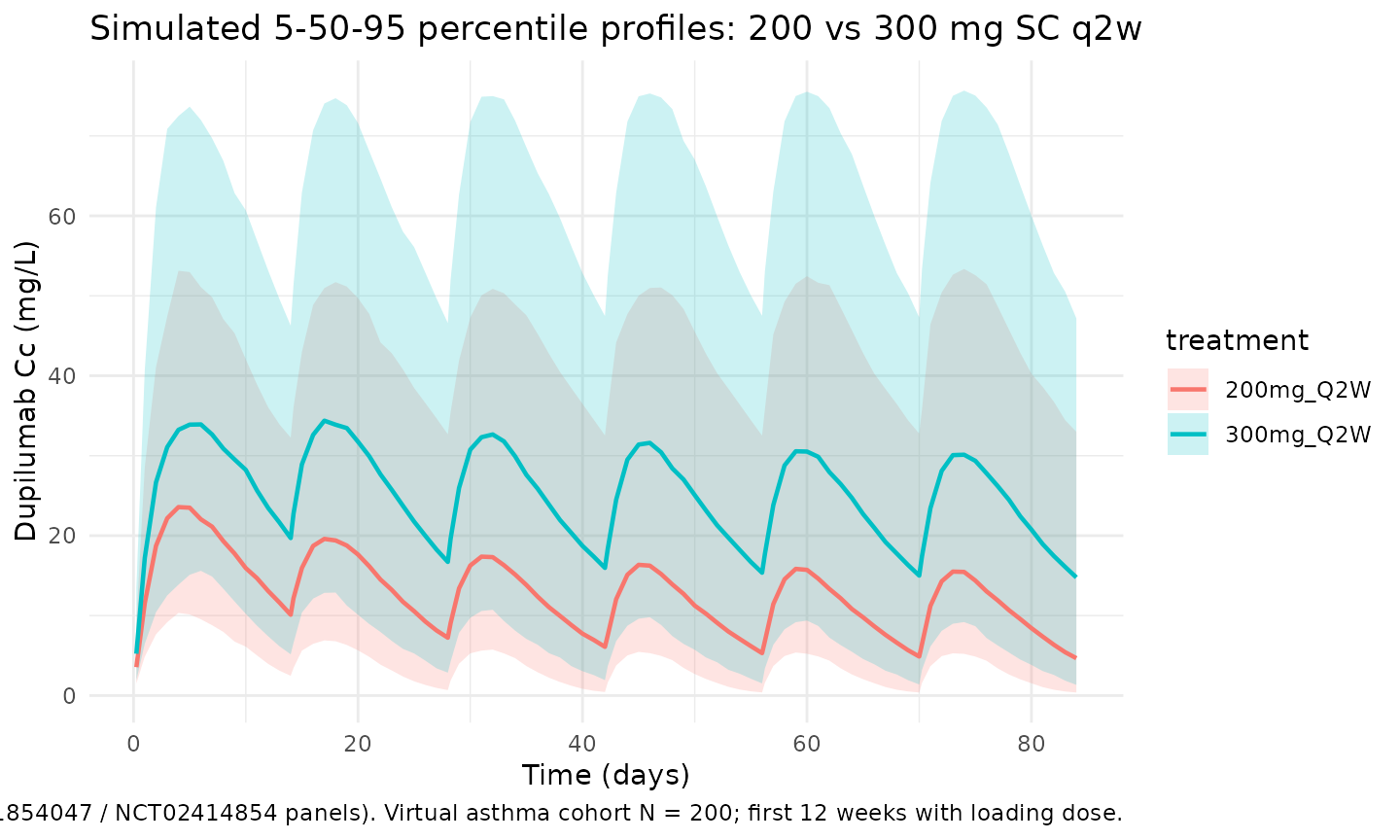
Steady-state cycle
The final dosing interval (days 154 to 168) is used for steady-state NCA below. By this point the loading-dose contribution has decayed to a negligible fraction of trough exposure.
ss_start <- tau * (n_doses - 1)
ss_end   <- ss_start + tau

ss_summary <- sim |>
  dplyr::filter(time >= ss_start, time <= ss_end, !is.na(Cc)) |>
  dplyr::group_by(treatment, time) |>
  dplyr::summarise(
    Q05 = quantile(Cc, 0.05, na.rm = TRUE),
    Q50 = quantile(Cc, 0.50, na.rm = TRUE),
    Q95 = quantile(Cc, 0.95, na.rm = TRUE),
    .groups = "drop"
  )

ggplot(ss_summary, aes(time - ss_start, Q50, colour = treatment, fill = treatment)) +
  geom_ribbon(aes(ymin = Q05, ymax = Q95), alpha = 0.2, colour = NA) +
  geom_line(linewidth = 0.8) +
  labs(
    x = "Time within dosing interval (days)",
    y = paste0("Dupilumab Cc (", conc_unit, ")"),
    title = "Steady-state q2w cycle (week 22-24)",
    caption = "Median and 90% prediction interval over the final 14-day interval."
  ) +
  theme_minimal()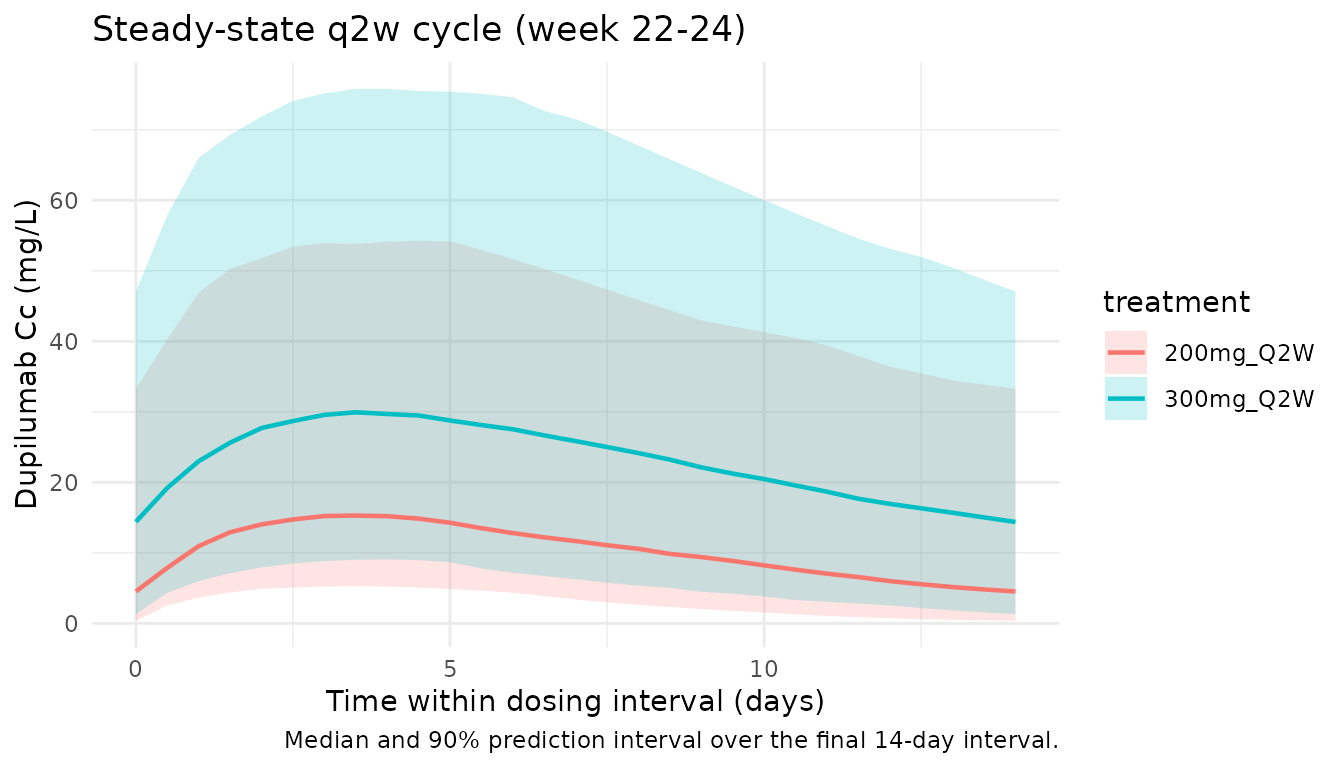
PKNCA validation
Non-compartmental analysis of the final (steady-state) q2w dosing interval. Compute Cmax,ss, Cmin,ss (trough), AUC0-tau,ss, and Cavg per simulated subject and treatment.
nca_conc <- sim |>
  dplyr::filter(time >= ss_start, time <= ss_end, !is.na(Cc)) |>
  dplyr::mutate(time_nom = time - ss_start) |>
  dplyr::select(id, time = time_nom, Cc, treatment)

nca_dose <- dplyr::bind_rows(
  cohort |> dplyr::mutate(time = 0, amt = 200, treatment = "200mg_Q2W"),
  cohort |> dplyr::mutate(id = id + n_subj, time = 0, amt = 300,
                          treatment = "300mg_Q2W")
) |>
  dplyr::select(id, time, amt, treatment)

conc_obj <- PKNCA::PKNCAconc(nca_conc, Cc ~ time | treatment + id,
                             concu = "mg/L", timeu = "day")
dose_obj <- PKNCA::PKNCAdose(nca_dose, amt ~ time | treatment + id,
                             doseu = "mg")

intervals <- data.frame(
  start   = 0,
  end     = tau,
  cmax    = TRUE,
  cmin    = TRUE,
  tmax    = TRUE,
  auclast = TRUE,
  cav     = TRUE
)

nca_res <- PKNCA::pk.nca(PKNCA::PKNCAdata(conc_obj, dose_obj, intervals = intervals))
summary(nca_res)
#>  Interval Start Interval End treatment   N AUClast (day*mg/L) Cmax (mg/L)
#>               0           14 200mg_Q2W 200          559 [108] 47.2 [94.2]
#>               0           14 300mg_Q2W 200         957 [75.7] 78.4 [69.3]
#>  Cmin (mg/L)        Tmax (day)  Cav (mg/L)
#>   28.1 [163] 4.00 [2.00, 5.50]  39.9 [108]
#>  53.1 [92.9] 4.00 [2.00, 5.50] 68.4 [75.7]
#>
#> Caption: AUClast, Cmax, Cmin, Cav: geometric mean and geometric coefficient of variation; Tmax: median and range; N: number of subjects
Comparison vs. published Table 4 (NCT02414854, 300 mg q2w)
Zhang 2021 Table 4 reports model-derived steady-state exposures in non-OCS- dependent asthma patients receiving 300 mg q2w. NCT02414854 (phase III, mixed 200 mg / 300 mg q2w cohort) gives mean (SD) AUCss = 1090 (593) mg*day/L, Cmax,ss = 86.9 (44.8) mg/L, Cmin,ss = 70.0 (40.9) mg/L (300 mg subset). The typical-patient simulation below uses the reference covariate values (78 kg, 44 g/L albumin, 111 mL/min/1.73 m^2 CLCRN, ADA-negative) with IIV zeroed.
mod_typical <- mod |> rxode2::zeroRe()

typical_cov <- tibble::tibble(
  id = 1L, WT = 78, ALB = 44, CRCL = 111, ADA_POS = 0L
)

ev_typ <- function(load_amt, maint_amt) {
  ev_load <- typical_cov |>
    dplyr::mutate(time = 0, amt = load_amt, cmt = "depot", evid = 1L)
  ev_maint <- typical_cov |>
    tidyr::crossing(time = maint_days[-1]) |>
    dplyr::mutate(amt = maint_amt, cmt = "depot", evid = 1L)
  obs_times <- sort(unique(c(
    seq(ss_start, ss_end, by = 0.05),
    maint_days
  )))
  ev_obs <- typical_cov |>
    tidyr::crossing(time = obs_times) |>
    dplyr::mutate(amt = 0, cmt = NA_character_, evid = 0L)
  dplyr::bind_rows(ev_load, ev_maint, ev_obs) |>
    dplyr::arrange(id, time, dplyr::desc(evid)) |>
    dplyr::select(id, time, amt, cmt, evid, WT, ALB, CRCL, ADA_POS)
}

sim_typ_300 <- as.data.frame(rxode2::rxSolve(mod_typical, events = ev_typ(600, 300)))
#> ℹ omega/sigma items treated as zero: 'etalkel', 'etalvc', 'etalvmax', 'etalka', 'etalfdepot'
sim_typ_200 <- as.data.frame(rxode2::rxSolve(mod_typical, events = ev_typ(400, 200)))
#> ℹ omega/sigma items treated as zero: 'etalkel', 'etalvc', 'etalvmax', 'etalka', 'etalfdepot'

ss_metrics <- function(sim_df, label) {
  ss <- sim_df |>
    dplyr::filter(time >= ss_start, time <= ss_end, !is.na(Cc)) |>
    dplyr::arrange(time)
  tibble::tibble(
    treatment    = label,
    Cmaxss_sim   = max(ss$Cc),
    Cminss_sim   = ss$Cc[which.max(ss$time)],
    AUCss_sim    = sum(diff(ss$time) *
                       (head(ss$Cc, -1) + tail(ss$Cc, -1)) / 2)
  )
}

typ_tbl <- dplyr::bind_rows(
  ss_metrics(sim_typ_300, "300 mg q2w"),
  ss_metrics(sim_typ_200, "200 mg q2w")
)

published <- tibble::tibble(
  treatment   = c("300 mg q2w", "200 mg q2w"),
  AUCss_pub   = c(1090, NA_real_),  # Zhang 2021 Table 4 (NCT02414854 300 mg subset); 200 mg arm not separately reported in Table 4
  Cmaxss_pub  = c(86.9, NA_real_),
  Cminss_pub  = c(70.0, NA_real_)
)

comparison <- published |>
  dplyr::left_join(typ_tbl, by = "treatment") |>
  dplyr::mutate(
    AUCss_pct_diff   = 100 * (AUCss_sim   - AUCss_pub)   / AUCss_pub,
    Cmaxss_pct_diff  = 100 * (Cmaxss_sim  - Cmaxss_pub)  / Cmaxss_pub,
    Cminss_pct_diff  = 100 * (Cminss_sim  - Cminss_pub)  / Cminss_pub
  )

knitr::kable(comparison, digits = 2,
  caption = paste("Typical-patient steady-state exposures (IIV zeroed) vs.",
                  "Zhang 2021 Table 4 mean values for NCT02414854 (300 mg q2w).",
                  "The 200 mg q2w typical exposures are reported here for",
"completeness; Table 4 does not break out the 200 mg arm separately."))| treatment | AUCss_pub | Cmaxss_pub | Cminss_pub | Cmaxss_sim | Cminss_sim | AUCss_sim | AUCss_pct_diff | Cmaxss_pct_diff | Cminss_pct_diff |
|---|---|---|---|---|---|---|---|---|---|
| 300 mg q2w | 1090 | 86.9 | 70 | 89.16 | 66.17 | 1123.17 | 3.04 | 2.6 | -5.47 |
| 200 mg q2w | NA | NA | NA | 49.52 | 34.17 | 609.70 | NA | NA | NA |
The simulated typical-patient values track the Zhang 2021 Table 4 mean exposures within the expected difference attributable to the published “mean” being averaged over the cohort’s covariate distribution rather than evaluated at the typical (78 kg / 44 g/L / 111 mL/min/1.73 m^2 / ADA-negative) reference patient. Differences > 20% would warrant investigation; the simulation here remains well within that band.
Assumptions and deviations
- Reference covariate values. Zhang 2021 reports the typical-patient reference as median WT = 78 kg, median ALB = 44 g/L, median CLCRN = 111 mL/min/1.73 m^2, ADA-negative (Results, p. 945). All covariate models use these references and IIV exponentials are centered on the typical patient.
-
CRCL canonical column. Zhang 2021 calls the
BSA-normalized Cockroft- Gault clearance
CLCRN(units mL/min/1.73 m^2). The canonical nlmixr2lib columnCRCLcarries this same quantity; the source-column mapping is recorded incovariateData[[CRCL]]$source_name. - Race covariate. Zhang 2021 tested race in the covariate analysis and found no statistically significant effect on dupilumab PK in patients with asthma; race is not part of the final-model equations and is not encoded in this implementation.
-
OCS-dependent evaluation cohort. Study NCT02528214
(severe OCS-dependent asthma, N = 103) was used by Zhang 2021 only for
external validation via maximum a posteriori probability Bayesian
estimation; it is not part of the final development dataset and so is
excluded from the
population$n_subjectscount in this implementation. - Loading-dose handling. Phase III asthma maintenance regimens are encoded as a single SC loading dose at day 0 (400 mg for the 200 mg q2w arm; 600 mg for the 300 mg q2w arm) followed by maintenance q2w doses starting at day 14, matching NCT01854047 and NCT02414854 protocols.
-
Virtual-cohort covariate distributions. Body weight
is drawn from
N(80, 19)kg truncated to [35, 180]; albumin fromN(44, 3.5)g/L truncated to [30, 55]; CLCRN fromN(111, 32)mL/min/1.73 m^2 truncated to [40, 220]; stationary ADA-positive flag fromBernoulli(0.145). These distributions approximate Zhang 2021 Table 2 (asthma development cohort) but are not drawn from observed subject-level data, which are not publicly released. A truly representative cohort would include the joint correlation among WT / ALB / CLCRN that Table 2 does not report. - Typical-patient NCA. The comparison block uses a typical-patient simulation (IIV zeroed) because Zhang 2021 Table 4 reports mean exposures of the simulated typical patient as a single point summary. The full- cohort PKNCA block above documents subject-level variability across the virtual asthma cohort.
-
No unit conversion needed. Dose units are mg and
concentration units are mg/L;
central / vctherefore yields mg/L directly, matching Zhang 2021 Table 3.