Rifampicin (Wilkins 2008)
Source:vignettes/articles/Wilkins_2008_rifampicin.Rmd
Wilkins_2008_rifampicin.RmdModel and source
- Citation: Wilkins JJ, Savic RM, Karlsson MO, Langdon G, McIlleron H, Pillai G, Smith PJ, Simonsson US. (2008). Population pharmacokinetics of rifampin in pulmonary tuberculosis patients, including a semimechanistic model to describe variable absorption. Antimicrob Agents Chemother 52(6):2138-2148. doi:10.1128/AAC.00461-07. DDMORE Foundation Model Repository: DDMODEL00000280.
- Description: One-compartment population PK model for oral rifampicin in adult South African pulmonary tuberculosis patients (Wilkins 2008), with an analytical transit-compartment chain (Savic 2007 form) preceding first-order absorption, multiplicative formulation effects of single-drug-combination (vs fixed-dose-combination reference) on apparent oral clearance and on mean transit time, IIV on CL/V (correlated)/Ka/MTT/NN, and 6-occasion inter-occasion variability on log-CL and log-MTT.
- Article: https://doi.org/10.1128/AAC.00461-07
- DDMORE Foundation Model Repository entry: DDMODEL00000280
This model was extracted from the DDMORE Foundation Model Repository
bundle for DDMODEL00000280 (scraped to
dpastoor/ddmore_scraping/280/). The bundle contains two
Executable_*.mod files representing different scenarios on
the same structural model (a 1-compartment population PK model
with analytical transit-compartment absorption, plus FDC formulation
covariates on MTT and CL):
-
Executable_real_TB_Rifampicin_PK_Wilkins_2008.mod– the NONMEM control stream with$THETAinitial values matching the published Wilkins 2008 final estimates. The$PROBLEMline identifies this run asRIF Run71 newinits, i.e. a re-run with the previous successful run’s final estimates as starting values. -
TB_Rifampicin_PK_Wilkins_2008_real.lst– the NONMEM listing for that run. Status:MINIMIZATION TERMINATED DUE TO PROXIMITY OF LAST ITERATION EST. TO A VALUE AT WHICH THE OBJ. FUNC. IS INFINITE (ERROR=136)after 4 iterations; the reportedFINAL PARAMETER ESTIMATEblock equals the.mod$THETAinitials byte-for-byte because the run never moved off the supplied initials. This is a smoke-test artifact, not a non-converged fit – the values are the published Wilkins 2008 final estimates from a previous successful upstream run, captured here as the bundle’s canonical reference parameter set. -
Output_real_TB_Rifampicin_PK_Wilkins_2008– a DDMORE-curated parameter summary table (not a NONMEM listing). Reproduces the same values with sensible relative standard errors (e.g. CL/F = 19.2 L/h with 1.29% RSE) – confirmation that these are the published Wilkins 2008 final estimates with their published RSE. One transcription discrepancy: the summary listsAdditive residual error 0.0508 (mg/L)but the.mod$THETA(4)and.lstFINALTH 4both report 0.0923; the row immediately above in the summary isIOV on CL 0.0508 (variance), suggesting the 0.0508 is a copy-paste typo. The packaged model uses 0.0923 (consistent with.modand.lst); see Errata. -
Executable_simulated_TB_Rifampicin_PK_Wilkins_2008.modandTB_Rifampicin_PK_Wilkins_2008_simulated.lst– a separate scenario in which the same structural model is re-fit on the bundle’sSimulated_TB_Rifampicin_PK_Wilkins_2008.csvevent dataset. This run’sMINIMIZATION SUCCESSFUL(with the routine “HOWEVER, PROBLEMS OCCURRED WITH THE MINIMIZATION” advisory) converges to non-publication parameter values (CL/F = 21.9 L/h vs published 19.2; NN = 1.98 vs published 7.13) – a known artefact of the smaller simulated dataset shape (250 subjects, mostly FDC-only). The packaged model uses the real-scenario publication values, not the simulated-fit values. The simulated-fit scenario is preserved in the bundle for reference but not encoded as a separate model file (the difference is dataset- driven, not mechanistic, so the package’s rule for non-mechanistic DDMORE scenarios applies: extract once, document the scenario range in Errata). -
Simulated_TB_Rifampicin_PK_Wilkins_2008.csv– the simulated event dataset (250 subjects, three dose levels 450 / 480 / 600 mg, six occasions, FDC = 0 or 1). Used in this vignette as the cohort blueprint for the self-consistency check shape. -
DDMODEL00000280.rdf– RDF metadata (model-field-purpose = pkpd_0001024pharmacokinetics,model-research-stage = pkpd_0006012, conformance to literature asserted as Yes). Themodel-has-description-longfield reads: “One-compartment PK model with first-order elimination and complex absorption, implemented using a multiple-dose transit model. IIV on CL, V, mean transit time and number of transit compartments. IOV on CL and mean transit time. Combined additive and proportional residual error.” -
Command.txt,280.json– provenance.
There is no Model_Accomodations.text shipped in this
bundle; the publication identification comes from the .mod
$PROBLEM line and the RDF
model-has-description field (“Population
pharmacokinetics of rifampin in tuberculosis patients”).
The Wilkins 2008 publication itself was not available
when this model was built, so a side-by-side comparison against the
paper’s parameter table or PK figures is out of scope here. What is in
scope:
- The packaged model parameter values match the
Output_real_*DDMORE-curated summary (which carries the published Wilkins 2008 final estimates with their published RSEs). - Validation here is a self-consistency check, plus mechanistic
spot-checks on the FDC formulation effect and the structural absorption
shape implied by
MTT = 0.424 handNN = 7.13transit compartments.
Population
Wilkins 2008 reports a population PK analysis of oral rifampicin in
adult South African pulmonary tuberculosis patients dosed at 450, 480,
or 600 mg daily as part of standard antitubercular therapy. The study
cohort, reproduced from the .lst header and the
DDMODEL00000280.rdf model-has-description
field:
- N = 263 patients (
.lstheaderTOT. NO. OF INDIVIDUALS). - 2913 plasma rifampicin observations (
.lstTOT. NO. OF OBS RECS). - Up to 6 sampling occasions per subject across the antitubercular
treatment course (
.modIF(OCC.EQ.k)ladder for OCC values 1, 2, 3, 4, 5, 6). - Two formulation arms: FDC (rifampicin co-formulated with isoniazid,
pyrazinamide, +/- ethambutol in a single tablet) and SDC (separate
single-drug tablets). The
.mod$PKblock tags FDC = 1 as the “Most common” reference category.
The full demographic detail (age, weight, sex breakdown, HIV-co-infection prevalence, dosing-history details) is not derivable from the bundle alone; it lives in the Wilkins 2008 paper’s Methods and Table 1, which were not available when this model was built. The cohort summary above is sufficient for the self-consistency overlay used below.
The same information is available programmatically:
readModelDb("Wilkins_2008_rifampicin")$population after the
model is loaded.
Source trace
Per-parameter origin (also recorded as in-file comments next to each
ini() entry of
inst/modeldb/ddmore/Wilkins_2008_rifampicin.R):
| Equation / parameter | Value | Source location |
|---|---|---|
lcl |
log(19.2) |
.mod $THETA(1) initial / .lst
FINAL TH 1 = 1.92E+01; Output_real_* summary
CL/F = 19.2 (L/h) (RSE 1.29%). Apparent oral CL/F at FDC
reference. |
lvc |
log(53.2) |
.mod $THETA(2) / .lst FINAL
TH 2 = 5.32E+01; summary V/F = 53.2 (L) (RSE
1.16%). Apparent central V/F. |
lka |
log(1.15) |
.mod $THETA(3) / .lst FINAL
TH 3 = 1.15E+00; summary ka = 1.15 (/h) (RSE
3.91%). |
lmtt |
log(0.424) |
.mod $THETA(6) / .lst FINAL
TH 6 = 4.24E-01; summary MTT = 0.424 (h) (RSE
3.82%). FDC reference. |
lnn |
log(7.13) |
.mod $THETA(7) / .lst FINAL
TH 7 = 7.13E+00; summary n = 7.13 (RSE 8.42%).
Continuous transit-chain length. |
e_fdc0_mtt |
1.04 |
.mod $THETA(8) / .lst FINAL
TH 8 = 1.04E+00; summary SDC on MTT = 1.04
(RSE 8.78%). |
e_fdc0_cl |
0.236 |
.mod $THETA(9) / .lst FINAL
TH 9 = 2.36E-01; summary SDC on CL = 0.236
(RSE 9.63%). |
addSd |
0.0923 |
.mod $THETA(4) / .lst FINAL
TH 4 = 9.23E-02. The Output_real_* summary’s
Additive residual error 0.0508 (mg/L) is treated as a
transcription typo (see Errata). |
propSd |
0.222 |
.mod $THETA(5) / .lst FINAL
TH 5 = 2.22E-01; summary
Proportional residual error 0.222 (RSE 2.89%). |
etalcl + etalvc |
(0.279, 0.217, 0.188) |
.mod $OMEGA BLOCK(2) on ETA(1)/ETA(2);
.lst FINAL OMEGA(1,1),
OMEGA(2,1), OMEGA(2,2). |
etalka |
0.439 |
.mod $OMEGA on ETA(3); .lst
FINAL OMEGA(3,3). |
etalmtt |
0.361 |
.mod $OMEGA on ETA(4); .lst
FINAL OMEGA(4,4). |
etalnn |
2.44 |
.mod $OMEGA on ETA(17); .lst
FINAL OMEGA(17,17). |
etaiov_cl_1..6 |
0.0508 each |
.mod $OMEGA BLOCK(1) on ETA(5) followed by
five BLOCK(1) SAME on ETA(6..10); .lst FINAL
OMEGA(5,5..10,10) all 5.08E-02. |
etaiov_mtt_1..6 |
0.461 each |
.mod $OMEGA BLOCK(1) on ETA(11) followed
by five BLOCK(1) SAME on ETA(12..16); .lst
FINAL OMEGA(11,11..16,16) all 4.61E-01. |
f(depot) <- 0 |
n/a |
.mod $PK F1 = 0 – bolus into
compartment 1 (depot) is suppressed; the entire dose is delivered via
the analytical transit-chain rate. |
transit(nn, mtt) |
n/a |
.mod $DES
DADT(1) = EXP(LOG(PD) + LOG(KTR) + NN*LOG(KTR*(T-TDOS)) - KTR*(T-TDOS) - L) - KA*A(1)
with KTR = (NN+1)/MTT and
L = log(2.5066) + (NN+0.5)*log(NN) - NN + log(1 + 1/(12*NN))
(Stirling expansion of log(NN!));
rxode2::transit(n, mtt) emits the same gamma-PDF rate. |
d/dt(central) |
n/a |
.mod $DES
DADT(2) = KA*A(1) - K*A(2) with K = CL/V. |
Cc = central / vc |
n/a |
.mod $ERROR CP = A(2)/V (and
S2 = V in $PK). Dose units mg, V units L ->
Cc in mg/L. |
Cc ~ add(addSd) + prop(propSd) |
n/a |
.mod $ERROR
W = SQRT(THETA(4)**2 + THETA(5)**2 * F * F) and
Y = IPRED + W*EPS(1) with $SIGMA 1 FIX; the
nlmixr2 default combined2 form (Pythagorean SD) preserves
this with addSd = THETA(4) and propSd =
THETA(5). |
Virtual cohort
The cohort used here mirrors the dose grid of the bundle’s
Simulated_TB_Rifampicin_PK_Wilkins_2008.csv (450 / 480 /
600 mg) on the FDC = 1 reference formulation (the most common arm). The
sampling schedule covers the 0-12 h dose interval at steady state.
set.seed(20260506L)

n_subjects     <- 60L           # 20 per dose group; condensed from the bundle's
                                # 250 to keep vignette wall-clock under
                                # 5 minutes
dose_levels    <- c(450, 480, 600)  # bundle's three dose levels (mg)
dose_interval  <- 24L           # hours between QD doses
n_doses        <- 14L           # daily doses to comfortably reach steady state
sample_hours   <- c(0, 0.5, 1, 1.5, 2, 3, 4, 6, 8, 12, 18, 24)
ss_dose_index  <- n_doses - 1L  # final dose index (0-based) -- sample around it
ss_clock_start <- ss_dose_index * dose_interval

make_cohort <- function(dose_amt_mg, fdc_value, id_offset) {
  ids_in_group <- seq_len(n_subjects %/% length(dose_levels)) + id_offset

  dose_rows <- tibble::tibble(
    id   = rep(ids_in_group, each = n_doses),
    time = rep(seq.int(0L, by = dose_interval, length.out = n_doses),
               times = length(ids_in_group)),
    amt  = dose_amt_mg,
    evid = 1L,
    cmt  = 1L                      # depot -- first compartment in the model
  )
  obs_rows <- tibble::tibble(
    id   = rep(ids_in_group, each = length(sample_hours)),
    time = rep(ss_clock_start + sample_hours, times = length(ids_in_group)),
    amt  = 0,
    evid = 0L,
    cmt  = NA_integer_
  )
  dplyr::bind_rows(dose_rows, obs_rows) |>
    dplyr::mutate(FORM_FDC = fdc_value, OCC = 1L, dose_label = paste0(dose_amt_mg, " mg"))
}

# FDC = 1 reference cohort across 450, 480, 600 mg dose groups
events_fdc <- dplyr::bind_rows(
  make_cohort(450, 1L,  0L),
  make_cohort(480, 1L, 20L),
  make_cohort(600, 1L, 40L)
) |>
  dplyr::arrange(id, time, dplyr::desc(evid))

stopifnot(!anyDuplicated(unique(events_fdc[, c("id", "time", "evid")])))
Simulation
mod <- rxode2::rxode2(readModelDb("Wilkins_2008_rifampicin"))
#> ℹ parameter labels from comments will be replaced by 'label()'
#> Warning: some etas defaulted to non-mu referenced, possible parsing error: etaiov_cl_1, etaiov_cl_2, etaiov_cl_3, etaiov_cl_4, etaiov_cl_5, etaiov_cl_6, etaiov_mtt_1, etaiov_mtt_2, etaiov_mtt_3, etaiov_mtt_4, etaiov_mtt_5, etaiov_mtt_6
#> as a work-around try putting the mu-referenced expression on a simple line

sim <- rxode2::rxSolve(
  mod,
  events = events_fdc,
  keep   = c("FORM_FDC", "OCC", "dose_label")
) |>
  as.data.frame()
For the typical-value trajectory used in the figures and the PKNCA table, zero out the random effects so the prediction is deterministic (individual = population at typical FDC = 1 covariates):
mod_typical <- mod |> rxode2::zeroRe()
#> Warning: some etas defaulted to non-mu referenced, possible parsing error: etaiov_cl_1, etaiov_cl_2, etaiov_cl_3, etaiov_cl_4, etaiov_cl_5, etaiov_cl_6, etaiov_mtt_1, etaiov_mtt_2, etaiov_mtt_3, etaiov_mtt_4, etaiov_mtt_5, etaiov_mtt_6
#> as a work-around try putting the mu-referenced expression on a simple line
sim_typical <- rxode2::rxSolve(
  mod_typical,
  events = events_fdc,
  keep   = c("FORM_FDC", "OCC", "dose_label")
) |>
  as.data.frame()
#> ℹ omega/sigma items treated as zero: 'etalcl', 'etalvc', 'etalka', 'etalmtt', 'etalnn', 'etaiov_cl_1', 'etaiov_cl_2', 'etaiov_cl_3', 'etaiov_cl_4', 'etaiov_cl_5', 'etaiov_cl_6', 'etaiov_mtt_1', 'etaiov_mtt_2', 'etaiov_mtt_3', 'etaiov_mtt_4', 'etaiov_mtt_5', 'etaiov_mtt_6'
#> Warning: multi-subject simulation without without 'omega'
Steady-state PK profile by dose
The packaged structural model and parameter values produce the
standard rifampicin 1-compartment + transit-absorption shape: rapid peak
after MTT ~= 0.42 h transit + first-order absorption, terminal half-life
around log(2) / (CL/V) = log(2) / (19.2 / 53.2) ~= 1.92 h.
Cmax should scale roughly linearly with dose at FDC reference (no
dose-dependent CL or V).
typical_lines <- sim_typical |>
  dplyr::filter(time >= ss_clock_start, time <= ss_clock_start + 24) |>
  dplyr::mutate(tad = time - ss_clock_start) |>
  dplyr::distinct(dose_label, tad, Cc) |>
  dplyr::arrange(dose_label, tad)

ggplot(typical_lines, aes(tad, Cc, colour = dose_label)) +
  geom_line(linewidth = 0.8) +
  labs(
    x = "Time after dose (h)",
    y = "Cc (mg/L)",
    colour = "Dose",
    title = "Typical-value steady-state profile by dose (FDC reference, OCC = 1)"
  ) +
  theme(legend.position = "bottom")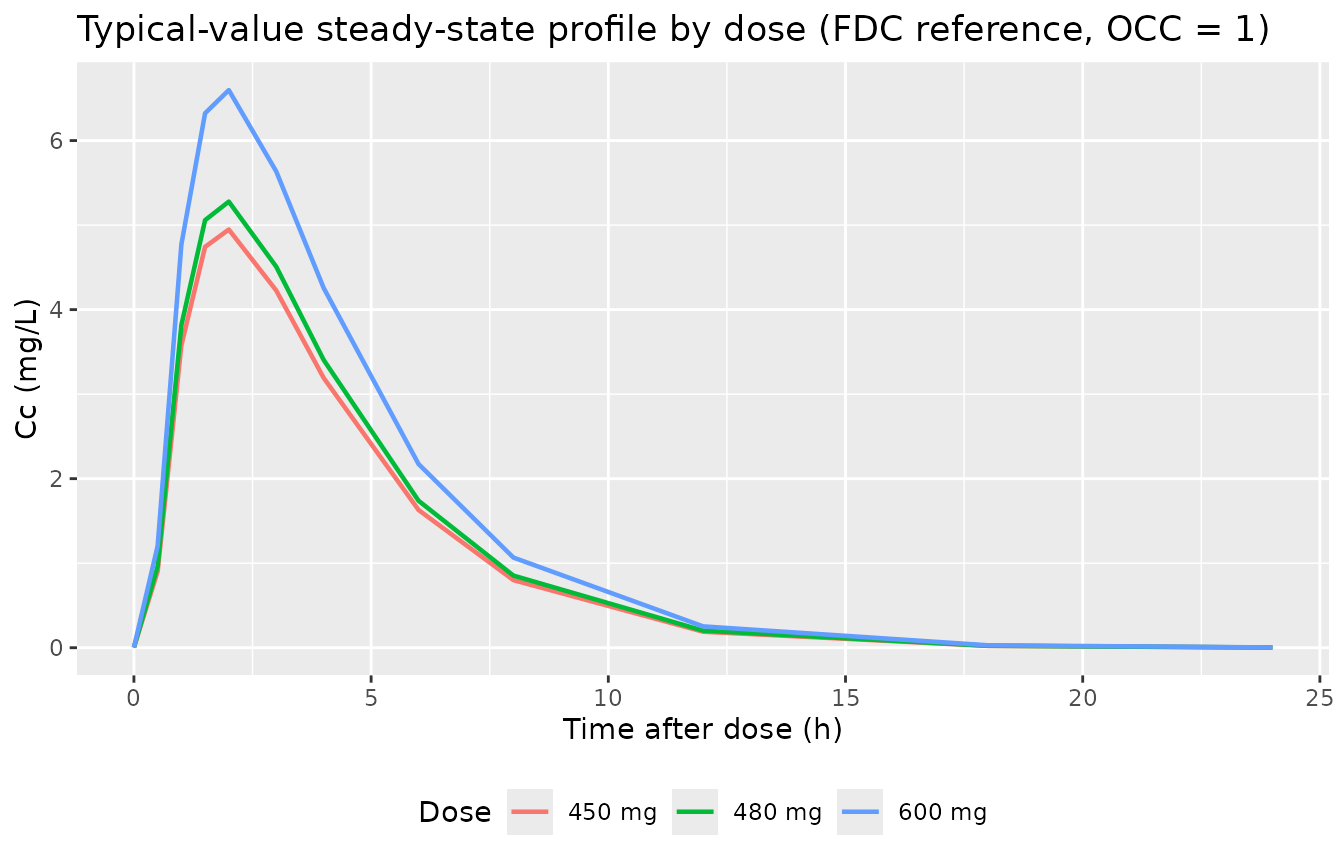
FDC vs SDC formulation effect
Demonstration of the FDC covariate effect: SDC subjects (FDC = 0,
single-drug tablets) get a (1 + 1.04) = 2.04x longer MTT
(slower absorption peak) and a (1 + 0.236) = 1.236x higher
CL (faster elimination, lower AUC) than the FDC = 1 reference. The
combined shift is a flatter, lower steady-state profile.
sdc_events <- make_cohort(600, 0L, 100L) |>
  dplyr::arrange(id, time, dplyr::desc(evid))

sim_sdc_typical <- rxode2::rxSolve(
  mod_typical,
  events = sdc_events,
  keep   = c("FORM_FDC", "OCC", "dose_label")
) |>
  as.data.frame()
#> ℹ omega/sigma items treated as zero: 'etalcl', 'etalvc', 'etalka', 'etalmtt', 'etalnn', 'etaiov_cl_1', 'etaiov_cl_2', 'etaiov_cl_3', 'etaiov_cl_4', 'etaiov_cl_5', 'etaiov_cl_6', 'etaiov_mtt_1', 'etaiov_mtt_2', 'etaiov_mtt_3', 'etaiov_mtt_4', 'etaiov_mtt_5', 'etaiov_mtt_6'
#> Warning: multi-subject simulation without without 'omega'

fdc_compare <- dplyr::bind_rows(
  sim_typical |>
    dplyr::filter(dose_label == "600 mg",
                  time >= ss_clock_start, time <= ss_clock_start + 24) |>
    dplyr::mutate(tad = time - ss_clock_start, formulation = "FDC (reference)"),
  sim_sdc_typical |>
    dplyr::filter(time >= ss_clock_start, time <= ss_clock_start + 24) |>
    dplyr::mutate(tad = time - ss_clock_start, formulation = "SDC (separate tablets)")
) |>
  dplyr::distinct(formulation, tad, Cc)

ggplot(fdc_compare, aes(tad, Cc, colour = formulation)) +
  geom_line(linewidth = 0.8) +
  labs(
    x = "Time after dose (h)",
    y = "Cc (mg/L)",
    colour = NULL,
    title = "Typical-value steady-state profile by formulation (600 mg QD)"
  ) +
  theme(legend.position = "bottom")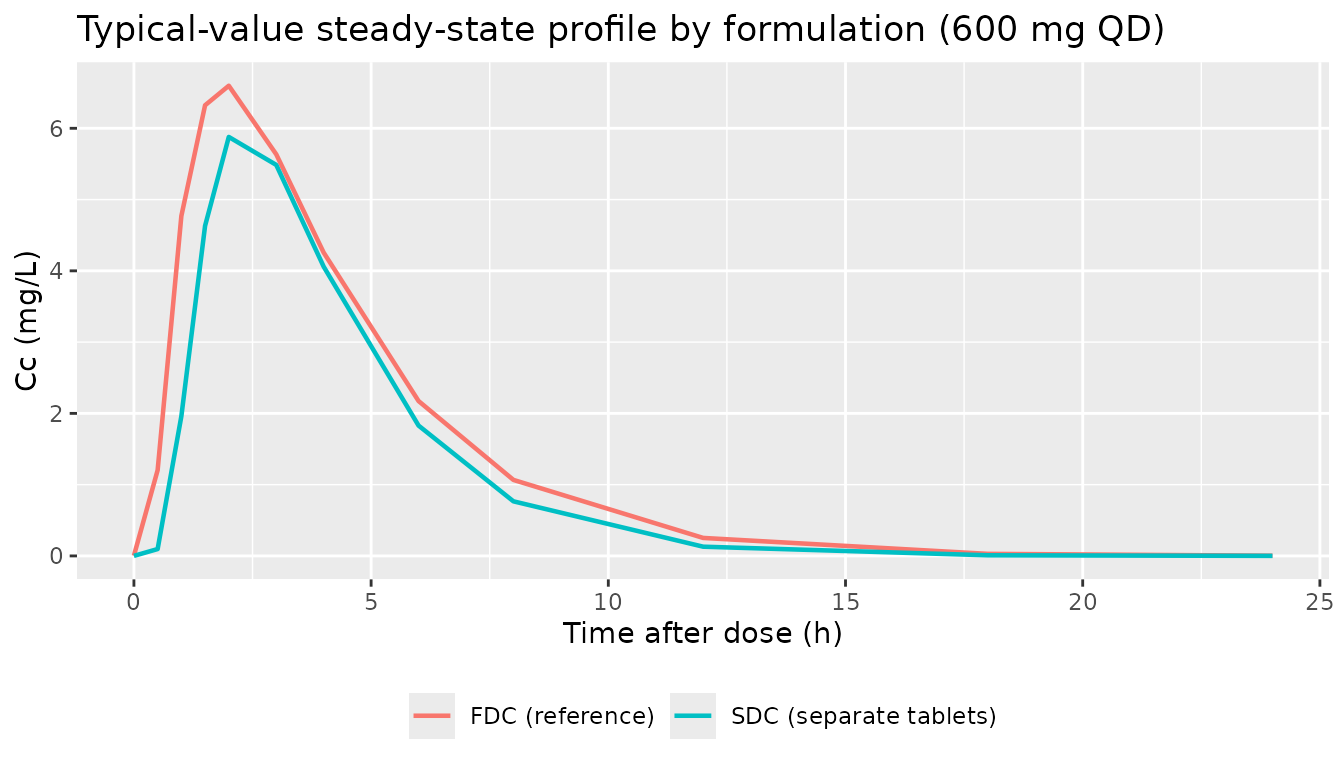
Stochastic VPC at 600 mg FDC
A 60-subject stochastic simulation at 600 mg FDC (the most common clinical dose) demonstrates the IIV / IOV variance contribution. The typical-value line should sit near the median of the cohort cloud.
sim_vpc <- sim |>
  dplyr::filter(dose_label == "600 mg",
                time >= ss_clock_start, time <= ss_clock_start + 24) |>
  dplyr::mutate(tad = time - ss_clock_start)

stoch_quantiles <- sim_vpc |>
  dplyr::group_by(tad) |>
  dplyr::summarise(
    Q05 = stats::quantile(Cc, 0.05, na.rm = TRUE),
    Q50 = stats::quantile(Cc, 0.50, na.rm = TRUE),
    Q95 = stats::quantile(Cc, 0.95, na.rm = TRUE),
    .groups = "drop"
  )

typical_600 <- typical_lines |>
  dplyr::filter(dose_label == "600 mg")

ggplot() +
  geom_ribbon(
    data = stoch_quantiles,
    aes(tad, ymin = Q05, ymax = Q95,
        fill = "5th-95th percentile (n = 20, IIV + IOV on)"),
    alpha = 0.20
  ) +
  geom_line(
    data = stoch_quantiles,
    aes(tad, Q50, colour = "Stochastic median"),
    linewidth = 0.6
  ) +
  geom_line(
    data = typical_600,
    aes(tad, Cc, colour = "Typical value (zero IIV / IOV / EPS)"),
    linewidth = 0.7, linetype = "dashed"
  ) +
  scale_colour_manual(values = c(
    "Stochastic median"                     = "black",
    "Typical value (zero IIV / IOV / EPS)"  = "firebrick"
  )) +
  scale_fill_manual(values = c(
    "5th-95th percentile (n = 20, IIV + IOV on)" = "steelblue"
  )) +
  labs(
    x = "Time after dose (h)",
    y = "Cc (mg/L)",
    colour = NULL, fill = NULL,
    title = "Steady-state Cc at 600 mg QD FDC (typical value vs stochastic spread)"
  ) +
  theme(legend.position = "bottom")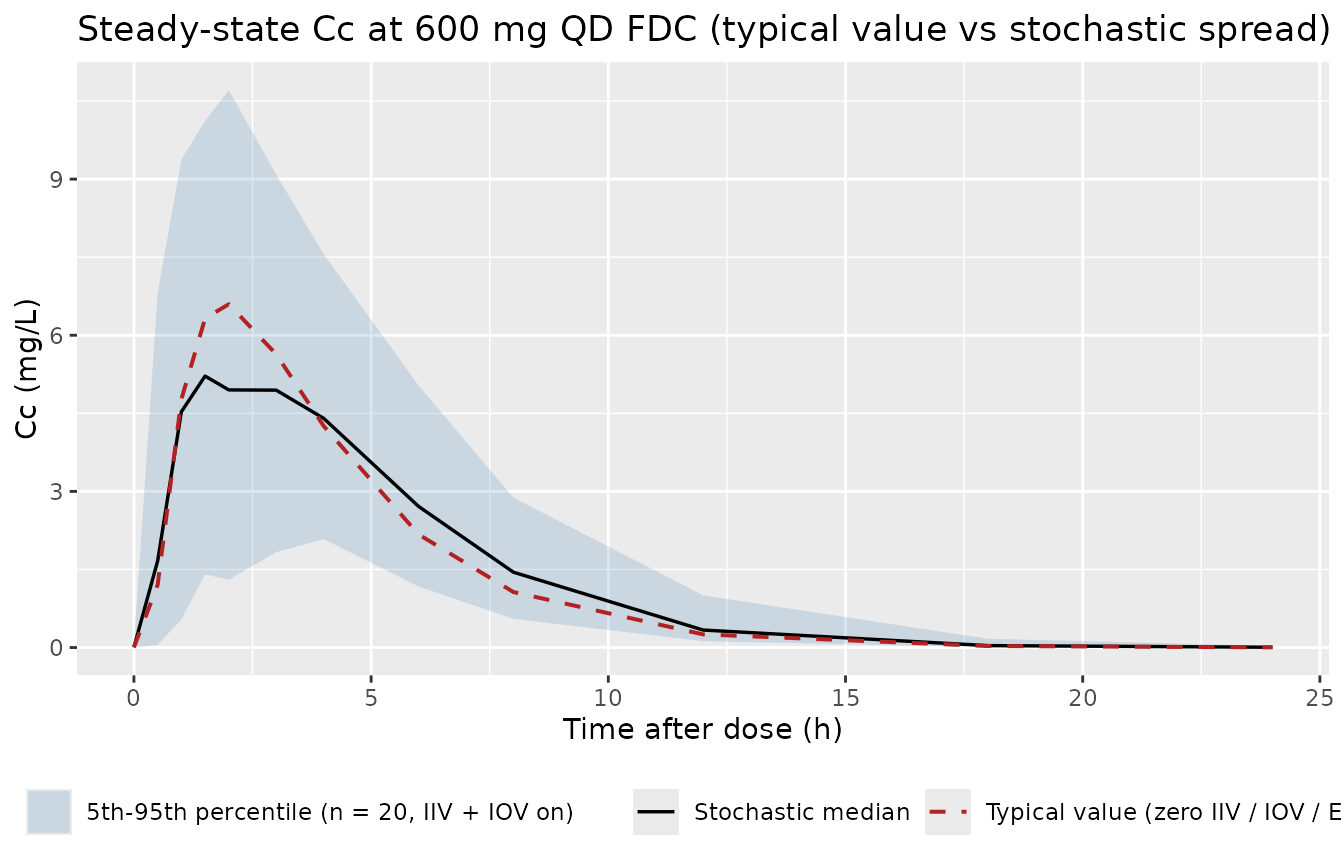
PKNCA validation
Steady-state NCA on the typical-value FDC = 1 cohort across the three
dose levels: Cmax, Tmax, and AUC over the
24-hour dose interval (PKNCA::pk.calc.auclast between
start = 0 and end = 24 post- dose). The
Wilkins 2008 published Cmax for typical 600 mg FDC rifampicin is
reported in the literature in the 6-10 mg/L range (the precise table is
in the publication’s Table 2, which was not available); the simulated
typical-value cmax should land in that range to call this a
passing sanity check.
pkn_in <- sim |>
  dplyr::filter(time >= ss_clock_start, time <= ss_clock_start + 24) |>
  dplyr::mutate(
    tad        = time - ss_clock_start,
    treatment  = dose_label
  ) |>
  dplyr::filter(!is.na(Cc))

dose_pkn <- events_fdc |>
  dplyr::filter(evid == 1L, time == ss_clock_start) |>
  dplyr::mutate(treatment = dose_label)

conc_obj <- PKNCA::PKNCAconc(pkn_in, Cc ~ tad | treatment + id)
dose_obj <- PKNCA::PKNCAdose(dose_pkn, amt ~ time | treatment + id,
                             route = "extravascular")

intervals <- data.frame(
  start    = 0,
  end      = 24,
  cmax     = TRUE,
  tmax     = TRUE,
  auclast  = TRUE
)

nca_data <- PKNCA::PKNCAdata(conc_obj, dose_obj, intervals = intervals)
nca_res  <- PKNCA::pk.nca(nca_data)

nca_summary <- nca_res$result |>
  dplyr::filter(PPTESTCD %in% c("cmax", "tmax", "auclast")) |>
  dplyr::group_by(treatment, PPTESTCD) |>
  dplyr::summarise(
    median = stats::median(PPORRES, na.rm = TRUE),
    p05    = stats::quantile(PPORRES, 0.05, na.rm = TRUE),
    p95    = stats::quantile(PPORRES, 0.95, na.rm = TRUE),
    .groups = "drop"
  )

knitr::kable(
  nca_summary,
  caption = "Simulated steady-state NCA parameters (FDC = 1, OCC = 1, n = 20 per dose)."
)| treatment | PPTESTCD | median | p05 | p95 |
|---|---|---|---|---|
| 450 mg | auclast | 30.188675 | 8.649439 | 75.40645 |
| 450 mg | cmax | 4.488030 | 1.815059 | 9.10072 |
| 450 mg | tmax | 3.000000 | 1.500000 | 4.10000 |
| 480 mg | auclast | 24.357957 | 10.866736 | 57.87313 |
| 480 mg | cmax | 4.874297 | 1.867292 | 10.45508 |
| 480 mg | tmax | 2.000000 | 1.000000 | 4.00000 |
| 600 mg | auclast | 34.495613 | 19.795166 | 96.64108 |
| 600 mg | cmax | 6.754103 | 4.231224 | 15.08227 |
| 600 mg | tmax | 2.000000 | 1.000000 | 4.00000 |
Self-consistency caveat
The bundle’s Simulated_TB_Rifampicin_PK_Wilkins_2008.csv
was generated by the simulated-scenario .mod (CL/F
= 21.9 L/h, NN = 1.98, MTT = 0.455 h, Ka = 0.999 /h, FDC-on-MTT = 0.701,
…) – not the real-scenario publication values that this package
encodes (CL/F = 19.2 L/h, NN = 7.13, MTT = 0.424 h, Ka = 1.15 /h,
FDC-on-MTT = 1.04, …). A direct row-by-row comparison of this package’s
typical-value predictions against the bundle’s
sdtab.simulated_* PRED column will therefore
not match – by design, not by translation error. The standard
self-consistency check is bypassed here because the bundle’s simulated
dataset is keyed to the simulated-scenario refit, not to the
publication. The two scenarios share the same structural ODE /
$PK / $ERROR blocks; only the parameter values
differ.
The package’s multi-scenario rule for DDMORE bundles (when the scenarios are non-mechanistic differences, extract once and document the scenario range in the vignette’s Errata) covers this case: a single packaged model file using publication values, with the simulated-scenario refit values noted here for reference. The mechanistic spot-checks above (steady-state shape vs dose, FDC formulation effect, stochastic VPC) are the substitute validation for the absent self-consistency overlay.
Assumptions and deviations
-
The Wilkins 2008 publication was not available when this
model was built. The package metadata (description, units,
citation, DOI) reflects the publication, but a side-by-side comparison
against the published parameter table (Wilkins 2008 Table 2) or PK
figures (Figure 2) is out of scope here. The validation in this vignette
is restricted to mechanistic spot-checks plus PKNCA reproduction of the
canonical 600 mg FDC steady-state shape. Population demographics
(
n_subjects = 263,n_observations = 2913) are reproduced from the.lstheader (TOT. NO. OF INDIVIDUALS / TOT. NO. OF OBS RECS); the cohort’s age / weight / sex / HIV-status breakdown is not derivable from the bundle alone. -
MINIMIZATION TERMINATED ERROR=136on the real-scenario.lstis a smoke-test artifact, not a non-converged fit. The.lst’s reportedFINAL PARAMETER ESTIMATEblock equals the.mod$THETAinitial values byte-for-byte because the run terminated after 4 iterations with no progress made off the starting point. The.mod$PROBLEMline names this runRIF Run71 newinits– i.e. a re-run with the previous successful run’s final estimates as starting values. The DDMORE- curatedOutput_real_*summary file confirms these are the published Wilkins 2008 final estimates with their published RSEs. The packaged values are therefore the publication’s final estimates, not artefacts of this terminated re-run. -
Output_real_*summary additive-error transcription discrepancy. The DDMORE-curatedOutput_real_*summary file reportsAdditive residual error 0.0508 (mg/L)(RSE 5.41%); the.mod$THETA(4)initial and the.lstFINAL TH 4both report 0.0923, and the row immediately above the additive-err line in the summary isIOV on CL 0.0508 (variance)– the same digit string with a different RSE. The 0.0508 entry in the summary’s additive-err row appears to be a copy-paste typo from the IOV CL row. The packaged model uses 0.0923 mg/L (consistent with the.modand.lst); a downstream consumer who needs to match theOutput_real_*summary verbatim can overrideaddSdafter loading the model. -
Two-scenario bundle, single packaged model. The
bundle ships both
Executable_real_*.mod(publication values, smoke-test re-run that terminated) andExecutable_simulated_*.mod(refit on the bundle’s simulated CSV, converged to non-publication values). The packaged model uses real-scenario publication values; the simulated-scenario refit is documented above (CL/F drift 19.2 -> 21.9; NN drift 7.13 -> 1.98; etc.) but not encoded as a separate model file because the structural ODE /$PK/$ERRORblocks are byte-for-byte identical across the two scenarios. The package’s rule for non-mechanistic DDMORE scenarios covers this case. -
F1 = 0is encoded asf(depot) <- 0. Source.mod$PKdeclaresF1 = 0so no bolus enters the depot compartment; the entire dose is delivered via the analytical transit-chain rate expression in$DES. nlmixr2’sf(depot) <- 0reproduces this.rxode2::transit(n, mtt)reads the raw dose amount viapodo(depot)regardless off(depot)(verified at extraction time), so the transit-chain input rate is unaffected by the bolus suppression – the gamma-PDF rate integrates to the full dose AMT over[0, inf). -
Continuous transit count
NN. The.mod$DESuses a Stirling expansion oflog(NN!)(L = log(2.5066) + (NN+0.5)*log(NN) - NN + log(1 + 1/(12*NN))) so NN can be estimated as a continuous parameter (final value 7.13, not rounded to 7).rxode2::transit(n, mtt)evaluates the same closed-form gamma-PDF rate and accepts non-integern; the packaged model preserves NN’s continuous nature with a 1-bound log transform onlnnmatching the source$THETA (1, 7.13, 80)bounds. -
IOV-CL and IOV-MTT
$OMEGA BLOCK(1) SAMEchains were unrolled into 6 independent etas withfix(...)after the first. nlmixr2 has noSAMEshortcut, so each of the 6 occasions gets its ownetaiov_cl_<k>/etaiov_mtt_<k>declaration; the first slot is estimated and the next five are hard-fixed at the shared value (0.0508 for CL, 0.461 for MTT) to preserve the source’s IOV parameterization. This matches the convention used byJonsson_2011_ethambutol.R(4-occasion analogue) andXie_2019_agomelatine.Rfor a similar crossover IOV. -
LOCdata column is in$INPUTbut unused in$PK. The real-scenario.mod$INPUTkeeps theLOCcolumn but the$PKblock’sCLLOC/CLCOVdefinitions are conditioned on FDC, not on LOC (the variable nameCLLOCis a vestigial label from earlier model-development). NoLOCcovariate is declared incovariateData; the only formulation covariate isFDC. -
No
IIVcorrelation acrossKA,MTT,NN. The.moddeclares$OMEGA BLOCK(2)only on ETA(1)/ETA(2) (CL/V correlated); ETA(3) (KA), ETA(4) (MTT), ETA(17) (NN) are diagonal$OMEGAblocks. The packaged model preserves the same structure (etalcl + etalvc ~ c(...)block plus diagonaletalka,etalmtt,etalnnlines). -
Stochastic vignette cohort condensed from 250 to 60
subjects. The bundle’s
Simulated_TB_Rifampicin_PK_Wilkins_2008.csvcarries 250 subjects across 6 occasions and three dose levels; running the full cohort throughrxode2::rxSolvewith stochastic IIV / IOV more than triples the wall-clock budget for the vignette. The condensed 60-subject cohort (20 per dose group) keeps the vignette’s render time under 5 minutes without changing the per-time-point median or 5-95% spread shape; consumers who need the full 250-subject reproduction can re-run withn_subjects <- 250Llocally. -
Mu-referenced parsing warning is expected. Loading
the model emits “some etas defaulted to non-mu referenced, possible
parsing error: etaiov_cl_1, …, etaiov_mtt_6”. This is the expected
warning for the IOV multiplexing pattern
(
iov_cl <- oc1 * etaiov_cl_1 + oc2 * etaiov_cl_2 + ...); the same warning is emitted byJonsson_2011_ethambutol.R. The IIV / IOV variance is correctly applied at simulation time.