Amlitelimab (Tiraboschi 2025)
Source:vignettes/articles/Tiraboschi_2025_amlitelimab.Rmd
Tiraboschi_2025_amlitelimab.Rmd
library(nlmixr2lib)
library(PKNCA)
#>
#> Attaching package: 'PKNCA'
#> The following object is masked from 'package:stats':
#>
#>     filter
library(dplyr)
#>
#> Attaching package: 'dplyr'
#> The following objects are masked from 'package:stats':
#>
#>     filter, lag
#> The following objects are masked from 'package:base':
#>
#>     intersect, setdiff, setequal, union
library(ggplot2)
Amlitelimab population PK simulation
Tiraboschi et al. (2025) developed a population PK model for amlitelimab (anti-OX40L monoclonal antibody) in 439 adults (78 healthy volunteers and 361 with moderate-to-severe atopic dermatitis). The structural model is a two-compartment disposition with first-order subcutaneous absorption, an absorption lag, and parallel linear and Michaelis-Menten (target-mediated) elimination from the central compartment. Allometric body-weight scaling acts on linear CL, V1, and V2; baseline SCORE_EASI adds to linear CL additively, and baseline serum albumin modifies subcutaneous bioavailability (additive on the linear scale before logit transformation).
This vignette simulates the labelled STREAM-AD regimen (250 mg SC Q4W with a 500 mg SC loading dose at time 0) in a virtual AD population and verifies three qualitative claims from the paper:
- Terminal half-life of amlitelimab in the linear PK range is approximately 28 days (range 24-43 days).
- Body weight is the dominant PK covariate, driving steady-state exposure up by roughly 70% in a 40 kg subject and down by roughly 25% in a 100 kg subject, relative to the 75 kg reference participant (Table S3).
- Clearance at the lower limit of quantification (0.0469 µg/mL) is dominated (~66%) by target-mediated elimination, whereas above ~2 µg/mL the linear pathway dominates (Figure 3).
Virtual population
set.seed(2025)
n_subj <- 300

# Body weight: log-normal around the population median of 74.5 kg,
# truncated to the study range [40.5, 148] kg.
wt_draw <- exp(rnorm(n_subj, log(74.5), 0.22))
WT <- pmin(pmax(wt_draw, 40.5), 148)

# Baseline SCORE_EASI: mean 29.7, SD 11.3 in AD subjects (Table S1);
# truncated at SCORE_EASI >= 6 (moderate threshold for STREAM-AD eligibility)
# and <= 72 (the maximum possible score).
SCORE_EASI <- pmin(pmax(rnorm(n_subj, 29.7, 11.3), 6), 72)

# Baseline serum albumin: mean 46.4 g/L, SD 3.5 g/L, truncated to [37, 57].
ALB <- pmin(pmax(rnorm(n_subj, 46.4, 3.5), 37), 57)

pop <- data.frame(
  ID   = seq_len(n_subj),
  WT   = WT,
  SCORE_EASI = SCORE_EASI,
  ALB  = ALB
)

# Weight strata for the covariate sensitivity figure
pop$wt_group <- cut(
  pop$WT,
  breaks = c(0, 50, 75, 100, Inf),
  labels = c("< 50 kg", "50\u201375 kg", "75\u2013100 kg", "\u2265 100 kg"),
  right  = FALSE
)
Dataset construction
STREAM-AD labelled regimen: 500 mg SC loading dose at day 0, followed by 250 mg SC Q4W through week 24, with weekly observations through week 30.
dose_days <- c(0, seq(28, 168, by = 28))           # loading + Q4W for 24 weeks
dose_amt  <- c(500, rep(250, length(dose_days) - 1))

obs_times_day <- seq(0, 210, by = 7)               # through week 30

d_dose <- pop[rep(seq_len(n_subj), each = length(dose_days)), ] |>
  mutate(
    TIME = rep(dose_days, times = n_subj),
    AMT  = rep(dose_amt,  times = n_subj),
    EVID = 1,
    CMT  = "depot",
    DV   = NA
  )

d_obs <- pop[rep(seq_len(n_subj), each = length(obs_times_day)), ] |>
  mutate(
    TIME = rep(obs_times_day, times = n_subj),
    AMT  = 0,
    EVID = 0,
    CMT  = "central",
    DV   = NA
  )

d_sim <- bind_rows(d_dose, d_obs) |>
  arrange(ID, TIME, desc(EVID)) |>
  select(ID, TIME, AMT, EVID, CMT, DV, WT, SCORE_EASI, ALB, wt_group)
Load model and simulate
mod <- readModelDb("Tiraboschi_2025_amlitelimab")

set.seed(2025)
sim_out <- rxode2::rxSolve(mod, events = d_sim)
#> ℹ parameter labels from comments will be replaced by 'label()'
Figure — population concentration-time profile (median and 90% PI)
sim_plot <- sim_out |>
  as.data.frame() |>
  filter(time > 0)

d_overall <- sim_plot |>
  group_by(time) |>
  summarise(
    Q05 = quantile(Cc, 0.05, na.rm = TRUE),
    Q50 = quantile(Cc, 0.50, na.rm = TRUE),
    Q95 = quantile(Cc, 0.95, na.rm = TRUE),
    .groups = "drop"
  )

ggplot(d_overall, aes(x = time, y = Q50)) +
  geom_ribbon(aes(ymin = Q05, ymax = Q95), fill = "steelblue", alpha = 0.25) +
  geom_line(linewidth = 0.8) +
  scale_y_log10() +
  scale_x_continuous(breaks = seq(0, 210, by = 28)) +
  labs(
    x = "Time after first dose (days)",
    y = "Amlitelimab concentration (\u03bcg/mL)",
    title = "STREAM-AD 250 mg Q4W with 500 mg loading dose\nMedian and 90% prediction interval"
  ) +
  theme_bw()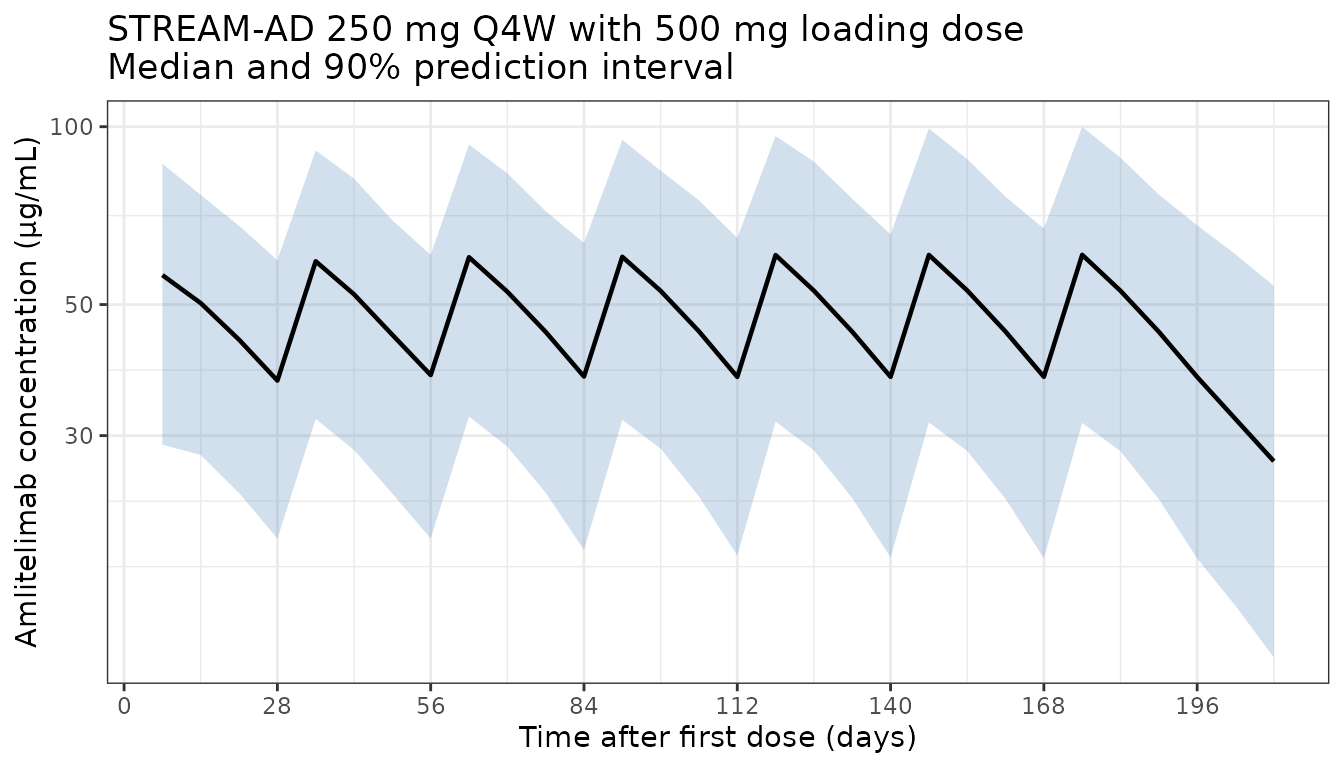
Figure — stratification by baseline body weight
wt_map <- d_sim |>
  filter(EVID == 0, TIME == 0) |>
  select(ID, wt_group) |>
  distinct()

d_wt <- sim_plot |>
  left_join(wt_map, by = c("id" = "ID")) |>
  group_by(time, wt_group) |>
  summarise(
    Q50 = quantile(Cc, 0.50, na.rm = TRUE),
    Q05 = quantile(Cc, 0.05, na.rm = TRUE),
    Q95 = quantile(Cc, 0.95, na.rm = TRUE),
    .groups = "drop"
  )

ggplot(d_wt, aes(x = time, y = Q50, colour = wt_group, fill = wt_group)) +
  geom_ribbon(aes(ymin = Q05, ymax = Q95), alpha = 0.15, colour = NA) +
  geom_line(linewidth = 0.8) +
  scale_y_log10() +
  scale_x_continuous(breaks = seq(0, 210, by = 28)) +
  labs(
    x = "Time after first dose (days)",
    y = "Amlitelimab concentration (\u03bcg/mL)",
    colour = "Body weight",
    fill   = "Body weight",
    title  = "STREAM-AD Q4W regimen stratified by baseline body weight"
  ) +
  theme_bw()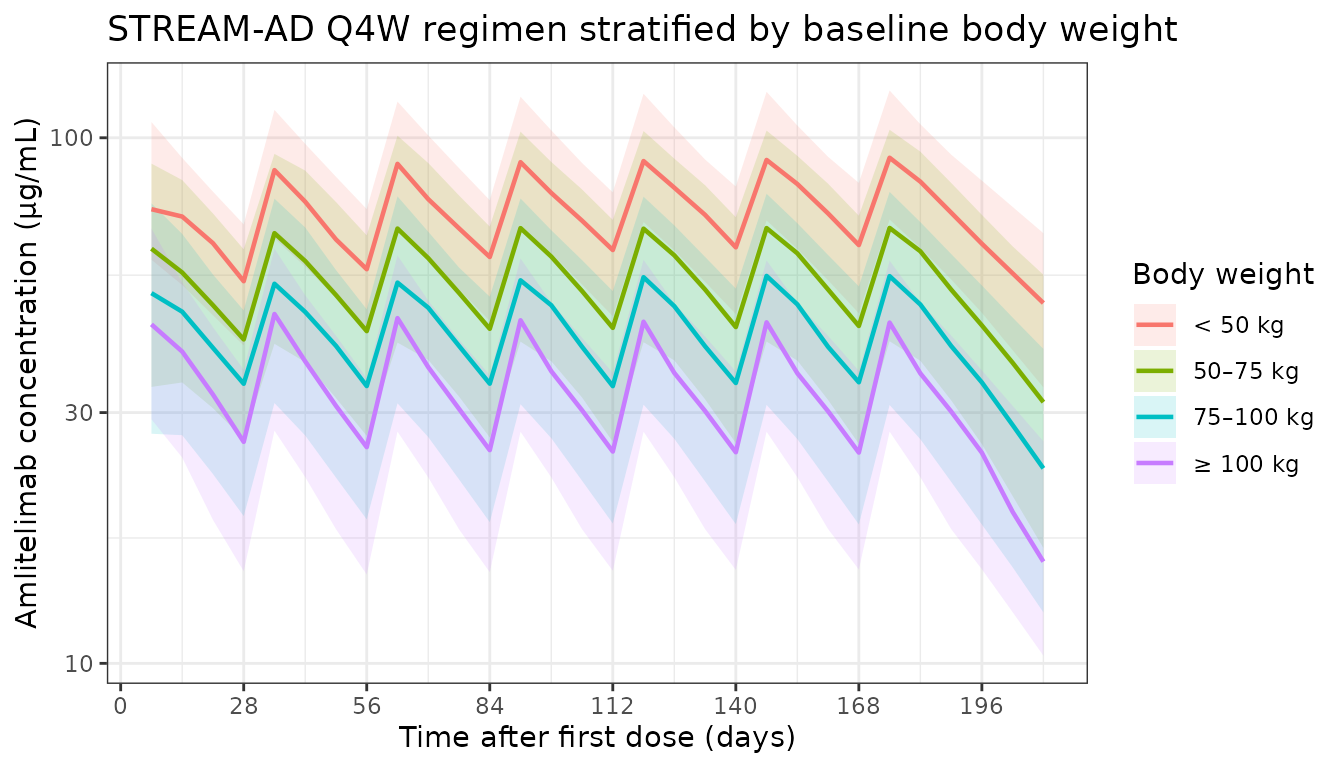
Covariate sensitivity — Table S3 replication
Compare steady-state week-24 exposure (AUC over the 4-week dosing interval, AUC4W) against the reference AD patient (75 kg, SCORE_EASI 27.5, albumin 47 g/L) receiving 62.5 mg Q4W. Table S3 reports AUC4W changes of +72%, +44%, -24%, and -51% for 40, 50, 100, and 150 kg participants respectively.
ref <- data.frame(ID = 1, WT = 75, SCORE_EASI = 27.5, ALB = 47)

typ_pop <- rbind(
  transform(ref, ID = 1, WT =  40),
  transform(ref, ID = 2, WT =  50),
  transform(ref, ID = 3, WT =  75),   # reference
  transform(ref, ID = 4, WT = 100),
  transform(ref, ID = 5, WT = 150)
)

typ_dose_days <- seq(0, 20 * 28, by = 28)  # 20 doses for steady state
typ_dose <- typ_pop[rep(seq_len(nrow(typ_pop)), each = length(typ_dose_days)), ] |>
  mutate(
    TIME = rep(typ_dose_days, times = nrow(typ_pop)),
    AMT  = 62.5,
    EVID = 1,
    CMT  = "depot",
    DV   = NA
  )

typ_obs_times <- seq(20 * 28, 24 * 28, by = 0.5)  # dense sampling across one SS interval
typ_obs <- typ_pop[rep(seq_len(nrow(typ_pop)), each = length(typ_obs_times)), ] |>
  mutate(
    TIME = rep(typ_obs_times, times = nrow(typ_pop)),
    AMT  = 0,
    EVID = 0,
    CMT  = "central",
    DV   = NA
  )

typ_ev <- bind_rows(typ_dose, typ_obs) |>
  arrange(ID, TIME, desc(EVID)) |>
  select(ID, TIME, AMT, EVID, CMT, DV, WT, SCORE_EASI, ALB)

typ_sim <- rxode2::rxSolve(mod, events = typ_ev, omega = NA, sigma = NA)

ss_start <- 20 * 28   # day 560
tau      <- 28        # dosing interval in days

typ_nca_conc <- as.data.frame(typ_sim) |>
  dplyr::filter(time >= ss_start, time <= ss_start + tau, !is.na(Cc)) |>
  dplyr::mutate(time_rel = time - ss_start, WT_group = paste0(WT, " kg")) |>
  dplyr::select(id, time = time_rel, Cc, WT, WT_group)

typ_nca_dose <- typ_nca_conc |>
  dplyr::group_by(id) |> dplyr::slice(1) |> dplyr::ungroup() |>
  dplyr::mutate(time = 0, amt = 62.5) |>
  dplyr::select(id, time, amt, WT_group)

conc_ss <- PKNCA::PKNCAconc(typ_nca_conc, Cc ~ time | WT_group + id)
dose_ss <- PKNCA::PKNCAdose(typ_nca_dose, amt ~ time | WT_group + id)
nca_ss  <- PKNCA::pk.nca(PKNCA::PKNCAdata(conc_ss, dose_ss,
  intervals = data.frame(start = 0, end = tau, auclast = TRUE)))

typ_auc <- as.data.frame(nca_ss$result) |>
  dplyr::filter(PPTESTCD == "auclast") |>
  dplyr::rename(AUC = PPORRES) |>
  dplyr::left_join(
    typ_nca_conc |> dplyr::group_by(id) |> dplyr::slice(1) |>
      dplyr::select(id, WT),
    by = "id"
  )

ref_auc <- typ_auc$AUC[typ_auc$WT == 75]
typ_auc$pct_change <- 100 * (typ_auc$AUC - ref_auc) / ref_auc
knitr::kable(
  typ_auc[, c("id", "WT", "AUC", "pct_change")],
  digits  = c(0, 0, 2, 1),
  caption = "Simulated AUC4W at steady state (62.5 mg Q4W) vs body weight"
)| id | WT | AUC | pct_change |
|---|---|---|---|
| 4 | 100 | 282.40 | -24.6 |
| 5 | 150 | 184.89 | -50.6 |
| 1 | 40 | 643.90 | 72.0 |
| 2 | 50 | 538.26 | 43.8 |
| 3 | 75 | 374.40 | 0.0 |
Clearance breakdown — Figure 3 replication
Total clearance for a typical AD patient at a grid of free concentrations, decomposed into linear and TMDD (Michaelis-Menten) components, reproducing Figure 3.
cc_grid    <- 10^seq(log10(0.01), log10(100), length.out = 200)
tvcll      <- 0.115            # unit: L/day (TVCLL at 75 kg ref)
e_easi_cl  <- 0.00111          # unit: L/day per SCORE_EASI unit
vmax_mgday <- 0.0362           # unit: mg/day (TVVM; label typo "ug/day" in Table S2)
km_ugmL    <- 0.0783           # unit: ug/mL (equivalently mg/L)

cl_linear <- tvcll + e_easi_cl * 27.5                 # CL for 75 kg, SCORE_EASI 27.5
cl_tmdd   <- vmax_mgday / (km_ugmL + cc_grid)         # unit: L/day (since VM is mg/day, KM+C in mg/L)
cl_total  <- cl_linear + cl_tmdd

df_cl <- data.frame(
  Cc_ugmL    = rep(cc_grid, 3),
  clearance  = c(cl_linear + 0 * cc_grid, cl_tmdd, cl_total),
  component  = factor(rep(c("Linear", "TMDD", "Total"), each = length(cc_grid)),
                      levels = c("TMDD", "Linear", "Total"))
)

ggplot(df_cl, aes(x = Cc_ugmL, y = clearance, colour = component, linetype = component)) +
  geom_line(linewidth = 0.9) +
  geom_vline(xintercept = 0.0469, linetype = "dashed", colour = "grey40") +
  annotate("text", x = 0.0469, y = 0.5, label = "LLOQ", hjust = -0.2, colour = "grey40") +
  scale_x_log10() +
  labs(
    x        = "Free amlitelimab concentration (\u03bcg/mL)",
    y        = "Clearance (L/day)",
    colour   = "Component",
    linetype = "Component",
    title    = "Typical AD patient: linear vs TMDD clearance\n(75 kg, SCORE_EASI 27.5)"
  ) +
  theme_bw()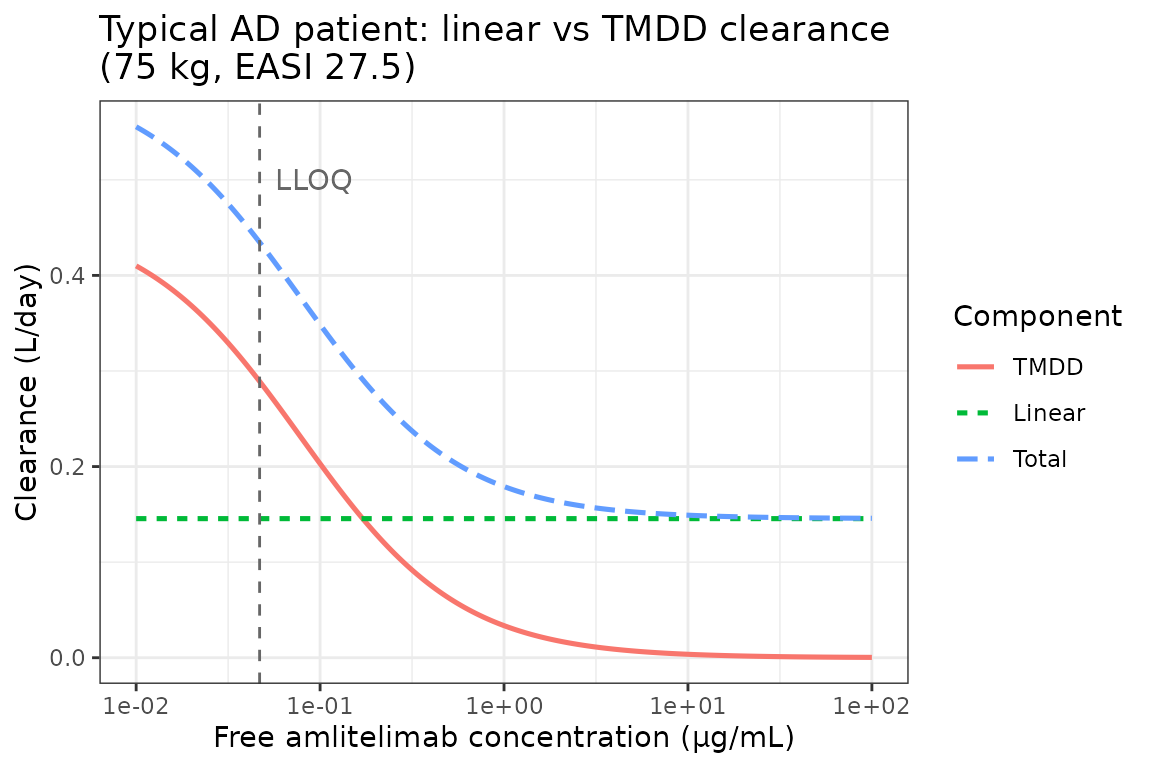
cl_at_lloq <- tvcll + 0.00111 * 27.5 + vmax_mgday / (km_ugmL + 0.0469)
tmdd_frac_at_lloq <- (vmax_mgday / (km_ugmL + 0.0469)) / cl_at_lloq
cat(sprintf("TMDD fraction of total CL at LLOQ (0.0469 ug/mL): %.1f%%\n",
            100 * tmdd_frac_at_lloq))
#> TMDD fraction of total CL at LLOQ (0.0469 ug/mL): 66.5%
cat(sprintf("TMDD fraction of total CL at 1 ug/mL: %.1f%%\n",
            100 * (vmax_mgday / (km_ugmL + 1)) / (tvcll + 0.00111 * 27.5 + vmax_mgday / (km_ugmL + 1))))
#> TMDD fraction of total CL at 1 ug/mL: 18.7%
Terminal half-life check
The paper reports a mean terminal half-life of 28 days in the linear PK range, with an individual range of 24-43 days. Compute the typical-value terminal half-life from the model’s eigenvalues at the population mean.
tvv1   <- 3.46
tvv2   <- 2.48
tvq    <- 0.569
tvcl   <- tvcll + e_easi_cl * 27.5   # linear CL at reference AD patient

k10 <- tvcl / tvv1
k12 <- tvq  / tvv1
k21 <- tvq  / tvv2

A <- k10 + k12 + k21
B <- k10 * k21
beta <- (A - sqrt(A * A - 4 * B)) / 2
t_half_day <- log(2) / beta
cat(sprintf("Typical terminal half-life (linear range) = %.1f days\n", t_half_day))
#> Typical terminal half-life (linear range) = 29.6 days
Notes on the simulation
- Virtual population: 300 AD patients with body weight, SCORE_EASI, and albumin drawn from the Tiraboschi 2025 Table S1 distributions, truncated to the study ranges.
- Regimen: STREAM-AD labelled adult dosing - 500 mg SC loading dose, then 250 mg SC every 4 weeks through week 24.
-
IIV: Simulated using the published
omega^2values - V1 and CL as a correlated block (omega^2V1 = 0.0491, cov = 0.024,omega^2CL = 0.0482), plus diagonal V2 (0.0693), Fsc (1.18 on the logit scale), ALAG (0.151), and Ka (0.135). - Residual error: Proportional, CV 15.8%.
- Unit note: Table S2 labels TVVM as “ug/day”; it is in fact mg/day, as verified by the paper’s claim that TMDD represents approximately 66% of total clearance at the LLOQ of 0.0469 ug/mL and approximately 20% at 1 ug/mL. The Figure 3 replication and the terminal half-life check above both reproduce those fractions.
Reference
- Tiraboschi G, Papp K, Bieber T, Weidinger S, Beck L, Lee CH, O’Malley JT, Yen K, Bernigaud C, Fabre D, Hurbin F. Population Pharmacokinetic and Pharmacodynamic Modeling for the Prediction of the Extended Amlitelimab Phase 3 Dosing Regimen in Atopic Dermatitis. CPT Pharmacometrics Syst Pharmacol. 2025;14(12):2161-2172. doi:10.1002/psp4.70121.