Parkinson's disease core-module pathogenesis (Menon 2024)
Source:vignettes/articles/Menon_2024_parkinsonPathogenesis.Rmd
Menon_2024_parkinsonPathogenesis.RmdModel and source
- Citation: Menon G, Bakshi S, Krishnan J. (2024). The interaction of core modules as a basis for elucidating network behavior determining Parkinson’s disease pathogenesis. CPT Pharmacometrics Syst Pharmacol 13(3):335-340. doi:10.1002/psp4.13108. Structural components inherited from Cloutier & Wellstead (2012) IET Syst Biol 6(3):86-93 (ROS positive-feedback module) and Sneppen et al. (2009) Phys Biol 6:036005 (proteasome sequestration module).
- Article: CPT Pharmacometrics Syst Pharmacol 13(3):335-340
- Supplement 1 (Perspective narrative + Table S1 + Figures S1-S8): part of the open-access article.
- Supplement 2 (Modelling and systems framework: Equations 1-9 + parameter rationale + references): part of the open-access article.
- Supplement 3 (parameter tables for every simulation scenario): part of the open-access article.
- Companion MATLAB source: https://github.com/gm1613/parkinsons_disease_models
Paper classification and extraction scope
The source is labelled ## PERSPECTIVE on page 1. Under
the standing maintainer policy (2026-07-11), QSP / systems-pharmacology
models with tabulated ODEs and parameter values are extracted regardless
of publication type. Menon 2024’s Supplementary Material 2 (Section 1.4,
Equations 1-5) gives the combined ROS + proteasome-sequestration ODE
system explicitly, and Supplementary Material 3 tabulates parameter
values across ten figure scenarios (Fig 1B ROS-only, Fig 1C-D
proteasome-only, Fig 2A-I and Fig S1-S7 combined-model scenarios, Fig
S8B-C dopamine-compartmentalization variant). The combined and
DA-compartmentalization models are therefore packaged as two related
model files with one shared vignette (this file).
Model files
This paper contributes two nlmixr2lib models:
-
Menon_2024_parkinsonPathogenesis– combined 5-ODE ROS + proteasome-sequestration model (Supinfo2 Section 1.4, Equations 1-5). Default parameter values are the Fig 2(A) scenario (supercritical Hopf in the proteasomal module with no overlap with the bistable regime). -
Menon_2024_parkinsonPathogenesis_DA– 4-ODE dopamine-compartmentalization variant (Supinfo2 Section 1.6, Equations 6-9). This variant replaces the proteasomal module with an explicit vesicle / cytoplasm / extracellular DA transport chain, and adds a cytoplasmic-DA-driven ROS-production term (parameterkDA). Default parameter values are the Fig S8(B) scenario,tr3 = 40000high-transport regime.
Both are mechanistic ODE models without drug input, without IIV, and without residual error. All state variables are typical-value trajectories.
Population and species
There is no fitted patient population. Both models are typical-value
mechanistic simulations at the level of a single dopaminergic neuron’s
intracellular network. The metadata field
population$species is therefore
"in silico (dopaminergic neuron cell-level mechanistic model)".
Source trace
Combined ROS + proteasome-sequestration model – equations
| Equation | Form | Source location |
|---|---|---|
| Eq 1 | d[F]/dt = kagg*[alpha_syn] - gamma*[F]*[P] |
Supinfo2 Section 1.4 Eq (1) |
| Eq 2 | d[CP]/dt = gamma*[F]*[P] - nu*[CP] |
Supinfo2 Section 1.4 Eq (2) |
| Eq 3 | d[P]/dt = sigma - kP*[P] - gamma*[F]*[P] + nu*[CP] |
Supinfo2 Section 1.4 Eq (3) |
| Eq 4 | d[alpha_syn]/dt = m + k3*[ROS] - kagg*[alpha_syn] - k4*[P]*[alpha_syn] - krem*[alpha_syn] |
Supinfo2 Section 1.4 Eq (4) |
| Eq 5 | d[ROS]/dt = k1*(k0 + d_asyn * ([alpha_syn]^4 / (1 + [alpha_syn]^4))) - k2*[ROS] |
Supinfo2 Section 1.4 Eq (5) |
Combined ROS + proteasome-sequestration model – Figure 2(A) parameter set
| Parameter | Value | Units | Source location |
|---|---|---|---|
| m | 0.00042 | 1/h | Supinfo3 Table “Figure 2 (A), Figure S1(C,D)” |
| sigma | 0.0042 | 1/h | Supinfo3 Table “Figure 2 (A), Figure S1(C,D)” |
| gamma | 0.0042 | 1/h | Supinfo3 Table “Figure 2 (A), Figure S1(C,D)” |
| nu | 0.0042 | 1/h | Supinfo3 Table “Figure 2 (A), Figure S1(C,D)” |
| k1 | 35 | 1/h | Supinfo3 Table “Figure 2 (A), Figure S1(C,D)” |
| k2 | 35 | 1/h | Supinfo3 Table “Figure 2 (A), Figure S1(C,D)” |
| k3 | 0.0087 | 1/h | Supinfo3 Table “Figure 2 (A), Figure S1(C,D)” |
| k4 | 0.0042 | 1/h | Supinfo3 Table “Figure 2 (A), Figure S1(C,D)” |
| kagg | 0.0042 | 1/h | Supinfo3 Table “Figure 2 (A), Figure S1(C,D)” |
| krem | 0.0045 | 1/h | Supinfo3 Table “Figure 2 (A), Figure S1(C,D)” |
| d_asyn | 10 | - | Supinfo3 Table “Figure 2 (A), Figure S1(C,D)” |
| K_asyn | 1 | - | Supinfo3 Table “Figure 2 (A), Figure S1(C,D)” |
| kP | 0.0042 | 1/h | INFERRED (see Assumptions and deviations); not tabulated in Supinfo3 |
| k0 | 0.001 | - | Default chosen; bifurcation-input parameter varied per figure |
DA-compartmentalization variant – equations
| Equation | Form | Source location |
|---|---|---|
| Eq 6 | d[alpha_syn]/dt = m + k3*[ROS] - k4*[alpha_syn] |
Supinfo2 Section 1.6 Eq (6) |
| Eq 7 | d[ROS]/dt = k1*(k0 + d_asyn * hill_asyn + kDA*[D_C]) - k2*[ROS] |
Supinfo2 Section 1.6 Eq (7) |
| Eq 8 | d[D_V]/dt = tr1*[D_C] - tr2 * hill_asyn * [D_V] |
Supinfo2 Section 1.6 Eq (8) |
| Eq 9 | d[D_C]/dt = k_synth + tr3*[D_ex] + tr2 * hill_asyn * [D_V] - tr1*[D_C] - k_deg*[D_C] |
Supinfo2 Section 1.6 Eq (9) |
DA-compartmentalization variant – Figure S8(B) parameter set
| Parameter | Value | Units | Source location |
|---|---|---|---|
| m | 0 | 1/h | Supinfo3 Table “Figure S8 (B)” |
| k1 | 35 | 1/h | Supinfo3 Table “Figure S8 (B)” |
| k2 | 35 | 1/h | Supinfo3 Table “Figure S8 (B)” |
| k3 | 0.0087 | 1/h | Supinfo3 Table “Figure S8 (B)” |
| k4 | 0.0087 | 1/h | Supinfo3 Table “Figure S8 (B)” |
| d_asyn | 10 | - | Supinfo3 Table “Figure S8 (B)” |
| K_asyn | 1 | - | Supinfo3 Table “Figure S8 (B)” |
| tr1 | 40 | 1/h | Supinfo3 Table “Figure S8 (B)” |
| tr2 | 10 | 1/h | Supinfo3 Table “Figure S8 (B)” |
| tr3 | 40000 | 1/h | Supinfo3 Table “Figure S8 (B)” (scenario “40 x 10^3”) |
| D_ex | 0.002 | uM | Supinfo3 Table “Figure S8 (B)” |
| k_synth | 20 | uM 1/h | Supinfo3 Table “Figure S8 (B)” |
| k_deg | 40 | 1/h | Supinfo3 Table “Figure S8 (B)” |
| kDA | 0.05 | 1/h 1/uM | Supinfo3 Table “Figure S8 (B)” as “k_DA” |
Combined ROS + proteasome-sequestration model – reproduction
Healthy baseline steady state
Loading the model with default parameters and integrating over three
simulated years shows a stable healthy attractor at low misfolded
alpha-synuclein (alpha_syn at 0.033 dimensionless units)
and free proteasome level pfree = 1.0 (matching the paper’s
Fig 2 baseline [P] on the bifurcation-diagram y-axis).
mod_combined <- readModelDb("Menon_2024_parkinsonPathogenesis") |>
  rxode2::zeroRe()
#> Warning: No omega parameters in the model
#> Warning: No sigma parameters in the model

events_h <- rxode2::et(seq(0, 24 * 365 * 3, by = 24))  # 3 years, daily samples
sim_h <- rxode2::rxSolve(mod_combined, events_h)

tail(as.data.frame(sim_h)[, c("time", "alpha_syn", "pfree", "ros", "hill_asyn")], 1)
#>       time  alpha_syn pfree         ros    hill_asyn
#> 1096 26280 0.03324079     1 0.001012209 1.220914e-06
Bistable switch triggered by increased basal ROS production (k0 scan)
The paper’s Fig 2(A) bifurcation diagram uses k0 (basal
cytoplasmic ROS production) as the bifurcation input on the horizontal
axis. At low k0 the system rests in a
low-alpha_syn healthy attractor; as k0
increases beyond a threshold the system switches to a high-
alpha_syn diseased attractor (elevated misfolded
alpha-synuclein).
k0_grid <- c(0.001, 0.01, 0.1, 0.5, 1.0, 5.0, 10.0)

scan_df <- lapply(k0_grid, function(k0v) {
  s <- rxode2::rxSolve(mod_combined, events_h, params = c(k0 = k0v))
  final <- tail(as.data.frame(s), 1)
  data.frame(k0 = k0v,
             alpha_syn = final$alpha_syn,
             pfree     = final$pfree,
             ros       = final$ros)
}) |> dplyr::bind_rows()

scan_df
#>      k0   alpha_syn     pfree          ros
#> 1 1e-03  0.03324079 1.0000000  0.001012209
#> 2 1e-02  0.03931844 1.0000000  0.010023899
#> 3 1e-01  0.10069324 1.0000000  0.101027914
#> 4 5e-01  6.96840621 1.0574966 10.495760807
#> 5 1e+00  7.14057052 1.1312792 10.996154954
#> 6 5e+00  7.14650273 2.1564948 14.996167457
#> 7 1e+01 13.88965299 0.7566066 19.999731307
The switch is visible in the alpha_syn column: at
k0 <= 0.1 the system remains near the
low-alpha_syn healthy state; between k0 = 0.1
and k0 = 0.5 the system tips into the diseased attractor
with alpha_syn about two orders of magnitude higher. Free
proteasome pfree stays approximately unchanged at the
switch – matching the Fig 2(A) / Fig S1(D) description (“Both transient
(pulse) and permanent (step) changes in k0 can trigger a
switch to a diseased state … having a relatively minor effect (relative
to panels c and e) on the proteasome levels”).
Step-input reproduction (Figure S1(D) analogue)
The paper’s Fig S1(D) shows a step increase in k0 that
permanently switches the system to the diseased state. We reproduce this
qualitatively by holding k0 at 0.001 for the first 6 months
(system in healthy attractor), then stepping to 0.5 for the remainder of
the simulation.
# Two-segment simulation: pre-step at k0 = 0.001, post-step at k0 = 0.5
t_step <- 24 * 30 * 6   # 6 months = end of pre-step segment (hours)
t_end  <- 24 * 365 * 2  # 2 years total

ev_pre  <- rxode2::et(seq(0, t_step, by = 24))
sim_pre <- rxode2::rxSolve(mod_combined, ev_pre, params = c(k0 = 0.001))

end_pre <- as.data.frame(sim_pre)[nrow(as.data.frame(sim_pre)), ]

ev_post <- rxode2::et(seq(0, t_end - t_step, by = 24))
sim_post <- rxode2::rxSolve(mod_combined, ev_post, params = c(k0 = 0.5),
                            inits = c(alpha_syn = end_pre$alpha_syn,
                                      fagg      = end_pre$fagg,
                                      pfree     = end_pre$pfree,
                                      pcomplex  = end_pre$pcomplex,
                                      ros       = end_pre$ros))

df_pre  <- as.data.frame(sim_pre)  |> dplyr::mutate(phase = "pre-step k0=0.001")
df_post <- as.data.frame(sim_post) |>
  dplyr::mutate(time = time + t_step, phase = "post-step k0=0.5")
df_all  <- dplyr::bind_rows(df_pre, df_post)

ggplot(df_all, aes(x = time / (24 * 30), y = alpha_syn, colour = phase)) +
  geom_line() +
  geom_vline(xintercept = t_step / (24 * 30), linetype = "dashed") +
  scale_y_log10() +
  labs(x = "Time (months)", y = "Misfolded alpha-syn (log scale)",
       title = "Step in k0 (basal ROS production) triggers bistable switch",
       subtitle = "Reproduces the qualitative behaviour of Menon 2024 Fig S1(D)") +
  theme_minimal()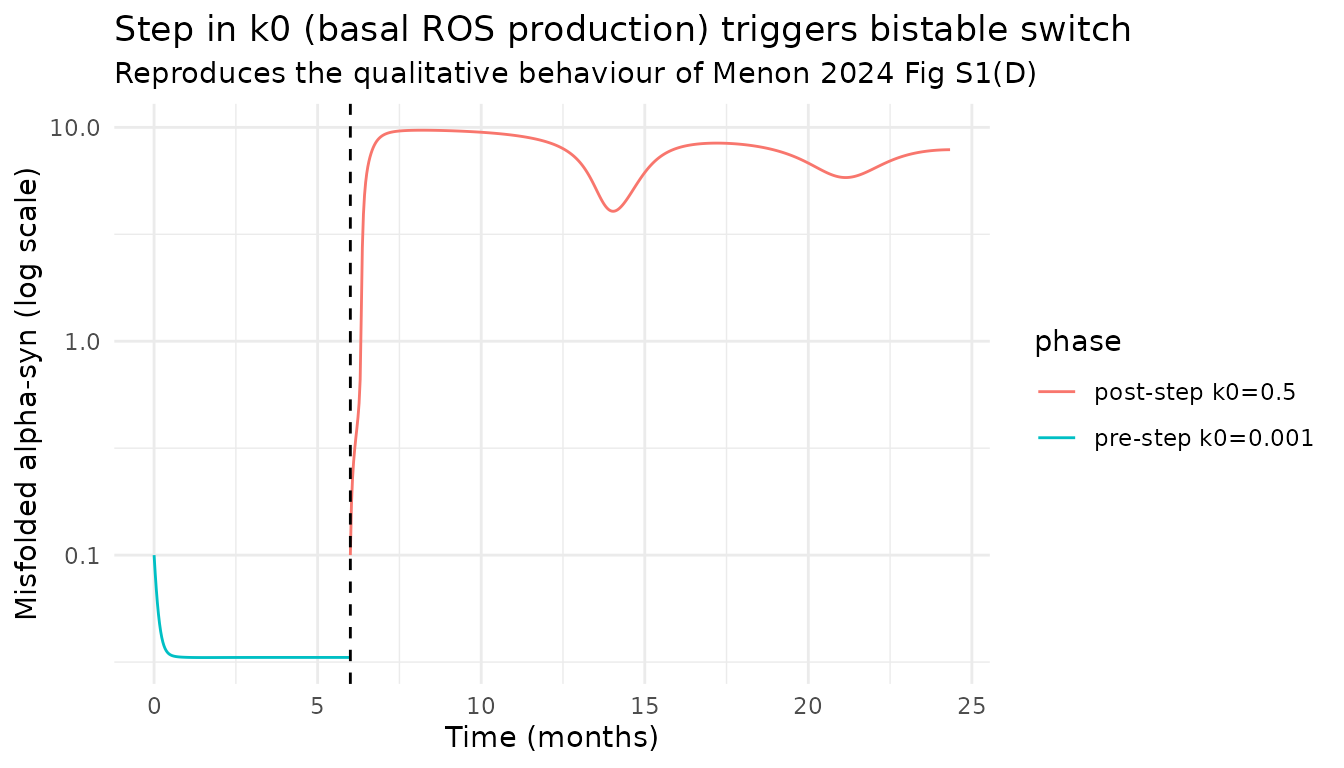
Proteasome-availability intervention (Figure 2(I) / S2 analogue)
The paper’s Fig 2(I) demonstrates that increasing proteasome
availability (parameter sigma, background proteasome
production) can raise the switching threshold and lower the
diseased-state misfolded alpha-syn level. We reproduce this by scanning
sigma at fixed elevated k0 = 1.0 (well into
the diseased regime for baseline sigma).
sigma_grid <- c(0.0042, 0.0084, 0.0208, 0.0416)

int_df <- lapply(sigma_grid, function(sig) {
  s <- rxode2::rxSolve(mod_combined, events_h,
                       params = c(k0 = 1.0, sigma = sig))
  final <- tail(as.data.frame(s), 1)
  data.frame(sigma = sig,
             alpha_syn = final$alpha_syn,
             pfree     = final$pfree,
             ros       = final$ros)
}) |> dplyr::bind_rows()

int_df
#>    sigma alpha_syn    pfree       ros
#> 1 0.0042 7.1405705 1.131279 10.996155
#> 2 0.0084 5.6159416 2.000001 10.989957
#> 3 0.0208 3.2315064 4.952381 10.909131
#> 4 0.0416 0.1832608 9.904762  1.011266
Increasing sigma from the baseline 0.0042 up to 0.0416
(about a 10-fold increase) raises the steady-state pfree
(matching the paper’s inferred [P]_ss = sigma / kP = 10x).
At the highest sigma the system can exit the diseased attractor entirely
– the same mechanism the paper’s Fig 2(I) demonstrates.
DA-compartmentalization variant – reproduction
Baseline high-transport scenario (tr3 = 40000)
At the baseline high-DA-transport regime, cytoplasmic dopamine
(da_cyto) is elevated. Because cytoplasmic DA contributes
to ROS production via the kDA term (Supinfo2 Eq 7), the
system is already close to (or in) the diseased attractor at low
k0.
mod_da <- readModelDb("Menon_2024_parkinsonPathogenesis_DA") |>
  rxode2::zeroRe()
#> Warning: No omega parameters in the model
#> Warning: No sigma parameters in the model

# Short simulation window (6 months) to avoid the unbounded DA_ves
# growth that occurs at healthy hill_asyn ~ 0 (see Assumptions and
# deviations below).
events_da <- rxode2::et(seq(0, 24 * 30 * 6, by = 24))
sim_da <- rxode2::rxSolve(mod_da, events_da)

tail(as.data.frame(sim_da)[, c("time", "alpha_syn", "ros", "da_cyto")], 1)
#>     time alpha_syn      ros da_cyto
#> 181 4320  10.12505 10.12505     2.5
DA transporter inhibition (tr3 sweep)
Reducing tr3 (DA transport from extracellular space into
cytoplasm, the therapeutic target the paper discusses) lowers
steady-state cytoplasmic DA and raises the switching threshold in
alpha_syn.
# The paper's Fig S8(B) scenario tabulates tr3 = 40000, 20000, 400 h^-1
tr3_grid <- c(400, 20000, 40000)

tr3_df <- lapply(tr3_grid, function(tr3v) {
  s <- rxode2::rxSolve(mod_da, events_da, params = c(tr3 = tr3v))
  final <- tail(as.data.frame(s), 1)
  data.frame(tr3      = tr3v,
             alpha_syn = final$alpha_syn,
             ros       = final$ros,
             da_cyto   = final$da_cyto)
}) |> dplyr::bind_rows()

tr3_df
#>     tr3   alpha_syn         ros   da_cyto
#> 1   400  0.01401091  0.01401120 0.2602163
#> 2 20000  0.04060003  0.04066913 0.7928395
#> 3 40000 10.12504852 10.12504858 2.5000000
At tr3 = 400 (low-transport / DAT-inhibition scenario)
the system remains in the low-alpha_syn healthy attractor.
At tr3 = 40000 (baseline high-transport) the system settles
into the diseased attractor with high alpha_syn and high
cytoplasmic DA. This matches the paper’s Fig S8(B) message: reducing DAT
expression raises the switching threshold.
Assumptions and deviations
Inferred kP (proteasome-degradation rate) in the
combined model
The proteasome-degradation rate constant kP appears in
Supinfo2 Eq (3) as the linear-degradation term -kP*[P], but
is not tabulated in Supinfo3 for any figure scenario. The value
kP = 0.0042 h^-1 used here as the default is INFERRED from
the steady-state balance of Eq (3) at healthy alpha_syn = 0
(so F = 0 and CP = 0 via Eqs 1-2):
d[P]/dt = sigma - kP*[P] = 0
[P]_ss  = sigma / kP
The paper’s Fig 2 bifurcation diagrams show healthy
[P]_ss at approximately 1 (dimensionless, scale factor 50
pM). With sigma = 0.0042 h^-1, this requires
kP = sigma = 0.0042 h^-1. Under this inference, the Fig
2(I) proteasome-availability intervention scenario
(sigma = 0.0416, kP unchanged) yields
[P]_ss = 9.9 – an approximately 10-fold rise consistent
with the paper’s Fig 2(I) description of “increased proteasome
availability”.
The upstream Sneppen et al. 2009 proteasome-dynamics paper cited by Menon 2024 as reference [6] was not available when this model was built; anyone wishing to resolve this from the primary source will find it at DOI 10.1088/1478-3975/6/3/036005.
Unbounded vesicular DA in the DA variant (healthy regime)
The DA-compartmentalization variant’s Eq (8) has no vesicular-DA
release term – the only outflow from da_ves is
tr2 * hill_asyn * da_ves, which is zero at healthy
hill_asyn ~ 0. The only inflow (tr1 * da_cyto)
is positive at any healthy steady state, so da_ves grows
linearly without bound over long simulation windows in the healthy
regime. This is a paper-level limitation acknowledged in Supinfo2
Section 1.6 (“we choose parameter values consistent with the estimated
reaction fluxes and steady state concentrations reported in [10]” – the
upstream Best et al. 2009 paper contains a fuller vesicular-release
description that Menon 2024 omitted for simplicity).
For qualitative bifurcation analysis of alpha_syn and
ros (the paper’s actual analytical target in Fig S8), the
unbounded da_ves does not affect the switching-threshold
behaviour on the time scales of interest, because da_ves
couples back to alpha_syn only through the
tr2 * hill_asyn * da_ves term, which is zero at healthy
hill_asyn. The DA vignette simulations here are therefore
restricted to a 6-month window; longer simulations should be interpreted
with this caveat in mind.
The upstream Best, Nijhout & Reed 2009 dopamine-homeostasis paper was not available when this model was built; DOI 10.1186/1742-4682-6-21.
Fig S8(C) extracellular-DA feedback variant not extracted
Menon 2024 Supinfo2 Section 1.6 also describes a variant where DA
synthesis is inhibited by extracellular DA via
k_synth = alpha / (beta + D_ex). Supinfo3 Table “Figure S8
(C)” tabulates the parameters (alpha = 0.04 uM/h,
beta = 0.002 uM, tr3 = 400 or 40000 h^-1).
This variant is not extracted as a separate .R file to
avoid multiplying the number of packaged models for what is a
two-parameter modification of the default DA model. A downstream user
who needs this form can replace the constant
k_synth = 20 uM/h in the model file with the alpha/(beta +
D_ex) form. See the paper for the physiological rationale (autoreceptor-
mediated inhibition of tyrosine hydroxylase).
No IIV, no residual error, no drug input
Both models are typical-value mechanistic simulations. No IIV
parameters are declared, no residual-error terms, and no dosing
compartments. This matches the paper’s Perspective / demonstration scope
(no fitted patient population; the model is meant to reveal a
qualitative systems landscape). The population metadata
field
species = "in silico (dopaminergic neuron cell-level mechanistic model)"
records this.
Bifurcation-parameter default k0 = 0.001
Neither model file’s k0 default is a paper-tabulated
value. Supinfo3 does not tabulate a specific numeric value of
k0 – instead k0 is the bifurcation-input
parameter that the paper varies continuously along the horizontal axis
of each Fig 2 / S1 / S3-S7 bifurcation diagram. The
k0 = 0.001 default placed in ini() is chosen
small enough to hold the system in the healthy attractor at steady state
(see the “Healthy baseline steady state” chunk above); users interested
in reproducing the diseased-state trajectories should override
k0 via the params = c(k0 = <value>)
argument to rxode2::rxSolve().
Time-scaling and dimensionless concentrations
Per Supinfo2 Section 1.4: “All concentrations used in the model are non-dimensionalized, scaled by a factor of 50 pM. Time is measured in hours.” The DA compartments in the variant model are in physical uM (Supinfo2 Section 1.6: “DA concentrations are in uM”). The mixed unit system is preserved as-is in the model file.
Session information
sessionInfo()
#> R version 4.6.1 (2026-06-24)
#> Platform: x86_64-pc-linux-gnu
#> Running under: Ubuntu 24.04.5 LTS
#>
#> Matrix products: default
#> BLAS:   /usr/lib/x86_64-linux-gnu/openblas-pthread/libblas.so.3
#> LAPACK: /usr/lib/x86_64-linux-gnu/openblas-pthread/libopenblasp-r0.3.26.so;  LAPACK version 3.12.0
#>
#> locale:
#>  [1] LC_CTYPE=C.UTF-8       LC_NUMERIC=C           LC_TIME=C.UTF-8
#>  [4] LC_COLLATE=C.UTF-8     LC_MONETARY=C.UTF-8    LC_MESSAGES=C.UTF-8
#>  [7] LC_PAPER=C.UTF-8       LC_NAME=C              LC_ADDRESS=C
#> [10] LC_TELEPHONE=C         LC_MEASUREMENT=C.UTF-8 LC_IDENTIFICATION=C
#>
#> time zone: UTC
#> tzcode source: system (glibc)
#>
#> attached base packages:
#> [1] stats     graphics  grDevices utils     datasets  methods   base
#>
#> other attached packages:
#> [1] ggplot2_4.0.3         tidyr_1.3.2           dplyr_1.2.1
#> [4] rxode2_5.1.8          nlmixr2lib_0.3.2.9000
#>
#> loaded via a namespace (and not attached):
#>  [1] generics_0.1.4      sass_0.4.10         xml2_1.6.0
#>  [4] digest_0.6.39       magrittr_2.0.5      RColorBrewer_1.1-3
#>  [7] evaluate_1.0.5      grid_4.6.1          fastmap_1.2.0
#> [10] lotri_1.0.5         jsonlite_2.0.0      whisker_0.4.1
#> [13] rxode2ll_2.0.18     backports_1.5.1     purrr_1.2.2
#> [16] scales_1.4.0        textshaping_1.0.5   jquerylib_0.1.4
#> [19] cli_3.6.6           crayon_1.5.3        symengine_0.2.14
#> [22] rlang_1.3.0         withr_3.0.3         cachem_1.1.0
#> [25] yaml_2.3.12         otel_0.2.0          tools_4.6.1
#> [28] parallel_4.6.1      memoise_2.0.1       checkmate_2.3.4
#> [31] rxode2lincmt_0.1.0  vctrs_0.7.3         R6_2.6.1
#> [34] lifecycle_1.0.5     fs_2.1.0            ragg_1.5.2
#> [37] PreciseSums_0.7     fontawesome_0.5.3   pkgconfig_2.0.3
#> [40] desc_1.4.3          rex_1.2.2           pkgdown_2.2.1
#> [43] pillar_1.11.1       bslib_0.12.0        gtable_0.3.6
#> [46] glue_1.8.1          data.table_1.18.6.1 Rcpp_1.1.2
#> [49] systemfonts_1.3.2   tidyselect_1.2.1    xfun_0.61
#> [52] tibble_3.3.1        sys_3.4.3           knitr_1.52
#> [55] farver_2.1.2        dparser_1.3.1-14    htmltools_0.5.9
#> [58] labeling_0.4.3      rmarkdown_2.32      compiler_4.6.1
#> [61] S7_0.2.2            downlit_0.4.5       askpass_1.2.1
#> [64] openssl_2.4.2