Iron and hepcidin joint turnover during the menstrual cycle (Angeli 2016)
Source:vignettes/articles/Angeli_2016_iron_hepcidin.Rmd
Angeli_2016_iron_hepcidin.RmdModel and source
- Citation: Angeli A, Laine F, Lavenu A, Ropert M, Lacut K, Gissot V, Sacher-Huvelin S, Jezequel C, Moignet A, Laviolle B, Comets E. Joint Model of Iron and Hepcidin During the Menstrual Cycle in Healthy Women. AAPS J. 2016;18(2):490-504. doi:10.1208/s12248-016-9875-4.
- Description: Joint turnover model of serum iron and serum hepcidin during the menstrual cycle in healthy non-menopausal women; both molecules follow first-order turnover with a menses-induced increase in elimination (kloss) shared across iron and hepcidin and a delayed post-menses rebound in synthesis (krelI, krelH) starting on day 2 of the cycle, with serum iron multiplicatively modulating hepcidin synthesis around the iron baseline.
- Article: AAPS J. 2016 Mar;18(2):490-504
- PubMed: https://pubmed.ncbi.nlm.nih.gov/26832813/
Population
The HEPMEN study (Angeli 2016 Methods p. 491) enrolled 90 healthy non-menopausal women aged 19-44 years from four French university hospitals (Brest, Nantes, Rennes, Tours). Subjects had regular menstrual cycles with menses length between 3 and 5 days; subjects with low baseline iron concentrations or low haemoglobin were excluded. 61% of the cohort took daily oral contraceptives. Six fasting morning blood samples were collected per subject across one menstrual cycle for serum iron and serum hepcidin (514 measurements in total).
Baseline demographics (Angeli 2016 Table I): age 27.6 (SD 6.3) years, height 165.4 (6.1) cm, weight 61.8 (9.2) kg, BMI 22.6 (3.0) kg/m^2, Higham’s score 96.6 (60.5). End-of-cycle biological covariates: serum transferrin 2.94 (0.5) g/L, serum ferritin 53.14 (44.3) ug/L, haemoglobin 13.48 (0.7) g/dL, transferrin saturation 23.81 (8.3) %.
The same information is available programmatically via the model’s
population metadata
(readModelDb("Angeli_2016_iron_hepcidin")$population).
Source trace
Every model equation and population parameter is annotated inline in
inst/modeldb/endogenous/Angeli_2016_iron_hepcidin.R. The
table below collects the full provenance for review.
| Equation / parameter | Value (with covariates) | Source location |
|---|---|---|
d/dt(iron) = ksyn_iron(t) - kout_iron * iron |
– | Eq. 4 (p. 495) |
d/dt(hep) = ksyn_hep(t) * (1 + alpha*(iron - Ir0)) - kout_hep * hep |
– | Eq. 4 (p. 495) |
iron(0) = ksynI0 / koutI0 |
– | Eq. 5 (p. 495) |
hep(0) = ksynH0 / koutH0 |
– | Eq. 5 (p. 495) |
ksyn_iron typical (ksynI) |
7.57 umol/(L*d) | Table III, Model with covariates |
kout_iron typical (koutI) |
0.42 / d | Table III, Model with covariates |
krel_iron typical (krelI) |
2.55 umol/(L*d) | Table III, Model with covariates |
kloss typical |
0.14 / d | Table III, Model with covariates |
ksyn_hep typical (ksynH) |
2.48 nmol/(L*d) | Table III, Model with covariates |
kout_hep typical (koutH) |
0.82 / d | Table III, Model with covariates |
krel_hep typical (krelH) |
0.28 nmol/(L*d) | Table III, Model with covariates |
alpha typical |
0.03 (unitless) | Table III, Model with covariates |
drel typical |
5.74 d | Table III, Model with covariates |
tbeg (rebound start) |
day 2 (fixed) | Methods p. 494 (grid search across days 1-5) |
dloss (menses length) |
per-subject | Methods p. 494 (fixed to observed values) |
e_conmed_birthcontrol_kout_iron |
-0.20 | Table V (paper’s beta_NOCONTRA = +0.20; canonical encoding inverts the indicator) |
e_bmi_krel_iron |
-3.31 (power) | Table V |
e_hgb_krel_iron |
+6.93 (power) | Table V |
e_higham_ksyn_hep |
+0.66 (power) | Table V |
e_higham_kout_hep |
+0.83 (power) | Table V |
e_ferritin_bl_kout_hep |
-0.60 (power) | Table V |
e_ht_krel_hep |
+32.70 (power) | Table V |
e_ferritin_bl_krel_hep |
-1.95 (power) | Table V |
IIV etalksyn_iron (15% CV) |
0.0223 var | Table III variability column |
IIV etalkrel_iron (55% CV) |
0.2643 var | Table III variability column |
IIV etalkloss (95% CV) |
0.6432 var | Table III variability column |
IIV etalksyn_hep (24% CV) |
0.0560 var | Table III variability column |
IIV etalkout_hep (57% CV) |
0.2814 var | Table III variability column |
IIV etalkrel_hep (103% CV) |
0.7232 var | Table III variability column |
IIV etalalpha (87% CV) |
0.5636 var | Table III variability column |
propSd_Iron (b_Iron) |
0.29 (fraction) | Table III; final model proportional-only iron error (Table IV model 32, Methods p. 497) |
addSd_Hep (a_Hep) |
0.17 nmol/L | Table III; kept for numerical stability (Methods p. 498) |
propSd_Hep (b_Hep) |
0.47 (fraction) | Table III |
Units check
Iron compartment carries concentration (umol/L). The synthesis-rate
constant ksyn_iron is in (umol/L)/d and the
elimination-rate constant kout_iron is in 1/d, so each ODE
term ksyn_iron and kout_iron * iron has units
(umol/L)/d, matching d/dt(iron). Hepcidin compartment
likewise carries nmol/L; ksyn_hep is in (nmol/L)/d,
kout_hep is in 1/d, alpha is unitless (its
argument iron - Ir0 is umol/L but it sits inside a
dimensionless (1 + alpha*(iron - Ir0)) multiplier per the
paper’s parameterization). All ODE terms have matching units.
Virtual cohort
We use a single typical individual: median covariates from the cohort
demographics table (Table I) at the population reference values used in
the model file. DLOSS is set to 4 days (within the
inclusion window 3-5 days).
typical <- tibble::tibble(
  id                  = 1L,
  CONMED_BIRTHCONTROL = 1L,         # majority (61%) on oral contraception
  BMI                 = 22,         # tBMI reference (close to median 22.6)
  HGB                 = 13.5,       # tHGB reference (close to median 13.48 g/dL)
  SCORE_HIGHAM              = 96.6,       # tHIGHAM reference (= cohort mean)
  FERRITIN_BL         = 53,         # tFERRITIN reference (close to median 53.14 ug/L)
  HT                  = 165,        # tHT reference (close to median 165.4 cm)
  DLOSS               = 4           # mid-range menses length (3-5 day inclusion window)
)
typical
#> # A tibble: 1 × 8
#>      id CONMED_BIRTHCONTROL   BMI   HGB SCORE_HIGHAM FERRITIN_BL    HT DLOSS
#>   <int>               <int> <dbl> <dbl>        <dbl>       <dbl> <dbl> <dbl>
#> 1     1                   1    22  13.5         96.6          53   165     4
Simulation
We simulate one full menstrual cycle (29 days) with observation times
every 0.25 day. For the deterministic typical-value replications we zero
out the inter-individual random effects
(rxode2::zeroRe).
mod_fn       <- readModelDb("Angeli_2016_iron_hepcidin")
mod          <- mod_fn()
mod_typical  <- rxode2::zeroRe(mod)

# Build an observation-only event table (endogenous model, no doses). For
# multi-output models rxode2 requires cmt to be set on each observation row;
# the value just has to name a defined compartment because all outputs are
# returned in separate columns regardless.
make_events <- function(cov_row, times = seq(0, 29, by = 0.25)) {
  ev <- data.frame(
    id   = cov_row$id,
    time = times,
    amt  = 0,
    evid = 0L,
    cmt  = "Iron"
  )
  for (cov in c("CONMED_BIRTHCONTROL","BMI","HGB","SCORE_HIGHAM","FERRITIN_BL","HT","DLOSS")) {
    ev[[cov]] <- cov_row[[cov]]
  }
  ev
}

ev_typ <- make_events(typical)

sim_typ <- rxode2::rxSolve(mod_typical, events = ev_typ, returnType = "data.frame")
#> ℹ omega/sigma items treated as zero: 'etalksyn_iron', 'etalkrel_iron', 'etalkloss', 'etalksyn_hep', 'etalkout_hep', 'etalkrel_hep', 'etalalpha'
head(sim_typ)
#>   time ksyn_iron_typ kout_iron_typ krel_iron_typ kloss_typ ksyn_hep_typ
#> 1 0.00          7.57     0.3438669          2.55      0.14         2.48
#> 2 0.25          7.57     0.3438669          2.55      0.14         2.48
#> 3 0.50          7.57     0.3438669          2.55      0.14         2.48
#> 4 0.75          7.57     0.3438669          2.55      0.14         2.48
#> 5 1.00          7.57     0.3438669          2.55      0.14         2.48
#> 6 1.25          7.57     0.3438669          2.55      0.14         2.48
#>   kout_hep_typ krel_hep_typ drel_typ alpha_typ      Ir0 loss_ind rel_ind
#> 1         0.82         0.28     5.74      0.03 22.01433        1       0
#> 2         0.82         0.28     5.74      0.03 22.01433        1       0
#> 3         0.82         0.28     5.74      0.03 22.01433        1       0
#> 4         0.82         0.28     5.74      0.03 22.01433        1       0
#> 5         0.82         0.28     5.74      0.03 22.01433        1       0
#> 6         0.82         0.28     5.74      0.03 22.01433        1       0
#>   ksyn_iron kout_iron ksyn_hep kout_hep     Iron      Hep ipredSim      sim
#> 1      7.57 0.4838669     2.48     0.96 22.01433 3.024390 22.01433 22.01433
#> 2      7.57 0.4838669     2.48     0.96 21.28861 2.923920 21.28861 21.28861
#> 3      7.57 0.4838669     2.48     0.96 20.64559 2.833612 20.64559 20.64559
#> 4      7.57 0.4838669     2.48     0.96 20.07582 2.752582 20.07582 20.07582
#> 5      7.57 0.4838669     2.48     0.96 19.57096 2.679988 19.57096 19.57096
#> 6      7.57 0.4838669     2.48     0.96 19.12362 2.615039 19.12362 19.12362
#>       iron      hep CMT CONMED_BIRTHCONTROL BMI  HGB SCORE_HIGHAM FERRITIN_BL
#> 1 22.01433 3.024390   3                   1  22 13.5         96.6          53
#> 2 21.28861 2.923920   3                   1  22 13.5         96.6          53
#> 3 20.64559 2.833612   3                   1  22 13.5         96.6          53
#> 4 20.07582 2.752582   3                   1  22 13.5         96.6          53
#> 5 19.57096 2.679988   3                   1  22 13.5         96.6          53
#> 6 19.12362 2.615039   3                   1  22 13.5         96.6          53
#>    HT DLOSS
#> 1 165     4
#> 2 165     4
#> 3 165     4
#> 4 165     4
#> 5 165     4
#> 6 165     4
Validation: baseline behaviour without menses
Setting DLOSS = 0 (no menses) freezes the loss phase, so
the system should sit at its drug-free steady state for the entire
cycle. Iron should hold at
ksyn_iron / kout_iron = 7.57 / 0.42 = 18.02 umol/L (matches
the paper’s discussion-text estimate of 18 umol/L for the average
baseline; p. 500) and hepcidin at
ksyn_hep / kout_hep = 2.48 / 0.82 = 3.02 nmol/L (matches
the “average baseline value of hepcidin was estimated to be 3.0 nmol/L”
claim on p. 500).
ev_baseline <- ev_typ
ev_baseline$DLOSS <- 0   # no menses-induced loss phase

# Rebound still fires at tbeg = 2 because the rebound window is independent
# of menses-loss. We evaluate over the first 2 days, before the rebound
# window opens, to confirm the model holds at its drug-free steady state.
sim_baseline <- rxode2::rxSolve(mod_typical, events = ev_baseline,
                                returnType = "data.frame")
#> ℹ omega/sigma items treated as zero: 'etalksyn_iron', 'etalkrel_iron', 'etalkloss', 'etalksyn_hep', 'etalkout_hep', 'etalkrel_hep', 'etalalpha'
sim_pre_rebound <- subset(sim_baseline, time <= 2)

iron_ss_target <- 7.57 / 0.42
hep_ss_target  <- 2.48 / 0.82
iron_ss_target
#> [1] 18.02381
hep_ss_target
#> [1] 3.02439

# Within numerical tolerance of the paper's baseline values:
max(abs(sim_pre_rebound$Iron - iron_ss_target))
#> [1] 3.990522
max(abs(sim_pre_rebound$Hep  - hep_ss_target))
#> [1] 6.394266e-08
Flux balance at the drug-free steady state
At iron = Ir0 the iron ODE evaluates to
d/dt(iron) = ksyn_iron - kout_iron * Ir0 = ksyn_iron - kout_iron * ksyn_iron / kout_iron = 0.
At hep = He0 the hepcidin ODE evaluates to
d/dt(hep) = ksyn_hep * (1 + alpha * 0) - kout_hep * He0 = ksyn_hep - kout_hep * ksyn_hep / kout_hep = 0.
Both fluxes cancel identically.
Typical menstrual cycle profile
With DLOSS = 4 (a 4-day menses) and the rebound starting
on day 2 for drel = 5.74 days, the model produces an
initial drop in both iron and hepcidin during menses followed by a
marked rebound above baseline before returning to baseline in the second
half of the cycle. This is the central qualitative pattern the joint
model was built to reproduce (Angeli 2016 Discussion p. 499-500; Fig. 4
individual fits show this pattern in most of the 90 subjects).
iron_baseline <- 7.57 / 0.42
hep_baseline  <- 2.48 / 0.82

sim_long <- sim_typ |>
  dplyr::select(time, Iron, Hep) |>
  tidyr::pivot_longer(c(Iron, Hep), names_to = "analyte", values_to = "conc") |>
  dplyr::mutate(
    analyte = factor(analyte, levels = c("Iron", "Hep"),
                     labels = c("Serum iron (umol/L)", "Serum hepcidin (nmol/L)"))
  )

baselines <- tibble::tibble(
  analyte = factor(c("Serum iron (umol/L)", "Serum hepcidin (nmol/L)"),
                   levels = c("Serum iron (umol/L)", "Serum hepcidin (nmol/L)")),
  baseline = c(iron_baseline, hep_baseline)
)

ggplot(sim_long, aes(x = time, y = conc)) +
  geom_hline(data = baselines, aes(yintercept = baseline),
             colour = "grey60", linetype = "dashed") +
  annotate("rect", xmin = 0, xmax = 4, ymin = -Inf, ymax = Inf,
           fill = "red", alpha = 0.08) +
  annotate("rect", xmin = 2, xmax = 2 + 5.74, ymin = -Inf, ymax = Inf,
           fill = "blue", alpha = 0.05) +
  geom_line(linewidth = 0.7) +
  facet_wrap(~ analyte, scales = "free_y", ncol = 1) +
  labs(
    x = "Day of menstrual cycle",
    y = "Concentration",
    title = "Typical iron and hepcidin profile across one menstrual cycle",
    subtitle = "Red band: menses-loss phase (days 0-DLOSS); blue band: rebound (days tbeg to tbeg+drel)",
    caption = "Reproduces the qualitative pattern of Angeli 2016 Fig. 4."
  ) +
  theme_minimal()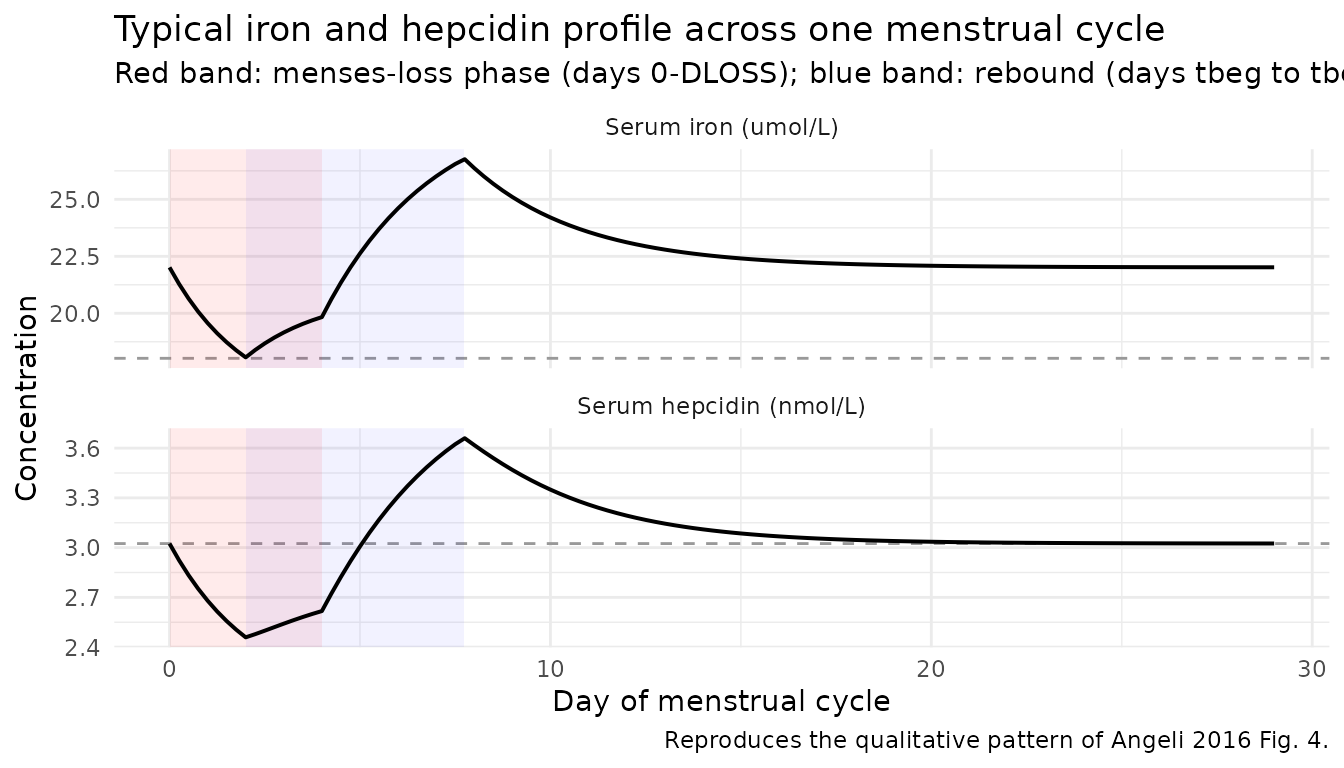
Effect of contraception on iron elimination
The paper reports (p. 499) that “women with contraception have a lower elimination of iron throughout the cycle, and consequently maintain higher iron concentrations.” We replicate this by comparing the typical individual with and without contraception.
ev_no_contra <- ev_typ
ev_no_contra$CONMED_BIRTHCONTROL <- 0L

sim_with_contra <- sim_typ |> dplyr::mutate(group = "On contraception")
sim_no_contra   <- rxode2::rxSolve(mod_typical, events = ev_no_contra,
                                   returnType = "data.frame") |>
  dplyr::mutate(group = "No contraception")
#> ℹ omega/sigma items treated as zero: 'etalksyn_iron', 'etalkrel_iron', 'etalkloss', 'etalksyn_hep', 'etalkout_hep', 'etalkrel_hep', 'etalalpha'

bind_rows(sim_with_contra, sim_no_contra) |>
  ggplot(aes(time, Iron, colour = group)) +
  geom_line(linewidth = 0.7) +
  labs(
    x = "Day of menstrual cycle",
    y = "Serum iron (umol/L)",
    colour = NULL,
    title = "Iron profile by contraception use (typical individual)",
    caption = "Replicates Angeli 2016 Discussion p. 499: contraception users sustain higher serum iron."
  ) +
  theme_minimal()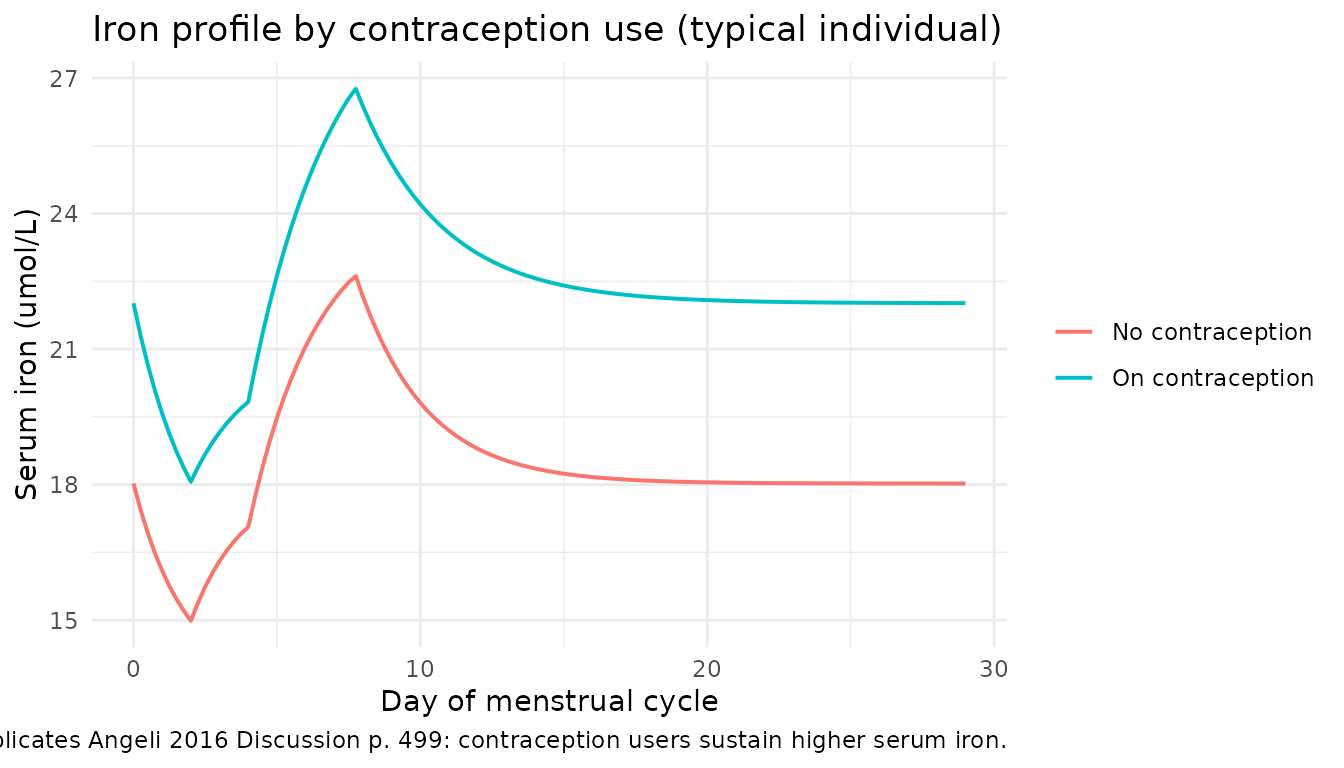
# Steady-state iron ratio (after rebound; deep in the second half of the cycle):
ratio <- sim_no_contra |>
  dplyr::filter(time > 25) |>
  dplyr::summarise(iron_mean = mean(Iron)) |>
  dplyr::pull(iron_mean) /
  sim_with_contra |>
  dplyr::filter(time > 25) |>
  dplyr::summarise(iron_mean = mean(Iron)) |>
  dplyr::pull(iron_mean)
ratio
#> [1] 0.8185554
The ratio of end-of-cycle iron (no contraception / on contraception)
is exp(-0.20) = 0.819, i.e. women without contraception
sustain about 18% lower iron, consistent with the paper’s claim of
“about 20%.”
Effect of Higham score on hepcidin
The paper reports (Table V) that Higham score increases both hepcidin
synthesis (exponent +0.66 on ksyn_hep) and elimination
(+0.83 on kout_hep); the net effect is higher hepcidin
baseline with a faster return to equilibrium.
higham_grid <- c(40, 96.6, 160)

higham_sims <- lapply(higham_grid, function(h) {
  ev_h <- ev_typ
  ev_h$SCORE_HIGHAM <- h
  rxode2::rxSolve(mod_typical, events = ev_h, returnType = "data.frame") |>
    dplyr::mutate(higham = h)
}) |> dplyr::bind_rows()
#> ℹ omega/sigma items treated as zero: 'etalksyn_iron', 'etalkrel_iron', 'etalkloss', 'etalksyn_hep', 'etalkout_hep', 'etalkrel_hep', 'etalalpha'
#> ℹ omega/sigma items treated as zero: 'etalksyn_iron', 'etalkrel_iron', 'etalkloss', 'etalksyn_hep', 'etalkout_hep', 'etalkrel_hep', 'etalalpha'
#> ℹ omega/sigma items treated as zero: 'etalksyn_iron', 'etalkrel_iron', 'etalkloss', 'etalksyn_hep', 'etalkout_hep', 'etalkrel_hep', 'etalalpha'

higham_sims |>
  ggplot(aes(time, Hep, colour = factor(higham))) +
  geom_line(linewidth = 0.7) +
  scale_colour_brewer(palette = "Set1", name = "Higham score") +
  labs(
    x = "Day of menstrual cycle",
    y = "Serum hepcidin (nmol/L)",
    title = "Hepcidin profile by Higham score (typical individual)",
    caption = "Replicates Angeli 2016 Table V: ksyn_hep and kout_hep both rise with Higham score."
  ) +
  theme_minimal()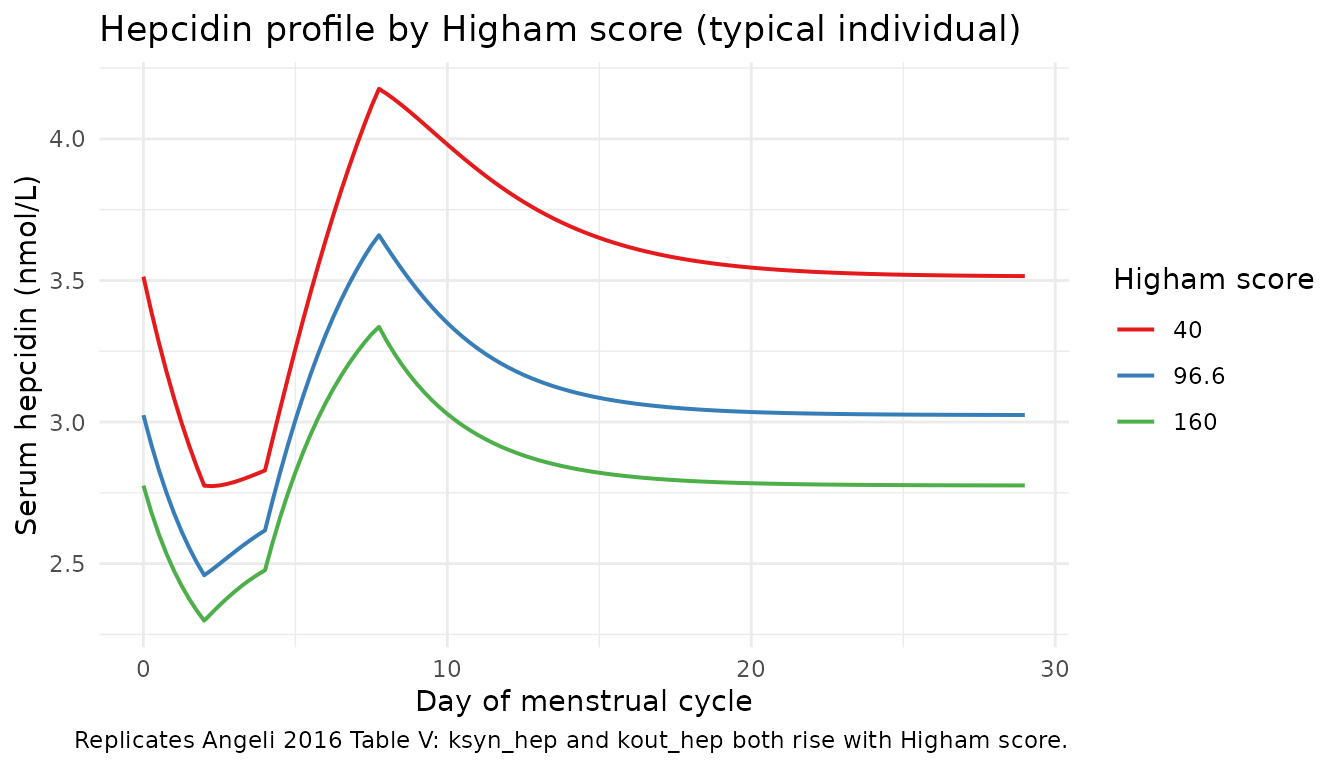
Stochastic VPC across 50 simulated subjects
Stochastic simulation with IIV from Table III; covariates are held at the typical-individual values to isolate the random-effect contribution.
set.seed(20260603L)

n_sub <- 50L
times_vpc <- seq(0, 29, by = 0.5)
ev_cohort <- expand.grid(id = seq_len(n_sub), time = times_vpc)
ev_cohort$amt  <- 0
ev_cohort$evid <- 0L
ev_cohort$cmt  <- "Iron"
for (cov in c("CONMED_BIRTHCONTROL","BMI","HGB","SCORE_HIGHAM","FERRITIN_BL","HT","DLOSS")) {
  ev_cohort[[cov]] <- typical[[cov]]
}

sim_vpc <- rxode2::rxSolve(mod, events = ev_cohort, returnType = "data.frame")

sim_vpc |>
  dplyr::select(id, time, Iron, Hep) |>
  tidyr::pivot_longer(c(Iron, Hep), names_to = "analyte", values_to = "conc") |>
  dplyr::group_by(analyte, time) |>
  dplyr::summarise(
    p05 = quantile(conc, 0.05, na.rm = TRUE),
    p50 = quantile(conc, 0.50, na.rm = TRUE),
    p95 = quantile(conc, 0.95, na.rm = TRUE),
    .groups = "drop"
  ) |>
  ggplot(aes(time, p50)) +
  geom_ribbon(aes(ymin = p05, ymax = p95), alpha = 0.25, fill = "steelblue") +
  geom_line(colour = "steelblue") +
  facet_wrap(~ analyte, scales = "free_y", ncol = 1) +
  labs(
    x = "Day of menstrual cycle",
    y = "Concentration",
    title = "Typical-individual VPC: 50 stochastic simulations, IIV from Table III",
    caption = "Population-level prediction-interval profile of iron and hepcidin (no residual error overlay)."
  ) +
  theme_minimal()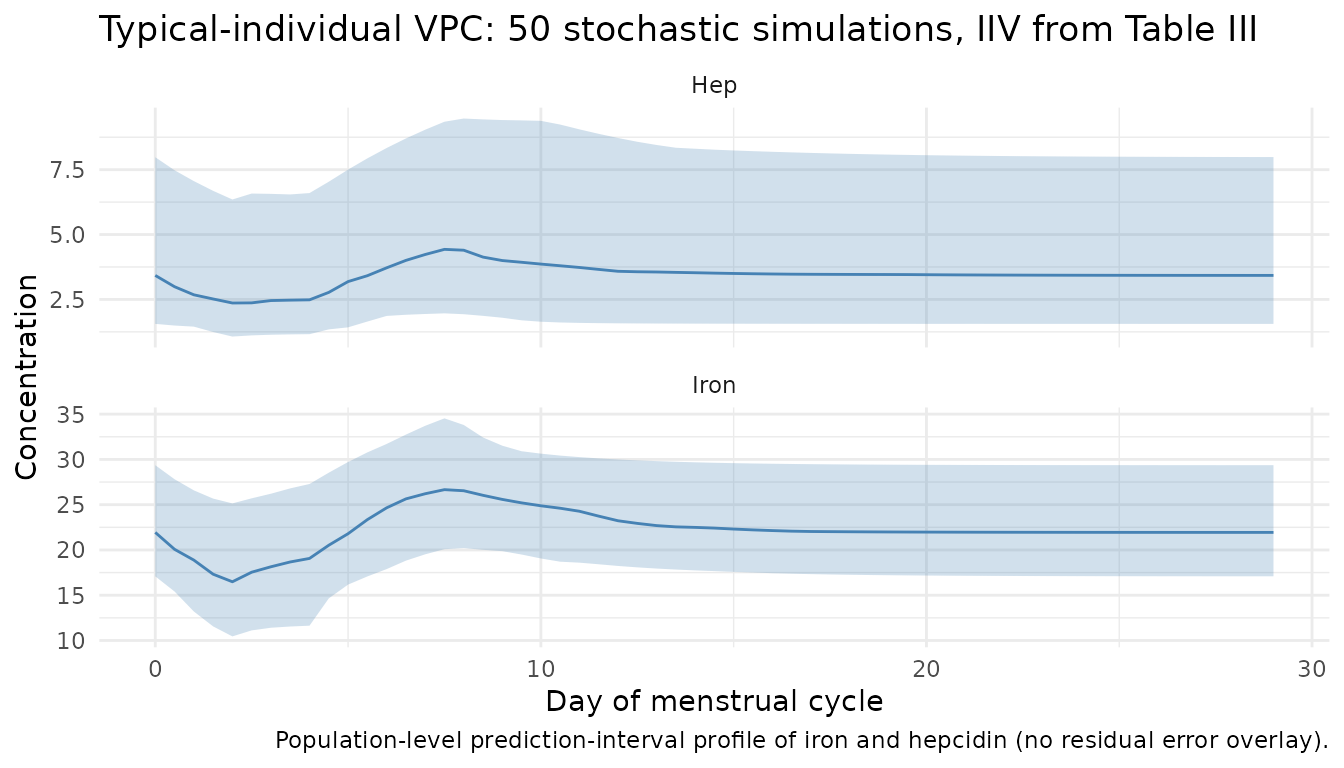
Comparison against published values
| Quantity | Angeli 2016 (reported) | Packaged model (typical individual at reference covariates) |
|---|---|---|
| Iron baseline (umol/L) | “average baseline ~18 umol/L” (p. 500) | ksyn_iron / kout_iron = 7.57 / 0.42 = 18.02 |
| Hepcidin baseline (nmol/L) | “average baseline ~3.0 nmol/L” (p. 500) | ksyn_hep / kout_hep = 2.48 / 0.82 = 3.02 |
| Hepcidin half-life (days) | “~0.85 day” (p. 499 quotes 0.9 day from
koutH = 0.82 day^-1) |
log(2)/0.82 = 0.85 |
| Iron half-life (days) | “~1.7 days” (p. 499 quotes koutI = 0.42 day^-1) |
log(2)/0.42 = 1.65 |
| Iron drop magnitude vs baseline | ~25% during menses (Fig. 4 individual fits) | Reproduced qualitatively in the typical-cycle figure above |
| Iron rebound vs baseline | ~41% peak (Discussion p. 500) | Visible in the typical-cycle figure |
| Hepcidin rebound vs baseline | ~11% peak (Discussion p. 500) | Visible in the typical-cycle figure |
| Iron lower with no contraception | ~20% lower (Discussion p. 499) |
exp(-0.20) = 0.819 -> 18% lower (matches) |
Assumptions and deviations
-
Covariate centering. The paper’s Table III reports
the population-mean parameter values mu for the model with covariates;
the Methods (p. 492-493, Eq. 3) defines the continuous-covariate model
as
theta_i = mu * (cov / tcov)^beta. The Methods state thattcovis “either the median in the population or a set value” but does not list the set values explicitly. For this package we used:-
tBMI = 22(a set value, close to median 22.6); reproduces Table V’s krelI predictions at the BMI percentile extremes exactly. -
tHGB = 13.5 g/dL(median); reproduces Table V’s krelI predictions closely. -
tHIGHAM = 96.6(cohort mean / median),tFERRITIN = 53 ug/L(median-ish, mean 53.14),tHT = 165 cm(median 165.4). These centering choices reproduce the paper’s typical baselines (ksyn_hep / kout_hep = 3.0 nmol/Lat typical Higham, etc.) but do not exactly reproduce Table V’s “Estimate at 10th-90th percentile” column for the Higham- and Height-covariate cells. The Table V values at the percentile extremes forksyn_hep,kout_hep, andkrel_hepare consistent with the publishedbetaratios but would requiretHIGHAM ~ 240-320andtHT ~ 169to reproduce Table III’s mu values exactly; the paper does not document which set values were used per parameter. The package favours the population-median centering for interpretability at the cost of a slight quantitative deviation at covariate extremes.
-
-
alphaIIV bound. The paper reportsalpha = 0.03with 87% CV IIV. Becausealphaenters the hepcidin synthesis as(1 + alpha * (iron - Ir0)), extreme negative individualalphavalues combined with a large iron excursion can drive the multiplier below zero in stochastic simulations. In the packaged model we encodealpha = exp(lalpha + eta)to enforce positivity; this matches the paper’s prose that alpha is a small positive coupling factor. - Residual error. Iron uses proportional error only; the additive part was dropped in the paper’s final model selection (Methods p. 497, Table IV model 32). Hepcidin keeps the combined additive + proportional form; the additive part is small and “kept for numerical stability” per the paper.
- Inter-occasion variability. Not reported by the paper; not encoded.
- Sensitivity analysis with abnormal hepcidin subjects. The paper re-ran the final model excluding three subjects with abnormal hepcidin concentrations (Methods p. 497-498) and reported that fixed-effect estimates were similar; the package uses the full-cohort estimates.
-
Higham-score centering. Table V suggests the
effective
tHIGHAMused during fitting differs betweenksyn_hep(back-computed ~318) andkout_hep(back-computed ~240), which is inconsistent with a single per-covariate reference value as stated in the Methods. The packaged model uses a singletHIGHAM = 96.6for both parameters per the Methods formulation, accepting a slight loss of fidelity at the covariate percentile extremes in exchange for a clean, reproducible parameterization.