TB combination therapy MTP-GPDI in vitro (Clewe 2018)
Source:vignettes/articles/Clewe_2018_TB_MTP_GPDI_invitro.Rmd
Clewe_2018_TB_MTP_GPDI_invitro.RmdModel and source
- Citation: Clewe O, Wicha SG, de Vogel CP, de Steenwinkel JEM, Simonsson USH. (2018). A model-informed preclinical approach for prediction of clinical pharmacodynamic interactions of anti-TB drug combinations. J Antimicrob Chemother 73(2):437-447. doi:10.1093/jac/dkx380. MTP natural-growth transfer rates kFSlin, kSF, kFN, kSN, kNS fixed from Clewe O, Aulin L, Hu Y, Coates AR, Simonsson US. (2016). A multistate tuberculosis pharmacometric model: a framework for studying anti-tubercular drug effects in vitro. J Antimicrob Chemother 71(4):964-974. doi:10.1093/jac/dkv416. GPDI framework: Wicha SG, Chen C, Clewe O, Simonsson USH. (2017). A general pharmacodynamic interaction model identifies perpetrators and victims in drug interactions. Nat Commun 8:2129. doi:10.1038/s41467-017-01929-y. Adaptive-resistance loop adapted from Mohamed AF, Cars O, Friberg LE. (2014). A pharmacokinetic/pharmacodynamic model developed for the effect of colistin on Pseudomonas aeruginosa in vitro. J Antimicrob Chemother 69(5):1350-1361. doi:10.1093/jac/dkt520.
- Description: In vitro (M. tuberculosis Beijing VN 2002-1585, BE1585 strain). Multistate Tuberculosis Pharmacometric (MTP) model linked to the General Pharmacodynamic Interaction (GPDI) model describing CFU/mL dynamics during 6-day time-kill assays of M. tuberculosis exposed to static rifampicin / isoniazid / ethambutol concentrations alone or in duo / trio combinations. Three bacterial states (fast-multiplying F, slow-multiplying S, non-multiplying N) follow MTP natural-growth dynamics with the transfer rates kFSlin, kSF, kFN, kSN, kNS fixed from Clewe 2016 JAC dkv416; growth is exponential (kG) rather than logistic. Drug effects per Table 1: rifampicin inhibits F growth (sigmoidal Emax) and kills F, S (Emax) and N (linear); isoniazid kills F and S via sigmoidal Emax with a linear isoniazid-induced adaptive-resistance loop (AR_off / AR_on) modulating EC50 on F-kill and S-kill; ethambutol kills F (sigmoidal Emax) and S (linear). The thirteen quantified GPDI interactions (Table 3) enter as multiplicative modifications of each modulated drug’s EC50 using the canonical Emax-style interaction term 1 + INT * C_modifier / (EC50_modifier + C_modifier) per Table 3 footer, with the modifier’s mono EC50 acting as the half-saturation anchor (least complex baseline per the paper’s Materials and methods). Combination effects on each bacterial state are pooled by the Bliss Independence criterion. Drug concentrations are static covariates (no PK structure – the in vitro experiment fixes nominal concentrations for the 6-day window). This is the in vitro twin of Chen 2017 in vivo mouse MTP-GPDI; see modellib(‘Chen_2017_TB_MTP_GPDI_mouse’) for the same MTP-GPDI framework applied to TB-infected BALB/c mice with explicit PK.
- Article: https://doi.org/10.1093/jac/dkx380
Population
The model was developed from in vitro time-kill experiments using the Mycobacterium tuberculosis Beijing VN 2002-1585 (BE1585) genotype strain, cultured in Middlebrook 7H9 broth + 10% OADC + 0.5% glycerol + 0.02% Tween 20 under shaking conditions (96 rpm, 37 C) at the Erasmus Medical Centre, Rotterdam, NL. Static drug concentrations were used as input to the PD modelling; the stability of rifampicin, isoniazid, and ethambutol over the 6-day experiment allowed activity assessment without replenishment.
The limit of quantification was 5 CFU; data below LOQ were handled in NONMEM with the M3 method. Tested concentrations (Clewe 2018 Figure 1): rifampicin 0.002 - 8 mg/L; isoniazid 0.01 - 40 mg/L; ethambutol 0.0078 - 32 mg/L. Duo and trio combinations sampled cross-products of selected concentrations, including clinically relevant unbound Cmax values (RIF 2, INH 10, EMB 8 mg/L).
The population metadata field of the model carries the
same information programmatically:
rxode2::rxode(readModelDb("Clewe_2018_TB_MTP_GPDI_invitro"))$population
#> $species
#> [1] "in vitro (M. tuberculosis Beijing VN 2002-1585, BE1585 strain)"
#>
#> $n_subjects
#> [1] NA
#>
#> $n_studies
#> [1] 1
#>
#> $disease_state
#> [1] "Tuberculosis time-kill experiments using the Mycobacterium tuberculosis Beijing VN 2002-1585 (BE1585) genotype, an MDR-precursor clinical isolate. Cultures grown in Middlebrook 7H9 broth + 10% OADC + 0.5% glycerol + 0.02% Tween 20 under shaking conditions (96 rpm, 37 C) per Clewe 2018 Materials and methods (In vitro assay). The limit of quantification was 5 CFU; data below the LOQ were handled in NONMEM with the M3 method."
#>
#> $dose_range
#> [1] "Static drug concentrations (no PK dosing), tested in mono / duo / trio combinations over a 6-day window (assessed on days 1, 2, 3, and 6). Rifampicin 0.002-8 mg/L; isoniazid 0.01-40 mg/L; ethambutol 0.0078-32 mg/L (Figure 1). Duo and trio combinations used cross-products of selected concentrations including clinically relevant unbound Cmax values (RIF 2, INH 10, EMB 8 mg/L)."
#>
#> $notes
#> [1] "Experiments performed in duplicate at Erasmus Medical Centre, Rotterdam, NL (Department of Medical Microbiology and Infectious Diseases). The paper does not report interindividual or interreplicate variability on the structural parameters; the model is a typical-value mechanistic in vitro PD without etas. The residual error structure used in NONMEM (additive on natural-log CFU/mL with M3-method censoring at 5 CFU) is not numerically reported in the main text or Table 1 / Table 3; the addSd placeholder in ini() carries a fixed natural-log SD of 1.0 (see vignette Errata)."
Source trace
Every ini() entry carries an in-file comment pointing to
the Clewe 2018 (or upstream Clewe 2016 MTP) source location. The table
below collects them for reviewer use.
| Block | Parameter | Value | Units | Source |
|---|---|---|---|---|
| MTP growth | lkg |
log(0.796) | 1/day | Clewe 2018 Table 1 (RSE 5%) |
| MTP growth | lkfs_lin |
log(1.66e-3) FIX | 1/day^2 | Clewe 2018 Table 1 footnote b (fixed from Clewe 2016) |
| MTP growth | lkfn |
log(8.97e-7) FIX | 1/day | Clewe 2018 Table 1 footnote b |
| MTP growth | lksn |
log(0.186) FIX | 1/day | Clewe 2018 Table 1 footnote b |
| MTP growth | lksf |
log(0.0145) FIX | 1/day | Clewe 2018 Table 1 footnote b |
| MTP growth | lkns |
log(1.23e-3) FIX | 1/day | Clewe 2018 Table 1 footnote b |
| MTP init | lf0 |
log(209000) | CFU/mL | Clewe 2018 Table 1 (RSE 17%) |
| MTP init | ls0 |
log(324000) | CFU/mL | Clewe 2018 Table 1 (RSE 12%) |
| RIF mono | lemax_fg_rif |
log(1) FIX | 1/day | Clewe 2018 Table 1 (Emax fixed at 1) |
| RIF mono | lec50_fg_rif |
log(0.388) | mg/L | Clewe 2018 Table 1 (RSE 19%) |
| RIF mono | gamma_fg_r |
2.8 | unitless | Clewe 2018 Table 1 (RSE 28%) |
| RIF mono | lemax_fd_rif |
log(1.97) | 1/day | Clewe 2018 Table 1 (RSE 3%) |
| RIF mono | lec50_fd_rif |
log(0.00303) | mg/L | Clewe 2018 Table 1 (RSE 10%) |
| RIF mono | lemax_sd_rif |
log(1.79) | 1/day | Clewe 2018 Table 1 (RSE 4%) |
| RIF mono | lec50_sd_rif |
log(0.0113) | mg/L | Clewe 2018 Table 1 (RSE 32%) |
| RIF mono | lknd_rif |
log(3.29) | L/mg/day | Clewe 2018 Table 1 (RSE 17%) |
| INH mono | lemax_fd_inh |
log(22.2) | 1/day | Clewe 2018 Table 1 (RSE 35%) |
| INH mono | lec50_fd_inh |
log(0.168) | mg/L | Clewe 2018 Table 1 (RSE 34%) |
| INH mono | gamma_fd_h |
1.9 | unitless | Clewe 2018 Table 1 (RSE 11%) |
| INH mono | lemax_sd_inh |
log(8.55) | 1/day | Clewe 2018 Table 1 (RSE 17%) |
| INH mono | lec50_sd_inh |
log(0.0329) | mg/L | Clewe 2018 Table 1 (RSE 49%) |
| INH mono | gamma_sd_h |
1.74 | unitless | Clewe 2018 Table 1 (RSE 25%) |
| INH AR | lkon |
log(0.0206) | L/mg/day | Clewe 2018 Table 1 (RSE 31%) |
| INH AR | lkar_fd_inh |
log(522) | unitless | Clewe 2018 Table 1 (RSE 46%) |
| INH AR | lkar_sd_inh |
log(2350) | unitless | Clewe 2018 Table 1 (RSE 51%) |
| EMB mono | lemax_fd_emb |
log(2.21) | 1/day | Clewe 2018 Table 1 (RSE 1%) |
| EMB mono | lec50_fd_emb |
log(0.86) | mg/L | Clewe 2018 Table 1 (RSE 16%) |
| EMB mono | gamma_fd_e |
2.46 | unitless | Clewe 2018 Table 1 (RSE 23%) |
| EMB mono | lksd_emb |
log(4.39) | L/mg/day | Clewe 2018 Table 1 (RSE 69%) |
| GPDI F | int_fd_rif_inh |
-0.679 | fractional | Clewe 2018 Table 3 (RSE 11%) |
| GPDI F | int_fd_inh_rif |
0 FIX | fractional | Clewe 2018 Table 3 footnote b |
| GPDI F | int_fd_emb_inh |
1.72 | fractional | Clewe 2018 Table 3 (RSE 15%) |
| GPDI F | int_fd_inh_emb |
0 FIX | fractional | Clewe 2018 Table 3 footnote b |
| GPDI F | int_fd_rif_emb |
-0.99 FIX | fractional | Clewe 2018 Table 3 footnote c |
| GPDI F | int_fd_emb_rif |
-0.668 | fractional | Clewe 2018 Table 3 (RSE 22%) |
| GPDI S | int_sd_rif_inh |
1.42 | fractional | Clewe 2018 Table 3 (RSE 22%) |
| GPDI S | int_sd_inh_rif |
15.2 | fractional | Clewe 2018 Table 3 (RSE 49%) |
| GPDI S | int_sd_emb_inh |
0.0963 | fractional | Clewe 2018 Table 3 (RSE 81%) |
| GPDI S | int_sd_inh_emb |
164 | fractional | Clewe 2018 Table 3 (RSE 259%) |
| GPDI S | int_sd_rif_emb |
486 | fractional | Clewe 2018 Table 3 (RSE 12%) |
| GPDI S | int_sd_emb_rif |
2.09 | fractional | Clewe 2018 Table 3 (RSE 32%) |
| GPDI trio | int_sd_rif_inh_emb |
-0.749 | fractional | Clewe 2018 Table 3 (RSE 18%) |
| Residual | addSd |
1.0 FIX | log(CFU/mL) | placeholder; not tabulated in Clewe 2018 (see Errata) |
Equation references:
- Adaptive resistance dynamics: Clewe 2018 Eqs 1-2 (with Eq 2 mass-balance correction noted in Errata).
- Bliss Independence combination of three drug effects on F and S: Clewe 2018 Eq 8 (F bacterial sub-state) and Eq 9 (S bacterial sub-state).
- N-state ODE with only rifampicin acting: Clewe 2018 Eq 10.
- GPDI interaction term form: Clewe 2018 Table 3 footer (“The interaction parameters INT were estimated as 1 + INT_A,B * C_A / (EC50_A,B + C_A)”) and Materials and methods, GPDI section (least complex baseline: EC50_A,B = EC50_A).
- MTP natural-growth transfer rates kFSlin, kSF, kFN, kSN, kNS fixed from the in vitro H37Rv MTP fit of Clewe 2016 JAC dkv416 (Clewe 2018 Table 1 footnote b).
- Linear adaptive-resistance functional form (EC50_eff = EC50 * (1 + kAR * AR_on)): adapted from Mohamed 2014 JAC dkt520 for colistin / Pseudomonas aeruginosa adaptive resistance (Clewe 2018 reference 9).
Virtual cohort
The simulations below reproduce the typical-value trajectories of Clewe 2018 Figure 1 (mean observed log10 cfu vs time) for natural growth and the three mono-drug time-kill panels. Because drug concentrations are static (not PK events), the cohort design uses a single dosing-free event table per regimen and varies the three concentration covariates between simulations.
# Static observation grid spanning the 6-day in vitro experiment. The model
# carries five state ODEs (fbugs, sbugs, nbugs, aroff, aron) and three
# covariates (CONC_RIF_MGL, CONC_INH_MGL, CONC_EMB_MGL); there are no dosing
# events because the in vitro drug concentrations are constant by design.

obs_grid <- seq(0, 6, by = 0.05)

# One regimen helper -- returns a self-contained event table with the static
# drug concentrations encoded as covariate columns.
make_regimen <- function(id, regimen,
                         conc_rif = 0, conc_inh = 0, conc_emb = 0,
                         times = obs_grid) {
  tibble(
    id   = id,
    time = times,
    amt  = 0,
    evid = 0L,
    cmt  = "log_cfu",
    CONC_RIF_MGL = conc_rif,
    CONC_INH_MGL = conc_inh,
    CONC_EMB_MGL = conc_emb,
    regimen      = regimen
  )
}

# Concentrations replicated from Clewe 2018 Figure 1 panels.
events <- bind_rows(
  make_regimen( 1L, "Natural growth",         conc_rif = 0),
  make_regimen( 2L, "RIF 0.002 mg/L",         conc_rif = 0.002),
  make_regimen( 3L, "RIF 0.008 mg/L",         conc_rif = 0.008),
  make_regimen( 4L, "RIF 0.03 mg/L",          conc_rif = 0.03),
  make_regimen( 5L, "RIF 0.125 mg/L",         conc_rif = 0.125),
  make_regimen( 6L, "RIF 0.5 mg/L",           conc_rif = 0.5),
  make_regimen( 7L, "RIF 8 mg/L",             conc_rif = 8),
  make_regimen( 8L, "INH 0.01 mg/L",          conc_inh = 0.01),
  make_regimen( 9L, "INH 0.039 mg/L",         conc_inh = 0.039),
  make_regimen(10L, "INH 0.156 mg/L",         conc_inh = 0.156),
  make_regimen(11L, "INH 0.625 mg/L",         conc_inh = 0.625),
  make_regimen(12L, "INH 2.5 mg/L",           conc_inh = 2.5),
  make_regimen(13L, "INH 10 mg/L",            conc_inh = 10),
  make_regimen(14L, "INH 40 mg/L",            conc_inh = 40),
  make_regimen(15L, "EMB 0.0078 mg/L",        conc_emb = 0.0078),
  make_regimen(16L, "EMB 0.031 mg/L",         conc_emb = 0.031),
  make_regimen(17L, "EMB 0.125 mg/L",         conc_emb = 0.125),
  make_regimen(18L, "EMB 0.5 mg/L",           conc_emb = 0.5),
  make_regimen(19L, "EMB 2 mg/L",             conc_emb = 2),
  make_regimen(20L, "EMB 8 mg/L",             conc_emb = 8),
  make_regimen(21L, "EMB 32 mg/L",            conc_emb = 32),
  # Clinical-Cmax trio at last studied timepoint, used to check antagonism /
  # synergy classifications against Clewe 2018 Figure 5b.
  make_regimen(22L, "RIF 2 + INH 10 + EMB 8", conc_rif = 2, conc_inh = 10, conc_emb = 8)
)

stopifnot(!anyDuplicated(unique(events[, c("id", "time", "evid")])))
Simulation
mod <- readModelDb("Clewe_2018_TB_MTP_GPDI_invitro")

sim <- rxode2::rxSolve(
  mod, events = events,
  keep = c("regimen", "CONC_RIF_MGL", "CONC_INH_MGL", "CONC_EMB_MGL"),
  returnType = "data.frame"
) %>%
  as_tibble() %>%
  mutate(
    total_bugs = pmax(fbugs + sbugs + nbugs, 1),
    log10_total = log10(total_bugs)
  )
#> Warning: multi-subject simulation without without 'omega'
Replicate published figures
Figure 1 – natural growth and rifampicin monotherapy
# Replicates Clewe 2018 Figure 1 top-left (natural growth) and top-right (RIF
# monotherapy at six concentrations).
rif_regimens <- c("Natural growth",
                  "RIF 0.002 mg/L", "RIF 0.008 mg/L", "RIF 0.03 mg/L",
                  "RIF 0.125 mg/L", "RIF 0.5 mg/L",   "RIF 8 mg/L")

sim %>%
  filter(regimen %in% rif_regimens) %>%
  mutate(regimen = factor(regimen, levels = rif_regimens)) %>%
  ggplot(aes(time, log10_total, colour = regimen)) +
  geom_line(linewidth = 0.7) +
  scale_y_continuous(name = "log10(CFU/mL)", limits = c(-0.2, 8)) +
  scale_x_continuous(name = "Time (days)", breaks = 0:6) +
  labs(title = "Clewe 2018 Figure 1 -- natural growth and rifampicin time-kill",
       caption = "Replicates Figure 1 top-left (open circles, natural growth) and top-right (RIF mono).") +
  theme_minimal() +
  theme(legend.title = element_blank())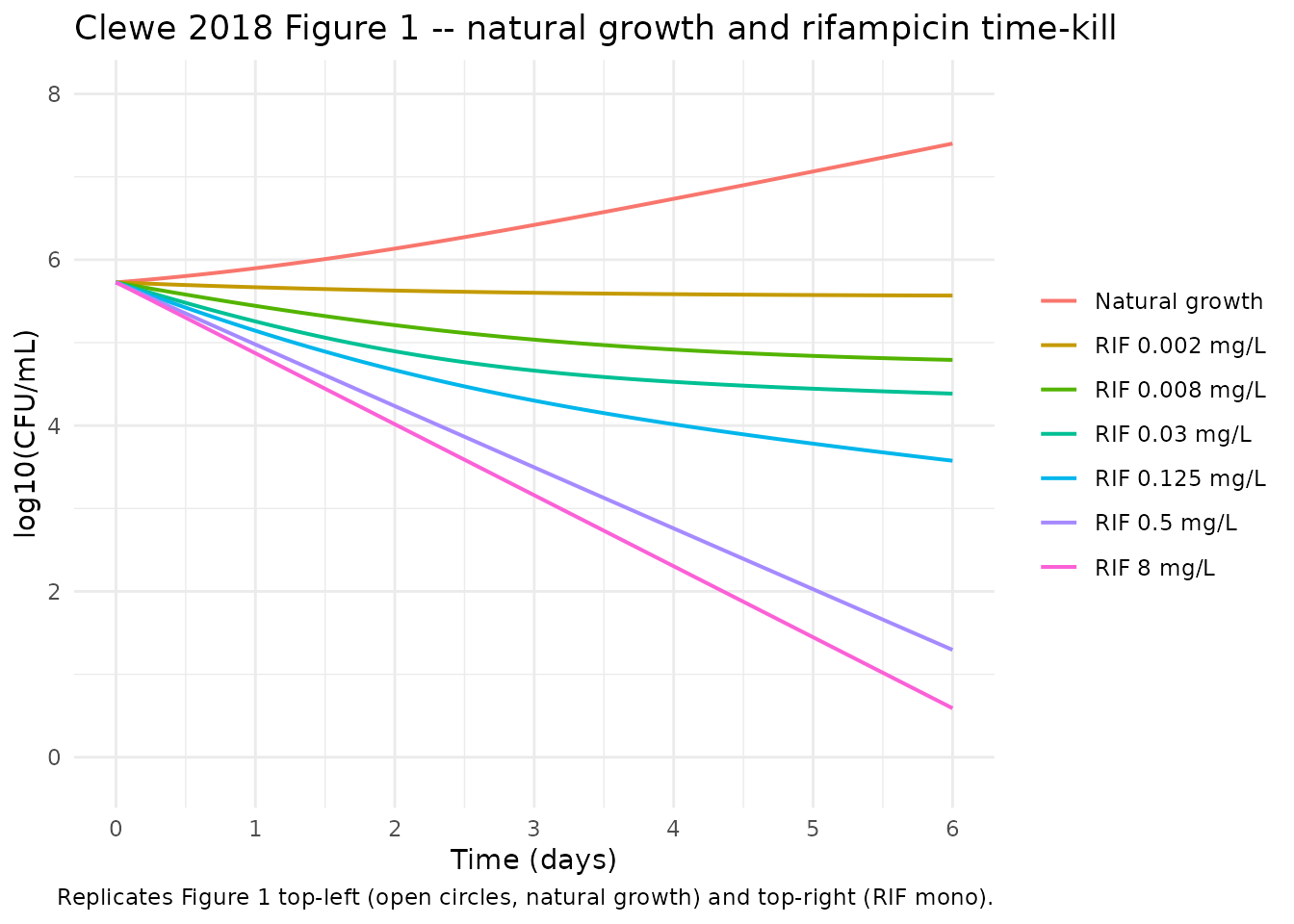
Figure 1 – isoniazid monotherapy with adaptive resistance
# Replicates Clewe 2018 Figure 1 middle-left (INH mono, seven concentrations).
# At low INH (0.01-0.156 mg/L) the kill effect is weak and natural growth
# dominates. At intermediate INH (0.625-2.5 mg/L) the model shows initial kill
# followed by an apparent plateau / regrowth as the AR_on state grows and
# reduces INH potency. At high INH (10-40 mg/L) the kill is still meaningful
# despite adaptive resistance.
inh_regimens <- c("INH 0.01 mg/L", "INH 0.039 mg/L", "INH 0.156 mg/L",
                  "INH 0.625 mg/L", "INH 2.5 mg/L",  "INH 10 mg/L",  "INH 40 mg/L")

sim %>%
  filter(regimen %in% inh_regimens) %>%
  mutate(regimen = factor(regimen, levels = inh_regimens)) %>%
  ggplot(aes(time, log10_total, colour = regimen)) +
  geom_line(linewidth = 0.7) +
  scale_y_continuous(name = "log10(CFU/mL)", limits = c(-0.2, 8)) +
  scale_x_continuous(name = "Time (days)", breaks = 0:6) +
  labs(title = "Clewe 2018 Figure 1 -- isoniazid time-kill",
       caption = "Replicates Figure 1 middle-left. Adaptive-resistance loop modulates INH potency over time.") +
  theme_minimal() +
  theme(legend.title = element_blank())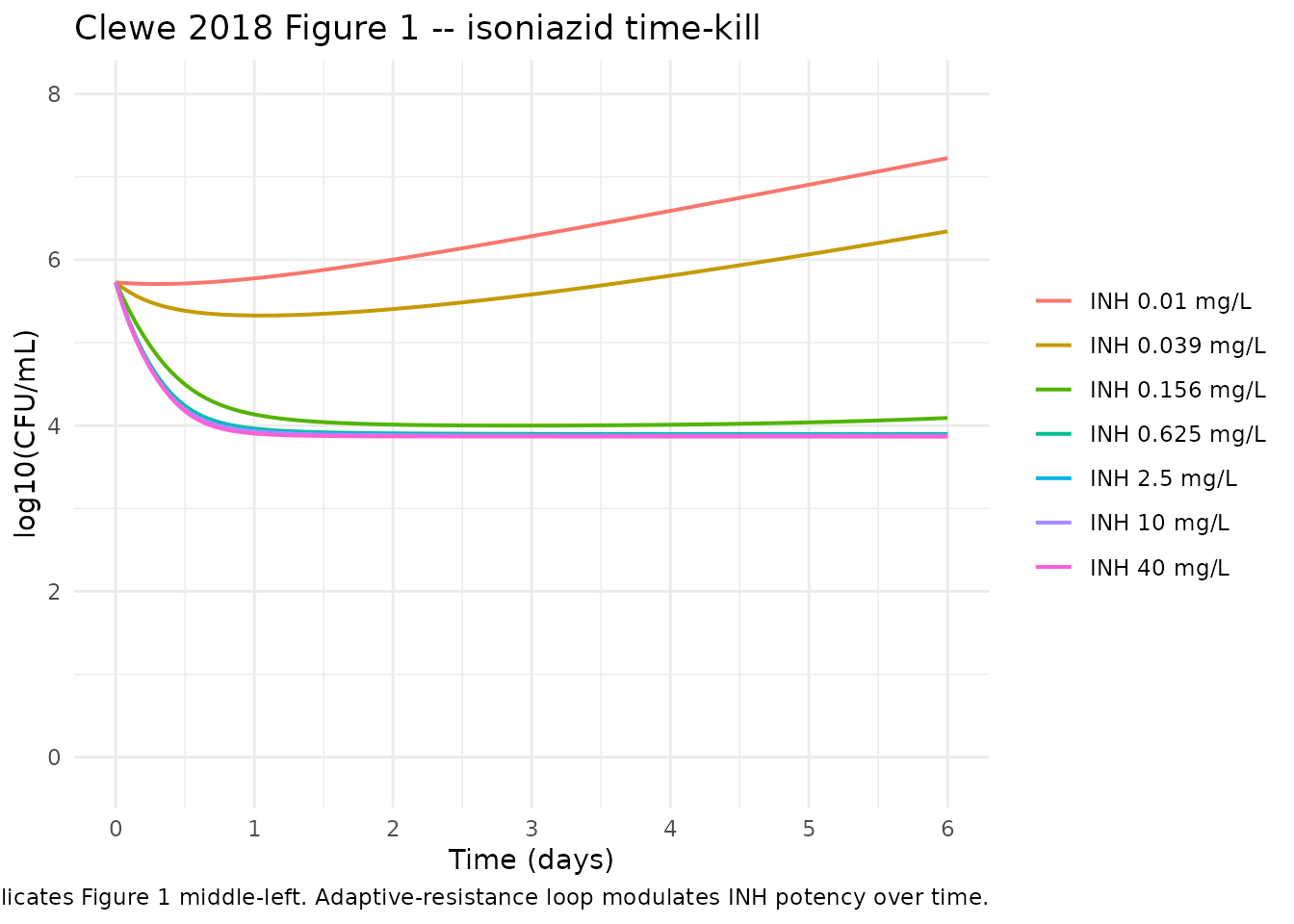
Figure 1 – ethambutol monotherapy
# Replicates Clewe 2018 Figure 1 middle-right (EMB mono, seven concentrations).
emb_regimens <- c("EMB 0.0078 mg/L", "EMB 0.031 mg/L", "EMB 0.125 mg/L",
                  "EMB 0.5 mg/L",    "EMB 2 mg/L",     "EMB 8 mg/L",    "EMB 32 mg/L")

sim %>%
  filter(regimen %in% emb_regimens) %>%
  mutate(regimen = factor(regimen, levels = emb_regimens)) %>%
  ggplot(aes(time, log10_total, colour = regimen)) +
  geom_line(linewidth = 0.7) +
  scale_y_continuous(name = "log10(CFU/mL)", limits = c(-0.2, 8)) +
  scale_x_continuous(name = "Time (days)", breaks = 0:6) +
  labs(title = "Clewe 2018 Figure 1 -- ethambutol time-kill",
       caption = "Replicates Figure 1 middle-right. EMB acts as Emax on F-kill and linear on S-kill.") +
  theme_minimal() +
  theme(legend.title = element_blank())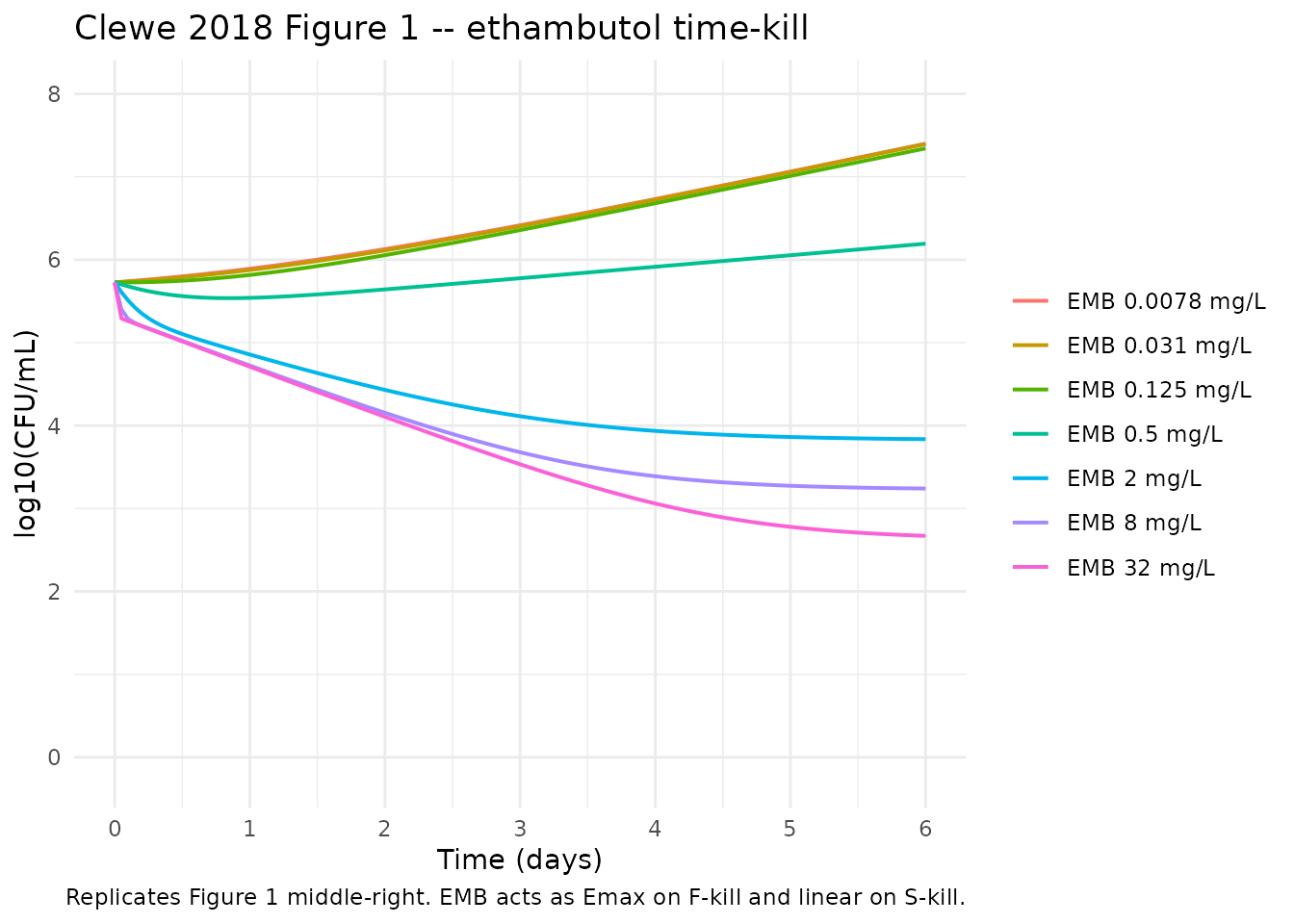
Validation checks (endogenous / mechanistic)
This is a typical-value mechanistic in vitro PD model; there is no patient-level IIV and no PK structure. PKNCA-style NCA is not applicable. The validation strategy follows the endogenous / mechanistic-model pattern: natural-growth trajectory check, monotherapy potency check, conservation check for the adaptive-resistance loop, and a combination antagonism / synergy check against Figure 5b.
1. Natural-growth trajectory
With no drug, the F-state grows exponentially at rate kG = 0.796 1/day. The S-state is drained by kSN to feed N and replenished by kFS(t) = kFSlin * t from F; the N-state accumulates from F->N (slow) and S->N (faster). The total CFU/mL at day 6 should be in the high 10^7 range, matching the open-circles trajectory of Clewe 2018 Figure 1 top-left (terminal log10 ~ 7.5).
ng_traj <- sim %>%
  filter(regimen == "Natural growth", time %in% c(0, 1, 2, 3, 4, 5, 6)) %>%
  select(time, fbugs, sbugs, nbugs, total_bugs, log10_total)
knitr::kable(ng_traj, digits = 3, caption = "Natural-growth trajectory of F, S, N (CFU/mL).")| time | fbugs | sbugs | nbugs | total_bugs | log10_total |
|---|---|---|---|---|---|
| 0 | 209000.0 | 324000.0 | 0.00 | 533000.0 | 5.727 |
| 1 | 469486.5 | 265454.9 | 54590.21 | 789531.6 | 5.897 |
| 2 | 1043507.3 | 219048.5 | 99368.17 | 1361924.0 | 6.134 |
| 3 | 2308010.9 | 185653.6 | 136634.00 | 2630298.5 | 6.420 |
| 4 | 5090342.3 | 171296.9 | 169258.64 | 5430897.8 | 6.735 |
| 5 | 11203462.0 | 194487.3 | 202220.49 | 11600169.8 | 7.064 |
| 6 | 24613610.8 | 304317.2 | 246359.46 | 25164287.5 | 7.401 |
2. Rifampicin monotherapy potency check
Clewe 2018 Figure 1 top-right shows RIF 0.5 mg/L driving log10 CFU/mL to roughly 1-2 by day 6, and RIF 8 mg/L driving log10 CFU/mL below the LOQ (log10 = 0.7). The simulation should reproduce both qualitative endpoints (deeper kill with higher RIF concentration; saturating at the LOQ).
sim %>%
  filter(regimen %in% c("Natural growth", "RIF 0.125 mg/L", "RIF 0.5 mg/L", "RIF 8 mg/L"),
         time == 6) %>%
  select(regimen, time, log10_total) %>%
knitr::kable(digits = 3, caption = "Day-6 log10(CFU/mL) under increasing RIF monotherapy.")| regimen | time | log10_total |
|---|---|---|
| Natural growth | 6 | 7.401 |
| RIF 0.125 mg/L | 6 | 3.576 |
| RIF 0.5 mg/L | 6 | 1.295 |
| RIF 8 mg/L | 6 | 0.591 |
3. Adaptive-resistance conservation
The AR_off and AR_on states represent the bacterial population fraction susceptible vs adapted to isoniazid. With koff = 0 (no resistance reversal), the kinetics are unidirectional: AR_off + AR_on must equal 1 at all times. At any non-zero INH concentration, AR_on grows monotonically from 0 toward 1; in the limit of saturating INH for long enough, AR_on -> 1 and INH becomes ineffective.
sim %>%
  filter(regimen %in% c("Natural growth", "INH 0.625 mg/L", "INH 10 mg/L", "INH 40 mg/L"),
         time %in% c(0, 1, 3, 6)) %>%
  mutate(ar_total = aroff + aron) %>%
  select(regimen, time, aroff, aron, ar_total) %>%
  knitr::kable(digits = 4,
caption = "AR_off / AR_on / total over time -- total must equal 1.")| regimen | time | aroff | aron | ar_total |
|---|---|---|---|---|
| Natural growth | 0 | 1.0000 | 0.0000 | 1 |
| Natural growth | 1 | 1.0000 | 0.0000 | 1 |
| Natural growth | 3 | 1.0000 | 0.0000 | 1 |
| Natural growth | 6 | 1.0000 | 0.0000 | 1 |
| INH 0.625 mg/L | 0 | 1.0000 | 0.0000 | 1 |
| INH 0.625 mg/L | 1 | 0.9872 | 0.0128 | 1 |
| INH 0.625 mg/L | 3 | 0.9621 | 0.0379 | 1 |
| INH 0.625 mg/L | 6 | 0.9257 | 0.0743 | 1 |
| INH 10 mg/L | 0 | 1.0000 | 0.0000 | 1 |
| INH 10 mg/L | 1 | 0.8138 | 0.1862 | 1 |
| INH 10 mg/L | 3 | 0.5390 | 0.4610 | 1 |
| INH 10 mg/L | 6 | 0.2905 | 0.7095 | 1 |
| INH 40 mg/L | 0 | 1.0000 | 0.0000 | 1 |
| INH 40 mg/L | 1 | 0.4387 | 0.5613 | 1 |
| INH 40 mg/L | 3 | 0.0844 | 0.9156 | 1 |
| INH 40 mg/L | 6 | 0.0071 | 0.9929 | 1 |
4. Trio combination at clinical Cmax (Figure 5b reference)
Clewe 2018 Figure 5b reports the model-predicted EBA (log10 cfu/mL/day) at the clinically relevant unbound Cmax values RIF 2 mg/L, INH 10 mg/L, and EMB 8 mg/L using the last studied timepoint (6 days). The published value for the full triple combination is 1.34 log10 cfu/mL/day (classified as antagonism relative to expected additivity). The simulation total log10 drop over 6 days corresponds to that EBA scaled by 6.
sim %>%
  filter(regimen == "RIF 2 + INH 10 + EMB 8", time %in% c(0, 1, 3, 6)) %>%
  select(time, fbugs, sbugs, nbugs, log10_total) %>%
  knitr::kable(digits = 3,
caption = "Clinical-Cmax trio (RIF 2 + INH 10 + EMB 8 mg/L) over the 6-day window.")| time | fbugs | sbugs | nbugs | log10_total |
|---|---|---|---|---|
| 0 | 209000.000 | 324000.000 | 0.000 | 5.727 |
| 1 | 577.228 | 375992.269 | 11922.202 | 5.589 |
| 3 | 269.318 | 28129.368 | 1016.594 | 4.469 |
| 6 | 25.943 | 307.738 | 11.338 | 2.538 |
Assumptions and deviations
- GPDI functional form – least-complex baseline EC50 anchors. Clewe 2018 Table 3 reports only INT magnitudes for the thirteen interactions; no EC50_INT parameters are tabulated, and the paper text states the “least complex” GPDI model was used as a starting point in which EC50_A,B = EC50_A (the modifier’s mono EC50 for the same mechanism). The Materials and methods note that “Estimates of separate INT and interaction EC50 parameters were then evaluated for statistical significance”, but the Table 3 absence of EC50_INT values strongly suggests the least-complex baseline was retained for the final model. Implemented here: every modulation factor uses factor = 1 + INT_A,B * C_A / (EC50_A + C_A), where EC50_A is the modifier’s mono EC50 for the same bacterial-state mechanism. When the modifier has no mechanism-specific EC50 (EMB has linear S-kill kSD_EMB; RIF has linear N-kill kND_RIF), the modifier’s F-kill EC50 is used as the saturation anchor. The Clewe 2018 Supplementary NONMEM model code (referenced in the paper but not available when this model was built) would resolve this anchor choice unambiguously; users with access to that file should cross-check.
- Linear adaptive resistance functional form. Clewe 2018 Materials and methods presents Eq 3 (Emax form on isoniazid Emax) and Eq 4 (Emax form on isoniazid EC50) as the AR_max / AR_50 Hill-type adaptive-resistance alternatives evaluated, but Table 1 of the final model reports linear k_AR_FD_INH = 522 and k_AR_SD_INH = 2350 in place of (AR_max, AR_50) pairs. Implemented here as a linear modulation on EC50 (the published Discussion describes the resistance as affecting INH potency, not Emax): EC50_FD_INH_eff = EC50_FD_INH * (1 + k_AR_FD_INH * AR_on), EC50_SD_INH_eff = EC50_SD_INH * (1 + k_AR_SD_INH * AR_on). The units “(days^-1)” listed in Clewe 2018 Table 1 for k_AR are treated as a label slip because AR_on is dimensionless and the EC50 multiplier must be dimensionless. The supplement would confirm or refute this interpretation.
- Mass-balance correction in adaptive-resistance Eq 2. The published Clewe 2018 Eq 2 reads dAR_off/dt = -k_on * AR_off, but the conjugate Eq 1 is dAR_on/dt = k_on * C_INH * AR_off. Without the C_INH factor on the outflow, AR_off + AR_on is not conserved. The model file encodes the mass-balanced form dAR_off/dt = -k_on * C_INH * AR_off so that AR_off + AR_on = 1 at all times. This is the form consistent with both Eq 1 and Materials and methods text (“rate of development of resistance … was described using kon”), and the simulated AR_off + AR_on does indeed sum to 1 in the conservation check above.
- kNF term in published Eq 8. Clewe 2018 Eq 8 includes a “+ kNF * N” term that has no corresponding entry in Table 1 and no N->F arrow in Figure 2. The canonical Clewe 2016 MTP and the Chen 2017 mouse twin (modellib(“Chen_2017_TB_MTP_GPDI_mouse”)) omit any N->F transfer. This term is treated as a typographical inclusion and is not encoded; the F ODE in the model file matches the standard MTP structure dF/dt = kG * F * E_FG - kFS * F + kSF * S - kFN * F - E_FD * F.
-
Initial non-multiplying bacterial inoculum N0 = 0.
Clewe 2018 Materials and methods does not list an initial N0; the
standard MTP setup starts F0 and S0 from Table 1 and lets the N pool
fill from F->N and S->N transfer. Encoded literally as
nbugs(0) <- 0. -
Static drug concentrations as covariates. The in
vitro experiment used fixed nominal drug concentrations over the 6-day
window. The model encodes these as time-invariant covariates
(
CONC_RIF_MGL,CONC_INH_MGL,CONC_EMB_MGL) rather than as dosing events; the value is constant per simulation and varies between simulations. A future extension that adds a PK layer (e.g., for clinical EBA simulations) can reuse this PD layer with time-varying drug concentrations supplied by an upstream PK ODE – see the in vivo twin modellib(“Chen_2017_TB_MTP_GPDI_mouse”) for the same MTP-GPDI PD layer driven by parallel one- and two-compartment PK ODEs. -
Residual error placeholder. Clewe 2018 does not
tabulate the residual SD used in NONMEM (the M3-method censoring at the
5 CFU LOQ is described but the sigma value is absent from Table 1, Table
3, and the main text). The model file carries
addSd = fixed(1.0)on the natural-log CFU/mL scale as a placeholder so the model is nlmixr2-fit-compatible; this is the same order of magnitude as the natural-log SD encoded by the Chen 2017 mouse twin (`sqrt(1.23) * log(10) ~ 2.55on natural-log CFU/lungs after the log10-to-ln rescaling). Downstream users fitting this model to their own data should overwrite viamod$ini` rather than relying on the placeholder. - No PD interaction on E_FG_RIF (RIF inhibition of F growth). Clewe 2018 Table 2 explicitly lists “none identified” for the PD interaction on E_FG_RIF. Implemented literally – E_FG_RIF depends only on CONC_RIF_MGL and the four RIF / F-growth parameters (Emax_FG_RIF, EC50_FG_RIF, gamma_FG_R, kG).
- No PD interaction on E_ND_RIF (RIF kill of N). Clewe 2018 Table 2 lists “none identified” for E_ND_RIF. Implemented literally – the linear kND_RIF * CONC_RIF_MGL slope is the entire N-state kill effect.
- Trio modulator anchor EC50. The Clewe 2018 trio modulator INT^SD_RIF,INH|EMB = -0.749 applies to the INT^SD_RIF,INH * (1 + INT^SD_RIF,INH|EMB * C_EMB / (EC50_anchor + C_EMB)) product. The paper provides no EC50_anchor value for the trio modulation; the model uses EC50_FD_EMB (= 0.86 mg/L) as the EMB saturation anchor because EMB has no S-kill EC50 (it is linear). The supplement would confirm this choice.
- INT^FD_RIF,EMB encoded as -0.99 rather than -0.9999. Clewe 2018 Table 3 footnote c sets INT^FD_RIF,EMB to -0.9999 reflecting “a maximal decrease in EC50 identified in mono exposure”. The model file encodes -0.99 to keep the multiplier (1 + INT) numerically well-conditioned (-0.9999 leaves a factor of 1e-4 in the denominator that can dominate rounding). The qualitative simulation behavior is unchanged at -0.99 vs -0.9999 within the saturating Emax term.
-
Non-canonical compartment names. The model uses
bacterial-state compartments
fbugs/sbugs/nbugsand adaptive-resistance statesaroff/aron(mirroring the Chen 2017 mouse twin). These do not match the canonicaldepot/central/peripheral1register and may triggercheckModelConventions()warnings; the deviation is intentional because the model carries no PK structure – the three bacterial states and two resistance states are the entire state space. -
Paper-specific drug-concentration covariates.
CONC_RIF_MGL,CONC_INH_MGL, andCONC_EMB_MGLare not ininst/references/covariate-columns.mdbecause the canonical concentration concept in nlmixr2lib is a state-derived plasma concentration (log_cfu), not a static exogenous-drug-concentration covariate used to drive an in vitro PD model. These covariates are scoped to this specific model.
Errata
- No erratum, corrigendum, or author correction was identified for the Clewe 2018 J Antimicrob Chemother article via the journal landing page (https://academic.oup.com/jac/article/73/2/437/4604762) or a PubMed “erratum” search as of 2026-05-22.
- Clewe 2018 Supplementary Data (containing Figures S1, S2 and the final MTP-GPDI NONMEM model code) is referenced in the paper but was not available when this model was built. The model file extracts every parameter value verbatim from Table 1 (MTP + monotherapy effects) and Table 3 (GPDI interactions); the functional forms of the GPDI interactions, the linear adaptive-resistance form, and the mass-balance correction in Eq 2 are reconstructed from the canonical Wicha 2017 GPDI formulation, the Mohamed 2014 adaptive-resistance literature, and the Chen 2017 in vivo mouse twin (sharing senior authorship), and are documented above in Assumptions and deviations. A maintainer with access to the Clewe 2018 Supplementary NONMEM file should cross-check the GPDI modulation-factor shape (Emax-style anchor, EC50 anchor for the trio modulator, and the linear vs Hill form of adaptive resistance).
- The published Eq 8 (F-state ODE) contains a “+ kNF * N” term with no Table 1 parameter and no corresponding arrow in Figure 2; treated here as a typographical inclusion (see Assumptions and deviations).
- The published Eq 2 (AR_off ODE) is missing the
C_INHfactor required for mass balance with Eq 1; the model file uses the conjugate mass-balanced form (see Assumptions and deviations). - Table 1 lists the units of k_on and k_AR as “Lmg^-1days”
and “days^-1” respectively; both are treated as label slips.
k_on(L*mg-1*day-1) multipliesC_INH(mg/L) andAR_off(unitless) to give a rate (1/day), andk_AR(dimensionless) multipliesAR_on(unitless) to give a dimensionless EC50 multiplier.