Fluconazole and caspofungin against Candida albicans (Venisse 2008)
Source:vignettes/articles/Venisse_2008_candida_albicans.Rmd
Venisse_2008_candida_albicans.RmdModel and source
Venisse et al. (2008) developed two mechanism-based PK-PD models on the same in vitro Candida albicans (ATCC 3153) preparation, fitted simultaneously in a single NONMEM run:
-
modellib("Venisse_2008_fluconazole")– fluconazole, fungistatic (growth inhibition Imax model). -
modellib("Venisse_2008_caspofungin")– caspofungin, fungicidal (death stimulation Emax model).
The Candida-population parameters (Kg, Kd,
Nmax) are shared across drugs and reproduced identically in
both files; the drug-specific PD parameters (IC50,
Imax; EC50, Emax) are
different.
- Article: https://doi.org/10.1128/AAC.01030-07
Population
The experimental population is an in vitro Candida albicans culture (ATCC 3153 reference strain, NCCLS-susceptible). Six experiments were performed (three fluconazole, three caspofungin), each comprising a drug-free growth control plus three drug arms with different initial concentrations (Table 1 of the paper). The growth medium was RPMI 1640 supplemented with 2% sorbitol; incubation at 37 C in a 400 mL glass flask under continuous magnetic stirring with peristaltic-pump broth renewal calibrated to a 3 h elimination half-life. The starting Candida inoculum was 5 x 10^3 CFU/mL, introduced 4 h before the drug.
The MICs measured for this isolate were:
- Fluconazole MIC = 1.56 ug/mL (NCCLS-susceptible).
- Caspofungin MIC = 0.015 ug/mL (typical of susceptible C. albicans).
The same information is available programmatically via each model’s
population metadata.
Source trace
| Component | Value or form | Source |
|---|---|---|
| Drug PK: 1-compartment IV | d/dt(central) = -kel * central |
Methods, PK-PD analysis |
CL |
1.54 mL/min = 0.0924 L/h (fixed) | Methods, PK-PD analysis |
V |
0.4 L (fixed, bulk flask volume) | Methods, PK-PD analysis |
kel derived |
CL/V = 0.231 1/h (drug t1/2 = 3 h) |
Methods |
| Candida natural growth + death | Eq. 1: dN/dt = (Kg - Kd) * N
|
Page 938, Eq. 1 |
| Saturable growth (Mouton) | Eq. 2: dN/dt = Kg * (1 - N/Nmax) * N - Kd * N
|
Page 938, Eq. 2 |
| With broth renewal | Eq. 3:
dN/dt = Kg * (1 - N/Nmax) * N - Kd * N - Ke * N
|
Page 938, Eq. 3 |
| Fluconazole growth inhibition | Eq. 4:
dN/dt = Kg * (1 - N/Nmax) * (1 - Imax*C/(IC50 + C)) * N - Kd*N - Ke*N
|
Page 938, Eq. 4 |
| Caspofungin death stimulation | Eq. 5:
dN/dt = Kg * (1 - N/Nmax) * N - Emax*C/(EC50 + C) * N - Kd*N - Ke*N
|
Page 938, Eq. 5 |
Kg = 0.864 1/h |
growth rate, SE 0.0321 | Table 2 |
Kd = 0.0414 1/h |
natural death rate, SE 0.0245 | Table 2 |
Nmax = 1.48e6 CFU/mL |
maximum carrying capacity, SE 5.54e5 | Table 2 |
Ke = 0.231 1/h |
broth renewal rate, fixed | Methods, page 938 |
IC50 = 0.0929 ug/mL |
fluconazole IC50, SE 0.0567 | Table 2 |
Imax = 0.675 |
fluconazole maximum fractional inhibition, SE 0.0342 (< 1; see Discussion) | Table 2 |
EC50 = 2.51e-4 ug/mL |
caspofungin EC50, SE 4.62e-5 | Table 2 |
Emax = 0.804 1/h |
caspofungin maximum killing rate, SE 0.0511 | Table 2 |
eta(Nmax) = 225% CV exp. |
omega^2 = log(2.25^2 + 1) = 1.802 (natural-log scale) | Table 2 |
eta(Emax) = 65% CV exp. |
omega^2 = log(0.65^2 + 1) = 0.353 (caspofungin only) | Table 2 |
epsilon flu = 197% CV exp. |
sigma_ln = sqrt(log(1.97^2 + 1)) = 1.259 (additive on log CFU/mL) | Table 2 |
epsilon casp = 96% CV exp. |
sigma_ln = sqrt(log(0.96^2 + 1)) = 0.808 (additive on log CFU/mL) | Table 2 |
Validation strategy
Because the source data are CFU/mL counts under a fixed drug-PK kernel and the paper does not report NCA-style metrics, PKNCA is not the appropriate validation target. Instead the vignette walks the typical-value trajectories under three scenarios:
- Natural growth control (no drug) – confirms the saturable-growth + broth-renewal balance yields the in vitro carrying capacity reported in the paper (~ 1.0e6 CFU/mL – see below for the analytic steady state).
- Figure 3A replication – fluconazole at the six C0 values shown in the paper’s symbols (control, 0.01, 0.1, 1, 10, 100 ug/mL).
- Figure 3B replication – caspofungin at the six C0 values shown in the paper’s symbols (control, 0.001, 0.01, 0.1, 1, 10 ug/mL).
A side-by-side parameter table at the end confirms the file’s typical values agree with Table 2 byte-for-byte.
Analytic steady-state of the drug-free control
With drug absent and Ke = 0.231 1/h active, Equation 3
has steady state where Kg * (1 - N/Nmax) = Kd + Ke.
Plugging the Table 2 typical values:
Kg   <- 0.864
Kd   <- 0.0414
Ke   <- 0.231
Nmax <- 1.48e6
N_ss <- Nmax * (1 - (Kd + Ke) / Kg)
N_ss
#> [1] 1013389
log10(N_ss)
#> [1] 6.005776
So the typical-value plateau is approximately 1.0e6 CFU/mL (log10 ~
6.0), about 68% of the Nmax parameter value (1.48e6
CFU/mL). The remaining gap from Nmax is consumed by the
natural-death (Kd) and broth-renewal (Ke) loss
terms. (The paper’s Discussion also reports that complementary
experiments without broth renewal raised the plateau to ~ 1e8
CFU/mL.)
Virtual cohort: typical-value trajectories
Each cohort below is the typical-value (zero between-experiment
variance) prediction for a single C0 arm. We use the drug-PK kernel from
each model file and dose the bath at t = 4 h to deliver
C0 * V of drug (amt in mg, V in L) so the initial bath
concentration equals the experimental C0.
V_bath <- 0.4   # litres

# rxode2 expects amt in the same mass units the model uses (here, mg in the
# linear-mg/L = ug/mL convention). dose = C0 * V to deliver an initial bath
# concentration of C0 in ug/mL.
mk_events <- function(C0_vec, t_obs = c(0, 4, seq(4.1, 31, by = 0.25)),
                      id_offset = 0L) {
  out <- vector("list", length(C0_vec))
  for (k in seq_along(C0_vec)) {
    id <- id_offset + k
    C0 <- C0_vec[k]
    dose <- C0 * V_bath  # mg
    if (C0 == 0) {
      ev <- rxode2::et(time = t_obs) %>%
        rxode2::et(id = id)
    } else {
      ev <- rxode2::et(amt = dose, time = 4, cmt = "central") %>%
        rxode2::et(time = t_obs) %>%
        rxode2::et(id = id)
    }
    df <- as.data.frame(ev)
    df$C0 <- C0
    out[[k]] <- df
  }
  dplyr::bind_rows(out)
}
C0_flu  <- c(0, 0.01, 0.1, 1, 10, 100)
C0_casp <- c(0, 0.001, 0.01, 0.1, 1, 10)

events_flu  <- mk_events(C0_flu,  id_offset = 0L)
events_casp <- mk_events(C0_casp, id_offset = 100L)

stopifnot(!anyDuplicated(unique(events_flu[, c("id", "time", "evid")])))
stopifnot(!anyDuplicated(unique(events_casp[, c("id", "time", "evid")])))
flu_typical  <- rxode2::zeroRe(flu)
casp_typical <- rxode2::zeroRe(casp)

sim_flu  <- rxode2::rxSolve(flu_typical,  events = events_flu,  keep = "C0")
sim_casp <- rxode2::rxSolve(casp_typical, events = events_casp, keep = "C0")

sim_flu_df  <- as.data.frame(sim_flu)
sim_casp_df <- as.data.frame(sim_casp)

range(sim_flu_df$candida)
#> [1]    5000 1013386
range(sim_casp_df$candida)
#> [1]     155.4566 1013386.4758
Replicate Figure 3A – fluconazole fungistatic time-kill
sim_flu_df %>%
  dplyr::mutate(
    log10_cfu = log10(pmax(candida, 1)),
    label     = ifelse(C0 == 0, "control",
                       sprintf("C0 = %g ug/mL", C0))
  ) %>%
  ggplot(aes(time, log10_cfu,
             colour = factor(C0),
             linetype = factor(C0))) +
  geom_line(linewidth = 0.6) +
  scale_x_continuous(breaks = seq(0, 32, by = 4)) +
  scale_y_continuous(limits = c(3, 7), breaks = seq(3, 7)) +
  labs(
    title    = "Figure 3A replication: fluconazole fungistatic effect",
    subtitle = "Typical-value trajectories at the six C0 symbols in Venisse 2008",
    x        = "Time after inoculum introduction (h)",
    y        = "log10(CFU/mL)",
    colour   = "Initial fluconazole (ug/mL)",
    linetype = "Initial fluconazole (ug/mL)",
    caption  = "Replicates Figure 3A of Venisse 2008. Drug introduced at t = 4 h."
  ) +
  theme_minimal()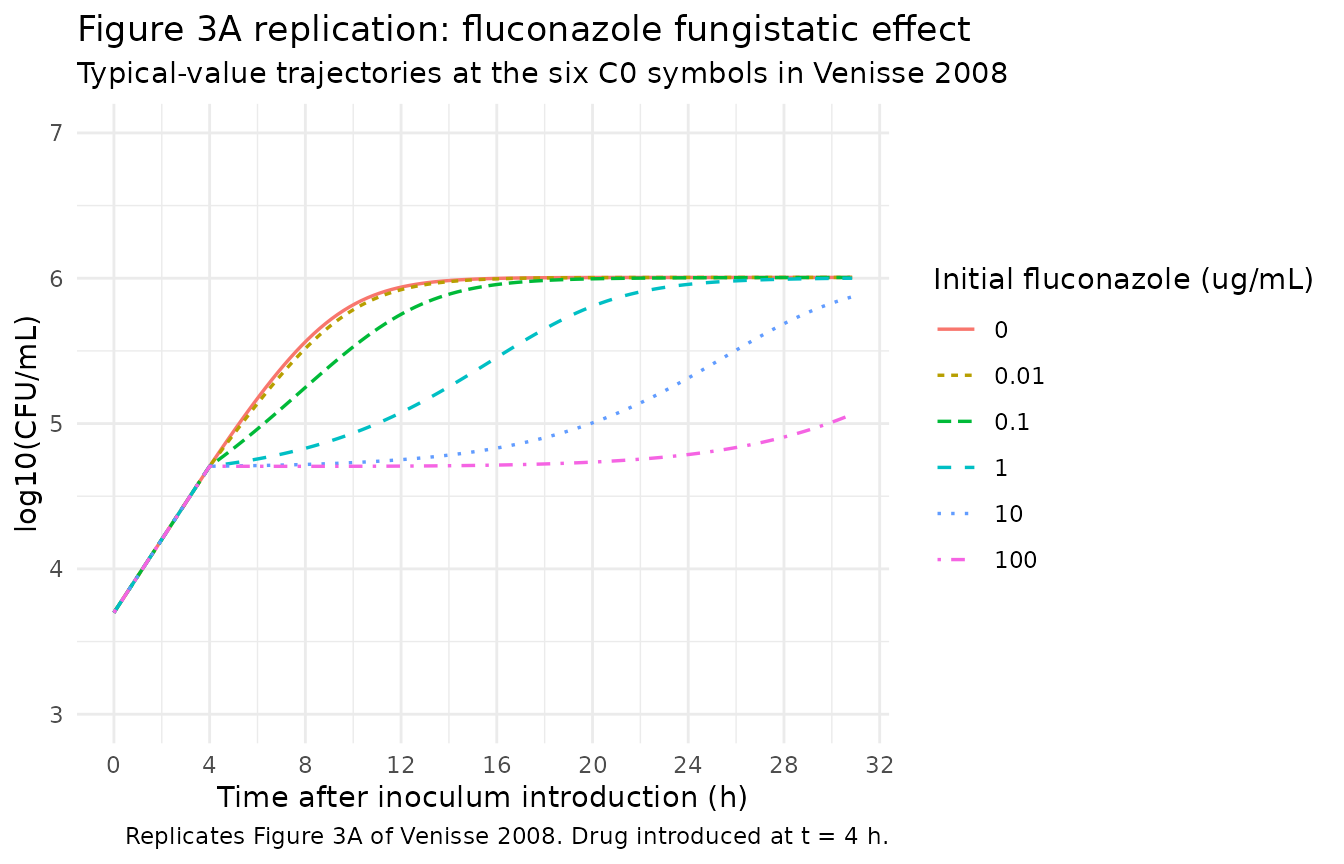
The control curve rises from the 5e3 inoculum to a plateau near
log10(N_ss) ~ 5.67, in line with the analytic steady state above. The
drug arms delay or partially suppress growth in a
concentration-dependent way but never drive a decay phase: because
Imax = 0.675 < 1 the growth rate can be reduced by at
most 67.5%, so the post-drug rate
Kg * (1 - Imax) = 0.864 * 0.325 = 0.281 1/h still exceeds
the loss rate Kd + Ke = 0.272 1/h, leaving a small positive
net growth even at saturating fluconazole concentrations. This matches
the paper’s observation (Discussion paragraph 4: “Candida growth slowed
but was still observed at the highest initial fluconazole
concentrations”).
Replicate Figure 3B – caspofungin fungicidal time-kill
sim_casp_df %>%
  dplyr::mutate(
    log10_cfu = log10(pmax(candida, 1)),
    label     = ifelse(C0 == 0, "control",
                       sprintf("C0 = %g ug/mL", C0))
  ) %>%
  ggplot(aes(time, log10_cfu,
             colour = factor(C0),
             linetype = factor(C0))) +
  geom_line(linewidth = 0.6) +
  scale_x_continuous(breaks = seq(0, 32, by = 4)) +
  scale_y_continuous(limits = c(0, 7), breaks = seq(0, 7)) +
  labs(
    title    = "Figure 3B replication: caspofungin fungicidal effect",
    subtitle = "Typical-value trajectories at the six C0 symbols in Venisse 2008",
    x        = "Time after inoculum introduction (h)",
    y        = "log10(CFU/mL)",
    colour   = "Initial caspofungin (ug/mL)",
    linetype = "Initial caspofungin (ug/mL)",
    caption  = "Replicates Figure 3B of Venisse 2008. Drug introduced at t = 4 h."
  ) +
  theme_minimal()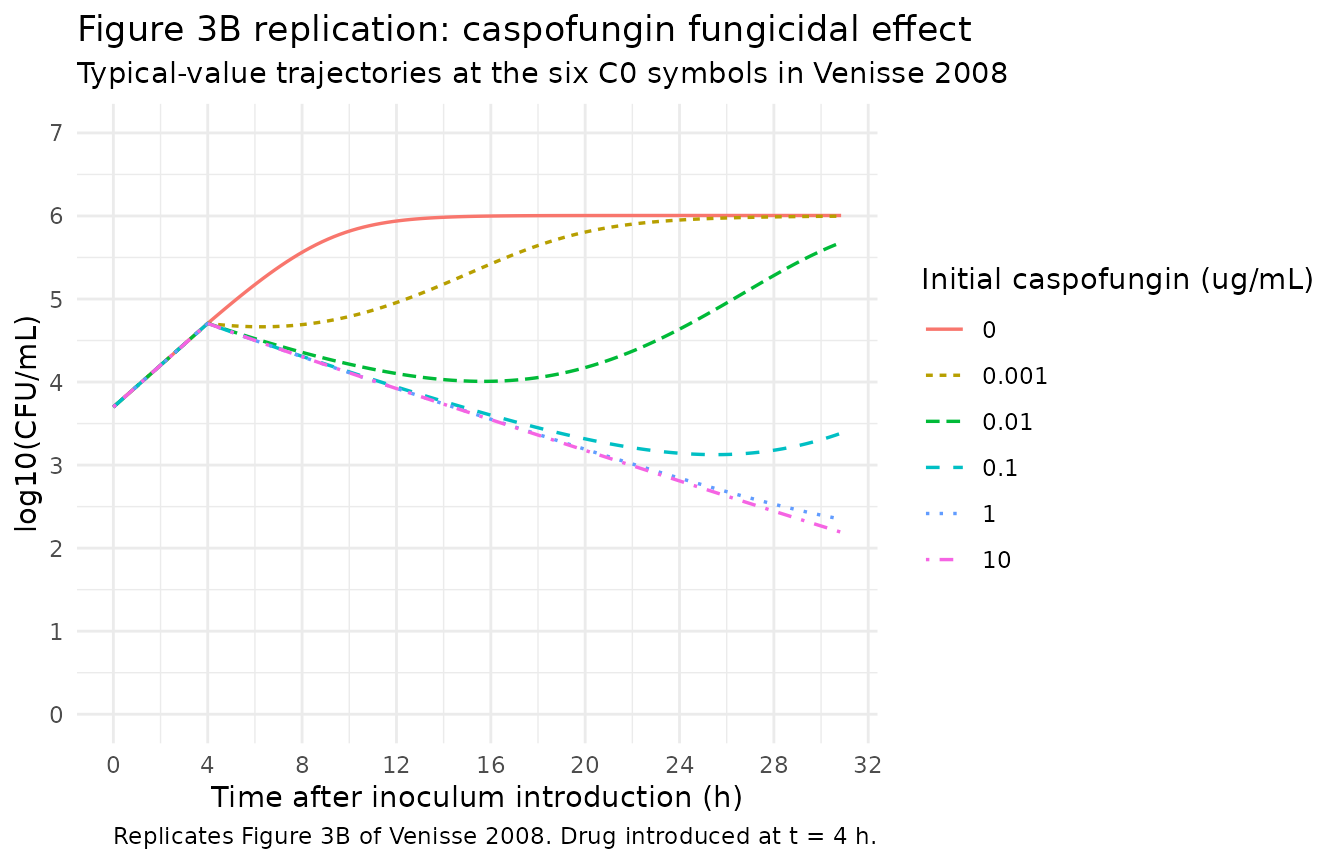
The control curve matches the fluconazole control panel by
construction (same Candida-growth parameters). The treated arms show the
concentration-dependent initial CFU decay followed by regrowth that the
paper highlights as the hallmark of fungicidal activity. Because
EC50 = 2.51e-4 ug/mL is two-to-three orders of magnitude
below the clinical Cmax, even C0 = 0.001 ug/mL induces a measurable
initial decay.
Parameter table
| Parameter | Paper | File |
|---|---|---|
| CL (L/h, fixed) | 0.0924 | 0.0924 |
| V (L, fixed) | 0.4 | 0.4 |
| Ke (1/h, fixed) | 0.231 | 0.231 |
| Kg (1/h) | 0.864 | 0.864 |
| Kd (1/h) | 0.0414 | 0.0414 |
| Nmax (CFU/mL) | 1.48e6 | 1.48e6 |
| IC50 fluconazole (ug/mL) | 0.0929 | 0.0929 |
| Imax fluconazole | 0.675 | 0.675 |
| EC50 caspofungin (ug/mL) | 2.51e-4 | 2.51e-4 |
| Emax caspofungin (1/h) | 0.804 | 0.804 |
| eta(Nmax) (CV%) | 225 | 225 (omega^2 = 1.802) |
| eta(Emax) (CV%) | 65 | 65 (omega^2 = 0.353) |
| epsilon flu (CV%) | 197 | 197 (addSd on log CFU/mL = 1.259) |
| epsilon casp (CV%) | 96 | 96 (addSd on log CFU/mL = 0.808) |
Assumptions and deviations
-
The single observation is a fungal burden, not a concentration. For both Venisse models the observed output is the natural log of the Candida CFU/mL count (with a +1 floor to avoid log(0) under saturating caspofungin), and it is named
log_cfu, the registered canonical for a log CFU PD output. The drug concentration isCc <- central / vc, the registered canonical for a central-compartment concentration, and is not observed.These two names were previously swapped:
Ccheld the fungal burden and the drug concentration was the near-homographiccc. That mis-stated the convention –Ccdenotes the central drug concentration whether or not it is the observed output – and left the two quantities distinguishable only by letter case. NONMEM exponential residual mapped to additive on log scale. The paper reports the residual as “exponential” with the variance summarised as a percent CV on the linear CFU/mL scale (Table 2: 197% for fluconazole, 96% for caspofungin). nlmixr2’s equivalent is an additive residual on the natural-log-transformed observation; the SD is
sqrt(log(CV^2 + 1)). Both files document the conversion inline next toaddSd.Eta on Emax in caspofungin only. The paper’s joint fit gave
eta(Nmax) = 225% CV(shared between drugs) andeta(Emax) = 65% CV(caspofungin-specific). The fluconazole file therefore carries onlyetalnmax; the caspofungin file carriesetalnmax+etalemax. No IIV was estimated on Imax, IC50, EC50, Kg, or Kd, so none is added here.Initial inoculum 5e3 CFU/mL at t = 0. The paper’s experimental timeline starts at inoculation, with drug introduced 4 h later. The model files anchor
candida(0) = 5000at simulation time 0; the vignette dosing schedule introduces the drug at t = 4 h to reproduce the experimental timing.No covariates. Both files declare
covariateData <- list(). The Venisse experiments are typical-value in vitro with replicate experimental variability captured by the etas; no subject-level covariates are reported or relevant.Imax < 1is a paper-specific structural finding. The paper’s Discussion paragraph 4 notes that even at fluconazole concentrations exceeding the MIC by > 200-fold, Candida growth was not fully inhibited; the estimatedImax = 0.675is load-bearing for the fungistatic-vs-fungicidal mechanistic distinction. The packaged file does not constrainImaxto (0, 1) via a logit transform – it carries the typical value 0.675 directly. Re-fits should restore the (0, 1) bound through a transform if intended.